Introduction
Several authors have investigated the methods of neuroethics: a recent fast-growing addition to bioethics that involves several approaches to different problems that stem from relating ethics to neuroscience.Footnote 1, Footnote 2 This research is important and needed to define the boundaries of this new discipline, to harmonize its interdisciplinarity, that also crosses the natural sciences humanities divide, and thus to ground its projects. Some methodological contributions in this area are foundational and aim at stretching across the discipline or substantive parts of it.Footnote 3 However, assessing how to address specific neuroethical problems is also important.
In this paper, we focus on methodological issues that are relevant to the neuroethical investigation of the significance of advancements in neuroscience, and related sciences of mind and behavior, for the legal and moral responsibility of psychopathic offenders.Footnote 4–Footnote 6 Broadly, responsibility requires the capacity to appreciate the nature of our actions, including their moral dimension, to deliberate on what to do and to control our actions.Footnote 7 Findings in neuroscience might force us to rethink responsibility, both in ordinary thinking and in law, in two different ways. One way is to be highly revisionary of our current moral and legal judgments about responsibility. Neuroscience, in fact, might force on us very dramatic and general ways to rethink human agency. For instance, neuroscience has attempted to explain our experience of control as an “illusion.”Footnote 8–Footnote 10 A less revisionary and dramatic, but more immediate, practical impact of neuroscience could be to undermine current moral or legal approaches to the responsibility of specific individuals or classes of individuals. For example, the legal or moral responsibility of many prison inmates might be put into question due to their brain abnormalities.Footnote 11
In this paper, we highlight, investigate and conceptually analyze some methodological issues in the less revisionary neuroethical research on responsibility. We discuss these issues by considering the debate about the legal responsibility of psychopaths.Footnote 12, Footnote 13 Psychopathy is a personality disorder characterized by emotional, interpersonal, and lifestyle traits and persistent antisocial behavior.Footnote 14 The debate about psychopathy illustrates many of the methodological options, and pitfalls, of neuroethical investigation. There are important methodological challenges when analyzing the normative issues relevant to the responsibility of psychopathic offenders and on how the empirical evidence is brought to bear into this normative domain. It is methodologically fundamental that the normative analysis is premised on an explicitly formulated and defended view on how they are grounded in legal and ethical concepts of responsibility. When interpreting the significance of neuroscientific data for responsibility, it is important to address conceptual issues about the capacities required for responsibility and determine which neuroscientific data are relevant. Moreover, it is important to avoid basing inferences about the responsibility of psychopathic offenders on a selective and simplistic reading of the scientific literature.
We proceed as follows. In the next section, we introduce the notion of psychopathy measured by the Psychopathy Checklist—Revised (PCL-R),Footnote 15 and the debate about the responsibility of psychopathic offenders. In addition, we offer an explanatory schema that highlights the two interrelated principal dimensions of investigation on this issue. In the remaining two sections, we consider the methodological challenges, and possible pitfalls, relative to these dimensions.
The Responsibility of the Psychopathic Offender: An Explanatory Schema
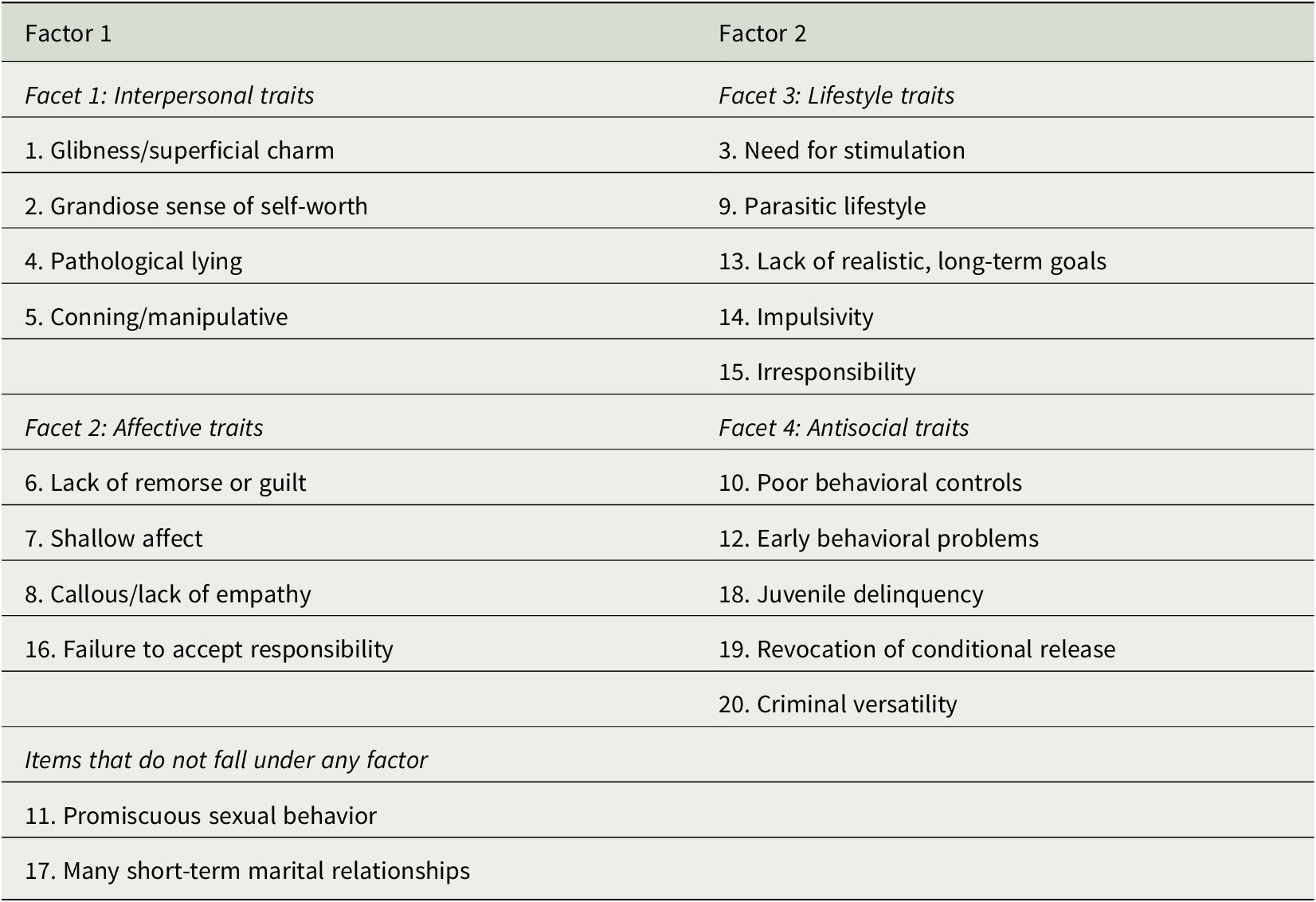
Robert Hare’s PCL-R is a widely used tool for the diagnosis of psychopathy. According to the PCL-R, psychopaths score highly on items such as Glib/superficial charm, Lack of empathy, Grandiose sense of self-worth, Conning/manipulativeness, Lack of remorse or guilt, Parasitic lifestyle, Poor behavioral controls, Early behavioral problems, Lack of realistic long-terms goals, Impulsivity, and Irresponsibility. The items of PCL-R group into four factors, as presented in Table 1.
Psychopathy Checklist Revised Items Classified According to Factors and FacetsFootnote 16
Although PCL-R is not the only available measure and concept of psychopathy,Footnote 17 nor is it an uncontested one,Footnote 18 it continues to play a central role in the discussion of the responsibility of the psychopathic offender.Footnote 19–Footnote 21 This is because this measure is widely adopted in scientific research and it also widely used in forensic contexts,Footnote 22 thus determining what could be called a paradigm in the study of psychopathy.
Debate about the moral responsibility of psychopaths has been progressively characterized by reliance on neuropsychological data. Some earlier attempts by philosophers to address the issue of the responsibility or moral status of psychopaths were conditional. The reasoning thus would assume a certain account of psychopathy, admittedly extrapolated from the available psychiatric characterization, and then offer an account based on philosophical theories of moral understanding, motivation, or punishment.Footnote 23–Footnote 25 These proposals would leave an open empirical issue about whether psychopathy would satisfy their assumptions. The focus of these works seemed to be more on clarifying or testing philosophical theories. Soon philosophers and legal scholars begun to refer to empirical literature, principally related to the PCL-R characterizing the condition, to ground their reflections, many of them concluding that psychopathic offender should be not regarded as legally or morally accountable.Footnote 26–Footnote 31 However, especially due to new empirical research and a more careful and less selective use of the empirical literature, some have argued that the science on psychopathy does not provide the needed evidence.Footnote 32, Footnote 33
To explicate the methodological issues in the debate, let us consider a schematic characterization of the reasoning underling the approach of several authors who are involved in it. The explanatory reasoning about responsibility and psychopathy often goes as follows:
-
1) Moral understanding, moral or legal responsibility, moral reason, and other important moral phenomena require psychological capacities.
-
2) The findings of neuroscience are relevant to psychological capacities.
Therefore:
-
3) The findings of neuroscience have implications for the moral phenomena that depend on these capacities.
Let us consider, in turn, the two premises of this argument as applied to the case of the responsibility of the psychopathic offender, to highlight the methodological challenges to formulating and assessing them.
The Normative Dimension of the Research
Methodological approaches to the investigation of the psychological capacities underpinning moral phenomena can be placed on a spectrum that has been described in the case of bioethics.Footnote 34 One extreme of this spectrum involves empirically unconstrained philosophical theorizing, based on techniques such as making distinctions, speculation, and reliance on philosophical theories. At the other extreme, there are accounts that rely on claims about relevant social practices (what people in fact do) and on empirical research.
Regarding the first premise in the explanatory schema introduced above, the task is to establish the psychological capacities that are prerequisites for criminal responsibility, and thus the exculpating incapacities. Now, one methodological option, that perhaps is at a midpoint of the general spectrum of approaches considered above, is to draw on the legal concepts used in insanity or diminished responsibility defenses. A more demanding philosophical approach would use a more abstract and prescriptive account of these capacities, by relying, for example, on philosophical theories about punishment, moral responsibility, moral psychology, or agency more generally.
Choosing a position on this methodological spectrum depends on assumptions about how practical or pressing the neuroethical research is, and its role within the targeted practical domain (descriptive, clarificatory, critical, or revisionary). For example, adopting a position more toward the philosophical end of the spectrum could make sense if the aim is to investigate the truth about whether psychopaths are morally responsible. Drawing on current legal concepts could make sense if the aim is to consider the relevance of research about psychopathy for how current insanity and diminished responsibility defenses should be interpreted. In any case, the way in which the psychological capacities relevant to that neuroethical investigation are identified should be explicated and justified. We will illustrate how these different methodological assumptions play out in the case of the legal responsibility of psychopaths.
Some neuroethical positions in the debate about how we should respond to psychopathy are explicitly based on philosophical accounts of moral responsibility and thus on philosophical views about the underling capacities of moral understanding and motivation. For example, in two early discussions of the social response to psychopathy, Jeffrie G. Murphy and John Deigh use a Kantian account of moral psychology.Footnote 35, Footnote 36 Thus, their investigation of psychopathy and what it implies for responsibility, punishment, or different forms of institutionalization is based on speculation about whether and how psychopaths might fail to universalize their maxims in accordance with Kantian prescriptive moral psychology. “Sentimentalist” or “neo-Humean” accounts of responsibility have also been used to interpret what neurological findings mean for the responsibility of psychopaths.Footnote 37
If the aim of these neuroethical explanations is to revise our legal concepts of the insanity and diminished responsibility defenses, they are vulnerable to several objections and might turn out to be not very useful. Because they are based on philosophical accounts of responsibility or relevant notions for it, they might fail to describe in any realistic way the ordinary practices of criminal exculpation and be unreasonably revisionary about these practices. Specifically, they might introduce unrealistic demands on the actual capacities of those who are subjects of the practice. For example, the moral competence required to be criminally responsible in a Kantian sense is the ability to universalize maxims for action, and this puts the bar very high. There is a second significant problem in that it makes the neuroethical claim contingent on the truth of a specific moral theory, which weakens the claim in a way that is problematic for interdisciplinary areas such as bioethics.Footnote 38 Finally, these philosophical accounts of moral psychology might be grounded in controversial views of the “good” that do not sit well with respect for the pluralism of values that characterizes liberal democratic societies. Although that might not be problematic for philosophical purposes, it is problematic for public policy within a liberal democracy.
It seems, thus, that a position further toward the descriptive end of the methodological spectrum should be adopted in the case of criminal responsibility and psychopathy. Neuroethical investigation should aim to be practically normative: to generate recommendations that can inform the understanding and assessment of criminal responsibility. A plausible methodological approach is to begin with actual legal concepts and the less legally controversial accounts of the relevant psychological capacities.
The insanity defense and whether it is correct have been debated by legal scholars in a manner that sidesteps philosophical debates about the psychological capacities required for moral responsibility.Footnote 39 The M’Naghten rule is a standard exculpation due to insanity that is adopted widely, although despite the use of type of defense (e.g., some States in the United States have abolished it) and how to formulate it are debated.Footnote 40, Footnote 41 According to this rule, a defense by insanity is applicable when:
(…) the party accused acted under such a defect of reason, from a disease of the mind, as not to know the nature and the quality of the act he was doing, or if he did know it, he did not know he was doing what was wrong. (…) If the accused was conscious that the act was one which he ought not to do, and if that act was at the same time contrary to the law of the land, he is punishable.Footnote 42
The rule was introduced during the trial of Daniel M’Naghten in England in 1843. M’Naghten was acquitted of murder by reason of insanity for killing Edward Drummond, who he believed to be Robert Peel, the British Prime Minister.
This rule addresses two kinds of cognitive deficiency that need to be the result of a mental disorder to be exculpatory. The first is when someone cannot comprehend the nature of the act they committed. The second concerns an inability to comprehend the legal wrongness of the act (sometimes this is called the right/wrong rule). These two cognitive deficiencies are about a person’s ability to understand what they have done, so they can be described as epistemic preconditions for criminal responsibility. Therefore, a responsible agent should be capable of being in “contact with reality” and possess relevant legal or moral knowledge or understanding.
Whether psychopathy is a mental illness has also been investigated. The neuroethical investigation of psychopathy might be related to legal systems that adopt insanity defenses that refer to mental disorder or illness. This is a highly complex issue that has been investigated within the context of the more general debate on what confers to a condition a mental disorder status.Footnote 43–Footnote 47 This debate considers also whether and how neuropsychological evidence about psychopathy is relevant for its disorder status. Thus, this could be also an important topic for neuroethical investigations on the responsibility of the psychopathic offenders. In the remainder, however, we focus on research concerning whether psychopaths have exculpating incapacities.
Some argue that the emotional capacities of psychopaths are impaired and that these impairments should be included in the list of exculpatory factors.Footnote 48, Footnote 49 The M’Naghten rule emphasizes the importance of being able to understand the nature of an action for criminal responsibility. Poor impulse control, or not being able to resist violent emotions, or indeed not being able to experience emotions, are not viewed as relevant to an insanity defense under this rule. So, in effect, those who argue that poor emotional regulation is an excuse are suggesting we should expand the psychological and legal concepts that are considered. Thus, in this case, the capacities that are thought relevant to responsibility imply a revision of legal practice or a new interpretation of existing laws. The issues of whether and how impulse control are relevant to criminal responsibility are controversial in the law.
Although the M’Naghten rule contemplates only these two epistemic conditions, a second plausible kind of condition is “self-control,” which broadly speaking means the ability to act voluntarily and not as a result of coercion, or compulsion.Footnote 50 Some case law has accepted a lack of self-control to be a mitigating factor in sentencing.Footnote 51 According to the American Model Penal Code, for instance, a person might not be responsible for a certain action if at the time of performing it he lacked the capacity to conform to the requirements of the law.Footnote 52
Although some have argued that psychopaths are impaired in ways relevant to legal formulations of exculpation or mitigation,Footnote 53 grounding the neuroethical discussion of criminal responsibility in legal concepts and capacities does not guarantee avoiding controversial assumptions. In characterizing the knowledge or understanding of the wrongness of an act, the English legal practice, for instance, tends to equate it to the awareness of the legal wrongness of the act, that is, to the knowledge that the law prohibits it. On the other hand, the Australian common law characterizes this knowledge as knowledge or awareness of the reasons “which to ordinary people make that act right or wrong,” offering thus a “moral wrongness” reading that also involves a capacity to track some reasons for considering the act wrong, besides the fact that there is an explicitly prohibiting against it.
It is clear, then, that even when adopting a descriptive approach, a close reading of the law reveals some unresolved issues about legal concepts. There are different methodological options for tackling these difficulties. Different philosophical views on punishment might recommend different interpretations of the epistemic conditions for accountability. If we assume that punishment serves a communicative function in demonstrating that what was done is wrong, then responsibility might require the agent to be a competent moral interlocutor.Footnote 54 Some of the literature on criminal responsibility and psychopathy points to them lacking deep moral understanding.Footnote 55 But other accounts of punishment emphasize public protection and they would lead to a different conclusion.
An alternative is to focus on the practical impact of these two approaches to the right/wrong rule to specific cases. It could be relevant to consider judicial reasoning rather than philosophical foundational doctrines. Let us consider the following cases, as reported by Ira Packer:
Schmidt killed a woman and acknowledged that he knew that killing was against the law of the state but claimed that he killed the victim in response to the voice of God commanding him to do so as a sacrifice and atonement. The trial judge stated that the relevant standard was whether the defendant understood that the act was against the law.Footnote 56
Judge Cardozo of the New York Court of Appeals eloquently argued that the standard should include whether the defendant understood the act to be morally, as well as legally, wrong (New York v. Schmidt, 1915). Judge Cardozo argued that the narrow definition of legal wrongfulness adopted by the trial judge would:
…rob the rule of all relation to the mental health and true capacity of the criminal. The interpretation placed upon the statute by the trial judge may be tested by its consequences. A mother kills her infant child to whom she has been devotedly attached. She knows the nature and quality of the act; she knows that the law condemns it; but she is inspired by an insane delusion that God has appeared to her and ordained the sacrifice. It seems a mockery to say that, within the meaning of the statute, she knows that the act is wrong … We find nothing either in the history of the rule, or in its reason and purpose, or in judicial exposition of its meaning, to justify a conclusion so abhorrent.
Let us consider another legal case considered by Ira Packer:
Hamann killed a man who worked with his father due to the delusional belief that his father’s life was endangered by the victim, whom he characterized as a “malicious adversary.” (State v. Hamann, 1979)
Hamann admitted that he understood that killing the victim was a criminal act but believed that society would recognize that he had “righted a great injustice.” To address this case, the following legal argument was advanced:
In this world of revolutionary and often violent change it is futile to pretend that our society maintains a consensus on moral questions beyond what it writes into its laws. Contemporary philosophers and theologians ponder mightily but without notable success to reach agreement on the “general mores” of our society. National debates rage over a myriad of moral issues. Few are resolved with anything approaching unanimity. Impossible uncertainty over the so-called general mores renders the appreciation of morality a tool unfit for the task of measuring sanity.Footnote 57
These cases, and the above interpretations, show that when assessing criminal responsibility, even when engaging with a close reading of the law, there are important methodological choices to be made. It seems clear that an interdisciplinary approach here is inevitable. However, even if issues about the general nature of the capacities required for legal accountability are settled, for example, by cautiously focusing on specific legal traditions, other issues are left open for neuroethics.
The capacities that the law deems necessary for responsibility need to be specified in some detail to be related to evidence coming from the science of the brain, mind, and behavior. Some philosophers, legal scholars, and experts of human behavior have converged on the idea that criminal responsibility, and the relative formulation of exculpatory defenses, should be spelled out in terms of rational capacities.Footnote 58, Footnote 59 In fact, it is maintained that the law in most countries regards and addresses humans as agents that form intentions to act based on reasons such as their motivations, beliefs, and values.Footnote 60, Footnote 61 Rationality in this context, thus, should be understood in an encompassing sense that implies a general picture of human beings as rational purposive creatures capable of acting in accordance with reasons. This view underpins the idea that human agency can be described, explained, and predicted by referring to intentions, desires, and beliefs that offer reasons for action.Footnote 62, Footnote 63
However, there are different accounts of agency that emphasize different aspects of rationality. Some, such as Charles Taylor, claim that agency should be understood as a project of creating meaning by living in accordance with socioculturally embedded value frameworks.Footnote 64 Then, there are contractualists, such as Scanlon, who think that agency should be understood as an attempt to act on reasons that could not reasonably be rejected by other agents.Footnote 65 Although there are some resemblances between divergent accounts, such as these, how to apply a general framework about agency and rationality to the specific capacities required by the law requires significant debate. There is a need for investigations that elaborate and apply such accounts.
Having considered some neuroethical issues and, thus, methodological recommendations that concern the first normative premise of the general argumentative schema at issue, let us move to consider some relative to the second premise, that concerns neuroscientific evidence.
The Relevant Neuroscience
A fundamental step in the study of the impact of neuroscience for responsibility concerns individuating the neuroscientific results that are relevant to the psychological capacities at issue. This can be called an interfacing step that relates psychological descriptions and explanations to neuroscientific results.
There are several epistemological issues that need to be addressed when considering the interfacing step. The first concerns knowing how neuroscientific information is relevant to legal responsibility. It has been correctly pointed out that neuroscientific evidence can be neither direct nor independent evidence against legal responsibility. Stephen Morse considers the case of whether adolescents who commit a capital crime should be exempted from capital punishment and advances several relevant considerations. By adopting a wide understanding of behavioral criteria, that include conduct and inferred mental states, Morse maintains that:
Assuming the validity of the neuroscientific evidence, what does it add? The rigorous behavioral studies already confirm the behavioral differences [between adolescents and adults].… At most, the neuroscientific evidence provides a partial causal explanation of why the observed behavioral differences exist and thus some further evidence of the validity of the behavioral differences. It is only of limited and indirect relevance to responsibility assessment, which is based on behavioral criteria.Footnote 66
Morse offers two important insights. One is that neural evidence is relevant to responsibility if it relates to the presence or absence of the psychological capacities for legal responsibility, that are usually individuated by reference to behaviors and inferable mental states. The other insight is that the evidential relevance of neuroscience needs to be proved. That is, there is a need to prove why neuroscientific evidence offers better validation than robust behavioral results. Let us address preliminarily this second important issue.
Behavior, although indicative of the presence or absence of a psychological capacity, could be a specific performance in specific circumstances. The discovery of an internal cause or being able to advance a hypothesis about plausible internal causes, might help to determine that the lack of performance is due to incapacity or diminished capacity. In addition, when determining whether the offender lacked the relevant capacities when committing the crime, information about the neurology of that person could tell us about a relatively fixed feature of the agent that might have retrospective value. In any case, these general remarks do not minimize the importance for work on criminal responsibility in asking whether neuroscientific evidence at issue is more corroborating than the behavioral evidence usually considered in the courts.
Morse’s other insight is that bringing neuroscientific evidence to bear on criminal responsibility requires demonstrating its relevance to the explanation or characterization of behavior. This means, establishing whether the psychological, rational, capacities for criminal responsibility are affected. In the case of psychopaths, different types of neuroscientific information could be used when assessing the presence of exculpating incapacities or deficits: images of differences in neuroanatomy or function (fMRI, MRI, and PET), assumed neurofunctional mechanisms, and neuropsychological tests. The neural correlates of psychopathy can include dysfunctions in the hippocampus, structural and functional impairments in frontal lobes and the prefrontal cortex (PFC) in particular, amygdala dysfunction, and impairments in orbitofrontal and ventrolateral cortex in response selection and control.Footnote 67, Footnote 68 However, it is important to be aware that similar “psychopathic” brains (modulo current scientific brain imagining knowledge) do not produce the same behavior or psychological capacities.Footnote 69 For this reason, experimental paradigms that can be interpreted as measuring the relevant psychological capacities (incapacities) are key to the neuroethical problem here at issue.
The interfacing step requires measures of the relevant psychological incapacities contemplated by the law. These psychological measures, as in any other contexts, need to be reliable and (construct, content, and criterion) valid,Footnote 70 independent of experimental context, and generalizable across individuals in ways that are useful for the law. It is important to note that when insanity or other defenses are used, there are also thresholds of legally admissible scientific evidence to consider.Footnote 71 Some neuroethical literature on psychopathy fails to be rigorous in this way. Let us consider some examples taken from the debate on psychopathy.
Some have argued that psychopathic individuals should be exculpated, because, given their performance in the moral/conventional distinction task, they lack or have a diminished capacity for moral understanding.Footnote 72, Footnote 73 This task, developed by Elliot Turiel,Footnote 74 is used to investigate how people classify transgressions, usually presented to them with vignettes, in terms of their seriousness, permissibility, and how these evaluations depend on prohibitions by authorities. Research suggests that transgressions that harm a victim are judged to be very serious, impermissible, even when an authority approves of them. These are the moral transgressions. Contraventions to conventionally expected social behaviors, that do not harm victims, are considered less serious and more acceptable than the moral ones. Some researchers studied the performance of psychopathic individuals and children with psychopathic tendencies in the moral/conventional task.Footnote 75–Footnote 77 These studies offered evidence that these individuals perform differently on the moral and conventional task from controls. In addition, these results were related to dysfunction in emotional systems that scientific hypotheses relate, in turn, to the neuroanatomy of psychopaths.
However, drawing from these data insight on responsibility is problematic in many ways. First, there are conceptual issues about whether the psychological tasks at issue offer a valid measure of the kind of moral understanding required for moral or legal responsibility.Footnote 78 Second, some new evidence appears to put pressure on the conclusion that individuals with psychopathy cannot draw the same distinction between conventional and moral transgressions as the controls.Footnote 79–Footnote 81 This shows that bringing neuroscientific hypotheses or results to the law requires the use of psychological and behavioral paradigms that can individuate deficits or incapacities that can then be related to characteristic neural anatomy or physiology. But such psychological instruments, especially when targeting the kind of higher-order constructs, such as moral understanding or control, might be empirically or conceptually inadequate.
Other philosophers and legal scholars involved in the debate about psychopathy have focused on empirical paradigms that measure less complex cognitive capacities relative to learning tasks to argue that individual with psychopathy suffer severe rational impairments.Footnote 82 In fact, there is a significant literature that shows that psychopaths perform less well than controls in some learning tasks, such as response reversal,Footnote 83 passive avoidance,Footnote 84 and gambling tasks.Footnote 85 In addition, behavioral experiments in controlled conditions show that psychopaths perform characteristically with paradigms aimed at measuring emotional response and decisionmaking.Footnote 86 Finally, there are empirical studies which suggest that psychopaths manifest anatomical and physiological peculiarities in their PFC, especially in the orbitofrontal and ventrolateral cortex, the hippocampus, and the amygdala that might be related to these specific performances in learning tasks and decisionmaking.Footnote 87
However, many authors that have concluded that psychopathic offenders are not responsible have overlooked the fact that psychopaths’ deficits in these tasks depend on the context. They depend on attention and on the activation of parts of the brain in relation to the type of task. There is no evidence, in fact, that these deficits are of global nature.Footnote 88 These results are, therefore, not ecologically valid in a way to be applicable to legal responsibility or practical irrationality.Footnote 89
Conclusion
To recapitulate the impact of neuroscience on certain ethically relevant social practices requires spelling out the relevant psychological capacities (incapacities) within that practice. This requires explicit methodological assumptions on how to balance prescriptive and descriptive elements in the approach. The interface between neuroscience and the practice at issue requires an adequate operationalization of the relevant psychological capacities and incapacities. This requires, in turn, specific psychological paradigms that would enable us to correlate legally relevant psychological incapacities (capacities) with neural mechanisms and exculpating peculiarities.
Acknowledgments
This article is an outcome of the Project RAD, funded by the Croatian Science Foundation (PI Luca Malatesti, grant IP-2018-01-3518).