

INTRODUCTION
Chironomids (Insecta: Diptera: Chironomidae) comprise one of the most abundant and diverse aquatic insect taxa (Cranston, Reference Cranston, Cranston and Pinder1995). They are considered sensitive to changes in environmental conditions due to the stenotopic condition of many species, which have narrow ecological ranges and high sensitivity to natural and anthropogenic changes. Chironomid larvae are also a useful paleo-proxy thanks to their chitinous cephalic capsules, which are generally very well-preserved in lake sediments (Millet et al., Reference Millet, Massa, Bichet, Frossard, Belle and Gauthier2014) and can be identified in order to make inferences about past environmental conditions (Walker, Reference Walker, Smol, Birks and Last2001).
Studies focused on the paleoclimate of Patagonia during the last millennium have identified different climatic periods (Villalba, Reference Villalba1990, Reference Villalba1994; Lara and Villalba, Reference Lara and Villalba1993; Bertrand et al., Reference Bertrand, Boes, Castiaux, Charlet, Urrutia, Espinoza, Lepoint, Charlier and Fagel2005). For instance, dendrochronological studies in northern Patagonia (Argentina) and a multi-proxy analysis in Lake Puyehue in southern Chile have identified a cold and humid period with abundant precipitation, associated with the onset of the European Little Ice Age (LIA) between AD 1490 and 1700. These studies also identified a dry period between AD 1740 and 1900, with low paleoproductivity and precipitation between AD 1800–1900. Additionally, an increase in temperature from 1912 to present, associated with the beginning of the global warming trend of the twentieth century, was identified (Bertrand et al., Reference Bertrand, Boes, Castiaux, Charlet, Urrutia, Espinoza, Lepoint, Charlier and Fagel2005; Masiokas et al., Reference Masiokas, Rivera, Lukman, Espizua, Villalba, Delgado and Aravena2009; Montes de Oca et al., 2013).
Studies in northern Patagonia confirm the sensitivity of fossil chironomids to climate variability (Massaferro et al., Reference Massaferro, Brooks and Haberle2005a, Reference Massaferro, Moreno, Denton, Vandergoes and Dieffenbacher.Krall2009; Massaferro and Larocque-Tobler, Reference Massaferro and Larocque-Tobler2013). Previous research has shown that the main changes in chironomid assemblages in lacustrine environments in Patagonia have been due to changes in the climatic conditions of the region. For example, in Lake Moreno Oeste (northern Patagonia), the main change in the chironomid community in the past 700 years was associated with the end of the cold period (~AD 1500–1700) and the beginning of the dry period (~AD 1740–1900; Williams et al., Reference Williams, Rieradevall, Añón Suárez, Rizzo, Daga, Ribeiro Guevara and Arribére2016).
The sensitivity of high-altitude lakes to environmental disturbances makes these remote environments excellent archives for paleoenvironmental studies (Battarbee et al., Reference Battarbee, Grytnes, Thompson, Appleby, CatalanJ Korhola, Birks, Heegaard and Lami2002). Lake Tonček is a high-altitude (1750 m above sea level [asl]) and small lake of glacial origin, located in the Nahuel Huapi National Park (NHNP), in the arc-shaped Southern Volcanic Zone (SVZ) in the northern Patagonian Andes. This volcanic arc includes several active volcanoes from the Miocene, such as Villarrica, Puyehue-Cordón Caulle, Osorno, and Calbuco, among others (Daga et al., Reference Daga, Ribeiro Guevara, Sanchez and Arribere2008). Data about volcanic ash depositions from a sedimentary sequence comprising the last 900 years from Lake Tonček is available in Daga et al. (Reference Daga, Ribeiro Guevara, Sanchez and Arribere2010).
Volcanic ash (also known as tephra) deposition produce changes in the chemical and physical properties of the water, so it may have a direct impact on lake ecosystems (Eastwood et al., Reference Eastwood, Tibby, Roberts, Birks and Lamb2002). The impacts of the ash deposition can include an increase in nutrient input; reduction of light penetration; sediment-water interface sealing; burying of macrophytes in littoral zones; and changes in the pH, turbidity, nutrients, conductivity, and salinity of the lake water (Eastwood et al., Reference Eastwood, Tibby, Roberts, Birks and Lamb2002). The ash deposition also produces changes in the lake sedimentological structure, with lower organic content and coarser grain size (Araneda et al., Reference Araneda, Cruces, Torres, Bertrand, Fagel, Treutler, Chirinos, Barra and Urrutia2007). Additionally, tephra deposition may deeply impact the fauna, producing severe changes in the structure and composition, or generating instantaneous drops in diversity and abundance of biotic communities (Massaferro and Corley, Reference Massaferro and Corley1998; Massaferro et al., Reference Massaferro, Ribeiro Guevara, Rizzo and Arribére2005b; Araneda et al., Reference Araneda, Cruces, Torres, Bertrand, Fagel, Treutler, Chirinos, Barra and Urrutia2007).
Paleolimnological proxies may help us to elucidate whether aquatic communities are resistant and resilient to tephra, assess the magnitude of its effect on the aquatic environment, and evaluate the impact of highly recurrent volcanic episodes on the benthic communities of chironomids. A number of studies have reported the effects of tephra on chironomid assemblages in oligotrophic lakes located between 758–1150 m asl in the Andes (Massaferro et al., Reference Massaferro, Ribeiro Guevara, Rizzo and Arribére2005b; Araneda et al., Reference Araneda, Cruces, Torres, Bertrand, Fagel, Treutler, Chirinos, Barra and Urrutia2007; Williams et al., Reference Williams, Rieradevall, Añón Suárez, Rizzo, Daga, Ribeiro Guevara and Arribére2016). Although these studies recorded changes in chironomid abundance and composition during tephra depositions, in general the community rapidly recovered its abundance and diversity after the volcanic events, returning to the previous structure, thus exhibiting a high resilience capacity (Massaferro et al., Reference Massaferro, Ribeiro Guevara, Rizzo and Arribére2005b; Araneda et al., Reference Araneda, Cruces, Torres, Bertrand, Fagel, Treutler, Chirinos, Barra and Urrutia2007; Williams et al., Reference Williams, Rieradevall, Añón Suárez, Rizzo, Daga, Ribeiro Guevara and Arribére2016). Massaferro et al. (Reference Massaferro, Correa-Metrio, Montes de Oca and Mauad2017) and Montes de Oca et al. (Reference Montes de Oca, Motta, Plastani, Laprida, Lami and Massaferro2017) conducted chironomid abundance and composition studies in Lake Tonček spanning the last 200 years. In these studies, the authors identified the tephra as belonging to the 1960–1961 Puyehue Cordon Caulle/Calbuco volcanic complex. Contrary to what was observed by Massaferro et al. (Reference Massaferro, Ribeiro Guevara, Rizzo and Arribére2005b), Araneda et al. (Reference Araneda, Cruces, Torres, Bertrand, Fagel, Treutler, Chirinos, Barra and Urrutia2007), and Williams et al. (Reference Williams, Rieradevall, Añón Suárez, Rizzo, Daga, Ribeiro Guevara and Arribére2016), the chironomid assemblages studied by Massaferro et al. (Reference Massaferro, Correa-Metrio, Montes de Oca and Mauad2017) did not return to the original state after the impact of the tephra. The question that arises is: are there any changes in the response of the chironomid community after successive and different volcanic eruptions affecting this high-altitude lake over the past millennium?
The aim of our study was to document the responses of the subfossil chironomid community (taxa composition, turnover, structure, and development of morphological mouthpart anomalies) to the effects of successive volcanic ash deposition during the last millennium in a high-mountain lake from northern Patagonia. We compared this record to regional paleoclimatic reconstructions to interpret the possible links to climate variability, such as regional temperature and precipitation changes, providing information about the response of the chironomid community to changing paleoclimatic conditions.
SITE DESCRIPTION
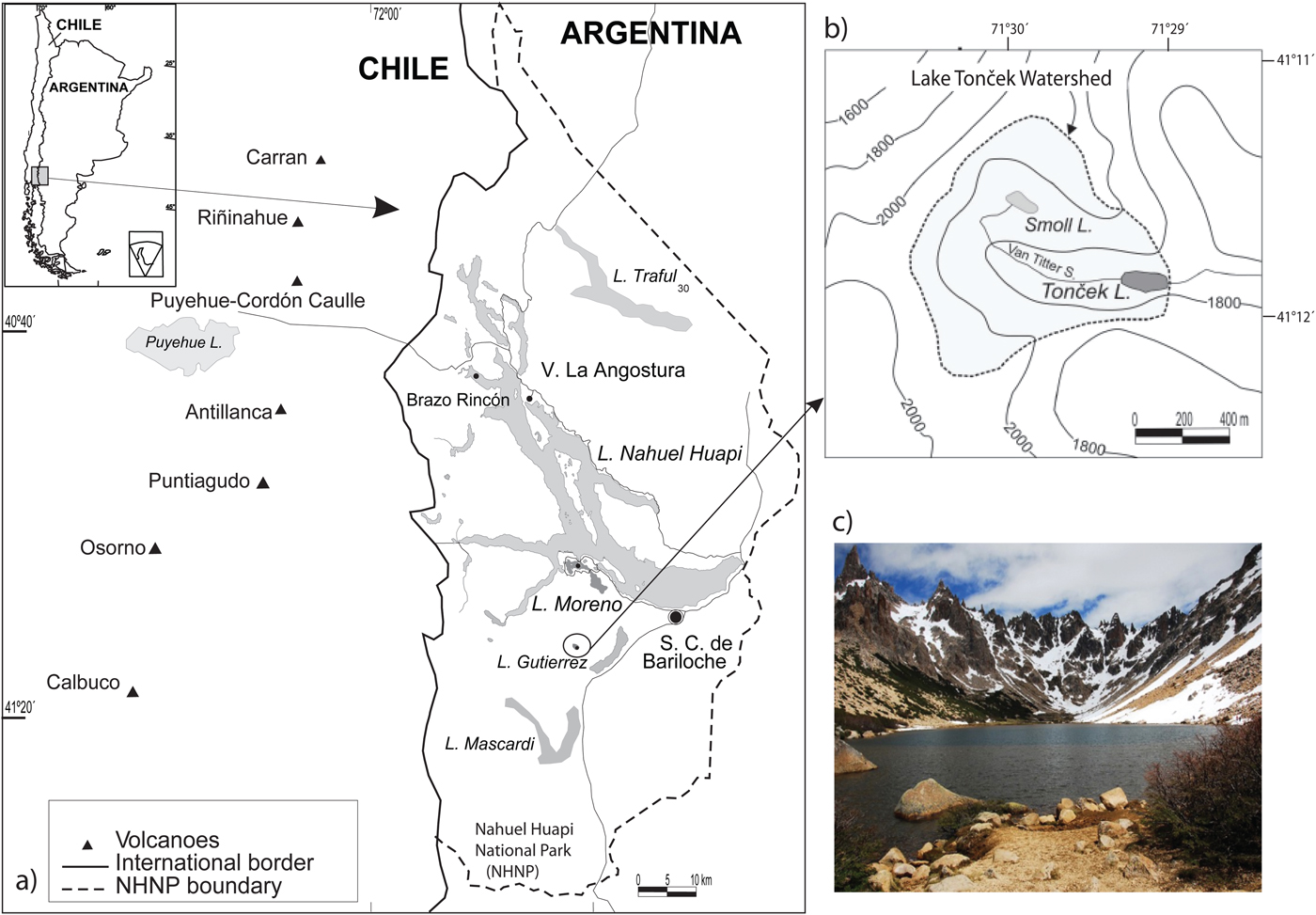
Lake Tonček (41°12'S, 71°29'W, 1750 m asl) is a high-altitude and small shallow lake (surface area = 0.03 km2; maximum depth = 12 m) in the Catedral mountain (northern Patagonia, Argentina), at the foot of high peaks with steep slopes. It is ice-covered for six to eight months, with an ice thickness of up to 2 m during winter. The lake morphology is relatively simple with two distinctive sections: a deep central zone that is surrounded by a shallow ring, which is 0.5 m deep and up to 30 m wide. The boundary between these two sections is a steep slope dropping up to 12 m (Modenuti, Reference Modenutti1993). The watershed of the lake is small, with an extension of approximately 2.5 km2. It comprises one smaller lake situated 100 m higher, Lake Schmoll, which is connected to Lake Tonček by Van Titter Stream, which in turn meanders across wetlands, acting as the effluent stream and connecting this lake with Lake Gutierrez (Fig.1; Ribeiro Guevara et al., Reference Ribeiro Guevara, Meili, Rizzo, Daga and Arribére2010).
(color online) Study area. (a) Section of Nahuel Huapi National Park (NHNP), northern Patagonia, Argentina. (b) Detail of Lake Tonček watershed. (c) Photograph of Lake Tonček. Modified from Ribeiro Guevara et al. (Reference Ribeiro Guevara, Meili, Rizzo, Daga and Arribére2010).

Lake Tonček is an ultraoligotrophic and dimictic system (Diaz et al., Reference Díaz, Pedrozo, Reynolds and Temporetti2007). It is fed mainly by precipitation and snowmelt. The water is characterized by low total phosphorous (7.0 μg/L) and nitrogen (175.8 μg/L) concentrations (Garcia et al., Reference Garcia, Dieguez and Queimaliños2015). The lake is situated above the tree line in a bedrock depression and its watershed is dominated by rocky surroundings with scarce soil development, scattered timberline forests (Nothofagus pumilio, “krummholz”) and high-Andean vegetation (Gaultheria pumila and Baccharis magellanica; Ferreyra et al., Reference Ferreyra, Cingolani, Ezcurra and Bran1998). Although in Lake Tonček there are no submerged macrophytes, an abundant presence of mosses of the Family Amblystegiaceae is observed (Motta, Reference Motta2017). The water body encloses a simple trophic structure without fish and the zooplankton community structure is relatively simple, dominated mainly by the rotifer Hexarthra bulgarica and the calanoid copepod Pseudoboeckella gibbosa (Modenutti, Reference Modenutti1993).
Materials And Methods
Sampling, sedimentological, and chronological analysis
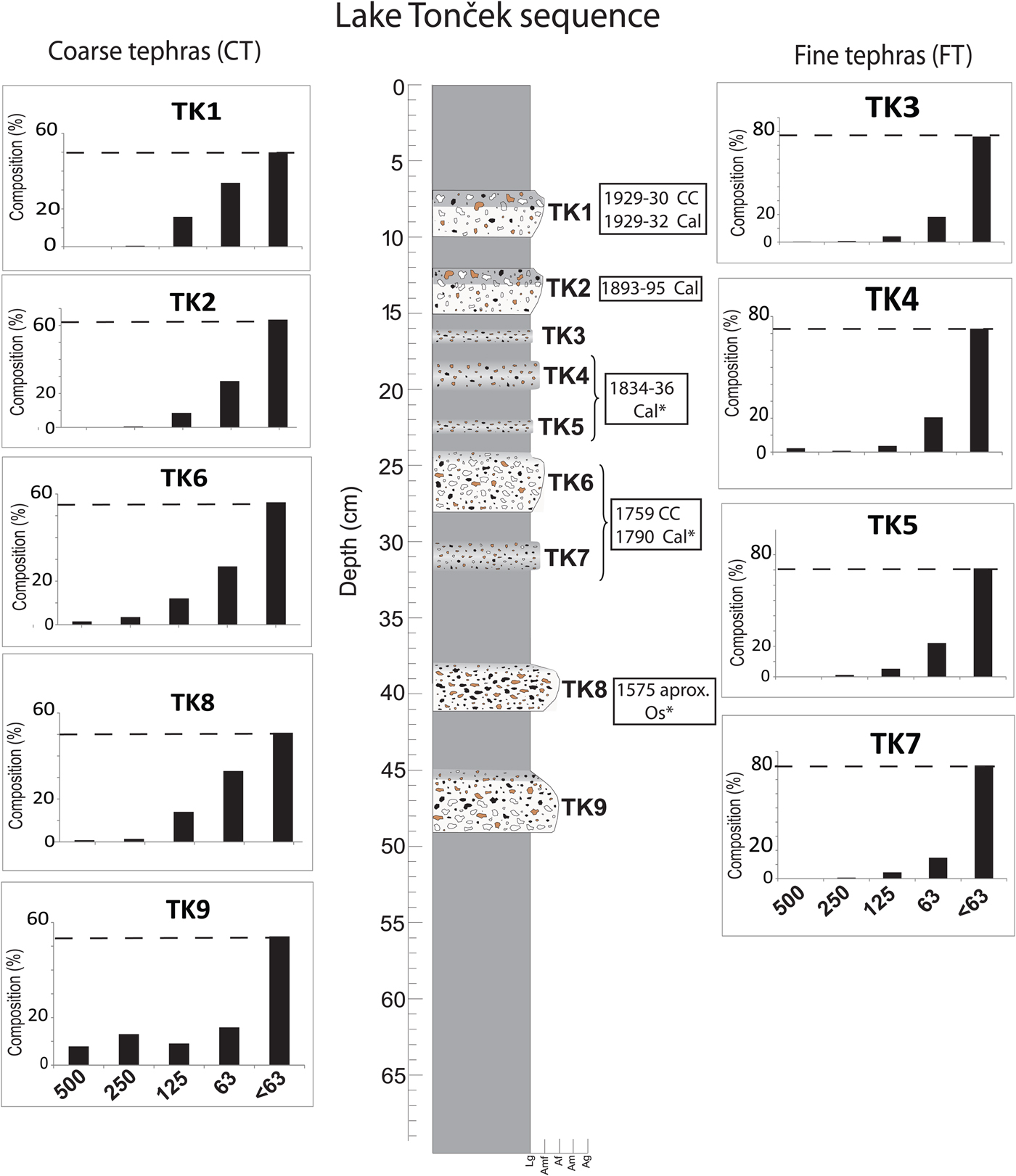
A 69-cm-long sediment core was extracted with a messenger-activated gravity corer from the deepest point (12 m) of Lake Tonček. The sediment sequence was longitudinally opened using a portable circular saw, sliding a copper plate through the sediment to divide it into two semicylindrical sections. Photographs, sediment characteristics, granulometric properties, and color of the opened core are described in Rizzo (Reference Rizzo2007) and Daga et al. (Reference Daga, Ribeiro Guevara, Sanchez and Arribere2010). The sediment consisted mostly of homogeneous silty clay-size material composed of siliciclastic material in variable proportions, with subtle changes in particle size and color. Nine tephra layers were identified (Fig. 2); the geochemical and morphological characteristics of the core, including a discussion of the composition and origin of tephra, are described in Daga et al. (Reference Daga, Ribeiro Guevara, Sanchez and Arribere2010). The tephra layers were associated with eruptions of Calbuco volcano and the Puyehue-Cordón Caulle system (Daga et al., Reference Daga, Ribeiro Guevara, Sanchez and Arribere2010).
(color online) Detail of the sedimentary sequence from Lake Tonček (extracted and modified from Daga et al. Reference Daga, Ribeiro Guevara, Sanchez and Arribere2010). Granulometry composition of (a) coarse and (b) fine tephras is shown. The tephras show the proposed date and the source: CC, Cordón Caulle; Cal, Calbuco; Os, Osorno; *, possible source. Modified from Daga et al. (Reference Daga, Ribeiro Guevara, Sanchez and Arribere2010). Note that the variable y-axis scales reach 60% in coarse tephras and 80% in fine tephras.

Both semicylindrical sections were subsampled every 1 cm. The subsamples were freeze-dried until constant weight was reached and homogenized afterwards. The organic matter (OM) content was estimated using loss on ignition (LOI) at 550°C for 4 h (Heiri et al., Reference Heiri, Lotter and Lemcke2001). Biogenic silica (BSi) concentration was measured in Lake Tonček sediments using the method outlined by DeMaster (Reference DeMaster1981). Sediment samples were leached in 1% Na2CO3, and aliquots extracted after 1, 2, 3, 4, and 5 h were analyzed for dissolved silica using a wet-alkali digestion technique and measured with a spectrophotometer (GENESYS 20 Thermo Spectronic). A least-squares regression analysis was applied on the increase in Si extracted versus time and extrapolation to the intercept allowed estimation of BSi concentration (DeMaster, Reference DeMaster1981).
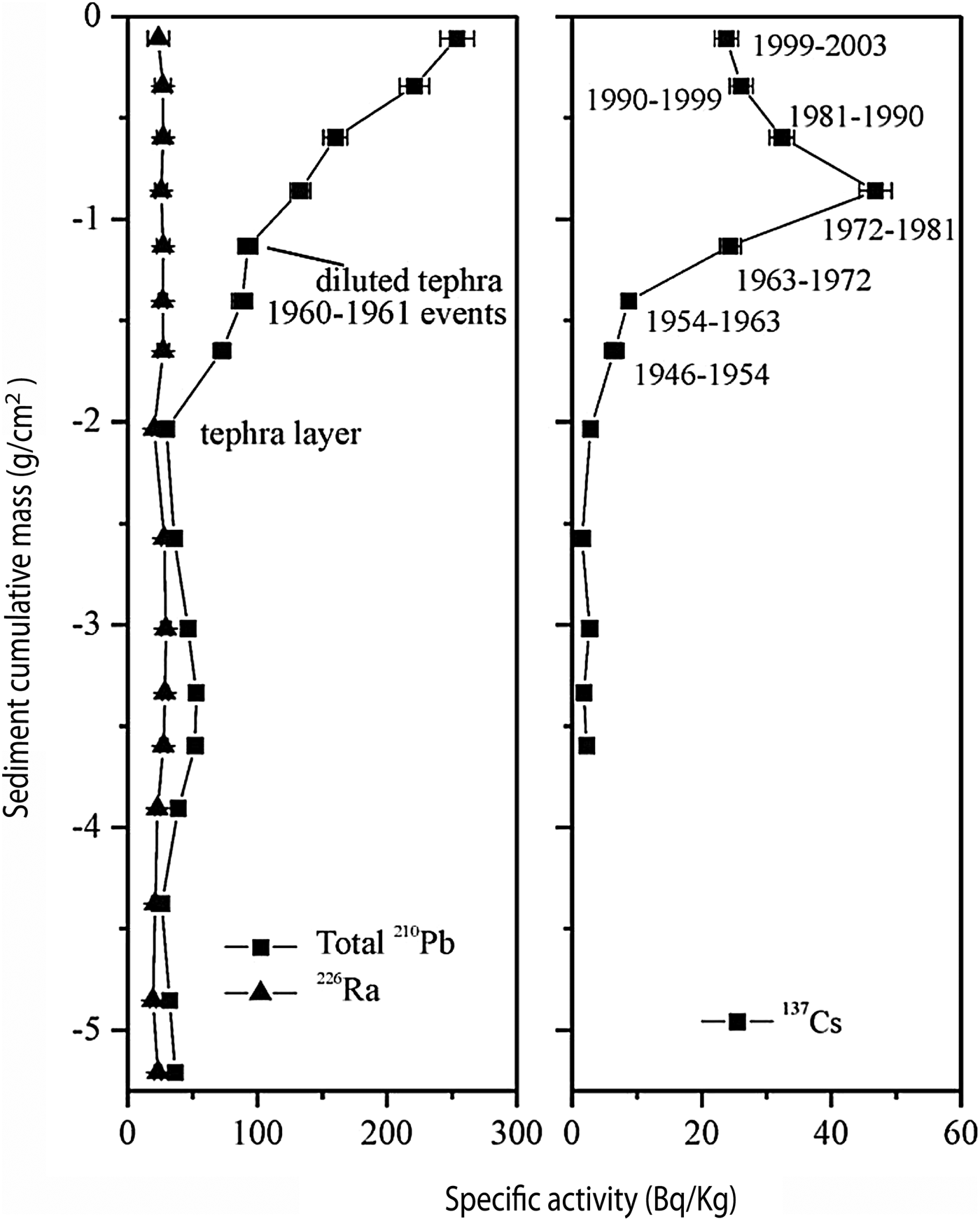
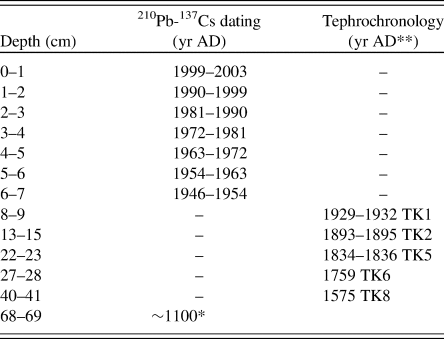
The sediment accumulation rate of the sequence was determined by the 210Pb and 137Cs dating techniques in Ribeiro Guevara et al. (Reference Ribeiro Guevara, Meili, Rizzo, Daga and Arribére2010). Total 210Pb specific activity profile in Lake Tonček sequence had an approximately exponential behavior with significant unsupported 210Pb up to 1 g/cm2 sediment cumulative mass, which allowed 210Pb dating in upper 5 cm layers (Fig. 3). The sedimentation rate determined by a CRS (Constant Rate of Supply) model was 26.3 mg/cm/yr (0.105 cm/yr; Daga et al., Reference Daga, Ribeiro Guevara, Sanchez and Arribere2010). 137Cs dating was performed via correlation of the specific activity profile with the historical fallout sequence in the study region (Ribeiro Guevara and Arribére, Reference Ribeiro Guevara and Arribére2002), and was in good agreement with 210Pb dating. Dates for deeper sediments were obtained by extrapolating sediment mass depth, using the sedimentation rate determined by 210Pb dating in the upper 7 cm. We achieved this by discounting volcanic ashes from the sediments by estimating the fraction composition in each layer with a binocular microscope. Dating estimation by extrapolation of 210Pb dating was used for tephrochronological correlations (Table 1), defining the age of the tephra layers by comparison of the geochemical composition with the volcanic sources and the historical eruptive records (Daga et al., Reference Daga, Ribeiro Guevara, Sanchez and Arribere2010), allowing a consistent sediment sequence chronology covering the past 900 yr of sedimentation (Fig. 3, Table 1).
(a) Lake Tonček sedimentary sequence. Specific activity profiles of 137Cs, 210Pb, and 226Ra (in secular equilibrium with supported 210Pb).

Dating estimation by extrapolation of 210Pb dating and tephrochronological correlations covering the past 900 yr of sedimentation. * E, estimate based on extrapolation of 210Pb sedimentation rate after the last tephra correlated with historical eruptions. **, corresponds to approximate dates.

Chironomid identification
Chironomid head capsules were extracted from sediments by picking head capsules from 1 g dry mass of each sediment subsample following the standard methods found in Walker (Reference Walker, Smol, Birks and Last2001). The cephalic capsules were mounted on slides and identified to genus level following Wiederholm (Reference Wiederholm1983), Coffman and Ferrington (Reference Coffman, Ferrington, Merrit and Cummings1996), Cranston (Reference Cranston2000), and Epler (Reference Epler2001). To identify the Tanypodinae specimens, we followed the method of Rieradevall and Brooks (Reference Rieradevall and Brooks2001) based on cephalic setation. Photomicrographs of each taxon were taken using a Nikon Coolpix 995 camera.
Chironomid capsules with any morphological mouthpart feature that departed from the normal configuration (missing or extra teeth and breakage and abrasion of mouthparts) were identified and quantified. In each subsample, the percentage of anomalies was calculated dividing the number of capsules with any type of morphological anomaly by the total number of capsules in that sample.
Statistical analysis
The relative abundance of each taxon is presented as a percentage of the total abundance in each subsample using TILIA and TILIA GRAPH v.1.7.16 (Grimm, Reference Grimm1987). To distinguish different associations in the chironomid community along the sequence, a stratigraphically constrained sum-of-squares cluster analysis (CONISS) was employed. Zonation was used when examining major differences in CONISS groups; using the program Primer 6.1.6 (Clarke and Gorley, Reference Clarke and Gorley2005), the significance of changes among the zones was performed with an analysis of similarity (ANOSIM; Clarke and Warwick, Reference Clarke and Warwick2001) with zones as factors. The similarity percentage procedure (SIMPER) on transformed variables (Primer 6.1.6; Clarke and Gorley, Reference Clarke and Gorley2005) was used to determine which taxa contributed most to the differences among the groups. The taxonomic diversity for chironomid assemblage in each subsample was calculated using the Shannon index (H') and the evenness of the community was estimated through the richness index (R) and equitability (J; Zar, Reference Zar1996; Begon et al., Reference Begon, Harper and Townsend1999). For statistical analysis, taxa with abundances higher than 1% and present in at least two samples were used.
Principal component analysis (PCA) was applied to the chironomid assemblage data (taxa abundance per layer) to assess composition structure (Birks, Reference Birks1998). First, a detrended correspondence analysis (DCA) was run to test the gradient length of species composition and to determine the appropriate constrained ordination technique (i.e., canonical correspondence analysis, CCA, or redundancy analysis, RDA; ter Braak and Prentice, Reference ter Braak and Prentice1988). Our dataset responded linearly to environmental gradients (SD < 3), so we used PCA. This analysis was run in CANOCO 4.5 (ter Braak and Ŝmilauer, Reference ter Braak and Ŝmilauer1998). DCA and PCA were performed using CANOCO version 4.5 (ter Braak, Reference ter Braak1991; ter Braak and Ŝmilauer, Reference ter Braak and Ŝmilauer1998) applying square-root transformation of species data to down-weight rare taxa. Scores were generated using CanoDraw.
RESULTS
Core stratigraphy
Profiles of OM (LOI %) and BSi (mg/g) followed similar patterns along the sequence (Fig. 4), with average values of 12.4% and 11.8 mg/g, respectively (Fig. 4, Table 2).
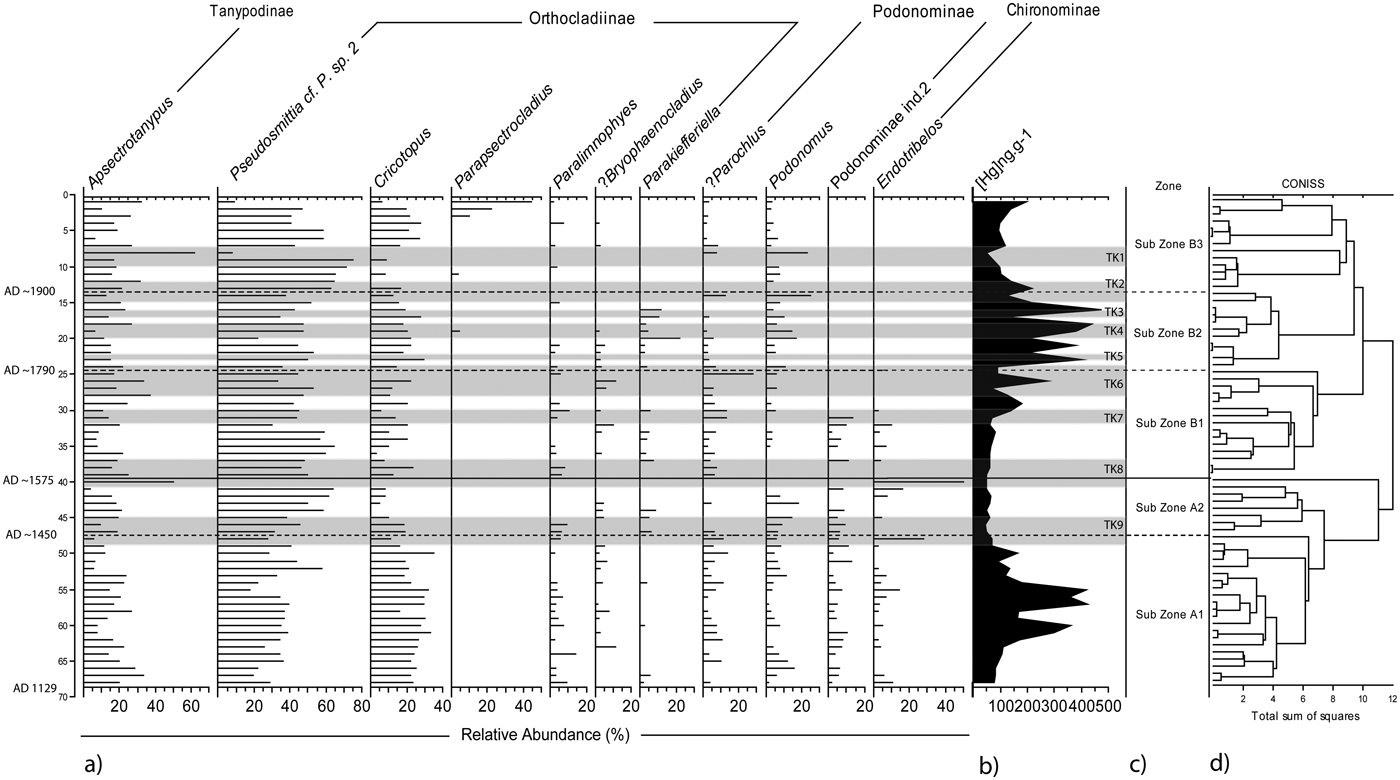
(a) Relative abundance of Chironomidae taxa of Lake Tonček; (b) total abundance of head capsules (HC/g); (c) diversity index (H); (d) richness (R); (e) mouthpart anomalies (%); (f) loss on ignition (LOI, %); (g) biogenic silica (BSi) concentration profile (mg/g); (h) chironomid zones calculated by a CONISS cluster analysis (Tilia version 1.7.16). Volcanic ash layers are presented in gray (TK1–TK9).

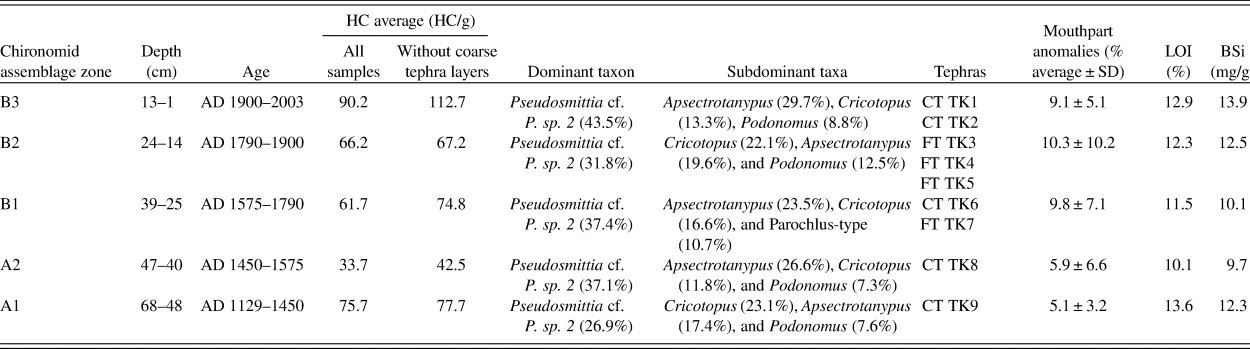
Summary of the chironomid assemblage biozones, layer depth (cm), age period, head capsules (HC) average, dominant and subdominant taxa, coarse (CT) and fine (FT) tephras, mouthpart anomalies (%), loss on ignition (LOI, %), and biogenic silica (BSi, mg/g) for each zone. Average relative abundance of each taxon is shown in parenthesis.

The nine tephra layers, named TK1–TK9 (Fig. 2), presented variable geochemical composition and grain-size distribution according to their different volcanic sources (Daga et al., Reference Daga, Ribeiro Guevara, Sanchez and Arribere2010), being composed of different percentages of coarse-grain size particles (63–500 μm) and fine sediment (<63 μm). The coarser fraction of each tephra mainly comprises volcanic particles (pumice, scoria, and glass shards) while the finer fraction contain variable proportions of fine volcanic material mixed with lacustrine sediment.
Tephras TK1, TK2, TK6, TK8, and TK9 were visually identified by coarser grain size, containing less than 60% of fine (<63 μm) sediment fraction (Fig. 2). Tephras TK3, TK4, TK5, and TK7, on the other hand, were identified under binocular magnifying glass given the size of volcanic particles, and their composition was made of more than 70% of the fine fraction (<63 μm). Therefore, TK1, TK2, TK6, TK8, and TK9 are referred as coarse tephras (CT), while TK3, TK4, TK5, and TK7 are considered as fine tephras (FT) in the following sections according to their grain-size distribution (Fig. 2).
Subfossil chironomid community
A total of 4686 head capsules were recorded in the 68 sediment samples obtained from the core. A minimum of 50 head capsules were identified in most subsamples except in CT layers, which contained fewer capsules. Other layers also had a few head capsules, but always more than 30, which are enough to warrant analysis (Larocque-Tobler et al., Reference Larocque-Tobler, Grosjean, Heiri, Bigler and Blass2009). Eighteen taxa were recorded, belonging to the subfamilies Orthocladiinae (68.7%), Tanypodinae (17.2%), Podonominae (11.8%), and Chironominae (Tribu Chironomini: 2.4%). At the genus level, Pseudosmittia cf. P. sp. 2 (Roback and Coffmann, Reference Roback and Coffman1983, pp. 39, fig. 199–201) was the most abundant(41.9%), followed by Cricotopus (18.2%) and Apsectrotanypus (17.2%). Less abundant taxa included Podonomus (4.7%), Parochlus-type (4.1%), Paralimnophyes (2.4%), Podonominae undiff.2 (2.3%), Parapsectrocladius (2.1%), Endotribelos (2%), Parakiefferiella (1.5%), and Bryophaenocladius-type (1.4%; Fig. 4). Other taxa presented abundances of less than 1%, such as Podonominae undiff.1 (0.7%), Orthocladiinae undiff.3 (0.6%), Orthocladiinae undiff.1 (0.3%), Chironominae undiff.1 (0.2%), Apedilum (0.1%), Orthocladiinae undiff.2 (0.1%), and Orthocladiinae undiff.4 (0.1%). Representative images of the chironomids found are shown in Supplemental Figure 1.
We registered the lowest H´ (0.3) at the 40 cm (CT TK8) and the highest H´ (0.89) at the 54 cm layer. The lowest R (3) was recorded at 8 and 12 cm (CT TK1 and TK2, respectively); and the highest R (10) was observed at the 1 cm layer (Fig. 4).
Based on the relative abundance of chironomids, the CONISS analysis divided the core in two main biozones, named A and B, which were further subdivided into A1 and A2 and B1–B3, respectively. The separation of zones and subzones was coincident with the presence of coarse tephras: zones A and B were separated by CT TK8, subzones A1 and A2 by CT TK9, subzones B1 and B2 by CT TK6, and subzones B2 and B3 by CT TK2 (Fig. 4).
According to the ANOSIM test, there was a significant difference in the composition of chironomid assemblages among the established zones (R = 0.36, P < 0.001). The main characteristics of these biozones (depth, age, average number of capsules, presence/absence of tephras, percentage of mouthpart anomalies, OM content, and BSi concentration) and their dominant taxa obtained from SIMPER analysis are shown in Table 2 and described below.
Zone A (68–40 cm; ~AD 1110 to AD 1575)
This zone was subdivided in subzones A1 and A2. The dominant taxon was Pseudosmittia cf. P. sp. 2, followed by Cricotopus, Apsectrotanypus, and Podonomus. Although the taxa composition was similar in A1 and in A2, the relative abundance of Pseudosmittia cf. P. sp. 2 increased and Cricotopus decreased in A2 (Table 2). Parochlus-type. was absent at 40–42 and 44–46 cm, which were included within CT TK8 and TK9 (Fig. 4). The abundance of Paralimnophyes decreased in zone A2 (1.9%), being absent from 45 cm (CT TK9) to the top of this subzone. The relative abundances of Endotribelos, Podonomus, and Podonominae undiff .2 were relatively constant in zone A, although Endotribelos showed peaks of maximum abundance at 48 (CT TK9) and 40 cm (CT TK8; 27.8 and 50%, respectively).
Zone B (39–1 cm; AD 1575–2003)
This zone was subdivided in subzones B1–B3. Similar to the previous zone, the dominant taxon was Pseudosmittia cf. P. sp. 2, followed by Apsectrotanypus, Cricotopus, Podonomus, and Parochlus-type. Podonominae undiff. 2 and Endotribelos were absent from 29 cm to the top of the core. The maximum relative abundance of Parakiefferiella was recorded at 20 cm (16.7%; FT TK4) but it was absent from 15 cm to the top of the core. From 19 cm (FT TK4), a decrease in the abundance of Bryophaenocladius-type was found (Fig. 4).
The average number of head capsules registered a notable increase from subzone B3 (mainly from 7 cm up) reaching 90.2 capsules/g in this entire subzone and 123.7 capsules/g in the 1–7 cm section (Fig. 4). Pseudosmittia cf. P. sp. 2 showed a high abundance along this period, but at 8 cm (CT TK1) its abundance decreased (7.7%). The relative abundance of Parapsectrocladius showed an increase from 3 cm on, reaching its maximum (41.4%) at 1 cm (Fig. 4).
Volcanic ash and chironomids
The chironomid community showed differential responses to the tephra layers. Total abundance, richness, and diversity decreased only in CT (Fig. 2 and 4). This overall decrease was mainly due to decreases in the abundance of the most abundant taxa: Pseudosmittia cf. P. sp. 2 and Cricotopus. Other taxa, such as Apsectrotanypus and Podonomus, remained stable in CT, increasing their relative abundance compared to the more abundant ones (Fig. 4). During CT TK9, the relative abundances of Podonominae undiff.2 and Endotribelos were stable, while both taxa disappear after the FT TK7. Parakiefferiella was not recorded neither, from CT TK2 to the top (Fig. 4). In FT layers, chironomid community abundance, richness, and diversity were not altered.
In general, chironomid capsules from CT layers showed a higher percentage of damaged mouthparts caused by mechanical wear, breakage, or abrasion (Fig. 4). The average percentage of anomalies along the core without considering CT layers was 6.9%. Considering only the CT layers, the average increases to 14.2% (Fig. 4). The anomalies in the mouthparts were differentially distributed among the taxa studied; for example, Orthocladiinae (Pseudosmittia cf. P. sp. 2, and Cricotopus and Parakiefferiella), Podonominae (Podonomus, Parochlus-type., and Podonominae undiff.2) and Chironominae (Endotribelos) were mainly affected in their mentum and mandibles, showing broken or worn teeth. Tanypodinae (Apsectrotanypus) presented changes in ligulae (broken central or lateral teeth) and paraligulae (Supplemental Figure 2).
PCA analysis
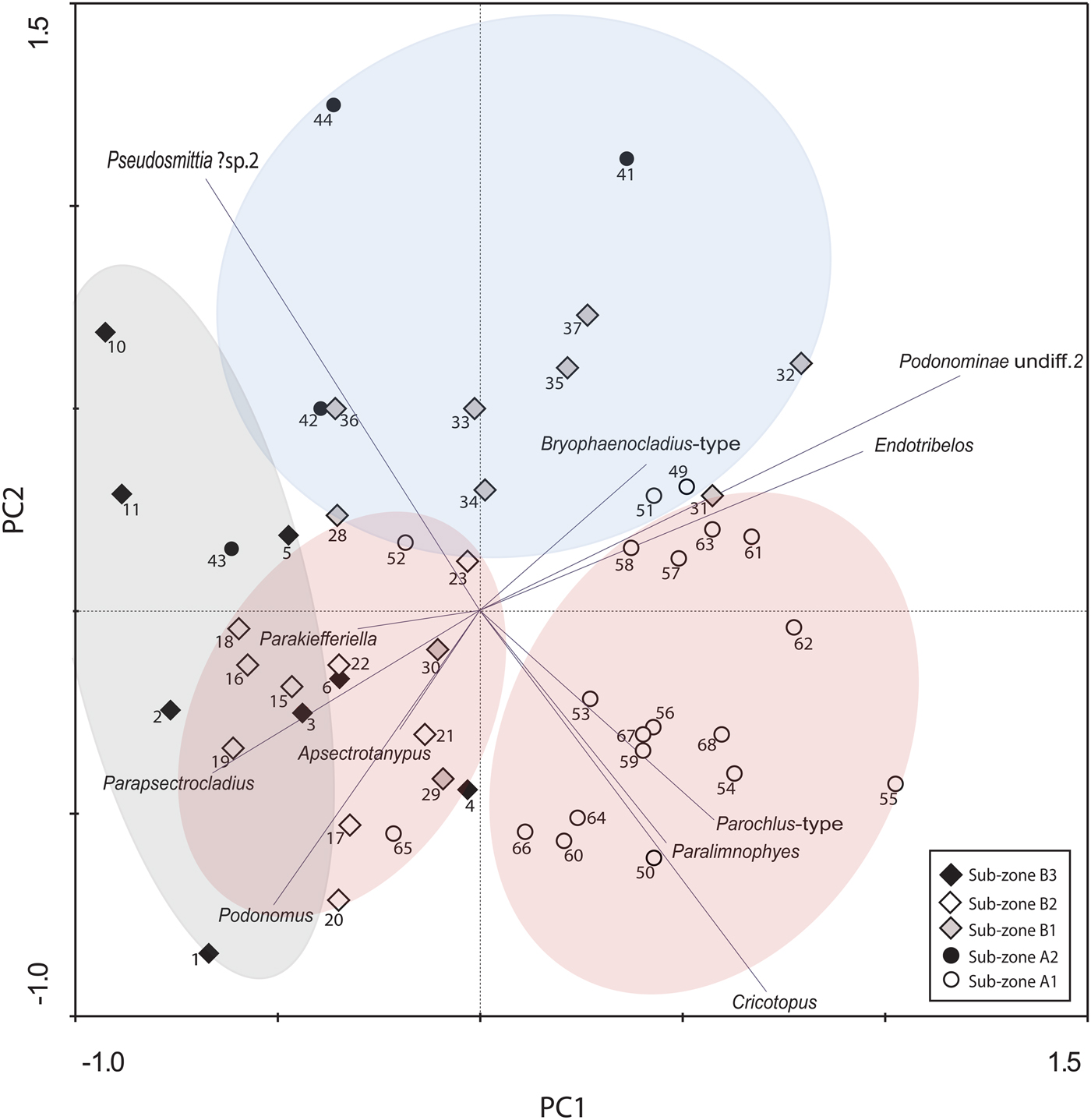
Based on the low values of abundance, richness, and diversity recorded in coarse tephra layers, these samples were excluded from the PCA analysis (Fig. 5). The first axis explains 20% of the total variance and both axes explain 36.1% of the total variance. Differences between the main biozones determined from the cluster analysis are also apparent in the PCA analysis (Fig. 5). Samples in subzone A1 (white circles) are pooled at the positive end of axis one of the PCA. Samples in subzones A2 (black circles) and B1(gray rhombus) are assembled at the positive end of axis two. Finally, samples in subzones B2 (white rhombus) and B3 (black rhombus) are pooled at the negative end of axis one. The main taxa that determined the distribution of the samples are indicated in Figure 5.
PCA biplot of chironomid percentages with biozone A samples as circles (A1, white; A2, black) and biozone B samples as rhombuses (B1, gray; B2, white; B3, black). Red ovals indicate periods of warm climate and low precipitation, blue oval represents cold climate and higher precipitation, and gray oval indicates the global warming period. The main taxa that determined the distribution of the samples are also shown. (For interpretation of the references to color in this figure legend, the reader is referred to the web version of this article.)

DISCUSSION
Lake Tonček chironomid community
The high abundances of cold weather associated taxa such as Pseudosmittia cf. P. sp. 2 together with the presence of ultra-cold stenothermic taxa such as Podonomus and Parochlus characterize Lake Tonček as a high-altitude lake (Massaferro and Brooks, Reference Massaferro and Brooks2002; Massaferro and Larocque-Tobler, Reference Massaferro and Larocque-Tobler2013). The chironomid taxa composition of this lake is similar to other high mountain lakes in other parts of the world (Rieradevall et al., Reference Rieradevall, Jiménez and Prat1998; Rieradevall and Prat, Reference Rieradevall, Prat and Hoffrichter1999), being its species adapted to littoral habitats (Lods-Crozet et al., Reference Lods-Crozet, Oertli and Robinson2012; Brooks and Heiri, Reference Brooks and Heiri2013). In Lake Tonček, the scarce development of the littoral and sublittoral zones due the abrupt slope towards the deepest zone added to the thick ice cover that annually forms for six to eight months could also influence the structure and composition of the chironomid community. In summary, factors such as low temperature, ice cover, and the morphometry of the lake play an important role in the determination of the composition and distribution of lake-dwelling chironomid larvae (Zhang et al., Reference Zhang, Zheng, Cao, Gao and Shen2012).
Although no replacements of the main chironomid taxa (Pseudosmittia cf. P. sp. 2, Cricotopus, Apsectrotanypus, and Podonomus) were observed along the Tonček sequence, changes in the relative abundance of dominant and subdominant taxa were the variables that determined the zones in the core (Table 2). The clear dominance of Pseudosmittia cf. P. sp. 2 (Orthocladiinae) could be associated with the wetlands surrounding the lake and its inlet because this taxa is predominantly semiterrestrial to terrestrial, with some species living in the splash zone of lakes (Wiederholm, Reference Wiederholm1983). Cricotopus (Orthocladiinae) occurs in all types of water bodies and their larvae are associated frequently with aquatic macrophytes, algae, and cyanobacteria (Nostoc). Some larvae mine in macrophytes, but others graze on the surfaces (Wiederholm, Reference Wiederholm1983). In Lake Tonček, Cricotopus could be associated with mosses of the family Amblystegiaceae, feeding or scraping on its superficial live tissues (Motta, Reference Motta2017). In Patagonia, Massaferro and Larocque-Tobler (Reference Massaferro and Larocque-Tobler2013) observed that this genus seems to have a bimodal distribution, with two abundance peaks in lakes between 3–5°C and 6–7°C. This distribution pattern might be due to the fact that the different species within genus Cricotopus have not yet been taxonomically differentiated. Larvae of Apsectrotanypus (Tanypodinae) are generally found in cold springs and small lotic bodies of water and may be regarded as cold stenothermic (Wiederholm, Reference Wiederholm1983). The presence of Podonominae subfamily (Podonomus, Parochlus-type, and Podonominae undiff.2) is considered a cold indicator because this group is essentially cold tolerant, requiring high oxygen concentrations to thrive (Massaferro and Larocque-Tobler, Reference Massaferro and Larocque-Tobler2013).
Chironomid responses to changing climatic conditions
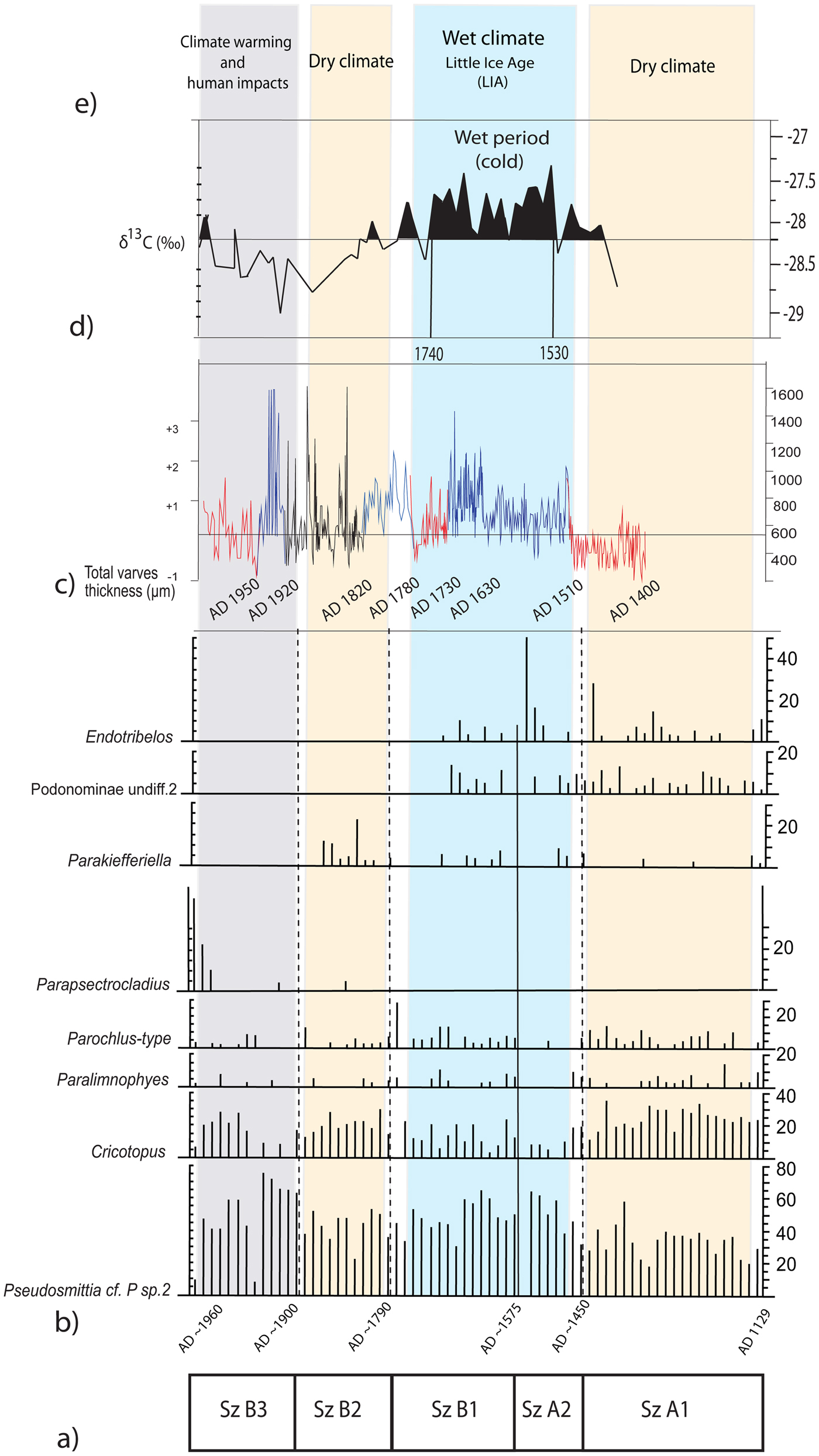
In the sequence from Lake Tonček, the main chironomid groups defined by the cluster and PCA analyses (Fig. 4 and 5) are relate to the climatic periods described for Patagonia for the past millennium (Villalba, Reference Villalba1990, Reference Villalba1994; Lara and Villalba, Reference Lara and Villalba1993; Bertrand et al., Reference Bertrand, Boes, Castiaux, Charlet, Urrutia, Espinoza, Lepoint, Charlier and Fagel2005; Neukom et al., Reference Neukom, Luterbacher, Villalba, Küttel, Frank, Jones and Grosjean2011). The subzone A1 (~AD 1110–AD 1450) recorded a dominance of Pseudosmittia cf. P. sp. 2, Cricotopus, and Apsectrotanypus. Later on, subzone A2 (~AD 1450 to AD 1575) showed decreases in the relative abundance of some taxa such as Paralimnophyes, Cricotopus, and Parochlus-type, increases of Pseudosmittia cf. P. sp. 2, and a general decrease in total chironomid abundance (Fig. 4). Accordingly, PCA analysis pools samples corresponding to subzone A1 at the positive end of axis one, represented by Paralimnophyes, Cricotopus, and Parochlus-type. Samples from subzones A2 and B1 are grouped at the positive end of axis two and are mainly represented by Pseudosmittia cf. P. sp. 2 (Fig. 5). These groups temporally match the end of a warm period around ~AD 1400 in Patagonia. After this warm period, climate turned colder and there was an increase in precipitation, events associated with the onset of the European Little Ice Age (Fig. 4; Villalba, Reference Villalba1990, Reference Villalba1994; Lara and Villalba, Reference Lara and Villalba1993; Bertrand et al., Reference Bertrand, Boes, Castiaux, Charlet, Urrutia, Espinoza, Lepoint, Charlier and Fagel2005). These climatic conditions could have affected the chironomid assemblages, explaining the changes observed from subzone A2 to zone B. Paralimnophyes is known for its detritivore habits, feeding preferably on the bottom of lakes, and Cricotopus is a littoral taxa generally associated with aquatic vegetation (Wiederholm, Reference Wiederholm1983; Motta, Reference Motta2017; Williams, Reference Williams2017). Some species of Parochlus have been recorded living associated with aquatic mosses on the bottom of lakes (Rico and Quesada, Reference Rico and Quesada2013). Therefore, the cold and humid weather period in Patagonia (AD 1490–1700), evident in subzones A2 and B1, might have affected the chironomid assemblages via changes in food and habitat availability (Fig. 6, Table 2). OM and BSi values decreased during subzones A2 and B1 as well (Fig. 4, Table 2), possibly due to the dilution with siliciclastics from the catchment, caused by increased erosion due to the increase in precipitation (Massaferro et al., Reference Massaferro, Correa-Metrio, Montes de Oca and Mauad2017; Chang et al., Reference Chang, Zhang, Liu, Sun, Langdon and Shulmeister2018). This increase in rainfall could have enhanced the formation of wetlands surrounding the lake, increasing the habitat availability for Pseudosmittia cf. P. sp. 2 in Lake Tonček (Fig. 6). Similarly, Michelutti et al. (Reference Michelutti, Lemmen, Cooke, Hobbs, Wolfe, Kurek and Smol2016) observed in Laguna Baños (a small and high Andean lake near Quito, Ecuador) that the subfossil chironomid community responded primarily to precipitation, showing a recent increase in the number of terrestrial and semiterrestrial taxa possibly related to changes in the precipitation regime or, alternatively, a greater number of large episodic rainfall events.
(a) Zones of Lake Tonček sequence and (b) relative abundance of main Chironomidae taxa related to precipitation and temperature changes. Comparison of Lake Tonček profile with northern Patagonia precipitation reconstructions with different proxy records. (c) Paleo-precipitation periods (red line, dry period; blue line, wet period; black line, variable precipitation period) based on total varve thickness from Lake Puyehue. Modified from Boes and Fagel (Reference Boes and Fagel2008). (d) Reconstruction of changes of paleoproductivity (d13C) from Lake Puyehue, indicating a wet period associated with lower temperatures during AD 1530–1740. Modified from Bertrand et al. (Reference Bertrand, Boes, Castiaux, Charlet, Urrutia, Espinoza, Lepoint, Charlier and Fagel2005). (e) Main paleoclimatic periods in Patagonia (Villalba, Reference Villalba1990, Reference Villalba1994; Lara and Villalba, Reference Lara and Villalba1993; Bertrand et al. Reference Bertrand, Boes, Castiaux, Charlet, Urrutia, Espinoza, Lepoint, Charlier and Fagel2005). Red, blue, and gray colors indicate dry climate, wet period, and a warming trend together with human impacts, respectively. (For interpretation of the references to color in this figure legend, the reader is referred to the web version of this article.)

The absence of Podonominae undiff.2 and Endotribelos from 29 cm (~AD 1700) to the top of the sequence could be possibly associated not only with changes in temperature, but also with variations in regional precipitation. In general, the Podonominae can be considered cold tolerant and their larvae are adapted to the lower-to-middle range of temperatures (Ashe et al., Reference Ashe, Murray and Reiss1987), so their absence could be related to the end of a cold and humid period and the beginning of a dry period (Fig. 6; Bertrand et al., Reference Bertrand, Boes, Castiaux, Charlet, Urrutia, Espinoza, Lepoint, Charlier and Fagel2005). In fact, the absence of Podonominae undiff.2 and Endotribelos in Lake Tonček sequence matches changes in precipitation described for other lakes of the same region (Fig. 6). Boes and Fagel (Reference Boes and Fagel2008) found different precipitation periods in Patagonia between ~AD 1630–1780. Between ~AD 1630–1730, a heavier autumn/winter precipitation period (~500 mm) was found, with a higher lake level in comparison with present-day conditions. From ~AD 1730 on, the authors describe a short period of lower regional precipitation, i.e., dryer autumn/winter with less turbulence and less nutrient turnover (Fig. 6). Other authors have also described different responses to precipitation changes by the chironomid community in other, rather different regions (Massaferro and Brooks, Reference Massaferro and Brooks2002; Rees et al., Reference Rees, Cwynar and Fletcher2015; Wang et al., Reference Wang, Brooks, Chen, Hu, Wang, Liu, Xu and Chen2016; Chang et al., Reference Chang, Zhang, Liu, Sun, Langdon and Shulmeister2018).
The decrease in abundance of Bryophaenocladius-type from 22 cm (~AD 1810) and the absence of Parakiefierella from 15 cm (~AD 1890) in subzone B2 can be tentatively explained by their optimum temperatures. Bryophaenocladius-type, as most Orthocladiinae members, is a cold-adapted species (Ashe et al., Reference Ashe, Murray and Reiss1987). Parakiefferiella, in turn, exhibits a bimodal optimal temperature with the peaks of abundance at 3–5 and 7–9°C (Massaferro and Larocque-Tobler, Reference Massaferro and Larocque-Tobler2013). Therefore, the abundance pattern observed in subzone B3 could be correlated with the beginning of the global warming trend of ~AD 1900 in Patagonia (Fig. 4 and 6; Villalba, Reference Villalba1990, Reference Villalba1994; Lara and Villalba, Reference Lara and Villalba1993; Bertrand et al., Reference Bertrand, Boes, Castiaux, Charlet, Urrutia, Espinoza, Lepoint, Charlier and Fagel2005). PCA analysis also reinforces our conclusion, given that samples corresponding to subzones B2 and B3 are grouped at the negative end of axis one, mainly represented by Parapsectrocladius (Fig. 5).
Chironomid total abundance sharply increased from 7 cm (~AD 1940) in subzone B3 (~AD 1900 to AD 2003), Parapsectrocladius representing most of this abundance in the upper 3 cm (Fig. 4). Beginning in the twentieth century, a global warming trend coincident with the first human activities was described for Patagonia (Fig. 6; Masiokas et al., Reference Masiokas, Rivera, Lukman, Espizua, Villalba, Delgado and Aravena2009; Veblen et al., Reference Veblen, Holz, Paritsis, Raffaele, Kitzberger and Blackhall2011). The surrounding area of Lake Tonček is an attractive site for climbers and hikers and, since 1957, there has been a mountain hut next to the lake that offers several services to visitors, including cooking services and bathrooms (Montes de Oca et al., Reference Montes de Oca, Motta, Plastani, Laprida, Lami and Massaferro2017). Rising temperatures in the twentieth century, along with increased human activities in the last 50 yr caused environmental changes that enhanced lake productivity (Massaferro et al., Reference Massaferro, Correa-Metrio, Montes de Oca and Mauad2017; Montes de Oca et al., Reference Montes de Oca, Motta, Plastani, Laprida, Lami and Massaferro2017). Regarding precipitation, Boes and Fagel (Reference Boes and Fagel2008) described different periods of precipitation in South America between ~ AD 1920 and 2000. The period between ~AD 1920–1950 evidenced more humid conditions but precipitation in autumn/winter decreased between ~AD 1950–2000 (Fig. 6). In Lake Tonček, this change in precipitation is evident in the results of our PCA analysis, in which chironomid assemblages from layers 10 and 11 cm are grouped close to samples corresponding to subzones A2 and B1, characterized by their high precipitation levels (Fig. 5). Ruiz et al. (Reference Ruiz, Berthier, Viale, Pitte and Masiokas2017), based on the study of glacier-wide mass changes in the Monte Tronador (northern Patagonia), observed the same overall trends towards warmer and drier conditions over the last decades, recording a notable increase in warm season temperatures in the late 1970s. From the twentieth century, Lake Tonček was subjected to a higher development of the periphytic community as a consequence of increased human activities together with warmer climatic conditions. These events could have produced an increase in total chironomid abundance and the development and multiplication of warm-associated chironomid taxa, like Parapsectrocladius, which is known to live associated with macrophytes and higher temperatures (Williams, Reference Williams2017).
Chironomid responses to volcanic ash deposition
The abrupt decrease in diversity, richness, and abundance observed in CT layers of Lake Tonček sequence was also reported for Lake Moreno Oeste (Patagonia, Argentina), where the chironomid community also responded differently to several volcanic tephras, depending on their grain size distribution (Williams et al., Reference Williams, Rieradevall, Añón Suárez, Rizzo, Daga, Ribeiro Guevara and Arribére2016). The CT layers could have produced notable decreases in diversity, richness, and abundance of chironomid assemblages due to the input of high amounts of volcanic ash accumulating several centimeters in the lake over a short period of time, thus altering the normal sedimentation pattern. Alternatively, FT layers may not have had an effect on the chironomid community. This can be explained by the fact that these layers correspond to volcanic ashes from minor or more distal eruptions reaching the lake catchment. In such cases, the minor amounts of volcanic ash together with the hydrodynamic properties of fine volcanic particles in water (suspension and drifting) and late inputs from the catchment (surface runoff and winds) could generate tephra layers mixed with lake sediments, producing less evident volcanic deposits (Lowe, Reference Lowe2011; Williams et al., Reference Williams, Rieradevall, Añón Suárez, Rizzo, Daga, Ribeiro Guevara and Arribére2016).
The different responses of the chironomid taxa to volcanic ash could be associated with their ecology and different feeding habits. Changes in taxa distribution and abundance in some tephra layers, such as the increase of Podonomus and Parochlus-type (Podonominae) abundance in CT TK1, TK2, and TK6, could be related to the increased phytoplankton biomass, which was likely due to a combination of increased phosphorus and lowered light intensities caused by suspended ash, as was observed by Modenutti et al. (Reference Modenutti, Balseiro, Elser, Bastidas Navarro, Cuassolo, Laspoumaderes, Souza and Díaz Villanueva2013) in north Andean Patagonian lakes Espejo, Correntoso, Nahuel Huapi, Gutiérrez, and Mascardi after the 2011 eruption of the Caulle/Puyehue volcanoes. Given that Podonomus and Parochlus-type feed on algae (Ashe et al., Reference Ashe, Murray and Reiss1987), they could have been favored by the new conditions. In contrast, decreases in the abundance of Pseudosmittia cf. P. sp. 2 and Cricotopus were coincident with CT TK1 and TK2, which could be attributed to the negative effect of volcanic ash, since they are mainly collector-gatherer organisms (Orthocladiinae; Ashe et al., Reference Ashe, Murray and Reiss1987).
In general, despite the abrupt decrease in chironomid abundance, richness, and diversity observed in CT layers from Lake Tonček, the community tended to revert to the same conditions observed before the volcanic ash deposition, restoring relative abundances to pre-disturbance levels within the next centimeter. This high resilience capacity was previously observed in other studies (Massaferro et al., Reference Massaferro, Ribeiro Guevara, Rizzo and Arribére2005b; Araneda et al., Reference Araneda, Cruces, Torres, Bertrand, Fagel, Treutler, Chirinos, Barra and Urrutia2007; Williams et al., Reference Williams, Rieradevall, Añón Suárez, Rizzo, Daga, Ribeiro Guevara and Arribére2016). The time elapsed to the recovery of the chironomid community was consistent with other observations (5 to 10 yr; Miserendino et al., Reference Miserendino, Archangelsky, Brand and Epele2012, and references therein); however, the sedimentation rate of Lake Tonček (0.105 cm/yr) does not allow a more precise comparison.
Despite the fast rate of recovery, some chironomid taxa were not registered above some tephras. For instance, from CT TK6 to the top of the sequence, the absence of Endotribelos and Podonominae undiff.2 was notable; and Parakiefferiella was not observed from FT TK3 to the top. As previously mentioned, Massaferro et al. (Reference Massaferro, Correa-Metrio, Montes de Oca and Mauad2017) observed in Lake Tonček that the chironomid community did not recover to the original state after the volcanic ash fall of the 1960 Puyehue/Calbuco volcanic events. The authors attributed this response to the lack of vegetation cover and the presence of macrophytes in the basin, which offered no protection for the aquatic environment, leaving the ecosystem highly exposed to the effect of the volcanic ashes. Our results, based on the different responses of the chironomid assemblages against different types of volcanic events, granulometric, and geochemical compositions, suggest that, in addition to the climatic variations, the chironomid community could also be compromised by the grain-size distribution and the frequency of the volcanic events (Williams et al., Reference Williams, Rieradevall, Añón Suárez, Rizzo, Daga, Ribeiro Guevara and Arribére2016).
In CT layers (except TK8) from the sequence, we observed an increase in morphological mouthparts anomalies caused by breakage or abrasion and mechanical wear (Fig. 4), possibly produced by physical contact of the mouthparts with mineral particles and organic material. This type of damage should not be considered as deformity screening, such as missing or extra teeth (Vermeulen, Reference Vermeulen1995). Moreover, the observed anomalies were not equivalent in all the chironomid taxa. This is possibly related to the different ecological requirements (e.g., feeding habits) of the larval stage that determine the relationship of the larva with the sediment (Martinez et al., Reference Martinez, Moore, Schaumloffel and Dasgupta2002). Orthocladiinae members registered the greatest percentage of anomalies, since their larvae are mainly collector-gatherers and have close contact with the sediment. In contrast, the percentage of anomalies in Tanypodinae larvae was much lower, possibly related to the predator feeding habits that characterize this subfamily (Supplemental Figure 2; Ashe et al., Reference Ashe, Murray and Reiss1987).
CONCLUSION
The most important changes in the subfossil chironomid community from Lake Tonček over the past millennium were driven by a combination of climate conditions and volcanism. Although the main changes in the chironomid community were mostly associated with temperature shifts, variations in precipitation also played an influential role. The location of the lake above the tree line and devoid of protective vegetation also played a part in the ecosystem-wide effects of erosive processes caused by precipitation.
The chironomid communities at Lake Tonček showed a high resilience to the deposition of the coarse tephras. Despite the sharp decrease in abundance and diversity, and the increase in mouthpart anomalies following the deposition, the community rapidly recovered to its previous condition. Some taxa, however, disappeared from some layers to the top of the core, such as Podonominae undiff.2 and Endotribelos from 30 cm on and Parakiefferiella from 15 cm on, possibly as a response to a combination of successive volcanic ash fall and changing climatic conditions in the region.
The response of chironomid assemblages to environmental impacts in the high mountain Lake Tonček reported here represents a significant contribution to the paleoenvironmental toolkit for Patagonian ecosystems. The changing paleoclimatic conditions inferred from subfossil chironomid assemblages at Lake Tonček was generally consistent with other temperature and precipitation reconstructions from the region based on chironomid remains and other climate proxies, further stressing the potential for chironomid-based reconstructions of high mountain lakes.
ACKNOWLEDGMENTS
The authors thank Senior Editor Derek Booth and Associate Editor Terri Lacourse, and two anonymous reviewers for their important suggestions to improve the manuscript. This work was partially funded by the projects PICT 2006-33838 and PICT 2006-1051 of the Agencia Nacional de Promoción Científica y Tecnologica (Argentina) and by the International Atomic Agency, project TCA-ARG/7/006.
SUPPLEMENTARY MATERIAL
To view supplementary material for this article, please visit https://doi.org/10.1017/qua.2019.5.