1. Introduction
A well-known example of the benefits conferred by the division of labor appears in Adam Smith’s The Wealth of Nations. In his discussion of the pin factory, Smith noted that the efficiency gains derived from specialization could yield an increase of productivity between 240- and 4,800-fold from that of a single individual. Whereas a single worker might endeavor to produce 20 pins in a day, a group of 10 in a single factory had been seen to produce upward of 12 pounds.
Does the same hold true for the division of cognitive labor? Would there be more discoveries or would discoveries come faster if scientists divided their labor? For a number of reasons, the answer is obviously yes: undivided cognitive labor would lead to unnecessary repetition, scientists would fail to benefit from the unequal distribution of skill and talent, and, finally, complex projects would become unmanageable given only a single worker. However, some have argued for a positive answer for other reasons. In particular, Weisberg and Muldoon (Reference Weisberg and Muldoon2009) suggest that diversity of research strategies may “stimulate … greater levels of epistemic production” (225) and contend that even small steps toward a more diverse community of scientists “massively boosts the productivity of that population” (246–47, italics added).
The argument Weisberg and Muldoon provide for this claim uses a formal model of search strategies on an “epistemic landscape,” a natural reinterpretation of the idea of a fitness landscape from evolutionary biology. In what follows, we show that, contrary to what they report, a careful examination of their formal model does not actually support many of the conclusions they attempt to draw regarding the division of cognitive labor. There are three main reasons. First, for the particular epistemic landscape they consider, the purported benefits of cognitive diversity are exaggerated due to a failure to consider a broad enough comparison class of search strategies. We provide several examples of homogeneous populations that prove surprisingly efficient at searching the space and identifying the points of epistemic interest. Second, the apparent benefits of cognitive diversity reported largely derive from implementation errors in two of the three search strategies they discuss. And third, if the model of epistemic landscapes is generalized to more rugged, higher-dimensional landscapes whose overall topography is not discernible by the individuals,Footnote 1 social learning and the division of cognitive labor only helps in particular circumstances. The upshot is that, although there clearly are real benefits from the division of cognitive labor, the reasons have nothing to do with the epistemic reasons suggested by Weisberg and Muldoon’s formal model.
The overall structure of the article is as follows. In section 2 we briefly revisit the original epistemic landscape model. In section 3 we derive results providing an upper bound for efficient search strategies on that landscape; essentially, no rational scientist should perform worse than this value. We then show that some of the search strategies investigated by Weisberg and Muldoon fare far worse than this constraint. Section 4 shows why the search strategies considered by Weisberg and Muldoon performed so badly. Section 5 considers two key hypotheses that they claim to have substantiated, and we show that our reexamination of the model invalidates both hypotheses, effectively undermining their attempts to provide epistemic reasons for the division of cognitive labor. Section 6 demonstrates that homogeneous populations can do even better than heterogeneous populations, in some cases. And, finally, in section 7 we generalize the epistemic landscape model and argue that whether the division of cognitive labor is advantageous depends on features of the landscape that may well be unknowable.
2. Epistemic Landscapes
The basic idea of an epistemic landscape derives from Sewall Wright’s (Reference Wright and Jones1932) insight in population biology that one can represent the fitness values of genotypes in terms of an abstract landscape. There, a particular genotype corresponds to a point in a highly multidimensional landscape, with the fitness value of that genotype as its “height” and “nearby” points on the landscape being genotypes accessible via point mutation, recombination, and so on.Footnote 2 Analogously, we can think of an “epistemic landscape,” where a point of the landscape represents a particular research approach to investigating a topic of inquiry. A research approach consists of the composite set of research questions, instruments, techniques, and methods used, as well as background theories a scientist or group of scientists rely on.
Not all research approaches to a topic of inquiry are equally fruitful, though. Some research approaches bring better results or more publications or more useful applications than others. Following Weisberg and Muldoon, we can treat each approach as having a significance between 0 and 1. This generates an abstract landscape over the various research approaches, with the height of each approach corresponding to its significance. The entire landscape itself represents a single topic of inquiry.Footnote 3
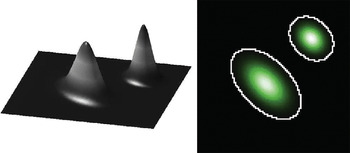
How do they proceed to model this? First, they fix the form of the epistemic landscape. For simplicity, they work with a discrete 101 × 101 lattice, wrapping at the edges to form a torus, with two peaks as illustrated in figure 1. Second, they must operationalize the concept of finding points of epistemic significance on this landscape. This can be broken down into two components:
Epistemic Success: The time required to visit the two peaks.
Epistemic Progress: The percentage of the significant regions explored after a given time.
Three-dimensional and two-dimensional projections of the epistemic landscape. Left, Weisberg and Muldoon (Reference Weisberg and Muldoon2009), fig. 1. Right, Significance hills are indicated by shaded gradient, with the perimeter highlighted.

Given these two aims, how should scientists search the space? Since a point in two dimensions represents a research approach, this becomes the question of how a scientist should move about the landscape in light of the information available to her.Footnote 4 A variety of different kinds of information exist that one might use. There is epistemic information, such as the significance of one’s current approach. There is also social information, such as how often a certain approach has been tried before or whether it has been tried at all. Finally, there is the possibility of using metric information, such as how far away is the nearest scientist.Footnote 5
Weisberg and Muldoon consider three search strategies: a “control” and two others that they call “mavericks” and “followers.” The control strategy, also referred to as the “HE rule” (short for “hill-climbing with experimentation”) only uses epistemic information, whereas mavericks and followers use both epistemic information and social information. Essentially, the HE rule instructs a scientist to try to climb a hill toward the peak (without being able to detect the gradient) and otherwise to follow a straight line on the landscape with, occasionally, a random change in direction. Followers, as the name suggests, are intended to favor explored approaches that have been previously considered and only take significance into account as a secondary consideration. The maverick strategy, however, is sensitive to research approaches that have been explored previously and deliberately seeks out unexplored approaches at random.
3. Controls, Followers, Mavericks, and the Efficiency of Search
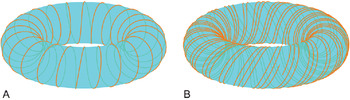
Before getting into the details of the Weisberg and Muldoon model, let us first establish some clear upper bounds on the search efficiencies one might expect to find. Recall that the control strategy attempts to hill climb, if in an area of epistemic significance, and otherwise follows a straight line, with occasional random changes in direction. If we dispense with the requirements of hill climbing and the occasional random reorientation when in areas of zero significance, we get a search strategy that can be proven to almost always visit both peaks and exhaustively search the entire space. How so? Recall that, since the two-dimensional landscape wraps at the edges, it is topologically equivalent to a torus. The Kronecker foliation of the torus is obtained by projecting a straight line in the real plane with slope θ onto the surface of the torus. If the slope θ is rational, the projected line forms a closed loop; if the slope is irrational, the line will be dense in the surface of the torus (fig. A1 illustrates both types of foliations).Footnote 6 Since the epistemic landscape under consideration is divided into discrete cells, the fact that the Kronecker foliation is dense in the surface of the torus guarantees that a single agent who simply follows a straight line will, in finite time, search the entire space.Footnote 7 Call an agent employing such a strategy a “foliator.”Footnote 8 A population of foliators will manage to explore the entire space more quickly than a single agent. And since almost all of the possible slopes θ that an agent may follow are irrational, a population of foliators uses a simpler search strategy than Weisberg and Muldoon’s control agents but can be proven to almost always succeed in achieving both epistemic aims.
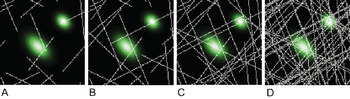
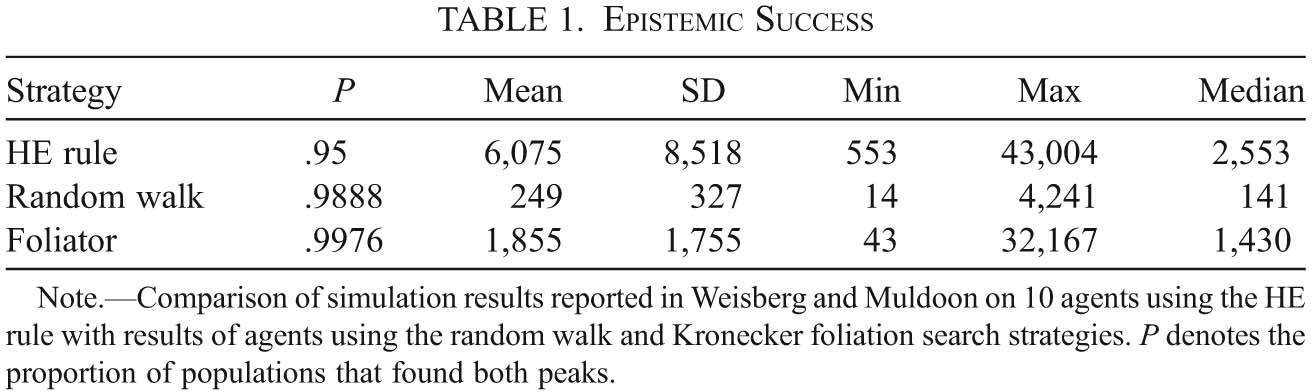
Let us estimate the efficiency of this search rule by simulation. Figure 2 illustrates one result from a simulation containing 10 foliators beginning at random locations in the area of zero significance, which we call the “desert.” Notice that the foliator strategy can be quite quick: within 500 steps, one peak of the landscape had already been found and 37% of the entire landscape explored. Out of 5,000 simulations run with 10 foliators and random initial conditions, 4,988 managed to find both peaks within 50,000 steps. The mean time required to find both peaks was 1,855 steps, with minimum and maximum times of 43 and 32,167 steps, respectively, and a median time of 1,430 steps.
Epistemic search by 10 foliators. Squares are ‘bread crumbs’ showing approaches that have been visited. A, 50 iterations; B, 100 iterations; C, 200 iterations; D, 500 iterations.

Now compare these results with the results reported by Weisberg and Muldoon (see table 1). The discrepancy reveals something rather curious. In a simulation with 100 repetitions of populations of 10 HE rule agents, only 95 populations found both peaks within the time allowed (50,000 steps). Of these 95 populations: “the time to finding the two significant peaks varied considerably from a maximum of 43,004 cycles to a minimum of 553 cycles. The mean for these runs was 6,075 with standard deviation 8,518 and the median was 2,553. More importantly, the length of runs is distributed in a heavy-tailed distribution, with 60% of the runs being completed in 4,000 cycles and 80% being completed in 10,000 cycles” (Reference Weisberg and Muldoon2009, 236). In short, foliators—who never attempt to hill climb and who never pick a new direction of travel—are both more effective at finding both peaks (with a success rate of 99.7% instead of 95%) and faster (a mean time of 1,855 steps, as opposed to 6,075). Let us bracket this observation, for the moment, and return to it at the end of this section.

| Strategy | P | Mean | SD | Min | Max | Median |
|---|---|---|---|---|---|---|
| HE rule | .95 | 6,075 | 8,518 | 553 | 43,004 | 2,553 |
| Random walk | .9888 | 249 | 327 | 14 | 4,241 | 141 |
| Foliator | .9976 | 1,855 | 1,755 | 43 | 32,167 | 1,430 |
Note Comparison of simulation results reported in Weisberg and Muldoon on 10 agents using the HE rule with results of agents using the random walk and Kronecker foliation search strategies. P denotes the proportion of populations that found both peaks.
Now consider, as an alternative search strategy, the case of a simple random walk. Assume that at points of zero significance (the desert) the agent randomly moves to one of its eight nearest neighbors, with all transition probabilities equal; at points with positive significance, the agent follows the gradient. This means that at points of zero significance, an agent’s movement at a time is independent from her movement at all previous times and that once the agent enters a region with positive epistemic significance, she never leaves. Thus we can treat the two hills as a single absorbing state and model the movement of the agent in the desert as a Markov process.
Let kn,m denote the expected time to absorption for an agent starting at location (n, m). By construction, k i,j=0 for all points (i, j) having positive epistemic significance. Furthermore, for all points (n, m) having zero epistemic significance, we know that

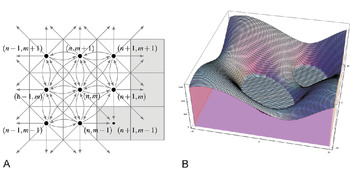
Figure 3A illustrates the local transition diagram for a point in the desert bordering the perimeter of a hill. This gives a system of 10,201 simultaneous linear equations. If we only consider equations generated from points having zero significance and the perimeter of the two epistemically significant regions, the system reduces to 8,273 simultaneous linear equations. Figure 3B illustrates the expected hitting time of the absorbing state, for each point in the landscape.Footnote 9 The maximum expected hitting time is a fraction over 1,600 steps. The average hitting time, for a single agent starting in the desert, is 881.9 steps.
Analytically solving for the expected waiting time of the random walk search strategy. A, Portion of the Markov chain transition diagram for the random walk search strategy. Gray areas represent absorbing states. For simplicity, only the state transitions exiting the 3 × 4 block of points are shown. B, Plot of the expected number of steps required for an agent to encounter a region of epistemic significance via a random walk (height of each column represents the expected number of steps).

Since it is not feasible to obtain an analytic solution for a population of 10 agents engaged in independent random walks, we examined this via simulation. Out of 5,000 populations of 10 agents, all starting from random initial conditions, 4,944 found both peaks. In all remaining 56 cases, all 10 agents had found the same peak. (With the random walk search strategy, when an agent finds a peak it stays there.) The mean time required to find both peaks was 249 steps, with a minimum and maximum time of 14 and 4,241 steps respectively, and a median of 141 steps. After 500 iterations on average 15.6% of the total landscape had been explored.
In summary, we have shown that if we are interested in both effectiveness (were both peaks found?) and efficiency (how long did it take to find both peaks?), the HE rule did worse than pure populations of foliators or random walkers. (Table 1 has a comparison of all three strategies.) In particular the HE rule—despite taking epistemic information into account by hill climbing—did worse on average by a factor of three when compared to the foliator strategy, which simply ignored this information. Furthermore, the HE rule did worse than the random walk strategy by a factor of roughly 24. Admittedly, our random walk strategy would be expected to do better, in regions of positive significance, because it simply followed the gradient, whereas the HE rule used a probe-and-adjust method to hill climb. But that surely does not explain everything about why it did over 24 times worse.
4. A Closer Look
Why did the control scientists perform so badly? Let us examine the exact statement of the HE rule as described in the original article. It is as follows:
HE Rule:
1. Move forward one patch.
2. Ask: Is the patch I am investigating more significant than my previous patch?
If yes: Move forward one patch.
If no: Ask: Is it equally significant as the previous patch?
If yes: With 2% probability, move forward one patch with a random heading. Otherwise, do not move.
If no: Move back to the previous patch. Set a new random heading. Begin again at Step 1. (Weisberg and Muldoon Reference Weisberg and Muldoon2009, 231–32)
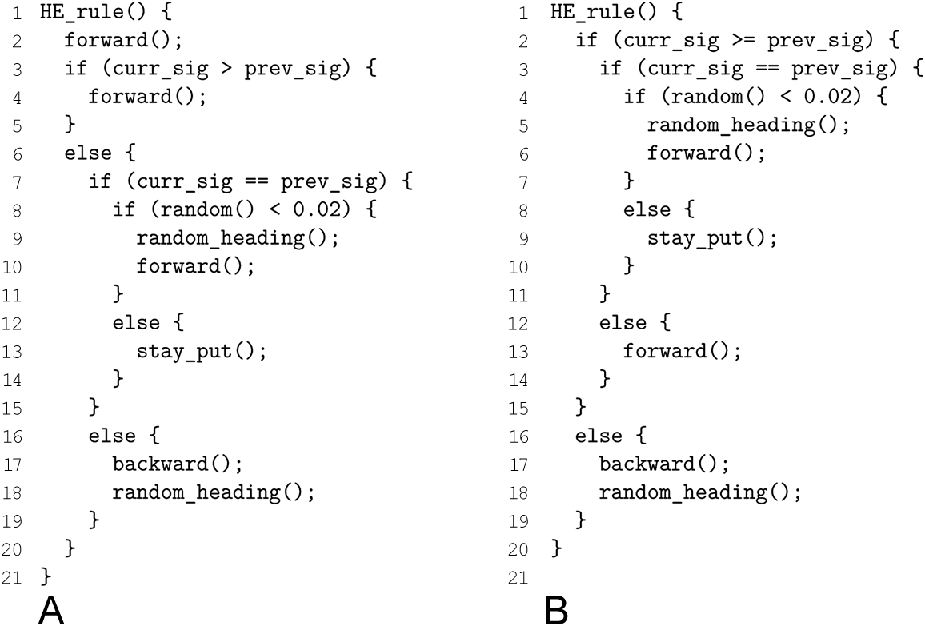
Scope ambiguities regarding the nested conditionals in step 2 make the rule, as stated, open to multiple interpretations. The pseudocode representation provided in figure 4A makes precise the scope relations between the else-clauses of the conditionals under one interpretation. Here, step 1 of the published version of the HE rule corresponds to the forward() command in line 2. Step 2 corresponds to the nested conditionals and commands in lines 3–20. There is nothing corresponding to the “Begin again at Step 1” instruction because we assume each agent calls HE_rule() at the start of each iteration.
Two implementations of the HE rule search strategy. Variables curr_sig and prev_sig refer to the significance of the site currently occupied by the agent and the significance of the site previously occupied by the agent, respectively. A, As in the article; B, as implemented.

From this, it is clear that our foliator rule approximates the HE rule quite well: when exploring areas of zero significance, the test on line 3 fails, and the test on line 7 succeeds. As the test on line 8 succeeds only 2% of the time, the remaining 98% of the time the HE rule will not reset its heading. Thus, when the forward() command on line 2 is invoked at the start of the next iteration, the agent continues to move forward according to its previous heading (i.e., in a straight line). Furthermore, this shows that the stay_put() command on line 13 is not, strictly speaking, necessary, since the agent has already taken one step forward during the current iteration. (Indeed, this serves to highlight a small error in the Weisberg-Muldoon statement of the HE rule: when in areas of increasing significance, the combination of the forward() command on line 2 and the successful test on line 3 ensures that the agent will step forward twice in the same iteration.)
Inspection of the original code used in the Weisberg-Muldoon simulation, which they made available, revealed that their actual implementation was as in figure 4B. There are several things to note. First, the absence of a forward() command at the beginning means that agents are not guaranteed to move at least once each iteration. Second, the test condition at line 2 contains the ≥ operator. When exploring regions of zero significance, this means the test at line 2 will succeed, dropping us immediately into the test at line 3, which will also succeed. A control agent, given lines 4–6, moves forward at a random heading with a 2% probability and otherwise remains stationary 98% of the time.
In other words, whereas the description of the HE rule in the article suggests that agents ought to behave rather like foliators, Weisberg and Muldoon’s actual implementation has those agents behaving like lethargic random walkers. This explains the difference between our baseline results and those reported by Weisberg and Muldoon. However, it also calls into question the meaningfulness of the comparison between control agents who use the HE rule and other search strategies. Since control agents do nothing 98% of the time, unless a similar delay is incorporated into the definition of any compared search strategies, we are comparing rules that operate on fundamentally different timescales.
Let us now turn to the follower strategy. Here is the definition, as in the original article:
Follow[er] Rule:
Ask: Have any of the approaches in my Moore neighborhood been investigated?
…
If yes: Ask: Is the significance of any of the investigated approaches greater than the significance of my current approach?
If yes: Move towards the approach of greater significance. If there is a tie, pick randomly between them.
If no: If there is an unvisited approach in the Moore neighborhood, move to it, otherwise, stop.
If no: Choose a new approach in the Moore neighborhood at random. (Weisberg and Muldoon Reference Weisberg and Muldoon2009, 239–40)
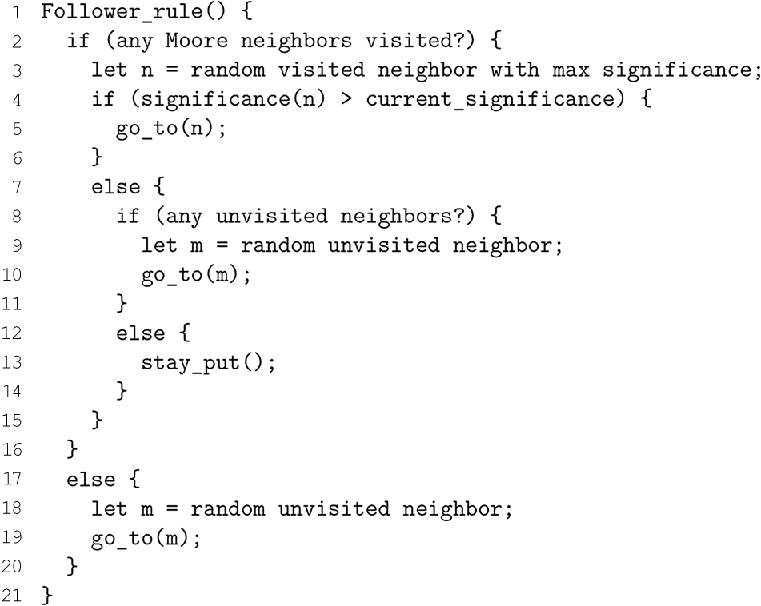
In our version (see fig. 5), there is no need to specify the tie-breaking rule explicitly because we have already selected, at line 3, a random visited neighbor with maximum significance.
Follower rule.

As interpreted, the follower rule performs a biased random walk that can get stuck. In the presence of sites that have been previously visited, and that are of greater significance, the rule moves to one of those sites at random. When no visited sites are of greater significance, it moves to a random unvisited site. However, when entirely surrounded by visited sites of equal significance—as can happen in the desert—the follower rule will end up getting trapped in a cycle of length 2, flipping back and forth between two visited states.
How does this interpretation compare with the results Weisberg and Muldoon report? They write:
With only 10 followers, not a single population managed to find both approaches of maximum significance and only 3% managed to find at least one approach of maximum significance. … With 200 followers, a single approach of maximum significance was found 60% of the time, with both approaches being found only 12% of the time. However, when the populations of followers did find both peaks, this happened very rapidly with an average time to converge … of 56 cycles, which suggests that the randomly placed agents were near the boundary of significance at the beginning of the simulation. (Reference Weisberg and Muldoon2009, 240)
Even though the biased random walk performed by the followers can get stuck in the desert, it seems strange that a population of 200 followers only found one peak 60% of the time, and both peaks only 12% of the time. Further cause for concern should arise when one reads that when followers did find both peaks it happened “very rapidly.” How can a search strategy perform so badly at searching, generally, yet succeed so rapidly when it does?
Inspection of the code used by Weisberg and Muldoon showed that their implementation was functionally equivalent to our interpretation (see fig. 5) except for the test at line 4, which in their version was
if (significance(n) >= current_significance) {
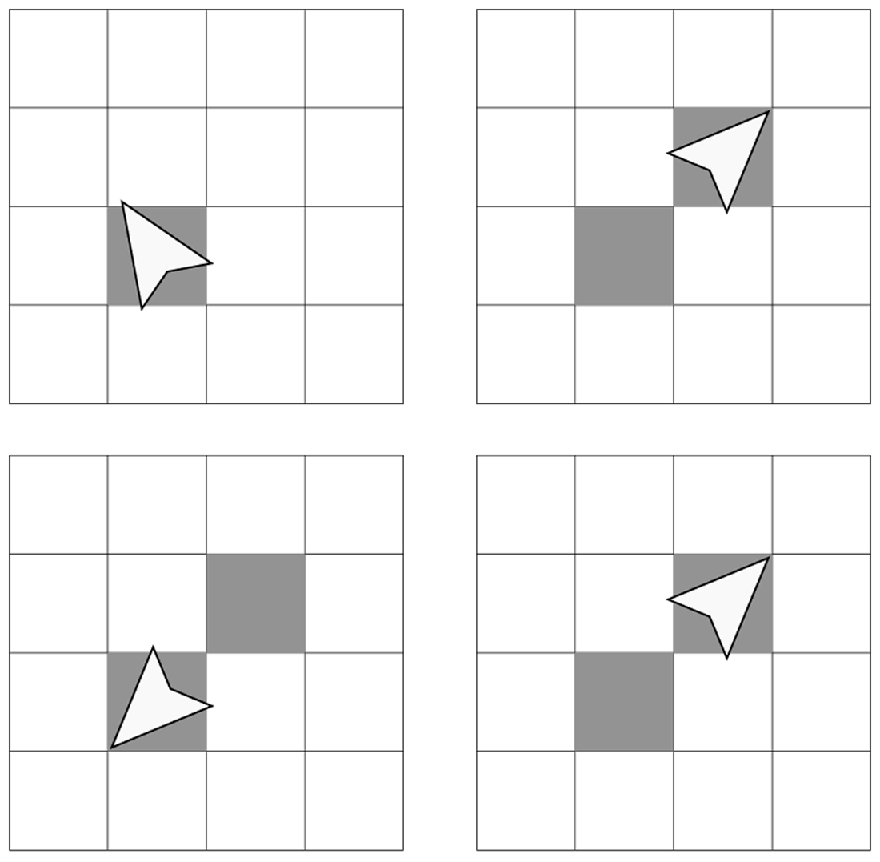
The use of the ≥ operator instead of the > operator is a serious error. Given a sparse distribution of followers, where each agent is at least three squares distant from every other in regions of zero significance, the agents get stuck in a loop.
Figure 6 illustrates how this happens in detail. In the initial state shown in the upper left, the if-test at line 2 of the follower rule fails, but the if-test at line 8 succeeds, resulting in the agent moving to an adjacent site selected at random. But then, in a configuration like that shown in the upper right, the if-test at line 2 now succeeds, and because the Weisberg-Muldoon implementation of the follower rule has the ≥ operator at line 4, the agent simply moves back to its previous position.Footnote 10 From this point on, the follower oscillates between the two visited sites. Instead of following others, the agent ‘chases his own tail’.
Implementation of the follower rule typically results in cycles of length 2. (All shown sites have zero significance.) Agent moves from the initial configuration (upper left) to a randomly selected unvisited square (upper right). It then returns to a previously visited site whose significance is greater than or equal to the significance of the current site (bottom left) and is stuck in a loop (bottom right).

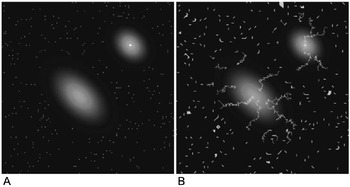
Thus we see why only 3% of the 100 simulations of 10 followers managed to find a single peak: most of the time they were in regions of zero significance, which resulted in the followers getting trapped in a cycle as described in figure 6. It also explains why larger populations of followers, when they managed to find both peaks, found both peaks so quickly: the random initialization positioned a few followers in a site of zero significance that was adjacent to a region of positive significance. If the follower happens to randomly move into an area of positive significance, it will then proceed to climb up the hill via a random walk. With this in mind, consider the one graphic from the original Weisberg and Muldoon article that showed the paths traveled by a population of 300 followers, reproduced in figure 7. Here we see that only agents positioned near the region of epistemic significance eventually managed to climb toward the top of the peak. Furthermore, the vast majority of paths traveled by followers consist of mere oscillations between two adjacent squares, exactly as one would expect given the code analysis.
Weisberg and Muldoon (Reference Weisberg and Muldoon2009), fig. 8, showing the exploration of the epistemic landscape by 300 followers before (A) and after (B) movement began. Tails plot the path they followed. Note that the vast majority of followers are trapped in cycles of length 2.

5. On the Division of Cognitive Labor
Weisberg and Muldoon note that “modern science requires the division of cognitive labor” (Reference Weisberg and Muldoon2009, 225) and claim that their simulation results illustrate the epistemic benefit so conferred. But what, exactly, do we mean by the “division of cognitive labor”? Consider the following disambiguation. On one hand, we have the phenomenon that scientists choose different approaches to investigate a research topic. In the epistemic landscape (which represents the research topic), the agents can occupy different points (which represent research approaches). Scientists specialize in different approaches. This is one meaning of division of cognitive labor. It describes a phenomenon of coordination. On the other hand, we have the phenomenon that scientists use different strategies to choose their research approach. The agents move across the epistemic landscape according to different strategies. Some scientists employ methods simply because they are trending (these would be the followers), whereas others favor approaches because they are exotic or unusual (these would be the mavericks). This is a second meaning of division of cognitive labor. It describes a phenomenon of diversity. Let us call the phenomenon where different people work on different projects epistemic coordination and the latter, where different people have different reasons to work on different projects, cognitive diversity.
When Kitcher (Reference Kitcher1993) and Strevens (Reference Strevens2003) use the Marginal Contribution and Reward model to explain why scientists pursue different research approaches, they seek to explain the phenomenon of epistemic coordination. They show that research behavior of scientists is coordinated when scientists are sensitive to social and epistemic information. Very roughly, scientists seek to maximize the rewards that accrue from scientific discoveries. They consider both the likelihood that an avenue will generate results (epistemic information) and the number of other scientists working on that avenue (social information). This yields the phenomenon that the scientific community spreads out across different possible avenues for research. However, because Kitcher and Strevens assume that all scientists choose among possible avenues for research in essentially the same way, they do not address cognitive diversity.
In contrast, an example of research on cognitive diversity can be found under the headings of “swarm intelligence” or “wisdom of the crowds.”Footnote 11 For example, similar to Weisberg and Muldoon, Hong and Page (Reference Hong and Page2004) develop a model of agents searching for local maxima in a space. The agents are cognitively diverse in two ways. Not only do they use different strategies to explore the epistemic space, but they also represent the epistemic space differently; each individual has its own language to describe the points in the space. This is an example of a model of agents that are cognitively diverse.Footnote 12 More generally, models of cognitive diversity can be found in areas ranging from complex systems research and theoretical biology (Bonabeu, Dorigo, and Theraulaz Reference Bonabeu, Dorigo and Theraulaz1999; Krause et al. Reference Krause, James, Faria, Ruxton and Krause2011) and management and organization studies (Thomas and Ely Reference Thomas and Ely1996; Polzer, Milton, and Swarm Reference Polzer, Milton and Swarm2002; Jackson, Joshi, and Erhardt Reference Jackson, Joshi and Erhardt2003) to psychology (Kerr and Tindale Reference Kerr and Tindale2004), computer science (Clearwater, Huberman, and Hogg Reference Clearwater, Huberman and Hogg1991), and economics (Hong and Page Reference Hong and Page2004; Arrow et al. Reference Arrow, Forsythe, Gorham, Hahn, Hanson, Ledyard, Levmore, Litan, Milgrom and Nelson2008).
The epistemic landscape of Weisberg and Muldoon models division of cognitive labor in both senses. Agents take different approaches on a research topic (epistemic coordination), and they use different strategies in choosing those approaches (cognitive diversity). The central observation of “general trends about the division of cognitive labor” (Reference Weisberg and Muldoon2009, 249) made by Weisberg and Muldoon is that cognitive diversity gives a scientific community an epistemic advantage. An increase in epistemic performance ensues if a community of researchers uses different epistemic search strategies. Weisberg and Muldoon argue that “to be maximally effective, scientists need to really divide their cognitive labor” (227) and that a “healthy number of followers with a small number of mavericks” would provide an “optimal way” (251) to do so. They write that this is because there is a “very significant indirect affect that mavericks have on the research progress via their ability to stimulate the followers” (249). That sounds like a fine example of epistemic benefits of cognitive diversity.Footnote 13 Is it true?
Weisberg and Muldoon observe that the epistemic performance of a population of followers increases when mavericks are added to it (247–48).Footnote 14 Does this vindicate the thesis that cognitive diversity improves epistemic performance? It does not if the improvement rests on a defective implementation of the search strategies. And it does not vindicate the thesis if the improvement is only due to the epistemic performance of the agents that have been added. It seems that both are the case here.
Furthermore, Weisberg and Muldoon describe that the improvement in epistemic performance is due to the following “indirect affect.” They write: “Mavericks help many of the followers to get unstuck, and to explore more fruitful areas of the epistemic landscape” (Reference Weisberg and Muldoon2009, 247). Maverick scientists may help follower scientists get unstuck, but the followers should not have been stuck in the first place. As shown above, the search strategy of follower scientists suffered from a defective implementation such that they ended up chasing their own tail. The beneficial “indirect affect” that Weisberg and Muldoon describe requires a population of follower scientists that has hardly left the place where they started. If a search strategy performs so direly, the result that a complementary strategy improves overall performance is hardly surprising. It does not vindicate the thesis that there is an epistemic reason for cognitive diversity in any interesting sense.
If the follower strategy worked properly, in that it did not get stuck almost immediately in a cycle, would there still be an indirect affect to vindicate the thesis that there is an epistemic reason for cognitive diversity? We show that this is not the case. It turns out that the improvement in epistemic performance is exclusively due to the performance of the mavericks that are added to the population of followers. It should not be surprising that the epistemic performance of a population increases when agents are added. In particular, this is true when these agents are mavericks, who have been shown to perform quite well.
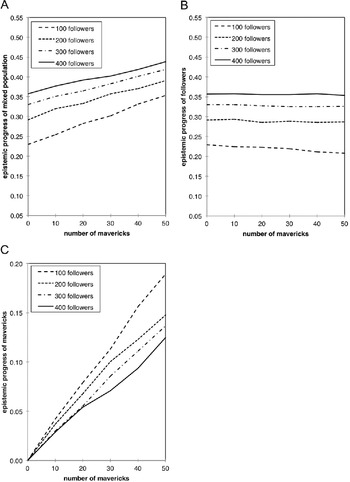
We set up a simulation to record the epistemic progress of followers and mavericks separately as the mavericks are added to a population of followers. In these simulations, we used a correct implementation of the follower search strategy. This separate bookkeeping enables us to identify which subpopulation caused the increase in the total epistemic progress of the mixed population. We ran simulations with 100 repetitions for each condition, for populations of followers with an initial size of 100, 200, 300, and 400. We observed how the epistemic progress of this population changes as maverick scientists are added. Replicating the experiment from Weisberg and Muldoon, we added 10, 20, 30, 40, and 50 maverick scientists. We measured the epistemic progress after 1,000 iterations, recording the total epistemic progress of the mixed population and the progress of each subpopulation (see fig. 8).
Epistemic progress of a population as mavericks are added. Increase of the mixed population (A) is almost entirely due to the maverick subpopulation (C). Epistemic progress of the follower subpopulation (B) remains unchanged while mavericks are added.

For all initial sizes of follower populations, the epistemic progress of the followers remains virtually unaffected by the presence of mavericks. In the case of the initial population size of 100 followers, the epistemic progress of the follower subpopulation even decreased. While a pure population of 100 followers managed to explore 23% of the significant points after 1,000 steps, when mavericks are added to the population this number goes slightly downward. The epistemic progress of the follower subpopulation in the presence of 50 mavericks reaches only 21%.
Thus, the increase in the epistemic progress of the mixed population can be solely accounted for by the epistemic progress of the maverick subpopulation. Indeed, if anything, the followers seems to get in the way of the mavericks. The mavericks are doing particularly well when only a few followers are present. Notice that the epistemic progress of a maverick subpopulation of the size of 50 is 19% in the presence of a follower subpopulation of a size of 100. The epistemic progress of the maverick subpopulation decreases as the size of the follower subpopulation increases. The maverick subpopulation of the same size achieves an epistemic progress of 15% when the follower subpopulation has a size of 200, 14% when it has a size of 300, and 12% when it has a size of 400.
6. Efficient Search in Homogeneous Populations
The Weisberg and Muldoon epistemic landscape model features three different kinds of information: epistemic, social, and metric. Although control agents use epistemic and followers and mavericks use both epistemic and social information, none of the three strategies considered use metric information. To an extent, using metric information (how far away other nearby scientists are and where they are going) can be interpreted as a “strategic follower” strategy: it pays attention to where other scientists are going rather than seeking parts of the landscape where they have been. Since there is good reason to suspect that some scientists behave in roughly similar ways (in that they consciously align their “research brand” with what is trending), let us consider how such a search strategy performs. Let us call this strategy the “swarm.” Stated informally, a swarm scientist receives information about what others in her area are working on via journals and conferences and adjusts her own approach such that it is always similar but yet distinct to the approaches pursued by others in her area. Furthermore, when she observes that many of her colleagues incorporate a certain turn into their approaches, she will try to imitate this change.
There are at least four interesting parallels between the epistemic search of a scientific community and the foraging behavior of animal groups. First, individuals in a school of fish or a flock of birds need to coordinate their behavior to avoid occupying the same space at the same time. In scientific research, this is the problem of epistemic coordination: we do not want everyone to be attempting to do the same thing at the same time, as such redundancy would often be a waste of effort. Second, the animal group often has a common goal, such as finding food or traveling to a nesting site. Analogously, the scientific community has epistemic aims, such as determining a high-yield, cost-effective way of manufacturing graphene. Third, information is distributed differently among individuals in a group: only a small subset of individual animals in a group may have information about the location of particular food site. Analogously, only a small subset of researchers has experience with a particular approach to the research topic. Finally, just like how some herd-based animals follow others who take the lead, a similar behavior may be found in the scientific community.Footnote 15
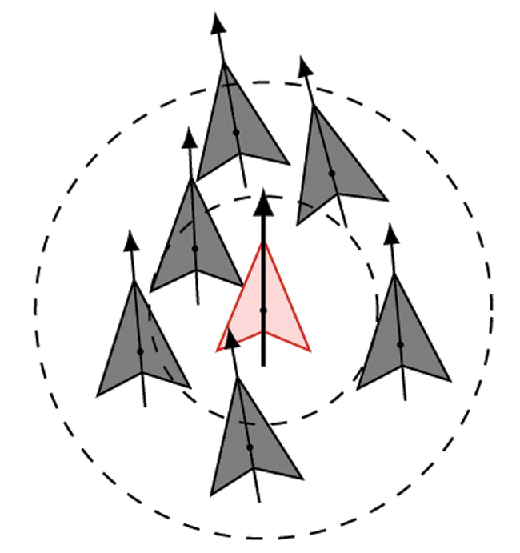
Theoretical biology has a rich literature on collective behavior (see Sumpter Reference Sumpter2010, chap. 5, for an overview). The swarm search strategy we use is a simplified version of one by Couzin et al. (Reference Couzin, Krause, Franks and Levin2005) and similar to the Boids model (Reynolds Reference Reynolds and Stone1987). Roughly, if another agent gets too close, then the agent swerves to avoid collision. Otherwise, the agent aligns its direction of travel with the other agents around it. More precisely, the space surrounding the agent is divided into two different “zones,” as shown in figure 9, a zone of repulsion and a zone of orientation. If there is another agent in the front half of the agent’s zone of repulsion, then the agent changes its direction to the right if the closest individual is ahead and to the left, and the agent changes its direction to the left if the closest individual is ahead and to the right. If there are individuals in an agent’s zone of orientation but not its zone of repulsion, then the agent adjusts its direction by the mean of the differences between its own direction and the directions of the individuals in the zone of orientation.
Focal agent of a flocking swarm with its zone of orientation (outer circle) and repulsion (inner circle).

Although figure 9 assumes that the radius of the zone of repulsion is smaller than that of the zone of orientation, this need not be the case. If the radius of the zone of repulsion is greater or equal to the radius of the zone of orientation, the resulting swarm has considerably different properties. To distinguish between these two cases, let us introduce some terminology: call the latter case a “repulsing swarm” and the former case a “flocking swarm.” The flocking swarm can be thought of as being composed of “strategic followers,” with the repulsing swarm being composed of “strategic mavericks.”
Note that swarm scientists also use epistemic information but in a manner somewhat different from the HE rule. Since some scientists have the ability to intuit the correct way to develop a theory—think of Newton, Einstein, von Neumann, and Feynmann—we incorporate this into the model by assigning to each agent a probability of being “clairvoyant.” That is, each agent who happens to be in a region of positive significance has a probability of guessing the direction to the top of the hill.Footnote 16 When this happens, the clairvoyant agent adjusts its heading to point in the direction of its insight. Clairvoyance does not last, though, and so the initial flash of insight might disappear as the agent further adjusts its behavior to the rest of the surrounding swarm. Brilliant ideas may go unrecognized.
Compare this with the complexity of the behavior of the other agents. The HE rule, maverick, and follower agents all change their behavior when they enter an area of positive significance. Each of them uses epistemic information in each move to climb toward the top of the hill. The swarm strategy exhibits no richer behavior or greater complexity than these strategies.
In short, in each iteration a swarm scientist does as follows. If the agent is on a point of positive significance, it has a one-off moment of clairvoyance with probability p, which causes it to change its direction toward the closest peak, taking one step forward. Otherwise, it adjusts its direction to align with all the other agents in its zone of orientation, or it swerves away from the closest nearby agent in its zone of repulsion, if there is any. After aligning or swerving, the agent moves one step forward.
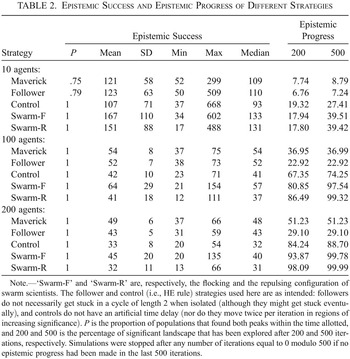
We ran simulations starting with populations of 10 agents, increasing the population by 10 to up to 400 agents with 100 repetitions each.Footnote 17 We investigated the flocking swarm strategy and the repulsing swarm strategy.Footnote 18 The probability of clairvoyance was 0.03 for the flocking swarm and 0.015 for the repulsing swarm. We compare our results with similar simulations using mavericks and the follower scientists.Footnote 19 The results for 10, 200, and 400 agents can be found in table 2.Footnote 20

| Epistemic Success | Epistemic Progress | |||||||
|---|---|---|---|---|---|---|---|---|
| Strategy | P | Mean | SD | Min | Max | Median | 200 | 500 |
| 10 agents: | ||||||||
| Maverick | .75 | 121 | 58 | 52 | 299 | 109 | 7.74 | 8.79 |
| Follower | .79 | 123 | 63 | 50 | 509 | 110 | 6.76 | 7.24 |
| Control | 1 | 107 | 71 | 37 | 668 | 93 | 19.32 | 27.41 |
| Swarm-F | 1 | 167 | 110 | 34 | 602 | 133 | 17.94 | 39.51 |
| Swarm-R | 1 | 151 | 88 | 17 | 488 | 131 | 17.80 | 39.42 |
| 100 agents: | ||||||||
| Maverick | 1 | 54 | 8 | 37 | 75 | 54 | 36.95 | 36.99 |
| Follower | 1 | 52 | 7 | 38 | 73 | 52 | 22.92 | 22.92 |
| Control | 1 | 42 | 10 | 23 | 71 | 41 | 67.35 | 74.25 |
| Swarm-F | 1 | 64 | 29 | 21 | 154 | 57 | 80.85 | 97.54 |
| Swarm-R | 1 | 41 | 18 | 12 | 111 | 37 | 86.49 | 99.32 |
| 200 agents: | ||||||||
| Maverick | 1 | 49 | 6 | 37 | 66 | 48 | 51.23 | 51.23 |
| Follower | 1 | 43 | 5 | 31 | 59 | 43 | 29.10 | 29.10 |
| Control | 1 | 33 | 8 | 20 | 54 | 32 | 84.24 | 88.70 |
| Swarm-F | 1 | 45 | 20 | 20 | 135 | 40 | 93.87 | 99.78 |
| Swarm-R | 1 | 32 | 11 | 13 | 66 | 31 | 98.09 | 99.99 |
Note ‘Swarm-F’ and ‘Swarm-R’ are, respectively, the flocking and the repulsing configuration of swarm scientists. The follower and control (i.e., HE rule) strategies used here are as intended: followers do not necessarily get stuck in a cycle of length 2 when isolated (although they might get stuck eventually), and controls do not have an artificial time delay (nor do they move twice per iteration in regions of increasing significance). P is the proportion of populations that found both peaks within the time allotted, and 200 and 500 is the percentage of significant landscape that has been explored after 200 and 500 iterations, respectively. Simulations were stopped after any number of iterations equal to 0 modulo 500 if no epistemic progress had been made in the last 500 iterations.
On epistemic success, we found that mavericks and followers perform better than the swarm strategy only if the populations are sufficiently small and the population of maverick or follower agents actually manages to find both peaks. We found that as the size of the population increases beyond 30, this result no longer holds. Then the swarm strategy performs better than the maverick and the follower strategy. The repulsing swarm configuration performs particularly well. Consider the median time to find both peaks for populations of size 100. Mavericks, followers, and the flocking swarm configuration have a median time between 50 and 60 iterations to find both peaks, whereas half of all the repulsing swarm populations find both peaks already after 37 iterations.
On epistemic progress, as previously shown, we found that the maverick scientists have a greater epistemic performance than follower agents. However, swarm scientists have an even greater epistemic performance than the maverick scientists; the repulsive swarm configuration seems to do slightly better than the flocking swarm configuration. The take-home message is that cognitively homogeneous populations of agents can do very well.
7. A Generalized Epistemic Landscape Model
One further concern with the Weisberg and Muldoon model derives from the simplicity of the epistemic landscape considered. Although we are generally ignorant about the shape of the epistemic landscapes underlying real scientific research, it is clear that they have at least two properties that are largely absent from the Weisberg and Muldoon landscape. First, on real epistemic landscapes, it is much easier to get trapped at a local optimum and much harder to identify the global optimum. And second, when we consider the “epistemic fitness” conferred by a combination of scientific methods, theories, techniques, and so on, there is a much greater degree of interdependency than a two-dimensional landscape would allow. If we consider more “realistic” epistemic landscapes, what, if anything, can we infer about the benefits of cognitive diversity?
We can begin to consider this question by reinterpreting the NK-landscape model of Kauffman and Levin (Reference Kauffman and Levin1987) and Kauffman and Weinberger (Reference Kauffman and Weinberger1989) as an epistemic landscape. The idea is straightforward: suppose we have a set of N scientific propositions, where these propositions may consist of both abstract general statements of high theory as well as specific statements of particular laboratory technique. The belief state of an individual scientist can be represented by a vector  , where bi = 0 if the scientist does not believe the ith proposition, and bi = 1 if the scientist does believe the ith proposition.
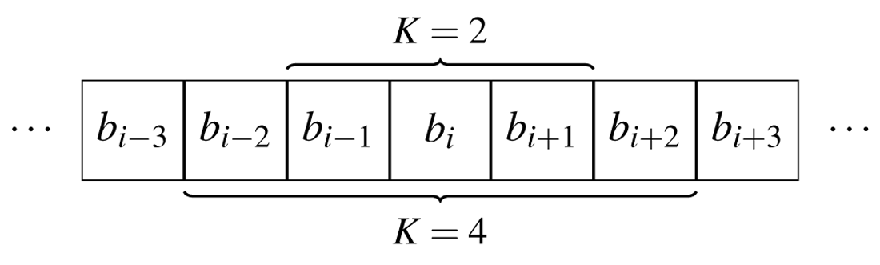
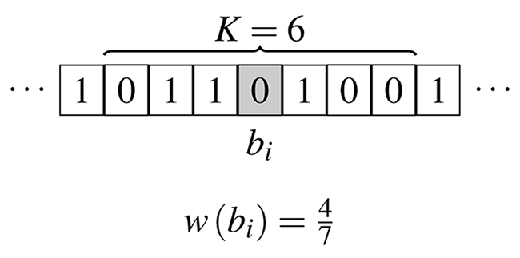
The reason why NK landscapes are useful for thinking about epistemic landscapes is that they allow one to model interdependencies between the various propositions believed (or not believed) by a scientist. That is, the fitness contribution of bi may depend on not just the value of bi (0 or 1) but the value of several other entries in the scientist’s overall belief state. The fitness function, in a word, may have varying degrees of epistasis. Let 0 ≤ K ≤ N denote the number of interdependencies contributing to the fitness contribution of bi. (See fig. 10 for an illustration of two different epistatic regions.) One can think of the amount of epistasis in a fitness function for an epistemic landscape as a formal model of the Quinean web of belief.
Two different regions of epistasis for the bit bi.

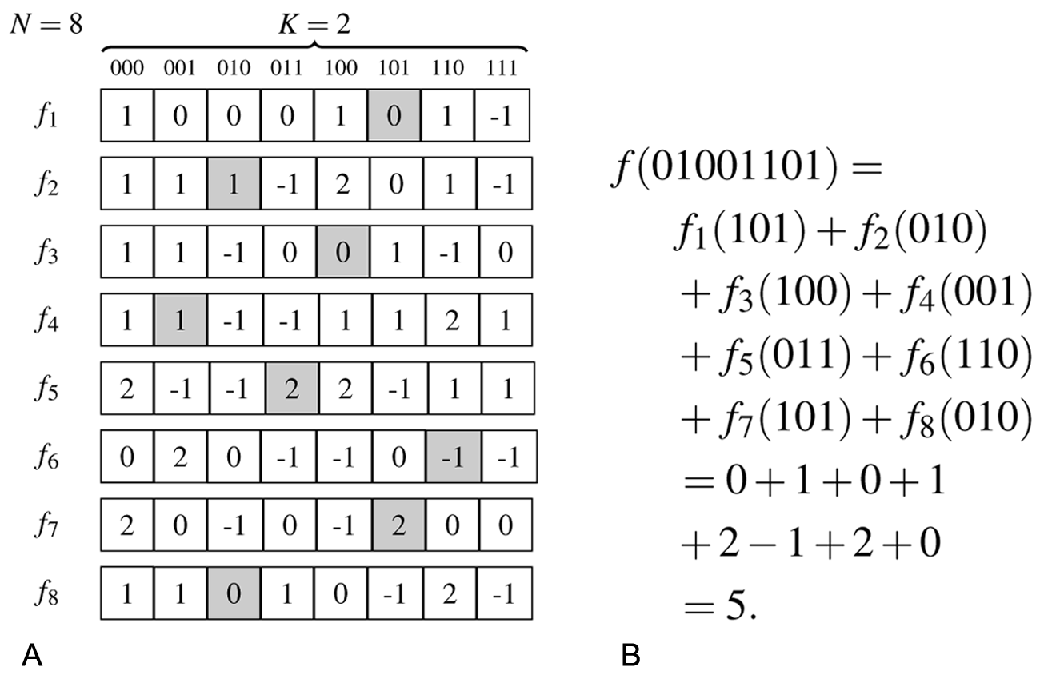
Figure 11 illustrates how the fitness of a belief vector is calculated for a bit string of length 8 and epistasis 2. The fitness function f is defined in terms of eight other functions f 1, … , f 8, where function fi is used to determine the fitness contribution of bit bi. Since the degree of epistasis is 2, the fitness of bit bi also depends on the values of b i−1 and b i+1 (where, at the end of the bit string, we wrap around the ends to avoid edge effects). The individual fitness functions f 1, … , f 8 are defined using the lookup table in figure 11A. In general, if N is the length of the bit string  , then

Although we consider, simply for reasons of simplicity, only two possible values for each bi (full belief or full denial), there is no reason why we could not allow more finely grained credal states. If we denote the number of credal states by A, then we see that the Weisberg-Muldoon epistemic landscape model is simply an NK landscape with N = 2, K = 2, and A = 101 and a particular fitness function. (See the appendix for further details regarding the calculation of fitness functions on NK landscapes.)
Applying a fitness function defined via a lookup table to a bit string. A, Lookup table for the fitness function f; B, applying the fitness function f to the bit string 01001101.

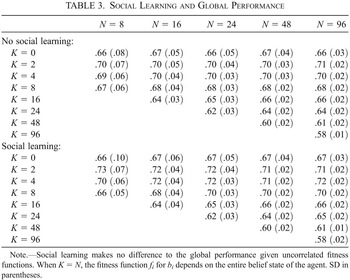
In order to see whether social learning and cognitive diversity help people reach the peak of greatest epistemic fitness on NK landscapes, let us consider—as a baseline result—how a single independent agent would fare. Assume that the agent searches via probe and adjust as follows. The agent starts with a randomly selected belief vector of length N. In each iteration, the agent probes one randomly selected belief by considering its alternate value (0 if 1, and 1 if 0). If changing that belief yields an overall increase in fitness, the agent keeps the change; if changing that belief decreased the fitness, the change is rejected. Table 3 illustrates the simulation results for a range of values of N and K. For each set of values of N and K, 100 simulations were performed, running for 1,000 iterations. Each simulation used a randomly generated uncorrelated fitness function.Footnote 21 The mean fitness over all simulations (and the standard deviation) are shown.

| N = 8 | N = 16 | N = 24 | N = 48 | N = 96 | |
|---|---|---|---|---|---|
| No social learning: | |||||
| K = 0 | .66 (.08) | .67 (.05) | .66 (.05) | .67 (.04) | .66 (.03) |
| K = 2 | .70 (.07) | .70 (.05) | .70 (.04) | .70 (.03) | .71 (.02) |
| K = 4 | .69 (.06) | .70 (.04) | .70 (.03) | .70 (.03) | .70 (.02) |
| K = 8 | .67 (.06) | .68 (.04) | .68 (.03) | .68 (.02) | .68 (.02) |
| K = 16 | .64 (.03) | .65 (.03) | .66 (.02) | .66 (.02) | |
| K = 24 | .62 (.03) | .64 (.02) | .64 (.02) | ||
| K = 48 | .60 (.02) | .61 (.02) | |||
| K = 96 | .58 (.01) | ||||
| Social learning: | |||||
| K = 0 | .66 (.10) | .67 (.06) | .67 (.05) | .67 (.04) | .67 (.03) |
| K = 2 | .73 (.07) | .72 (.04) | .72 (.04) | .71 (.02) | .71 (.02) |
| K = 4 | .70 (.06) | .72 (.04) | .72 (.03) | .71 (.02) | .72 (.02) |
| K = 8 | .66 (.05) | .68 (.04) | .70 (.03) | .70 (.02) | .70 (.02) |
| K = 16 | .64 (.04) | .65 (.03) | .66 (.02) | .66 (.02) | |
| K = 24 | .62 (.03) | .64 (.02) | .65 (.02) | ||
| K = 48 | .60 (.02) | .61 (.01) | |||
| K = 96 | .58 (.02) |
Note Social learning makes no difference to the global performance given uncorrelated fitness functions. When K = N, the fitness function fi for bi depends on the entire belief state of the agent. SD in parentheses.
Now consider the possibility of social learning. Suppose we have a population consisting of some fixed number of agents. At the end of each iteration, each individual polls every other. If agent M changed bi such that it yielded greater fitness to M, then all other agents incorporate that change.Footnote 22 As table 3 shows, social learning makes absolutely no difference in cases of uncorrelated fitness functions. Furthermore, social learning may actually be detrimental for the performance of the agents, given epistasis.Footnote 23
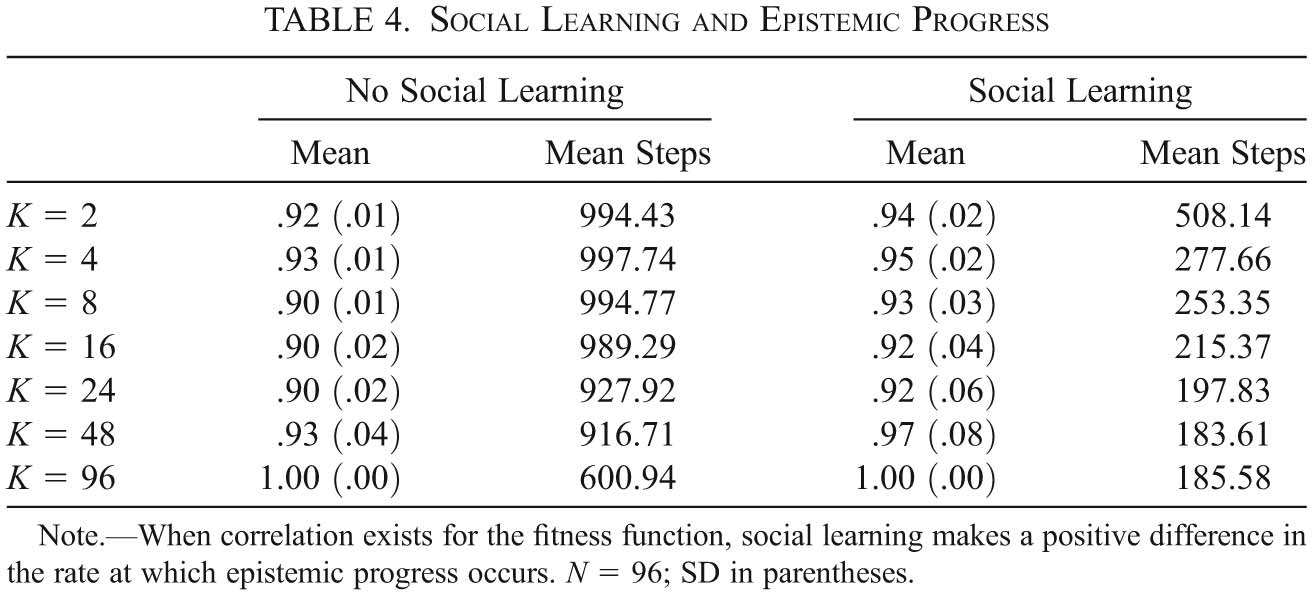
The crucial difference between the NK model just described and the Weisberg and Muldoon epistemic landscape is this. Expressed as an NK model, Weisberg and Muldoon’s model assumes fitness functions are highly correlated. Let us suppose, for the sake of argument, that the fitness function used is similarly highly correlated. In particular, assume that the fitness of bi is simply the relative frequency of the current value of bi in its epistatic region (see fig. 12). The results for simulations where the fitness functions are correlated in this way, as in table 4, show that, in this case, there is indeed a positive effect of social learning on the rate of epistemic progress.
Correlated fitness function. Local fitness of any bit bi is the relative frequency of the current value of bi = 1 in its epistatic region.


| No Social Learning | Social Learning | |||
|---|---|---|---|---|
| Mean | Mean Steps | Mean | Mean Steps | |
| K = 2 | .92 (.01) | 994.43 | .94 (.02) | 508.14 |
| K = 4 | .93 (.01) | 997.74 | .95 (.02) | 277.66 |
| K = 8 | .90 (.01) | 994.77 | .93 (.03) | 253.35 |
| K = 16 | .90 (.02) | 989.29 | .92 (.04) | 215.37 |
| K = 24 | .90 (.02) | 927.92 | .92 (.06) | 197.83 |
| K = 48 | .93 (.04) | 916.71 | .97 (.08) | 183.61 |
| K = 96 | 1.00 (.00) | 600.94 | 1.00 (.00) | 185.58 |
Note When correlation exists for the fitness function, social learning makes a positive difference in the rate at which epistemic progress occurs. N = 96; SD in parentheses.
Why does this matter? It matters because the Weisberg and Muldoon model builds into the basic topology of the epistemic landscape correlations that make social learning advantageous. As such, we should not be surprised to find, in the case they consider, that cognitive diversity and social interactions between agents can be beneficial. But, as the generalization to NK landscapes shows, social learning is not always beneficial. Whether social learning is beneficial or harmful depends on the topology of the epistemic landscape, a point of which we know very little. In some cases we might well suspect that social learning will be advantageous (e.g., Does the problem decompose into subproblems? Does the problem require a diverse set of skills possessed by no single individual?), but we cannot be sure that social learning will be advantageous because we will not know the epistemic landscape’s topology.
We stress this point because, although Weisberg and Muldoon acknowledge that “landscapes can be made more rugged, they can contain more information,” and so on, they suggest that some of their findings do, in fact, generalize. They state that “even with our current models and current landscape, we have observed a number of very interesting general trends about the division of cognitive labour.” What are some of these general trends? For one, that “followers seem very well suited for puzzle solving—the simple articulation of details of a paradigm. Mavericks can partially fulfill this role, but their search patterns through the epistemic landscape are not particularly well suited for the kind of long term analyses required, for example, to add one more decimal place to a known constant” (Reference Weisberg and Muldoon2009, 249). And also: “We have also seen that in mixed populations, mavericks can provide pathways for followers to find the base of the peaks on the epistemic landscape. Once the followers find these bases, they are reasonably efficient at finding the tops. And mavericks can also stimulate followers to engage in pure puzzle solving, ensuring that the landscape is fully explored to find hidden significant approaches. Therefore, mixed populations of mavericks and followers are valuable divisions of cognitive labor” (250). And, finally: “As we showed, individual mavericks find the peaks extraordinarily quickly and indeed the whole population converges rapidly on those peaks. This means that if one wants to search the landscape rapidly for the most significant truths, one should employ a population of mavericks, at least as opposed to followers or controls” (250, italics added).
Each of these claims would be uninteresting if “the [epistemic] landscape” only referred to the epistemic landscape modeled in the article. The reason why these claims are interesting is that they gesture toward general properties of scientific practice and suggest fruitful ways of organizing scientific research. Yet it only makes sense to say that one should employ a population of mavericks in cases where the epistemic landscape is such that the maverick strategy would be beneficial, and it is far from obvious that the maverick strategy will prove to be beneficial on an arbitrary epistemic landscape or when the model is adjusted to allow for greater realism by, say, incorporating observation error.Footnote 24 So, although the general trends have a certain degree of intuitive appeal, it is unclear to what extent these claims are, in general, justified by the Weisberg and Muldoon epistemic landscape model.
8. Conclusion
The Weisberg-Muldoon model has received a considerable amount of attention regarding its purported claim to show that there are epistemic reasons for the division of cognitive labor. In particular, Weisberg and Muldoon alleged to show that the “maverick” research strategy is far better than its competitors,Footnote 25 and one of the “general trends” (Reference Weisberg and Muldoon2009, 249) they observed is that “to be maximally effective, scientists need to really divide their cognitive labor” (227). We have argued that these two claims are not true. Maverick scientists do not perform far better than their competitors, such as the HE rule, once the implementation errors that handicapped the other search types have been corrected. By proper bookkeeping, we have shown that the increase in the performance of the mixed population is only due to the performance of the added mavericks. As for the benefits of cognitive diversity, we have constructed at least one other search strategy, the “swarm scientist,” which, in some cases, outperforms the maverick scientists.
In saying this, we do not wish to be understood as arguing that there are no epistemic reasons for cognitive diversity. We are simply pointing out that, despite its intuitive appeal, the Weisberg and Muldoon model does not succeed in showing that there are epistemic reasons for cognitive diversity. Furthermore, since so much in their methodology turns on assumptions regarding the specific nature of the epistemic landscape—something whose very nature is beyond our ken—we are skeptical as to whether their particular method of arguing for the epistemic benefits of cognitive diversity can ever succeed.
Appendix: Generating Uncorrelated Fitness Functions on Large NK Landscapes
Following Kauffman and Levin (Reference Kauffman and Levin1987), fix integers N and K such that 0 ≤ K ≤ N. The total fitness of a bit string b 1b 2 … bN is calculated using fitness functions f 1, … , fN, where fi is applied to bit bi and the surrounding region of epistasis consisting of the K bits flanking bi on the left and right. (To prevent edge effects, we assume the bit string wraps at the edges to ensure that all bits have regions of epistasis the same size.) For small N and K, the fitness function can be defined using a lookup table specifying all 2K+1 values for each of the N fitness functions, as shown in figure 11.
For large N and K, it is not feasible to define fitness functions using a lookup table. If N = 100 and K = 60, an uncorrelated fitness function would have 100 × 261 different values. However, it is possible to procedurally define an uncorrelated fitness function using a trick similar to that used by programmers of the 1984 video game Elite. (That game had to fit 8 different universes, each containing 256 planets with unique properties, into 16 kilobytes of memory.) We used a common 19937 Mersenne Twister RNG to procedurally generate the fitness functions.
Given fixed values of N, K with K < N, let S = (s 1, … , sN) be a list of N different salt values. Denote the region of epistasis around bit i at time t by  . The fitness contribution of bi at t is determined by seeding the RNG with the bits of
 (zeroing out the remaining bits in the state space of the RNG) and generating a random real number between 0 and 1. As long as the length of
 , we obtain a unique seed. This is because the state of the 19937 Mersenne Twister is 624 words, each with 32 bits, so there are 624 × 32 = 19,968 bits in the state. If the length of
 is sufficiently less than the length of the state space, the random value will be unique (and reproducible). This yields a completely uncorrelated fitness function.
Online Appendix
A, Partial foliation of the torus by a line with a rational slope. Notice that the line self-intersects. B, Partial foliation of the torus by the initial segment of a line with an irrational slope. Notice that the line fails to self-intersect and will densely cover the torus over repeated windings.

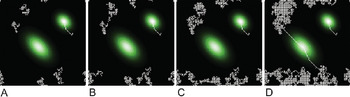
Epistemic search by 10 agents using the random walk strategy. One peak has been found after less than 50 steps. A, 50 iterations; B, 100 iterations; C, 200 iterations; D, 500 iterations.

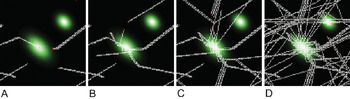
Epistemic search by 10 swarm agents in the flocking configuration. Notice that one peak has been found within 50 steps. A, 50 iterations; B, 100 iterations; C, 200 iterations; D, 500 iterations.

 and the minor radius a length of 1/2. The surface of the torus is equivalent to a rectangular lattice of height 1 and width
 that wraps at the edge. A line in the plane with a slope of
 (and hence irrational) will, when mapped onto the torus, self-intersect after three loops. However, if we take ‘irrational’ to mean ‘irrational with respect to the major and minor radii of the torus’, then the claim holds.
 groups that were randomly located in the desert. The radius for each group in which each agent was randomly placed is
 . To start the simulation without a pre-run to form stable swarms, all members of a group were given the same random heading.
 of
 , which has length K + 1. The fitness contribution of each of the possible
 arguments to fi is set to a randomly chosen value in [0, 1], drawn from the uniform distribution. With such an uncorrelated fitness function, knowledge of the values of the entries in the region of epistasis around some bi gives no information as to whether the 1-mutant neighbor will have greater or lower fitness than the current belief vector.