Borderline personality disorder (BPD) is characterized by interpersonal dysfunction, behavioral impulsivity, affective dysregulation, and identity disturbance. It is prevalent in an estimated 1% to 6% of the general adult population (Grant et al., Reference Grant, Chou, Goldstein, Huang, Stinson and Saha2008; Lenzenweger, Reference Lenzenweger2008; Torgersen, Kringlen, & Cramer, Reference Torgersen, Kringlen and Cramer2001). Clinically diagnosed BPD is costly economically (Bender et al., Reference Bender, Dolan, Skodol, Sanislow, Dyck and McGlashan2001; Zanarini, Jacoby, Frankenburg, Reich, & Fitzmaurice, Reference Zanarini, Jacoby, Frankenburg, Reich and Fitzmaurice2009) and entails intense inner pain and self-harming behavior that compromises patients' mental and physical well-being (Zanarini et al., Reference Zanarini, Frankenburg, Reich, Fitzmaurice, Weinberg and Gunderson2008; Zanarini, Frankenburg, Hennen, Reich, & Silk, Reference Zanarini, Frankenburg, Hennen, Reich and Silk2005). Recent research suggests that effective prevention and early intervention for BPD are possible, but improved means to identify children at risk are needed (Chanen, Jovev, McCutcheon, Jackson, & McGorry, Reference Chanen, Jovev, McCutcheon, Jackson and McGorry2008). A growing body of evidence indicates that borderline personality related characteristics (BPRCs) are present in children and that children who exhibit these characteristics are at elevated risk to develop BPD as adults (Bernstein et al., Reference Bernstein, Cohen, Velez, Schwabstone, Siever and Shinsato1993; Bornovalova, Hicks, Iacono, & McGue, Reference Bornovalova, Hicks, Iacono and McGue2009; Chabrol, Montovany, Chouicha, Callahan, & Mullet, Reference Chabrol, Montovany, Chouicha, Callahan and Mullet2001; Chanen, Jovev, & Jackson, Reference Chanen, Jovev and Jackson2007; Crick, Murray-Close, & Woods, Reference Crick, Murray-Close and Woods2005; Gratz et al., Reference Gratz, Tull, Reynolds, Bagge, Latzman and Daughters2009; Johnson et al., Reference Johnson, Cohen, Kasen, Skodol, Hamagami and Brook2000; Lewinsohn, Rohde, Seeley, & Klein, Reference Lewinsohn, Rohde, Seeley and Klein1997; Macfie & Swan, Reference Macfie and Swan2009; Winograd, Cohen, & Chen, Reference Winograd, Cohen and Chen2008). However, diagnosis of BPD for persons younger than age 18 years remains controversial and the clinical and theoretical significance of BPRCs in children is unclear. From a clinical perspective, it is important to know whether children who exhibit BPRCs share risk contexts or clinical features that could provide points of entry for risk assessment and preventative intervention or treatment. From a theoretical perspective, it is important to know how the phenomenon of BPRCs in childhood fits into current understandings of the developmental psychopathology of BPD and whether children who exhibit these characteristics should be a focus for etiological research.
The currently ascendant theories of BPD etiology are diathesis–stress theories that posit interaction between a child's genetic vulnerability and harsh treatment in the family environment (Crowell, Beauchaine, & Linehan, Reference Crowell, Beauchaine and Linehan2009; Fonagy, Target, & Gergely, Reference Fonagy, Target and Gergely2000; Gunderson & Lyons-Ruth, Reference Gunderson and Lyons-Ruth2008; Linehan, Reference Linehan1993; Paris, Reference Paris2005; Zanarini & Frankenburg, Reference Zanarini and Frankenburg2007). There is evidence that inherited and environmental factors each influence BPD etiology. Studies of psychiatric patients show BPD is familial (Zanarini, Barison, Frankenburg, Reich, & Hudson, Reference Zanarini, Barison, Frankenburg, Reich and Hudson2009) and studies of twin samples show it is heritable (Distel et al., Reference Distel, Trull, Derom, Thiery, Grimmer and Martin2008; Kendler et al., Reference Kendler, Aggen, Czajkowski, Roysamb, Tambs and Torgersen2008; Torgersen et al., Reference Torgersen, Lygren, Oien, Skre, Onstad and Edvardsen2000, Reference Torgersen, Czajkowski, Jacobson, Reichborn-Kjennerud, Roysamb and Neale2008). Correspondingly, retrospective and prospective studies link BPD in adulthood with harsh treatment early in life (Battle et al., Reference Battle, Shea, Johnson, Yen, Zlotnick and Zanarini2004; Bradley, Jenei, & Westen, Reference Bradley, Jenei and Westen2005; Carlson, Egeland, & Sroufe, Reference Carlson, Egeland and Sroufe2009; Crawford, Cohen, Chen, Anglin, & Ehrensaft, Reference Crawford, Cohen, Chen, Anglin and Ehrensaft2009; Johnson, Cohen, Chen, Kasen, & Brook, Reference Johnson, Cohen, Chen, Kasen and Brook2006; Reich & Zanarini, Reference Reich and Zanarini2001; Zanarini et al., Reference Zanarini, Williams, Lewis, Reich, Vera and Marino1997). Parallel findings are beginning to emerge from studies of BPRCs in samples of children (Bornovalova et al., Reference Bornovalova, Hicks, Iacono and McGue2009; Crawford et al., Reference Crawford, Cohen, Chen, Anglin and Ehrensaft2009). Research that extends these findings to test diathesis–stress theories of borderline etiology is needed.
A gap in the scientific literature is research that (a) establishes environmental mediation of the pathway from harsh childhood treatment to BPRCs and (b) directly evaluates the diathesis–stress model of borderline etiology by testing for interaction between inherited risk and harsh treatment. A strong test of the diathesis–stress model requires a prospective longitudinal design with measures of familial liability, measures of harsh treatment during childhood, and measures of early-emerging BPRCs soon thereafter.
In this study, we investigate whether the etiology of BPRCs in children is consistent with the dominant theoretical models of the etiology of BPD in adults. We describe antecedents and comorbidities of BPRCs in a cohort of twin children followed prospectively from age 5 to age 12 years and we test the independent and interactive contributions of inherited and environmental risk factors identified in theoretical models and empirical studies of borderline etiology. First, we describe the heritability, cognitive, behavioral, and affective antecedents, and psychiatric comorbidities of BPRCs to evaluate their correspondence with findings from adult samples. Specifically, we address three questions:
Aim 1.1: Are BPRCs in childhood heritable? We exploited the twin design of our sample to estimate the genetic contribution to children's BPRCs.
Aim 1.2: Are BPRCs in childhood preceded by poor cognitive function and behavioral and affective dysregulation earlier in life? We exploited the prospective design of our sample to test relationships between children's IQ, executive function, theory of mind, temperament, impulsivity, externalizing problems and internalizing problems measured at age 5 years and their BPRCs measured at age 12 years.
Aim 1.3: Are BPRCs in childhood accompanied by other psychiatric symptoms? We asked if symptoms of conduct disorder, depression, anxiety, and psychosis were more common among 12-year-olds who exhibited BPRCs.
Second, we test hypotheses that address diathesis–stress interaction in the etiology of BPRCs.
Aim 2.1: To test the hypothesis that harsh treatment during childhood contributes to the etiology of BPRCs, we tested associations between a child's experience of physical maltreatment and maternal negative expressed emotion before age 10 years and his/her BPRCs at age 12 years. We used comparisons of twins within families to rule out the confounding effects of family background factors (e.g., social class) and children's genotypes.
Aim 2.2: To test the hypothesis that an inherited diathesis interacts with harsh treatment during childhood in the etiology of BPRCs, we tested for interaction between a child's family history of psychiatric disorder and his/her exposure to harsh treatment in a series of models predicting the child's BPRCs at age 12 years. If the diathesis–stress model of BPD etiology applies to BPRCs in children, those who experience harsh treatment will be especially likely to exhibit BPRCs if they also have a positive family psychiatric history.
Methods
Sample
Participants were members of the Environmental Risk (E-Risk) Longitudinal Twin Study, which tracks the development of a nationally representative birth cohort of 2,232 British children. The sample was selected from a larger birth register of twins born in England and Wales in 1994–1995 (Trouton, Spinath, & Plomin, Reference Trouton, Spinath and Plomin2002). Details about the sample have been reported previously (Moffitt & E-Risk Team, Reference Moffitt2002). Briefly, the E-Risk sample was constructed in 1999–2000, when 1,116 families with same-sex 5-year-old twins participated in home-visit assessments (93% of eligible families; 54% of twin pairs were monozygotic and 51% were female). Families were recruited to represent the UK population of families with newborns in the 1990s, based on residential location throughout England and Wales and mother's age (i.e., older mothers having twins via assisted reproduction were underselected and teenaged mothers with twins were overselected). We used this sampling to replace high-risk families who were selectively lost to the register via nonresponse and to ensure sufficient numbers of children growing up in high-risk environments. Follow-ups were conducted when the children were aged 7 years (98% participation), 10 years (96% participation) and, most recently, 12 years (96% participation). Parents gave informed consent and children gave assent. Ethical approval was granted by the Joint South London and Maudsley and the Institute of Psychiatry Research Ethics Committee.
Measures
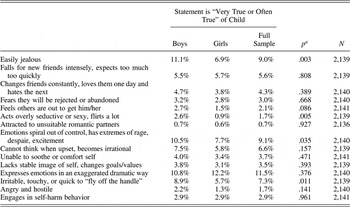
BPRCs at age 12 years were assessed during interviews with mothers when the children were age 12 years. Mothers responded to questions from a dimensional assessment of BPRCs derived from the Shedler–Westen Assessment Procedure 200-item Q-Sort for Adolescents (SWAP-200-A; Westen, Shedler, Durrett, Glass, & Martens, Reference Westen, Shedler, Durrett, Glass and Martens2003). Items in the SWAP-200-A borderline assessment were selected from the set of SWAP-200-A items most commonly used by a sample of 294 doctoral-level clinicians to describe adolescent patients meeting DSM-IV diagnostic criteria for adult BPD (Bradley, Zittel Conklin, & Westen, Reference Bradley, Zittel Conklin and Westen2005). The items reflect the three core features of adult BPD: affective instability/dysregulation, impulsivity/behavioral dysregulation, and disturbed relatedness/interpersonal dysfunction (Gunderson, Reference Gunderson2009; Lieb, Zanarini, Schmahl, Linehan, & Bohus, Reference Lieb, Zanarini, Schmahl, Linehan and Bohus2004; Sanislow et al., Reference Sanislow, Little, Ansell, Grilo, Daversa and Markowitz2009). We selected items that did not overlap with scales in the Achenbach System of Empirically Based Assessment (Achenbach, Reference Achenbach2009) or symptom criteria for other childhood disorders. Table 1 shows the 15 items and their response frequencies. Sex differences were observed in 4 of 15 items.
Caregiver ratings of borderline personality related characteristics scale items for boys and girls

Note: Items were selected that did not overlap with Achenbach System of Empirically Based Assessment scales or symptom criteria for other childhood disorders. Self-harm was coded as present/absent on the basis of interviews with mothers during home visits. Self-harm was excluded from the scale for the analysis predicting self-harm and was included in the scale in all other anlayses. Differences in response patterns by child sex were evaluated using logistic regression. Standard errors were adjusted to account for nonindependence of twin data.
aThe value for test of sex difference.
We constructed a dimensional scale of BPRCs by summing positive responses to the 15 questions; internal consistency reliability (Cronbach α) was 0.86. We also generated a dichotomous measure identifying the group of children at the extreme end of the borderline dimension (the extreme borderline group) by identifying children at or above the 95th percentile of the quantitative symptom scale (N = 122, 5.7% of the sample). The 5% (or 2 SD) cutoff is consistent with previous approaches to identifying “clinically significant” borderline pathology using a dimensional measure (Winograd et al., Reference Winograd, Cohen and Chen2008), falls within the range of prevalence estimates reported for clinically significant borderline pathology in adolescents (Bernstein et al., Reference Bernstein, Cohen, Velez, Schwabstone, Siever and Shinsato1993; Chabrol et al., Reference Chabrol, Montovany, Chouicha, Callahan and Mullet2001; Lewinsohn et al., Reference Lewinsohn, Rohde, Seeley and Klein1997), and is consistent with the most recent estimates of the prevalence of BPD in adults in the community (Grant et al., Reference Grant, Chou, Goldstein, Huang, Stinson and Saha2008). The dimensional and dichotomous measures were characterized by modest sex differences. Compared to girls, boys exhibited more BPRCs (boys, mean = 4.50, SD = 4.77; girls, mean = 4.00, SD = 4.29; t = 2.09, p = .037) and were more likely to be in the extreme borderline group (6.8% of boys vs. 4.6% of girls, p = .052). Although BPD is thought to be more prevalent in women compared to men, studies of borderline personality in community-based samples of children and adults often find no difference between the sexes (Bernstein et al., Reference Bernstein, Cohen, Velez, Schwabstone, Siever and Shinsato1993; Chabrol et al., Reference Chabrol, Montovany, Duconge, Kallmeyer, Mullet and Leichsenring2004; Gratz et al., Reference Gratz, Tull, Reynolds, Bagge, Latzman and Daughters2009; Lenzenweger, Lane, Loranger, & Kessler, Reference Lenzenweger, Lane, Loranger and Kessler2007; Torgersen et al., Reference Torgersen, Kringlen and Cramer2001). Differences in BPRCs between boys and girls in our sample are small, in keeping with this literature.
To establish the incremental predictive validity of our measure of BPRCs, we tested the relationship between children's BPRCs and their self-harm behavior. Self-harm is especially characteristic of BPD (Skodol, Gunderson, et al., Reference Skodol, Gunderson, Pfohl, Widiger, Livesley and Siever2002), but is also associated with more general emotional and behavioral problems (Lewinsohn, Rohde, & Seeley, Reference Lewinsohn, Rohde and Seeley1993). Our analysis tested whether children's BPRCs predicted self-harm that was not explained by their emotional and behavioral problems at the same age: we regressed self-harm on BPRCs while statistically controlling for mothers' Achenbach System of Empirically Based Assessment (Achenbach, Reference Achenbach2009) ratings of their children's internalizing and externalizing problems. For these analyses only, the borderline phenotype was measured without self-harm as part of the scale. Children in the extreme borderline group and those with more BPRCs (excluding self-harm) more often engaged in self-harm, net of risk attributable to their emotional and behavioral problems (odds ratio [OR] = 6.84, 95% confidence interval [CI] = 2.39–19.61, p < .001 for borderline group membership; OR = 1.13, 95% CI = 1.02–1.25, p = .022 for BPRCs). This result supports the validity of our measure of BPRCs.
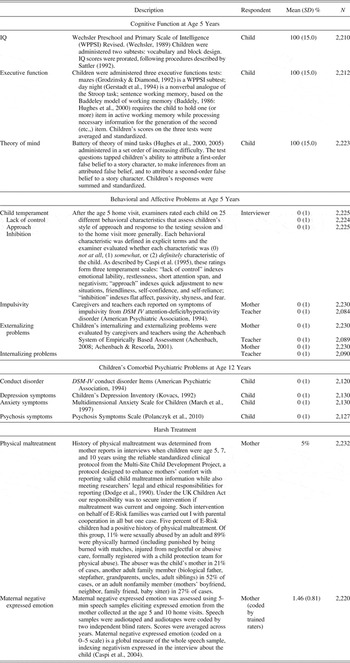
Children's cognitive function and behavioral and affective problems at age 5 years were assessed through direct testing of children, mothers' reports to home visitors, and by teachers' reports to postal questionnaires. Detailed descriptions of these measures are included in Table 2.
Measures of children's cognitive function and behavioral and affective problems at age 5 years and comorbid psychiatric problems at age 12 years

Children's comorbid psychiatric problems at age 12 years were assessed through children's reports of their own symptoms of conduct disorder, depression, anxiety, and psychosis. Detailed descriptions of these measures are included in Table 2.
Measures of harsh treatment included (a) the child's history of physical maltreatment through age 10 years obtained in interviews with mothers when children were ages 5, 7, and 10 years and (b) measurements of maternal negative expressed emotion, assessed from speech samples of children's mothers collected during home visits when children were ages 5 and 10 years. Detailed descriptions of these 2 measures are included in Table 2.
Children's family histories of psychiatric disorder were ascertained at the age-12 assessment from reports by biological parents following a standardized and valid protocol (Milne, Caspi, Crump, et al., Reference Milne, Caspi, Crump, Poulton, Rutter and Sears2009; Milne et al., Reference Milne, Moffitt, Crump, Poulton, Rutter and Sears2008). Family history of psychiatric disorder (hereafter “positive family history”) was defined as a report of hospitalization for psychiatric disorder or substance-use problem, or attempted or completed suicide for any of the child's biological mother, father, grandparents, or aunts and uncles. Thirty-one percent of the 2140 children for whom a biological parent reported family information had a positive family history.
Statistical analyses
Descriptive analyses
To describe antecedents and comorbidities of BPRCs in childhood, we began by using biometric modeling in MPlus (Muthén & Muthén, Reference Muthén and Muthén1998–Reference Muthén and Muthén2009) to test the heritability of children's BPRCs (Aim 1.1). Next, using regression analyses, we tested whether children with BPRCs at age 12 years differed from comparison children in their cognitive functioning and behavioral and affective problems at age 5 years (Aim 1.2). Finally, using regression analyses, we tested whether children with BPRCs had more co-occurring psychiatric symptoms than comparison children (Aim 1.3).
Testing for association between harsh treatment and BPRCs (Aim 2.1)
We tested whether children's history of harsh treatment (i.e., physical maltreatment, maternal negative expressed emotion) through age 10 years predicted their BPRCs at age 12 years. Because associations between harsh treatment and BPRCs could be confounded by features of the family environment (e.g., social class, family structure) that caused children to experience harsh treatment and to exhibit BPRCs, we subjected these longitudinal associations to the acid test of a twin-difference analysis. This analysis compared the twins in a family to determine whether the twin who received harsher treatment exhibited more BPRCs relative to his/her age and sex-matched co-twin. Because comparisons were made within families, associations could not be confounded by common causes in the family environment. In a further attempt to rule out confounding that could arise from gene–environment correlations in which the same inherited factor caused parents to treat children harshly and children to develop BPRCs, we repeated the the twin-difference analysis restricting our sample to only the monozygotic (MZ) twin pairs. Because MZ twins share nearly all of their genomes, the MZ twin difference design rules out genetic and family-level confounds.
Testing for interaction between family psychiatric history and harsh treatment in the etiology of BPRCs (Aim 2.2)
We tested whether children's experiences of harsh treatment placed them at especially increased risk to develop BPRCs if they had a positive family psychiatric history. Analyses that considered the dimensional BPRCs scale score used a linear regression model including main-effect terms for family history and harsh treatment and a product term representing the interaction between these two main effects.
We repeated our twin difference acid test for the interaction analyses. In tests of interaction, the twin difference analysis asks: are differences between twins in harsh treatment stronger predictors of differences between twins in BPRCs if the family has a positive psychiatric history? A twin difference interaction analysis rules out the possibility that a spurious interaction could arise because families with positive psychiatric history differed from those with no psychiatric history in ways that caused parents to treat children harshly and caused children to develop BPRCs. To rule out the possibility that a spurious interaction could arise from skewed distributions of the variables in a model, we replicated analyses using log transformations of continuous measures.
To ensure results were robust to measurement scale, we also tested for interaction predicting the dichotomous outcome of extreme borderline group membership. We defined interaction as the epidemiological construct of biological synergy (Berenbaum, Reference Berenbaum1989; Rothman, Greenland, & Walker, Reference Rothman, Greenland and Walker1980), in which the effect of two risk factors present together is greater than the sum of their independent effects. We tested diathesis–stress interaction using the 2 × 4 table method to compare relative risks (RR) among children with different combinations of exposures to positive family psychiatric history and exposures to harsh treatment. This method is recommended for investigations of diathesis–stress interaction with dichotomous outcomes (Botto & Khoury, Reference Botto and Khoury2001; Schwartz, Reference Schwartz2006). In the 2 × 4 table method, interaction was tested as “departure from additivity” (here, if the risk ratio for children with both risk factors was greater than the sum of risk ratios for children with either risk factor independently). We estimated confidence intervals for departures from additivity calculated from the 2 × 4 table by bootstrapping. Because the 2 × 4 table method requires dichotomization of continuous treatment measures, we dichotomized maternal negative expressed emotion at the 80th percentile value (scale score = 2.5). Results were verified using the original (continuous) measure of negative expressed emotion using the BINREG procedure in STATA. BINREG fits a generalized linear model adapted to the binomial family to estimate risk differences and has been used to test interaction in the etiology of categorical psychiatric phenotypes (van Os, Hanssen, Bak, Bijl, & Vollebergh, Reference van Os, Hanssen, Bak, Bijl and Vollebergh2003).
Analyses were conducted using STATA 10.0 (StataCorp, 2009). Twin-difference analyses were implemented using a family-level fixed-effects regression model (Madsen & Osler, Reference Madsen and Osler2009). Standard errors were adjusted to account for nonindependence of twin data in models that did not explicitly incorporate the data set's twin design (Williams, Reference Williams2000).
Results
Descriptive analyses
Aim 1.1: Are BPRCs in childhood heritable? The correlation between twins on the BPRCs scale was 0.66 among MZ twins and 0.29 among dizotic (DZ) twins. Biometric modeling estimated that genetic factors accounted for 66% (95% CI = 62%–70%) of the variance in BPRCs. The probandwise concordance rate (McGue, Reference McGue1992) for extreme borderline group membership, that is, the probability that a twin would be in the extreme group conditional on their co-twin being in that group, was 52% for MZ twins and 7% for DZ twins. The greater concordance rate for MZ compared to DZ twin pairs indicates that genetic factors contributed to twins' BPRCs.
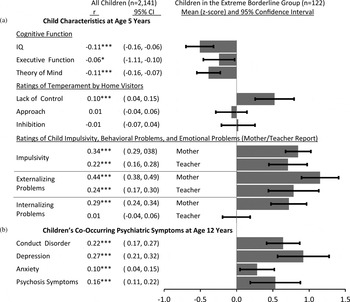
Aim 1.2: Are BPRCs in childhood preceded by poor cognitive function and behavioral and affective dysregulation earlier in life? Consistent with research showing impaired cognitive function, heightened impulsivity, and behavioral and affective dysregulation among adults meeting diagnostic criteria for BPD (Grant et al., Reference Grant, Chou, Goldstein, Huang, Stinson and Saha2008; Judd, Reference Judd2005), children in the extreme borderline group and who exhibited more BPRCs at age 12 years had lower IQs and less well developed theory of mind, lacked self-control, and had high levels of impulsivity and externalizing and internalizing problems at age 5 years (Figure 1a).
Psychiatric antecedents and comorbidities of borderline personality related characteristics in 12-year-old children: correlations with the Dimensional Borderline Scale and deviations from sample means (z scores) for children in the extreme borderline group. (Left) Correlations were estimated as standardized coefficients from regressions of the continuous scales measuring psychiatric antecedents and comorbidities on the dimensional measure of borderline personality related characteristics. *p < .05, ***p < .001. (Right) The graphs depict means (z scores) and 95% confidence intervals for the psychiatric antecedents and comorbidities among children in the extreme borderline group. The sample mean is represented by zero. The y axis measures standard deviations from the mean. All estimates were adjusted for the nonindependence of twin data.

Aim 1.3: Are BPRCs in childhood accompanied by other psychiatric symptoms? Children in the extreme borderline group and who exhibited more BPRCs at age 12 years reported more symptoms of other psychiatric problems, particularly depression, but also conduct disorder, psychosis, and anxiety (Figure 1b).
Hypothesis tests
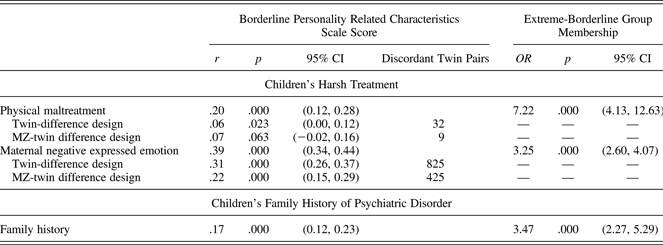
Aim 2.1: Harsh treatment during childhood contributes to the etiology of BPRCs. Children's exposure to harsh treatment before age 10 years predicted their BPRCs at age 12 years. Parallel findings were observed for both measures of harsh treatment: physical maltreatment and maternal negative expressed emotion (Table 3).
Tests of children's harsh treatment prior to age 10 years and family history of psychiatric disorder as risk factors for borderline personality related characteristics at age 12 years
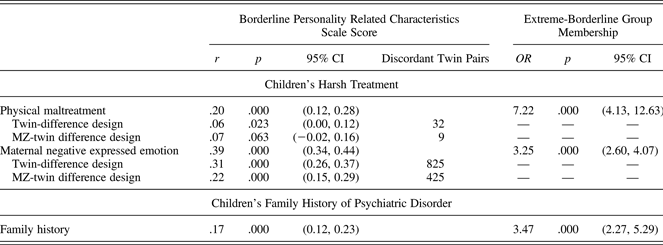
Note: Odds ratios (OR) were estimated with logistic regression models. Effect size correlations (Pearson r) were estimated as standardized regression coefficients from ordinary least squares and, in the case of twin-difference analyses, fixed effects regression models. Twin difference analyses could not be conducted for extreme borderline group membership because most twins were in the same group on that outcome. Standard errors in logistic and ordinary least squares regression models were adjusted for nonindependence of twin data. CI, confidence interval; MZ, monozygotic.
Children with a history of physical maltreatment exhibited more BPRCs (r = .20, p < .001). This association remained statistically significant in a twin difference design, which controlled for unmeasured family-level confounds. Compared to his/her nonmaltreated co-twin, the maltreated twin exhibited more BPRCs, although the effect size was small (r = .06, p = .023). A similar effect size was observed using an MZ twin difference design, which controlled genetic and family-level confounds, although too few twin pairs were discordant for maltreatment for the effect to reach statistical significance (r = .07, p = .063). Children with a history of physical maltreatment were also more likely to be in the extreme borderline group (OR = 7.22, 95% CI = 1.13, 12.63). Twin difference analyses could not be conducted for extreme borderline group membership because most co-twins were in the same group on that outcome.
Children exposed to greater maternal negative expressed emotion exhibited more BPRCs (r = .39, p < .001). This association remained statistically significant in twin difference and MZ twin difference analyses (r = .31 and r = .22, respectively, p < .001 for both tests). Children exposed to greater maternal negative expressed emotion were also more likely to be in the extreme borderline group (OR = 3.25, 95% CI = 2.60, 4.07).
Aim 2.2: Family history interacts with harsh treatment in the etiology of BPRCs. Family history of psychiatric disorder constituted a significant diathesis for the development of BPRCs; children with positive family histories exhibited more BPRCs (r = .17, p < .001) and were more likely to be in the extreme borderline group (OR = 3.47, 95% CI = 2.27, 5.29; Table 3). Family history can establish familiality, but it cannot distinguish the source of this effect, that is, whether it is genetic or environmental. Modified Sobel–Goodman tests of mediation (Preacher & Hayes, Reference Preacher and Hayes2008) estimated that physical maltreatment mediated 9% of the family history–BPRCs association, maternal negative expressed emotion mediated 16% of the family history–BPRCs association. This suggests that family psychiatric history communicates risk for BPRCs even in the absence of harsh treatment.
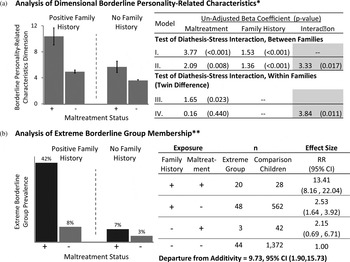
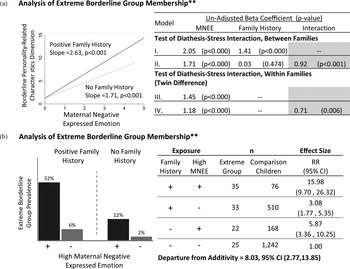
We observed evidence of diathesis–stress interaction in borderline etiology between family psychiatric history and harsh treatment. Children who experienced harsh treatment were at greater risk of developing BPRCs if they had a positive family psychiatric history. Parallel findings were observed for physical maltreatment (Figure 2) and for maternal negative expressed emotion (Figure 3). Findings were consistent across analyses of dimensional BPRCs (Figures 2a and 3a) and dichotomous extreme borderline group membership (Figures 2b and 3b), as described next.
Diathesis–stress interaction between family history of psychiatric disorder and physical maltreatment. The figure shows (a) the diathesis–stress interaction in the analyses of the dimensional outcome of borderline personality related characteristics and (b) the dichotomous outcome of extreme borderline group. The convergence between these analyses indicates the interaction is not an artifact of measurement scale. (a) *Error bars in the graph represent standard errors of means, adjusted for nonindependence of twin data. Model I is an ordinary least-squares regression of borderline personality related characteristics on physical maltreatment and family history. Model II adds an interaction between family history and maltreatment. Model III is a twin-difference analysis. A family history coefficient cannot be estimated in a twin-difference analysis, which controls for this and all other family-level factors, child sex, and child age. Model IV is a twin difference analysis including the interaction between family history and maltreatment. The interaction term from this model indexes the degree to which a difference between twins in maltreatment status is a stronger predictor of the difference between those twins in borderline symptoms in families with positive psychiatric history. Standard errors in models I and II were adjusted to account for nonindependence of twin data. Twelve of the 32 twin pairs discordant for maltreatment had positive family history of psychiatric disorder. (b) The analysis of the extreme borderline group membership. (** + +) Children with both risk factors, (+− ) children with positive family history only, (−+ ) children with maltreatment only, (− −) children with neither risk factor; risk ratios calculated relative to children with neither risk factor. Departure from additivity = relative risk (RR)[++ ] − (RR[+− ] + RR[−+ ] − 1). Ninety-five percent confidence intervals were adjusted for nonindependence of twin data. Confidence interval for departure from additivity estimated from 1000 bootstrap repetitions.

Diathesis–stress interaction between family history of psychiatric disorder and maternal negative expressed emotion. The figure shows (a) the diathesis–stress interaction in analyses of the dimensional outcome of borderline personality related characteristics and (b) the dichotomous outcome of extreme borderline group. The convergence between these analyses indicates the interaction is not an artifact of measurement scale. (a) *Slopes reflect coefficients estimated from ordinary least-squares regression. Model I is an ordinary least-squares regression of borderline personality related characteristics on maternal negative expressed emotion and family history. Model II adds an interaction between family history and maternal negative expressed emotion to the model. Model III is a twin difference analysis. A family history coefficient cannot be estimated in a twin-difference analysis, which controls for this and all other family-level factors, child sex, and child age. Model IV is a twin difference analysis including the interaction between family history and maternal negative expressed emotion. The interaction term from this model indexes the degree to which a difference between twins in maternal negative expressed emotion is a stronger predictor of the difference between those twins in borderline symptoms in families with positive psychiatric history. Standard errors in Models I and II were adjusted to account for nonindependence of twin data. A total of 252 of 825 twin pairs discordant for maternal negative expressed emotion had positive family history of psychiatric disorder. (b) (** ++ ) Children with both risk factors, (+− ) children with positive family history only, (−+ ) children exposed to high negative expressed emotion only, (− −) children with neither risk factor; risk ratios calculated relative to children with neither risk factor. Departure from additivity = relative risk (RR)[++ ] − (RR[+− ] + RR[−+ ] − 1). Ninety-five percent confidence intervals were adjusted for nonindependence of twin data. The confidence interval for the departure from additivity was estimated from 100 bootstrap repetitions.

Figure 2 depicts diathesis–stress interaction between family history and physical maltreatment. Figure 2a presents analyses of the dimensional BPRCs. The left side of Figure 2a shows mean BPRCs scale scores as a function of maltreatment among children with positive family history and among children with no family history. The right side of Figure 2a presents results of regression analyses of diathesis–stress interaction. We observed a significant interaction between family history and maltreatment (p = .017, Model II). We replicated this analysis using a twin difference design. The twin who was maltreated exhibited more BPRCs relative to their age- and sex-matched co-twin, and this sibling difference was wider in families with a positive psychiatric history (p = .011, Model IV). We obtained comparable results when these models were tested using a log-transformation of the BPRC scale score as the dependent variable (not shown). Figure 2b presents analyses of the dichotomous outcome of extreme borderline group membership. The left side of Figure 2b shows extreme borderline group prevalence as a function of maltreatment among children with positive family history and among children with no family history. The right side of Figure 2b shows the 2 × 4 analysis of diathesis–stress interaction. This analysis presents the number of extreme borderline group and comparison children in four groups of children defined by family history (positive/negative) and physical maltreatment (positive/negative). Children with both risk factors were 13.41 (95% CI = 8.61, 22.04) times more likely to be in the extreme borderline group than were children with neither risk factor. In contrast, children with only positive family history were only 2.53 (95% CI = 1.64, 3.92) times more likely and children with only maltreatment were only 2.15 (95% CI = 0.69, 6.71) times more likely to be in the extreme borderline group relative to children with neither risk factor. Analysis of diathesis–stress interaction showed a significant departure from additivity of 9.73 (95% CI = 1.90, 15.73), indicating that there is a significant interaction between diathesis and stress. We obtained comparable results from a test of interaction using the BINREG procedure in STATA (not shown).
Figure 3 depicts diathesis–stress interaction between family history and maternal negative expressed emotion. Figure 3a presents analyses of the dimensional BPRCs. The left side of Figure 3a shows a graph of predicted slopes for BPRCs as a function of negative expressed emotion among children with positive family history and among children with no family history. The right side of Figure 3a presents regression analyses of diathesis-stress interaction. We observed a significant interaction between family history and negative expressed emotion (p = .001, Model II). This finding was replicated in the twin difference analysis (p = .006, Model IV). We obtained comparable results when these models were tested using a log-transformation of the BPRCs scale score as the dependent variable and when our measure of maternal negative expressed emotion was also log-transformed (not shown). Figure 3b shows analyses of the dichotomous outcome of extreme borderline group membership. The 2 × 4 analysis of diathesis–stress interaction in Figure 3b shows a significant departure from additivity of 8.03 (95% CI = 2.77, 13.85), indicating a significant interaction between diathesis and stress. We obtained comparable results from a test of interaction using the BINREG procedure in STATA (not shown).
Discussion
We investigated the etiology of BPRCs in a birth cohort of twins ascertained from the general population and studied from age 5 to 12 years. Results are consistent with previous prospective studies of adult BPD and support previously untested theoretical models of diathesis–stress interaction in borderline etiology. Our clinical description of BPRCs overlaps with characterizations of childhood BPD by earlier theorists (Bemporad, Smith, Hanson, & Cicchetti, Reference Bemporad, Smith, Hanson and Cicchetti1982), including heterogeneous cognitive deficits, intermittent losses of reality testing, poor functioning in response to stress, inability to contain or manage anxiety, and episodic behavioral dyscontrol. Our clinical description of BPRCs is also consistent with findings from previous empirical studies of BPRCs in children (Carlson et al., Reference Carlson, Egeland and Sroufe2009; Chanen et al., Reference Chanen, Jovev and Jackson2007; Crick et al., Reference Crick, Murray-Close and Woods2005).
BPRCs at age 12 years were heritable within the range of estimates reported for adult BPD (Distel et al., Reference Distel, Trull, Derom, Thiery, Grimmer and Martin2008; Torgersen et al., Reference Torgersen, Lygren, Oien, Skre, Onstad and Edvardsen2000) and were preceded by poor cognitive function and behavioral and affective dysregulation at age 5 years. This profile is consistent with findings from retrospective studies of adults with BPD (Grant et al., Reference Grant, Chou, Goldstein, Huang, Stinson and Saha2008; Judd, Reference Judd2005), studies of BPRCs in adolescent clinical and community samples (Chanen et al., Reference Chanen, Jovev and Jackson2007; Crick et al., Reference Crick, Murray-Close and Woods2005; Gratz et al., Reference Gratz, Tull, Reynolds, Bagge, Latzman and Daughters2009; Paris, Zelkowitz, Guzder, Joseph, & Feldman, Reference Paris, Zelkowitz, Guzder, Joseph and Feldman1999), and prospective studies that include observations of children's psychological functioning and their borderline outcomes in adulthood (Bornovalova et al., Reference Bornovalova, Hicks, Iacono and McGue2009; Carlson et al., Reference Carlson, Egeland and Sroufe2009; Crawford et al., Reference Crawford, Cohen, Chen, Anglin and Ehrensaft2009). Consistent also with etiological research on child and adult borderline personality (Battle et al., Reference Battle, Shea, Johnson, Yen, Zlotnick and Zanarini2004; Carlson et al., Reference Carlson, Egeland and Sroufe2009; Crawford et al., Reference Crawford, Cohen, Chen, Anglin and Ehrensaft2009; Guzder, Paris, Zelkowitz, & Feldman, Reference Guzder, Paris, Zelkowitz and Feldman1999; Guzder, Paris, Zelkowitz, & Marchessault, Reference Guzder, Paris, Zelkowitz and Marchessault1996; Johnson et al., Reference Johnson, Cohen, Chen, Kasen and Brook2006; Zanarini, Reference Zanarini2000), children in our study who were exposed to harsh treatment earlier in life exhibited more BPRCs at age 12 years. This finding survived our “acid-test” of twin difference and MZ twin difference analyses, indicating that the association was specific to children's personal experiences of harsh treatment (i.e., not attributable to features of their families that were shared with their co-twins) and was environmentally mediated (i.e., not attributable to gene–environment correlation): children who were physically maltreated or exposed to greater maternal negative expressed emotion developed more BPRCs compared to peers, co-twins, and genetically identical co-twins who were treated less harshly. Moreover, children were especially vulnerable to developing BPRCs following experiences of harsh treatment if they carried a positive family history of psychiatric disorder. In analyses of dimensional and dichotomous measures of BPRCs and using comparisons of peers and of co-twins, risk from a history of physical maltreatment and from exposure to maternal negative expressed emotion was greater for children with positive family psychiatric history. Consistent with diathesis–stress theories of borderline etiology (Crowell et al., Reference Crowell, Beauchaine, McCauley, Smith, Stevens and Sylvers2005; Fonagy et al., Reference Fonagy, Target and Gergely2000; Gunderson & Lyons-Ruth, Reference Gunderson and Lyons-Ruth2008; Linehan, Reference Linehan1993; Paris, Reference Paris2005; Zanarini & Frankenburg, Reference Zanarini and Frankenburg2007), inherited liability and harsh treatment both contributed to BPRCs, and each acted as a more virulent risk factor in the presence of the other.
Our findings have implications for theory, research, and clinical practice, and provide support for developmental theories of borderline etiology (Crowell et al., Reference Crowell, Beauchaine, McCauley, Smith, Stevens and Sylvers2005; Fonagy & Bateman, Reference Fonagy and Bateman2008; Gunderson & Lyons-Ruth, Reference Gunderson and Lyons-Ruth2008). With respect to theory, two interesting findings emerge. First, consistent with the assumption of an attachment-specific dysfunction in BPD, BPRCs were associated with physical maltreatment as well as maternal negative expressed emotion. Other prospective longitudinal studies (Carlson et al., Reference Carlson, Egeland and Sroufe2009; Crawford et al., Reference Crawford, Cohen, Chen, Anglin and Ehrensaft2009; Johnson et al., Reference Johnson, Cohen, Chen, Kasen and Brook2006) have also reported that both maltreatment and maternal negativity directed at the child are potent predictors of borderline symptomatology. A unique contribution of our study is that we were able to demonstrate environmental mediation of this pathway. Second, the effects of harsh treatment were most potent in children with a family history of psychiatric disorder. Family history of psychiatric disorder may be an indicator of a vulnerability for more intense emotional response to parental malevolence leading to an increased likelihood of disrupting the neurobehavioral system subserving attachment (Coan, Reference Coan, Cassidy and Shaver2008; Fox & Hane, Reference Fox, Hane, Cassidy and Shaver2008) also implicated in borderline etiology (Gunderson & Lyons-Ruth, Reference Gunderson and Lyons-Ruth2008; Stanley & Siever, Reference Stanley and Siever2010). A full understanding of the nature of the interaction between familial vulnerability and childhood adversity will require research to disentangle relationships among the multiple biological systems (Siever & Davis, Reference Siever and Davis1991; Siever, Torgersen, Gunderson, Livesley, & Kendler, Reference Siever, Torgersen, Gunderson, Livesley and Kendler2002; Skodol, Siever, et al., Reference Siever, Torgersen, Gunderson, Livesley and Kendler2002; Stanley & Siever, Reference Stanley and Siever2010) and multiple genes (Joyce et al., Reference Joyce, McHugh, McKenzie, Sullivan, Mulder and Luty2006; Lyons-Ruth et al., Reference Lyons-Ruth, Holmesa, Sasvari-Szekely, Ronai, Nemoda and Pauls2007; Nemoda et al., Reference Nemoda, Ronai, Sasvari-Szekely, Pauls, Holmes and Lyons-Ruth2005, Reference Nemoda, Lyons-Ruth, Szekely, Bertha, Faludi and Sasvari-Szekely2010) implicated in borderline etiology. More generally, future etiological research on BPRCs in children should proceed within a diathesis–stress framework. Studies of risk and protective environments may benefit from considering populations with positive family psychiatric history, which can serve as a proxy measure of diathesis. Studies seeking to identify genes for borderline personality may increase their power to detect genotype–phenotype associations by considering samples with positive family histories of psychiatric disorder or with histories of harsh childhood treatment. In the first case, risk genotypes may be more common in samples with positive family psychiatric history. In the second case, the associations between risk genotypes and borderline phenotypes may be larger in magnitude in populations with a history of harsh treatment (Caspi, Hariri, Holmes, Uher, & Moffitt, Reference Caspi, Hariri, Holmes, Uher and Moffitt2010).
Our findings also have implications for prevention. At the level of psychological processes, the diathesis–stress model underscores the importance of early family-based interventions in preventing the progression from childhood BPRCs to adult BPD. Prevention and treatment should be person centered, with interventions aiming to ensure that the family resumes its role in facilitating the child's self-regulation. Such evidence-based intervention protocols are available for infancy (Donelan-McCall, Eckenrode, & Olds, Reference Donelan-McCall, Eckenrode and Olds2009; Olds, Sadler, & Kitzman, Reference Olds, Sadler and Kitzman2007) and preschool (Campbell, Pungello, Miller-Johnson, Burchinal, & Ramey, Reference Campbell, Pungello, Miller-Johnson, Burchinal and Ramey2001; Gottlieb & Blair, Reference Gottlieb and Blair2004). Prioritizing children with positive family history may help target prevention.
Diagnostic assessment tools and treatments derived from diathesis–stress theories of borderline etiology, including dialectical behavioral therapy (Linehan, Armstrong, Suarez, Allmon, & Heard, Reference Linehan, Armstrong, Suarez, Allmon and Heard1991) and mentalization-based therapy (Fonagy & Luyten, Reference Fonagy and Luyten2009), also receive support from findings in this study. These treatment approaches have shown success in clinical trials (Bateman & Fonagy, Reference Bateman and Fonagy2008; Bateman, Ryle, Fonagy, & Kerr, Reference Bateman, Ryle, Fonagy and Kerr2007; Chiesa, Fonagy, & Holmes, Reference Chiesa, Fonagy and Holmes2006; Linehan et al., Reference Linehan, Dimeff, Reynolds, Comtois, Welch and Heagerty2002, Reference Linehan, Comtois, Murray, Brown, Gallop and Heard2006), but direct tests of their diathesis–stress theoretical models can refine clinical practice. To further inform treatment, research is needed that links interaction between inherited liability and harsh treatment to the cognitive, behavioral, and emotional underpinnings of borderline personality.
These implications should be considered in light of several limitations. First, measurement of BPRCs in children is relatively new and replication of findings using alternate measures of borderline personality is necessary. Nevertheless, our measure of borderline personality showed good construct validity and expected patterns of psychiatric comorbidity (Skodol, Gunderson, et al., Reference Skodol, Siever, Livesley, Gunderson, Pfohl and Widiger2002; Zanarini et al., Reference Zanarini, Frankenburg, Dubo, Sickel, Trikha and Levin1998). Although there are competing approaches to measurement of juvenile BPD traits, the content of the Shedler–Westen system used in our study overlaps with these other instruments (Crick et al., Reference Crick, Murray-Close and Woods2005; Rogosch & Cicchetti, Reference Rogosch and Cicchetti2005; Tellegen & Waller, Reference Tellegen, Waller, Boyle, Matthews and Saklofske2008; Zanarini, Frankenburg, Sickel, & Yong, Reference Zanarini, Frankenburg, Sickel and Yong1996) and with the proposed revisions of DSM-V (American Psychiatric Association, 2010), attesting to its construct validity. Nevertheless, the BPRCs measured in our study may be tapping a general risk syndrome, rather than a developmental precursor specific to adult BPD. We will need to follow-up with this sample in adulthood to determine how well childhood BPRCs predict adult BPD compared to other forms of psychopathology. Second, children's BPRCs were assessed in interviews with mothers. Mothers were also the source of information on family history, maltreatment and, by providing speech samples, our ratings of expressed emotion. Consequently, correlations among these measures may be inflated due to a shared reporter. However, this potential limitation may be mitigated by the time lapse between measurements; the most proximate measurements of maltreatment and expressed emotion were collected 2 years before measurements of BPRCs and family history. More importantly, shared-reporter bias cannot account for the consistent pattern of associations we observed in twin difference analyses. Third, we did not have access to a specific risk genotype or family history of BPD per se. We measured diathesis using family history of serious psychiatric disorder because BPD is a complex disorder that likely involves many genes (Beauchaine, Klein, Crowell, Derbidge, & Gatzke-Kopp, Reference Beauchaine, Klein, Crowell, Derbidge and Gatzke-Kopp2009; Gunderson & Lyons-Ruth, Reference Gunderson and Lyons-Ruth2008; Stanley & Siever, Reference Stanley and Siever2010), and because relatives of borderline probands exhibit a range of affective and impulse spectrum disorders (Zanarini et al., Reference Zanarini, Frankenburg, Yong, Raviola, Reich and Hennen2004). In addition, it is important to acknowledge that family history reflects not only genetic vulnerability, but also environmental inputs. Nevertheless, environmental inputs comprised in family history did not substantively overlap with the environmental inputs we studied, physical maltreatment and maternal negative expressed emotion; consistent with the diathesis–stress model, our measures of harsh treatment were principally moderators and not mediators of the association between family history and BPRCs. Fourth, the risk factors included in this study are not specific to BPD, but predict many other psychiatric disorders (Cannon et al., Reference Cannon, Caspi, Moffitt, Harrington, Taylor and Murray2002; Caspi, Moffitt, Newman, & Silva, Reference Caspi, Moffitt, Newman and Silva1996; Kim-Cohen et al., Reference Kim-Cohen, Arseneault, Caspi, Tomas, Taylor and Moffitt2005; Koenen et al., Reference Koenen, Moffitt, Roberts, Martin, Kubzansky and Harrington2009; Milne, Caspi, Harrington, et al., Reference Milne, Caspi, Harrington, Poulton, Rutter and Moffitt2009; Moffitt et al., Reference Moffitt, Caspi, Harrington, Milne, Melchior and Goldberg2007; Polanczyk et al., Reference Polanczyk, Caspi, Williams, Price, Danese and Sugden2009). This raises the question of how specific disorders emerge from a common early risk profile. Finally, we studied a cohort of twins and our results may not generalize to singletons. However, there is no evidence to suggest that twins and singleton differ in their family psychiatric history, experiences of harsh treatment, or in behavior problems (Johnson, Krueger, Bouchard, & McGue, Reference Johnson, Krueger, Bouchard and McGue2002).
Despite these limitations, our study has important strengths. The validity of our findings is supported by five design features: (a) we assessed two different types of harsh treatment over the first decade of life; (b) we assessed harsh treatment prospectively, prior to our measurement of the borderline outcome; (c) we used twin pair comparisons to disentangle harsh treatment from influences of child genotype or other family environments; (d) we replicated our analyses using different outcome definitions and different estimation procedures, ensuring that the results were not statistical artifacts; and (e) we relied on a representative sample (of twins) from the general population, supporting generalization of findings.
Several studies have recently alerted the research and clinical communities to the emergence of borderline personality symptoms during childhood (Chanen, Jovev, McCutcheon, Jackson, & McGorry, Reference Chanen, Jovev, McCutcheon, Jackson and McGorry2008; Miller, Muehlenkamp, & Jacobson, Reference Miller, Muehlenkamp and Jacobson2008; Sharp & Romero, Reference Sharp and Romero2007). Results from our study and from other recent investigations in community samples of children (Crawford et al., Reference Crawford, Cohen, Chen, Anglin and Ehrensaft2009; Crick et al., Reference Crick, Murray-Close and Woods2005; Winograd et al., Reference Winograd, Cohen and Chen2008) reveal that BPRCs are distributed quantitatively in children, consistent with the dimensional model of personality disturbance accepted for adults (Livesley, Jang, Jackson, & Vernon, Reference Livesley, Jang, Jackson and Vernon1993; Widiger & Trull, Reference Widiger and Trull2007), and that childhood BPRCs share key etiological features with adult BPD. Further, our study presents evidence that BPRCs early in life emerge from the interaction between an inherited diathesis and experiences of harsh treatment, consistent with theoretical models of adult borderline etiology (Crowell et al., Reference Crowell, Beauchaine, McCauley, Smith, Stevens and Sylvers2005; Fonagy et al., Reference Fonagy, Target and Gergely2000; Gunderson & Lyons-Ruth, Reference Gunderson and Lyons-Ruth2008; Linehan, Reference Linehan1993; Paris, Reference Paris2005; Zanarini & Frankenburg, Reference Zanarini and Frankenburg2007). Etiological studies and clinical trials of treatment modalities that do not assess inherited diathesis for borderline personality are likely to underestimate the influence of harsh treatment on the development of BPRCs.