Introduction
Rural poultry has been defined as any genetic stock, be it improved or unimproved, that is raised extensively or semi-intensively of usually less than 100 individuals in the flock at a given time (Sonaiya, Reference SONAIYA2007). Over 65% of the 150 million Nigerian poultry population is rural based, supplying universally acceptable animal protein, income, ceremonial and ritual needs (FLD & PCS, 2006; Sonaiya, Reference SONAIYA2007). Nigeria had an outbreak of HPAI in 2006 that drastically affected both rural and commercial poultry production and populations (NADIS, 2006, 2008; Tesfai, Reference TESFAI2008). Although the outbreak of HPAI is now under control, Newcastle disease (ND) appearing in different forms, continues to affect HPAI reporting in both rural and commercial based flocks (Musa et al., Reference MUSA, ABDU, SACKEY, OLADELE, LAWAL and YAKUBU2010). This study, involving active participation of all stakeholders, was necessary to certify the disease-free status for HPAI in the Plateau region.
All over the world rural people and regions are experiencing an accelerating rate of change resulting in continuous and quick information exchanges, alongside training skills and knowledge application (Chambers, Reference CHAMBERS1990; Andy, Reference ANDY1999; Bett et al., Reference BETT, JOST, ALLPORT and MARINER2009). Researchers in turn have to keep up with updated knowledge offered by rapid appraisals that enables learning during face-to-face contact with rural people (Chambers, Reference CHAMBERS1990; Andy, Reference ANDY1999). Participation is a voluntary process where people share their knowledge, resources, skills to control or influence decisions that may affect them. It is a learning process with an empowerment opportunity for the people involved to find solutions to their developmental challenges (Andy, Reference ANDY1999; Mariner and Paskin, Reference MARINER and PASKIN2000; Hussain et al., Reference HUSSAIN, IQBAL, TAYLOR and ROEDER2001; Jost et al., Reference JOST, MARINER, ROEDER, SAWITRI and MACGREGOR-SKINNER2007). Participatory rural appraisal (PRA) became obvious as an intelligent gathering process using a set of shared ideas about the nature of rural problems utilizing multiple probed techniques that make use of key informants and relevant stakeholders in order to solve existing problems (Gibbs, Reference GIBBS1990; Chambers, Reference CHAMBERS1990; Andy, Reference ANDY1999; Jost et al., Reference JOST, MARINER, ROEDER, SAWITRI and MACGREGOR-SKINNER2007; Bett et al., Reference BETT, JOST, ALLPORT and MARINER2009). Participatory epidemiology (PE) approaches can be applied in research, active surveillance, needs and impact assessments (Mariner and Paskin, Reference MARINER and PASKIN2000; Hussain et al., Reference HUSSAIN, IQBAL, TAYLOR and ROEDER2001; Andy and Mariner, Reference ANDY and MARINER2002; Jost et al., Reference JOST, MARINER, ROEDER, SAWITRI and MACGREGOR-SKINNER2007; Bett et al., Reference BETT, JOST, ALLPORT and MARINER2009). It is globally accepted as a proven technique which overcomes the shortcomings of the conventional epidemiological approaches (Jost et al., Reference JOST, MARINER, ROEDER, SAWITRI and MACGREGOR-SKINNER2007). This approach first started as a community based animal health program which now is internationally applied as an effective disease control mechanism. The approach utilises professionals, generates and analyses qualitative data and obtains vital indigenous knowledge of human as well as animal health and production. As an example, the successful global rinderpest eradication program took into consideration PE (Jost et al., Reference JOST, MARINER, ROEDER, SAWITRI and MACGREGOR-SKINNER2007). The Office International de Epizootics (OIE) accepted the PE concept and broadened it to participatory disease surveillance (PDS) (Jost et al., Reference JOST, MARINER, ROEDER, SAWITRI and MACGREGOR-SKINNER2007). PDS is a workable concept which rapidly assists to locate, prevent, control and eradicate important livestock diseases. The technique allows for rapid identification of animal health problems through utilisation of farmers’ knowledge (Bett et al., Reference BETT, JOST, ALLPORT and MARINER2009). Therefore, PDS use is directly relevant to achieve this objective. This paper shares practical PDS field experience in the Jos Plateau and highlights PE methodology in general.
the study area
Plateau State is situated in the middle belt zone of Nigeria with a land mass of 30,611.75 square kilometers, human population of 3,383,027 and 17 administrative units with the state capital in Jos. The state has about 50 ethnic groups who are predominantly rural farmers (NPC, 2006). The provision of veterinary services is mainly sustained by the government. The state has a regional veterinary laboratory in the National Veterinary Research Institute, Vom.
site selection for the survey
It is generally recommended that, in a village system, one village is selected for the study to overcome most of the limitations posed by a large number of participants, however, several villages may be selected, especially when study goals require several specific villages (Mantana, Reference MANTANA1990). Based on this, a random selection of 90 villages from ten districts (which are the smallest administrative units in the state) was made (Bett et al., Reference BETT, JOST, ALLPORT and MARINER2009).
team set up and data collection during the survey
The trained PDS team of five members was assigned to investigate the current status of HPAI and any other related poultry diseases in the Plateau State under the EDRSAIA funded program. The study was conducted during October- November, 2009.
The participatory disease surveillance team one was made up of three members, assigned the roles of facilitator, moderator and recorder. It is important to note that a team of two or three interdisciplinary members is regarded as a small team, which is considered most appropriate for studies covering many sites or in studies requiring long-term participation or maximum research interactions (Mantana, Reference MANTANA1990).
An agricultural extension agent (AEA) or a community animal health worker (CAHW) was selected as the key informant and co-opted in to the team. They were responsible for informing farmers and organising meeting venues for the study. A schedule of visits was made, whereby two villages were visited per day (morning or afternoon). A focus group discussion was conducted involving at least 15 participants. In some instances large groups or communities, where mixed meetings of men and women was socially unacceptable, were separated by gender. Each interview (guided by a check list of open-ended questions) lasted for 30-45 minutes and transect walks followed immediately. Participatory epidemiological tools were applied with a large degree of flexibility according to local situation needs and utilised 100/30 counters.
Activities involved in the survey
individual versus group discussions
Both individual and group interviews are permissible in the model used. However, we adapted group interviews because these are more useful in obtaining village level-information since individuals assist each other in supplying information about the community, and immediate cross-checking of information is possible (Mantana, Reference MANTANA1990). Previous published surveys have found that sensitive information is typically best obtained through group interviews (Chambers, Reference CHAMBERS1990). The only limitation to group discussions is that it is difficult to manage large groups which need breaking down into smaller ones (Mantana, Reference MANTANA1990). Pebbles and sticks were used as counters to quantify the relative incidence or importance that certain issues or diseases had on the poultry health and livelihoods.
Interview techniques
necessary steps in the interview procedure
Approach: It is considered best to keep as low a profile in the rural setting as possible (Chambers, Reference CHAMBERS1990). This involved appropriate dress, driving simple unbranded vehicles and accepting any hospitality that the villagers offered.
Timing: A researcher in the rural area must be aware of farmers daily work schedules, seasonal activities, work habits and climatic changes (Chambers, Reference CHAMBERS1990). In our experience, the best time for meetings was between 4 and 5 pm when farmers returned from farm and between 8 and 11 am on market days.
Warm up: In informal interviews, rather than go straight in to the subject matter, it is recommended that farmers be greeted according to their local customs and be treated with courtesy and respect at all times (Chambers, Reference CHAMBERS1990).
Dialogue: Straightforwardness and honest admission of a researcher while acknowledging the farmer's expertise gives the best results in conducting the survey. However, where farmers do not answer questions, it should be rephrased using more familiar terms. Interviews should not exceed 30-45 minutes (Chambers, Reference CHAMBERS1990).
The PDS team members followed pre-determined protocols as to who was to lead the interview, what language to use, when and how to interrupt and when to terminate questioning when necessary. This was important in order not to confuse respondents and for the team to decide whether an interpreter was necessary. One team member was responsible for note taking; this is because previous surveys conducted revealed that 50% of interviews were lost within 24 hours and over 75% within two days (Chambers, Reference CHAMBERS1990). The importance of note taking should then not be overemphasised. However an official looking questionnaire intimidates and destroys farmer's confidence. Therefore, a pre-test of farmers’ confidence is necessary and this can be done by drawing a layout or cropping pattern of the community while interacting with farmers (Rhoades, Reference RHOADES1990).
identification and scoring of livelihood means of the community
By starting the discussion with an open ended question typical of a semi structured questionnaire ‘What do people do here for a living’? It is recommended that interviewers start questions with ‘what, who, when, where, why or how (known as the six helpers) in order to avoid yes or no answers (leading questions) (Mantana, Reference MANTANA1990). The important occupations of the people in the study area were farming (crop and livestock), minor trading and local mining. These were assessed using proportional pilling (PP), simple ranking (SR) and pair wise ranking (PWR) which are some participatory epidemiology tools.
In the proportional piling exercise, the farmer was given a chance to give relative scores to a list of occupations regarded to be very relevant to the community. This was done by visually dividing 100 counters (pebbles) into the various occupations listed. This was adjusted and readjusted until a consensus was reached by other farmers.
probing the information obtained
This is a continuous questioning process where responses from farmers are further used to pose new questions so that unexpected information and new topics are included. If the process goes smoothly, farmers feel more part of the interview process (Mantana, Reference MANTANA1990). Probing also allows farmers to describe problems in their own terms and checks internal consistency within individual accounts (Jost et al., Reference JOST, MARINER, ROEDER, SAWITRI and MACGREGOR-SKINNER2007). Based on this therefore, farmers where asked why they believed farming was their most important occupation. Their responses were that all households in the community where engaged in farming/livestock rearing and that whoever does not go to farm was considered badly within the community. Another farmer was given a chance to rank the same livelihood means in order of importance to their survival/dependence in the community (simple ranking). Furthermore, the listed livelihoods were compared in pairs (Pair wise ranking) to see which was more relevant and dependable to the generality of the populace. Incidentally all the results obtained from the various exercises were the same (farming, small trading, local mining and others). In PE all information obtained is subjected to cross-checking using multiple techniques and an informant to validate data, this process is referred to as triangulation.
Obtaining livestock information
livestock population, management and constraints in the community
Questions included 'What types of livestock were kept, how were kept and what major problems were encountered with keeping them'? Participants were first asked to list livestock species kept, then how they were reared and finally constraints associated with keeping them. The results revealed that the abundant livestock species kept in terms of population were graded as indigenous poultry, goats, sheep cattle and pigs respectively. After each exercise participants were asked if the scores represented their perceptions. For example, they stated that there was no house in the community without chickens, most kept goats and sheep but these were not as plentiful as chickens, and only few households kept pigs. All animals were predominantly free range with little or no veterinary care and feed supplementations. PP and SR further revealed major constraints to livestock development to be diseases, feed scarcity and lack of knowledge on how to improve production.
identification and scoring of poultry diseases
The question ‘what poultry diseases were common in the community over the past one year’ resulted in to a list of local names of poultry diseases and or syndromes. Matrix scoring for disease definition and MS for disease impact (discussed below) identified Newcastle disease (ND), fowl pox (FP), lousiness (LS), syngamosis (SY), and other respiratory diseases (RD) with respect to prevalence, losses due to mortality and decreased productivity, and effects on farmers’ livelihood.
An overview of some pe tools used in the study
matrix scoring
Many farmers had difficulty differentiating between ND, SY and RD. Based on this therefore, pair wise ranking was done and then matrix scoring was used to evaluate which specific clinical signs were more consistent with a particular disease. Variables such as age and breed affected, clinical signs (systems mostly affected) and post-mortem gross lesions observed were used as indicators. These were scored against diseases known to poses similar signs in a matrix comparison (matrix scoring for disease definition). In this exercise, nervous signs, high mortality and whitish diarrhoea recognised by farmers clearly indicated ND; presence of earthworms as important in the incidence of the disease and young birds mainly affected was highly suggestive of SY, while low morbidity/mortality and progressive respiratory distress was suggestive of other respiratory diseases (ORD) such as chronic respiratory disease or aspergillosis.
participatory mapping
The farmers were curious to see the map of their community been drawn with their own hands. This was done to get the actual information from the farmers with respect to livestock movement, grazing areas and to show the presence of natural resources like rivers, streams, forest reserves, ponds, and grazing areas. It was surprising to see both the literate and illiterate farmers contributing to draw the map
transect walk
The transect walks were specifically conducted after the interviews. It gave us opportunities to observe the environment and some of the listed natural resources and particularly to identify risk factors with respect to HPAI and other diseases. One danger of rural appraisals is being misled by farmers, for example a previous researcher posed as a labourer in order to correctly determine the exact cost of maize cultivation (Chambers, Reference CHAMBERS1990). We were also able to investigate farmers concerns, especially where ND was active. Samples were collected for further laboratory investigation and useful advice and suggestions were given to the farmers. We also observed veterinary related facilities where available.
seasonal calendar
This valuable PE tool gave us an idea of the prevalence and seasonality of livestock diseases in the study area. Presence of vectors or carrier animals that may assist in the propagation of certain diseases were identified using this tool (Mariner et al., Reference MARINER, MANZOOR, ROODER and CATLEY2003; Jost et al., Reference JOST, MARINER, ROEDER, SAWITRI and MACGREGOR-SKINNER2007). For instance ND, even though occurs all year round, was more common during the cold ‘Hamattan’ (windy) season. SY was associated with rainy season and presence of earth worms in the environment. In this exercise, a line was drawn and divided into 12 equal parts to represent 12 months of the year preferable identifying the months in the farmers local languages. Pictures or animations were used to identify diseases; onset, prevalence, vectors and seasonality were determined by scoring (PP) using pebbles. This exercise was continuously debated until all the farmers agreed upon the scores and the actual situation/data were arrived at.
timeline
Is a powerful PE tool that uses retrospective approach to explore frequency of disease occurrence and general events overtime to come up with a proven data/situation (Mariner and Paskin, Reference MARINER and PASKIN2000). For instance the farmers were of the opinion that ND was more devastating any time there was excessive cold and prolonged Hamattan as happened in 2003 and 2007, and when there were excessive rains during those periods. A line was drawn on the ground to represent the study period and key livestock events were identified to observe if they have influencing effects and or can be used to remember when the outbreak occurred.
disease impact assessment
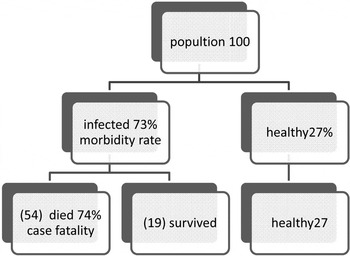
The farmers were asked why poultry was so important to the community. Answers included: easy to start and maintain a flock; a source of quick money to solve pressing needs; the only readily cheap source of protein (egg/meat) and for celebrations and gifts. It was therefore necessary for the team to evaluate losses due to ND outbreak being the most important poultry disease in the community. Disease impact matrix scoring (DIMS) was used to evaluate the impact of ND. About 74% losses of local chickens were expected to be recorded each year in the study areas based on our assessment. DIMS further identified and assessed impacts of certain diseases on the livelihood of the community. For instance outbreaks of ND affected negatively all households in the studied community for all identified factors.
traditional/indigenous veterinary knowledge
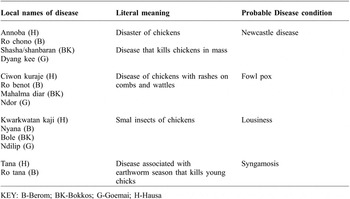
The existing veterinary knowledge is concerned with the clinical, epidemiological, gross manifestations of diseases conditions as well as remedies or solutions to livestock production and health. Most times these are known and given literary meanings that may correspond to specific disease entities in various languages. In Table 1, ND was recognized by most Hausa (H) farmers as farin kashi (whitish diarrhea), farfadiya (epileptiform convulsion) or annoba (disaster of chicken); the Birom (B) famers referred to it as ro-chono and shabaran by the Bokkos (BK) farmers. Fowl pox is recognised by the farmers as papular necrotic lesions on unfeathered parts of the body and so referred to as ciwon kuraje (H), robenot (B), mahal-madiar (BK) all meaning rashes on the birds skin. Kwarkwata (H), ngana (B), bole (BK) and ndilip (Goemai) all mean lice on the body of the chicken. Rotana (B) and tana (H) is a disease syndrome common to young birds during the rainy season which is associated with earthworm consumption. Another interesting finding was the traditional management of livestock health conditions particularly the use of herbs. Gautan kaji/mandrak (H), tulup and kiwano (B) were widely utilised as remedies to most poultry diseases, particularly ND. Palm and engine oils were commonly used to treat lousiness and pox lesions while kitchen soot and baobab leaves were commonly used to treat diarrhoea cases in large food animals.
Summary of poultry disease syndromes identified in upper and lower plateau.

KEY: B-Berom; BK-Bokkos; G-Goemai; H-Hausa
Discussions
The essentials of rural research include communication and co-operation between rural dwellers and researchers for the understanding of rural problems and issues that will lead to proper monitoring of trends and changes necessary for rapid feedback and proposing viable solutions. Such approaches that will allow direct and intensive dialogue between researchers and inhabitants are favoured over more conventional approaches (Rhoades, Reference RHOADES1990; Andy and Mariner, Reference ANDY and MARINER2002). A veterinary surveillance system is only effective when it has the confidence of the producers. This is the key concept of participatory epidemiology.
A participatory disease investigation should first have a clear objective and a comprehensive checklist for the discussion to remain focused, because farmers need to understand the objectives clearly so that expectations are appropriate. Selection of key informants who are educated on the subject matter and farmer's participation are necessary for a successful PDS. The PDS team members must be assigned specific roles so that there is no confusion during the exercise.
From this study, it appeared only endemic, prevalent and economically important livestock diseases were well known to farmers. Such diseases had their local names and traditional managements. However, less economically important and emerging diseases despite their economic and probable zoonotic significance remained fairly unknown to farmers. Despite a few farmers hearing about HPAI, almost all farmers could not recognize the signs of HPAI. Therefore, any PDS team should incorporate enlightenment on especially emerging zoonotic diseases as part of their schedules.
Newcastle disease is the major and economically important poultry disease in the study area. This is in line with the findings of many researchers all over the world, making ND the most economically important poultry disease in these areas. It is a well known poultry disease to local farmers, has local names, recognised patterns of occurrence and traditional management using herbs. Outbreaks of ND could lead to proportionally high mortality affecting poultry populations, owner's livelihood and protein availability. It would also affect HPAI reporting when mortality is exceptionally high and no laboratory facilities are available to confirm immediate outbreaks. Figure 1 justifies above farmers testimonies on the impact of ND in poultry population and the likelihood of confusing ND with HPAI. since most farmers had no idea on HPAI and believed that any poultry associated with excessively high mortality is ND.
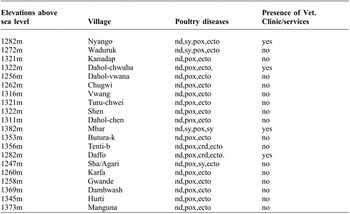
Pox and ectoparasitism are common poultry diseases in the study area, but are less significant in terms of mortality. They are managed locally using palm and engine oils which probably cause death of ectoparasites by suffocation, while, for the necrotic pox lesions, the oil may soften and lead to early removal thereby enhancing healing. Table 2 dealt with syndromes of major poultry disease as recognized by farmers. It showed that ND, Pox and Ectoparasitism have been endemic for decades and posed real challenge to rural poultry production. This is further supported by the fact that the disease had possibly inherited local remedies that existed in the farming communities for long.
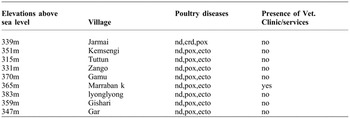
Syngamosis appears to be undocumented poultry disease in the study area and the state at large, however it was found to be more common amongst poultry reared on the high plateau than the lower plateau, probably due to the abundance of the intermediate host (earthworm). Table 3 showed non existence of syngamosis, but had same ND, POX and ectoparasitism prevalence in the lower plateau. Due to climatic differences between upper and lower plateau, lack of suitable intermediate host or other factors that this research could not identify may be responsible for the absence of syngamosis in the studied area. From the available literature, no attention whatsoever was given to these three diseases in the study areas, when compared to ND, and farmers continued to suffer losses from them.
Results of proportional piling for morbidity and case fatality in a population of Newcastle disease infected rural poultry in Jos Plateau.

Summary results of PP, PWR, MS and TW conducted in the upper plateau.

Summary of results for lower plateau.

Veterinary services and infrastructures are inadequate in these communities; at most two non-functional Veterinary clinics were seen per ten villages visited. Therefore, farmers rely on their ethno-veterinary knowledge to solve livestock health problems. Although some of these traditional management protocols by farmers may have some scientific basis, such samples and practices need to be further researched and validated.
When farmers were asked to give major constraints that may likely hinder the improvement of poultry production in the communities. Income (kudi), poultry diseases (Ro), lack of knowledge and access to veterinary services were mentioned as major hindrances to improved poultry production initiatives. Proportional piling was conducted and gave income, disease, knowledge and access to veterinary as 1,2, 3, 4 respectively. This information when used by policy makers to provide soft loans, thermostable vaccines to farmers, and also educate farmers and make available veterinary facilities and personnel to rural communities will not only improve poultry production but reduce poverty in such communities.
As part of our instant feedback to the visited communities, we identified and recommended patronage of livestock health professionals to address disease and health problems and also recommended annual ND vaccination of rural poultry to the Plateau State Government, especially before periods and conditions identified with outbreaks. This later recommendation was implemented by the Government of Plateau State and the effect of the vaccination has significantly benefitted farmers.
During this survey, the PDS team members and farmers developed new relationships and respect for indigenous knowledge. The farmers would welcome further research from PDS Policy makers, as such surveys provide a clear and accurate picture of the local poultry farmers’ constraints, particularly major disease profiles, and, for the first time, acted immediately by procuring enough ND vaccine for comprehensive rural poultry vaccination in the state.
The current status of the animal health information system and infrastructures appear to be weak and inadequate. This is because most communities had little or no access to veterinary personnel or facilities, yet Ministries continue to get monthly reports from such communities by their workers. There was also very limited geographical coverage of veterinary clinics which will lead to incorrect reporting of disease events. As a result, there appeared limited accurate information on livestock population in the study area.
Conclusions
Hands-on experience is an essential element of rapid rural appraisal and cannot be performed remotely (Gibbs, Reference GIBBS1990). PE is flexible, which is essential to both plan the work and to work the plan. It adapts triangulation, which is a reliable technique that combines and approaches information from different points of view (usually a minimum of three, hence triangulation) so that quality information is obtained after these processes of crosschecking. Semi-structured interviews have the advantage of questions being modified as new information appears. Appraisals are processes of rapid progressive learning, utilising farmers’ perception and understanding of resource situations and problems, and using multidisciplinary approaches to arrive at viable solutions to local problems. Therefore PE is quite useful to evaluate the exact livestock situation in a community and the data obtained are usually sufficiently qualitative to effect organisational changes that may be more responsive to farmers' priorities. The Nigerian Government should therefore support the PDS approach for livestock health policy reforms.
Plate 1
Proportional pilling for importance of poultry in a community Shen village.

Plate 2
Local remedy to many poultry diseases common to many communities in the Jos Plateau.

Plate 3
Some local remedies used to treat poultry diseases in most Plateau communities.