INTRODUCTION
Dendrodorid slugs are elongate–ovate, tuberculate, soft-bodied slugs with broad mantle skirt and rhinophores having well developed lamellate clubs. Sea slugs representing the family Dendrodoridae are distributed globally across the oceans. The identification of species within the genus Dendrodoris Ehrenberg remains challenging due to the lack of key taxonomic characters such as radula, not to speak of the variations in colorations exhibited by the animals (Kay & Young, Reference Kay and Young1969). Valdes et al. (Reference Valdes, Ortea, Avila and Ballestero1996) reviewed the taxonomy of Dendrodoris in the Atlantic Ocean. Valdes (Reference Valdes2002) reported on the phylogenetic relationships of the cryptobranch dorids and re-established the validity of the genus Dendrodoris. This genus has about 42 valid species (Bouchet & Gofas, Reference Bouchet and Gofas2013) and the species recorded from India include D. fumata (Rüppell & Leuckart), D. guttata (Odhner), D. nigra (Stimpson) and D. tuberculosa (Quoy & Gaimard) (Apte, Reference Apte2009, Reference Apte2012; Apte et al., Reference Apte, Bhave and Parasharya2010; Ramakrishna et al., Reference Ramakrishna, Raghunathan, Sivaperuman, Yogesh Kumar, Raghuraman, Immanuel and Rajan2010; Bhave & Apte, Reference Bhave and Apte2011).
In the present paper we report the first record of Dendrodoris coronata (Kay & Young, Reference Kay and Young1969) from Kadmat Island, Lakshadweep, India.
RESULTS
SYSTEMATICS
Order NUDIBRANCHIA Cuvier, 1817
Suborder EUCTENIDIACEA Tardy, 1970
Family DENDRODORIDIDAE O'Donoghue, 1924
Dendrodoris Ehrenberg, 1831
Dendrodoris coronata Kay & Young, Reference Kay and Young1969
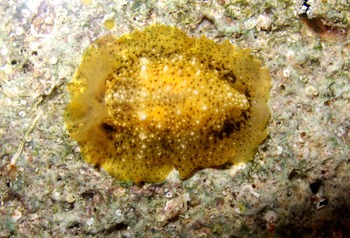
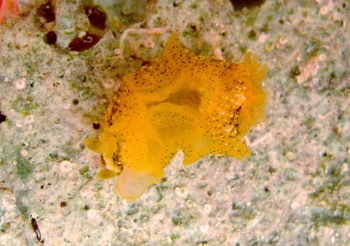
(Figures 1 & 2)
Dendrodoris coronata, 13 mm length, collected from Kadmat Island, Lakshadweep—dorsal view.

Dendrodoris coronata, 13 mm length, collected from Kadmat Island, Lakshadweep—ventral view.

MATERIAL EXAMINED
One live specimen (total length 13 mm, width 6 mm) collected from Kadmat Island (11°10′42″N 72°45′37″E) of Lakshadweep by snorkelling from a depth of 1.6 m on 23 June 2013. The animal was found on the underside of rocks that are encrusted with sponges. The specimen was deposited in the museum collections of the Department of Aquatic Biology and Fisheries, University of Kerala, Kariavattom, 695581, Thiruvananthapuram, Kerala, India (Accession number DABF-UOK/GAS 1).
The material was identified following descriptions provided by Kay & Young (Reference Kay and Young1969), Gosliner et al. (Reference Gosliner, Behrens and Valdés2008) and Yonow (Reference Yonow2008).
DESCRIPTION
Soft, broadly oval body with wider posterior end; convex above. Mantle margins thin and undulated. Characteristic transverse crown-like mid-dorsal band of tubercles present immediately in front of the gills. Branchiae large and feathery, located at the posterior part the body. Rhinophores long and slender with about 12 lamellae. A pair of auriculate oral tentacles borders the minute mouth.
Mantle light yellow, with scattered black spots that are generally smaller in diameter than the majority of the white warts; dark speckling coalesces to form patches in some regions. Branchiae light yellowish in colour. The rhinophores light yellow. Foot yellowish.
REMARKS
This species was originally recorded from the Hawaiian Islands by Kay & Young (Reference Kay and Young1969). Subsequently it has been recorded from the Marshall Islands (Johnson & Boucher, Reference Johnson and Boucher1983), Papua New Guinea (Valdes & Gosliner, Reference Valdes and Gosliner1999), New Caledonia (Heros et al., Reference Heros, Lozouet, Maestrati, Cosel, Brabent, Bouchet, Payri and Richard2007), Japan, Palau and Palmyra Atoll (Gosliner et al., 2008), Jeddah, Saudi Arabia and the northern Red Sea (Yonow, Reference Yonow2008), and South-east Queensland, Australia (Vantier et al., Reference Vantier, Williamson and Willan2010). The record of this species from Kadmat Island of Lakshadweep confirms the extended known range of this species into the western Indian Ocean.
ACKNOWLEDGEMENTS
The authors thank the Department of Biotechnology, Government of India for the financial support of the project. Sneha Chandran thanks the Department of Science and Technology, Government of India for the INSPIRE fellowship. Thanks are due to Dr Richard C. Willan of the Museum and Art Gallery of the Northern Territory, Australia for confirming identification of the slug. We also thank the Forests and Wildlife Department of Union Territory of Lakshadweep for the official permission to study marine molluscs of the islands.