Current efforts to map the human genome for quantitative trait loci have provided a promising new direction for studying genes and environment during development (Rutter, Reference Rutter2007). Studies examining parenting, for example, have suggested that a history of abuse or neglect may influence the way in which alleles of key genes regulate aspects of psychopathology (Caspi et al., Reference Caspi, McClay, Moffitt, Mill, Martin and Craig2002, Reference Caspi, Sugden, Moffitt, Taylor, Craig and Harrington2003, Reference Caspi, Moffitt, Cannon, McClay, Murray and Harrington2005). Rutter (Reference Rutter2007) cites these studies as providing a strong basis for further examination of the mechanisms of Gene × Environment interaction (G × E).
We recently reviewed the influence of a number of genetic alleles on aspects of temperament and attention (Posner, Rothbart, & Sheese, Reference Posner, Rothbart and Sheese2007; Rothbart, Sheese, & Posner, in press), and in this paper we examine the joint influence of parenting and a common genetic variation on child temperament in early childhood. We examine the dopamine receptor D4 gene (DRD4), which has been related to the efficiency of the executive attention network (Fossella et al., Reference Fossella, Sommer, Fan, Wu, Swanson and Pfaff2002) and to aspects of attention-deficit/hyperactivity disorder (ADHD; Swanson, Flodman, et al., Reference Swanson, Flodman, Kennedy, Spence, Moyzis and Schuck2000). We consider how DRD4 interacts with the quality of observed parenting to predict individual differences in activity level, high-intensity pleasure, and impulsivity as aggregated into a scale we call sensation seeking. We also examine the higher order temperamental factor of effortful control, which has been related to the efficiency of the executive attention network (Rothbart & Rueda, Reference Rothbart, Rueda, Mayr, Awh and Keele2005), and is an important predictor of social and emotional functioning in children (Rothbart & Posner, Reference Rothbart, Posner and Cicchetti2006).
One allelic variant of DRD4 that has seven 48 base pair tandem repeats in the third exon (NM 000797), referred to here as the 7 repeat, appears to be particularly important for attention-related outcomes. For example, attention-deficit/hyperactivity disorder (ADHD) has frequently been related to the 7 repeat (Swanson, Flodman, et al., Reference Swanson, Flodman, Kennedy, Spence, Moyzis and Schuck2000). However, many unanswered questions remain about the involvement of the 7 repeat in attention. Originally it was thought that carriers of the 7 repeat had deficits in attention, but a study using three laboratory tasks failed to show a deficit in executive, orienting, or alerting attention networks (Swanson, Oosterlaan, et al., Reference Swanson, Oosterlaan, Murias, Schuck and Flodman2000). Using the Attention Network Test (ANT), which measures the efficiency of all three networks, Fosella et al. (Reference Fossella, Sommer, Fan, Wu, Swanson and Pfaff2002) found that people with the more common 4 repeat rather than the 7 repeat had the lowest efficiency in the executive network. A different approach to the relation between the 7 repeat and ADHD involves the temperamental variable sensation seeking as measured from questionnaires (Auerbach, Faroy, Ebstein, Kahana, & Levine, Reference Auerbach, Faroy, Ebstein, Kahana and Levine2001). Sensation seeking is related to high levels of activity and impulsivity. It has been shown that children with the 7 repeat are high in sensation seeking, and sensation seeking may be related to the symptoms of ADHD.
Animal studies have supported a link between the DRD4 gene and aspects of exploratory and risk-taking behaviors that closely mirror sensation seeking (Livak, Rodgers, & Lichter, Reference Livak, Rogers and Lichter1995). In one study, DRD4 knockout mice were compared with wild-type mice, that served as a normal control, in three tests of novelty seeking including movement in the open field (Grandy & Kruzich, Reference Grandy, Kruzich and Posner2004). The DRD4 knockout mice responded less to novelty than did the wild type, indicating a role of DRD4 for novelty seeking in the mouse. It has also been found that variations in DRD4 in Vervet monkeys account for a significant portion of the variance in the latency to approach a threatening novel object (Bailey, Breidenthal, Jorgensen, McCracken, & Fairbanks, Reference Bailey, Breidenthal, Jorgensen, McCracken and Fairbanks2007).
Given previous findings, we expected that temperament measure of sensation seeking, but not effortful control, would be related to allelic variation in the DRD4 gene.
It is also important to consider that the effects of DRD4 may be moderated by environmental factors. Recent work suggests that the influence of variations in DRD4 may interact with environmental factors to predict social and emotional functioning in early development (Bakermans-Kranenburg & van IJzendoorn, Reference van IJzendoorn and Bakermans-Kranenburg2006; van IJzendoorn & Bakersman-Kranenburg, Reference van IJzendoorn and Bakermans-Kranenburg2006). These authors found that infants with a 7-repeat allele of the DRD4 were more susceptible to maternal unresolved loss or trauma in relation to disorganized attachment. They also observed that maternal sensitivity at 10 months was associated with subsequent lower externalizing behavior at 39 months, but only for children with a 7-repeat allele. One interpretation of these results is that children with a 7-repeat DRD4 allele may be more susceptible to early environmental risk factors.
In considering DRD4 as a predictor it is also important to consider that the links between DRD4 and particular outcomes may vary over the course of development. For example, it has been shown that for male infants the rate of visual habituation is related to the presence of the 7-repeat allele, whereas for adolescent males sensation seeking as measured by questionnaire is related to the presence of the 7 repeat (Laucht, Becker, & Schmidt, Reference Laucht, Becker and Schmidt2006). The current study of toddlers is carried out in the context of a longitudinal examination of the origin of early forms of self-regulation. Participants were first seen as infants at 7 months of age. We found evidence suggesting that the frequency of anticipatory looking might reflect the early development of self-regulation (Sheese, Rothbart, Posner, White, & Fraundorf, Reference Sheese, Rothbart, Posner, White and Fraundorf2007). Both caution in reaching toward novel objects and frequency of self-regulation were positively related to the frequency of anticipatory looks.
The same infants returned to the laboratory at age 18–21 months. At this age we genotyped the children and their caregiver and examined the 7 repeat in relation to two aspects of temperament. First, we examined the 7 repeat in relation to sensation seeking, a temperament construct reflecting individual differences in activity levels and approach behaviors. Second, we examine the 7 repeat in relation to effortful control, a temperament construct that has been linked to executive attention in children, adolescents, and adults. Third, we examine whether the 7 repeat interacts with the quality of parenting to predict effortful control and sensation seeking.
Method
Data for the current study are from an ongoing longitudinal study of the development of attention and temperament conducted at the University of Oregon. Families were recruited from the local community and children first brought into the laboratory when they were 7–9 months of age. They returned again when the children were 18–21 months of age. Methods and data reported here are from the 18- to 21-month assessment. The study will conclude with an assessment of attention and temperament related outcomes when the children are 4 years of age.
Procedure
Families were mailed the temperament questionnaire described below and asked to complete it prior to arriving at the laboratory. Families came into the laboratory for a single session lasting less than 1 hr. During the laboratory session buccal cell samples were collected for genotyping and the parent and child participated in a free play exercise. Families were also involved in additional laboratory assessments of attention and temperament; these measures are not included in the current paper.
Participants and missing data
Fifty-four families agreed to provide samples for genotyping. Of these, 8 were excluded from subsequent analysis for failure to return the temperament questionnaire. One additional family was excluded because of video equipment malfunction. The final sample used for analyses included 45 children with complete data (16 females, 29 males; 85% White and non-Hispanic, 10% Asian, 5% unreported or other).
Temperament
Caregivers were asked to complete the Early Childhood Behavior Questionnaire (ECBQ; Putnam, Gartstein, & Rothbart, Reference Putnam, Gartstein and Rothbart2006). Activity level (α = .74), high-intensity pleasure (α = .67), and impulsivity (α = .70) scales from the ECBQ were z-scored and averaged to form the aggregate sensation seeking measure (α = .66). The attentional focusing (α = .85), attentional shifting (α = .67), and inhibitory control (α = .90) scales from the ECBQ were z-scored and averaged to form the aggregate effortful control measure (α = .58).
Parental interaction
Parenting quality was assessed using a video-taped free-play procedure and a rating scheme adapted from the National Institute of Child Health and Human Development (NICHD) Study of Early Child Care (1993; see also Egeland & Hiester, Reference Egeland and Hiester1993). The parent was asked to play with the child for 10 min in a laboratory room that contained only toys and an area rug. This interaction was videotaped and subsequently rated. Raters watched the entire interaction and then used 7-point Likert scales to rate the parent on the following items (see NICHD Early Child Care Research Network, 1993, for additional details): (a) supportive presence (showing positive regard and emotional support), (b) respect for autonomy (unintrusive in interactions with child), (c) stimulation of cognitive development (shows directed instruction, teaching), (d) hostility (shows anger, rejection, negative regard), and (e) confidence (shows confidence in interactions with child). Twenty videos (44%) were coded twice to assess interrater reliability. Interrater reliability was adequate (r = .76). Hostility was reversed and ratings on these five items were aggregated into single-parenting quality measure (α = .81). For data analysis, parenting quality was dichotomized using a median split to produce higher and lower quality parenting groups.
Genotyping
Genomic DNA was isolated from buccal cell samples taken from each child using QuickExtract DNA extraction solution (Epicentre, Madison, WI). The DRD4 variable number tandem repeat (VNTR) polymorphism was amplified using 0.2 µM of each primer DRD4F 5′-GCGACTACGTGGTCTACTCG and DRD4R 5′-AGGACCCTCATGGCCTTG (Fossella et al., Reference Fossella, Sommer, Fan, Wu, Swanson and Pfaff2002; Licther et al., 1993) in a mixture containing 8% dimethylsulfoxide, 200 µM of dNTP, 2.5 mM of MgCl2, 1 × (NH4)2SO4 buffer (Fermentas, Hanover, MD), 2.5 units of recombinant Taq polymerase (Fermentas), and approximately 20 ng of genomic DNA in a volume of 25 µl. The samples were heated in a PTC-200 or 225 thermocycler (MJ Research, Incline Village, NV) at 95°C for 3 min, then cycled 40 times at 95°C for 20 s, 57°C for 20 s, and 72°C for 1 min, followed by 72°C for 3 min. The products were separated and visualized on a 2% agarose gel (type 1-A, Sigma, St. Louis, MO) stained with ethidium bromide.
Based on the genotyping procedure children were assigned to either the 7-repeat present (individuals with one or two copies of the 7-repeat allele) or the 7-repeat absent group (individuals with no 7-repeat alleles). We found that 31% of the children (n = 14) had at a least one 7 repeat, a result consistent with previous findings (Wang et al., Reference Wang, Ding, Flodman, Kidd, Kidd and Grady2004).
Results
Sensation seeking
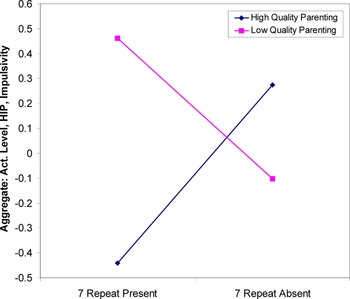
We first constructed an aggregate scale consisting of activity level, high-intensity pleasure, and impulsivity as measured by the ECBQ. An analysis of covariance (ANCOVA) was conducted treating DRD4 status (7 repeat present or 7 repeat absent) and parenting quality (higher or lower quality) as predictors, child age (in days) and gender as covariates, and the sensation seeking aggregate scale as the dependent variable. There was no evidence of a significant main effect of either DRD4 status, F (1, 39) = 0.09, p = .77, or parenting, F (1, 39) = 1.01, p = .32. However, there was evidence of a significant interaction between child DRD4 status and parenting quality, F (1, 39) = 6.63, p = .01, partial η2 = .15. This interaction is presented in Figure 1.
The presence of the 7-repeat allele of the dopamine receptor D4 gene interacts with the quality of parenting to determine three aspects of child temperament, activity level, impulsivity, and high-intensity pleasure that are aggregated into a measure of sensation seeking. [A color version of this figure can be viewed online at multimediafluids.uam.elogim.com]

To follow up this interaction an ANCOVA analysis was repeated separately for the 7-repeat present and 7-repeat absent groups. For the 7-repeat absent group there was no evidence of significant main effect of parenting quality, F (1, 27) = 1.61, p = .22. For the 7-repeat present group there was a significant main effect of parenting quality, F (1, 10) = 8.69, p = .02, partial η2 = .15, with lower quality parenting (M = 0.56, SE = 0.22) being associated with significantly higher levels of sensation seeking in comparison to those with higher quality parenting (M = –0.49, SE = 0.26).
Effortful control
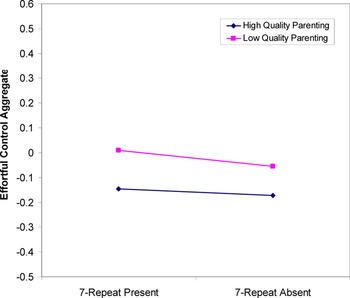
The data for effortful control are shown in Figure 2. An ANCOVA was conducted treating DRD4 status (7 repeat present or absent) and parenting quality (higher quality or lower quality) as predictors, child age (in days) and gender as covariates, and the effortful control aggregate scale as the dependent variable. There was no evidence of a significant main effect of either DRD4 status, F (1, 39) = 0.04, p = .85, or parenting, F (1, 39) = 0.29, p = .59. There was also no evidence of a significant interaction between DRD4 status and parenting quality, F (1, 39) = 0.01, p = .94.
The presence of the 7-repeat allele and the quality of parenting exert no influence on the aggregate measure of effortful control. [A color version of this figure can be viewed online at multimediafluids.uam.elogim.com]

Discussion
Sensation seeking
The finding that the 7-repeat allele of the DRD4 is under positive selective pressure (Ding et al., Reference Ding, Chi, Grady, Morishima, Kidd and Kidd2002) has led to a number of speculations about its meaning for the evolution and adaptability of human societies (Harpending & Cochran, Reference Harpending and Cochran2002; Wang et al., Reference Wang, Ding, Flodman, Kidd, Kidd and Grady2004). Wang and associates argue that because the 7-repeat has a decreased response to dopamine, it leads to activities including risky behaviors that work to increase brain dopamine. Methylphenidate serves to counteract this effect by increasing brain dopamine. Both Harpending and Cochran (Reference Harpending and Cochran2002) and Wang et al. (Reference Wang, Ding, Flodman, Kidd, Kidd and Grady2004) argue that in some societies and cultures the 7 repeat increases survival value, leading to increases in the frequency of this allele.
The results from the current study, indicating that the presence of the 7 repeat is associated with a greater influence of parenting, may contribute to our understanding of the reason for its positive selection. If the 7 repeat allows the caregiver to exert more influence on the temperament of their child, it could make the child more successful in adapting to the social environment. For example, Ahadi, Rothbart, and Ye (Reference Ahadi, Rothbart and Ye1993) have indicated that effortful control in the United States is related to less expression of negative affect, whereas in China, effortful control is more related to a reduction in extraversion. The ability of temperament to adjust to the environment of child rearing may help account for why a genetic variation increasing parental influence would be positively selected.
Molecular analysis has indicated that as many as 300 of the genes that influence brain function in the human genome are under positive selection (Wang, Kodama, Baldi, & Moyzis, Reference Wang, Kodama, Baldi and Moyzis2006). Genes that promote flexibility in response to environmental demands would allow the environment to shape critical aspects of child behavior and could serve as a general mechanism allowing culture to influence behavior. Studies of other G × E would be needed to determine whether other genes under positive selective pressure can have alleles that enable increased influence of environmental factors.
Our observation of the relationship between DRD4 and the environment may also modify our view on how the 7 repeat might contribute to ADHD and other externalizing disorders. Although a part of the process involves genetics, there would also be a role for parenting quality. Our limited observation of parent child interaction is not sufficient to allow us to know exactly how parents might influence their child's activity level and impulsivity, and is also possible that the characteristics of the children are influencing the parenting quality we observe. The finding nevertheless suggests some role for parenting in determining the degree of their child's activity level, impulsivity, and affinity to risky pleasure. The parents involved in our study had shown sufficient interest in their children to enroll in the longitudinal study. There was no reason to regard them as anything other than normal or perhaps superior parents. Because the various dimensions of the NICHD ratings scales were highly correlated, it is not possible to say from our study exactly what aspects of parenting style might be most important for our effects, although this would be an important target for future studies.
Rutter (Reference Rutter2007) points out that traditionally nature–nurture interactions between genes and environment were thought to be rare. However, increasing evidence from biology and medicine and from the study of abused children (Caspi et al., Reference Caspi, McClay, Moffitt, Mill, Martin and Craig2002, Reference Caspi, Sugden, Moffitt, Taylor, Craig and Harrington2003, Reference Caspi, Moffitt, Cannon, McClay, Murray and Harrington2005) has demonstrated such influences. Differences likely to be encountered in normal home environments have been less studied. Bakermans-Kranenburg and van IJzendoorn (Reference Bakermans-Kranenburg and van IJzendoorn2006) and van IJzendoorn and Barkersmans-Kranenburg (Reference van IJzendoorn and Bakermans-Kranenburg2006) both find evidence similar to ours that in the presence of the 7-repeat allele parent variables show a stronger effect on child outcomes in parent ratings of externalizing behavior. It has also been shown that the presence of the 7 repeat produces a larger influence of intelligence on externalizing behavior (DeYoung et al., Reference DeYoung, Peterson, Seguin, Meja, Pihl and Beitchman2006). Further research examining the effect of differences in normal child-rearing practices in interaction with genetic variation will be critically important in developmental studies.
Executive attention
Based on the previous findings (Swanson, Oosterlaan, et al., 2000), we did not expect to find any difference between 7 repeat present and absent in effortful control. Consistent with this, Figure 2 shows no significant difference in parental reports of effortful between those with and without the 7-repeat allele. Previous results (Fossella et al., Reference Fossella, Sommer, Fan, Wu, Swanson and Pfaff2002) suggest that the 4-repeat allele might be associated with deficits in executive attention; however, we did not have sufficient children with an absence of the 4 repeat to test this hypothesis.
Mechanisms
Parenting quality could have its effect on child temperament through genetic or epigenetic mechanisms. If parenting quality is also determined by genetic factors, our statistical G × E could be purely genetic. This is also true of other reported G × E that involve natural parents (e.g., Caspi et al., Reference Caspi, McClay, Moffitt, Mill, Martin and Craig2002, Reference Caspi, Sugden, Moffitt, Taylor, Craig and Harrington2003, Reference Caspi, Moffitt, Cannon, McClay, Murray and Harrington2005). To ensure that an environmental effect is free from genetic influences it would be necessary to have random assignment to environmental conditions.
In our studies of attention training, children were randomly assigned to training conditions (Rueda, Rothbart, McCandliss, Saccamanno, & Posner, Reference Rueda, Rothbart, McCandliss, Saccamanno and Posner2005). We found that a dopamine transporter (DAT1) gene was related to executive attention ability in this study, but because of small numbers involved we were not able to assess whether it interacted with the training versus control condition. Because lower skills in attention seemed to be related to a greater training effect, studies of larger groups might yield significant G × E that could be interpreted as being independent of genetic mechanisms.
Development and psychopathology
Regardless of the exact mechanism of the interaction illustrated in Figure 1, the evironment created by parenting, whether genetically influenced, interacts with the 7 repeat to produce important differences in child temperament.
Developmental psychopathologists have recognized the potential importance of studies of early childhood G × E in understanding multiple pathways to disorders (Cicchetti & Toth, Reference Cicchetti, Toth and Damon1998). We know that effortful control and executive attention deficits are related to self-regulation, and that they thus influence both internalizing and externalizing disorders (Rothbart & Posner, Reference Rothbart, Posner and Cicchetti2006). Our finding of a G × E related to parenting in a community sample is based upon ratings of a brief period of parent–child interaction, and provides a simple method for examining the role of genes and parenting in influencing aspects of temperament that are risk factors for psychopathology. Our finding that parenting can make a difference in the rated behavior of the child supports the use of interventions to improve behavior during childhood. Parent training may be one important approach, and other behavior interventions may also be effective.
We plan to test the same children at approximately 4 years of age when they can carry out tasks designed to measure executive attention, alerting, and orienting that are known to be influenced by candidate genes. We believe that such a longitudinal study provides the opportunity to examine the role that genes play in child attention and temperament at different phases of the development of underlying networks. Our current findings suggest that there is much to be learned from tests at this later age.