Introduction
Canada thistle (Cirsium arvense (L.) Scop.) is an aggressive, colony-forming perennial weed. Due to the high adaptation and regeneration capability as well as wide environmental amplitude these plants occur mostly in all arable cropsReference Holm, Plucknett, Pancho and Herberger1. Once established, it is very tenacious and difficult to controlReference Hodgson2, due to a very expansive root system that can give rise to new shoots from adventitious root buds. Canada thistle causes negative effects following direct competition for growth factors like water, light and nutrients. There are yield losses, yield problems as well as quality reduction of cropReference Donald3. Infestation with C. arvense under organic farming conditions is an increasing problem in Germany and most European countries. The spread of C. arvense is favored by low crop competition, a high proportion of cereals and spring crops in the rotationReference Verschwele and Häusler4 are either limited or missing autumn tillageReference Staniforth, Wiese and Wiese5, Reference Pekrun and Claupein6. Perennial weeds are very difficult to control by crop competitiveness. In order to be effective, most control options have to take place in the non-cropping periodReference Hatcher and Melander7.
The aim of the investigation presented here was the development of a strategy for sustainable control of C. arvense in organic crop production. The applied strategies were targeted on the depletion of assimilate reserves in the root system by a repeated disruption of the vegetative growth of C. arvense by autumn tillage or cut of forage crop in combination with competition for light between crop and thistles.
Materials and Methods
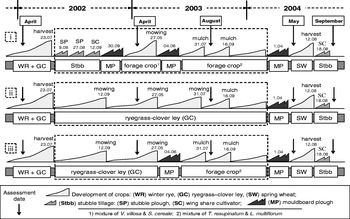
From 2002 to 2004, a one-factorial field experiment (strip-plot design) was established after winter rye harvest in an area heavily infested with C. arvense. The trial site was located at the organic research farm ‘Wiesengut’ in North-Rhine Westphalia, Germany (50°48′N, 7°17′E). The experiment consisted of three strategies with different treatments, each one with four replicates (plot size 10 m×23 m). In strategy (i) repeated stubble tillage was followed by subsequent cultivation of two forage crops. Stubble cultivation (repeated three times during August and September 2002) was carried out using a stubble plough (shallow ploughing, twice) and a wing share cultivator (once) (Fig. 1). In order to stimulate adventitious buds and to cut the emerging shoots of C. arvense the tillage depth was successively increased (6, 12 and 15 cm soil depth, respectively). At the time of tillage, the emerged thistle shoots had four to five leaves. According to the study of Dock GustavssonReference Dock Gustavsson8 most severe depletion of assimilate reserves in the root system can be achieved with control measures at this growth stage. The interval between stubble tillage passes was 2–3 weeks. After seedbed preparation (mouldboard plough at 30-cm soil depth followed by rotary harrow combined with drilling machine), a mixture of Vicia villosa (L.) and Secale cereale (L.) (50/80 kg ha−1) was sown. The forage mixture was mowed in May 2003 and then inverted by deep ploughing (30-cm soil depth). In June, another forage crop (Trifolium resupinatum L. mixed with Lolium multiflorum Lam.: 15 and 20 kg ha−1 respectively) was sown and mulched in July and September 2003 (Fig. 1). Strategies (ii) and (iii) were both based on ryegrass–clover ley (Trifolium pratense L. and L. multiflorum: 35 kg ha−1 standard mixture consisting of 29% clover and 71% ryegrass) established as underseeds in winter rye in spring 2002. In strategy (ii) the ryegrass–clover ley was maintained over the whole experiment and was regularly cut (mowed three times and then mulched). The plant material was either removed after crop mowing or was left on the field after mulching. The ryegrass–clover ley of strategy (iii) was mowed twice (September 2002 and May 2003), then ploughed (30-cm soil depth) and cultivated as in strategy (i). In March 2004, in all treatments after shallow cultivation (wing share cultivator, 10-cm soil depth), deep ploughing (30-cm soil depth) and seedbed preparation, spring wheat (cv. Combi, 400 seeds per m2 at 11-cm row distance) was sown.
Three strategies for controlling C. arvense: variation of crop rotation and soil tillage measures, 2002–2004.

The following parameters were assessed: plant density, ground cover and size (rosette radius) of C. arvense, crop ground cover and height. Density and size of C. arvense shoots were determined before establishing the treatments in April 2002 on the entire trial area (23 m×120 m) and at different times during the following years (April 2003, August 2003, May 2004 and September 2004) on four fixed standardized subplots of 3 m×3 m size in each plot.
C. arvense density (shoots per m2) was determined by counting the number of shoots. Size was determined by measuring of the rosette radius of shoots and classified in three groups: up to 5 cm, 5–10 cm and more than 10 cm. The rosette size of C. arvense shoots was used as an indicator of regrowth capacity of thistle to regenerate after treatments. Ground cover of thistles and crop were estimated during the vegetation period (all 7–10 days) by visual evaluation of covered ground by C. arvense (in five subplots at 1 m2 per plot) and crop (on entire plot), respectively. Height growth of clover (cm) was determined by measuring the crop length of 10 plants in each of four subplots per plot.
The statistical analysis of data was carried out with the ‘Statistical Analysis System’9. Parameter means were compared by multiple post hoc Tukey test (α=0.05).
Results and Discussion
Development of crops and thistles
Forage crops (V. villosa and S. cereale) (strategy i)
Crop plants emerged about 10 days after sowing and developed very well until winter. Thistle shoots appeared sporadically. At the end of the winter crop damage was assessed as being caused by snails. During the middle of April, this crop damage was compensated by an increase of the biomass of fast developing plants (ground cover 60%), that shaded the emerged thistles (ground cover 10%) substantially. At the beginning of May, crop mixture covered ground and thistle shoots up to 100%.
Ryegrass–clover ley (strategies ii and iii)
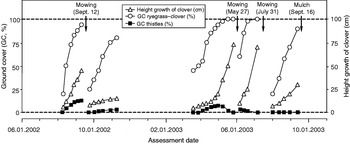
In September 2002, before the first mowing had been done, clover plants 40–45 cm high covered the ground almost completely (degree of cover: 90%, Fig. 2). At this assessment time many vigorous thistle shoots were identified, overgrowing the clover stand especially in several patches and hence, remaining unaffected by crop competition. Three weeks after the ryegrass–clover mowing the first thistle shoots developed either from the buds, on the roots or on the cut stems. The biggest part of such emerged thistles was covered by the already fast developed clover plants.
Development of ryegrass–clover (height growth of clover), ground cover of ryegrass–clover and thistles, respectively, during the vegetation 2002–2003 (compare Fig. 1, strategy ii).

At the beginning of April 2003, ryegrass–clover ley covered the ground at about 50%, at the same time the first thistles appeared. Until mid April ground cover of the crop (height of clover stand: 50 cm) increased up to 100% (Fig. 2), and almost all C. arvense shoots were shaded by the crop. Only a few thistles in several patches grew undisturbed. Immediately before the cut on May 2003, the ryegrass–clover stand (75 cm height) covered the thistles completely. A lot of thistle shoots within the clover stand were very weak. The leaves of these shoots had a pale, bright yellow color. After the third cut (end of July) ryegrass–clover increased their height growth slowly due to the drought at that time.
Forage crops (T. resupinatum and L. multiflorum) (strategies i and iii)
The drought period in June 2003 caused a low emergence of the forage crops. Instead, annual weeds, such as Polygonum spp. and Sinapsis arvensis (L.) established themselves very successfully despite the lack of moisture. Thus, weeds actually simulated the crop stand in our experiment. At the beginning of July, annual weeds covered the ground up to 30% and at the end of the month by up to 100% (weed height 45–50 cm). All emerged thistle shoots were completely shaded. After mulching (end of July) no further assessments were done due to drought stress resulting in poor plant growth.
Efficacy of control measures on thistle density
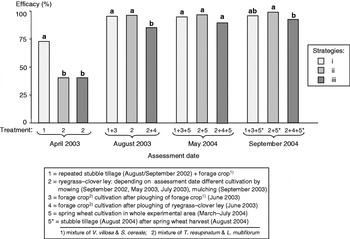
The distribution of C. arvense was extremely heterogeneous (0–60 shoots per m2). During the first assessment in April 2002, a density of 20–40 shoots per m2 was determined in several patches. On average, the mean number of thistles in the fixed standardized subplots was 10 shoots per m2. This initial thistle density was the basis for the efficacy determination of all control measures. Repeated stubble tillage with subsequent forage crop cultivation (mixture of V. villosa and S. cereale) as a winter catch crop (strategy i) resulted in a decline of shoot density of C. arvense by about 73% (assessed after 9 months in April 2003, Fig. 3). In contrast, a patchy ryegrass–clover stand with low shading ability and mowed only once in autumn (strategies ii and iii) reduced shoot density less effectively (efficacy 40%).
Efficacy of control measures: effect of repeated stubble tillage with subsequent forage crop cultivation (strategy i), repeated mowing of a ryegrass–clover ley (strategy ii) and forage crop cultivation following a ryegrass–clover ley (strategy iii) on C. arvense density (100%=10 shoots per m2=mean initial density of C. arvense in April 2002). Different letters within the column group indicate significant differences (Tukey test, α=0.05).

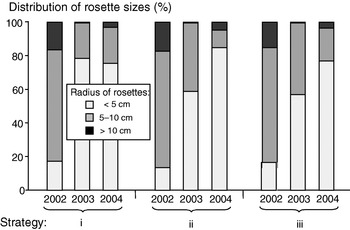
Regrowth capacity (based on the size of C. arvense rosettes) after repeated stubble tillage was also considerably lower than after mowing of a ryegrass–clover ley. Compared to strategies (ii) and (iii), repeated stubble tillage combined with forage cropping resulted in a lower percentage of bigger-sized thistles in April 2003 (Fig. 4). These lasting effects of stubble tillage compared with forage crop cultivation can be explained by the efficient continuous depletion of assimilates bound in the C. arvense root system, resulting in a decreased regrowth capacity of C. arvense by stimulating the emergence of new shoots together with repeated cutting of C. arvense shootsReference Håkansson10, Reference Boström and Fogelfors11. At the following assessment date (May 2004) a similar distribution of C. arvense rosette sizes in all strategies was determined.
Effect of repeated stubble tillage combined with subsequent forage crop cultivation (strategy i), repeated mowing of a ryegrass–clover ley (strategy ii) and forage crop cultivation following a ryegrass–clover (strategy iii) on the rosette size of C. arvense (assessment: April 2002, April 2003 and May 2004). Differences of rosettes sizes among different strategies at the same assessment date are not significant (Tukey test, α=0.05).

As shown in Fig. 3, subsequent forage crop cultivation after repeated stubble tillage (strategy i) was just as effective as a ryegrass–clover ley mowed three times (September 2002, May 2003 and July 2003, strategy ii) in reducing thistle density in August 2003. The efficacy of these two treatments was high at 96%. The efficacy of forage crop cultivation (mixture of T. resupinatum and L. multiflorum) after ploughing of ryegrass–clover ley in June 2003 (strategy iii) was also high (86%); however, significantly lower than that of the other two treatments. This was due to increased thistle density as a result of damage to the apical dominance of shoots during ploughing. The initially low shading ability of the forage crop was obviously not sufficient to stop the growth of emerging C. arvense shoots. Other studies have demonstrated the importance of a dense competitive crop stand for successful thistle suppressionReference Zimdahl, Lin and Dall'Armellina12, Reference Dau and Gerowitt13.
In May 2004, 22 months after the beginning of the experiment, long-term effects of strategy (i) (stubble tillage combined with competitive forage crops) and three times mowing and one mulching ryegrass–clover ley (strategy ii) also became apparent, as the shoot density of C. arvense decreased (efficacy 95–97%). The efficacy of forage crop cultivation following twice-mowed ryegrass–clover ley (89%, strategy iii) was not significantly different from both other treatments (Fig. 3). Combinations of competition for light, water and nutrients among crop and thistles with repeated removal of C. arvense shoots obviously contributed to fast depletion of assimilate reserves in the root system of thistles in all tested strategies. These results confirm other studies that have demonstrated a higher crop (ryegrass–clover) competition in combination with repeated mowing significantly decreased the shoot density of C. arvense Reference Donald3, Reference Häusler, Verschwele and Zwerger14. Repeated mowing of forage such as alfalfa or legume–grass mixtures can severely reduce thistle density. HodgsonReference Hodgson2 found that after 4 years of alfalfa, mowing alfalfa fields twice a year reduced C. arvense to 1% of its initial value. The frequency of defoliation corresponds with the degree of reduction of root assimilates. This relation has also been demonstrated in studies where topping of C. arvense shoots was followed by repeated grazingReference Mitchell and Abernethy15.
In our experiment, the regenerative capacity of thistles was considerably lower than that of clover when ryegrass–clover ley was mowed and/or mulched. The same response of C. arvense was observed by HodgsonReference Hodgson16 after alfalfa was cut. According to Dock GustavssonReference Dock Gustavsson17, the slow regeneration of thistles after the mowing of ryegrass–clover ley can be one of the most important reasons for thistle density reduction from year to year.
The timing of cultivation may be important for reducing C. arvense. Root carbohydrate reserves can vary with the seasonReference Arny18, Reference McAllister and Haderlie19. The lowest amount of assimilate reserves in the root system is considered to be found in early June, when flowering of C. arvense startsReference Hodgson2,20–Reference Otzen and Koridon22. Development of reproductive parts on the thistle plant results in high consumption of root assimilate reserves, placing the plant into a weakened stateReference Heinisch and Roemer23. Thus, during May/June thistle plants are considered equally susceptible to the different types of disturbance, i.e. deep ploughing (strategies i and iii) or mowing/mulching (strategy ii). Both root system and aerial shoots of undisturbed plants grow rapidly in a period immediately following this weak stageReference Håkansson10, Reference Wehsarg24, combined with efficient accumulation of carbohydrate reserves.
Dry weather conditions in summer 2003 might have caused a further reduction of C. arvense in the ryegrass–clover stand. Drought stress has been shown to increase the efficacy of mechanical control of C. arvense Reference Hansen25. When shoots are removed, root buds are stimulated to produce new shoots that might otherwise be suppressed, especially under water deficiency growing conditionsReference Hunter, Hsiao and McIntyre26. One can assume, that particularly under water stress, repeatedly disturbed and seriously weakened thistles were no longer able to emerge in our experiment. This fact could explain the strong reduction of C. arvense shoot density in summer 2003 as well as in spring 2004.
Final assessment in September 2004, 26 months after the beginning of the experiment resulted in efficacies of 96 and 99% in strategies (i) and (ii), respectively, whereas the efficacy of strategy (iii) (93%) was significantly lower than that of strategy (ii) (Fig. 3). These results indicated that control measures provided nearly complete thistle control throughout the duration of the experiment.
Conclusions
Our results suggest that the most effective medium-term (9 months) control of C. arvense in heavily infested areas is given by repeated stubble cultivation combined with increasing tillage depth and cultivation of a subsequent competitive crop. This method can mainly be recommended for vegetable growers or farmers without livestock, who cannot integrate perennial forage crops in their rotation. Efficient sustainable control of C. arvense can also be achieved by using a ryegrass–clover ley that is repeatedly mowed. Three mowings per season provide a better thistle control than two mowings. Mowing should be performed before the thistle shoots grow atop the crop stand and will get the full sunlight. High ground cover of ryegrass–clover ley (95–100%) is compulsory to minimize light access for residual emerging C. arvense shoots, and to limit the plants' replenishment with assimilates. This strategy can be recommended especially for forage production and production systems that require flexible crop rotations. Due to higher costs and lower efficacy, the strategy of forage crop cultivation following ploughing of ryegrass–clover ley in the phase of high susceptibility of C. arvense (May/June) cannot be recommended.
Acknowledgements
The authors wish to thank the Ministry of Environment, Nature, Agriculture and Consumer protection of North-Rhine Westphalia (Germany) for funding this research. The authors are indebted to Ms Judith Neuhoff for reviewing the English of non-native speakers.