Introduction
Dementia is common in older populations and it is challenging to provide sufficient healthcare to those living in their own homes. In the general population, the prevalence of dementia increases exponentially with age. In Western Europe, the prevalence is estimated to increase from 4.3% in the age group 70–74 years to 43.1% among people aged 90+ years (Prince et al., Reference Prince, Bryce, Albanese, Wimo, Ribeiro and Ferri2013). In 2010, 35.6 million people worldwide were estimated to be living with dementia, and most people with dementia live in developing countries (Prince et al., Reference Prince, Bryce, Albanese, Wimo, Ribeiro and Ferri2013). The numbers affected will double every 20 years to 81.1 million by 2040 (Ferri et al., Reference Ferri2005).
In Norway, the public sector plays an important role in offering health services and social care. The increase of the older population put a heavy strain on the provision of domiciliary care in the community. Among Norwegians over 66 years old, 16.9% receive some kind of domiciliary care (Otnes, Reference Otnes2010). Two main policies are universally accepted: to enable older people to stay in private homes as long as possible and to support family caregivers (Luppa et al., Reference Luppa, Luck, Brahler, Konig and Riedel-Heller2008).
Dementia is found in 80.5% of nursing home residents and neuropsychiatric symptoms (NPSs) are present in more than 80% of residents with dementia (Selbaek et al., Reference Selbaek, Kirkevold and Engedal2007; Zuidema et al., Reference Zuidema, Koopmans and Verhey2007). Over a five-year period, NPSs have been shown to occur in 97.0% of people with dementia living in the community. The most prevalent symptoms are depression, apathy, anxiety, and irritability (Steinberg et al., Reference Steinberg2008). Prevalence of NPSs is associated with both, the type (Martinez et al., Reference Martinez, Flores, De Las Heras, Lekumberri, Menocal and Imirizaldu2008) and severity of the dementia (Lyketsos et al., Reference Lyketsos, Lopez, Jones, Fitzpatrick, Breitner and Dekosky2002). The psychosocial environment and the amount of psychotropic drugs predict NPSs among nursing home residents. People with NPSs are given more psychoactive drugs and are more often physically restrained than those without symptoms (Zuidema et al., Reference Zuidema, Koopmans and Verhey2007).
NPSs predict a poorer quality of life, increased disability (Okura et al., Reference Okura, Plassman, Steffens, Llewellyn, Potter and Langa2010), and are as opposed to exposure of antipsychotics associated with time to institutionalization and death (Lopez et al., Reference Lopez2013). NPSs can be challenging and cause harm to both, the person with dementia and the family caregiver.
Epidemiological studies indicate high rates of antidepressant and antipsychotic drugs in the general population. Their use is more prevalent among women than among men, in older rather than in younger age groups (Barbui and Percudani, Reference Barbui and Percudani2006), and there is more use in institutional care (Ruths et al., Reference Ruths, Straand and Nygaard2001). People with anxiety and dementia are more frequently reported to use antipsychotic agents than people with schizophrenia and bi-polar disorder (Jano et al., Reference Jano, Johnson, Chen and Aparasu2008). It is important to consider potential risks when prescribing psychotropic drugs to people with dementia and take into account possible adverse reactions.
Prior to nursing home admission most people in Norway receive domiciliary care. Norwegian legislation makes domiciliary care a mandatory service in all municipalities. The service offered can be of medical and/or of practical nature like nursing, social care, community-based mental health, day-care, safety alarm, support person, and short-term stay in a nursing home.
To our knowledge, neither prevalence of neuropsychiatric symptoms (NPSs) nor dementia has been investigated in either Norwegian or international studies among older people receiving domiciliary care. The objective of this study was to (a) determine the prevalence of cognitive impairment, dementia, and NPSs among home-dwelling people, 70 years and older (70+ years), who receive domiciliary care and (b) describe their use of psychotropic drugs. We hypothesized that prevalence of cognitive impairment, dementia, and NPSs among older people receiving domiciliary care is higher than in general populations and lower than in nursing home populations.
Materials and methods
This is a descriptive study with a cross-sectional design.
Sample
A sample, representative of people, 70+ years receiving domiciliary care was recruited from 19 municipalities in five counties in the eastern part of Norway. Both rural and urban municipalities of various sizes were invited to collaborate in the study. People aged 70+ years, receiving some kind of domiciliary care and having a next of kin who saw them at least once a week, were eligible for inclusion. A random selection of recipients of domiciliary care was made, regardless of the amount and kind of service received. Of 1,795 eligible people, 795 refused to participate. Among those who rejected participation, the proportion of women (73.0% vs. 68.1%, p = 0.004) was higher and their mean age (85.0 SD 6.2 vs. 83.4 SD 5.7, p < 0.001) was higher than that of those who were included in the study. The final sample comprised 1,000 people aged 70+ years who were receiving domiciliary care.
Data collection
Data were collected between August 2008 and December 2010. A research nurse coordinated the project and cooperated with health workers, who were assessors in the municipalities. Altogether 134 assessors, mostly nurses, physiotherapists, and occupational therapists, in the 19 municipalities interviewed participants and their next of kin. The group of assessors went through a two-day course with training in how to use the assessment scales. Interviews with each participant and their next of kin were performed simultaneously in their own homes by two separate assessors. Written informed consent was collected from both the participant and their next of kin before the interviews were carried out. Due to practical considerations 67 (6.7%) next of kin had to be interviewed by phone within a fortnight from the participant interview.
Cognitive functioning and the severity of the dementia were measured by Mini-Mental State Examination (MMSE; Folstein et al., Reference Folstein, Folstein and Mchugh1975), Informant Questionnaire on Cognitive Decline in the Elderly (IQ-CODE; Jorm, Reference Jorm2004), Clock Drawing Test (CDT; Shulman, Reference Shulman2000) and Clinical Dementia Rating Scale (CDR; Hughes et al., Reference Hughes, Berg, Danziger, Coben and Martin1982).
MMSE is a valid, reliable, and widely used screening instrument (Engedal et al., Reference Engedal, Haugen, Gilje and Laake1988) for cognitive impairment and dementia. The items are added to give a sum score between 0 and 30, and lower scores indicate poorer cognitive functioning. The IQ-CODE is an interview with the closest proxy, which assesses observed change from ten years earlier. “No change” is scored 3 on a scale ranging 0–5. Values <3 indicate improvement and values >3 indicate deterioration. The CDT is rated to a score of 5 for a “perfect” clock; visuo-spatial errors from minor to severe is given a score from 4 to 1; and inability to make any reasonable representation of a clock is given a zero score. The CDR assesses the level of dementia. The CDR is scored by the assessor based on all available information, both from the participant and their next of kin. Based on an algorithm giving precedence to memory, a CDR score is generated with scores 0, 0.5, 1, 2, and 3, indicating no, possible, mild, moderate, and severe dementia, respectively.
Two physicians with wide experience in old age psychiatry independently made a diagnosis of dementia according to the ICD-10 (World Health Organization, 2013b) and mild cognitive impairment (MCI) according to the Winblad criteria (Winblad et al., Reference Winblad2004) using available information. Where they disagreed a third clinical expert was consulted and a consensus was reached.
NPSs were assessed with the Neuropsychiatric Inventory ten-item version (NPI-10). It collects information on symptoms in ten domains – delusions, hallucinations, agitation/aggression, depression, anxiety, euphoria, apathy, disinhibition, irritability, and aberrant motor behaviors. The ratings were based on symptoms occurring over the previous four weeks reported by the next of kin (Cummings et al., Reference Cummings, Mega, Gray, Rosenberg-Thompson, Carusi and Gornbein1994). Each item was rated by frequency (four-point scale), severity (three-point scale), and perceived caregiver distress (six-point scale). Frequency multiplied with severity gave the item score (1–12). In line with previous research scores, ≥4 and ≥9 on an individual item was taken to signify clinically significant and severe symptoms, respectively (Steinberg et al., Reference Steinberg2004; Selbaek et al., Reference Selbaek, Kirkevold and Engedal2007). All item scores were added to give an NPI sum-score (0–120).
The data on prescriptions and use of medical drugs were collected directly from the chart records of the domiciliary care services. The Anatomical Therapeutic Chemical (ATC) (World Health Organization, 2013a) classification system was used in order to identify five groups of psychotropic drugs: antipsychotics (N05A), anxiolytics (N05B), hypnotics (N05C), antidepressants (N06A), and cognitive enhancers (N06D).
Statistical analysis
Data were analyzed using IBM SPSS statistics Windows version 20 (IBM Corporation, Armonk, NY, USA). The frequencies of NPSs and use of psychotropic drugs were compared between participants with and without dementia, using the Pearson chi-square test. The same test was used to compare the prevalence of dementia between sexes in each age group. Associations between clinically significant NPSs (≥4) and prescription of psychotropic drugs were analyzed using Mantel-Haenszel Common Odds Ratio (OR) with a 95% Confidence Interval (CI). The number of cases on each individual NPS varies from that of the complete sample, because some cases lacked data on either frequency or severity of a symptom. In order to report the prevalence of any NPS in the sample, the value “not applicable” was changed to “not present” on the ten items (13–22 cases). In order to adjust for multiple comparisons, we used two-tailed significance at the 0.01 level.
Ethical considerations
All participants and their next of kin had prior to participation been given written and oral information about the project and signed an informed consent to their participation in the project. In the case of those lacking capacity for consent, their closest family proxy gave their informed consent on behalf of their next of kin. The project is approved by the Regional Committee for Medical and Health Research Ethics; Committee A, Eastern Norway (S-08111b), the Norwegian Social Science Data Services (NSD) (07–2008SI), and the Directorate for Health and Social Affairs (08/2984).
Results
Demographic characteristics
The mean age was 83.4 years (SD 5.7), 68.1% were female and 60.4% were widowed. Social care without nursing was received by 323 persons (32.5%), whereas 670 persons (67.5%) received domiciliary nursing and social care. Also, 547 persons (54.7%) reported good or very good physical health, and 665 persons (67.7%) were living alone.
Dementia
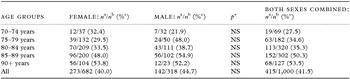
According to the Winblad criteria (Winblad et al., Reference Winblad2004), 27.8% of the sample had MCI. In further analyses, MCI are analyzed as part of the group without dementia. Dementia according to the ICD-10 criteria was present in 415 persons (41.5%) of the sample. Of these, 81 persons (19.5%) had a diagnosis of dementia that was known to the participant, their next of kin or registered in the chart records of the domiciliary care services. Of those participants who received nursing and social care and of those who received only social care, the prevalence of dementia was respectively 51.8% and 20.4% (χ 2 = 88.213, p < 0.001). The mean MMSE score was 24.5 (SD 4.8), mean IQ-CODE score was 3.5 (SD 0.6), 28.0% had CDR ≥1. Table 1 demonstrates that the prevalence of dementia was independent of sex, and increased with age. In the youngest group (aged 70–74 years) 27.5% had dementia, whereas 53.5% in the oldest group (aged 90+ years) had dementia.
The prevalence of dementia among older people who receive domiciliary care sorted by sex and age groups (N = 1,000)

aNumber of participants in age group with dementia.
bNumber of participants in age group.
cProportion of participants in age group with dementia.
*Pearson chi-square test.
Neuropsychiatric symptoms
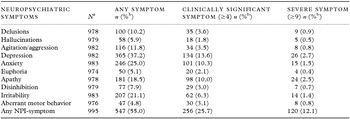
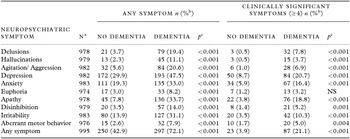
At least one NPS was present in 55.0% of the total sample, 72.1% and 42.9% in people with and without dementia, respectively (χ 2 = 83.188, p < 0.001). The highest NPI sum score in the sample was 75 and 448 persons had no NPSs. Depression (37.2%), anxiety (25.0%), and irritability (21.1%) were the most frequent NPSs. One or more clinically significant symptom defined as an NPI score ≥4 on a single item was exhibited by 25.7%. One or more severe symptoms (defined as a score ≥9 on a single NPI item) were exhibited by 12.1% of the sample (Table 2). All the individual NPSs were more frequent in participants with dementia than in those without dementia (Table 3).
The prevalence of neuropsychiatric symptoms (NPSs) at different levels of severity among older people who receive domiciliary care (N = 1,000)

aNumber of patients with complete data.
bPercentage among patients with complete data.
The prevalence of neuropsychiatric symptoms among older people with and without dementia who receive domiciliary care (N = 1,000)

aNumber of patients with complete data.
bPercentage among patients with and without dementia.
cPearson chi-square test.
Use of psychotropic drugs
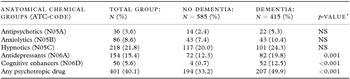
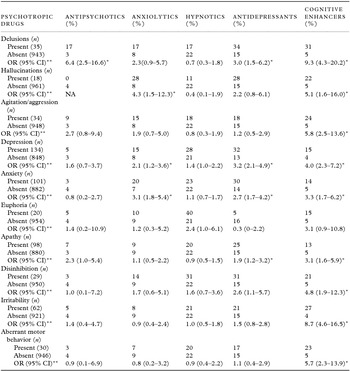
The use of psychotropic drugs is presented in Table 4. Of the participants, 40.1% were prescribed psychotropic drugs on a regular basis. The participants were prescribed up to five different types of psychotropic drugs. A larger proportion of those with dementia than those without dementia (49.9% vs. 33.2%, χ 2 = 28.246, p < 0.001) were prescribed psychotropic drugs. Antidepressants and antipsychotic drugs were more often given to people with dementia than to those without dementia.
The use of psychotropic drugs in older people with and without dementia who receive domiciliary care (N = 1,000)

*Pearson chi-square test.
Table 5 shows associations between the different NPSs and the use of psychotropic drugs. The use of antipsychotics was associated with delusions, anxiolytics with hallucination, depression, and anxiety. The use of hypnotics was not associated with any NPS, while cognitive enhancers were associated with all the NPSs except euphoria. The use of antidepressants was associated with delusions, depression, anxiety, and apathy.
The use of psychotropic drugs among older people who receive domiciliary care with clinically significant (≥4) neuropsychiatric symptoms (NPSs). In all comparisons, symptom absence is set as reference group

*p ≤ 0.01, Pearson chi-square test, df = 1.
**Mantel-Haenszel Common Odds Ratio (OR).
Note: NA = not applicable.
Discussion
This is the first Norwegian community-based study to systematically investigate the prevalence of dementia and NPSs among older people receiving domiciliary care. Few international studies have studied this group, which probably represents the majority of future nursing-home placements. In order to link findings to previous research, the results are compared to prevalence rates in the general population and in the nursing home population. When interpreting the findings, it is important to keep in mind that this sample receives some kind of domiciliary care.
The results show, as expected, that the prevalence of dementia increases with age. Participants aged 70–74 years have six times higher prevalence, participants aged 80–84 years show almost three times higher prevalence, while the oldest group (90+ years) shows a 10% higher prevalence compared to results reported in a recent systematic review (Prince et al., Reference Prince, Bryce, Albanese, Wimo, Ribeiro and Ferri2013). This review estimates dementia to be present in 7.2% of the general population above 60 years in Europe and report ten times higher prevalence rates (43.1% vs. 4.3%) in the oldest group (90+ years) compared to the group aged 70–74 years (Prince et al., Reference Prince, Bryce, Albanese, Wimo, Ribeiro and Ferri2013). In the present sample, the prevalence of dementia is almost twice as high (53.5% vs. 27.5%) in the oldest group. This suggests that people of 70–74 years with a decline in cognitive functioning are more likely to be in need of domiciliary care and people of 90+ years are offered nursing-home placements rather than domiciliary care. In the oldest age group, a bigger proportion of the general population also needs some kind of help, which might explain the reduced gap in prevalence above 90 years.
Selbaek et al. (Reference Selbaek, Kirkevold and Engedal2007) found that 80.5% of residents in nursing homes had dementia, which is twice as high as the prevalence of dementia in the present sample. The present results are in line with earlier research (Luppa et al., Reference Luppa, Luck, Brahler, Konig and Riedel-Heller2008; Okura et al., Reference Okura, Plassman, Steffens, Llewellyn, Potter and Langa2011; Lopez et al., Reference Lopez2013), which define cognitive impairment, type, and severity of dementia and NPSs to be important predictors for nursing-home placement.
The results of the present study demonstrate that dementia and NPSs are common among people who receive domiciliary care. A dementia prevalence rate of 41.5% suggests that municipalities in Norway already offer domiciliary care to many people suffering different stages of dementia. Dementia and NPSs are still not the main reason for offering a service, as it is mostly devoted to the care of physical disabilities, practical assistance or medical treatment (Finnvold, Reference Finnvold1997). Frailty, poly-pharmacy, NPSs (Monastero et al., Reference Monastero, Palmer, Qiu, Winblad and Fratiglioni2007), and functional limitations (Okura et al., Reference Okura, Plassman, Steffens, Llewellyn, Potter and Langa2010) are all associated with cognitive impairment and dementia. Cognitive function and NPSs are not assessed with the same thoroughness in domiciliary care (Selbaek and Høgset, Reference Selbaek and Høgset2010). Clinicians should be aware of the impact dementia and NPSs have, on decisions in everyday life and what support families need in order to continue co-living with their affected family member.
The low disclosure and diagnosis of dementia in this sample (19.5%) compared to the nursing home population (55.0%) (Selbaek et al., Reference Selbaek, Kirkevold and Engedal2007) indicates that general practitioners (GPs) have either avoided diagnosing their patient's cognitive impairment or omitted to communicate a diagnosis to the patient's family or partners in the health service. Where GPs have made a diagnosis, it is important that this is imparted to those affected by it. This enables family and health workers to agree upon decision making when it comes to how to meet NPSs in everyday life, evaluate the use and effects of psychotropic treatment, and tailor the domiciliary care offered to older people with dementia. Mutual decisions on such challenges might reduce caregiver's distress and enhance cognitive and psychological well-being of the older person.
In contrast to reports of dementia being more prevalent among females (Juncos-Rabadan et al., Reference Juncos-Rabadan2012), results from the present study show no difference between the sexes. Selection effects are likely to explain the findings.
The findings confirm NPSs to be highly related to dementia and show all the NPSs to appear more frequently among people with dementia. Depression (37.2%), anxiety (25.0%), irritability (21.1%), and apathy (18.5%) are in line with the international literature (Lyketsos et al., Reference Lyketsos, Lopez, Jones, Fitzpatrick, Breitner and Dekosky2002; Selbaek et al., Reference Selbaek, Kirkevold and Engedal2007; Geda et al., Reference Geda2008; Steinberg et al., Reference Steinberg2008), the most common symptoms. Frequencies of any symptom (55.0%), clinically significant (≥4) symptoms (25.7%) and severe (≥9) symptoms (12.1%) are lower than frequencies reported in Norwegian nursing-home patients (73.8%, 65.2% and 29.2% respectively; Selbaek et al., Reference Selbaek, Kirkevold and Engedal2007).
Despite some methodological differences, the results are comparable to several other studies (Lyketsos et al., Reference Lyketsos, Lopez, Jones, Fitzpatrick, Breitner and Dekosky2002; Geda et al., Reference Geda2008; Okura et al., Reference Okura, Plassman, Steffens, Llewellyn, Potter and Langa2010) that show NPSs to be less frequent in people without dementia than in people with cognitive impairment/dementia. This raises the question of whether cognitive deficits, dementia, and NPSs are sufficiently prioritized and systematically addressed when older people and their families consult the domiciliary care service. In order to reduce and treat neuropsychiatric symptoms, early detection, diagnosis, and knowledge about consequences of both the disease and the use of psychotropic drugs are important and feasible measures in community healthcare. High psychotropic prescriptions and low disclosures of dementia in this study actualize to what degree the older person is able to give informed consent about treatment with psychotropic drugs and to what extent GPs should include family on decision making in such decisions. Organizing health services, which systematically address such issues, is a first important step to understanding, managing, and intervening in the psychopathology of dementia, regardless of etiological or comorbid explanations. Such an approach could strengthen support for family caregivers and enable the person with dementia to stay at home as long as possible.
It is encouraging to report close associations between the presence of NPSs and the prescription of different psychotropic drugs dispensed for the symptom, even though it is difficult to interpret such associations in an analysis based on cross-sectional data. The prescriptions of anxiolytics (8.6%), antidepressants (15.4%), and antipsychotics (3.6%) were considerably lower than prescriptions of the same drugs in nursing homes (21.9%, 50.9% and 23.4%, respectively; Ruths et al., Reference Ruths2013). Recent studies show that NPSs is associated with time to institutionalization and death (Lopez et al., Reference Lopez2013) and that discontinuation of antipsychotics has negative effects on quality of life (Devanand et al., Reference Devanand, Pelton, Cunqueiro, Sackeim and Marder2011). This might make older people and their families prefer to have NPSs medicated at home in order to postpone institutionalization as long as possible. These findings must however be weighed against data showing uncertain efficacy as well as increased risk of serious adverse events associated with antipsychotic drug use (Ballard et al., Reference Ballard2009). The difference in the prevalence of dementia, NPSs, and prescription rates of psychotropic drugs in nursing homes compared to the present sample raises the question of whether dementia and the presence of NPSs are important predictors of nursing-home placements or whether dementia and NPSs are getting worse as a consequence of institutionalization. More research is needed into these questions.
The results of this study confirmed the supposition that prevalence of cognitive impairment, dementia, and NPSs among older people receiving domiciliary care is higher than in the general population and lower than in the nursing-home population. The study's strengths includes a randomly selected, large number of study participants from different counties in Norway, ensuring a sample representative of persons aged 70+ years receiving domiciliary care. The use of well-established assessment scales in an authentic clinical environment in the municipality enables comparisons. The structured face-to-face interviews with the participants and their next of kin simultaneously strengthen the information that was collected.
Limitations that should be considered are the fact that many assessors with different experience in using screening instruments were engaged in order to collect data from many municipalities. However, all the assessors completed comprehensive and standardized training prior to the data collection and all of the assessors were familiar with observing and cooperating with older people and their families in their homes. Participants in the study were selected on the basis of receiving a service from the municipality, so this clinical sample may not be representative of the general population aged 70+, but the findings is generalizable to people aged 70+ who receive domiciliary care.
Conclusion
Dementia is highly prevalent among older people receiving domiciliary care. However, only a minority of the people with dementia have a dementia diagnosis known to themselves, their relatives, or the domiciliary care services. People with dementia constitute a distinct group in terms of NPSs and psychotropic drug use, and municipalities offer important domiciliary care services to people suffering different stages of dementia. Early detection and correct diagnosis might increase the understanding of the family's everyday challenges and enable them to alleviate consequences of dementia and NPSs.
Conflict of interest
GS has given lectures at conferences sponsored by pharmaceutical companies. JNW, ØK, US, and LDH declare no conflict of interest.
Description of authors’ roles
GS, JNW, and ØK conceived the project and designed the overall study plan; GS, LDH, ØK, and JNW prepared the dataset and analyzed data; JNW wrote the paper and ØK, GS, and US were supervisors. All authors read and approved the final paper.
Acknowledgments
We are grateful to participating families and staff in the domiciliary care services for help in data collection. The project is made possible by funding from The Norwegian Directorate of Health and by grant 187980 from The Research Council of Norway and Norwegian Centre for Research, Education and Service Development, Innlandet Hospital Trust, and University of Agder.