Introduction
Schistosomiasis remains one of the most prevalent parasitic infections in the world and has significant economic and public health consequences. It is estimated that 200 million people are infected and 600 million people are at risk of infection (WHO, 1993; Chitsulo et al., Reference Chitsulo, Engels, Montresor and Savioli2000).
Three main schistosome species infect humans: Schistosoma mansoni, present mainly in Africa and South America; S. haematobium, found in Africa and the Middle East; and S. japonicum, which is endemic in Asia. Freshwater snails of the genus Biomphalaria play a major role as intermediate hosts in the transmission of S. mansoni. An intense multiplication of parasites occurs in these snails, making strategies to control snail populations a high priority for reduction of schistosomiasis transmission in endemic regions (WHO, 1984; Rey, Reference Rey2008).
At present, niclosamide (Bayluscide®, Bayer, Leverkusen, Germany) is the only commercially available molluscicide recommended by the World Health Organization (WHO) for large-scale use in schistosomiasis control programmes (WHO, 1993). Niclosamide is not toxic to humans, domestic animals or crops, although it is costly and ictiotoxic (WHO, 1973; McCullough & Mott, Reference McCullough and Mott1983). Moreover, it is rapidly decomposed by sunlight and its application does not prevent recolonization of sites by surviving snails, which could lead to selection of molluscicide-resistant populations. Thus, novel natural molluscicidal compounds from plants should be investigated as possible alternatives to synthetic products (Luna et al., Reference Luna, Santos, Lima, Omena, Mendonça, Bieber and Sant'Ana2005).
Members of the Piperaceae family are among a wide variety of species under study. The family comprises 14 genera and 1950 species (Mabberley, Reference Mabberley1997); Piper and Peperomia are the most abundant genera, with approximately 700 and 600 species, respectively (Joly, Reference Joly1993). Plants from the genus Piper are widely distributed throughout tropical and subtropical regions. Brazil has several species and promising studies on biological properties of plants of the Piperaceae family have been published (Navickiene et al., Reference Navickiene, Alécio, Kato, Bolzani, Young, Cavalheiro and Furlan2000; Danelutte et al., Reference Danelutte, Lago, Young and Kato2003, Reference Danelutte, Constantin, Delgado, Braz-Filho and Kato2005; Cysne et al., Reference Cysne, Canuto, Pessoa, Nunes and Silveira2005; Yamaguchi et al., Reference Yamaguchi, Lago, Tanizaki, Masuo and Kato2006).
Phytochemical investigations on Piper species have revealed many bioactive compounds such as amides, alkaloids, lignans, benzoic acids and chromenes (Parmar et al., Reference Parmar, Jain, Bisht, Jain, Taneja, Jha, Tyagi, Prasad, Wengel, Olsen and Boll1997; Alécio et al., Reference Alécio, Bolzani, Young, Kato and Furlan1998; Navickiene et al., Reference Navickiene, Alécio, Kato, Bolzani, Young, Cavalheiro and Furlan2000; Silva et al., Reference Silva, Navickiene, Kato, Bolzani, Meda, Young and Furlan2002). Chromenes and benzoic acid derivatives are frequently isolated from Piper species showing antimicrobial, antitumoral, germination inhibition, fungicidal (Nair & Burke, Reference Nair and Burke1990), insecticidal (Miranda et al., Reference Miranda, Oliveira, Rocha, Bortoli, Navickiene, Kato and Furlan2002) and anti-leishmania activities (Torres-Santos et al., Reference Torres-Santos, Moreira, Kaplan, Meirelles and Rossi-Bergmann1999). In the case of molluscicidal activity, only a few reports have addressed Piper species, including essential oil from P. marginatum (Rouquayrol et al., Reference Rouquayrol, Fonteles, Alencar, Matos and Craveiro1980) and P. tuberculatum (Sousa & Rouquayrol, Reference Sousa and Rouquayrol1974), chromenes and benzoic acid from P. aduncum (Orjala et al., Reference Orjala, Erdelmeier, Wright and Sticher1993a, Reference Orjala, Erdelmeier, Wright, Rali and Sticherb) and extracts from P. cubeba (Pandey & Singh, Reference Pandey and Singh2009).
In spite of the variety of secondary compounds described, no systematic evaluation of molluscicidal activity of Piperaceae extracts has been carried out. Thus, in this work, several crude extracts were assessed regarding molluscicidal and ovicidal properties.
Materials and methods
Molluscicidal and ovicidal assays were performed according to the methodology recommended by World Health Organization (WHO, 1965, 1983) and experimental procedures were employed according to accepted principles of animal welfare in experimental science.
Adults and egg masses were obtained from the population of Biomphalaria glabrata (Say, 1818) originally from Belo Horizonte, MG, Brazil and reared under laboratory conditions for several years, fed with fresh lettuce ad libitum and a balanced ration.
Plant material
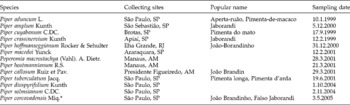
Fresh material of each species (table 1) was collected by Dr Massuo Jorge Kato and identified by Dr Elsie F. Guimarães from Instituto de Pesquisas Jardim Botânico do Rio de Janeiro and vouchers were deposited in the Herbarium of Jardim Botânico do Rio de Janeiro.
Piperaceae species screened for molluscicidal activity in B. glabrata.

Selected part for all species, leaves; * stem, leaves and roots. S, São Paulo; RJ, Rio de Janeiro, AM, Amazonas.
Preparation of plant extracts
Selected parts (table 1) of freshly collected plant material were separated, immediately air dried and finally dried in an oven at 45°C. Material was ground and powdered materials were extracted with dichloromethane:methanol (2:1) at room temperature (25–27°C) three times and filtered. Extracts were evaporated to dryness under vacuum in a rotoevaporator and stored at − 20°C.
A stock solution containing 1000 ppm of each extract was prepared by suspending 10 mg of extract in 0.1 ml of 99.9% dimethylsulphoxide (DMSO; Aldrich, Milwaukee, Wisconsin, USA) and making up to 10 ml with dechlorinated water. Stock solutions were diluted with dechlorinated water in order to provide assay solutions.
Assays for molluscicidal/ovicidal activities of plant extracts
Molluscicidal activities of extracts against adults of B. glabrata were determined according to previously described procedures (WHO, 1965, 1983). Snails with 10–18 mm shell diameter were exposed to test compounds for 24 h. After exposure, snails were washed and observed daily for 10 days to record the death rate. A negative control group was maintained in dechlorinated tap water containing 1% DMSO under the same experimental conditions. Bayluscide WP70® was used as a positive control. Extracts were tested first at concentrations of 500 and 100 ppm and those inactive were not investigated further. LC90 was determined for all selected extracts with ten animals per dose group, and experiments were repeated three times.
Based on values of LC90 for adults, egg masses with embryos at blastula stage (Camey & Verdonk, Reference Camey and Verdonk1970) were exposed to lethal concentrations of extracts for 24 h. At the end of exposure, egg masses were washed and observed for mortality daily for 7 days. Assays were repeated three times with about 100 embryos for each concentration. A control group was maintained in dechlorinated water containing 1% DMSO under the same experimental conditions.
Data analysis
LC90 was obtained from the logistic regression adjustment using a log-dose transformation. This corresponds to a maximum likelihood estimated for the logodds in a multinomial probability model.
Results
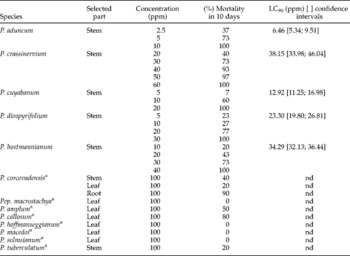
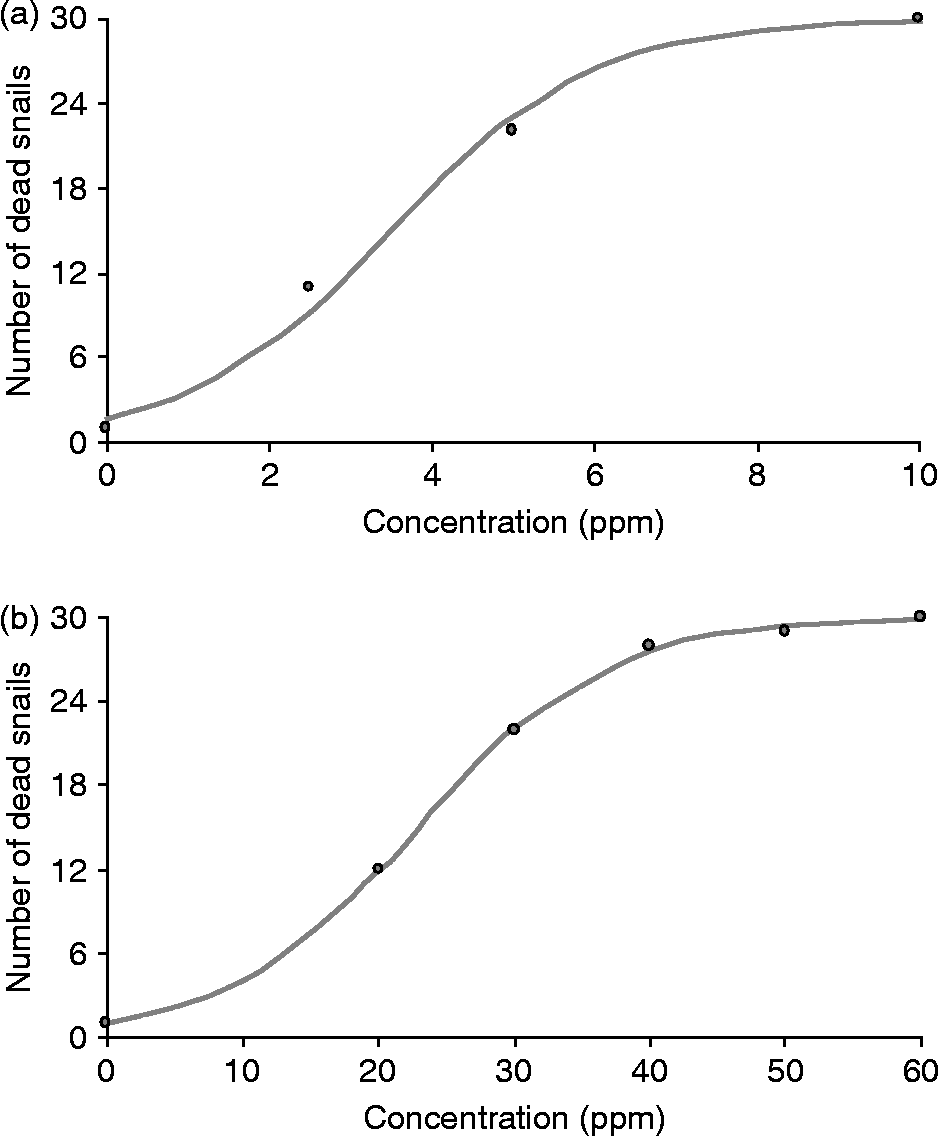
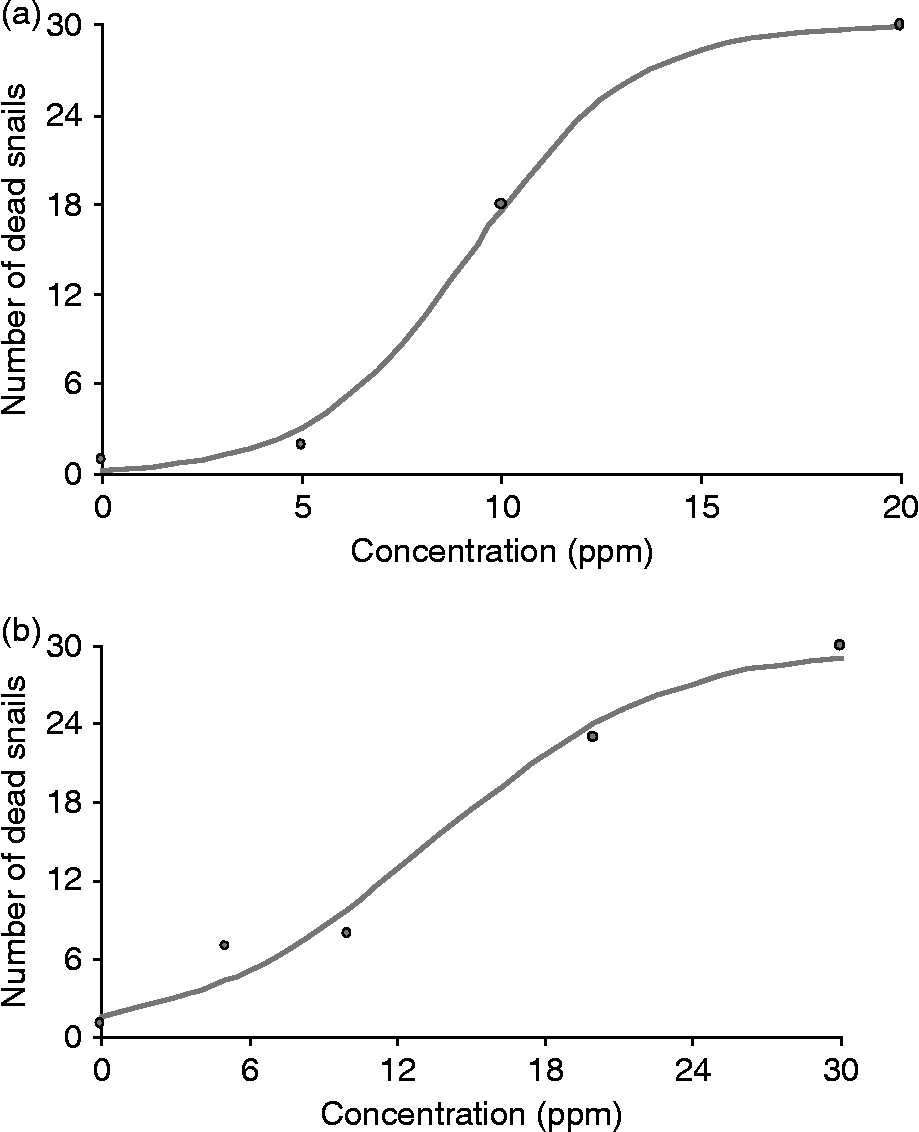
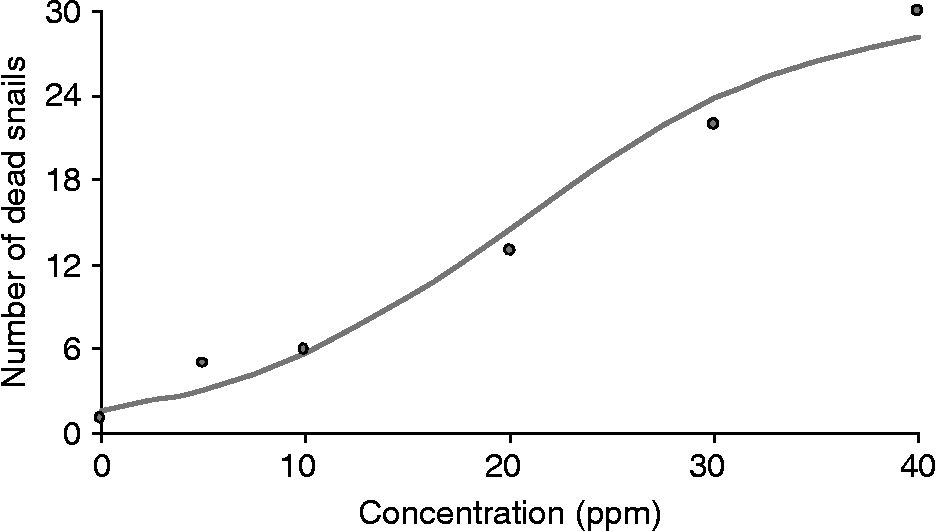
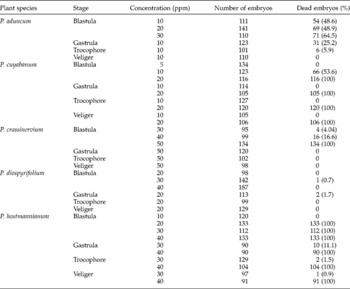
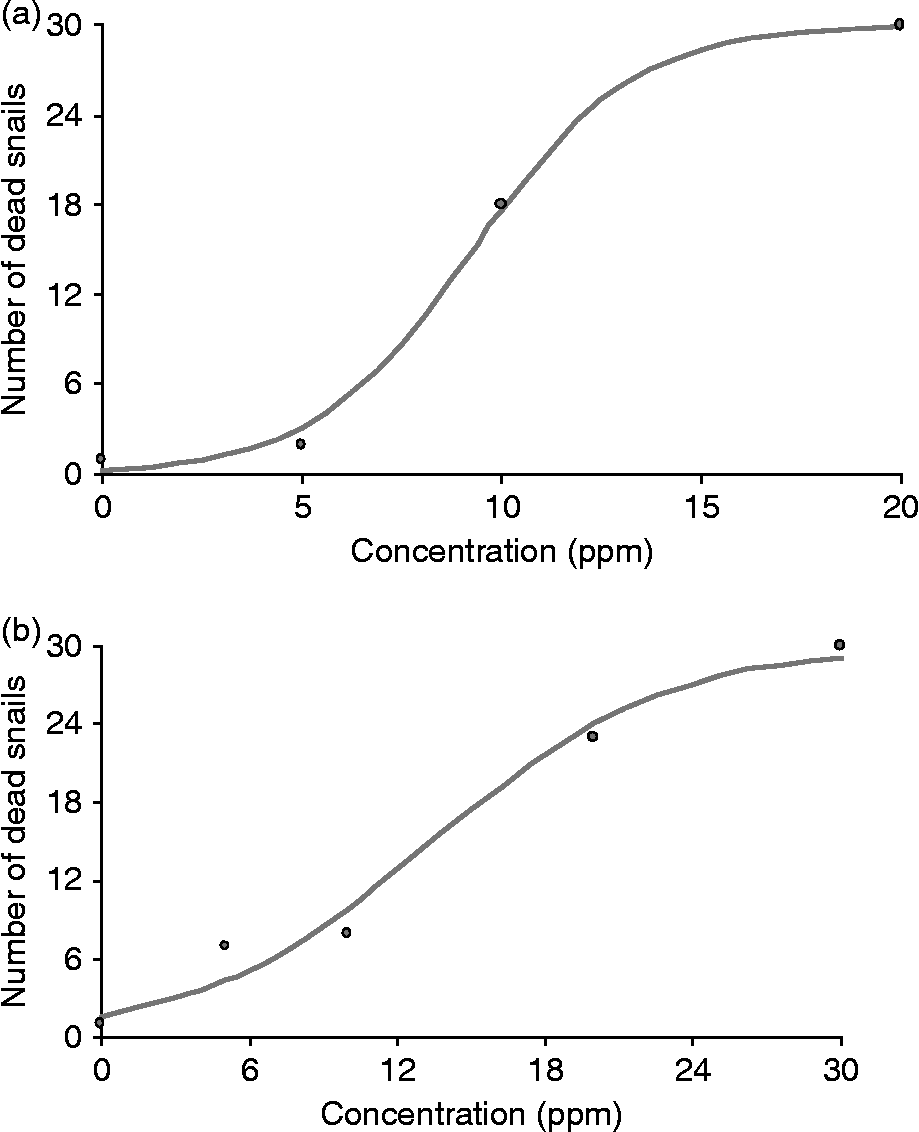
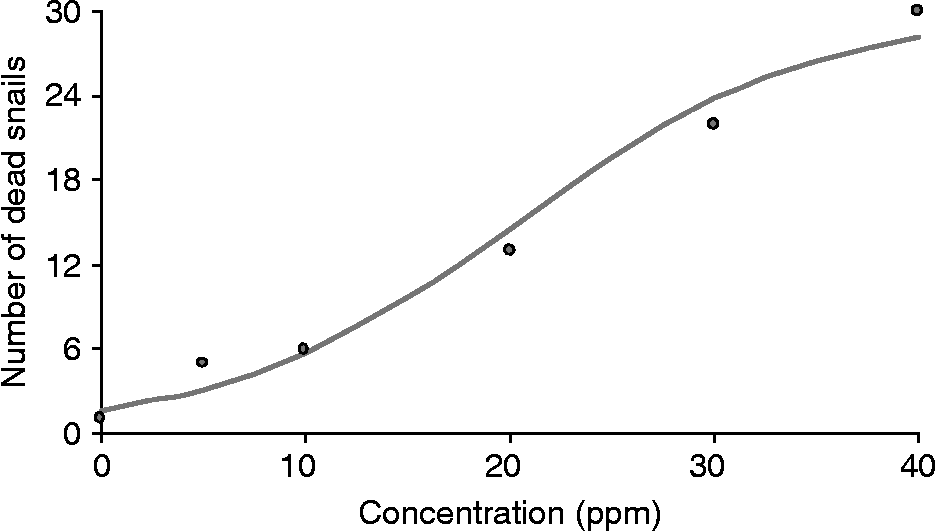
All extracts were 100% lethal to B. glabrata at 500 ppm but at 100 ppm, only leaf extracts of P. aduncum, P. crassinervium, P. cuyabanum, P. diospyrifolium and P. hostmannianum showed 100% lethality during 24 h of exposure, so the LC90 (table 2, figs 1–3) and ovicidal activity (table 3 and fig. 4) of these extracts were determined. Leaf extracts of Pep. macrostachya, P. hoffmanseggianum, P. macedoi and P. solmsianum did not show molluscicidal activity at 100 ppm; but mortality obtained with extracts of P. corcovadensis (stem, leaf and root), P. amplum (leaf), P. callosum (leaf) and P. tuberculatum (stem) reached a maximum of 90% at 100 ppm (table 2). The percentage of dead snails in the control group over 10 days of observation was 3.3% while dead embryos in control groups over 7 days were 1.6%.
Molluscicidal activity of Piperaceae extracts in adult B. glabrata.

n = 30 adult snails; Pep., Peperomia.
a n = 10 adult snails.
Estimated mortality of B. glabrata exposed to (a) P. aduncum leaf extract; (b) P. crassinervium leaf extract; logistic tendency function.
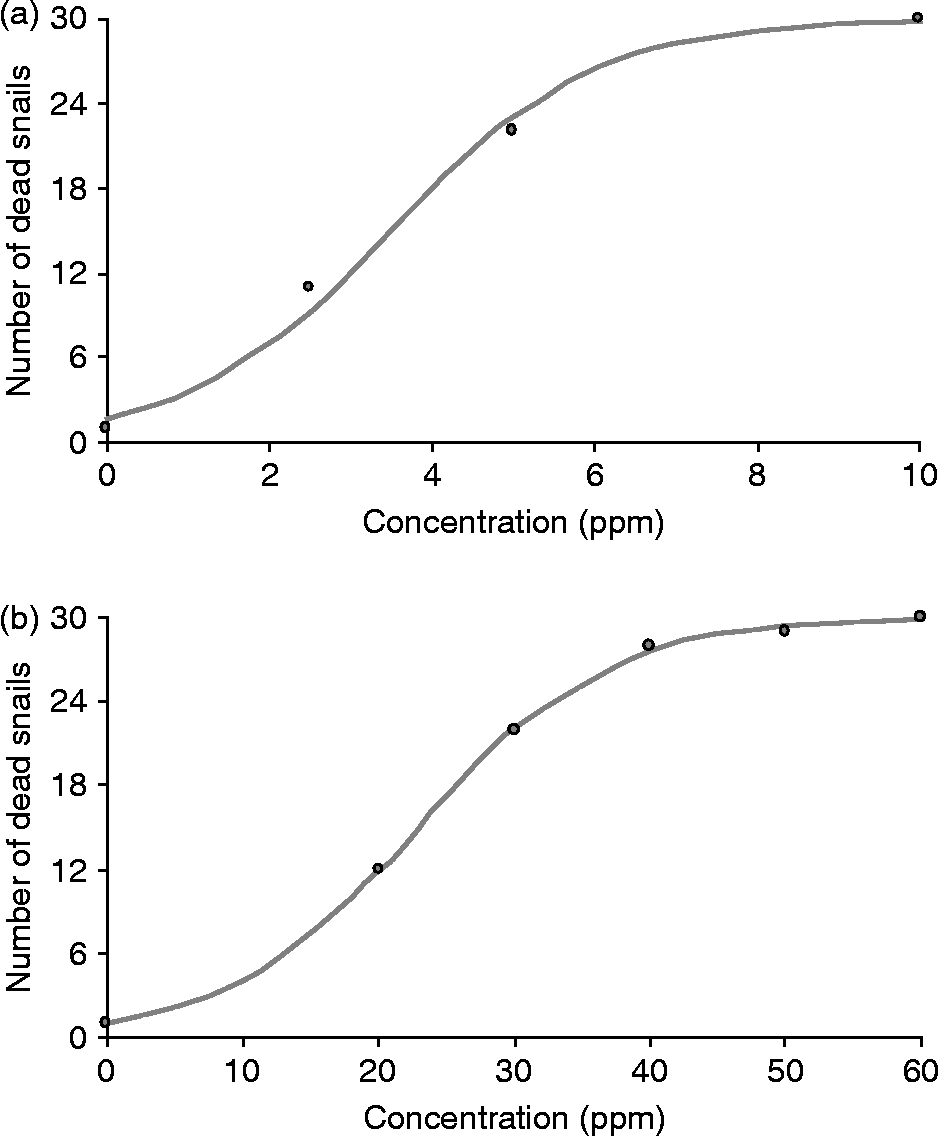
Estimated mortality of B. glabrata exposed to (a) P. cuyabanum leaf extract; (b) P. diospyrifolium leaf extract; logistic tendency function.
Estimated mortality of B. glabrata exposed to P. hostmannianum leaf extract; logistic tendency function.
Effect of leaf extracts from P. aduncum, P. cuyabanum, P. crassinervium, P. diospyrifolium and P. hostmannianum on B. glabrata embryos.

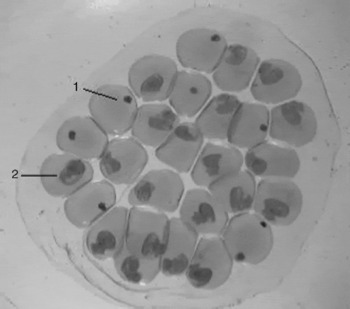
Embryos of B. glabrata after exposure at blastula stage to 10 ppm of P. cuyabanum leaf extract. 1, Dead embryo; 2, normal embryo at veliger stage.

Discussion
All 15 extracts from Piperaceae species were active with 100% mortality at 500 ppm. WHO (1983) recommends that a crude preparation of plant material should be active at 100 ppm or less and kill 90% of snails exposed for 24 h. Leaf extracts of P. aduncum, P. crassinervium, P. cuyabanum, P. diospyrifolium and P. hostmannianum were active at concentrations of less than 100 ppm, which make them good candidates for natural molluscicides (WHO, 1965, 1983).
Adult snails showed a similar response to extracts with molluscicidal action. A common feature was low values of LC90 associated with death during 24 h of exposure. At the highest concentrations, death occurred in the first hours of exposure. Release of haemolymph was also frequently observed and occurred in a dose–response manner. It is quite often associated with rupture of external membranes, but haemolymph could also be liberated through the haemal pore (Duncan, Reference Duncan1985). At present, information on the mode of action of molluscicides is scarce. As is true for most insecticides, the action of a molluscicide may conceivably be a multi-component process affecting more than one system. Several such responses indicative of this have been reported in the literature, for example a reduction in heart rate, swelling of tissues and alteration of water balance have been described (WHO, 1983). In our work, active extracts caused death after around 4 h of exposure, differing significantly from the action of the molluscicide Bayluscide WP70® which induces death only after 24 h, even at 100% lethal concentrations. The efficient molluscicide action observed in our study requires further investigation in order to unravel the possible mechanism of action for toxicity against B. glabrata.
Among the five selected Piperaceae extracts, P. crassinervium, P. cuyabanum and P. hostmannianum showed similar activity in adults and embryos. Sensitivity was inversely proportional to developmental stage. Mortality was highest in embryos at blastula stage, followed by gastrula, trocophore and veliger stages. This higher sensitivity could be attributed to intense cell proliferation activity at early stages; previous studies also showed a differential sensitivity according to developmental stages (Kawano et al., Reference Kawano, Chaves and Simões1979; Kawano & Simões, Reference Kawano and Simões1987; Kawano et al., Reference Kawano, Simões and Marques1991; Yamamoto et al., Reference Yamamoto, Kawano, Young, Haraguchi and Hiroki1996).
Piper aduncum was more active in adults than in embryos. A similar profile was observed with crude extracts and steroidal glycoalkaloid fraction of Lycopersicon esculentum, which showed high activity in adults and low effect in embryos (Leyton et al., Reference Leyton, Henderson, Mascara and Kawano2005). Similar results were obtained in B. glabrata, B. alexandrina and Bulinus truncatus in a study of the molluscicidal effect of Phytolacca dodecandra (Lemma et al., Reference Lemma, Goll, Newell, Parkhurst and Skinner1972). Pereira et al. (Reference Pereira, Souza and Mendes1978) evaluated a leaf extract of Euphorbia cotinifolia and observed an effect in B. glabrata embryos with 48 ppm, a concentration about 20 times higher than the 2.4 ppm observed to have an effect on adult specimens.
Piper diospyrifolium did not show molluscicidal activity in embryos at concentrations evaluated in adults. On the other hand, P. amplum was highly effective in embryos (LC90 of 8.8 ppm) despite its low activiy in adults (Teixeira, Reference Teixeira2004).
In a comprehensive screening, the highest proportions of molluscicidal species were detected in Euphorbiaceae, Asteraceae, Leguminosae, Phytolaccaceae, Polygonaceae, Rubiaceae and Rutaceae species (WHO, 1983; Kloos & McCullough, 1987). Jurberg et al. (Reference Jurberg, Vasconcellos and Mendes1989) describe active extracts from two species of Euphorbiaceae. In our study, five out of 13 Piperaceae species fulfilled the practical criterion for activity against B. glabrata. Based on results obtained with Piper extracts, further studies with P. aduncum, P. crassinervium, P. cuyabanum, P. diospyrifolium and P. hostmannianum should be carried out, looking at the isolation of bioactive compounds. At present, molluscicidal activity of P. aduncum and P. diospyrifolium fractions are being assessed. Concomitantly, we are perfoming bioassays with Daphnia similis and Ceridaphnia dubia to evaluate acute and chronic toxicity of bioactive compounds isolated from the selected Piper extracts. Cladoceran species have been used extensively; they have several advantages, such as high sensitivity and short reproductive cycles (Farre & Barcelo, Reference Farre and Barcelo2003). Inclusion of safety testing will ascertain whether toxic effects on non-target organisms are at acceptable levels.
Acknowledgements
This work was supported by Fundação de Amparo à Pesquisa do Estado de São Paulo (FAPESP) and Conselho Nacional de Desenvolvimento Científico e Tecnológico (CNPq).