In Dr. Doris Derby's self-published book, Poetagraphy: Artistic Reflections of a Mississippi Lifeline in Words and Images: 1963–1972 (2019), she states that “as a young woman not in the military but fighting in the troops of the Civil Rights Movement, I lived in a war zone for nine years in the southern parts of the American homeland.”Footnote 1 Within this “war zone,” one of Derby's many weapons of choice was a camera. Although Derby took on many roles during the movement – from educator to theatre maker to field secretary – her photographic work warrants specific consideration. During the movement, Derby took “thousands of photographs on so many topics.”Footnote 2 Although Derby's work has been featured in exhibitions around the world, and included in several photographic collections of the civil rights movement, the full significance and power of Derby's rich photographic archive has yet to be critically engaged with.Footnote 3 In particular, there is a significant lack of any academic scholarship considering Derby's photographic works. Examining Derby's photography in more depth does not just illuminate the work of a significant figure within the civil rights movement; it also challenges the largely male-dominated photographic canon. Crucially, Derby's womanist perspective emphasizes the role of African American women as agents of change, challenging a visual rhetoric that continues to overlook women. Through Derby's symbiotic relationships with womanism, community, and activism, these photographs offer an African American woman's perspective on the everyday realities of the civil rights movement in Mississippi. As such, this article utilizes the photography of Doris Derby to challenge the visual rhetoric of the civil rights movement, contest how African American women's everyday activism is visualized and remembered, and explore Derby's womanist approach as it pertains to photography.
When the Road to Freedom: Photographs of the Civil Rights Movement 1956–1968 was held at the High Museum of Art, Atlanta, in 2018, activist John Lewis was surprised to see the work by his colleague Doris Derby included. According to photographer Danny Lyons, Lewis commented, “I didn't know she took pictures.”Footnote 4 Lewis and Derby had worked alongside each other, and yet Lewis was not aware that photography was such a key facet of Derby's activism.Footnote 5 This exchange attests to the intriguing position of Derby's photographic work – Derby has an archive of imagery and a history as a photographer that has been unrecognized for decades, even by some of the most key figures of the civil rights movement. Within this exhibition collection, Doris Derby was the only African American woman whose work was exhibited, and one of only two women.
Examining most collections of civil rights movement photography reveals a similar lack of women photographers, and especially African American women photographers. Studying six collections of photography, women photographers make up only 5 percent of all photographers in these collections, whereas 82.5 percent are men.Footnote 6 African American women make up only 0.89 percent of the total.Footnote 7 Although there are undoubtedly other cultural factors meaning that it would have been difficult for African American women to carry cameras into protests – such as economic factors and the increased threat of violence – the focus on images generated by men risks excluding valuable perspectives. For instance, Steven Kasher's The Civil Rights Movement: A Photographic History, 1954–1968 (1996) powerfully combines imagery and text to convey a rich history of the movement, yet it largely excludes the photography of women. Of the photographers in the text Kasher states that “their pictures almost always convey the sense that they were photographing their own leaders, their own enemies, their own fellow victims,” yet follows this with a list of all-male photographers including Gordon Parks, Ernest Withers, and Bob Fletcher.Footnote 8 Within this text, Kasher defines “their” as “male.”
The study of African American women and photography in the civil rights movement has evolved significantly since Kasher's 1996 text. Multiple photographic works offer important reappraisals of the photographic archive of the era: Mark Speltz highlights civil rights activism outside the South; Don Carleton furthers ideas of the “long” movement by considering the “most iconic images taken between the 1930s and 1970s”; and Martin Berger highlights photographs of frequently overlooked subjects (including women and children) that are largely omitted from photographic canon.Footnote 9 These photographic collections challenge a simple “master narrative” approach, focussed on charismatic male leaders and iconic events, that continues to dominate much public history of the movement.Footnote 10 Yet whilst these works advance the photographic archive of the movement, they nevertheless continue to focus on the works of male photographers. Although scholars such as Leigh Raiford have emphasized the key role of photography within the movement, the role of African American women as photographers remains underdeveloped.Footnote 11
Outside their photographic contributions, the fact that African American women were the backbone of the civil rights movement has been well established in scholarship.Footnote 12 Their activism often existed in grassroots activities and organizing, operating through networks with other African American women, as they negotiated the “politics of respectability” that dictated their conduct within the movement.Footnote 13 The frequently gendered labour which they undertook – including more everyday actions such as teaching and volunteering – have been framed by historians such as Kristal Moore Clemons as acts of protest.Footnote 14 The activist consciousness of black women was shaped not just on the streets, in terms of marches or boycotts, but in spaces such as churches and beauty shops.Footnote 15 Figures such as Fannie Lou Hamer, Ella Baker, and Septima Clark have been recognized as leaders of the civil rights movement, as the role of women as leaders was long neglected in favour of notions of charismatic male leadership.Footnote 16 Yet this turn in scholarship has not been reflected in photographic depictions of the movement.
The most canonical images of the movement often fail to accurately reflect the experiences of black women in the civil rights movement. Berger notes, “women and young people appear in surprisingly few of the famous images of the civil rights struggle given the key role they played in advancing the cause.”Footnote 17 This is in part due to a visual rhetoric preoccupied with charismatic male leadership and scenes of violence or conflict, which the mainstream press of the time were more likely to print. Where women do appear in photography, Berger asserts that they tend to be engaged in acts of “passive resistance,” wherein they are presented as harmless figures in need of protection, such as in famous images of Ruby Bridges, Rosa Parks, and Elizabeth Eckford.Footnote 18 Although these images and activistic contributions were important, making such images the cornerstone of African American women in the movement's photographic canon does a disservice to women's organizing. African American women photographers such as Doris Derby tend to portray other black women with more agency and authority within the movement.
Instead of revealing this activism, the dominant photographic canon of the civil rights movement frequently privileges charismatic male leadership and appeals to liberal white audiences. The dominance of figures such as Martin Luther King Jr. in public memory creates a simpler narrative of the movement centralized around one figure.Footnote 19 Although the figures who were at the forefront should be celebrated, to make this the most visible strand of the movement risks erasing the contributions of thousands of other individuals, especially women. Furthermore, a simplistic narrative of peaceful black protest juxtaposed against white violence is frequently presented. Berger argues that “a few famous photographs have for many years defined the popular story told about the civil rights struggle: dignified black protestors passively resisted the laws and social conventions of South white society and suffered, with stoicism, unwarranted attacks by white mobs and police.”Footnote 20 These simplistic narratives not only create an uncomplicated perspective that belies the deeply entrenched and insidious power structures designed to keep African Americans without rights, but also remove the agency from African American activists as they imply that “whites, and not blacks, held the power needed to set the pace and establish the extent of reform.”Footnote 21 Therefore, as Sara Wood argues, acts of everyday resistance are sidelined in favour of dramatic events.Footnote 22 It is within this context that the photography of Doris Derby intervenes, decentring the white gaze and championing the everyday activism of the grassroots men and women of the movement.
To briefly summarize Derby's career is an almost impossible endeavour, as her experiences have encompassed multiple different strands of activism. Indeed, Derby herself remarked in 2018,
My history is long, and my life had a lot of paths always, so not just one path going one way. I always had a lot of streams coming together, which would be art, activism, scholarship and community. And I was gifted to have that kind of influence and ability to see the importance of them all coming together. A lot of times people like to just segment one aspect and that's it, but it's always been in my mind that it reveals the interconnectedness of our life and culture and history.Footnote 23
Derby's interconnectedness to multiple modes of expression and protest can be seen throughout her life. A native New Yorker who was born in 1939, Derby's childhood interests included dance, visual culture, and advocating for black representation and rights. Derby joined the National Association for the Advancement of Coloured People (NAACP) at the age of sixteen and “realized very early on that we were not represented visually and historically as black people. Persons of African descent. And I felt like this needed to change.”Footnote 24 She graduated from Hunter College in 1962 and joined the Student Nonviolent Coordinating Committee (SNCC) in 1962. After participating in the March on Washington (1963), Derby moved to the South and spent the next decade working in Mississippi, Georgia, and Alabama. Whilst she was there, Derby's achievements and activities were numerous: cofounding the Free Southern Theatre in 1963, working as a teacher in SNCC's Adult Literacy Project, working with the Liberty House Handcraft Marketing Cooperatives, being involved with documentary and film group Southern Media, Inc., and serving as a field secretary for SNCC. Following her decade of work, Derby returned to education at the University of Illinois at Urbana–Champaign and, between 1972 and 1980, she earned her PhD in cultural and social anthropology, specializing in African American studies. Derby subsequently worked as an academic at multiple institutions, including Georgia State University, and continued both her activism and her advocacy of African American rights. From 1966, with the establishment of Southern Media, Inc., Derby documented her experience in the South with the camera, and created a record of those around her.
Derby's choice to incorporate photography into her activism came from her long relationship with visual culture. From a young age, Derby “became very much into visual art. Film and painting. And my girlfriends and I, we would go to the movies every Saturday – so I was very much interested in the visual representation as were many people, many blacks. Why aren't we on screen?”Footnote 25 Derby adopted many visual mediums in order to express herself, including painting. Derby's experience painting, and her practice at composition, equipped her with the skills to create impactful images: Derby states that “the painting, from a visual perspective, and the photographs, went hand-in-hand. I developed my painting by studying people, particularly black people and families, especially women and children. I later translated that into photography.”Footnote 26 Her trajectory from painting to photography and her photographic prowess are made all the more impressive considering that she was “largely self-taught in the medium.”Footnote 27 That Derby's photographic experience was rooted in both a desire to represent her people and a foundation in a variety of different visual mediums can be seen in both the power and the artistry of her images. As Derby herself stated, “I take the pictures as I see them.”Footnote 28 Yet these pictures have not gained the attention they deserve.
This paper explores how Doris Derby's work challenges the visual rhetoric of the civil rights movement to encompass a womanist perspective, which emphasizes the everyday activism of the movement by focussing on activism within communities at a grassroots level. The term “womanist” is one that has been defined by many activists, with Alice Walker defining a womanist as “a woman who loves other women, sexually and/or nonsexually. Appreciates and prefers women's culture, women's emotional flexibility … and women's strength. Sometimes loves individual men, sexually and/or nonsexually. Committed to survival and wholeness of entire people, male and female.”Footnote 29 Derby has cited this in interviews, stating, “I believe my work with the Movement and indeed my life's journey fall into the womanist tradition as defined by Alice Walker,” and defined her womanist politics as “someone who is responsible, in charge, and serious.”Footnote 30 The connections between Derby and Walker are clear – indeed, Walker posed for Derby, and the subsequent portrait would become the cover image for The World Has Changed: Conversations with Alice Walker (2010). When further questioned on her womanist sensibilities, Derby expanded: “It was a black woman working alongside of and in conjunction with her family and her community to develop the community, to bring our people forward.”Footnote 31 Hence Derby's perspective as a womanist does not entirely exclude men, and also links to her focus on community and activism in her work. In particular, Derby's images represent an activism of the everyday that engages with the intersection between the public and private-facing protests of African Americans, and particularly African American women. Patricia Hill Collins describes “Black female spheres of influence” which embrace “a worldview that sees lived Black experiences as important to creating a critical Black consciousness and crafting political strategies.”Footnote 32 Through this everyday activism, for many of the subjects of Derby's photographs, the act of working in a space such as vegetable co-operatives is as empowering and as political as marching in a protest. As such, Derby's identity as a womanist, community organizer, photographer, and activist should be considered holistically, as Derby's approach to her work was fluid and encompassed multiple strands of thought at once. Indeed, when asked if she adhered to any philosophy when taking her images, Derby responded,
I don't I think I had a philosophy. I wasn't thinking philosophy. I was taking pictures of the people involved in the civil rights movement. The people living to improve it, involved in activities of self-help, self-development, self-pride and people who wanted to get out from being under a society that had its foot on their neck, and they want to improve their life for their family. I was looking for those people to take their pictures.Footnote 33
Examining the photography of Doris Derby tells the story of these people, and the everyday acts of resistance in which they engaged. Derby's photography broadens our understanding of civil rights movement protest photography beyond a narrow canon into one that encompasses women, grassroots community organizers, and multiple modes of everyday activism through a womanist lens.
Doris Derby's images of African American women are a significant presence in her archive. Derby's photographs show women working in collectives, sitting in meetings, and giving speeches. These women are active agents of change, and Derby portrays them as empowered, respectable, and dynamic contributors to the civil rights movement. Derby has recognized this component of her work within self-curated exhibition themes, to help categorize her work. Derby states of her exhibition Women, Agents of Change,
I have one [exhibition] called Women, Agents of Change in the American civil rights movement. And that's women across the country, across the board, it's not just Mississippi. It's throughout the country, it's on all different levels. And I always say that it's important for women, their images and their contribution – it should be known that it is all different levels. I say nationally known, known within like on a state level, on a community level, some not known outside of that small area, but they all made a contribution in some way for some aspect of the civil rights movement to take place. They may be educated, they may not be educated. They may be old, they may be young. And so it's a wide gambit of women represented in Women, Agents of Change.Footnote 34
Derby's dedication to capturing the realities of women in the civil rights movement speaks to her womanist perspective, and how she defines this term inclusively.Footnote 35 Reading these photographs alongside biographic and interview excerpts from Derby herself further centres Derby's womanist perspective at the core of these images.Footnote 36
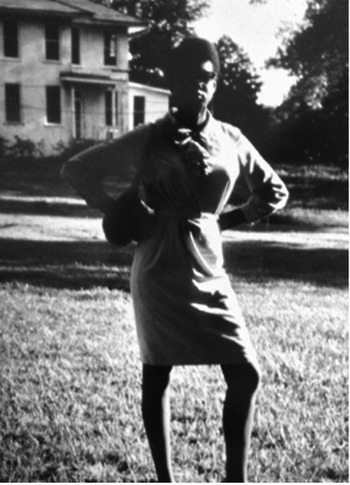
Derby's photograph of June Johnson demonstrates this womanist tradition, and was featured prominently in advertising materials for Derby's Women Change Agents: The Photographs of Doris Derby exhibition at Atlanta Airport in 2017 (Figure 1).Footnote 37 June Johnson was only fourteen years old when she first engaged with the civil rights movement in 1962, at which time she began to sneak into SNCC voter registration workshops in the evenings. Johnson would go on to organize voter drives with SNCC, and even though she was not old enough to vote herself, would serve as a witness to others. Yet perhaps the event for which Johnson is most commonly remembered was her 1963 arrest and beating by white police officers on her way back from a SNCC workshop, alongside other activists such as Fannie Lou Hamer.Footnote 38 Indeed, her traumatic experience is recounted in Danielle L. McGuire's Dark End of the Street: Black Women, Rape, and Resistance (2011), where McGuire writes, “According to Hamer, the officers ‘tore off most of her clothes’ and then forced her to strip off as they watched. Johnson's co-workers gasped when they saw her naked, bloody body and ‘bulging’ eye as she stumbled back to her cell.”Footnote 39 Although McGuire does valuable work drawing attention to the sexual abuse that women faced within the movement, to not acknowledge the role of some women outside the violence inflicted on them risks reducing some individuals to victims with no agency within the movement. Yet there was far more to Johnson's experience within the movement than this one horrifying incident. Laurence Guyot, former chairman of the Mississippi Freedom Democratic Party, states that despite the trauma of the event, “June Johnson remained active in voter registration … June, throughout her political career, was never bought and was never bossed. June was a free spirit who believed in the empowerment of people.”Footnote 40 It is this version of Johnson that Derby presents in this photograph.
June Johnson, activist, Student Nonviolent Coordinating Committee (SNCC), Mt. Beulah Center, Edwards, Mississippi, 1968. By Doris Derby. Gabbie Watts, “Airport Hosts Doris Derby's Photos of Women in Civil Rights,” WABE, 7 February 2017, at www.wabe.org/airport-hosts-doris-derbys-photos-women-civil-rights (accessed 31 August 2020).

Within Derby's frame, Johnson exudes confidence and defiance. Johnson's pose is powerful and self-assured: she stands with her hands on her waist, facing the camera directly, and her knee cocked. Of particular note is that fact that she does not smile in this image – her expression is serious, proud, and assured. Derby presents to us not a victim, but an empowered woman and activist. Through this image, Derby challenges the narrative of Johnson's victimization, and paints her as a womanist figure, “who is responsible, in charge, and serious.” Johnson's pose and direct gaze serve as a symbolic challenge to notions of “passive resistance” that dominate the movement's visual depictions of women. Indeed, rather than breaking Johnson down, her experience in prison served to galvanize her activism, as she stated, “I made a commitment to myself from that day; I didn't care what happened to me, I was going to be free or continue to be a part of a struggle to fight for the freedom of people of this country.”Footnote 41 It is this committed, determined woman who, by Derby's definition of womanism, loves struggle, “the folk, and herself.”Footnote 42 It is this empowerment that made this image such a fitting central advertising tool in the Women Change Agents exhibition.
To be a woman in the civil rights movement was to risk violence and sexual harassment from white people dedicated to maintaining the status quo of white supremacy. The sexism faced by many women within the movement from their allies has also been well documented, with Johnson herself stating, “Men ran the Movement … they made many of the decisions.”Footnote 43 Indeed, Clarissa Myrick-Harris indicated that Doris Derby “clashed” with the cofounders of the Free Southern Theatre – John O'Neal and Gilbert Moses – as O'Neal admitted that he and Moses expected Derby “to do the filing, the typing – because she's a woman.”Footnote 44 However, Derby refused to let any gendered assumptions affect her activities, stating that, of the men she encountered in the movement,
They might have had something in their mind, “women and girls don't do this or that,” but I was already my own person driven in my own way. So, I found persons who had the ultimate goal of what it is we wanted to create or see completed. If they had thought “oh women this and that,” I didn't even pay any attention to that because I was going to do what I was going to do regardless of what they want to do, but it happened that things we wanted to do came together. And if it didn't, then I went on and did whatever I was going to do otherwise.Footnote 45
Derby refused to accommodate sexist notions that would have curtailed her own definitions of activism. Derby made her gender a key part of her activism, rather than a limitation to be overcome. A fitting metaphor is that of Derby's dress. In 2017, upon seeing the yellow and black dress which Derby made when she first moved to the South, she stated, “that dress was specifically made for me as a photographer … I designed it and made two pockets at the top so I could put my camera lens and my film in it; that's why there's some little pockets at the top.”Footnote 46 To Derby, her gender was not a restriction – indeed, her womanist perspective offers a challenge to the dominant visual canon of the civil rights movement.
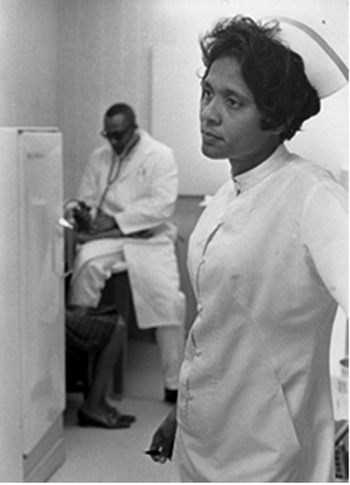
Doris Derby's 1968 image Nurse and Doctor, Health Clinic in the Mississippi Delta (Figure 2) was one of ninety-eight images to be included in the Road to Freedom exhibition. This image is perhaps one of Derby's most famous images, as it has been featured in multiple exhibitions.Footnote 47 The caption that accompanies this photograph reads:
In 1965, the TDHC [Tufts Delta Health Clinic] was established in the all-black town of Mound Bayou. Medical facilities were segregated, so black people received very inferior medical treatment, if any. Many died waiting for service. Led by Dr Jack Geiger, doctors applied for and received a large government grant in the mid-1960s to expand the Mound Bayou facilities. They hired more black physicians and nurses and provided home care. They established classes for adults in math, literacy, handcrafts and nutrition.Footnote 48
The caption reveals the extent to which the medical professionals were making a meaningful intervention into their community that Derby sought to capture. Closely analysing the image further reveals the framing techniques Derby utilized to empower the figure in her frame. As with much of Derby's work, the photograph offers a muted and unassuming perspective. Nurse Ora Bouie appears as the focus point, drawing the viewer's attention from the male African American doctor and the patient in the background to her dominant position in the foreground. Her dominant position in the right of the frame, taking up the length of the image, casts her in a powerful, protective role that stands between the photographer and the figures behind her. In focussing our attention on Nurse Bouie, Derby invites the viewer to linger on her professional composure and the quiet dignity of her appearance. Derby's framing defines Bouie in a manner consistent with Derby's definition of womanism, as a figure who is “responsible, in charge and serious.” Indeed, the quiet dignity of the everywoman is a key motif in Derby's photography.
Nurse Ora Bouie, and doctor, Tufts Delta Health Clinic, Mound Bayou, Mississippi, 1968. By Doris Derby. Julian Cox, Road to Freedom: Photographs of the Civil Rights Movement 1956–1968 (Atlanta: High Museum of Art, 2008), 105.

Nurse and Doctor stands in stark contrast to many of the images that dominate the canon of civil rights movement photography. Rather than focussing on charismatic male leadership or the violence inflicted on African American protestors by white mobs or police officers, we see a quiet moment in a professional setting. This photograph focusses on the professionalism and dignity of an African American woman and is entirely removed from the presence of any white people, or a white gaze, at all. Derby's picture evokes a self-sufficiency and self-reliance that many of the other images of the civil rights movement do not convey. In this way, Derby's photography provides a perspective on the civil rights movement that represents the activism of the movement in a more everyday, workplace setting. Derby was well aware of the power of her photography: “I knew I was making historic photographs,” Derby says. “I knew I was building this for the future.”Footnote 49
Yet Derby did not just taken images which focus on solo women in the frame, as her photographs also demonstrate her emphasis on the community-oriented aspect of womanism by focussing on community organizations. Derby's definition functioned, in part, “to develop the community.” When Derby first visited the Albany Movement office in 1962, she found that she fit in quickly, as “I have always been in a community acting, helping mode. It's like, ‘Okay, what do we need to do? What are we doing? What do we need to do?’”Footnote 50 Connected to her womanist and activist beliefs, Derby was engaged in activities designed to improve the communities in which she worked: from education programmes such as Head Start, to helping communities represent themselves with Southern Media, to starting a community-oriented theatre with the Free Southern Theatre. Indeed, building up the communities in which she worked was key to how Derby viewed her role in the movement:
You have to bear in mind that in the Civil Rights Movement in the black community during segregation you did not necessarily have the standard kinds of institutions. We had to remake them because standard institutional thought was segregated and controlled by the white power structure. We had to do other things. And there wasn't a lot of money to do things, so you had to see how you could create and build with people power, fundraising and volunteers from outside of the state, and new ideas.Footnote 51
Much of Derby's photographic practice was shaped directly by the wishes of the communities. When she worked with Southern Media, Inc., Derby would often take photographic assignments at the behest of the communities she worked with, as “we started advertising that we could go to communities and take pictures or work on a film. So that if the community needed a photographer, we could be available.”Footnote 52 Examples of this included portraits for local political campaigns. Yet Derby would also explore the communities she was working with to capture the everyday realities of local activism.
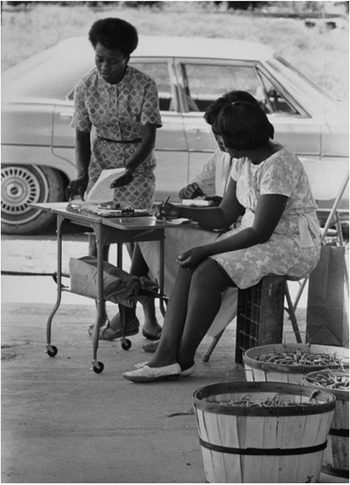
The image of L. C. Dorsey working at a vegetable collective, alongside two other women, demonstrates the grassroots and community-oriented aspect of Derby's work (Figure 3). These collectives, established by the Poor People's Campaign to promote economic opportunities, were a key grassroots organization of the movement in Mississippi. L. C. Dorsey, a former sharecropper, worked with the Mississippi Council on Human Relations and Southern Coalition on Jails and Prisons, as well as founding the North Bolivar County Farm Cooperative. This organization encouraged “subsistence farming and vocational training for women who had been dismissed from their jobs (mostly as maids and housekeepers in white homes) because they registered to vote.”Footnote 53 Dorsey fits Derby's definition of a womanist as a community activist who sought to better the lives of people around her. The North Bolivar County Farm Cooperative had a significant impact on the local community, as it provided work to five hundred impoverished families, resulted in the harvesting of more than a million pounds of vegetables in its first six months, and was featured in Life magazine for “more vegetables in its first year than the previous annual output of the entire Mississippi Delta region.”Footnote 54 Given this impressive track record it is therefore fitting that Derby chose to document Dorsey in action, working with other women at the cooperative.
L. C. Dorsey, North Bolivar County Vegetable Cooperative, 1968. By Doris Derby. Cox, Road to Freedom, 104.

Derby's interest in cooperatives as a site of community activism and empowerment is also worthy of note. In her efforts to publicize the importance of cooperatives, she highlighted them during a radio interview as “a unity thing where people are working not only for themselves but for the race.”Footnote 55 Derby's focus on the role of cooperatives continued after she left the South and pursued further education, as she wrote multiple essays on subjects such as the “The Needs of Handicraft Cooperatives: A Field Study” (1974) and “Co-operatives Have Something to Offer to Low-Income and Impoverished Persons” (1975).Footnote 56 Cooperatives, therefore, formed a key “counterspace” to the marches and protests of the mainstream movement, encapsulating an everyday, community-oriented activity.Footnote 57 Derby's representations of this are informed by her womanist advocation of collective action.
This photograph is featured in Martin A. Berger's aforementioned exhibition Freedom Now! Forgotten Photographs of the Civil Rights Struggle (2013). Berger notes,
From both narrative and visual standpoints, this is not a dramatic photograph. It does not illustrate a spectacular scene of confrontation or of lofty oration; instead it shows Dorsey and two seated women staffing a farm cooperative table, surrounded by baskets of produce. But this ordinary photograph, documenting the distribution of vegetables, points to an important aspect of black empowerment in the later 1960s. Given a shoestring budget, Dorsey and her coworkers put together an effective cooperative that employed hundreds of people, provided high-quality produce to thousands more, and served as a model of black self-sufficiency in a region where the opportunities for blacks were severely limited.Footnote 58
Berger attempts to challenge the dominant canon of the civil rights movement by bringing to attention some of the “forgotten” images of the movement and, whilst Derby's image is a welcome addition with an accompanying thought-provoking analysis, the collection features only one image by a woman. Nevertheless, the collection offers a powerful alternative archive, and Berger's analysis of this image highlights the way in which Derby captures the more everyday nature of the community activism in which these women engaged. Furthermore, Derby's use of distance in the framing of this image distinguishes it from many other civil rights images; the women are central to the frame, yet stand a considerable distance away from the photographer, with several containers of produce separating them from the viewer. Dorsey stands tall in the centre of the frame, bending slightly, engrossed in the task at hand. The disregard of the camera by the subject is a common motif in Derby's work, as it demonstrates the subjects’ dedication to the task at hand by denying the viewer their gaze. The fact that these women are closely isolated in the narrow frame creates a sense of independence; they are a closely knit unit of three, independent of other intervention. Indeed, in contrast to the established canon, this image does not show African American community perspectives in relation to white people, nor does it focus on charismatic male leadership. Instead, the framing of the picture reflects the subject of the picture; the women working closely together in the photograph demonstrate a spirit of collective independence that represents their cooperative agenda. Derby paints their seemingly unglamorous work through a womanist lens, highlighting their communal empowerment and everyday activism.
Many of Derby's other photographic images evoke a sense of community activists’ agency and power. Photographs of doll makers, quilters, and farmers evoke a similar sense of quiet empowerment, with Cox describing her photograph of a volunteer math teacher in Mound Bayou, Mississippi as “typical of the kind of picture she made, melding her passion for activism with a desire to record a social fabric that was largely ignored by the mainstream media.”Footnote 59 This social fabric was one that was rooted in acts of everyday resistance that, whilst they did not grab headlines, had a profound effect on the communities within which they were conducted. As Derby attested, “these were the people who were the basis of the Civil Rights Movement in Mississippi. It's men, it's women, and it's children who are exercising and pursuing their rights and their responsibilities to themselves, their family, community and country.”Footnote 60 Yet these ordinary people took on forms of resistance that defy easy categorization and were firmly engrained in their communities. As Derby explains, “these pursuits took many forms – education initiatives on all levels, economic development, voter education, community development, healthcare initiatives, cultural and rtistic expression, protest and peaceful demonstrations against injustice.”Footnote 61 Indeed, examining Derby's photographs fundamentally changes our idea of what activism and protest looked like during the civil rights movement, to one that extends far beyond activities such as marching, and encompasses a multifaceted and holistic approach. Yet there is one common thread within Derby's activism: her desire to elevate and celebrate the everyday acts of heroism and bravery of the men, women, and children in local communities. Derby spoke of this in a recent interview:
Outsiders often see those who are out there protesting, meeting with officials, or scenes from a tragedy – which all are very important. But not everybody was involved outwardly in that part. My focus was to document black people who were engaged in the struggle for equality and justice for all. To depict the life-giving force of the black community keeping on. Even though they face poverty and injustice, they're surviving, they're living.Footnote 62
This stands in contrast to the more traditional canon of the movement. Indeed, Martin Luther King Jr. famously spoke of the power of photography, television, and visuality as a tool of galvanizing public support and activism. Reflecting on the Birmingham Campaign and Project C in 1963, King suggested that the vivid imagery surrounding this event exposed the terrors of racism to the world. In Why We Can't Wait (1964), King wrote, “The brutality with which officials would have quelled the black individual became impotent … It was caught – as a fugitive from a penitentiary is often caught – in gigantic circling spotlights. It was imprisoned in a luminous glare revealing the naked truth to the whole world.”Footnote 63 Many images from that day became iconic staples of the civil rights movement canon; photographs of people having high-pressure fire hoses and dogs set on them undoubtedly changed public perceptions of the movement. Indeed, many of these iconic images inspired Derby herself to get involved in the movement in May 1963, as she recounts being moved by the images she saw, “the police get out the fire hoses and the police dogs and the billy clubs and all that, and it's televised. And I say oh my god this is ridiculous!”Footnote 64 Yet whilst these images are important testaments to the protestors’ bravery and provide a vital perspective on the Birmingham Campaign, to consider them representative of the whole movement does a disservice to thousands of African Americans engaged in everyday acts of resistance.
In 2019, Doris Derby self-published Poetagraphy: Artistic Reflections of a Mississippi Lifeline in Words and Images: 1963–1972. In this text Derby pairs her photographs alongside her own original poetry, which she wrote during her time in the South. The photography in this text encompasses a range of styles: from landscapes, to still life, to object studies, to candid shots, to documentary photography, to architecture. The text also encompasses a range of subjects, including African American men, women, and children. Furthermore, Derby's decision to curate her own images alongside her own poetry allows her to impress her own meaning on her images. The combination of poetry and photography is reminiscent of Sweet Flypaper of Life (1955) by poet Langston Hughes and photographer Roy DeCarava, which pairs the two mediums to provide a glimpse at life in Harlem. Whilst Sweet Flypaper of Life has been praised for its “dynamic interconnectivity” between the two modes,Footnote 65 and scholars such as Arnold Rampersad feel that the text “match[es] the images almost perfectly,” Derby's text has the added singularity of providing a dual photographic and poetic perspective on a situation where the photographer and the poet are one and the same.Footnote 66 Within this text, Derby challenges the visual rhetoric of the movement by utilizing her womanist lens and choosing to insinuate, rather than showcase, the threat of violence and white backlash that was pervasive throughout the movement.
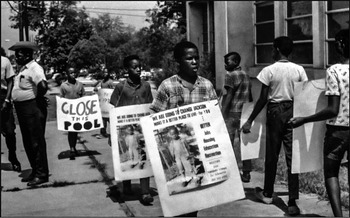
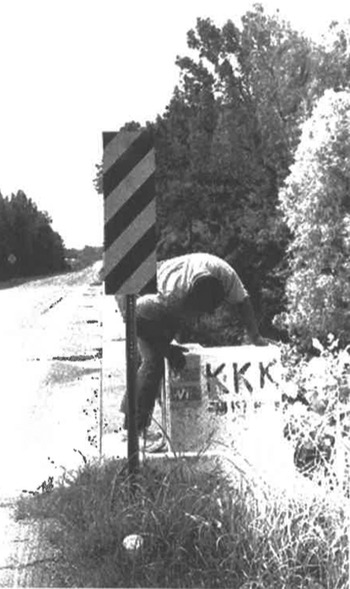
Derby's blend of poetry and photography challenges the traditional definitions of activism and protest that dominate the visual rhetoric of the movement, as images of children playing and women washing clothes are given an increased sense of profundity through the accompanying text. As one of many potential examples, the poem “Earth Child” situates the titular child's “beautiful / Blackness” alongside a photograph of a young African American boy crouching in a field.Footnote 67 In this way, everyday moments of the African American experience are presented as art, making poetry of seemingly mundane moments. Yet Derby also presents images in line with more recognizable modes of activism and resistance. One section that is of particular relevance is the double-page spread accompanying the poem “Signs of Spring,” alongside two photographs. Here we see two images that are consistent with more traditional ideas of “protest,” as in one image African American children march with signs to protest a segregated pool (Figure 4). In interview, Derby clarified that the children are “protesting the YMCA. For being segregated, the white Y had a pool for the boys, for the white kids not for the black.”Footnote 68 In the second, a young man bends to look at a concrete block along the side of the road where someone has written “KKK [Ku Klux Klan]” – a white supremacist organization active in the South (Figure 5). Whilst the young man is not part of an organized protest in this moment, the photograph nevertheless functions as an item of protest at the graffiti's existence – recording that it was on a concrete block next to a public sign, and the African American man's inspection of it. Perhaps he is thinking of how to get rid of it? The placement of Derby's political poem alongside this image further draws out its implications for protest. It is worth noting that this image has a male subject, indicating that whilst Derby's womanist beliefs advocated for the increased recognition of African American women, she did not exclude the presence of men, whom she recognized as part of the community. The poem alongside these two images speaks to the violence and danger which is implied in the images, with its talk of “screams nighttime, daytime, all the time, growing louder” and “as die-hard racists normally bring forth the blood / Of black and brown children, / with all their might.”Footnote 69 Yet even Derby's photography, which engages with more recognizable scenes of protest, stands in defiance of the dominant photographic canon of the movement, as she chooses to imply violence rather than portray it. Indeed, the figures in the photographs are active, moving dynamically to engage in their activities, yet are framed both outside victimhood and outside their relations to or conflicts with white people. Derby's framing paints the subjects of her photography as heroic; even though they are risking violence – as asserted by the text – they are not victimized or objectified in her lens by being subjected to it. In this way, Derby skilfully blends poetry and photography to make violence in the civil rights movement both implicit and explicit simultaneously. Instead of portraying traumatizing violence, Derby's visions of protest are dynamic, defiant, and black-led.
Children protest outside the YMCA, Jackson, Mississippi, late 1960s. By Doris Derby. Doris Derby, Poetagraphy: Artistic Reflections of a Mississippi Lifeline in Words and Images: 1963–1972 (self-published by Dr Doris Derby, 2019), 40.

Jr. Wilson, intern, Southern Media, Inc., outside Jackson, Mississippi, late 1960s. By Doris Derby. Derby, Poetagraphy, 41.

This is not to assert that Derby excluded violence from her images because it was not a part of her experience. Indeed, Derby's assertion that she was in a “war zone” was well founded. For countless organizers and grassroots activists in the movement, the threat of violence and intimidation was an everyday reality. Derby spoke out about the violence being faced by members of SNCC as early as 1962, where she spoke at the National Committee for Rural Schools Conference in New York, and detailed the “historically obsessive violence and intimidation” that both rural African Americans and SNCC members seeking to improve communities faced.Footnote 70 In a 2020 interview, Derby stated, “I had threats around me, I had situations,” and on one occasion when she stopped at a gas station she was threatened: “a guy came over to me and he put his hand on his waist and he had a gun there. And he told me which bathroom I'd better use.”Footnote 71 Nor was this the only time Derby experienced firsthand the violence the white South was prepared to inflict. In another incident, Derby recounts how in July 1965 at the Head Start programme in Durant, Mississippi,
Early in my stay there, when the center director and I were returning from shopping in town and passed the church where Head Start was first held, I saw something strange on the ground. There was a fire slowly moving up a cord that ran up the path to the church steps, onto the church's porch, and through the doorway of the church. I yelled for the director to stop. We jumped out of the car, stamped out the fire, and headed back to the newly built center.Footnote 72
Indeed, staff members kept rifles on site in case of an attack from the white population. On the evidence of these two examples, violence was a constant threat for activists in the South during the civil rights movement, and one that Doris Derby was acutely aware of. Yet Derby refused to dwell on the violence she faced, stating in a 1997 interview, “That the negative that happened, I don't think about those, you know, really, that much. It's all the positive things. When I look back on what, how – we changed the world basically.”Footnote 73 The civil rights movement was a complicated struggle that raised many conflicting emotions in those who participated, as Derby spoke of the community: “The work, commitment, joys, songs, battles, strategizing, gains, losses, and the horrors of violence and intimidation glued us together, kept the circle growing bigger.”Footnote 74 Whilst there is a wide range of imagery that portrays the horrors of violence and intimidation, Derby's photography offers a nuanced, womanist perspective that encapsulates multiple perspectives on the struggle – one that was not always rooted in violence, nor always rooted in joy, yet always rooted in the activism of everyday people – men, women, and children alike.
With an archive of over a thousand photographs, and a lifetime of experiences advocating for African American freedom and equality, there is scope for much more scholarship to be done on the life and works of Doris Derby. A woman who has lived a long and varied life, Derby has encompassed a wide range of other roles that are not addressed at length in this paper, including her involvement with the church, her life and work as an academic and educator, and her practice of cultural anthropology, focussing on African American studies. Much of her photographic archive remains unexamined, as are her wide range of paintings and other art pieces. Indeed, many of Derby's remarkable photographs are not included in this brief paper, including powerful portraits of leaders such as Fannie Lou Hamer, images of teachers in Head Start schools, and photographs of her many experiences in Africa. Although Derby's work is receiving due attention for her photography, as exhibitions and publications continue to emerge, Derby's work is worthy of further academic engagement and critical analysis.
Derby's photographs celebrate the wide range of activism that took place every day in the movement – from protests to vegetable cooperatives, and from grassroots activists to working professionals to children protesting their right to go for a swim. Many of the photographs in this chapter empower women in the movement and challenge the canonical dominance of portraying African Americans as victims or in relation to white people by evoking a womanist perspective. Although the existing canon of civil rights photography is valuable – and images of charismatic male leaders and violent conflicts are vital to understanding the movement – studying the photography of Doris Derby allows for a more nuanced insight into the everyday activism of the movement. As Derby herself reflected, “I walked away with a respect and awe for the strength and courage of ordinary black Mississippi people … Despite incurring violence and intimidation, they remained steadfast, prayerful, and focussed to go the extra mile for their freedom. Every day, I witnessed just how brave and determined people could be.”Footnote 75