




No CrossRef data available.
Language-naming practices, ideologies, and linguistic practices: Toward a comprehensive description of language varieties
Published online by Cambridge University Press: 02 May 2006
Abstract
Although it is well accepted that linguistic naming conventions provide valuable insights into the social and linguistic perceptions of people, this topic has not received much attention in sociolinguistics. Studies focus on the etymology of names, details about the social and historical circumstances of their emergence, and their users, and sometimes make recommendations about the appropriateness of terms. This article departs from this tradition. Focusing on the term “Takitaki” in French Guiana, it shows that an analysis of the discursive uses of language names by all local actors provides significant insights into the social and linguistic makeup of a complex sociolinguistic situation. Descriptions of languages in such settings should be based on the varieties identified by such an analysis and on practices in a range of naturalistic interactions. Based on these analytical steps, the authors propose a multi-perspective approach to language documentation.We would like to thank two anonymous reviewers and the editor of this journal for valuable comments and criticisms on an earlier version of this article. All remaining errors are, of course, our own responsibility.
Keywords
Information
- Type
- Research Article
- Information
- Copyright
- © 2006 Cambridge University Press
INTRODUCTION
Although it is well accepted that a name for a language (or people) is never neutral but always “exists in a dialectical relationship with social cognition and social behavior” (Smitherman 1991:117), the potential of names for shedding light on the social and linguistic reality of a particular linguistic situation has not yet been fully explored. Naming conventions are rarely investigated in much detail. They are generally discussed only briefly in the introductory sections of studies dealing with specific (socio)linguistic topics about the language so named (but see Smitherman 1991, Baugh 1991, Tabouret-Keller 1997).
Most of the research on conventions for naming language varieties deals with situations in which several different names are employed to designate what appears to be, from a linguist's perspective, a single language. Based on an analysis focusing on the etymology of the terms in question and details about the social, political, and historical circumstances of their emergence and their users, several different kinds of patterns have been identified. The different terms may either correspond to different varieties of what a linguist would call “the same language” (cf. Goodman's [1971] discussion on Ma'a/Mbugu as two stylistic variants of the same language, or Mous 2003 on Ma'a/Mbugu as the making of a mixed language), or they may reflect a conflict between native and non-native naming practices, as in the case of the terms “Eskimo” vs. “Inuit.” There are, however, also situations in which some of the coexisting names refer to different social varieties of the same language, others are self-designations, and yet others are official or colonial designations (cf. Mufwene 1997 on Kikongo/Kituba). For example, Pierre Alexandre raises some of these traditional questions for Africa when he asks:
Are Akuapen Twi and Asante Twi two dialects of the same language or two different languages? Are Laadi, Sundi, Mbembe, etc. dialects of a single kiKongo language, and, if not, is there such a thing as kiKongo? The Native speakers' opinion on such points can differ markedly from that of the linguists. My own tendency is to give more weight to the former, that is to use an anthropological rather than a purely linguistic approach. The rule ‘one language name = one language’ is generally useful, although far from absolute. (Alexandre 1971:655)
Another well-documented case is that of “Serbo-Croatian.” Depending on political and identity-related issues, it is either said to consist of one, two, three, or four different languages – Serbian, Croatian, Bosniac, and Montenegrin (see Thomas 1994, 2004; Calvet 1999; Bugarski 2004).
In the case of languages with a written tradition, the so-called nonstandard varieties are traditionally held in low esteem by social actors and public institutions, at least overtly, and are carefully distinguished from the so-called standard variety. In Francophone countries, for instance, nonstandard varieties, including French-lexified creoles, are viewed as “collateral languages” – that is, varieties that are related to standard French but that are not considered to be part of it. Both native speakers and outsiders refer to them using terms such as “patois” or “bad French,” which have overtly negative connotations. Researchers generally take this to mean that the native speakers have to a certain degree internalized negative attitudes about their native language (cf. Eloy 2004 for French nonstandard varieties, and Bavoux 2002 for French creoles). However, language attitude studies in anglophone Caribbean creole communities call into question such an interpretation. They show that even though people tend to use such terms to designate their language, they usually still attach a positive covert value to them, especially in in-group settings (cf. Mühleisen 2001 on Trinidad). Sidnell's (1998:94) discussion of language terms used in an Indo-Guyanese village (e.g., “broken down language,” “mix-up talk,” “brawlin' talk,” “patwa”) suggests not only that these allegedly derogatory terms do not carry negative connotations for their users but also that they do not refer to the same object, the creole. They designate different locally recognized social, ethnic, functional, and stylistic varieties of the creole. This is so partially because native speakers, unlike linguists, are not committed to a structural analysis and are free to name varieties on the basis of genre associations and social, identity, communicative, and other functions.1
This was pointed out by an anonymous reviewer.
Although these investigations have provided valuable information about the sociohistorical development of the community, their insights into the linguistic and social realities of an area are relatively limited. There seem to be two main reasons for this. First, scholars have not fully explored the socially constitutive nature of naming conventions. Second, researchers have tended to rely on a limited range of perspectives: their own, those of other linguists, and possibly that of the native speaker. They generally have not considered in detail how these names are employed in discourse by the various social actors in the local linguistic market (Bourdieu 1982). The native speaker's approach which determines linguistic status on the basis of political, social, historical, and other factors “is in most cases of little relevance for the ‘pure’ linguist” (Alexandre 1971:655), whose decisions are based on structural resemblances or differences in phonology, morphology, lexicon, and other formal systems.
A few studies also deal with situations in which a single term is used to refer to more than one language or variety. In these cases, researchers generally have focused on demonstrating the term's ambiguity and sometimes have argued in favor of abandoning it or have proposed the creation of new terms. Consider, for instance, the case of Arabic. Researchers generally highlight the designation's ambiguity and propose strategies to adapt it to the sociolinguistic reality of the linguistic practices in Arabic and the norms that govern them. For instance, Ferguson 1959 describes the reality of Arabic practices as a koiné and proposes the term “Arabic koiné.” Kaye 1994 proposes the term “Arabic multiglossia,” while Calvet 1999 prefers “Arabic schizoglossia.” More recently, Caubet 2001 proposes using modifiers, such as “Maghrebine” vs. “dialectal” Arabic, to distinguish the different varieties.
In Guyane (called “French Guiana” in English), the term “Takitaki” has in recent years come to be widely used as a cover term to designate the languages associated with the populations of African descent who originate from Suriname. The term derives from the creoles of Suriname (Sranan, Aluku, Ndyuka, and Pamaka), in which it generally means ‘to chatter’ (Shanks 2000:189).2
Takitaki is the reduplicated form of the verb taki ‘to speak, to say’. In the creoles of Suriname reduplication expresses a range of functions, among them intensification of an activity (cf. Huttar & Huttar 1994). Similar terms have been used to designate other creoles. Talkee-Talkee, for example, is an obsolete term for Jamaican and for Krio (Norval Smith, p.c., October 2005).
The aim of this article is twofold. First, we investigate the sociolinguistic complex commonly referred to as “the creoles of Suriname in Guyane.” Second, we propose a multi-perspective approach to the description of languages. We explore the conflicting uses of the term “Takitaki” in order to determine, by means of a discourse analytic method, what they suggest about the local social and linguistic setting. In particular, we investigate the following issues:
(i) What do the local linguistic terminology and the term “Takitaki” in particular suggest about how the different social actors conceptualize the social and linguistic reality?
(ii) What is the sociolinguistic status of “Takitaki” – from a sociolinguistic point of view, what is referred to by the term? How is the term evaluated and valued, and by whom?
(iii) What is the linguistic status of productions referred to by the name “Takitaki” – from a linguistic point of view, is it a language or a social, stylistic, or other kind of language variety?
The study considers the points of view of three kinds of social actors:
(a) The “native” perspective, generally the perspective of the Eastern Maroon (EM) population, who are speakers of the creoles Aluku, Ndyuka, Pamaka (but see below);
(b) the perspective(s) of linguists working in the region; and
(c) the non-native, non-linguist's perspective(s), the point of view of the other “ethnic” groups (e.g., Amerindian and metropolitan French populations and the creole populations of French Guiana and Suriname).
The investigation shows that the different local social actors do not only project different social evaluations onto the linguistic productions referred to as “Takitaki,” but they also have different views about the internal structure of the populations who use the variety. Moreover, they also assign different linguistic structures to these linguistic productions and conceptualize in very different ways the relations among the different varieties covered by the same term. Overall, the name “Takitaki” appears to cover a range of linguistic practices. They are similar in that they predominantly involve linguistic material from the creoles of Suriname, but their actual linguistic makeup and sociolinguistic status vary significantly. This investigation suggests that only an analytical framework that equally takes account of the social and linguistic perceptions, attitudes and ideologies of all social actors and also investigates the linguistic makeup of actual linguistic practices can provide comprehensive insight into the sociolinguistic makeup of such a multilingual area.
The article is organized as follows. The second part briefly presents the social context of the French overseas department of Guyane. The third part discusses the terminology used to refer to the English-lexified creoles of Suriname in order to provide a first insight into this complex linguistic situation and the different perspectives on it that exist. The fourth part investigates what we called above the sociolinguistic status of the term “Takitaki,” based on an analysis of its uses in different kinds of discourse and on the results of a survey that aimed to elicit attitudes toward Takitaki and other local languages. The fifth part is a brief description of the linguistic practices in two types of interactions in which speakers say they used Takitaki. Finally, we summarize the findings and discuss their implications.
THE SOCIAL CONTEXT OF GUYANE
The French overseas department of Guyane in general and the coastal region in the west in particular are highly multiethnic and multilingual. Apart from the Amerindian population, of which six ethnic groups are still present, various other ethnic groups have come to reside in Guyane as a result of various sociopolitical factors, such as the slave trade, colonialism, administrative departmentalization (1946), and recent migratory movements since the 1960s. They include the population of metropolitan French origin, which is constantly being renewed and makes up roughly 10% of the entire population; persons of French Antillean origin; the Guyanese Creole population, which until recently constituted the largest ethnic group; and four Surinamese maroon communities (“maroons” are descendants of escaped African slaves). Recent migratory movements have also led to the establishment of a small Hmong community and groups whose members originate from Suriname, Brazil, and Haiti.
None of these communities is monolingual or is associated with only one language. The linguistic repertoires of the members of one and the same community may vary greatly depending on social factors such as education, occupation, and residence. At this point, it is difficult to determine the linguistic background of the members of each of these communities because the French census does not record people's ethnic and linguistic background.
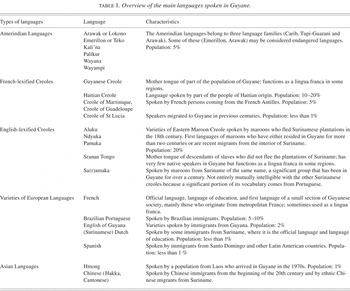
Table 1 gives a rough idea of the macrolinguistic situation in Guyane. It presents a breakdown of Guyane's languages and language varieties, along with some data on the numbers of speakers. The latter should be considered only an approximation because the figures represent an attempt to combine different estimates (Queixalós 2000, Price 2002, Collectif 2003) with the results of a sociolinguistic survey conducted in Guyane over the past five years (Léglise 2004, 2005, in press).
Overview of the main languages spoken in Guyane.

Regarding the “maroons of Suriname,” the Aluku community has been established in the interior of Guyane since 1860, while the traditional villages of the other maroon communities remain in Suriname. However, Saamaka as well as Ndyuka and Pamaka men have been coming to Guyane since about the 1860s for short or longer periods in search of cash labor opportunities (Price & Price 2003). The presence of these three maroon groups has, however, greatly increased since the civil war in Suriname in the late 1980s. The maroons have now become a permanent part of the Guyanese society.
OVERVIEW OF NAMING CONVENTIONS FOR THE CREOLES OF SURINAME
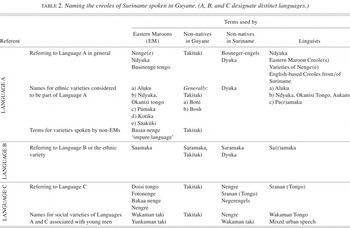
A number of different terms currently are used to refer to the linguistic complex generally called “the creoles of Suriname.” The various terms are hardly synonymous; they refer either to distinct sociolinguistic entities or to different social conceptualizations and evaluations of the same linguistic space. Table 2 gives an overview of the most common terms and matches them with the groups of people who typically employ them.
Naming the creoles of Suriname spoken in Guyane. (A, B, and C designate distinct languages.)

Table 2 reveals quite strikingly that the three broad groups of social actors identified above not only use partially different terms to refer to the forms of speech that belong to this linguistic complex; they also conceptualize it in quite different ways.
The most striking difference exists between the Eastern Maroon (EM) perspective and that of non-natives in Guyane. EMs distinguish among three different languages (which for the purposes of this article we call Languages A, B, and C), five distinct native ethnic varieties for Language A, and at least one social variety of Language A and one of Language C. Moreover, they also recognize the existence of non-native varieties of their native language.
In contrast to the EM perspective, non-EMs in Guyane essentially do not make or perceive any of these distinctions. The fact that they employ the same term to refer to all the speech forms distinguished by EMs suggests that they consider them to be one and the same thing – Takitaki. The perspective of non-natives in Suriname also differs from that of EMs and non-natives in Guyane. The Surinamese perspective recognizes the existence of two or three different languages – Languages A and C, and possibly also B – but it does not acknowledge the existence of social and ethnic varieties of Language A.
Foreign linguists working in the region, like EMs, recognize that several different languages are present and also that Language A has several ethnic varieties. In fact, they generally work more or less exclusively on one or another ethnic variety. However, most of them are little concerned with the existence of social varieties, particularly non-native varieties.
SOCIAL MEANINGS AND EVALUATION OF TAKITAKI
This section investigates the social meanings that are locally associated with the term “Takitaki” by examining the use of the term in different discourses. It focuses both on the social meanings and the linguistic structure that members of the local communities assign to the linguistic productions they refer to by the name “Takitaki,” and on their implicit and explicit social evaluations of these linguistic entities. The investigation is based on three kinds of data. The first is an analysis of individual interviews with adults living in Guyane who come from various ethnic backgrounds and from a wide range of professional backgrounds (e.g., the building industry, agriculture, the post office, teaching, medicine; see also Léglise 2005, in press). Interviewees were asked to discuss their own linguistic background and the linguistic situation in Guyane. The second data set is the result of a school survey that elicited schoolchildren's perceptions of the local linguistic situation and their attitudes toward the various linguistic varieties (Léglise 2004). Because 60% of the Guyanese population is under 20 years of age, it was important to have quantitative and qualitative data concerning this section of the population, which seems also to be implicated importantly in the naming practices discussed here. The third data set is an analysis of selected writings on the linguistic situation of Guyane by linguists working in the region. These three kinds of data were analyzed employing a French critical discourse analytical framework (Foucault 1972, Maingueneau 1995). The interpretation of the maroon discourses is based on consultations with local informants and about ten years of participation and observation in the community, employing a linguistic anthropological approach.
Takitaki and non-natives
The analysis of uses of Takitaki by non-natives (in Guyane), notably persons with a metropolitan French background or a local Guyanese Creole background, in interviews carried out in French dealing with their language attitudes and patterns of language use, shows clearly that the term carries negative connotations for them. It is considered to be not a local language but the language of recent immigrants:

Takitaki is generally assumed to consist of only one variety that is employed in the same way by all maroons (see ex. 2). It is not considered to have the status of a language but is felt to be a derivative of something more concrete and prestigious:

This variety is also considered to be quite simple. Non-native speakers of Takitaki varieties generally maintain that it is easily learned and constitutes an easy and natural way of communicating with people who do not speak European languages (see exx. 3, 4). This is a common stereotype about creoles in general:

Takitaki is viewed as a lingua franca which, however, carries a strong ethnic association (5) and appears to be the only viable means of communication in certain parts of Guyane (6):

In terms of its linguistic status, linguistic productions called “Takitaki” are typically categorized as a kind of bad English:

Moreover, Takitaki is generally assumed to be a simple speech variety which, compared with French, is easy to learn because it does not have “abstract categories” or “a grammar” and “lacks beauty”:

Takitaki and young EMs
The analysis of the uses of Takitaki by young EMs living in Guyane and attending primary or secondary school there suggests that it is employed mainly in interactions carried out in French with non-EMs (e.g., metropolitan French or Creole teachers, classmates from other ethnic groups, or European researchers; see ex. 12). However, it was also occasionally employed by them during conversations with one of the authors in one of the Eastern Maroon Creole (EMC) varieties (13) when they did not know the researcher. In relation to outsiders, the term has several distinct uses. It may be used to refer to the variety spoken by outsiders or non-EMs, such as people of metropolitan French, other European, Haitian, or Guyanese Creole ethnic origin (12, 13). In this context, the term appears to designate a variety that is not considered to be “real Nenge” but a kind of learner's or L2 variety – what is traditionally covered by the term “Basaa Nenge”:

Takitaki can also be employed as an out-group designation of the mother tongue. When it is used in this sense, the assumption is that the interlocutor (e.g., a metropolitan French person) does not understand the local social and linguistic diversity, such as the fact that there are different maroon groups who speak different linguistic varieties. The name of their ethnic group and/or that of their ethnic variety of EMC is supplied only if the interlocutor indicates that he or she has some understanding of the linguistic structure of the community, as with further or repeated questioning:

In addition to being used as an out-group designation for one's mother tongue, “Takitaki” is also used by young EMs to refer to the language common to all EMs, the EMC. This makes it possible to convey to an outsider that all EMs constitute a common social or ethnic group that speaks one common language. In this sense, “Takitaki” is similar to the natively used term “Nenge” (ex. 16). Currently, “Takitaki” used in this sense competes with the term “Businenge (Tongo)” ‘the language of the people of the interior’. The terms seem to be used interchangeably, but “Businenge Tongo,” which was introduced some years ago by a group of young Alukus at the Regional Council (Conseil Régional) of Guyane (Price & Price 2003), is now also frequently used by official bodies. As illustrated in the exchange in (16), “Businenge” is usually used only if the person being addressed appears to have some understanding of the local situation – for example, if she has rejected the term “Takitaki” or demanded further explanation.

There are several possible reasons for this last use of “Takitaki.” Some of the children employ this term to refer to their mother tongue because they claim not to know the actual name of “their” ethnic group/L1, as appears to be the case in (16). Such children are generally not in close contact with the members of a particular maroon community. They may, for instance, come from a mixed marriage where the family associates more closely with the family of the non-EM parent, or they may have grown up in a setting where members of different maroon groups live side by side, as in the urban centers, as in (15). However, this does not appear to be very common because very few children claimed to be ignorant about their linguistic background.
There are additional reasons why EMs choose to use the term “Takitaki” instead of the name of an ethnic variety. In a number of cases, by using this term the respondents were signaling their disinclination to reveal their ethnic background. The most common reason for this seems to be that the youngsters want to assert, in front of outsiders, the existence of many similarities among all EMs that essentially make them part of a common social entity. This usage is particularly prominent among members of the smaller maroon groups (Aluku, Pamaka), who, rather than being counted as Ndyuka, prefer to highlight the similarities among all three EM groups.
Despite close cultural similarities among the different EM groups, relations between them have not always been amicable. The Ndyuka, who are by far the largest EM group and who were formally recognized by the Dutch colonizers in 1760, strategically used their relatively exceptional status to dominate the Aluku and the Pamaka and functioned as intermediaries between these groups and the colonizers (Hoogbergen 1990). To this day, therefore, most Aluku and to a lesser extent Pamaka do not generally appreciate being referred to as Ndyuka. Moreover, in the context of large-scale migration, the differences among the maroon groups are increasingly being leveled. In the new context they largely face the same issues, such as finding jobs and housing.3
Price & Price (2003:93ff.) argue that the Aluku are currently not subject to the same conditions in coastal Guyane as the other maroons because they are French nationals by birth.
See also Price & Price (2003:93ff.), who argue that a pan-maroon identity is in the process of emerging among urban maroon adults but is partially being undermined by current French naturalization politics.
Another, related reason for avoiding reference to one's ethnic background seems to be a desire to highlight intergenerational or ideological differences in the community (cf. Vernon 1985). By using the more general terms, the youngsters essentially highlight the fact that they identify with an urban European lifestyle and world view and distance themselves from the traditional and rural context. As shown in (17), the rural and traditional tends to be attributed to previous generations:

Finally, in some cases we can hypothesize that young maroons employ the term “Takitaki” to “hide” their ethnic background because it is more difficult for them to assume a specific ethnic identity. For instance, several authors (Jolivet 1990, Price & Price 2003, Léglise 2004) have remarked on the fact that in the urban context, a Saamaka ethnic identity carries strongly negative connotations. It is associated with backwardness and is widely used as an insult. For young Saamaka, using the term “Takitaki” is a convenient way to disguise the fact that they are Saamaka, as in (18). It allows them to assert their maroon origin without having to specify their “shameful” specific origin. In their view, it does not really make a difference because most metropolitan French people and French Creoles will not be able to tell the difference between Eastern Maroons and Saamaka anyway:

Takitaki and local Amerindians
The interviews with schoolchildren of Amerindian origin revealed that there are at least two groups of people who could be called native speakers of Takitaki. Besides people of EM descent, there are also many young people of Amerindian origin who claim it as (one of) their mother tongues. Arawak schoolchildren from villages near St. Laurent distinguish between two types of Takitaki: the “Takitaki of the Amerindians” (19), which they claim to speak themselves, and the “Takitaki of the blacks,” the variety or varieties spoken mainly by persons of Afro-Surinamese origin. When asked, speakers insist that these are distinct:

Takitaki and linguists
In the literature, there are at least five different uses of Takitaki. Robert Hall (1948, 1966), for instance, appears to employ “Takitaki” to refer to Sranan Tongo, but it is possible that he uses it as a cover term for both Sranan Tongo and the EMC varieties; the latter used to be viewed as “rural varieties” of the former.5
The linguistic description of Takitaki in Hall 1948, which is based on Herskovits & Herskovits (1936), resembles modern Sranan Tongo. Later linguistic and anthropological publications about Sranan Tongo employed “Negro-English” (Rens 1953) or the Dutch equivalent “Neger-Engels/Negerengels” (Voorhoeve 1953). Starting in the late 1950s, the term “Sranan” seems to gain prominence in the linguistic literature (Voorhoeve 1962). Current linguistic publications on Guyane (e.g., Launey 1999, Collectif 2003, Goury & Migge 2003) and Suriname (Carlin & Arends 2002) generally avoid the term “Takitaki.”
Taki-Taki is the language of Paramaribo and other parts of Dutch Guiana, called by its own speakers tàkitáki or nèngeretóngo Negro language, in Dutch Neger-Engels, and in German Neger-Englisch. It and the closely related language of the Saramacca Bush-Negroes are creolized languages developed out of the jargonized English used by the slaves of English and Portuguese landholders who settled Dutch Guiana in the middle of the seventeenth century. Taki-Taki is spoken in several dialects, of which the chief is the Town-Negro speech of Paramaribo. (Hall 1948:92; footnote numbers deleted from quotation)
Currently, in some contexts, “Takitaki” is carefully used to refer to non-native designations of the three ethnic varieties of the EMC (Ndyuka, Pamaka, Aluku) and to Saamaka (22), while in others it is used to refer to these three or four varieties and Sranan Tongo, and/or an interdialectal koïné or a variety of foreigner talk spoken in St. Laurent:
[Aluku, Ndyuka, Paramaka, Saramaka, …] Sur le Maroni est très présent le sranan tongo, créole général du Surinam, de base anglaise et en cours de relexification néerlandaise, servant de langue véhiculaire sur cette frontière, de plus en plus sous une forme appelée wakaman tongo. L'ensemble des créoles à base anglaise mentionnés [note: Qu'en Guyane française on nomme génériquement taki taki, terme dans lequel le mépris côtoie l'ignorance] est assez homogène linguistiquement, la seule déviance notable résidant dans le lexique saramaka. (Queixalós 2000:302)
‘[Aluku, Ndyuka, Paramaka, Saramaka, …] On the Maroni river, Sranan Tongo, the main creole of Suriname, which is an English-lexified creole that is in the process of being relexified with Dutch, serves on this border as a lingua franca in the form of a variety increasingly referred to by the name of Wakaman Tongo. All the English-lexified creoles mentioned (note: which in French Guiana are collectively referred to by the name “Takitaki,” a term which combines contempt and ignorance) are linguistically sufficiently homogeneous. The only divergence is found in the lexicon of Saramaka.’
Le terme taki-taki, très couramment utilisé, est pourtant à éviter pour deux raisons: a) il est dépréciatif et surtout b) il est ambigu, puisqu'il peut désigner alternativement n'importe lequel des parlers businenge, mais aussi le sranan tongo, ou une variante de “sranan tongo étrangère” qui se développe à St Laurent chez les populations non businenge. (Collectif 2003:293)
‘The term “Takitaki,” widely used in Guyane, should be avoided for two reasons: a) it has negative connotations, and in addition, b) it is ambiguous because it may designate alternatively any of the languages of the maroons but also Sranan Tongo or a variety of foreigner talk of Sranan Tongo that is emerging in St. Laurent among the non-maroon populations.’
Il est ambigu, puisqu'il peut désigner alternativement n' importe lequel des parlers businenge, mais aussi le sranantongo, ou une sorte de koïnê interdialectale (dite aussi ‘langue du fleuve’) en constitution sur le Maroni et à St Laurent. (Collectif 2000:3)
‘It is ambiguous because it may designate alternatively any of the languages of the maroons but also Sranan Tongo or a kind of interdialectal koïnê (also called ‘the language of the river’) that is emerging on the Marowijne river and in St Laurent.’
For other linguists and anthropologists, “Takitaki” refers to an emerging language spoken on the Maroni River. It is assumed to be different from Sranan Tongo and from Nenge, and is called “Takitaki” only by persons of European background and French Creoles:
Accompagnant l'émergence d'une conscience de groupe, se forge sur le Maroni une ‘langue du fleuve’ que Blancs et Créoles confondent, sous l'appellation taki-taki, soit avec le sranan tongo, créole du Surinam, soit avec l'une des langues des Noirs Marrons qu'ils ne distinguent pas. (Grenand 2004:2)
‘Accompanied by the emergence of a group identity, a separate “language of the river” is emerging on the Marowijne river. Under the name of Takitaki, it is confused by Europeans and French Creoles either with Sranan Tongo, the creole of Suriname, or with one of the languages of the maroons which they do not distinguish from one another.’
Comparing the different uses of “Takitaki” and consequences for the linguistic situation
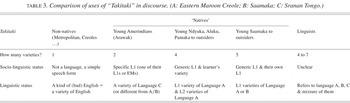
Analysis of uses of the term “Takitaki” by linguists and by various social actors in Guyane showed clearly that the term is used to refer to a number of different linguistic entities, including several kinds of first-language varieties associated with specific local ethnic groups (e.g., Amerindians and maroons), a newly emerging koiné, a “simplified” code, and a second-language or learner's variety. It may also be used to designate either one specific variety of the EMC or all maroon varieties, including or excluding Saamaka. The discussion also made it clear that different social actors seem to agree neither on the number of varieties covered by the term “Takitaki” nor on their sociolinguistic and linguistic status. Table 3 summarizes the findings from the above discussion.
Comparison of uses of “Takitaki” in discourse. (A: Eastern Maroon Creole; B: Saamaka; C: Sranan Tongo.)

Some of the varieties mentioned by the local actors are relatively well described, such as the L1 varieties of the three EM groups (cf. Huttar & Huttar 1994, Goury & Migge 2003). However, a number of the other varieties – for instance, the L1 varieties spoken by Amerindian groups and the learner's variety, lingua franca, and social varieties – so far have not received much attention from linguists. Overall, the analysis of the usage of the term “Takitaki” suggests that the local linguistic situation also involves the following kinds of varieties:
(i) Several L1 varieties of Sranan Tongo, such as the language that Amerindian children call “Takitaki of the Amerindians”;
(ii) Several L2 varieties of Sranan Tongo which are employed by the members of the various non-maroon ethnic groups of Suriname and Guyane;
(iii) Perhaps mixed and structurally “simplified” varieties employed by non-natives and natives who approximate L1 and L2 varieties of Sranan Tongo when conversing with speakers of these varieties to facilitate comprehension (i.e., foreigner talk); and
(iv) Bilingual or multilingual varieties (e.g., EMC combined with elements from Dutch, French, Sranan Tongo) spoken mostly by young maroons, such as Wakaman Tongo ‘travelers' language’ or Yunkuman Fasi ‘young man's speech’, or mixed urban speech varieties.
A BRIEF LINGUISTIC DESCRIPTION OF TWO VARIETIES OF TAKITAKI
This section provides a brief description and comparison of two of the varieties that are called “Takitaki” by the people employing them. The data are drawn from a corpus of recordings made in a range of settings, such as institutional contexts, public areas, and private homes. The recordings were made by the researchers, local field assistants, or both. In this section we discuss the characteristics of varieties of Takitaki used by non-EMs who do not claim this as their first language (Guyanese Creoles and Europeans), and by non-EMs (Arawak Amerindians) who claim Takitaki as their first language. The analysis of the salient properties of these data sets reveals that the Takitaki practices of the former do not conform closely to native EM speech but instead resemble what can be called a learner's variety. In contrast, the practices of Arawaks are strongly similar to native EM practices.
Examples (21–24) are utterances of different Guyanese Creole and metropolitan French women in their thirties who work as nurses at the hospital in St. Laurent. They were taken from interactions among the medical team (nurses and doctors) and several EM patients and some of their family members. These utterances differ in several ways from native EM productions. Most important in this respect is the fact that the constructions are structurally quite reduced. They contain only content words that are semantically and morphologically salient and transparent, such as verbs and nouns. Relatively nonsalient elements – such as the imperfective marker e and the future marker o – are not preserved, probably because the meanings they convey can be deduced from the content morphemes and the context in which the construction occurred.

More complex constructions such as the conditional construction in (22) are realized as reduced paratactic constructions in which the main function morphemes (efu, o, i) are omitted. The result resembles “pidgin English” – ‘not know, no tablets’:

Another strategy involves the regularization of variation. From among the natively used variants, speakers of this L2 variety pick out the most salient variant and use it as the only form in all contexts. Such an element is either morphologically particularly robust or resembles a similar form in their native language or another language that they know well. For instance, in the EMC (and Sranan Tongo) there is variation in the expression of the second person singular pronoun between i (non-emphatic, occurs before consonants), y (non-emphatic, before vowel) and yu (emphatic). However, in the L2 varieties only yu is consistently used. Yu is probably the most salient form for non-native speakers because it resembles the English second person pronoun.
A fourth strategy involves the use of French elements in place of EM elements that were most likely not acquired. In (23), the EM conditional marker efu is replaced by its French counterpart si. And in (24) the EM focus marker na is replaced by French c'est in an example that could be an instance of code-switching:

Finally, L2 speakers tend to select Sranan Tongo lexical items rather than EM ones in those cases in which the two differ. The examples in (25) illustrate this:

It is thus possible to conclude that public exchanges that are not carried out in French by hospital personnel and are often referred to by its practitioners with the term “Takitaki” involve a speech form that is lexically based on Sranan Tongo rather than on EMC, and structurally quite reduced. Moreover, it involves interference features from the various languages the practitioners know. The fact that this variety is lexically based largely on Sranan Tongo rather than on the EMC is most likely due to the fact that EMs tend to shift to Sranan Tongo in public out-group contexts (Migge 2002, forthcoming).
In contrast to the learner's variety discussed above, the linguistic practices of Arawak Amerindians much more closely resemble native EM practices. Consider the short exchange in (26), drawn from a recording realized in the home of an Arawak family living in the village of Ballaté6
The participants included one of the researchers, an EM male friend, an Arawak couple, and their two young children. The adults were all in their thirties. The two men knew each other reasonably well from a work-training program. It was a relaxed interaction.

The constructions employed by Arawak Amerindians are clearly not structurally reduced compared with the native EM model. They employ the function morphemes typical of the creoles of Suriname in the same way that the Afro-Surinamese population does. For instance, Arawaks regularly employ the imperfective marker e to indicate that an event takes place habitually (lines 1–2), and the relative past marker be(n) to convey that an event has occurred prior to the point of speaking (line 11). Moreover, they use the demonstrative modifiers in postnominal position (line 4), the copula na in equative contexts (line 7), and the copula de in locational contexts (line 5). Focus and presentative constructions regularly involve the particle (n)a (lines 2, 4), and nominal constituents are connected using the preposition anga ‘with’ (line 5). The pronominal forms also undergo phonological change when they are followed by a vowel, as in EMC – for example, u ‘we’ (line 9) changes to w (lines 1–2), or den ‘they’ (line 9) changes to de (line 1). The same is true of the negation marker: no changes to nei when followed by the imperfective marker, and to na when followed by the verb a(bi) ‘to have’ (line 9). The main difference between native EM practices and those of Arawaks seems to reside in the fact that the latter overwhelmingly select Sranan Tongo-based lexical items rather than EMC-based ones in those cases where they differ, such as the examples in (25).
This brief comparison of two varieties of what is referred to by its practitioners as Takitaki strongly suggests that this term covers a range of practices that are structurally quite distinct. However, they clearly resemble one another in that they predominantly involve vocabulary from Sranan Tongo.
CONCLUSION
Our investigation strongly supports Irvine & Gal's (2001:36) tenet that “there is no view from nowhere” in representing linguistic differences, and that “acts of speaking and acts of describing both depend on and contribute to the work of representations.” (79). Our analysis further suggests that this is also true of naming practices: Acts of naming linguistic varieties are never neutral but are always dependent on and contribute to their representation and to the representation of the speakers involved. With this essay, we hope to have shown that in order to understand the local social and particularly the linguistic situation of a multiethnic contact area, it is vital to assume an emic point of view. However, we propose also that it is vital to broaden the current linguistic anthropological notion of “emic” (Pike 1964, Mondada 2002) to include both the native perspective and the perspectives of the different social actors involved in the area and situation. Linguistic descriptions thus should not rely merely on linguists' or natives' perspectives but also need to consider the various other perspectives present in the local linguistic market.
With this article we have devised a new methodology for the documentation of languages with specific reference to multilingual areas. We proposed a three-step procedure that we applied to Takitaki: first, analysis of naming conventions; second, analysis of language attitudes using a discursive method; and third, a linguistic analysis of language varieties. In relation to step one, our analysis departs from previous discussions of naming conventions in that we were not concerned with the sociohistorical aspects of naming conventions and their political and linguistic appropriateness. Instead, we gave equal attention to each perspective, focusing on the insights that each view provides on the current makeup of the linguistic space and the possible directions of its development. The investigation of the naming conventions employed for the creoles of Suriname strikingly showed that the different social actors – EMs, Amerindians, members of other local ethnic groups, and linguists – have quite different perspectives on the makeup of the sociolinguistic space involving the creoles of Suriname in Guyane. They have different views on the sociolinguistic structure of this group of varieties, regarding such factors as the number of varieties involved, their relationships to one another, and the population groups associated with each of them.
With respect to the second step, we decided to take a closer look at the term “Takitaki” because it seemed to be problematic. Applying a discourse analytic approach, we showed that, contrary to linguists' view of this term, it is invested with various positive and negative social meanings by various groups of social actors. It is also used to refer to a variety of speech forms that are currently not practiced only by the maroons who are traditionally held to be the native speakers of these. Moreover, it turned out that young urban maroons strategically employ Takitaki in interactions with non-EMs to portray or assert newly emerging social realities (e.g. pan-maroon identities) to them.
In regard to step three, we provided a preliminary description of two different practices commonly referred to as “Takitaki” by their practitioners. One of them significantly differs from native EM practices and appears to be a type of learner's variety that is surprisingly based on Sranan Tongo rather than on EMC. The second variety also appears to be a variety of Sranan Tongo that is spoken natively by young Amerindians; it shows no reduction when compared with other L1 varieties. Other practices covered by the term “Takitaki” are currently being described in order to realize a systematic linguistic analysis of the different locally identified speech forms or varieties. Based on such an investigation, we hope to gain comprehensive insight into this dynamic linguistic space and to avoid the current practice of linguistic documentation which focuses largely on monostylistic productions (cf. Foley 2005).
References
REFERENCES
Alexandre, Pierre
(1971).
Multilingualism. In
Thomas Sebeok (ed.),
Linguistics in sub-Saharan Africa,
654–63.
The Hague:
Mouton.CrossRef
Baugh, John
(1991).
The politicization of changing among American slave
descendants.
American Speech
66:133–46.Google Scholar
Bavoux, Claudine
(2002).
Représentations et attitudes dans les aires
créolophones. In
Claudine Bavoux &
Didier de Robillard (eds.),
Univers créoles, 2:57–76.
St. Denis de la Réunion:
Anthropos.
Bourdieu, Pierre
(1982).
Ce que parler veut dire.
Paris:
Fayard.
Bugarski, Ranko
(2004).
What's in a name: The case of Serbo-Croatian.
Revue des Études Slaves
75:11–20.Google Scholar
Calvet, Louis-Jean
(1999).
Pour une écologie des langues du monde.
Paris:
Plon.
Carlin, Eithne B., &
Arends, Jacques
(2002) (eds.).
Atlas of the languages of Suriname.
Leiden:
KITLV.
Caubet, Dominique
(2001).
Maghrebine Arabic in France. In
G. Extra &
D. Gorter (eds.),
The other languages of Europe,
261–77.
Clevedon:
Multilingual Matters.
Collectif
(2000).
Les langues de Guyane: Document de travail.
Cayenne:
IRD Cayenne-CNRS-CELIA.
Collectif
(2003).
Les langues de Guyane. In
Bernard Cerquiglini (ed.),
Les langues de France,
269–303.
Paris:
Presses Universitaires de France.
Eloy, Jean-Michel
(2004) (ed.).
Des langues collatérales.
Paris:
L'Harmattan.
Foley, William
(2005).
Personhood and linguistic identity, purism and variation.
Paper presented at School of Oriental and African Studies,
London.
Foucault, Michel
(1972).
The Archeology of Knowledge.
London:
Tavistock.
Goodman, Morris
(1971).
The strange case of Mbugu. In
Dell Hymes (ed.),
Pidginization and creolization of languages,
243–54
Cambridge:
Cambridge University Press.
Goury, Laurence, &
Migge, Bettina
(2003).
Grammaire du nengee: Introduction aux langues aluku, ndyuka et
pamaka.
Paris:
Editions IRD.
Grenand, Françoise
(2004).
La Guyane: Une situation linguistique complexe.
Langues et Cité
4:2–3.Google Scholar
Hall, Robert A.
(1966).
Pidgin and creole languages.
Ithaca:
Cornell University Press.
Herskovits, Melville J., &
Herskovits, Frances S.
(1936).
Suriname folk-lore.
Columbia University Publications in Anthropology 27.
New York:
Columbia University Press.
Hoogbergen, Wim
(1990).
The Boni Maroon wars in Suriname.
Leiden:
Brill.
Huttar, George L., &
Huttar, Mary L.
(1994).
Ndyuka.
London:
Routledge.
Irvine, Judith, &Susan Gal
(2001).
Language ideology and linguistic differentiation. In
Paul Kroskrity (ed.),
Regimes of language: Ideology, politics, and identities,
35–83.
Santa Fe, NM:
School of American Research Press.
Jolivet, Marie-José
(1990).
Entre autochtone et immigrants: Diversité et logique des
positions créoles guyanaises.
Études Créoles
13:11–32.Google Scholar
Kaye, Alan
(1994).
Formal vs. informal in Arabic: Diglossia, triglossia, tetraglossia,
etc. – polyglossia-multiglossia viewed as a continuum.
Zeitschrift für Arabische Linguistik
27:47–66.Google Scholar
Launey, Michel
(1999).
Les langues de Guyane: Des langues régionales pas comme les
autres? In
Clairis Christos,
Denis Costaouec, &
Jean-Baptiste Coyos (eds.),
Langues et cultures régionales de France,
141–59.
Paris:
L'Harmattan.
Léglise, Isabelle
(2004).
Langues frontalières et langues d'immigration en Guyane
Française.
Glottopol
4:108–24.Google Scholar
Léglise, Isabelle
(2005).
Contacts de créoles à Mana (Guyane Française):
répertoires, pratiques, attitudes et gestion du
plurilinguisme.
Études Créoles
28(1):23–57.Google Scholar
Léglise, Isabelle (in press).
Environnement graphique, pratiques et attitudes linguistiques à
l'hôpital (St Laurent du Maroni). In
Isabelle Léglise &
Bettina Migge (eds.),
Pratiques et attitudes linguistiques en Guyane.
Paris:
Presses Universitaires de France.
Maingueneau, Dominique
(1995) (ed.).
Les analyses de discours en France.
Langages, 117.
Paris:
Larousse.
Migge, Bettina
(2002).
Code-mixing, gender and social identities among Eastern
Maroons.
Paper presented at the Society for Caribbean Linguistics, 14th
Biennial Conference, University of the West Indies, St. Augustine,
Trinidad & Tobago.
Migge, Bettina
(forthcoming).
Language alternation in creole communities: The case of the Eastern
Maroon community of Suriname and French Guiana.
Ms.
Mondada, Lorenza
(2002).
Pour une approche interactionnelle de la catégorisation des
ressources linguistiques par les locuteurs. In
Véronique Castellotti &
Didier de Robillard (eds.)
France, pays de contacts de langues,
23–35.
Louvain-la-neuve:
Cahiers de l'Institut Linguistique de Louvain.
Mous, Maarten
(2003).
The making of a mixed language: The case of
Ma'a/Mbugu.
Amsterdam:
John Benjamins.CrossRef
Mufwene, Salikoko
(1997).
Kituba. In
Sarah Thomason (ed.),
Contact languages: A wider perspective,
173–208.
Amsterdam:
John Benjamins.CrossRef
Mühleisen, Susanne
(2001).
Is ‘bad English’ dying out? A diachronic comparative
study of attitudes towards Creole versus Standard English in
Trinidad.
Philologie im Netz
15:43–78.Google Scholar
Pike, Kenneth L.
(1964).
Towards a theory of the structure of human behavior. In
Dell Hymes (ed.),
Language in culture and society,
54–62.
New York:
Harper & Row.
Price, Richard
(2002).
Maroons in Suriname and Guyane: How many and where?
New West Indian Guide
76:81–88.Google Scholar
Price, Richard, &
Price, Sally
(2003).
Les Marrons.
Châteauneuf-le-Rouge:
Vents d'Ailleurs.
Queixalós, Francisco
(2000).
Les langues de Guyane. In
Francisco Queixalós &
Odile Renault-Lescure (eds.),
As linguas amazonicas hoje,
299–306.
Sao Paulo:
IRD-ISA-MPEG.
Rens, L.
(1953).
The historical and social background of Surinam's Negro
English.
Amsterdam:
North-Holland.
Shanks, Louis
(2000).
A Buku fu Okanisi anga Ingiisi Wowtu. Aukan-English Dictionary and
English-Aukan Index.
Paramaribo, Suriname:
Summer Institute of Linguistics.
Sidnell, Jack
(1998).
Gender, space and linguistic practice in an Indo-Guyanese
Village.
Dissertation,
University of Toronto.
Smitherman, Geneva
(1991).
‘What is Africa to me?’ Language, ideology, and
African American.
American Speech
66:115–32.Google Scholar
Tabouret-Keller, Andrée
(1997).
Le Nom des langues.
Louvain-la-neuve:
Peeters.
Thomas, Paul-Louis
(1994).
Serbo-croate, serbe, croate … , bosniaque,
monténégrin: une, deux … , trois, quatre
langues?
Revue des Études Slaves
66(1):237–59.Google Scholar
Thomas, Paul-Louis
(2004) (ed.).
Points de vue croisés sur le serbo-croate (bosniaque, croate,
monténégrin, serbe).
Special issue,
Revue des Études Slaves
75(1).Google Scholar
Vernon, Diane
(1985).
Money magic in a modernizing maroon society.
Tokyo:
AA-Ken Caribbean Study Series, ILCAA
Voorhoeve, Jan
(1953).
Voorstudies tot een beschrijving van het Sranan Tongo (Negerengels
van Suriname).
Dissertation,
University of Amsterdam.
Voorhoeve, Jan
(1962).
Sranan syntax.
Amsterdam:
North Holland.
Overview of the main languages spoken in Guyane.
Naming the creoles of Suriname spoken in Guyane. (A, B, and C designate distinct languages.)
Comparison of uses of “Takitaki” in discourse. (A: Eastern Maroon Creole; B: Saamaka; C: Sranan Tongo.)
 You have
Access
- 30
- Cited by