1. Introduction
Throughout the lowermost Devonian, trilobite diversity is relatively poor. The Basal Pragian Event of regressive character contributed to the installation of shallow marine realms with carbonate sedimentation favourable for trilobites. This led to an increase in the generic diversity and, at least, to a preservation of the family diversity, which lasted with some changes until early Eifelian time (Chlupáč, Reference Chlupáč1994; Crônier & Van Viersen, Reference Crônier and Viersen2007).
The publications of Alberti (Reference Alberti1969, Reference Alberti1970, Reference Alberti1981), Morzadec (Reference Morzadec1997, Reference Morzadec2001), Chatterton et al. (Reference Chatterton, Fortey, Brett, Gibb and Kellar2006), McKellar & Chatterton (Reference McKellar and Chatterton2009) and Gibb & Chatterton (Reference Gibb and Chatterton2010) have been major contributions to our current knowledge of North African Lower Devonian trilobites.
The present paper is a contribution to the systematic study of the Lower Devonian trilobites and especially phacopid trilobites from SW Algeria. The discovery of new taxa assigned to Barrandeops, Geesops, Austerops and Phacops sensu lato gives us the opportunity to understand these forms more fully and to explore their palaeobiodiversity.
2. Geological setting and material
2.a. Local geological succession
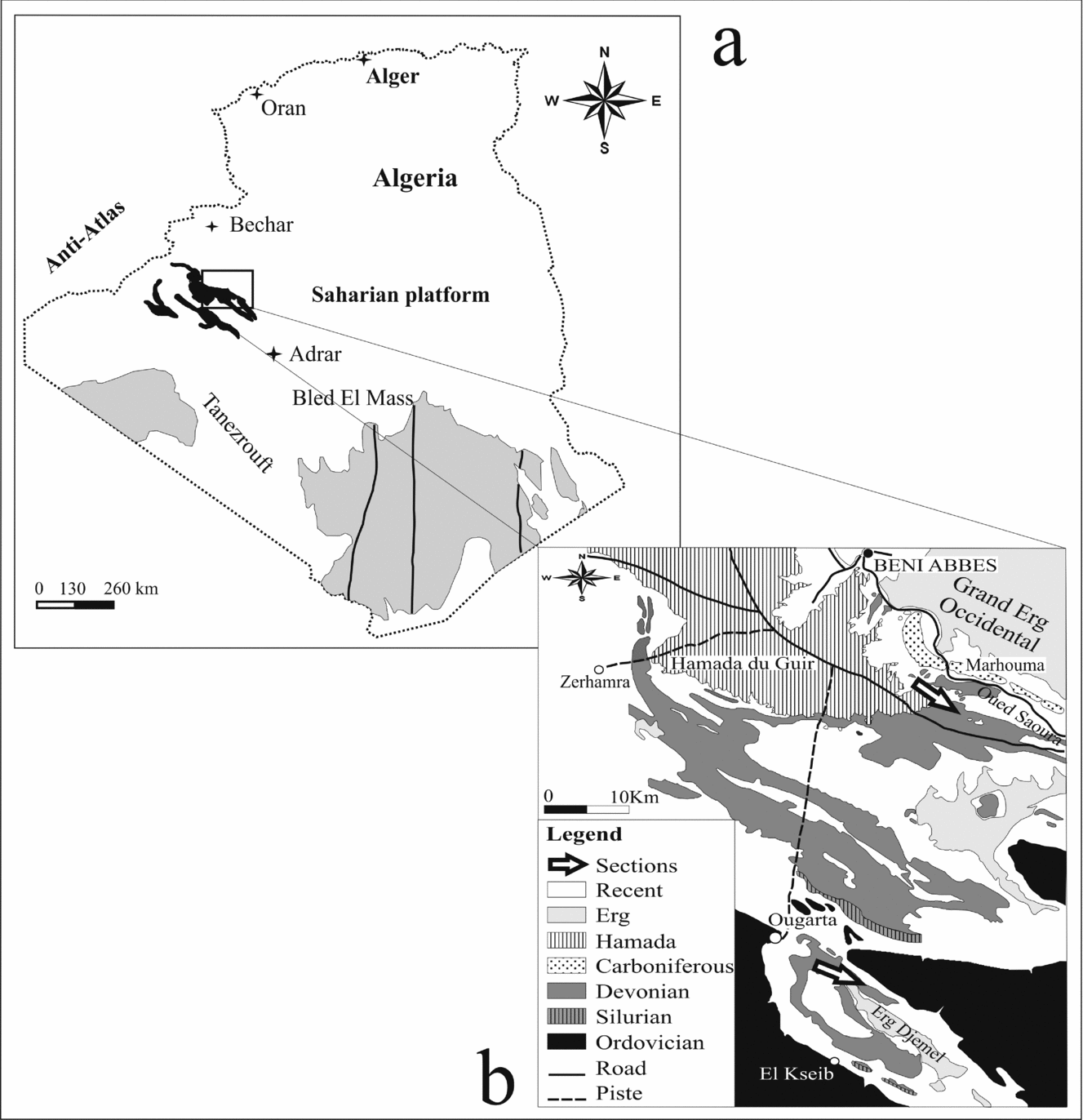
In southwestern Algeria, beyond the Saharan Atlas and the High Zousfana, a mountain range of Palaeozoic age called the Mountains of Ougarta or the Ougarta Range appears. This folded domain links the Moroccan Anti-Atlas to the northwest and the hills of Bled El Mass and Tanezrouft to the southeast (Fig. 1). The Mountains of Ougarta, which extend over 400 km in length and 200 km in width, are elongated in a NW–SE direction and subdivided into two structural units consisting of folds with the same long axis, i.e. two ‘beams’, separated by the Erg Er Raoui: (1) a northern unit, i.e. ‘beam of Saoura’, constituted by anticlines that expose Cambro-Ordovician outcrops and synclines that expose Siluro-Devonian outcrops; and (2) a southernmost unit, i.e. ‘beam of Daoura’ also called Kahal Tabelbala, located to the east of the Pan-African sutures that exposes only Cambro-Ordovician outcrops (Menchikoff, Reference Menchikoff1933; Donzeau, Reference Donzeau and Fabre1983; Fabre, Reference Fabre2005).
(a) Geographical location of the Marhouma and Erg el Djemel areas, SE of Beni-Abbès (30 km), Saoura Valley, Ougarta Basin, Algeria. (b) Location of studied Marhouma (‘km 30’) and Erg el Djemel (‘Ed’) sections. Extract of the geological map 1/200000.

The sampled material in the present study has been collected from two sections located in the beam of Saoura: (1) the ‘Erg el Djemel’ section located 70 km to the south of Beni-Abbès city and 7 km to the south of Ougarta village, and (2) the ‘Marhouma’ section called ‘km 30’, which is located 30 km to the SE of Beni-Abbès city and 5 km from the Marhouma oasis (Fig. 1). This ‘km 30’ section is used as reference for the lithostratigraphic correlations of the Devonian in North Africa (Le Maître, Reference Le Maître1952; Boumendjel et al. Reference Boumendjel, Morzadec, Paris, Plusquellec, Brice, Copper, Gourvennec, Jahnk, Lardeux, Le Menn, Melou and Racheboeuf1997).
The Palaeozoic deposits of Saoura have been known since the beginning of the twentieth century (Gautier, Reference Gautier1902). However, the stratigraphy and the fauna of the Devonian only began to be described later (Menchikoff, Reference Menchikoff1930, Reference Menchikoff1932, Reference Menchikoff1933, Reference Menchikoff1936; Le Maître, Reference Le Maître1952). Former works (Flamand, Reference Flamand1911; Menchikoff, Reference Menchikoff1936; Alimen et al. Reference Alimen, Le Maître, Menchikoff, Petter and Poueyto1952; Le Maître, Reference Le Maître1952; Legrand, Reference Legrand1967) were synthesized by Boumendjel et al. (Reference Boumendjel, Morzadec, Paris, Plusquellec, Brice, Copper, Gourvennec, Jahnk, Lardeux, Le Menn, Melou and Racheboeuf1997), who redefined the lithostratigraphic units of the Devonian of Saoura. Six formations were defined representing more than 1680 m in thickness, including the ‘Chefar el Ahmar’ Formation corresponding to the fifth formation from the base.
The fossils described herein were mainly collected from a ‘shell level’ containing a varied benthic fauna that was labelled FBV by A. Ouali Mehadji (unpub. Ph.D. thesis, Univ. Oran, 2004), previously labelled ‘Corraligène’ by Le Maître (Reference Le Maître1952). This level is situated in the base of the ‘Chefar el Ahmar’ Formation of the Saoura Valley and regarded as upper Emsian in age on the basis of cephalopods (Göddertz, Reference Göddertz1987), corals (Plusquellec, Reference Plusquellec1997) and brachiopods (A. Ouali Mehadji, unpub. Ph.D. thesis, Univ. Oran, 2004). The higher part of this formation is represented by alternating claystones and nodular limestones with goniatites called ‘Calcaires griottes’.
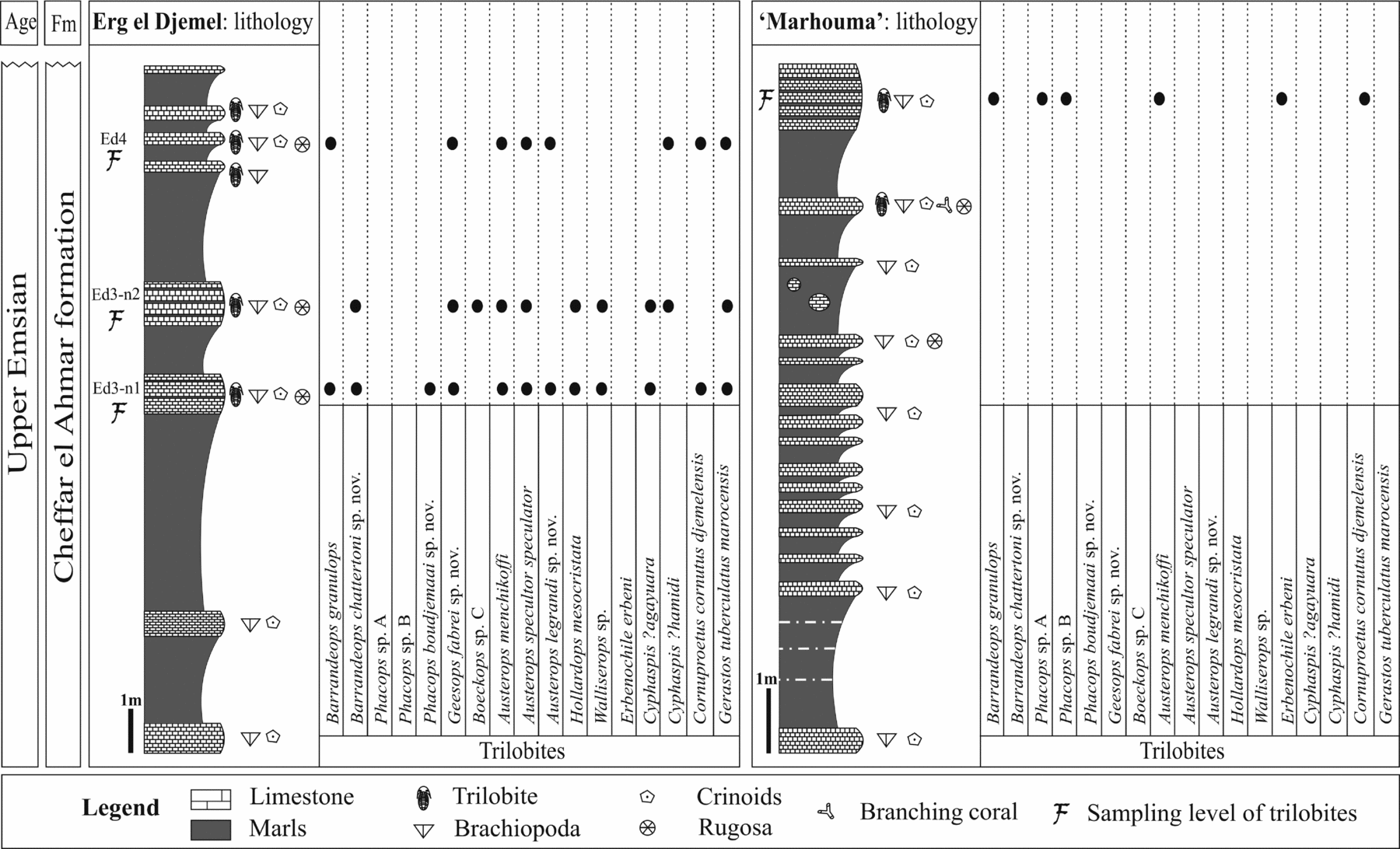
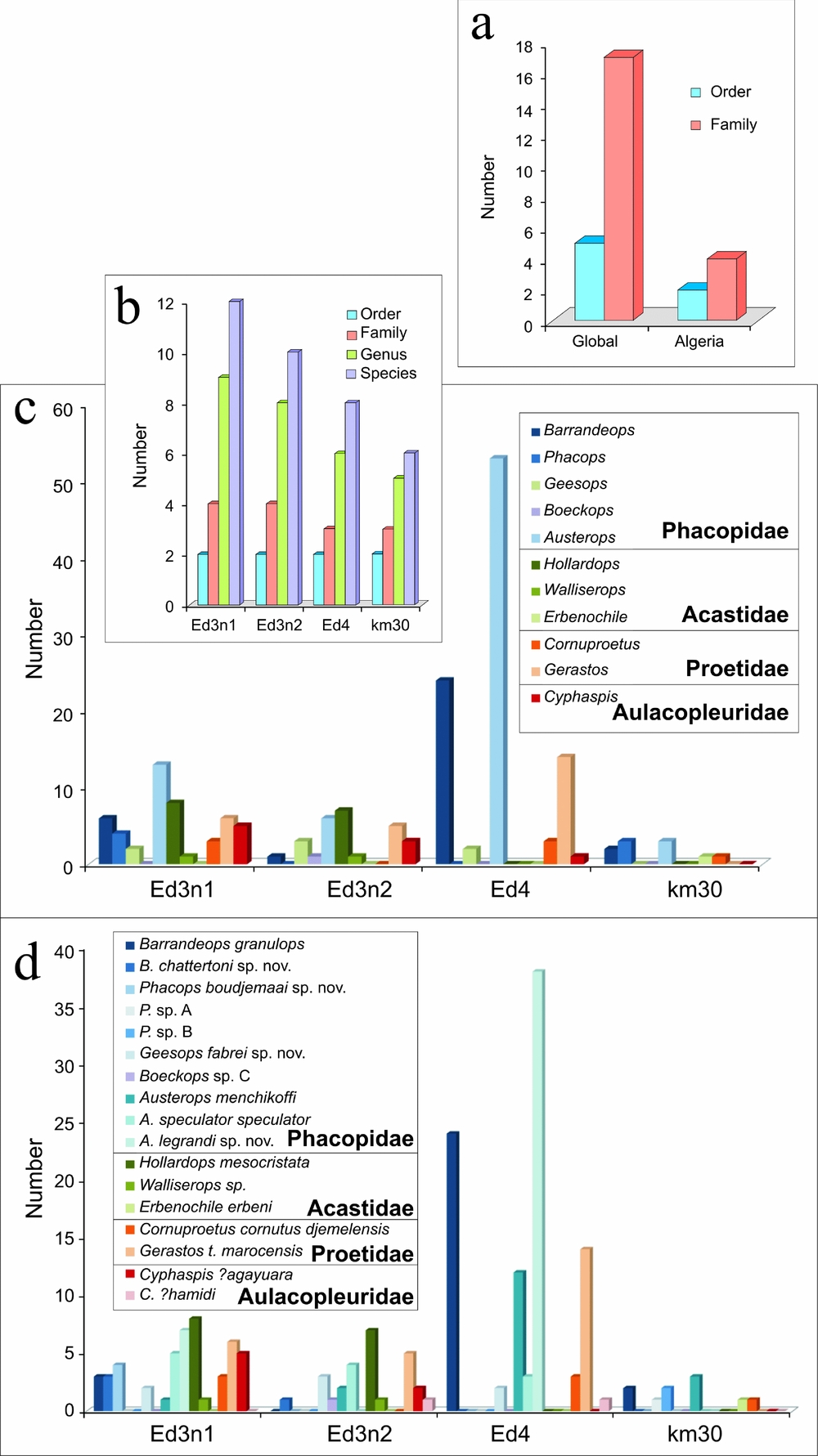
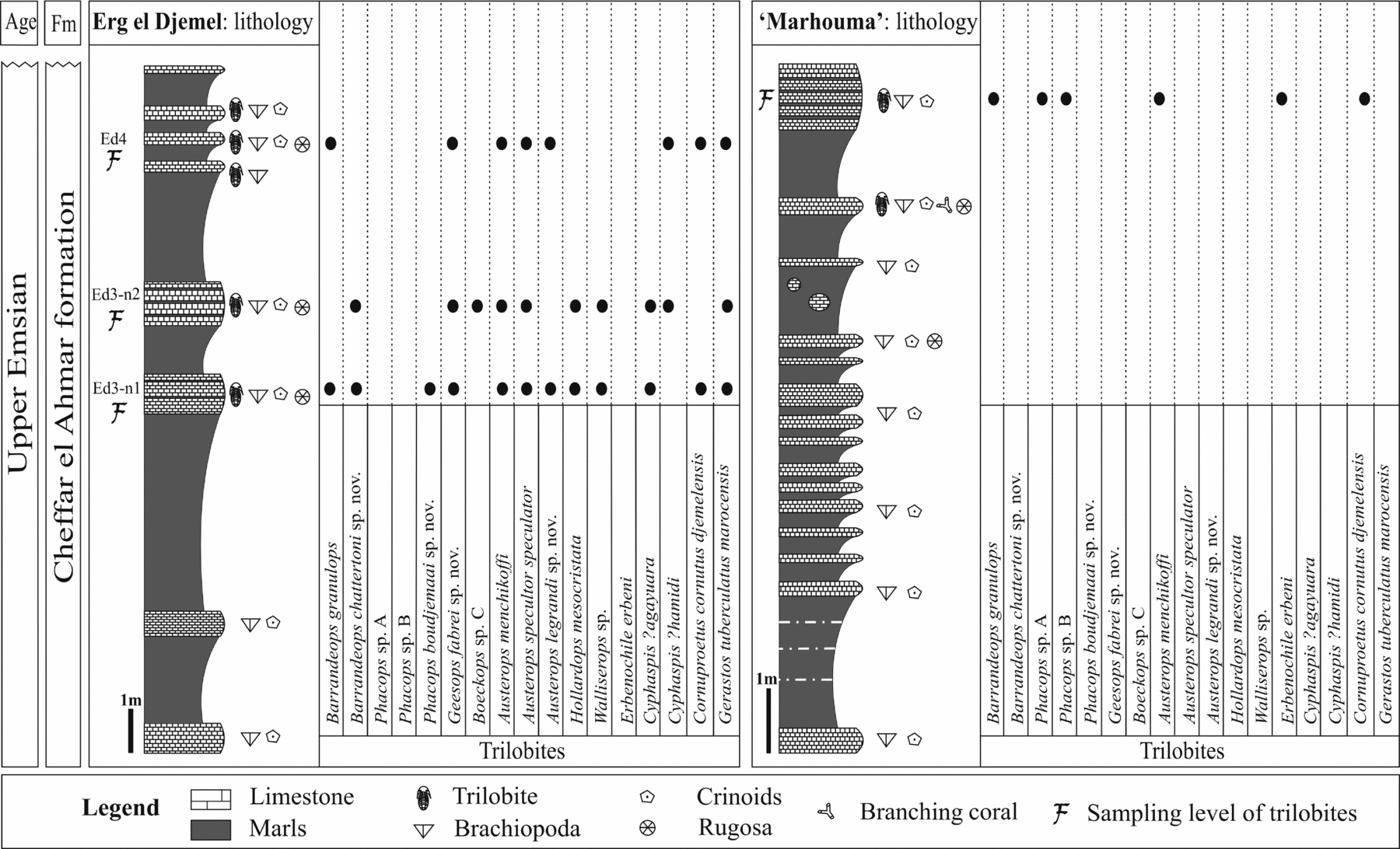
The ‘varied benthic fauna level’ (FBV) is represented by alternating grey claystone and grey calcareous limestones, which are sometimes nodular and strongly fossiliferous (trilobites, brachiopods, corals, crinoids, bryozoans, some rare gastropods, orthocerids and goniatites). In the Marhouma section, the FBV is 12 m thick and has eight major carbonate levels, the highest of which makes up a ‘trilobite level’ interrupted by green clay intercalations (Fig. 2). In the Erg el Djemel section, the FBV is 12 m thick and has six major carbonate levels, including three trilobite levels (Ed3n1, Ed3n2 and Ed4) also intercalated by green clay levels (Fig. 2).
Lithostratigraphic column of the ‘Chefar el Ahmar’ Formation and stratigraphical location of studied trilobites (from the Marhouma and the Erg el Djemel sections).
2.b. Trilobite faunas
In the published Lower Devonian faunal associations previously reported from Algeria, numerous trilobites from the Ougarta Basin have been described (23 species) and illustrated by Le Maître (Reference Le Maître1952), such as Phacops menchikoffi or Asteropyge mesocristata (original designation), as new species. Alberti (Reference Alberti1981) also studied the trilobites from this area and substantially contributed to the knowledge of the Lower Devonian stratigraphy of the Ougarta Basin. He defined several new species or subspecies, such as Cornuproetus (Cornuproetus) cornutus djemelensis from the Erg el Djemel section. Morzadec (Reference Morzadec1997) focused on the Devonian Asteropyginae and also contributed to the biostratigraphical concept of the Ougarta Basin. He described and illustrated 11 species, including five new species arranged in nine genera including two new genera, i.e. Hollardops represented by the common species H. mesocristata (Le Maître, Reference Le Maître1952) and Destombesina represented by the single species D. ougartensis Morzadec (Reference Morzadec1997).
As observed in other areas from the northern peri-Gondwanan margin, such as Morocco (Chatterton et al. Reference Chatterton, Fortey, Brett, Gibb and Kellar2006; McKellar & Chatterton, Reference McKellar and Chatterton2009; Gibb & Chatterton, Reference Gibb and Chatterton2010), the trilobite, and especially phacopid, remains are relatively abundant and well preserved. The trilobites include mostly complete and enrolled specimens. The studied trilobites with their geographic and stratigraphic locations are listed in Figure 2.
The material described and figured herein is housed in the University of Oran, Algeria (collection Di/UO 001–037).
3. Systematic palaeontology
Morphological terminology mainly follows Chlupáč (Reference Chlupáč1977), Crônier, Bignon & François (Reference Crônier, Bignon and François2011) and Gibb & Chatterton (Reference Gibb and Chatterton2010). Abbreviations used: ‘exsag.’ – exsagittal; ‘sag.’ – sagittal; ‘tr.’ – transverse; and according to the rules of synonymy lists (Matthews, Reference Matthews1973), some signs attached to the synonymy list have been used: ‘*’ for valid species; ‘.’ for responsibility assumed for attaching this reference to the type species; and ‘v’ for material seen.
Order PHACOPIDA Salter, Reference Salter1864
Family Phacopidae Hawle & Corda, Reference Hawle and Corda1847
Subfamily Phacopinae Hawle & Corda, Reference Hawle and Corda1847
Genus Barrandeops McKellar & Chatterton, Reference McKellar and Chatterton2009
Type species. Barrandeops forteyi McKellar & Chatterton, Reference McKellar and Chatterton2009: upper Emsian, Morocco.
Additional species. Barrandeops granulops (Chatterton et al. Reference Chatterton, Fortey, Brett, Gibb and Kellar2006): upper Emsian, Morocco; B. lebesus (Chatterton et al. Reference Chatterton, Fortey, Brett, Gibb and Kellar2006): Eifelian, Morocco; B. ovatus McKellar & Chatterton, Reference McKellar and Chatterton2009: upper Emsian, Morocco; B. chattertoni sp. nov.: upper Emsian, Algeria.
Remarks. Barrandeops was erected by McKellar & Chatterton (Reference McKellar and Chatterton2009) for a group of tuberculate Moroccan phacopids without pitting in the palpebral lobe and palpebral area. The previously described species such as Phacops turco praecedens Haas, Reference Haas1968 or Phacops (Phacops) saberensis torkozensis Schraut, Reference Schraut2000a , need to be re-evaluated.
Barrandeops granulops (Chatterton et al. Reference Chatterton, Fortey, Brett, Gibb and Kellar2006)
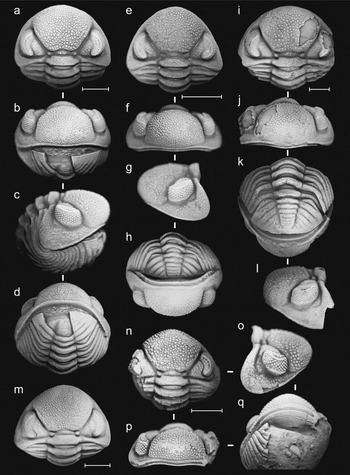
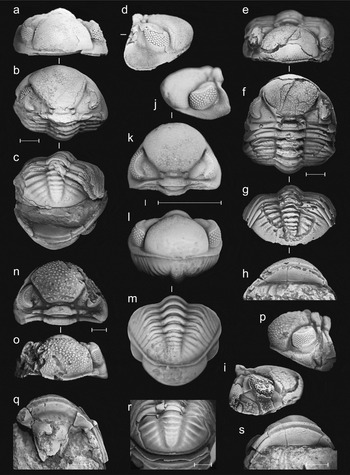
Figure 3a–m
v. 1952 [non] Phacops cf. turco Richter & Richter, Reference Richter and Richter1939; Le Maître, p. 157, pl. 21, fig. 7.
Phacopid trilobites from the ‘Chefar el Ahmar’ Formation, Lower Devonian, upper Emsian, Saoura Valley, Algeria. (a–d) Barrandeops granulops (Chatterton et al. Reference Chatterton, Fortey, Brett, Gibb and Kellar2006), Erg el Djemel section, Di/UO/028 (Ed4): (a–c) cephalon in dorsal, frontal and lateral views; (d) pygidium in dorsal view. (e–h) Barrandeops granulops (Chatterton et al. Reference Chatterton, Fortey, Brett, Gibb and Kellar2006), Erg el Djemel section, Di/UO/027 (Ed4): (e–g) small cephalon in dorsal, frontal and lateral views; (h) pygidium in dorsal view. (i–l) Barrandeops ?granulops (Chatterton et al. Reference Chatterton, Fortey, Brett, Gibb and Kellar2006), Marhouma section, Di/UO/034 (‘km 30’): (i–j, l) cephalon in dorsal, frontal and lateral views; (k) pygidium in dorsal view. (m) Barrandeops granulops (Chatterton et al. Reference Chatterton, Fortey, Brett, Gibb and Kellar2006), Erg el Djemel area, figured by Le Maître in 1952, GFCL405 (coll. Le Maître, Faculté libre des Sciences de Lille). (n–q) Phacops sensu lato sp. A, Marhouma section, Di/UO/032 (‘km 30’): cephalon in dorsal, lateral, frontal and ventral views. Scale bars = 5 mm.

2006 Phacops granulops sp. nov. Chatterton, Fortey, Brett, Gibb & McKellar, pp. 12–14, pl. 1.1–1.10, pl. 2.1–2.12, text-fig. 3.4.
2009 Barrandeops granulops (Chatterton et al.); McKellar & Chatterton, pp. 44–5.
Type material. Enrolled exoskeleton UA13295, from the upper Emsian, Timrhanrhart Formation, basal part of section at Jbel Gara el Zguilma, near Foum Zguid, Morocco.
Studied material. Twenty-nine mostly enrolled exoskeletons: two from the upper Emsian (base of the ‘Chefar el Ahmar’ Formation) of the Marhouma section (‘km 30’) and 27 from the Erg el Djemel section including ten small individuals (three from Ed3n1 and 24 from Ed4 with some specimens more or less eroded); Ougarta Basin, Saoura, Algeria.
Diagnosis. See McKellar & Chatterton (Reference McKellar and Chatterton2009).
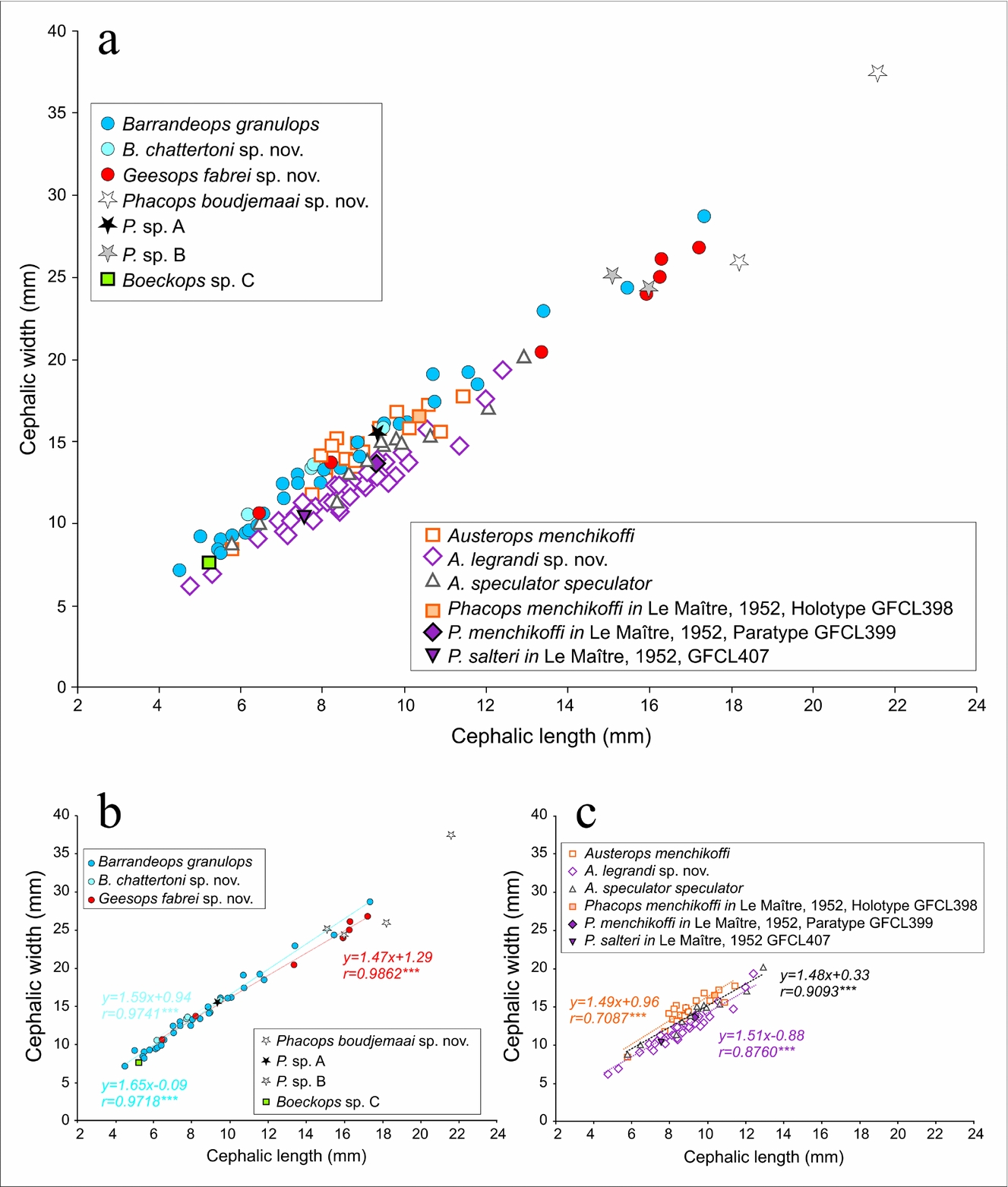
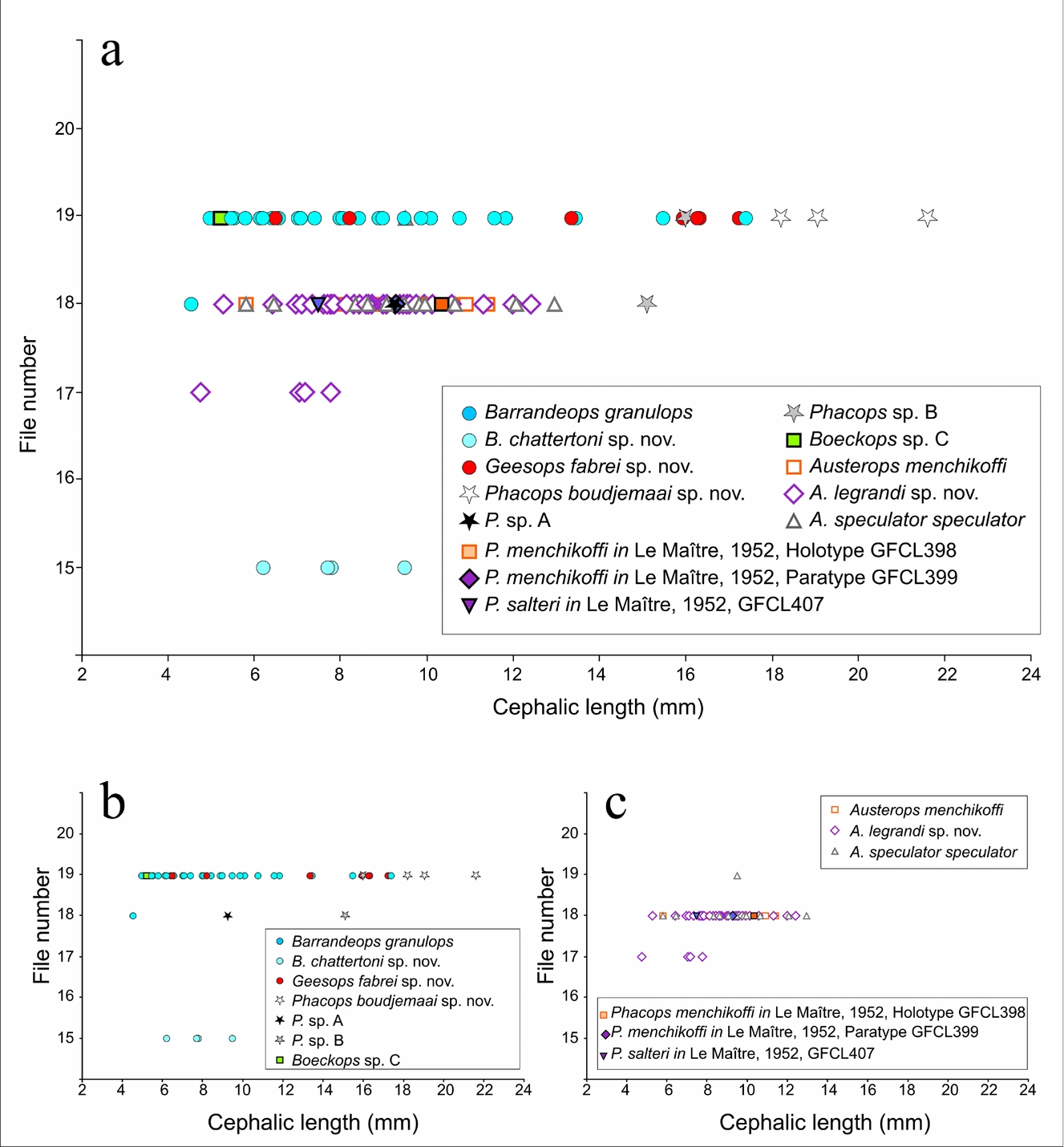
Remarks. The Algerian specimens show the main morphological features of Barrandeops granulops from Morocco: coarse conical tubercles, 19 dorsoventral files of lenses with 4–5 lenses per file, no pitting between tubercles of the palpebral lobe and the palpebral area, and a postocular pad with tubercles and a row of small tubercles at the base of the eye; only the axial furrows are a little less divergent (65–67° for Algerian specimens against more than 70° for Moroccan specimens). The smallest specimen at 4.5 mm long (sag.) has only 18 dorsoventral files of lenses with a maximum of four lenses per file. Its cephalic outline is less subcircular than for the oldest specimens and the tubercles are relatively coarser.
Among the best preserved specimens, one specimen from the Marhouma section (‘km 30’; Fig. 3i–l) seems to be slightly different from Barrandeops granulops sensu stricto. This specimen, with a large size (15.5 mm in cephalic length), has more scattered conical tubercles on the glabella and fewer tubercles on the intercalar ring.
Le Maître (Reference Le Maître1952) previously attributed some specimens to Phacops cf. turco Richter & Richter, Reference Richter and Richter1939. The specimen figured (pl. XXI, fig. 7; GFCL405, coll. Le Maître, Faculté libre des Sciences de Lille) from the Erg el Djemel section with 19 dorsoventral files of lenses and a maximum of five lenses per file is reassigned in this work to Barrandeops granulops.
Barrandeops granulops differs from B. lebesus (Chatterton et al. Reference Chatterton, Fortey, Brett, Gibb and Kellar2006) from the Eifelian of Morocco. Barrandeops lebesus has often 19 files of lenses with a maximum of six lenses per file, a coarse but less dense tuberculation on the glabella and a less pronounced and less tuberculated subocular pad.
Barrandeops granulops differs from Phacops (Phacops) saberensis torkozensis from the upper Emsian of Morocco. Phacops (Phacops) saberensis torkozensis has no distinct postocular pad, 17–18 files of lenses with five lenses per file, and a wider postocular area, inflated and continuous with the sub-lateral area.
Barrandeops granulops differs also from Phacops (Phacops) tafilaltanus Alberti, Reference Alberti1983 (pl. 2, fig. 12), from the upper Emsian of Morocco. Phacops (Phacops) tafilaltanus has a larger but less distinct postocular pad, a well-defined subocular pad with tubercles, 18 files of lenses with 4–5 lenses per file, and a less pronounced and less dense tuberculation on the glabella.
Barrandeops granulops shares with Phacops turco praecedens Haas, Reference Haas1968 (pl. 30, fig. 6, non fig. 7) from the Eifelian of Turkey the same number of lenses per file. However, Barrandeops granulops differs in having one more dorsoventral file, a smaller postocular pad and no tubercular subocular pad.
Occurrence. Upper Emsian; Morocco (Foum Zguid), Algeria (Saoura: Erg el Djemel, ‘km 30’ section).
Barrandeops chattertoni sp. nov.
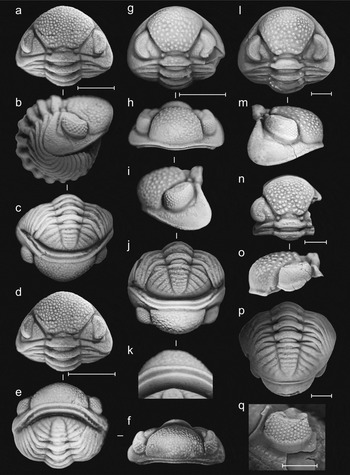
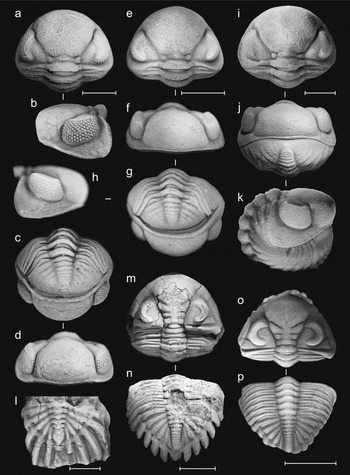
Figure 4a–f
Name. Named in honour of Dr Brian D. E. Chatterton, Professor Emeritus at Alberta University, an esteemed specialist on the Devonian trilobites from North Africa.
Phacopid trilobites from the ‘Chefar el Ahmar’ Formation, Lower Devonian, upper Emsian, Saoura Valley, Algeria. (a–c) Barrandeops chattertoni sp. nov., Erg el Djemel section, holotype Di/UO/001 (Ed3n1): (a–b) cephalon in dorsal and lateral views; (c) pygidium in dorsal view. (d–f) Barrandeops chattertoni sp. nov., Erg el Djemel section, Di/UO/002 (Ed3n1): (d, f) cephalon in dorsal and frontal views; (e) pygidium in dorsal view. (g–k) Geesops fabrei sp. nov., Erg el Djemel section, Di/UO/016 (Ed3n2): (g–i) cephalon in dorsal, frontal and lateral views; (j) pygidium in dorsal view; (k) detail of the cephalic doublure. (l, m) Geesops fabrei sp. nov., Erg el Djemel section, holotype Di/UO/017 (Ed3n2): cephalon in dorsal and lateral views. (n, o) Geesops fabrei sp. nov., Erg el Djemel section, figured by Le Maître in 1952, GFCL296 (coll. Le Maître, Faculté libre des Sciences de Lille): cephalon in dorsal and lateral views. (p) Geesops fabrei sp. nov., Erg el Djemel section, Di/UO/004 (Ed3n1): pygidium in dorsal view. (q) Geesops fabrei sp. nov., Erg el Djemel section, Di/UO/014 (Ed3n2): detail of the left eye. Scale bars = 5 mm.

Holotype. Complete enrolled individual from Ed3n1: Di/UO/001.
Paratype. Complete enrolled individual from Ed3n1: Di/UO/002.
Locus typicus. Erg el Djemel section, Saoura Valley, Ougarta Basin, Algeria.
Stratum typicum. Base of ‘Chefar el Ahmar’ Formation, upper Emsian, Lower Devonian.
Studied material. Four enrolled exoskeletons from the upper Emsian (base of ‘Chefar el Ahmar’ Formation) of the Erg el Djemel section (three specimens from Ed3n1 and one from Ed3n2).
Diagnosis. Cephalon wide; glabella with a wide base and a frontal outline slightly tapered; glabella and cheeks slightly inflated; S2 and S3 distinct; L1 swollen with a tuberculated intercalating ring; visual complex with 15 vertical lens files and a maximum of three lenses per file, longer (exsag.) than the postocular length of the genal field; palpebral furrow distinct. Pygidial axis relatively long and wide, with fairly complete terminal closure, and composed of 6–7 clear rings plus terminal piece; pygidial pleural field with five clear ribs. Dense coarse conical tubercles on cephalon without superimposed granules.
Description. Cephalon: Length/width ratio about 0.57. Dorsal view: Glabellar ratio of width at L1 / maximum width of frontal lobe about 0.53. Glabella bound by deep axial furrows that are highly divergent forwards (72°), with subangular anterolateral angles. Frontal outline slightly tapered anteriorly. Frontal lobe overhanging slightly a deep preglabellar furrow. S2 and S3 distinct. S1 continuous and curved more strongly forwards than S0 in its adaxial curvature, and becoming deeper in its distal portions. L1 shorter (sag.) than L0 (half L0 length) and with a wide (tr.) median portion relative to its total width. Median portion of L1 moderately inflated, with few tubercles. L1 with subcircular, inflated lateral lobes separated from its median part by a strong exsagittal furrow. S0 well marked and almost transverse in its middle portion. L0 wide (tr.) with lateral lobes poorly defined. Reniform visual surface with 15 dorsoventral files of lenses and a maximum of three lenses per file, with smaller lenses in the anterior median part. Inter-lensar sclera more thickened dorsally than ventrally. Palpebral furrow distinct. A row of tubercles present at the base of the visual surface. Exsagittal length of the postocular genal field less than half the length (exsag.) of the posterior border. Cheek moderately swollen. Lateral view: Glabella rounded anteriorly. Outline of L1 curved. L0 as high as the glabella at its maximum convexity. Anterior border short, ridge-like slightly projecting forwards and sloping posteroventrally. A marginulation extending from the anterolateral border up to the genal angle. Posterior border furrow deep and narrow. Lateral border furrow moderately deep, narrow behind the posterior branch of the facial suture and wider at the front of the eye. Posterolateral border furrow continuous and posterolateral border widening at the genal angle. Frontal view: Glabellar outline subcircular with lateral sides slightly flattened obliquely. Palpebral area slightly higher than the palpebral lobe. Ventral view: Vincular furrow deep, wide (sag.), curved and parallel to the preglabellar furrow. Because the specimens are enrolled, the posterior band of the cephalic doublure is not visible. Thorax: Strongly narrower (tr.) posteriorly. Maximum axial width (tr.) ratio of the last ring / first ring about 60%. Axial rings slightly convex with poorly defined lateral lobes. Axial furrows distinct. Anterior pleural band narrower (exsag.) than the posterior pleural band. Pleural furrows deep. Pygidium: Moderately long with a length/width ratio about 49.5% (excluding the half ring), and its maximum width (tr.) behind its midlength (sag.) in dorsal view. Posterior outline roughly transverse medially. Pygidial axis relatively long, wide, tapered, with fairly complete terminal closure. Up to seven rings plus the terminal piece compose the pygidial axis. Pygidial pleural field with five distinct ribs delimited by deep pleural furrows. Interpleural furrows indistinct. Pseudo-articulating half rings indicated by embayment in the posterior edge of rings. Ornamentation: Cephalon covered with dense, coarse conical tubercles of rather heterogeneous size without superimposed granules. Anterior band of the cephalic doublure with possibly some granulation and pits, posterior band showing short ridges medially. Small tubercles developed on the axial rings and the lateral border of thoracic segments, on the pleural ribs, the border and the pygidial axis.
Remarks. The specimens with a range size from 6.2 to 9.5 mm long (sag.) show some morphological features of Barrandeops forteyi McKellar & Chatterton, Reference McKellar and Chatterton2009 from the upper Emsian of Morocco such as coarse conical tubercles with dense distribution and an eye with a maximum of three (commonly) lenses per file. However, our Algerian specimens show only 15 dorsoventral files compared to 18 files for Barrandeops forteyi. Moreover, the subocular pad is poorly pronounced in the Algerian specimens and better pronounced in Barrandeops forteyi. The eye is less reniform in outline, without an extremely pronounced sclera and tapers further backwards laterally in Barrandeops chattertoni sp. nov.
Barrandeops chattertoni sp. nov. shares with B. granulops a reduced and non-tubercular subocular pad. Nevertheless, Barrandeops chattertoni sp. nov. differs from B. granulops in having coarser and denser cephalic tubercles, a raised intercalating ring L1, a visual surface less reniform in outline, palpebral lobes less turned inwards and 15 dorsoventral files (maximum three lenses per file) compared to 19 files (maximum 4–5 lenses per file) for B. granulops.
Barrandeops chattertoni sp. nov. differs from B. ovatus in having a reduced and non-tubercular subocular pad, a visual surface less reniform in outline, palpebral lobes less turned inwards and 15 dorsoventral files (maximum three lenses per file) compared to 19 files (maximum 5–6 lenses per file) for B. ovatus.
Barrandeops chattertoni sp. nov. shares some similar morphological features with Phacops (Phacops) turco praecedens from the Eifelian of Turkey (Haas, Reference Haas1968), such as the coarse and dense conical tubercles on the glabella. Nevertheless, the eye is slightly shorter (exsag.) dorsally and tapers further laterally in Barrandeops chattertoni sp. nov. Additionally, Barrandeops chattertoni sp. nov. differs from Phacops (Phacops) turco praecedens in having a subocular pad poorly differentiated, a visual surface less reniform in outline, palpebral lobes less turned inwards, an eye that tapers further backwards laterally and only 15 dorsoventral files compared to 18 files (maximum 4–5 lenses per file) for Phacops (Phacops) turco praecedens.
Eldredgeops rana tindoufensis (Burton & Eldredge, Reference Burton and Eldredge1974) from the upper Eifelian – lower Givetian of the Western Sahara (Tindouf Basin) differs from Barrandeops chattertoni sp. nov. in having 18 files of lenses with a maximum of eight lenses per file and a more reniform visual surface.
Occurrence. Upper Emsian; Algeria (Saoura: Erg el Djemel).
Genus Phacops Emmrich, Reference Emmrich1839
Type species. Calymene latifrons Bronn, Reference Bronn1825: Mid Devonian, Eifel, Germany.
Remarks. The synonymy of the genus is very extensive. After the original definition by Emmrich (Reference Emmrich1839), the most significant works are those of Barrande (Reference Barrande1852), Wedekind (Reference Wedekind1911), Richter & Richter (Reference Richter and Richter1926), Delo (Reference Delo1935), Campbell (Reference Campbell1967), Chlupáč (Reference Chlupáč1977) and McKellar & Chatterton (Reference McKellar and Chatterton2009). The earlier authors had already noticed the heterogeneity of the genus. Because of this heterogeneity, the understanding of the taxonomic status of the species is uneven and the justifiability of treating phacopine groups as sufficiently different for a valid attribution of generic or subgeneric taxonomic status remains problematic (McKellar & Chatterton, Reference McKellar and Chatterton2009; Crônier, Bignon & François, Reference Crônier, Bignon and François2011).
Phacops sensu lato sp. A
Figure 3n–q
Studied material. One incomplete cephalothorax from the upper Emsian (base of the ‘Chefar el Ahmar’ Formation) of the Marhouma section (‘km 30’); Ougarta Basin, Saoura, Algeria.
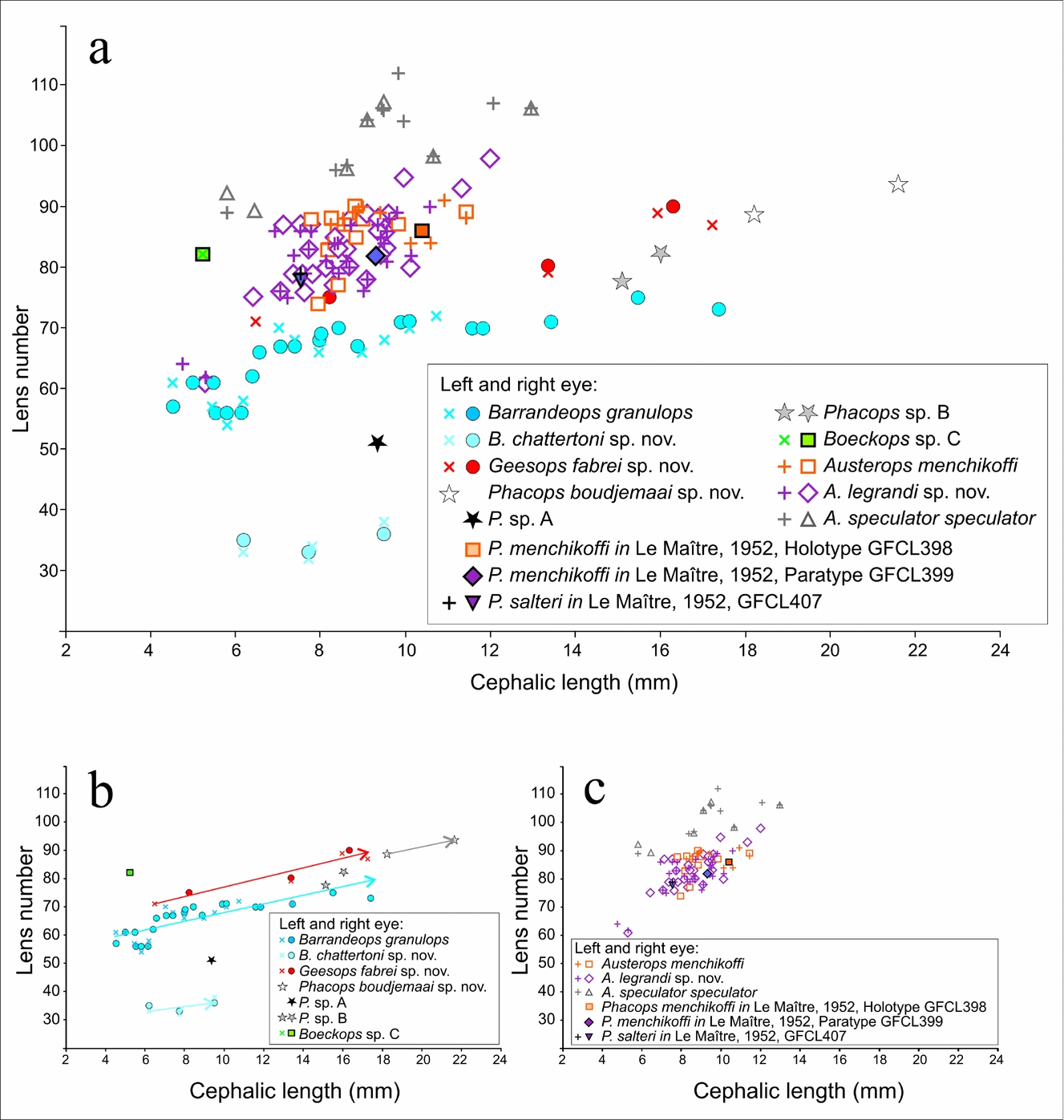
Description. Cephalon: Length/width ratio about 0.59. Dorsal view: Glabellar ratio of width at L1 / maximum width of frontal lobe about 0.55. Glabella bounded by deep axial furrows that are moderately divergent forwards (61°), with subangular anterolateral angles. Frontal outline slightly tapered anteriorly. Frontal lobe overhanging slightly a deep preglabellar furrow. S2 and S3 poorly defined. S1 continuous and curved more strongly forwards than S0 in its adaxial curvature, and becoming deeper in its distal portions. L1 shorter (sag.) than L0 (more than half L0 length) and with a wide (tr.) median portion relative to its total width. Median portion of L1 fairly inflated, with few tubercles. L1 with subquadrate, poorly inflated lateral lobes separated from its median part by a distinct exsagittal furrow. S0 well marked and almost transverse in its middle portion. L0 wide (tr.) with lateral lobes very poorly defined. Reniform visual surface with 18 dorsoventral files of lenses and a maximum of four lenses per file, with smaller lenses in the anterior median part (51 lenses in total). Inter-lensar sclera more thickened dorsally than ventrally. Palpebral furrow distinct. A row of tubercles present at the base of the visual surface. Exsagittal length of the postocular genal field a little more than half the length of the posterior border. Cheek moderately swollen. Lateral view: Glabella rounded anteriorly. Outline of L1 curved. L0 as high as glabella at its maximum convexity. Anterior border rather short, ridge-like, slightly projecting forwards and sloping posteroventrally. A marginulation probably extending from the anterolateral border up to the genal angle. Posterior border furrow deep and narrow. Lateral border furrow rather shallow, narrow behind the posterior branch of the facial suture and wider at the front of the eye. Posterolateral border furrow continuous and posterolateral border widening at the genal angle. Frontal view: Glabellar outline subcircular with lateral sides slightly flattened obliquely. Palpebral area higher than the palpebral lobe. Ventral view: Vincular furrow deep, wide (sag.), curved and parallel to the preglabellar furrow anteriorly. Posterior band of the cephalic doublure long (sag.) with a hypostomal suture slightly turned ventrally and convex backwards medially. Thorax: Partially preserved. Axial rings slightly convex with poorly defined lateral lobes. Axial furrows distinct. Anterior pleural band narrower (exsag.) than the posterior pleural band. Pleural furrows deep. Ornamentation: Cephalon covered with dense, coarse conical tubercles of heterogeneous size without superimposed granules. Anterior band of the cephalic doublure with possibly some granulation and pits, posterior band showing short ridges. Small tubercles developed on the axial rings and the pleural field of thoracic segments.
Remarks. This single specimen with a medium size (9.3 mm in cephalic length) is quite different from Barrandeops granulops s.s. This specimen possesses less globular lateral preoccipital lobes, 18 vertical files of lenses with a maximum of four lenses per file and sharper tubercles on the glabella. Additional material is necessary to give a definitive attribution.
Phacops sensu lato sp. B
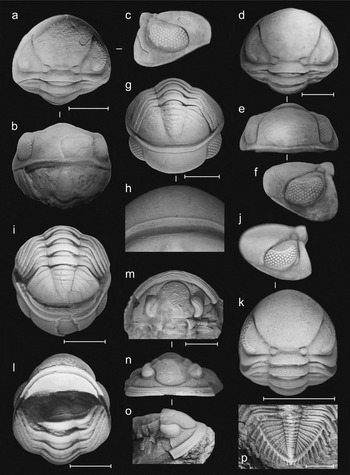
Figure 5a–i
Studied material. Two poorly preserved enrolled specimens from the upper Emsian (base of the ‘Chefar el Ahmar’ Formation) of the Marhouma section (‘km 30’); Ougarta Basin, Saoura, Algeria.
Phacopid trilobites from the ‘Chefar el Ahmar’ Formation, Lower Devonian, upper Emsian, Saoura Valley, Algeria. (a–d) Phacops sensu lato sp. B, Marhouma section, Di/UO/035 (‘km 30’): (a–b, d) cephalon in frontal, dorsal and lateral views; (c) pygidium in dorsal view. (e–i) Phacops s.l. sp. B, Marhouma section, Di/UO/033 (‘km 30’): (e, f, h, i) cephalon in frontal, dorsal, ventral and lateral views; (g) pygidium in dorsal view. (j–m) Boeckops sp. C, Erg el Djemel section, Di/UO/015 (Ed3n2): (j–l) cephalon in lateral, dorsal and frontal views; (m) pygidium in dorsal view. (n–p) Phacops s.l. boudjemaai sp. nov., Erg el Djemel section, holotype Di/UO/007 (Ed3n1): cephalon in dorsal, frontal and lateral views. (q) Phacops s.l. boudjemaai sp. nov., Erg el Djemel section, Di/UO/008 (Ed3n1): hypostome mostly exfoliated in dorsal view. (r) Phacops s.l. boudjemaai sp. nov., Erg el Djemel section, Di/UO/005 (Ed3n1): pygidium mostly exfoliated in dorsal view. (s) Phacops s.l. boudjemaai sp. nov., Erg el Djemel section, Di/UO/006 (Ed3n1): cephalic doublure in dorsal view. Scale bars = 5 mm.

Description. Cephalon: Length/width ratio about 0.61. Dorsal view: Glabellar ratio of width at L1 / maximum width of frontal lobe about 0.49. Glabella bound by deep axial furrows that are highly divergent forwards (74°), with subangular anterolateral angles. Frontal lobe overhanging slightly a deep preglabellar furrow. S2 and S3 visible on the exfoliated glabella. S1 seems to be continuous and curved more strongly forwards than S0 in its adaxial curvature, and becoming deeper in its distal portions. L1 shorter (sag.) than L0 (more than half the L0 length) and with a wide (tr.) median portion relative to its total width. Median portion of L1 inflated, with few fine tubercles. L1 with subcircular, inflated lateral lobes separated from its median part by a distinct exsagittal furrow. S0 well marked and almost transverse in its middle portion. L0 rather wide (tr.) with lateral lobes poorly defined. Reniform visual surface with 18–19 dorsoventral files of lenses and a maximum of six lenses per file, with smaller lenses in the anterior median part (78–82 lenses in total). Inter-lensar sclera thickened dorsally. Palpebral furrow distinct. A row of fine tubercles present at the base of the visual surface. Exsagittal length of the postocular genal field equal to the length of the posterior border. Cheek moderately swollen. Lateral view: Glabella rounded anteriorly. Outline of L1 curved. L0 as high as the glabella at its maximum convexity. Anterior border short, ridge-like, slightly projecting forwards and sloping posteroventrally. Posterior border furrow deep and narrow. Lateral border furrow rather shallow and broad. The posterolateral border furrow seems to be continuous and the posterolateral border widens at the genal angle. Frontal view: Glabellar outline subcircular with lateral sides slightly flattened obliquely. Palpebral area and palpebral lobe at about the same level. Ventral view: Vincular furrow deep, wide (sag.), curved and parallel to the preglabellar furrow. Posterior band of the cephalic doublure long (sag.) with a hypostomal suture slightly turned ventrally and convex backwards medially. Thorax: Slightly narrower (tr.) posteriorly. Maximum axial width (tr.) ratio of the last ring / first ring about 82%. Axial rings convex with poorly defined lateral lobes. Axial furrows distinct. Anterior pleural band narrower (exsag.) than the posterior pleural band. Pleural furrows deep. Pygidium: Rather long with a length/width ratio about 51% (excluding the half ring), and its maximum width (tr.) behind its midlength (sag.) in dorsal view. Posterior outline broadly rounded. Pygidial axis long, rather narrow and tapered. Up to seven rings plus the terminal piece compose the pygidial axis. Pygidial pleural field with five distinct ribs delimited by deep pleural furrows. Interpleural furrows distinct. Ornamentation: Cephalon covered with moderately dense, fine tubercles. Anterior band of the cephalic doublure with pits; posterior band with scaly granules medially, grading laterally into terrace ridges. Fine tubercles also developed on the thorax and the pygidium.
Remarks. These two poorly preserved large specimens (about 15 mm in cephalic length) are more different from Phacops sensu Campbell (Reference Campbell1967). Some features that characterize the genus such as a low maximal number of lenses per row, a very narrow postocular area and the presence of scaly tubercles/short ridges/terrace lines on the anterior part of the frontal lobe, according to McKellar & Chatterton (Reference McKellar and Chatterton2009), are missing. These two specimens possess a slightly reduced visual surface with a postocular field equal to the length of the posterior border, fine tubercles on the exoskeleton and no terrace lines on the anterior face of the composite lobe. Additional material is necessary to give a definitive attribution.
Phacops boudjemaai sp. nov.
Figure 5n–s
Name. Named in honour of Mr Boudjemâa, an Algerian guide who co-operated with geologists from the ‘Menchikoff’ Saharan Research Center in Beni-Abbès.
Holotype. A cephalothorax from Ed3n1: Di/UO/007.
Paratypes. One complete mostly exfoliated individual from Ed3n1: Di/UO/005; one mostly exfoliated cephalothorax with its cephalic doublure from Ed3n1: Di/UO/006; and one cephalothorax with its hypostome mostly exfoliated from Ed3n1: Di/UO/008.
Locus typicus. Erg el Djemel section, Saoura Valley, Ougarta Basin, Algeria.
Stratum typicum. Base of ‘Chefar el Ahmar’ Formation, upper Emsian, Lower Devonian.
Studied material. Three cephalothoraxes and one enrolled individual from the upper Emsian (base of ‘Chefar el Ahmar’ Formation) of the Erg el Djemel section (Ed3n1); Ougarta Basin, Saoura, Algeria.
Diagnosis. Cephalon wide; glabella with a wide base; cheeks strongly inflated; S2 and S3 indicated by discontinuity in sculpture; L1 very short (sag.) with a wide (tr.) and fairly depressed median portion with few tubercles, with small subcircular, inflated lateral lobes; visual complex with 19 vertical lens files and a maximum of six lenses per file; palpebral furrow distinct; lateral border furrow rather shallow and broad behind the posterior branch of the facial suture with a smooth subocular area. Pygidial axis rather long, relatively wide, strongly tapered and composed of 6–7 rings plus terminal piece; pygidial pleural field with six clear ribs. Dense coarse pustular tubercles with pits on cephalon. Dominant pits on lateral border.
Description. Cephalon: Length/width ratio about 0.57. Dorsal view: Glabellar ratio of width at L1 / maximum width of frontal lobe about 0.53. Glabella bound by deep axial furrows that are highly divergent forwards (71°), with subangular anterolateral angles. Frontal lobe overhanging slightly a deep preglabellar furrow. S2 and S3 distinct, indicated by discontinuity in sculpture. S1 continuous, deep and almost transverse as S0 in its middle portion. L1 shorter (sag.) than L0 (hardly less than half L0 length). Median portion of L1 wide (tr.) relative to the total width of L1 and fairly depressed, with few tubercles. L1 with small subcircular, inflated lateral lobes separated from its median part by a strong exsagittal furrow. S0 well marked. L0 slightly wide (0.36% of the total cephalic width tr.) with defined lateral lobes. Reniform visual surface with 19 dorsoventral files of lenses and a maximum of six lenses per file, with smaller lenses in the anterior median part. A row of small tubercles present at the base of the eye. Inter-lensar sclera thickened only dorsally. Palpebral furrow distinct. Exsagittal length of the postocular genal field half length of the posterior border. Cheek swollen. Lateral view: Glabella rounded anteriorly. Outline of L1 moderately curved. L0 as high as the glabella at its maximum convexity. Anterior border short with a ridge-like projection forwards. A marginulation extending from the anterolateral border up to the rounded genal angle. Posterior border furrow deep and narrow. Lateral border furrow rather shallow and broad behind the posterior branch of the facial suture with a smooth subocular area. Posterolateral border furrow continuous and posterolateral border widening at the genal angle. Frontal view: Glabellar outline subcircular with lateral sides slightly flattened obliquely. Palpebral area as high as the palpebral lobe. Ventral view: Vincular furrow deep, wide (sag.), curved and parallel to the preglabellar furrow. Posterior band of the cephalic doublure long (sag.) with a hypostomal suture slightly convex backwards medially. Hypostome: Mostly exfoliated, strongly elongated (sag.). Thorax: Slightly tapered; maximum axial width (tr.) ratio of the last ring / first ring about 89%. Axial rings fairly convex with inflated lateral lobes. Axial furrows distinct. Pleural furrows deep. Pygidium (exfoliated): Rather long with a length/width ratio about 51.6% (excluding the half ring), and its maximum width (tr.) at about its midlength (sag.) in dorsal view. Posterior outline broadly rounded. Pygidial axis long, relatively wide, strongly tapered. Up to seven distinct rings plus the terminal piece compose the pygidial axis. Pygidial pleural field with six distinct ribs delimited probably by deep pleural furrows. Ornamentation: Cephalon covered with dense, coarse pustular tubercles of heterogeneous size with pits. Lateral border covered with dominant pits, palpebral lobe with tubercles and pits. Anterior band of the cephalic doublure covered with scaly granules and distinct pits, and the posterior band with short ridges medially and anastomosing terrace ridges laterally.
Remarks. Phacops boudjemaai sp. nov. is attributed to the genus Phacops sensu lato. Some features that characterize the genus Phacops sensu Campbell (Reference Campbell1967), such as a low maximal number of lenses per row, a very narrow postocular area and the presence of scaly tubercles/short ridges/terrace lines on the anterior part of the frontal lobe (according to McKellar & Chatterton, Reference McKellar and Chatterton2009), are missing.
Phacops boudjemaai sp. nov. shares some morphological features with P. araw McKellar & Chatterton, Reference McKellar and Chatterton2009 from the Eifelian of South Morocco: a very short (sag.) and depressed L1 with reduced globular preoccipital lobes, and pits at the base of the visual surface and on the thoracic segments. Nevertheless, Phacops boudjemaai sp. nov. differs from P. araw in having 19 files with a maximum of six lenses per file compared to 18 files (rarely 19–20) with a maximum of four lenses per file in P. araw, a thinner inter-lensar sclera and non-scaly tubercles on the anterior part of the frontal lobe.
Phacops boudjemaai sp. nov. differs from Eldredgeops rana africanus (Burton & Eldredge, Reference Burton and Eldredge1974) from the upper Eifelian – lower Givetian of the Western Sahara in having a more prominent glabella with less pustular tubercles on the glabella, a thinner inter-lensar sclera, one more file of lenses and non-scaly tubercles on the anterior part of the frontal lobe.
Phacops boudjemaai sp. nov. shares with Geesops fabrei sp. nov a similar glabellar tuberculation, pits on the genal angle and the same number of files (19) of lenses in the eye. Phacops boudjemaai sp. nov. differs in having a preoccipital ring reduced in width (sag.) and depressed, preoccipital lobes reduced in size and a smooth, wider space at the base of eye (in lateral view).
Phacops boudjemaai sp. nov. shares with Geesops schlotheimi from the Eifelian of Germany a similar glabellar tuberculation and pits on the genal angle. Geesops schlotheimi differs in having one less dorsoventral file, a prominent median preoccipital tubercle on the well-defined intercalar ring, better-defined subocular and postocular pads, and a thicker inter-lensar sclera.
Occurrence. Upper Emsian; Algeria (Saoura: Erg el Djemel).
Genus Geesops Struve, Reference Struve1982
Type species. Calymmene schlotheimi Bronn, Reference Bronn1825: Eifelian, Eifel in Germany.
Additional species. Geesops sparsinodosus struvei (Schraut, Reference Schraut2000b ): Eifelian, Morocco; G. sparsinodosus gallicus Struve, Reference Struve1982: lower Eifelian, north of France; G. sparsinodosus sparsinodosus (Struve, Reference Struve1970): Eifelian, Germany; G. schlotheimi skalensis (Kielan, Reference Kielan1954): Givetian, Poland; G. brunopauli Struve, Reference Struve1982: Eifelian, Germany; G. battidohmi Struve, Reference Struve1982: lower Givetian, Germany; G. synapticus Struve, Reference Struve1982: lower Eifelian, Germany; G. fabrei sp. nov.: upper Emsian, Algeria.
Remarks. Geesops was erected by Struve (Reference Struve1982) for phacopids with a marginulate cephalic border closely related to Phacops sensu stricto (under its restrictive diagnosis). A previous study carried out by McKellar & Chatterton (Reference McKellar and Chatterton2009) showed that this genus formed from the species that were once part of Phacops constitutes more likely a valid genus characterized by a wide glabellar width and a palpebral area lower than the palpebral lobe.
Geesops fabrei sp. nov.
Figure 4g–q
v. 1952 [non] Phacops schlotheimi Bronn, Reference Bronn1825; Le Maître, p. 156, pl. 21, figs 3–5.
Name. Named in honour of Jean Fabre, a French professor of geology in Algiers and director of the Saharan Research Center in Beni-Abbès for 15 years.
Holotype. Almost complete enrolled individual from Ed3n2: Di/UO/017.
Paratypes. One enrolled individual from Ed3n1: Di/UO/004, and two individuals from Ed3n2: Di/UO/014 and Di/UO/016.
Locus typicus. Erg el Djemel section, Saoura Valley, Ougarta Basin, Algeria.
Stratum typicum. Base of ‘Chefar el Ahmar’ Formation, upper Emsian, Lower Devonian.
Studied material. Seven enrolled exoskeletons from the Erg el Djemel section (two in Ed3n1, three in Ed3n2, and two in Ed4).
Diagnosis. Cephalon narrow; glabella with a wide base; glabella slightly inflated and cheeks strongly inflated; S2 and S3 indicated by discontinuity in sculpture; L1 poorly swollen with few tubercles; visual complex with 19 vertical lens files and a maximum of six lenses per file; palpebral furrow distinct. Pygidial axis relatively long and wide. Dense coarse conical tubercles on cephalon without superimposed granules.
Description. Cephalon: Length/width ratio about 0.64. Dorsal view: Glabellar ratio of width at L1 / maximum width of frontal lobe about 0.53. Glabella bound by deep axial furrows that are moderately divergent forwards (60°), with broadly rounded anterolateral angles. Frontal lobe overhanging barely a shallow preglabellar furrow. S2 and S3 indicated by discontinuity in sculpture. S1 continuous and curved more strongly forwards than S0 in its adaxial curvature, and becoming deeper in its distal portions. L1 shorter (sag.) than L0 (less than half L0 length), with a wide (tr.) median portion relative to its total width. Median portion of L1 poorly inflated, with few tubercles. L1 with subcircular, inflated lateral lobes separated from its median part by a distinct exsagittal furrow. S0 well marked and almost transverse in its middle portion. L0 moderately narrow (tr.) with defined lateral lobes. Reniform visual surface with 19 dorsoventral files of lenses and a maximum of six lenses per file, with smaller lenses in the anterior median part. Inter-lensar sclera more thickened dorsally than ventrally. Palpebral furrow distinct. A row of tubercles present at the base of the visual surface. Exsagittal length of the postocular genal field less than half the length of the posterior border. Cheek strongly swollen. Lateral view: Glabella rounded anteriorly. Outline of L1 curved. L0 as high as the glabella at its maximum convexity. Anterior border long with a ridge-like projection forwards. A marginulation extending from the anterolateral border up to the genal angle. Posterior border furrow deep and narrow. Lateral border furrow deep, rather broad behind the posterior branch of the facial suture and wider at the front of the eye. Subocular librigenal field concave at the front of the eye and distinct at the back of the eye as a subocular pad with few tubercles. Posterolateral border furrow continuous and posterolateral border widening at the genal angle. Frontal view: Glabellar outline subcircular with its lateral sides flattened obliquely. Palpebral area slightly higher than the palpebral lobe. Anterior border showing a median inflexion towards the ventral side. Ventral view: Vincular furrow deep, wide (sag.), curved and parallel to the preglabellar furrow. Because all the known specimens are enrolled, the posterior band of the cephalic doublure is not visible. Thorax: Slightly tapered. Maximum axial width (tr.) ratio of the last ring / first ring about 82%. Axial rings convex with poorly defined lateral lobes. Axial furrows distinct. Anterior pleural band narrower (exsag.) than the posterior pleural band. Pleural furrows deep. Pygidium (only partially preserved): Rather long with a length/width ratio about 51% (excluding the half ring), and its maximum width (tr.) in front of the midlength. Posterior outline broadly rounded and slightly transverse medially. Pygidial axis long, rather wide and tapered. Pygidial pleural field with distinct ribs delimited by deep pleural furrows anteriorly. Ornamentation: Cephalon covered with dense, coarse conical tubercles without superimposed granules. Lateral border covered with dominant pits. Anterior band of the cephalic doublure with pits and scaly granulation. Tubercles present on the axial rings and the lateral border of thoracic segments, on the pleural ribs and the pygidial axis.
Remarks. The specimens attributed to Geesops fabrei sp. nov. share with Geesops schlotheimi (Bronn, Reference Bronn1825) from the Eifelian of Germany a similar glabellar tuberculation, and pits on the genal angle. Geesops schlotheimi differs in having one less dorsoventral file of lenses in the eye, a prominent median preoccipital tubercle on the well-defined intercalar ring, and wider subocular and postocular pads. Le Maître (Reference Le Maître1952) previously attributed some Algerian specimens to Geesops schlotheimi (Bronn, Reference Bronn1825). The specimen figured (pl. XXI, figs 3–5; GFCL296, coll. Le Maître, Faculté libre des Sciences de Lille) from the Erg el Djemel section with 18 dorsoventral files of lenses and a maximum of six lenses per file is reassigned herein to Geesops fabrei sp. nov.
Geesops fabrei sp. nov. differs from Eldredgeops rana africanus (Burton & Eldredge, Reference Burton and Eldredge1974) from the upper Eifelian – lower Givetian of the Western Sahara and Geesops sparsinodosus struvei (Schraut, Reference Schraut2000b ) from the Eifelian of Morocco. Eldredgeops rana africanus with 18 files and a maximum of six lenses per file also exhibits a wider and less prominent glabella, a more pustular ornamentation on the glabella, a thicker inter-lensar sclera and a smooth wider base of the eye. Geesops sparsinodosus struvei with 18 files and a maximum of six lenses per file also exhibits a wider smooth base of the eye and no subocular pad.
Occurrence: Upper Emsian; Algeria (Saoura: Erg el Djemel).
Genus Boeckops (Chlupáč, Reference Chlupáč1972)
Type species. Phacops boecki Hawle & Corda, Reference Hawle and Corda1847: Pragian, Barrandian area in the Czech Republic.
Additional species. Boeckops confluens (Richter & Richter, Reference Richter and Richter1939): Eifelian, Turkey; B. delphinoides (Chlupáč, Reference Chlupáč1972): Emsian, Czech Republic; B. planilimbatus (Wedekind, Reference Wedekind1914): Pragian?, Germany; B. proponticus (Haas, Reference Haas1968): upper Emsian, Turkey; B. stelcki McKellar & Chatterton, Reference McKellar and Chatterton2009: Emsian, Morocco; B. ‘zinkeni’ (Roemer, Reference Roemer1843) (sensu Jahnke, Reference Jahnke1969): Lower Devonian, Germany; B. zenonis (Chlupáč, Reference Chlupáč1977): Pragian, Czech Republic.
Boeckops sp. C
Figure 5j–m
Studied material. One small enrolled specimen from the upper Emsian (base of ‘Chefar el Ahmar’ Formation) of the Erg el Djemel section (Ed3n2).
Description. Cephalon: Length/width ratio about 0.68. Dorsal view: Glabellar ratio of width at L1 / maximum width of frontal lobe about 0.47. Glabella highly inflated, bound by shallow axial furrows, deeper anteriorly, highly divergent forwards (90°), with an anterior portion less divergent and subangular anterolateral angles. Frontal lobe strongly overhanging a rather shallow and narrow preglabellar furrow. S2 and S3 not distinct. S1 continuous and slightly more curved forwards than S0 in its adaxial curvature, and that becomes deeper in its distal portions. L1 shorter (sag.) than L0 (more than half L0 length), with a very wide (tr.) median portion relative to its total width. Median portion of L1 inflated with several tubercles. L1 with subcircular, uninflated lateral lobes separated from its median part by a shallow exsagittal furrow. S0 well marked and almost transverse in its middle portion. L0 rather wide (tr.), with no lateral lobes defined. Reniform visual surface with 18 dorsoventral files of lenses and a maximum of six lenses per file, with smaller lenses in the anterior median part. Inter-lensar sclera only thickened dorsally. Palpebral furrow distinct. Exsagittal length of the postocular genal field less than half the length of the posterior border. Cheek swollen. Lateral view: Glabella rounded anteriorly. Outline of L1 curved. L0 as high as the glabella at its maximum convexity. Anterior border probably short and ridge-like. A marginulation extending almost from the anterolateral border up to the genal angle. Posterior border furrow deep and narrow. Lateral border furrow moderately deep and narrow anteriorly, broad and concave behind the posterior branch of the facial suture. Posterolateral border furrow continuous and posterolateral border widening at the genal angle with a distinct node. Frontal view: Glabellar outline subcircular with its lateral sides slightly curved obliquely. Palpebral area higher than the palpebral lobe. Ventral view: Because the specimen is enrolled, the cephalic doublure is not visible. Thorax: Narrower (tr.) posteriorly. Maximum axial width (tr.) ratio of the last ring / first ring about 71%. Axial rings convex with no defined lateral lobes. Axial furrows distinct. Anterior pleural band narrower (exsag.) than the posterior pleural band. Pleural furrows deep. Pygidium: Poorly preserved, eroded. Rather long, with a length/width ratio about 51% (excluding the half ring), and its maximum width (tr.) at about its midlength (sag.) in dorsal view. Posterior outline broadly rounded. Pygidial axis long, rather wide, tapered. A minimum of five rings visible plus the terminal piece compose the pygidial axis. Pygidial pleural field with a minimum of four, but probably five, distinct ribs delimited by pleural furrows that are deep anteriorly. Ornamentation: Cephalon covered with moderately dense, medium-sized/fine tubercles without superimposed granules. Small tubercles visible more or less on the axial rings and the lateral border of thoracic segments.
Remarks. Boeckops sp. C, with a rather small size (5.3 mm in cephalic length), shows morphological features that are different from those of other species attributed to Boeckops. The single known Algerian specimen shares with Boeckops stelcki from the Emsian of Morocco the same number of vertical files of lenses in the eye, an inter-lensar sclera slightly thickened dorsally only, a weak palpebral furrow, a marginulation on the lateral border extending backwards to before the midlength of the eye and a rounded genal angle with a distinct node. Boeckops stelcki differs in having one more lens per vertical file (maximum of seven for Boeckops stelcki compared to six for Boeckops sp. C), a wider glabellar base, less divergent axial furrows, a narrower (tr.) occipital ring with well-defined lateral lobes, a narrow subocular pad, a granulated postocular pad and numerous evenly distributed fine tubercles on the lateral border.
Boeckops sp. C shares with B. proponticus from the upper Emsian of Turkey a similar ornamentation and a visual surface with the same number of vertical files. Boeckops proponticus differs in having a wider (exsag.) postocular area, one to two less lenses per file and no differentiated median portion with tubercles.
Boeckops sp. C shares with B. boecki from the Pragian of the Czech Republic an inter-lensar sclera slightly thickened dorsally only, a weak palpebral furrow, no subocular pad, a marginulation on the lateral border extending backwards to about the midlength of the eye and a rounded genal angle with a distinct node. Boeckops boecki differs in having more vertical files of lenses (21 files for B. boecki compared to 18 for B. sp. C), two more lenses per vertical file (maximum eight for B. boecki compared to six for B. sp. C), a wider glabellar base, less divergent axial furrows, a narrower (tr.) occipital ring with well-defined lateral lobes, a wide (exsag.) postocular pad and less dense and evenly distributed fine tubercles.
Additional material is necessary to give a definitive attribution.
Occurrence. Upper Emsian; Algeria (Saoura: Erg el Djemel).
Genus Austerops McKellar & Chatterton, Reference McKellar and Chatterton2009
Type species. Austerops kermiti McKellar & Chatterton, Reference McKellar and Chatterton2009: Eifelian, Morocco.
Additional species. Austerops salamandar McKellar & Chatterton, Reference McKellar and Chatterton2009: Eifelian, Morocco; A. speculator speculator (Alberti, Reference Alberti1970): upper Emsian, Eifelian, Algeria and Morocco; A. speculator punctatus McKellar & Chatterton, Reference McKellar and Chatterton2009: Eifelian, Morocco; A. legrandi sp. nov.: upper Emsian, Algeria; A. menchikoffi (Le Maître, Reference Le Maître1952): upper Emsian, Algeria and Morocco.
Remarks. Austerops was erected by McKellar & Chatterton (Reference McKellar and Chatterton2009) for a group of Moroccan phacopids with subdued and sparse tubercles, a faint palpebral furrow, and prominent and continuous terrace lines upon the cephalic doublure.
Austerops menchikoffi (Le Maître, Reference Le Maître1952)
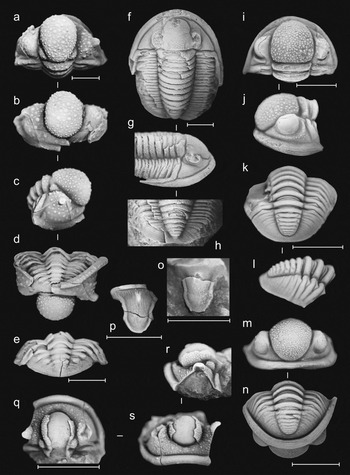
Figure 6e–k
v*. 1952 Phacops menchikoffi sp. nov. Le Maître, pp. 155–6, pl. XX, figs 16–20; non pl. XX, fig. 15, fig. 21, pl. XXI, fig. 10.
Trilobites from the ‘Chefar el Ahmar’ Formation, Lower Devonian, upper Emsian, Saoura Valley, Algeria. (a–d) Austerops speculator speculator (Alberti, Reference Alberti1970), Erg el Djemel section, Di/UO/013 (Ed3n2): (a–b, d) cephalon in dorsal, lateral and frontal views; (c) pygidium in dorsal view. (e–h) Austerops menchikoffi (Le Maître, Reference Le Maître1952), Erg el Djemel section, Di/UO/026 (Ed4): (e–f, h) cephalon in dorsal, frontal and lateral views; (g) pygidium in dorsal view. (i–k) Austerops menchikoffi (Le Maître, Reference Le Maître1952), Erg el Djemel section, holotype figured by Le Maître (Reference Le Maître1952), GFCL398 (coll. Le Maître, Faculté libre des Sciences de Lille): cephalon in dorsal, frontal and lateral views. (l) Walliserops sp., Erg el Djemel section, Di/UO/018 (Ed3n2). (m, n) Hollardops mesocristata (Le Maître, Reference Le Maître1952), Erg el Djemel section, Di/UO/010 (Ed3n1): cephalon and pygidium in dorsal views. (o, p) Hollardops mesocristata (Le Maître, Reference Le Maître1952), Erg el Djemel area, figured in Le Maître (Reference Le Maître1952), GFCL401 (coll. Le Maître, Faculté libre des Sciences de Lille): cephalon and pygidium in dorsal views. Scale bars = 5 mm.

. 2006 Phacops smoothops sp. nov. Chatterton, Fortey, Brett, Gibb & McKellar, p. 15, pl. 4–7.
. 2009 Austerops smoothops (Chatterton et al.); McKellar & Chatterton, p. 34.
Type material. Holotype enrolled exoskeleton GFCL398 (coll. Le Maître, Faculté libre des Sciences de Lille), from the upper Emsian (not lower Eifelian) from the Erg el Djemel section; Ougarta Basin, Saoura, Algeria.
Studied material. Eighteen enrolled exoskeletons with three from the upper Emsian (base of ‘Chefar el Ahmar’ Formation) of the Marhouma section (‘km 30’) and the other 15 from the Erg el Djemel section (one from Ed3n1, two from Ed3n2 and 12 from Ed4. Ougarta Basin, Saoura, Algeria.
Diagnosis. See Chatterton et al. (Reference Chatterton, Fortey, Brett, Gibb and Kellar2006).
Remarks. Le Maître (Reference Le Maître1952, p. 153) provided a description of the type material from the Erg el Djemel section. Chatterton et al. (Reference Chatterton, Fortey, Brett, Gibb and Kellar2006) and McKellar & Chatterton (Reference McKellar and Chatterton2009) made no mention of the menchikoffi species from the Erg el Djemel section (Saoura, Algeria) described for the first time by Le Maître in 1952. However, the menchikoffi holotype shows all the diagnostic features of the type species of the Austerops genus, namely Austerops smoothops Chatterton et al. Reference Chatterton, Fortey, Brett, Gibb and Kellar2006 from Morocco. Chatterton et al. (Reference Chatterton, Fortey, Brett, Gibb and Kellar2006, pp. 15–17) provided a full description of this Moroccan material. Only small differences between the Algerian and Moroccan populations can be reported such as the range of the angle between the axial furrows: 55–70° for the Algerian specimens and 60–75° for Moroccan ones. These small differences can be regarded as intra-specific variability. The menchikoffi species is thus a senior subjective synonym of the smoothops species. In her work, Le Maître (Reference Le Maître1952) had reported this Algerian species from the lower Eifelian. Recent works (Göddertz, Reference Göddertz1987; Boumendjel et al. Reference Boumendjel, Morzadec, Paris, Plusquellec, Brice, Copper, Gourvennec, Jahnk, Lardeux, Le Menn, Melou and Racheboeuf1997; Paris et al. Reference Paris, Boumendjel, Morzadec and Plusquellec1997; Ouali Mehadji et al. Reference Ouali Mehadji, Elmi, Racheboeuf and Mekahli2004) reconsidered the age of this section, which is now considered to be late Emsian in age.
Occurrence. Upper Emsian; Morocco (Jbel Gara el Zguilma), Algeria (Saoura: Erg el Djemel, ‘km 30’).
Austerops speculator speculator (Alberti, Reference Alberti1970)
Figure 6a–d
1951 Phacops fecundus Barrande; Gigout, p. 331.
1955 Phacops fecundus Barrande; Gigout, table B.
1965 Phacops fecundus Barrande; Gigout in Gigout, Destombes & Ferré, p. 9.
1969 Phacops (Phacops) cf. rana milleri Stewart; Alberti, p. 437.
1970 [partim] Phacops (Phacops) speculator sp. nov. Alberti, p. 91, pl. 12, figs 1, 2, 5, 6 [non pl. 12, figs 3, 4].
2009 Austerops speculator speculator (Alberti); McKellar & Chatterton, p. 34.
Type material. Rather fragmented cephalon ISCR/Gig786, from likely the Eifelian, near Sidi Abdallah des Rehamma, western Morocco.
Studied material. Twelve enrolled exoskeletons from the upper Emsian (base of ‘Chefar el Ahmar’ Formation) of the Erg el Djemel section (five from Ed3n1, four from Ed3n2 and three from Ed4); Saoura Valley, Ougarta Basin, Algeria.
Diagnosis. See McKellar & Chatterton (Reference McKellar and Chatterton2009).
Remarks. The new collected specimens show the main morphological features of Austerops speculator speculator (Alberti, Reference Alberti1970) from western Morocco and A. speculator punctatus from the Maider basin in Morocco: a narrow cephalon, a wide glabellar base, moderately divergent axial furrows, poorly defined S2 and S3, and S1 in its adaxial curvature, the same number of dorsoventral files of lenses, the inter-lensar sclera slightly thickened dorsally only and the exsagittal length of the postocular genal field less than half the length of the posterior border.
Austerops speculator punctatus differs basically in its sculpture in having pervasive pitting across the glabella, the palpebral lobe and the genal field and in having an insignificant postocular pad and a wide subocular area.
Austerops speculator speculator (Alberti, Reference Alberti1970) shares with A. menchikoffi a narrow cephalon, a wide glabellar base, moderately divergent axial furrows, poorly defined S2 and S3, and S1 in its adaxial curvature, an L1 with subcircular, inflated lateral lobes separated from its median part by a distinct exsagittal furrow, poorly defined lateral lobes of L0, the same number of dorsoventral files of lenses, the inter-lensar sclera being slightly thickened dorsally only and no subocular pad. However, Austerops menchikoffi differs in having a wider median portion relative to the total width of L1, two less lenses per file (maximum five for A. menchikoffi and eight for A. speculator speculator) and the exsagittal length of the postocular genal field being about half the length to equal the length of the posterior border.
Occurrence: Upper Emsian, Eifelian?; Algeria (Saoura: Erg el Djemel) and Morocco (western).
Austerops legrandi sp. nov.
Figure 7a–l
v. 1952 Phacops salteri Kozlowski; Le Maître, pl. 21, fig. 9.
Trilobites from the ‘Chefar el Ahmar’ Formation, Lower Devonian, upper Emsian, Saoura Valley, Algeria. (a–c) Austerops legrandi sp. nov., Erg el Djemel section, figured by Le Maître (Reference Le Maître1952), holotype GFCL399 (coll. Le Maître, Faculté libre des Sciences de Lille): cephalon in dorsal, frontal and lateral views. (d–f) Austerops legrandi sp. nov., Erg el Djemel section, Di/UO/003 (Ed3n1): cephalon in dorsal, frontal and lateral views. (g, h) Austerops legrandi sp. nov., Erg el Djemel section, Di/UO/009: pygidium and detail of the cephalic doublure in dorsal views. (i) Austerops legrandi sp. nov., Erg el Djemel section, Di/UO/025 (Ed4): pygidium in dorsal view. (j, k) Austerops legrandi sp. nov., Erg el Djemel section, Di/UO/024 (Ed4): cephalon in lateral and dorsal views. (l) Austerops legrandi sp. nov., Erg el Djemel section, Di/UO/023 (Ed4): cephalic doublure in dorsal view. (m–o) Cornuproetus cornutus djemelensis (Alberti, Reference Alberti1981), Erg el Djemel section, Di/UO/011 (Ed3n1): fragmented cephalon in dorsal, frontal and lateral views. (p) Erbenochile erbeni (Alberti, Reference Alberti1981), Marhouma section, Di/UO/036 (‘km 30’): pygidium in dorsal view. Scale bars = 5 mm.

v. 1952 Phacops menchikoffi sp. nov. Le Maître, pl. XX, figs 15, 21, pl. XXI, fig. 10.
Name. Named in honour of Dr Philippe Legrand who worked on the Devonian of the Algerian Sahara.
Holotype. Complete enrolled specimen GFCL399 (coll. Le Maître, Faculté libre des Sciences de Lille) figured by Le Maître (Reference Le Maître1952).
Paratypes. One enrolled individual from Ed3n1: Di/UO/003, four individuals from Ed4: Di/UO/009, Di/UO/023–025.
Locus typicus. Erg el Djemel section, Saoura Valley, Ougarta Basin, Algeria.
Stratum typicum. Base of ‘Chefar el Ahmar’ Formation, upper Emsian, Lower Devonian.
Studied material. Forty-two mostly enrolled specimens from the upper Emsian of the Erg el Djemel section (seven from Ed3n1 and thirty-five from Ed4). Ougarta Basin, Saoura, Algeria.
Diagnosis. Cephalon very narrow; glabella depressed with a very wide base; S1 poorly defined in its adaxial curvature; subquadrate, poorly inflated lateral lobes of L1; visual surface with 18 vertical lens files and a maximum of seven (often six) lenses per file; inter-lensar sclera thin with a slight thickening dorsally; palpebral furrow poorly defined; palpebral area higher than the palpebral lobe. Pygidium axis long (sag.), rather wide (tr.), strongly tapered with up to 6–7 rings plus the terminal piece; 4–5 poorly defined ribs. Almost smooth exoskeleton with scale-like granules on the anterior part of the frontal lobe.
Description. Cephalon: Length/width ratio about 0.67. Dorsal view: Glabellar ratio of width at L1 / maximum width of frontal lobe about 0.61. Glabella depressed, bound by shallow axial furrows that are moderately divergent forwards (65°), with the anterior portion less divergent, almost exsagitally aligned. Frontal lobe overhanging slightly a moderately impressed preglabellar furrow. S2 and S3 often not distinct. S1 poorly defined and curved rather more strongly forwards than S0 in its adaxial curvature, and that becomes deeper in its distal portions. L1 shorter (sag.) than L0 (half L0 length), with a wide (tr.) median portion relative to its total width. Median portion of L1 poorly inflated. L1 with subquadrate, poorly inflated lateral lobes separated from its median part by a distinct exsagittal furrow. S0 well marked and almost transverse in its middle portion. L0 short (tr.) with lateral lobes not defined. Reniform visual surface with 18 dorsoventral files of lenses and often six (sometimes seven) lenses per file, with smaller lenses in the anterior median part. Inter-lensar sclera thin with a slight thickening dorsally. Palpebral furrow poorly defined. Exsagittal length of the postocular genal field less than half the length of the posterior border. Cheek barely swollen. Lateral view: glabella rounded anteriorly. Outline of L1 curved. L0 as high as the glabella at its maximum convexity. Anterior border rather short, ridge-like, slightly projecting forwards and sloping posteroventrally. A marginulation that extends from the anterolateral border up to about opposite the midlength of the eye backwards. Posterior border furrow deep and narrow. Lateral border furrow shallow, concave behind the posterior branch of the facial suture as an expanded furrow. No subocular and postocular pad. Posterolateral border furrow continuous and posterolateral border widening at the genal angle. Frontal view: Glabellar outline subcircular with its lateral sides flattened subvertically. Palpebral area higher than the palpebral lobe. Ventral view: Vincular furrow deep, wide (sag.), curved and parallel to the preglabellar furrow. Posterior band of the cephalic doublure long (sag.) with a hypostomal suture transverse medially. Thorax: Composed of 11 thoracic segments, narrowing (tr.) posteriorly. Maximum axial width (tr.) ratio of the last ring / first ring about 75%. Axial rings convex with no defined lateral lobes, with barely a swelling of extremities. Axial furrows distinct. Anterior pleural band narrower (exsag.) than the posterior pleural band. Pleural furrows narrow and moderately impressed. Pygidium: Rather long with a length/width ratio about 51.8% (excluding the half ring), and its maximum width (tr.) behind its midlength (sag.) in dorsal view. Posterior outline broadly rounded. Pygidial axis long, rather wide, strongly tapered, with an almost complete terminal closure and an insignificant postaxial ridge. Up to 6–7 rings plus the terminal piece compose the pygidial axis. Pygidial pleural field with 4–5 poorly defined ribs delimited by rather deep, thin pleural furrows. Pseudo-articulating half rings indicated by expanded inter-ring furrows. Ornamentation: Glabella covered with fine granules on the anterior part of the composite lobe becoming scale-like granules to short ridges. Anterior band of the cephalic doublure covered with scaly granules and pits, posterior band with short ridges to continuous terrace lines laterally. Scattered fine tubercles seem to be present on the cephalic lateral border, the thoracic axis and the pygidial axis of some specimens.
Remarks. Some Algerian specimens described and figured by Le Maître (Reference Le Maître1952, p. 153) such as the paratype GFCL399 (pl. 20, fig. 21) and the specimen attributed to Phacops salteri GFCL407 (pl. 21, fig. 9) are assigned in this work to Austerops legrandi sp. nov. These specimens studied by Le Maître (Reference Le Maître1952) and the additional specimens studied in this work differ from A. menchikoffi in having a narrower cephalon with a wider glabellar base, shallower axial furrows that are less divergent in their anterior portion, subquadrate and poorly inflated lateral lobes of L1, an almost smooth ornamentation and a shorter (tr.) occipital ring.
Austerops legrandi sp. nov. differs from Phacops salteri Kozlowski, Reference Kozlowski1923 from Bolivia in having no median tubercle on L0, no short genal spines and no granulation as pronounced on the cephalon. In Phacops salteri, L1 is reduced to its stretched lateral preoccipital lobes (mixed S0 and S1), and the number of dorsoventral files of lenses does not exceed 17.
The new species shows morphological features similar to other species attributed to Austerops such as an S1 poorly defined in its adaxial curvature, a visual surface with 18 vertical lens files, an inter-lensar sclera slightly thickened dorsally only and a poorly defined palpebral furrow.
Austerops legrandi sp. nov. shares with A. kermiti from the Eifelian of Morocco a similar cephalic length/width ratio (very narrow), subquadrate and poorly inflated lateral lobes of L1, and no defined lateral lobes of L0. Austerops kermiti differs in having a narrower base of the glabella, less divergent axial furrows deflected adaxially at the front of the eye, more lenses per file (6–7 in A. legrandi sp. nov. compared to nine in A. kermiti), a palpebral area and a palpebral lobe at about the same level, and a shallower vincular furrow.
Austerops legrandi sp. nov. shares with A. salamandar from the Eifelian of Morocco the maximum number of lenses per file (seven: common for A. salamandar and occasionally for A. legrandi sp. nov.), no defined lateral lobes of L0 and the same depth of the vincular furrow. Austerops salamandar differs in having a narrower base of the glabella, less divergent axial furrows deflected adaxially at the front of the eye, subcircular and inflated lateral lobes of L1, and a palpebral area and palpebral lobe at about the same level.
Occurrence. Upper Emsian; Algeria (Saoura, Erg el Djemel).
Superfamily ACASTACEA Delo, Reference Delo1935
Family ACASTIDAE Delo, Reference Delo1935
Subfamily ASTEROPYGINAE Delo, Reference Delo1935
Genus Hollardops Morzadec, Reference Morzadec1997
Type species. Asteropyge mesocristata Le Maître, Reference Le Maître1952: upper Emsian, Algeria.
Additional species. Hollardops aithassainorum Chatterton et al. Reference Chatterton, Fortey, Brett, Gibb and Kellar2006: Eifelian, Morocco; H. boudibensis Morzadec, Reference Morzadec2001: upper Emsian, Morocco; H. burtandmimiae (Lieberman & Kloc, Reference Lieberman and Kloc1997): upper Emsian and Eifelian, Morocco; H. lemaitreae Morzadec, Reference Morzadec1997: upper Emsian, Algeria; H. struvei (Morzadec, Reference Morzadec1969): upper Emsian, France (Armorican Massif).
Hollardops mesocristata (Le Maître, Reference Le Maître1952)
Figure 6m–p
v*. 1952 Asteropyge mesocristata sp. nov. Le Maître, p. 153, pl. XX, figs 24–6.
1952 Asteropyge gr. michelini Rouault, Reference Rouault1851; Le Maître, pl. XXI, fig. 12.
1952 Asteropyge pectinata Roemer, Reference Roemer1850; Le Maître, pl. XXI, fig. 13.
1967 Asteropyge mesocristata Le Maître; Le Maître in Legrand, p. 274.
1997 Hollardops mesocristata (Le Maître); Morzadec, p. 149, pl. 2, fig. 8; pl. 5, fig. 9; pl. 6, figs 1, 3–6; pl. 7, figs 1–7; pl. 8, figs 5–8.
1997 Philipsmithiana hyfinkeli sp. nov. Lieberman & Kloc, p. 65, figs 6.1–6.5; figs 7.7, 7.9; figs 21.2, 21.5–9; figs 22.1–2, 22.5–6, 22.8–9, 22.11.
2001 Hollardops mesocristata (Le Maître); Morzadec, p. 71, pl. 8, figs 3, 6, 9; pl. 9, figs 1–4.
2004 Hollardops mesocristata (Le Maître); Jansen, Becker, Plodowski, Schindler, Vogel & Weddige, pl. 2, figs 1, 4.
2006 Hollardops mesocristata (Le Maître); Chatterton, Fortey, Brett, Gibb & McKellar, p. 26–7, pl. 14.1–6, pl. 15.1–7, pl. 16.1–6, pl. 20.8, 20.12, 20.15.
2014 Hollardops mesocristata (Le Maître); Bignon & Crônier, p. 20.
Type material. A small enrolled exoskeleton GFCL401 (coll. Le Maître, Faculté libre des Sciences de Lille), from the upper Emsian, Erg el Djemel section.
Studied material. Five enrolled exoskeletons and two fragmented pygidia from the upper Emsian (base of ‘Chefar el Ahmar’ Formation) of the Erg el Djemel section (five from Ed3n1 and two from Ed3n2).
Diagnosis. See Chatterton et al. (Reference Chatterton, Fortey, Brett, Gibb and Kellar2006).
Remarks. Le Maître (Reference Le Maître1952, p. 153) and Morzadec (Reference Morzadec1997, p. 149) provided a full description of the type material from the Erg el Djemel section. Additionally, Chatterton et al. (Reference Chatterton, Fortey, Brett, Gibb and Kellar2006) provided numerous illustrations of this species from the best specimens available from Morocco.
Occurrence. Upper Emsian; Algeria (Saoura: Erg el Djemel), Morocco (Foum Zguid).
Genus Walliserops Morzadec, Reference Morzadec2001
Type species. Walliserops trifurcatus Morzadec, Reference Morzadec2001: upper Emsian, Morocco.
Additional species. Walliserops hammii Chatterton et al. Reference Chatterton, Fortey, Brett, Gibb and Kellar2006: upper Emsian, Morocco; W. lindoei Chatterton & Gibbs, Reference Chatterton and Gibb2010: Eifelian, Morocco; W. tridens Chatterton et al. Reference Chatterton, Fortey, Brett, Gibb and Kellar2006: upper Emsian, Morocco.
Diagnosis. See Bignon & Crônier (Reference Bignon and Crônier2014).
Walliserops sp.
Figure 6l
Studied material. Two fragmented and poorly preserved pygidia from the upper Emsian (base of the ‘Chefar el Ahmar’ Formation) of the Erg el Djemel section (one from Ed3n1 and one from Ed3n2).
Remarks. Pygidia with seven pygidial axial rings with median broken spines, five pleural segments with broken spines on the distal part of each posterior band, and five pairs of pygidial spines developed only from posterior pleural bands.
Subfamily Odontochilinae Šnajdr, Reference Šnajdr1985
Genus Erbenochile Alberti, Reference Alberti1981
Type species. Odontochile (Erbenochile) erbeni Alberti, Reference Alberti1981: upper Emsian, Algeria.
Additional species. Erbenochile issoumourensis Chatterton & Gibb, Reference Chatterton and Gibb2010: upper Emsian or early Eifelian, Morocco.
Remarks. Chatterton & Gibb (Reference Chatterton and Gibb2010, pp. 1194, 1197) provided a comprehensive diagnosis and discussion of this genus that is represented by two species encountered in North Africa. Erbenochile erbeni differs from E. issoumourensis in having a taller eye with a greater number of lenses per file, long and tubular marginal spines on the pygidium and a larger axial spine on the first axial ring of the pygidium. Chatterton & Gibb (Reference Chatterton and Gibb2010) and Bignon & Crônier (Reference Bignon and Crônier2014, p. 29) confirmed the assignation of the genus Erbenochile to Odontochilinae Šnajdr, Reference Šnajdr1985. Budil, Hörbinger & Mencl (Reference Budil, Hörbinger and Mencl2009), however, considered the subfamily Odontochilinae as a subjective junior synonym of Dalmanitinae Vogdes, Reference Vogdes1890.
Erbenochile erbeni (Alberti, Reference Alberti1981)
Figure 7p
1950 Coronura aspectans Hall, Reference Hall1888; Le Maître, p. 254.
1952 Coronura aspectans (Conrad, Reference Conrad1841); Hall, Reference Hall1888; Le Maître, p. 152, pl. 20, fig. 30.
1967 Coronura aspectans Conrad; Le Maître in Legrand p. 274.
1981 Odontochile (Erbenochile) erbeni gen. et sp. nov.; Alberti, p. 368.
1995 Erbenochile erbeni (Alberti); Morzadec, pp. 615–19, fig. 2a–f.
1997 Erbenochile erbeni (Alberti); Morzadec, p. 153.
2003 Erbenochile erbeni (Alberti); Fortey & Chatterton, p. 1689, fig. 1a–e.
2006 Erbenochile erbeni (Alberti); Chatterton, Fortey, Brett, Gibb & McKellar, pp. 24–6, pl. 13.1–9.
2010 Erbenochile erbeni (Alberti); Chatterton & Gibb, pp. 1194–7, fig. 5.
2014 Erbenochile erbeni (Alberti); Bignon & Crônier, p. 29.
Type material. An incomplete thoracopygon GFCL403 (coll. Le Maître, Faculté libre des Sciences de Lille), from the upper Emsian, ‘km 30’ location, Algeria.
Studied material. One thoracopygon (plus the lower part of cephalon) from the upper Emsian (base of ‘Chefar el Ahmar’ Formation) of the Marhouma section (‘km 30’).
Diagnosis. See Chatterton et al. (Reference Chatterton, Fortey, Brett, Gibb and Kellar2006).
Remarks. Le Maître (Reference Le Maître1952, p. 152) and Morzadec (Reference Morzadec1995, p. 615) provided a description of the type material from the Erg el Djemel section. Additionally Chatterton et al. (Reference Chatterton, Fortey, Brett, Gibb and Kellar2006, pp. 24–5) provided a full description of this species from Morocco.
Occurrence: Upper Emsian; Algeria (Saoura: ‘km 30’), Morocco (Foum Zguid).
Order PROETIDA Fortey & Owens, Reference Fortey and Owens1975
Family Aulacopleuridae Angelin, Reference Angelin1854
Subfamily Otarioninae Richter & Richter, Reference Richter and Richter1926
Genus Cyphaspis Burmeister, Reference Burmeister1843
Type species. Phacops ceratophthalmus Goldfuss, Reference Goldfuss1843: Eifelian, Gerolstein in Germany.
Remarks. Adrain & Chatterton (Reference Adrain and Chatterton1996) provided an emended diagnosis and integrated 20 species into this genus. Four new species from Morocco were added by Chatterton et al. (Reference Chatterton, Fortey, Brett, Gibb and Kellar2006) including three from the upper Emsian: Cyphaspis agayuara, C. eberhardiei and C. hamidi.
Occurrence. Wenlock to Givetian; France, England, Czech Republic, Germany, Austria, Poland, Morocco, NW Canada, Australia.
Cyphaspis ?agayuara Chatterton et al. Reference Chatterton, Fortey, Brett, Gibb and Kellar2006
Figure 8a–e
2006 Cyphaspis agayuara sp. nov. Chatterton, Fortey, Brett, Gibb & McKellar, pp. 48–9, pls 42.1–42.7.
Trilobites from the ‘Chefar el Ahmar’ Formation, Lower Devonian, upper Emsian, Saoura Valley, Algeria. (a–d) Cyphaspis ?agayuara Chatterton et al. Reference Chatterton, Fortey, Brett, Gibb and Kellar2006, Erg el Djemel section, Di/UO/021 (Ed3n2): (a–c) cephalon in dorsal, frontal and lateral views; (d) pygidium in dorsal view. (e) Cyphaspis ?agayuara Chatterton et al. Reference Chatterton, Fortey, Brett, Gibb and Kellar2006, Erg el Djemel section, Di/UO/012 (Ed3n1): pygidium in dorsal view. (f–h) Cornuproetus cornutus djemelensis (Alberti, Reference Alberti1981), Erg el Djemel section, Di/UO/037 (‘km 30’): fragmented cephalon in dorsal, frontal and lateral views. (i, j) Gerastos tuberculatus marocensis Chatterton et al. Reference Chatterton, Fortey, Brett, Gibb and Kellar2006, Erg el Djemel section, Di/UO/030 (Ed4): cephalon in dorsal and lateral views. (k, l) Gerastos tuberculatus marocensis Chatterton et al. Reference Chatterton, Fortey, Brett, Gibb and Kellar2006, Erg el Djemel section, Di/UO/031 (Ed4): pygidium in dorsal and lateral views. (m, n) Gerastos tuberculatus marocensis Chatterton et al. Reference Chatterton, Fortey, Brett, Gibb and Kellar2006, Erg el Djemel section, Di/UO/029 (Ed4): (m) cephalon in frontal view; (n) pygidium in dorsal view. (o) ?Gerastos tuberculatus marocensis Chatterton et al. Reference Chatterton, Fortey, Brett, Gibb and Kellar2006, Erg el Djemel section, Di/UO/019 (Ed3n2): fragmented hypostome in dorsal view. (p) ?Gerastos tuberculatus marocensis Chatterton et al. Reference Chatterton, Fortey, Brett, Gibb and Kellar2006, Erg el Djemel section, Di/UO/020 (Ed3n2): hypostome in dorsal view. (q–s) Cyphaspis ?hamidi Chatterton et al. Reference Chatterton, Fortey, Brett, Gibb and Kellar2006, Erg el Djemel section, Di/UO/022 (Ed3n2): cephalon in dorsal, lateral and frontal views. Scale bars = 5 mm.

Type material. Complete articulated exoskeleton UA13397, from the upper Emsian Timrhanrhart Formation, section at Jbel Gara el Zguilma, near Foum Zguid, Morocco.
Studied material. Seven incomplete exoskeletons from the upper Emsian (base of ‘Chefar el Ahmar’ Formation) of the Erg el Djemel section (five from Ed3n1 and two from Ed3n2).
Remarks. The Algerian specimens show some morphological features of Cyphaspis agayuara from Morocco: coarse tubercles evenly distributed on fixigena, subsidiary tubercles across the occipital ring and a row of coarser tubercles sub-parallel across the preglabellar field. Unfortunately, owing to poor preservation, the length of the genal spines, the length of the axial spine on sixth thoracic segment and the presence of the (spinose) node on the occipital ring are not visible. Otherwise, the main difference is the presence of a coarse row of granules across the back of the thorax and pygidium crossing the third pygidial axial ring as in Cyphaspis eberhardiei s.s., not the second pygidial axial ring as in Cyphaspis agayuara s.s.
Cyphaspis ?hamidi Chatterton et al. Reference Chatterton, Fortey, Brett, Gibb and Kellar2006
Figure 8q–s
2006 Cyphaspis hamidi sp. nov. Chatterton, Fortey, Brett, Gibb & McKellar, pp. 51–3, pls 46.1–46.14, pls 54.4, 54.9, ?54.3, ?54.8.
Type material. Enrolled exoskeleton UA13402, from the upper Emsian, Timrhanrhart Formation, section at Jbel Gara el Zguilma, near Foum Zguid, Morocco.
Studied material. Two incomplete cephala from the upper Emsian (base of ‘Chefar el Ahmar’ Formation) of the Erg el Djemel section (one from Ed3n2 and one from Ed4).
Remarks. The Algerian specimens show the main morphological features of Cyphaspis hamidi from Morocco: a small cephalon with a moderately inflated glabella, fine- to medium-sized tubercles evenly distributed over cephalon and eyes strongly convex laterally without distinct socle. Unfortunately, owing to poor preservation, the length of the genal spines and the presence of the axial spine on the sixth thoracic segment are not visible.
Family Proetidae Salter, Reference Salter1864
Genus Gerastos Goldfuss, Reference Goldfuss1843
Type species. Proetus cuvieri Steininger, Reference Steininger1831: Eifelian, Germany.
Additional species (from Morocco only). Gerastos ainrasifus Gibb & Chatterton, Reference Gibb and Chatterton2010: Eifelian; G. aintawilus Gibb & Chatterton, Reference Gibb and Chatterton2010: Eifelian; G. akrechanus Alberti, Reference Alberti1969: Emsian, Morocco; G. cuvieri malisus Gibb & Chatterton, Reference Gibb and Chatterton2010: Eifelian; G. discombobulates Gibb & Chatterton, Reference Gibb and Chatterton2010: Eifelian; G. emmetus Gibb & Chatterton, Reference Gibb and Chatterton2010: Givetian; G. hammii Gibb & Chatterton, Reference Gibb and Chatterton2010: upper Emsian or Eifelian; G. izius Gibb & Chatterton, Reference Gibb and Chatterton2010: Givetian; G. lisanrasus Gibb & Chatterton, Reference Gibb and Chatterton2010: Eifelian; G. malisjildus Gibb & Chatterton, Reference Gibb and Chatterton2010: Eifelian; G. prox umerbianus Alberti, Reference Alberti1969: Eifelian or Givetian, Morocco; G. raribus Gibb & Chatterton, Reference Gibb and Chatterton2010: Givetian; G. rehamnanus Alberti, Reference Alberti1969: probably Lower Devonian, Morocco; G. taqus Gibb & Chatterton, Reference Gibb and Chatterton2010: Eifelian; G. tuberculatus marocensis Chatterton et al. Reference Chatterton, Fortey, Brett, Gibb and Kellar2006: upper Emsian–Eifelian.
Remarks. On the basis of well-preserved material, Gibb & Chatterton (Reference Gibb and Chatterton2010) described and illustrated 12 species and subspecies of Gerastos from the Lower to the Mid Devonian of Morocco. The diagnostic features between Gerastos, Longiproetus and Coniproetus were discussed by Owens (Reference Owens1973) and completed and/or modified by Lütke (Reference Lütke1990), Adrain (Reference Adrain1997) and Chatterton et al. (Reference Chatterton, Fortey, Brett, Gibb and Kellar2006). The main diagnostic features for Gerastos are: ζ and ε (with a great angle c. 160°) widely separated; convex (abax.) lateral margin of glabella that is as long as wide; distinct eye platform; no or short genal spine; indistinct lateral occipital lobes; band of parallel terrace lines and no curved terrace ridges on pygidium margin.
Gerastos tuberculatus (Barrande, Reference Barrande1846a
)
Gerastos tuberculatus marocensis Chatterton et al.
Reference Chatterton, Fortey, Brett, Gibb and Kellar2006
Figure 8i–p
1846a Proetus tuberculatus Barrande, p. 74.
1846b Proetus discretus Barrande; Barrande, p. 16.
1847 Proetus tuberculatus Barrande; Hawle & Corda, p. 72.
1852 Proetus tuberculatus Barrande; Barrande, p. 456, pl. 16, figs 18–20.
1946 Proetus (Proetus) tuberculatus (Barrande); Přibyl, p. 6.
1953 Proetus (Proetus) tuberculatus (Barrande); Přibyl, p. 59.
1969 Proetus (Proetus) tuberculatus (Barrande); Alberti, p.74, pl. 1, fig. 7.
1970 Proetus (Proetus) tuberculatus (Barrande); Přibyl in Horný & Bastl, p. 314.
?1970 Proetus (Proetus) sp. A aff. granulosus (Goldfuss, Reference Goldfuss1843); Alberti, p. 34, pl. 3, fig. 5.
1973 Proetus (Gerastos) tuberculatus (Barrande); Owens, pp. 9–10.
1980 Gerastos (Gerastos) tuberculatus (Barrande); Šnajdr, pp. 48–9, pl. 2, figs 12, 13.
2006 Gerastos tuberculatus marocensis ssp. nov. Chatterton, Fortey, Brett, Gibb & McKellar, pp. 43–5, pl. 37.1–8, pl. 38.3, pl. 38.6, pl. 39.1–12, pl. 54.5–7, pl. 54.11–13.
2010 Gerastos tuberculatus marocensis Chatterton et al.; Gibb & Chatterton, pp. 15–16, pl. 1.1–8, pl. 2.1–13, pl. 3.1–6, pl. 4.1–12, pl. 5.5–9, pl. 18.1–14
Type material. Complete exoskeleton UA13276 from the upper Emsian, Timrhanrhart Formation, section at Jbel Gara el Zguilma, near Foum Zguid, Morocco.
Studied material. Twenty-five specimens from the upper Emsian (base of ‘Chefar el Ahmar’ Formation) of the Erg el Djemel section (six individuals from Ed3n1, five from Ed3n2 and 14 from Ed4), and probably two hypostomes from Ed3n2.
Diagnosis. See Chatterton et al. (Reference Chatterton, Fortey, Brett, Gibb and Kellar2006).
Remarks. The new specimens show the main morphological features of Gerastos tuberculatus marocensis from the upper Emsian of Morocco: cephalic proportions, pointed tubercles much coarser on glabella, short genal spine, seven pygidial rings plus terminal piece, five (+ one) pygidial pleural and interpleural furrows and a shallow border furrow on the pygidium. Chatterton et al. (Reference Chatterton, Fortey, Brett, Gibb and Kellar2006) and Gibb & Chatterton (Reference Gibb and Chatterton2010) provided adequate descriptions and comparisons between the closest species.
Occurrence. Upper Emsian; Morocco (Foum Zguid), Algeria (Saoura: Erg el Djemel).
Genus Cornuproetus Richter & Richter, Reference Richter and Richter1919
Type species. Gerastos cornutus Goldfuss, Reference Goldfuss1843: Eifelian, Germany.
Additional species (from upper Emsian to Eifelian in North Africa only). Cornuproetus cornutus marrakechensis Alberti, Reference Alberti1969: ?Eifelian; Morocco; C. cornutus djemelensis Alberti, Reference Alberti1981: probably upper Emsian (not Eifelian), Algeria; C. midas amlanensis Alberti, Reference Alberti1969: Emsian; Morocco, Algeria; C. pernix boutsharafinensis Alberti, Reference Alberti1969: upper Emsian; Morocco; ?C. infans Alberti, Reference Alberti1969: ?Mid Devonian; Morocco; ?C. maidericus Alberti, Reference Alberti1969: upper Emsian; Morocco.
Remarks. Alberti (Reference Alberti1969) published the most extensive report about the classification of this genus divided into 16 subgenera. Additionally, he described and illustrated several new species including five from the upper Emsian of Morocco among more than 20 species illustrated, mostly according to their cranidia. Among these five new species, two were then reassigned to Cornuproetus (Paralepidoproetus): C. (P.) fauremuretae and C. (P.) chouberti (see Alberti, Reference Alberti1981). Moreover, Alberti (Reference Alberti1981) described and illustrated a new subspecies C. cornutus djemelensis from probably the upper Emsian (not Eifelian) of the Erg el Djemel section, Algeria. More work seems to be necessary in order to re-evaluate these previously described species.
Cornuproetus cornutus djemelensis (Alberti, Reference Alberti1981)
Figures 7m–o, 8f–h
1970 Cornuproetus (Cornuproetus) cornutus ssp. nov. B Alberti, p. 39.
1981 Cornuproetus (Cornuproetus) cornutus djemelensis ssp. nov. Alberti, p. 20, pl. 1, fig. 5.
Type material. Almost complete eroded enrolled exoskeleton GPIH from probably the upper Emsian (not Eifelian), Erg el Djemel section, Algeria.
Studied material. Seven poorly preserved exoskeletons with one from the upper Emsian (base of ‘Chefar el Ahmar’ Formation) of the Marhouma section (‘km 30’) and six from the Erg el Djemel section (three from Ed3n1, three from Ed4); Ougarta basin, Saoura, Algeria.
Diagnosis. See Alberti (Reference Alberti1969).
Remarks. The new specimens are characterized by slightly convex anterior and lateral cephalic borders, a violin-shaped inflated glabella, no distinct anteromedian cephalic projection, no epiborder furrow, no inflated lobes (only suggested by absence of tubercles) on genal field adjacent to front and back of a narrow socle, a short (sag.) distinct preglabellar field, few discontinuous and curved terrace ridges on the narrowly parabolic anteromedian portion of the cephalon; coarse tubercles equally sized and evenly distributed on the glabella, except in the glabellar furrows, and on the thoracic and pygidial axial rings; finer tubercles on the free cheeks and pleurae, very fine terrace ridges on the anterior and lateral portions of the glabella and fine short ridges on the palpebral lobes; a pygidium with four axial rings plus a terminal piece. A lowered broad (ant.) and tapered (post.) ridge is located behind the terminal piece that can be confused with an indistinct terminal piece (as suggested by Alberti, Reference Alberti1969). These specimens share the general morphology of Cornuproetus cornutus djemelensis from probably the upper Emsian of the Erg el Djemel section in Algeria, hitherto poorly known by an eroded enrolled specimen.
The Algerian specimens differ from the type species Cornuproetus cornutus cornutus (Goldfuss, Reference Goldfuss1843) from the Eifelian of Germany in having the back half of the glabella bulge more laterally, pygidial rings weakly lengthened laterally and no clear pygidial border.
The Algerian specimens share also some morphological characters with the cranidium of Cornuproetus cornutus marrakechensis from the ?Eifelian of Morocco (no associated pygidium known): the slightly convex and elevated anteromedian cephalic border; a short (sag.) distinct preglabellar field. However, the Algerian specimens differ in having a glabella that is more violin shaped than sub-rectangular/trapezoidal and palpebral lobes that are narrower (tr.).
The cranidium of Cornuproetus cornutus archeocornutus Šnajdr, Reference Šnajdr1980 from the lower Emsian of the Barrandian area of the Czech Republic differs in having a widely parabolic cephalic border, finer ornamentation and granulated palpebral lobes.
The cranidium of Cornuproetus midas amlanensis from the Emsian of Morocco and Algeria differs in having a glabella that is more subquadrate, with fine terrace lines and tubercles, a distinct epiborder furrow and an anterior border that is wider, with terrace lines covering the entire field.
The cranidium of Cornuproetus pernix boutsharafinensis from the upper Emsian of Morocco differs in having a glabella more subquadrate, a distinct epiborder furrow and an anterior border that is wider, with terrace lines covering the entire field.
Cornuproetus (Paralepidoproetus) fauremuretae and C. (P.) chouberti differ from C. cornutus djemelensis in having a wider cephalic border and fine, anastomosing, scaly terrace ridges on the glabella (see Alberti, Reference Alberti1981).
Diademaproetus mohamedi Chatterton et al. (Reference Chatterton, Fortey, Brett, Gibb and Kellar2006) from the lower Eifelian of Morocco differs in having a broader and flatter cephalic border with a distinct epiborder furrow, sparser tubercles and developed lobes on the genal field adjacent to the front and back of a narrow socle.
?Cornuproetus infans Alberti, Reference Alberti1969, a poorly preserved and fragmented cephalon from the Mid Devonian of Morocco, differs in having a more sub-rectangular and lower glabella, and an anterior border with terrace lines covering the entire field.
?Cornuproetus maidericus Alberti, Reference Alberti1969, a poorly preserved cranidium from the upper Emsian of Morocco, differs in having a much lowered glabella.
Occurrence. Upper Emsian; Algeria (Erg el Djemel).
4. Inter- and intra-specific variability in phacopids
4.a. Method
The terminology used herein to describe the eye of Phacopina is based on the work of Clarkson (Reference Clarkson1966).
The dimensions, especially the length and the width of cephala in dorsal view have been obtained using an optical image analyser (TPSdig v.2.17; Rohlf, Reference Rohlf2013).
The discontinuous postembryonic growth by successive moults results in size distributions often clustered into stage groupings (Dodd & Stanton, Reference Dodd and Stanton1990). These size distributions allow growth to be described using relatively simple numerical models. A univariate or bivariate plot of size distribution within a sample would be expected to show a discontinuous growth curve, individuals being pooled in distinct dimensional classes. Certain distribution sizes show no evidence of stage peaks because of growth rates, recruitment rates and overlap in size between instars (Sheldon, Reference Sheldon1988). In order to establish such a size series in the different Algerian species of phacopids we have constructed a bivariate plot using the width as a function of the length of cephala (Fig. 9).
Bivariate plot using the width (in mm) as a function of the length (in mm) of (a) 29 cephala of Barrandeops granulops (Chatterton et al. Reference Chatterton, Fortey, Brett, Gibb and Kellar2006), 4 cephala of B. chattertoni sp. nov., 4 cephala of Phacops boudjemaai sp. nov., 1 cephalon of P. sp. A, 2 cephala of P. sp. B, 7 cephala of Geesops fabrei sp. nov., 1 cephalon of Boeckops sp. C, 18 cephala of Austerops menchikoffi (Le Maître, Reference Le Maître1952), 12 cephala of Austerops speculator speculator (Alberti, Reference Alberti1970), 43 cephala of Austerops legrandi sp. nov.; (b) for Barrandeops, Phacops, Geesops and Boeckops species; and (c) for Austerops species.
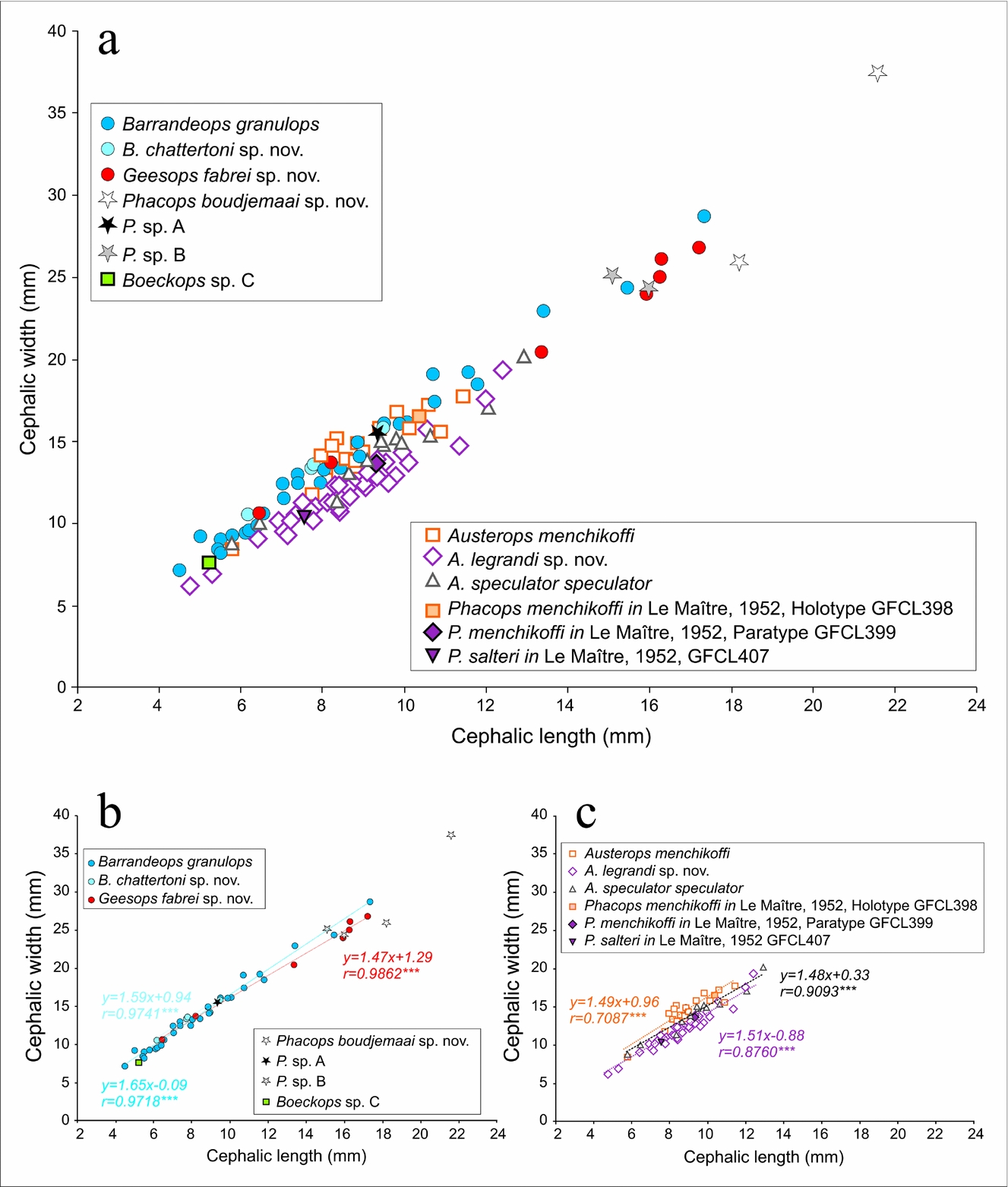
Moreover, in order to follow the morphological evolution of the eye, the number of dorsoventral files as a function of the cephalic length has been recorded on bivariate diagrams, for cephala (Fig. 10).
Bivariate plot using the number of files as a function of the cephalic length (in mm) in (a) 28 cephala of Barrandeops granulops (Chatterton et al. Reference Chatterton, Fortey, Brett, Gibb and Kellar2006), 4 cephala of B. chattertoni sp. nov., 2 cephala of Phacops boudjemaai sp. nov., 1 cephalon of P. sp. A, 2 cephala of P. sp. B, 6 cephala of Geesops fabrei sp. nov., 1 cephalon of Boeckops sp. C, 17 cephala of Austerops menchikoffi (Le Maître, Reference Le Maître1952), 12 cephala of Austerops speculator speculator (Alberti, Reference Alberti1970), 41 cephala of Austerops legrandi sp. nov.; (b) for Barrandeops, Phacops, Geesops and Boeckops species; and (c) for Austerops species.
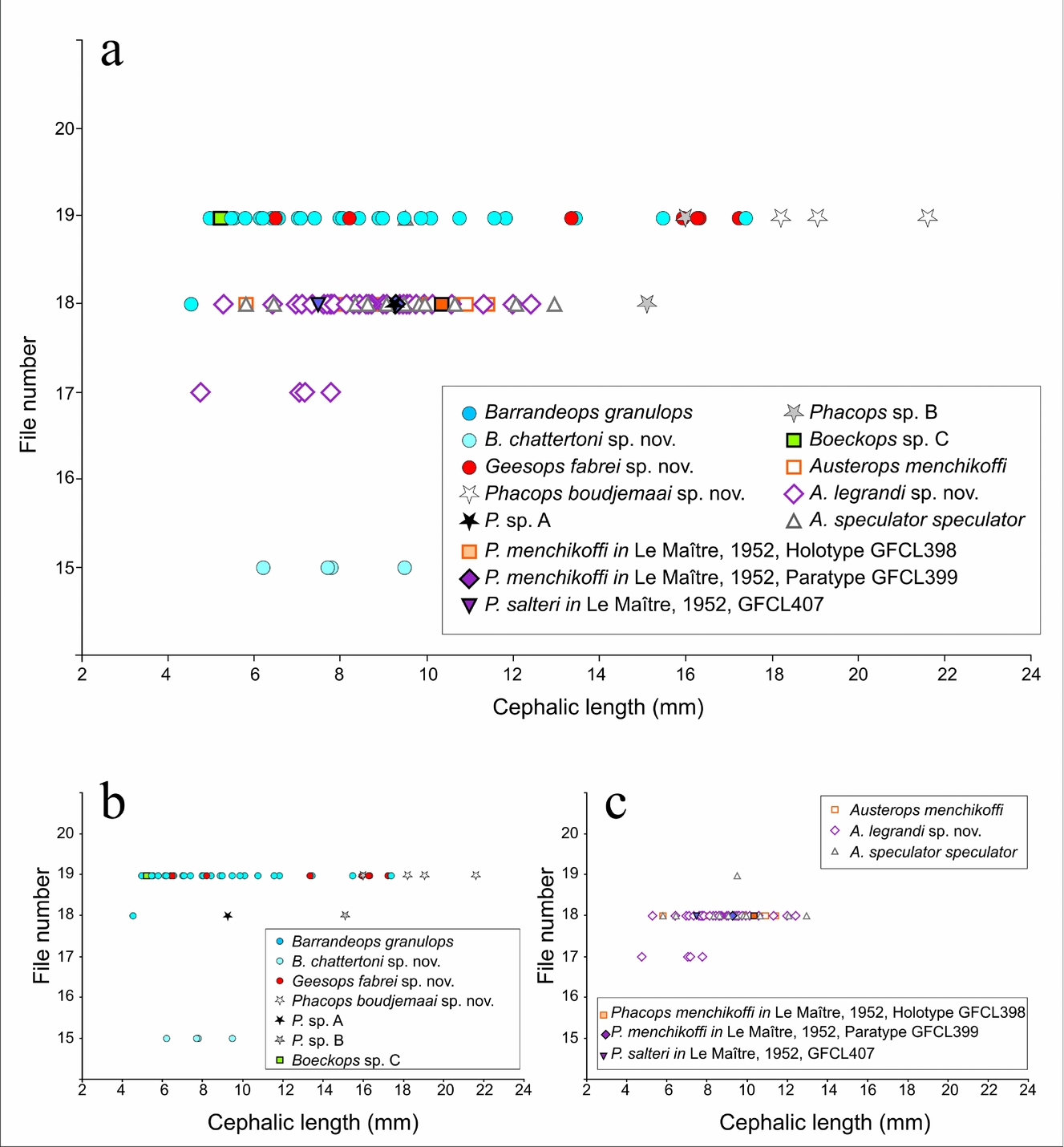
4.b. Results
4.b.1. Size distribution during ontogeny
The length/width plot of cephala (Fig. 9a) shows no distinct grouping. No distinct instars can be distinguished. The growth series is essentially represented by the holaspid period where no feature allows us to distinguish instars.
Moreover, the relative proportions of all phacopid cephala remain constant (y = ax+b; cephala: r = 0.8883, p<0.001***) whatever the degree of development of individuals (Fig. 9); that makes it possible to deduce that the correlation is positive with a width that varies proportionally with the length. Broadly, the studied phacopids present the same evolution in size.
Additionally, the relative proportions of each Barrandeops species remain constant (y = ax+b; cephala: r = 0.9718, p<0.001*** for B. granulops) whatever the degree of development of individuals (Fig. 9b); B. chattertoni sp. nov. is represented in our study by only four small individuals showing the same tendency as B. granulops (y = ax+b; cephala: r = 0.9741, p<0.01**; Fig. 9b).
The specimens assigned to different Phacops are represented by only one or two individuals. Phacops sp. A is represented by a single medium-sized individual. Phacops boudjemaai sp. nov. is represented by four specimens but only two complete large individuals. Phacops sp. B is represented by two large individuals, the cephalon being broader (26 mm) than long (17 mm) for the smallest individual.
The relative proportions of Geesops fabrei sp. nov. remain also constant (y = ax+b; cephala: r = 0.9862, p<0.001***) whatever the degree of development of individuals (Fig. 9b).
Moreover, the relative proportions of each Austerops species remain constant (y = ax+b; cephala: r = 0.7087, p<0.001*** for A. menchikoffi; r = 0.9093, p<0.001*** for A. speculator speculator; r = 0.8760, p<0.001*** for A. legrandi sp. nov.) whatever the degree of development of individuals (Fig. 9c).
For Austerops menchikoffi, the regression line passes by the point representing the holotype of Phacops menchikoffi, the previous assignation by Le Maître (Reference Le Maître1952) (GFCL398: pl. 20, figs 17–20).
For Austerops legrandi sp. nov., the regression line passes by the point representing Phacops salteri described by Le Maître in 1952, (GFCL407: Pl. 21, fig. 9) and is close to that of the paratype of P. menchikoffi, the previous assignation by Le Maître (Reference Le Maître1952) (GFCL399: pl. 20, fig. 21). This new species is characterized by proportions that differ from those of Austerops menchikoffi: for a given length, the individuals of the new species are narrower.
For Austerops speculator speculator, the individuals seem to show intermediate ratios (Fig. 9c).
4.b.2. Dorsoventral file distribution
The scatter diagram of the number of files versus the cephalic length seems to show that during growth there is a tendency for the files to increase in number (Fig. 10). This is obvious in Austerops legrandi sp. nov., where there are enough specimens to show a relatively important size range (Fig. 10). Additionally, different species are recognizable according to their own file number: Barrandeops granulops commonly has 19 dorsoventral files; only the youngest individual has only 18 files. Phacops boudjemaai sp. nov., represented by only three large individuals, has 19 dorsoventral files, the same number that is present in Barrandeops granulops. Barrandeops chattertoni sp. nov. can readily be distinguished by its reduced number of dorsoventral files of lenses (15), even if it is only represented by four young individuals. Austerops menchikoffi (including the holotype), A. speculator speculator and A. legrandi sp. nov. commonly have 18 files of lenses, except for four young individuals of A. legrandi sp. nov. that have only 17 files and one individual of A. speculator speculator that has 19 files.
The scatter diagram of the number of lenses versus the cephalic length seems to show also that during growth there is a tendency for the lenses to increase in number (Fig. 11). This is obvious in Barrandeops granulops or Austerops legrandi sp. nov where there are enough specimens to show a relatively important size range. For comparison, in Barrandeops granulops, the minimum number of lenses is 56, the maximum number is 75, and at the maximum height of the eye, vertical files of four or five lenses alternate; in B. chattertoni sp. nov., the minimum number of lenses is 32, the maximum number is 38, and at the maximum height of the eye, vertical files of three lenses alternate; in Geesops fabrei sp. nov., the minimum number of lenses is 71, the maximum number is 90, and at the maximum height of the eye, vertical files of five or six lenses alternate; in Phacops boudjemaai sp. nov., the minimum number of lenses is 89, the maximum number is 94, and at the maximum height of the eye, vertical files of six lenses alternate; in Austerops menchikoffi, the minimum number of lenses is 74, the maximum number is 91, and at the maximum height of the eye, vertical files of six or seven lenses alternate; in A. speculator speculator, the minimum number of lenses is 89, the maximum number is 112, and at the maximum height of the eye, vertical files of six, seven or eight lenses alternate; in A. legrandi sp. nov., the minimum number of lenses is 61, the maximum number is 98, and at the maximum height of the eye, vertical files of five, six or seven lenses alternate (Fig. 11).
Bivariate plot using the number of lenses as a function of the cephalic length (in mm) in (a) 28 cephala of Barrandeops granulops (Chatterton et al. Reference Chatterton, Fortey, Brett, Gibb and Kellar2006), 4 cephala of B. chattertoni sp. nov., 2 cephala of Phacops boudjemaai sp. nov., 1 cephalon of P. sp. A, 2 cephala of P. sp. B, 6 cephala of Geesops fabrei sp. nov., 1 cephalon of Boeckops sp. C, 17 cephala of Austerops menchikoffi (Le Maître, Reference Le Maître1952), 12 cephala of Austerops speculator speculator (Alberti, Reference Alberti1970), 41 cephala of Austerops legrandi sp. nov.; (b) for Barrandeops, Phacops, Geesops and Boeckops species; and (c) for Austerops species.
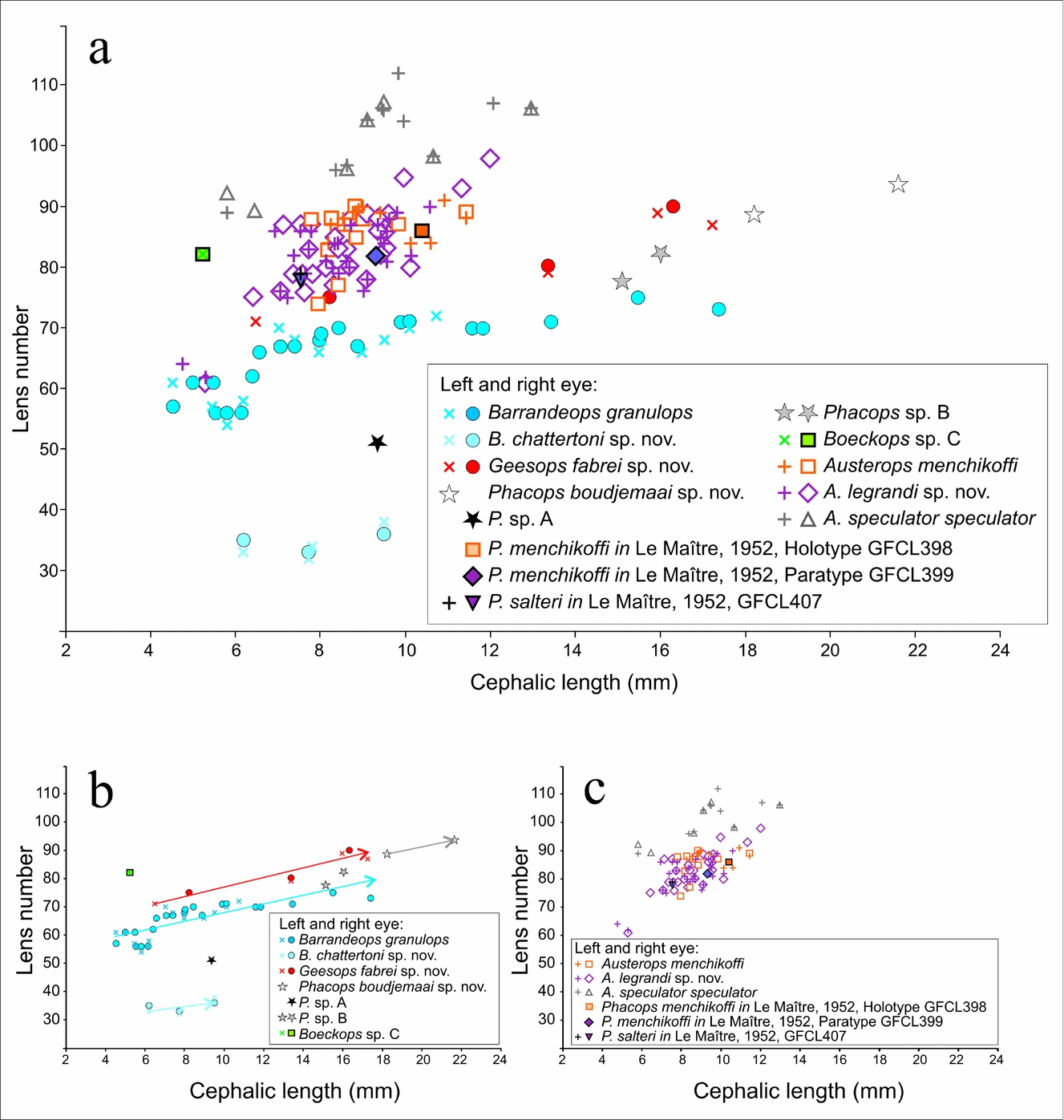
5. Biodiversity analysis
5.a. Method
The study of palaeobiodiversity is significant whatever the scale of study, even though estimates of Phanerozoic global biodiversity are limited by biases occurring in the fossil record. Fossiliferous biases comprise in particular the underrepresentation of some areas, inaccuracy in taxonomic data and irregular sampling intensity across organisms, environments and time intervals (Badgley, Reference Badgley2003), and notable improvements have been realized in the Phanerozoic diversity database (Alroy et al. Reference Alroy, Marshall, Bambach, Bezusko, Foote, Fürsich, Hansen, Holland, Ivany, Jablonski, Jacobs, Jones, Kosnik, Lidgard, Low, Miller, Novack-Gottshall, Olszewski, Patzkowsky, Raup, Roy, Sepkoski, Sommers, Wagner and Webber2001).
The study of palaeobiodiversity is based on a count of specimens for each taxon in each studied sample and their relative proportions. Additionally, to complete the palaeobiodiversity information and to evaluate its various components, several complementary ecological indices can be used in palaeontology (Harper, Reference Harper1999; Hammer & Harper, Reference Hammer and Harper2006), such as dominance, equitability or taxa richness.
In order to evaluate the taxonomic diversity in trilobites for the two studied Algerian sections, all the complete and disarticulated sclerites were identified and numbered. Additionally, we used the following indices: Specific richness (Dtot), Diversity (MR-index), Dominance (D-index) and Equitability (E-index).
Specific richness corresponds to the number of taxa, i.e. species: Dtot = S. Nevertheless, the reliability of this index is highly dependent on the sample size. In order to rule out bias related to sampling, this index can be completed by a rarefaction analysis (Krebs, Reference Krebs1989). This method compares the taxonomic diversity in samples of different sizes and estimates the number of expected taxa for any smaller sample size (Adrain, Westrop & Chatterton, Reference Adrain, Westrop and Chatterton2000; Hammer & Harper, Reference Hammer and Harper2006; Balseiro, Xaisfeld & Buatois, Reference Balseiro, Xaisfeld and Buatois2010). Some samples have numerous individuals, while others only a few. In order to compare these samples, the rarefaction analysis uses a reduced amount of individuals but an identical number for all the samples in order to compare their biodiversity for the same number of individuals.
Diversity measures are usually standardized against the sample size. The Shannon–Wiener index H (Shannon & Weaver, Reference Shannon and Weaver1949) takes into account the number of individuals as well as the number of taxa. This index considers the relative abundance of each taxon and gives weight to rare species. This index varies from 0 for a sample with only a single taxon to high values for samples with many taxa. H = −Σ(ni/n) ln(ni/n), where ni is number of individuals of taxon i. Margalef's richness index MR (Margalef, Reference Margalef1958) minimizes the effect of the sample size on estimating biodiversity. The higher the Margalef value, the greater the sample diversity. MR = (S−1)/ln(n), where S = number of species and n = number of individuals.
Dominance D measures based on relative abundance have high values for assemblages with a few common elements, and low values where species are more or less evenly represented. Dominance D = Σ(ni/n)2 . The index varies from 0 (taxa equally represented) to 1 (one dominant taxon).
Measures of equitability are usually the inverse of dominance. Equitability J = (−Σ(ni/n) ln(ni/n))/lnS) considers the uniformity of the distribution of individuals among the taxa present. This index varies from 0 to 1, where taxa are fairly represented with a similar number of individuals. Analyses were done using PAST v2.17 software (Hammer, Harper & Ryan, Reference Hammer, Harper and Ryan2001).
5.b. Results
5.b.1. Biodiversity
In the Saoura Valley, the palaeobiodiversity is not particularly high during Emsian time, characterized by only the two orders Phacopida and Proetida reported in this study (Fig. 12a, b). Only four families occur: Phacopidae and Acastidae (Phacopida), Proetidae and Aulacopleuridae (Proetida). For comparison, trilobite palaeobiodiversity from the Emsian at the global and regional scales (Saoura Valley) is given in Figure 12a. Trilobites seem to be poorly diverse macrofaunal constituents in the Emsian of the Saoura Valley, in contrast to their worldwide diversity (Fig. 12a). At a global scale, the Basal Pragian eustatic sea level fall (Chlupáč & Kukal, Reference Chlupáč, Kukal, Mc Millan, Embry and Glass1986) contributed to widening of shallow marine realms with carbonate sedimentation favourable for trilobites. This led, at least, to a preservation of the family diversity, which lasted with some changes until early Eifelian time.
(a) Total occurrences of trilobite orders and families at the global scale (modified from Feist, Reference Feist1991; Chlupáč, Reference Chlupáč1994) and in the Saoura Valley; (b) total occurrences of trilobite orders, families, genera and species in the four sampled Algerian levels; (c) number of individuals for each genus in each sampled Algerian level; (d) number of individuals for each species in each sampled Algerian level.
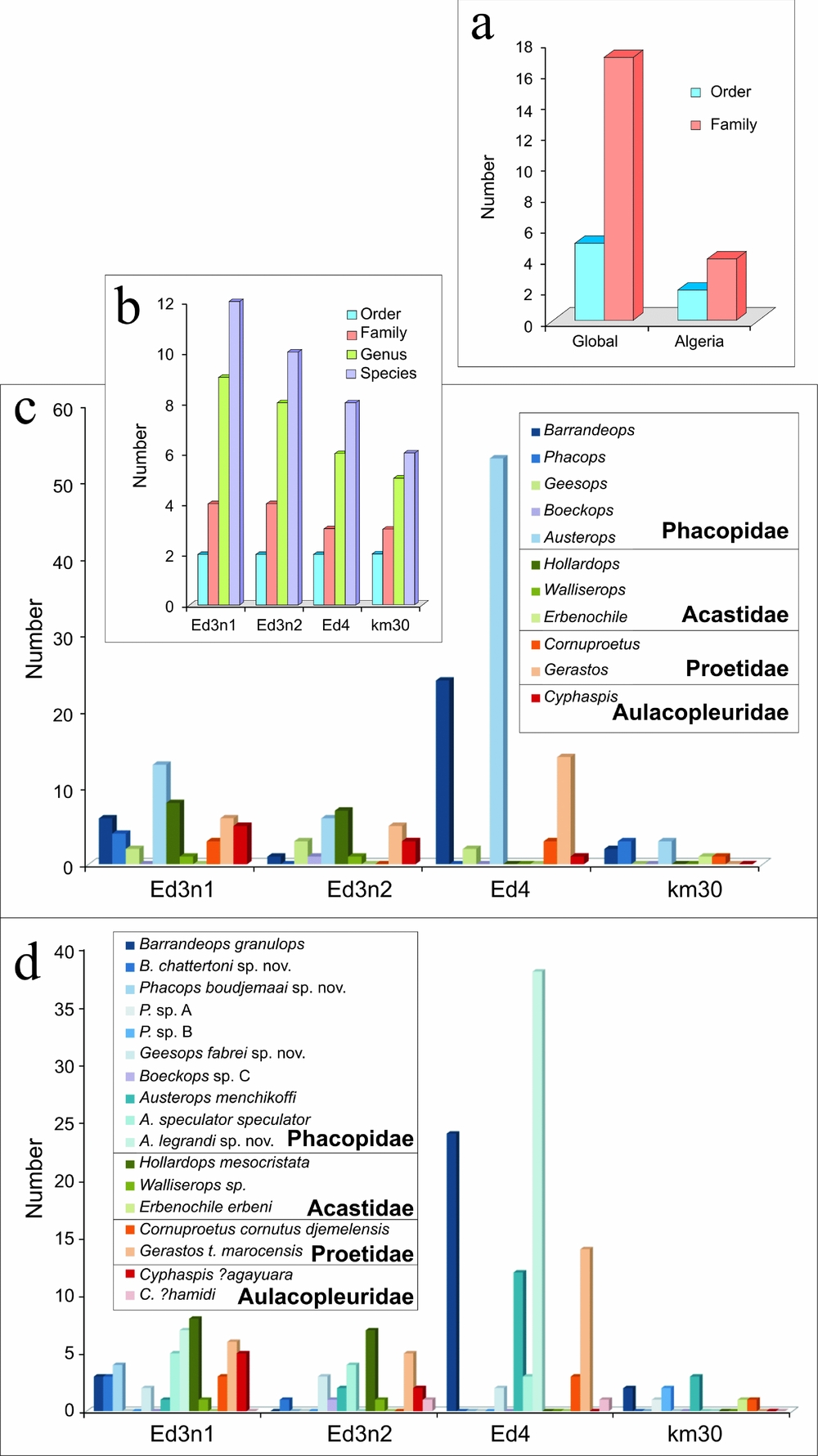
On a regional scale, at the beginning of late Emsian time, the Devonian marine transgression become generalized to the Western Saharan platform from Tassili to the Tindouf Basin and from Taoudenni to Ben Zireg towards the north, which underlined a sedimentary change to calcareous deposition (Ouali Mehadji et al. Reference Ouali Mehadji, Elmi, Racheboeuf and Mekahli2004, Reference Ouali Mehadji, Atif, Bouterfa, Nicollin and Besseghier2011). Even though the so-called ‘niveau coralligène’ constitutes a major fossiliferous deposit, the faunas are dominated by some benthic organisms such as brachiopods and crinoids (Ouali Mehadji et al. Reference Ouali Mehadji, Elmi, Racheboeuf and Mekahli2004), and other benthic organisms such as trilobites seem to be less diverse.
Works related to Algerian trilobites are fewer compared to nearby localities of Morocco. Although the carbonate outcrops can contain well-preserved fossils, difficult access to outcrops makes palaeontological studies difficult and the geological investigations are of purely economic interest in Algeria. However, representatives of others families such as Scutelluidae have been previously reported in Saoura by Le Maître (Reference Le Maître1952) but not yet found during our investigations.
New samples in the Saoura Valley corroborate the occurrences of Phacopida and Proetida (Fig. 12c, d) as mentioned by Le Maître (Reference Le Maître1952). Phacopidae are represented by Barrandeops, Phacops, Austerops, Geesops and Boeckops, five genera encountered also in Morocco (Schraut, Reference Schraut2000b ; Chatterton et al. Reference Chatterton, Fortey, Brett, Gibb and Kellar2006; McKellar & Chatterton, Reference McKellar and Chatterton2009); Acastidae are represented by Hollardops, Walliserops and Erbenochile, three genera encountered also in Morocco (Chatterton et al. Reference Chatterton, Fortey, Brett, Gibb and Kellar2006). Hollardops is among the most common Asteropyginae of North Africa during this time. Proetidae are represented by Gerastos and Cornuproetus, and Aulacoplauridae are represented by Cyphaspis, three genera encountered also in Morocco (Alberti, Reference Alberti1981; Chatterton et al. Reference Chatterton, Fortey, Brett, Gibb and Kellar2006).
In detail, genera and species seem to be better represented in the Erg el Djemel section, and especially in the Ed3n1 level compared to the Marhouma section (Fig. 12c, d). Nevertheless, the rarefaction analysis shows that the Marhouma section is under-sampled and seems to be similar to Ed3n1 and Ed3n2 (Fig. 13). Ed4 is the least diverse level (Fig. 13). Additional study and fieldwork are required to revise and complete the list of Early Devonian trilobites in the Saoura Valley.
Rarefaction curves for each studied Algerian level. Ed3n1–Ed4: levels from the Erg el Djemel section; ‘km 30’: level from the Marhouma section. Arrows indicate the comparative individual number for levels of the same size (10 for Ed3n1 v. ‘km 30’; 25 for Ed3n1 v. Ed4).
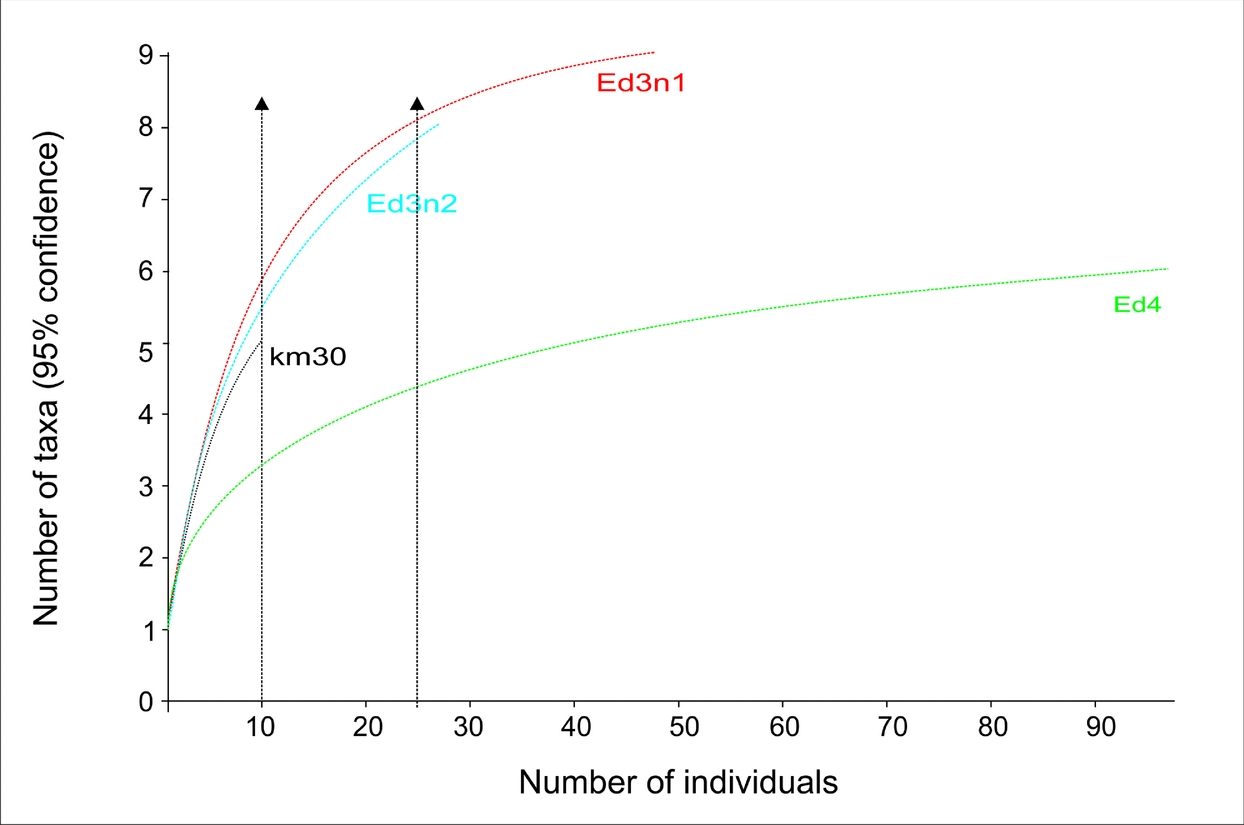
In Ed3n1, the fauna is dominated by the members of Phacopidae, which is represented by four genera and seven species, representing half the total number of specimens collected (52%, Fig. 14a, c). The other groups with a moderate relative abundance are Acastidae (19%), Proetidae (19%) and Aulacopleuridae (10%). For comparison, in Ed4, the fauna is dominated by the members of Phacopidae, which is represented only by three genera and five species, representing 82% of the total number of specimens (Fig. 14b, d). The other group with a moderate relative abundance is Proetidae (18%). Aulacopleuridae are poorly represented (1%) and Acastidae are not represented in this level.
Relative abundance of trilobite genera in the (a) Ed3n1 and (b) Ed4 levels from the Erg el Djemel section from the upper Emsian. Relative abundance of trilobite species in the (c) Ed3n1 and (d) Ed4 levels from the Erg el Djemel section from the upper Emsian.

5.b.2. Ecological structure
Palaeoecological parameters have permitted recognition of two assemblage types from the Saoura Valley on the basis of the relative abundance and diversity of the trilobite macrofauna. Thus, these two specific assemblage types are defined as follows (Figs 14, 15): (1) assemblage type A from Ed4 characterized by an important dominance of Austerops legrandi sp. nov. (40%) and Barrandeops granulops (25%). Ed4 could represent a ‘pioneer’ community where one or two very abundant, opportunistic species occur; (2) assemblage type B characterized by a relatively moderate diversity and evenness: Ed3n1 with 12 species and 48 individuals, Ed3n2 with 10 species and 27 individuals, and ‘km 30’ with 6 species and 10 individuals. The rarefaction analysis (Fig. 13) confirms that independently to the effect of sampling, the biodiversity in Ed3n1 and Ed3n2 is relatively high and similar. With equivalent sampling, the biodiversity in ‘km 30’ is slightly less diverse than those of the two preceding levels. Moreover, these biotas are relatively well-equally represented by numerous species (6.5 to 17%), although some species remain rarer than others (2%). Low values of the dominance index show that there is no predominant taxon (Fig. 15). By contrast to Ed4, Ed3n1, Ed3n2 and ‘km 30’ could represent almost ‘equilibrium’ communities. In such ‘equilibrium’ communities, there is a relatively high diversity of taxa more or less equally present (Brenchley & Harper, Reference Brenchley and Harper1998).
Comparison of three diversity indices in (a) the trilobite genera, and (b) the trilobite species in the four studied Algerian levels.
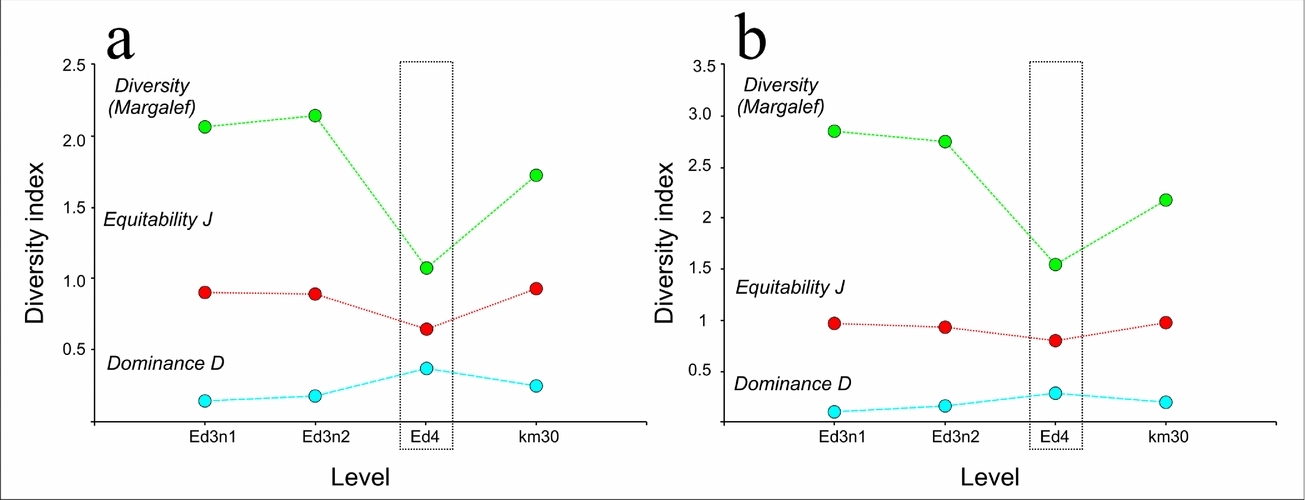
Additionally, these assemblages are either in situ or nearly in situ because they show no signs of long transportation. These assemblages could represent a former palaeocommunity where species are associated partly because they have similar physical tolerances of the environment and partly because they interact with one another through a food chain or through complementary niche requirements (Brenchley & Harper, Reference Brenchley and Harper1998).
6. Conclusions
The new investigation of trilobites in the Lower Devonian of Algeria allows the following conclusions to be drawn. On the basis of our material, it has been possible to identify new oculated species among several already known in Morocco. At a generic and specific scale, the Algerian faunule may be regarded as diverse and cosmopolitan without marked original features and, as expected from its geographic position (past and present), is particularly closely related to Moroccan faunas (e.g. presence of Barrandeops granulops, Hollardops mesocristata, Erbenochile erbeni, Gerastos tuberculatus marocensis, etc.).
Next, the biometric study of Phacopidae appears complementary to the systematic study (descriptive) because it enabled us to visualize and quantify partially the variability of the identified individuals. It especially enabled us to show that the new species Austerops legrandi sp. nov. differs from A. menchikoffi in having different cephalic proportions.
New samples in the Saoura Valley corroborate the distribution patterns of Phacopida and Proetida as mentioned by Le Maître (Reference Le Maître1952). Lower Devonian strata are characterized by abundant Phacopidae. Additional fieldwork is required to revise, complete and find rare representatives of other families such as Scutelluidae previously reported by Le Maître (Reference Le Maître1952) in the Saoura Valley.
Finally, two types of assemblages were recognized from the upper Emsian: an Ed4-biota dominated by Austerops legrandi sp. nov. (40%) and Barrandeops granulops (25%) that represents a ‘pioneer’ community with opportunistic species; and Ed3-biotas characterized by a relatively moderate diversity and evenness that can represent almost ‘equilibrium’ communities. Changes in species richness and ecological diversity of trilobites are in relation to physical environmental gradients. Changes in climate and topography limit most species ranges, resulting in considerable spatial turnover in species richness and ecological structure.
Acknowledgements
Our work benefited from the constructive remarks and the language corrections provided by B. D. E. Chatterton (Canada), and P. Budil (Czech Republic). This paper is a contribution to PHC TASSILI (Egide n°24496VJ; CMEP n°11MDU849), to UMR 8198 EvoEcoPaleo-CNRS, and to IGCP 596 ‘Climate change and biodiversity patterns in the Mid-Palaeozoic’.