Introduction
Depressive symptoms are common in late life. Prevalence is estimated with 17% by a recently published meta-analysis (Luppa et al., Reference Luppa2012a). Elderly individuals with depressive symptoms are faced with a number of negative consequences including functional decline, marked disability, decreased quality of life, and higher mortality from co-morbid medical conditions (Fiske et al., Reference Fiske, Wetherell and Gatz2009). Furthermore, it has been shown that depressive symptoms in old age are associated with an increased presentation of unexplained physical symptoms such as headache, gastrointestinal symptoms, and dizziness [8, 9], which partly may contribute to higher health service utilization and costs of depressed individuals in the healthcare system. Findings of systematic reviews examining health service utilization and costs of depression suggest that depression in late life contributes substantially to an increased service use and costs (Luppa et al., Reference Luppa, Heinrich, Angermeyer, König and Riedel-Heller2007; 2012b; König et al., Reference König, Luppa and Riedel-Heller2010). However, so far only five studies examined the impact of depressive symptoms on direct costs in elderly individuals (Livingston et al., Reference Livingston, Manela and Katona1997; Unutzer et al., Reference Unutzer1997; Luber et al., Reference Luber2001; Katon et al., Reference Katon, Lin, Russo and Unutzer2003; Luppa et al., Reference Luppa2008). Only one study examined costs in a longitudinal perspective (Unutzer et al., Reference Unutzer1997); yet, this study did not analyze the impact of different types of course of depressive symptomatology on direct cost (i.e. chronic, remittent, and incident depressive symptoms).
Thus, the aim of this prevalence-based bottom-up cost-of-illness study with incremental cost approach is to investigate health service use and direct costs from a societal perspective in a sample of depressed and non-depressed German primary care patients aged 75 years and older over a period of 4.5 years considering also different courses of depressive symptomatology.
Methods
Sample
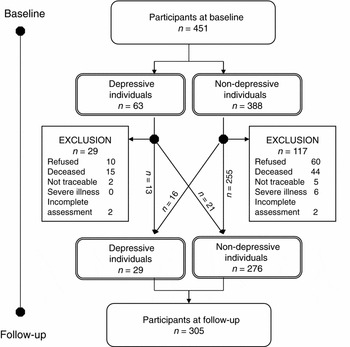
The study is a part of the longitudinal German study on Ageing, Cognition and Dementia in Primary Care Patients (AgeCoDe study), a study on early detection of mild cognitive impairment and dementia funded by the German Research Network on Degenerative Dementia (Kompetenznetz Degenerative Demenzen, KNDD), a study that was conducted at six centers (Bonn, Düsseldorf, Hamburg, Leipzig, Mannheim, Munich), representing an urban area of cities with a total population ranging between about 300,000 (Mannheim) and 1.8 million (Hamburg). Our analyses refer to the data of the study center Leipzig, where a total of 1,133 randomly selected individuals from 20 general medical practices in Leipzig meeting the inclusion criteria received a postal invitation from their General Practitioner (GP) to participate in the study. Inclusion criteria were being 75 years of age or older and at least one visit of the patient to the GP within the last 12 months. Exclusion criteria were GP consultations only through home visits, residence in a nursing home, severe illness that, according to the GP, would prove fatal within three months, insufficient ability to speak German, deafness or blindness, lacking ability to consent, and being only an irregular patient of the participating practice. Of the 451 patients who consented to participate in the baseline assessment between May 2004 and December 2005 (for detailed information on sampling frame, eligible subjects, and respondents, see Luppa et al., 2008), 305 were re-assessed at follow-up after 4.5 years. Seventy patients (15.5%) refused to participate, 59 (13.1%) had died before the follow-up interview, seven patients were not traceable (1.6%), six patients (1.3%) were not consultable due to very severe illness, and four patients (0.9%) had incomplete assessments (see Figure 1).
Sample attrition and course of depressive symptoms.

Comparison of baseline characteristics of participants in the prospective study (n = 305) and non-participants at follow-up (n = 146) showed no significant differences regarding age, gender, and marital status between both groups, but non-participants showed a higher mean Geriatric Depression Scale (GDS)-score at baseline than participants (3.1 vs. 2.3, p < 0.001), whereby 29 (19.9%) of them showed a GDS-score of 6 and more.
Instruments
Depressive symptoms were measured using a short version of the GDS-15, a 15-item screening instrument developed by Sheikh and Yesavage (Sheikh and Yesavage, Reference Sheikh and Yesavage1986) to identify elderly patients with depressive symptoms. We defined significant depressive symptoms with a score of 6 or greater on the GDS (range 0–15) as recommended for the German version (Gauggel and Birkner, Reference Gauggel and Birkner1999; Allgaier et al., Reference Allgaier, Kramer, Mergl, Fejtkova and Hegerl2011).
Comorbidity was measured by the number of medications prescribed at baseline and follow-up: the higher the number of prescriptions, the higher the comorbidity (Farley et al., Reference Farley, Harley and Devine2006).
Service use was assessed retrospectively over different time periods for services to control for recall difficulties, i.e. use of more memorable and consistent services was recorded over longer periods (Johnston et al., Reference Johnston, Buxton, Jones and Fitzpatrick1999). Time periods were: three months for outpatient services, use of outpatient non-physician provider, medical supply and dentures, pharmaceuticals and transport to medical treatments; six months for inpatient care and assisted living; and 12 months for use of home care. Measures of use were recorded depending on the type of service, i.e. frequency or mean duration of use (see also Luppa et al., 2008). Unit costs from a societal perspective were calculated for all services used, and for all pharmaceuticals and medical supply prescribed or privately purchased. Costs were extrapolated to annual costs and calculated in EURO at 2004/2005 price levels. For detailed information regarding determination of service use and monetary valuation, see Luppa et al. (Reference Luppa2008).
Statistical analyses
Statistical analyses were performed using PASW for Windows, version 20.0 (SPSS Inc.). Missing values for healthcare utilization were imputed by mean values of respective variables. Differences in characteristics between participants and non-participants at follow-up (age, gender, marital status, and GDS score) and between depressed and non-depressed individuals as well as between individuals with no, chronic, remittent, and incident depressive symptoms over study course (age, gender, marital status, education, comorbidity, GDS, and costs) were investigated using two-sided t-test, one-way ANOVA, Mann-Whitney U-test, Kruskal-Wallis test, and χ2-analyses as appropriate.
A common problem for health economics studies is a non-normal distribution of cost variables skewed to the right. For that reason, a multiple linear regression model with non-parametric bootstrapped standard errors (3,000 replications) and bias-corrected confidence intervals (Efron and Tibshirani, Reference Efron and Tibshirani1986) with mean annual direct costs at follow-up after 4.5 years as dependent variable was developed. In the fully adjusted model the following baseline variables were included as explanatory variables: age in years, gender, the number of medications as measure of comorbidity, and the GDS score (different cut-offs) as measurement of depression status.
Ethical approval
The ethics committee approved the study. Written informed consent was obtained from all participants.
Results
Sample characteristics
Depressive and Non-Depressive Symptoms
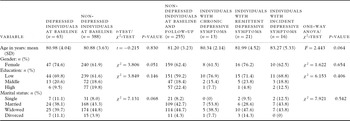
Sixty-three (14.0%) individuals of the 451 patients at baseline, and 29 (9.5%) individuals out of 305 at follow-up were classified as depressed (GDS-Score ≥ 6). Individuals with depressive symptoms did not differ significantly from non-depressed individuals regarding age, gender, education, and marital status (Table 1).
Baseline sociodemographic characteristics of depressed and non-depressed at baseline (n = 451) as well as individuals without depressive symptoms at baseline and follow-up, and with chronic, remittent, and incident depressive symptoms (n = 305)

Different Courses of Depressive Symptoms
A comparison of characteristics of individuals that were neither depressed at baseline (BL) nor at follow-up (FUP) with individuals showing chronic (depressive symptoms at baseline and follow-up, n = 13, thus 38% of followed-up depressed individuals), remittent (depressive symptoms only at baseline, n = 21, thus 62% of followed-up depressed individuals), or incident depressive symptoms (depressive symptoms only at follow-up, n = 16, thus 6% of followed-up non-depressed individuals) revealed no significant differences regarding age, gender, educational level, and marital status at baseline or follow-up (Table 1).
Service use
Depressive and Non-Depressive Symptoms
A comparison of service utilization of depressed and non-depressed individuals at baseline and follow-up showed significant differences between depressed and non-depressed individuals for mean total number of medications only at baseline (BL 5.8 vs. 4.9, p < 0.05, FUP 7.1 vs. 5.6, p = 0.068) and for use of antidepressants (AD) including St. John's wort (as verbal AD, which is commonly prescribed in Germany for mild depression), as well as tri- and tetracyclic AD, and SSRIs (20.6 vs. 4.9%, p < 0.001) also only at baseline as well as for use of medical supply (BL 25.4 vs. 14.2%, p < 0.05, FUP 48.3 vs. 25.8%, p < 0.05), and home care (BL 38.1 vs. 20.4%, p < 0.01, FUP 55.2 vs. 32.4%, p < 0.05) at baseline and follow-up. Also, 14% of depressed individuals visited a mental health specialist (i.e. psychiatrist or neurologist) at baseline and follow-up compared to 8% and 10% of non-depressed individuals. From baseline to follow-up, an increase in inpatient care (15.9 vs. 20.7%), medical supply (25.4 vs. 48.3%), and use of home care (38.1 vs. 55.2%), and a decrease in use of antidepressants (20.6 vs. 6.9%) and specialists visits (79.4 vs. 69.0%) in depressed individuals were found, which was not found in that degree in non-depressed individuals.
Different Courses of Depressive Symptoms
A comparison of individuals without depressive symptoms over the study course with individuals with chronic, remittent, or incident depressive symptoms showed only a significant difference between individuals with no depressive symptoms and with chronic depressive symptoms regarding mean number of medications at baseline (mean (SD) = 4.8 (0.2) vs. 6.8 (0.9) medications, p < 0.05). We found the highest mean number of physician contacts and medications at baseline in individuals with chronic depressive symptoms (mean (SD) = 6.8 (1.1) contacts, and 6.8 (0.9) medications). At follow-up, individuals with incident depressive symptoms showed the highest mean number of physician contacts and of medications (mean (SD) = 4.9 (0.6) contacts, and 7.3 (1.3) medications). For incident depressed individuals, an increase in use of outpatient non-physician services, medical supply, and home care was found. For individuals with chronic depressive symptoms, use of inpatient care, medical supply, and home care increased, and use of outpatient non-physician services and use of specialists decreased. For individuals with remittent depressive symptoms, the use of specialists, medical supply, and antidepressants decreased from baseline to follow-up. Mental health specialists were used most often by individuals with chronic depressive symptoms at baseline, followed by incident, remittent, and non-depressed individuals (23%, 14%, 13%, 9%), and by individuals with remittent depressive symptoms at follow-up followed by incident, chronic, and non-depressed individuals (29%, 25%, 0%, 8%).
Direct costs
Depressive and Non-Depressive Symptoms
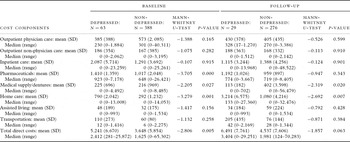
Table 2 shows the mean annual direct costs for different cost components and total mean annual direct costs as well as median values and ranges for depressed and non-depressed participants at baseline and follow-up. The mean annual direct costs per patient were €5,241 for depressed and €3,648 for non-depressed individuals at baseline, and €6,491 for depressed and €4,537 for non-depressed at follow-up. Thus, the mean annual direct costs of depressed individuals exceeded the costs of those without depressive symptoms by €1,593 and €1,954, or 30.4% and 30.1%, respectively. Mean costs of depressed individuals were higher in each of the cost components except for outpatient costs at baseline, and for inpatient care costs, medical supply, and assisted living at follow-up. Statistically significant differences between depressed and non-depressed individuals were found for pharmaceutical costs, costs for medical supply, and costs for home care at baseline, and for costs for medical supply as well as for home care at follow-up. The most relevant cost drivers of the direct costs of the depressed elderly were inpatient costs at baseline (40% of total annual direct costs), followed by costs of pharmaceuticals (27%) and home care (15%). At follow-up, the most relevant cost drivers for depressed individuals were costs for home care (50%), for pharmaceuticals (18%), and inpatient care (17%).
Mean annual direct costs of depressed and non-depressed individuals at baseline (n = 451) and follow-up (n = 305)

Different Courses of Depressive Symptoms
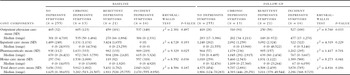
Mean annual total costs at baseline and follow-up were highest for individuals with chronic depressive symptoms (see Table 3). Mean annual direct costs increased from baseline to follow-up for individuals with no depressive symptoms by 16%. For chronic, remittent, and incident depressed participants, costs increased by 39%, 17%, and 27%, respectively.
Mean annual direct costs of individuals with no, chronic, remittent, and incident depressive symptoms at baseline and follow-up (n = 305)

We found no significant differences in mean annual direct costs between these four groups at baseline and follow-up.
Table 3 shows also costs for different cost categories according to course of depressive symptomatology. Costs for outpatient care decreased in all subgroups, and were strongest in individuals with chronic depressive symptoms. Costs for pharmaceuticals increased in individuals with incident and no depressive symptoms, and decreased for individuals with chronic and remittent depressive symptoms. Costs for inpatient care increased only for individuals with chronic and incident depressive symptoms. Costs for home care increased in all subgroups, but were strongest in individuals with chronic depressive symptoms. Statistical significant differences were found between individuals with remittent and incident depressive symptoms for outpatient costs at follow-up (Z = –2.193, p < 0.05), between individuals with chronic and no depressive symptoms (Z = –2.658, p < 0.01), and with chronic and incident depressive symptoms (Z = –2.017, p < 0.045) for costs for pharmaceuticals at baseline, and for costs for home care at baseline between individuals with chronic and no depressive symptoms (Z = –2.135, p < 0.05) as well as incident depressive symptoms (Z = –2.069, p < 0.05) and at follow-up between individuals with chronic and no depressive symptoms (Z = –2.426, p < 0.05).
Multivariate analyses
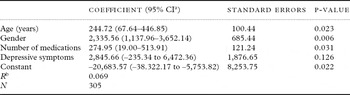
The multivariate linear regression model (see Table 4) investigated the impact of depressive symptoms, number of medications, age, and gender at baseline on mean annual direct costs after 4.5 years, and revealed three variables predicting future direct costs: number of medications, age, and gender. With each additional medication, the mean annual costs increased by €275. With every year of age, the direct costs increased by €245. Women caused €2,336 higher mean annual direct costs than men. Depressive symptoms, defined with a score of 6 or more on the GDS, showed no significant impact on future directs costs. But if the cut-off score was lowered to 5, 4, or 3, depressive symptoms at baseline showed a significant association with mean annual direct costs in the future (p < 0.05). The explained variance of mean annual direct costs in the linear regression model was with 7% quite low indicating that other factors than these included contribute to the occurrence of direct costs.
Linear regression of annual mean direct costs (n = 305)

a Bias-corrected confidence intervals.
b Bootstrap standard errors with 3,000 replications.
Discussion
The aim of the study was to investigate health service use and direct costs of a German primary care sample over a 4.5-year study course considering also the impact of different courses of depressive symptoms on direct costs.
We found that mean annual direct costs of individuals with depressive symptomatology exceeded the total direct costs of non-depressed individuals by almost one-third at baseline and follow-up. This is in line with the few studies on direct costs of depression in old age conducted in the USA (Livingston et al., Reference Livingston, Manela and Katona1997; Unutzer et al., Reference Unutzer1997; Katon et al., Reference Katon, Lin, Russo and Unutzer2003), and with the findings of a recently published review of health service use and costs of depressive symptoms in old age (Luppa et al., Reference Luppa, Sikorski, Motzek, Konnopka, König and Riedel-Heller2012b).
A novel finding is that presence of depressive symptoms at baseline shows a significant association with the mean annual costs after 4.5 years, and that this effect sustained after controlling for comorbidity as measured by number of medications at baseline (if a cut-off score between 3 and 5 for depressive symptomatology was chosen). This finding suggests an independent association of presence of depressive symptoms with future direct costs that is not only explained by a higher degree of comorbidity, but also that it apparently needs only few depressive symptoms to trigger an increase of direct costs. It has been discussed that the amplification of present symptoms of diseases and the increased presentation of non-specific medical complaints such as headache, gastrointestinal symptoms, and dizziness, which leads to an increase in medical examinations and prescriptions cause the higher direct costs (Waxman et al., Reference Waxman, McCreary, Weinrit and Carner1985; Luber et al., Reference Luber2001; Katon et al., Reference Katon, Lin, Russo and Unutzer2003). Furthermore, it has been suggested that the reason why individuals with depressive symptoms amplify somatic complaints and use more health services than their non-depressed counterparts is not due to the desire of emotional support through heavy contacts to healthcare professionals, but rather due to a distorted perception of severity of somatic symptoms and diseases: depressed individuals seem to appraise themselves worse and symptoms of diseases more severe than non-depressed individuals (Kirmayer, Reference Kirmayer2001; Levinson and Druss, Reference Levinson and Druss2005). The new aspect that depressive symptoms are also associated with direct costs in distant future may be explained by the common unfavorable course of depressive symptoms in old age: intermittency and chronicity rates in old age were reported with almost 50–60% (Cole et al., Reference Cole, Bellavance and Mansour1999; Harris et al., Reference Harris, Cook, Victor, DeWilde and Beighton2006). Furthermore, higher baseline depression level is considered as prognostic indicator for unfavorable course of depressive symptoms (Licht-Strunk et al., Reference Licht-Strunk, van der Windt, van Marwijk, de Haan and Beekman2007). Hence, individuals with higher depression score at baseline are at high risk of still suffering from depressive symptoms 4.5 years later. In our primary care-based sample, we found a somewhat lower rate of chronicity of 38% over the study course of 4.5 years than population-based representative studies in old age (Cole et al., Reference Cole, Bellavance and Mansour1999; Harris et al., Reference Harris, Cook, Victor, DeWilde and Beighton2006). Conceivable explanations may be: the higher age of our study population (75+) connected with a higher mortality rate of especially depressed individuals (Blazer, Reference Blazer2003); the exclusion of elderly individuals at higher risk of depressive symptoms, e.g. nursing home residents, patients with a dementia disorder; or the higher refusal rate at follow-up of patients with more depressive symptoms at baseline. Since patients with chronic depressive symptoms showed the highest direct costs over the study course, our findings of direct costs may be rather underestimated (see also, strength and limitations).
However, the association of depressive symptoms with future direct costs may also be affected by a higher comorbidity at follow-up in individuals with depressive symptoms. We found a considerable difference of costs for home care between depressed and non-depressed individuals at both time points, and a substantial increase of costs for home care for depressed individuals from baseline to follow-up, which may be due to a substantial increase in use of benefits from the nursing care insurance by depressed individuals: at baseline 13% of depressed individuals received benefits from nursing care insurance (non-depressed: 4%); at follow-up, the percentage increased to 34% (non-depressed: 9%). It is a fact that the need of care increases substantially in the age group of 80+ (Federal Statistical Office, 2011) and is closely related to increasing morbidity and functional impairment. Since in our sample an increase in need of care occurred mainly in depressed individuals, a close relationship of depressive symptoms and morbidity or functional impairment was demonstrated as previously reported (Blazer, Reference Blazer2003; Fiske et al., Reference Fiske, Wetherell and Gatz2009). The higher mean number of medications of depressed compared to non-depressed individuals at baseline supports the postulated association of depressive symptoms and morbidity. However, in this study one could not say which one caused the other. In the literature, on the one hand higher somatic comorbidity and functional impairment were reported as prognostic indicators for an unfavorable course of depressive symptoms in old age (Licht-Strunk et al., Reference Licht-Strunk, van der Windt, van Marwijk, de Haan and Beekman2007). On the other hand, depressive symptoms were also reported to have an impact on development and deterioration of somatic diseases and functional impairment (Fiske et al., Reference Fiske, Wetherell and Gatz2009). A view to direct costs associated with the course of depressive symptoms showed the highest costs for individuals with chronic depressive symptoms, and an increase of costs of chronic depressed individuals by 39% over the study course compared to 16% in non-depressed individuals. This increase was mainly due to an increase in costs for home care, so that in our sample especially chronic depressive symptoms seem to be highly associated with need of care. This finding was emphasized by the results that chronic depressed individuals showed the highest mean number of physician contacts and the highest mean number of medications at baseline. They were followed by individuals with incident depressive symptoms, which is, besides individuals with chronic depressive symptoms, a further important subgroup. For these individuals, the highest mean number of physician contact and medications was found at follow-up and an increase in use of outpatient non-physician services, medical supply, and home care from baseline to follow-up, which could be attributed (1) to the distorted perception of medical complaints due to the depressive perspective, (2) to a new severe illness that may have triggered the development of depressive symptoms, or (3) to a combination of both.
Mental healthcare was not often used by individuals with depressive symptoms. Treatment with antidepressants only occurred for 21% and 7% of depressed individuals at baseline and follow-up compared to 5% of non-depressed individual (whereby reasons of antidepressant prescription for non-depressed individual may be due to physician's diagnosis of depression or due to anxiety/panic or sleeping disorders (Gardarsdottir et al., Reference Gardarsdottir, Heerdink, van Dijk and Egberts2007)). Moreover, individuals with remittent depressive symptoms showed a decrease in antidepressants use from baseline to follow-up, which may be due to a termination of the treatment by the physician or by the patient him/herself due to an improvement of symptomatology. Only 14% of depressed individuals visited mental health specialists. This indicated that more unrecognized than recognized depressed cases were contained in the sample, and this is emphasized by the findings that depression in old age in primary care is often under-diagnosed (Callahan, Reference Callahan2001). However, one should keep in mind that clinical relevance and need of treatment of minor depressive symptoms remain unclear. Mean GDS score of depressed individuals at baseline and follow-up was 7.5 and 7.6, respectively, thus exceeding the threshold of 6 only slightly. On the other hand the general increase in health service use and costs (Luppa et al., Reference Luppa, Sikorski, Motzek, Konnopka, König and Riedel-Heller2012b), the often unfavorable course (Cole et al., Reference Cole, Bellavance and Mansour1999), and the number of well-investigated negative outcomes of depressive symptoms in old age (Blazer, Reference Blazer2003) may justify their treatment.
Furthermore, in our study increasing age was significantly associated with higher direct costs. This is in line with findings from another study conducted in Germany before (Linden et al., Reference Linden, Horgas, Gilberg and Steinhagen-Thiessen1997), and may be explained by the close association of advanced age with illness, frailty, and higher need for care (Linden et al., Reference Linden, Horgas, Gilberg and Steinhagen-Thiessen1997), and also by the influence of death-related costs (Raitano, Reference Raitano2006).
Strengths and limitations
Our study used a bottom-up approach, collecting data retrospectively by applying a questionnaire on service utilization in face-to-face interviews with the individuals. This approach allows a comprehensive assessment of resource use data of each participant, and individual data such as out-of-pocket expenses or costs of social services can be assessed, too. However, recall bias cannot be ruled out completely. Therefore, we aimed at minimizing the bias applying different time periods for cost components following recommendations by Johnston et al. (Reference Johnston, Buxton, Jones and Fitzpatrick1999). Furthermore, cost estimates reported should be seen as rather conservative estimates. Via exclusion criteria, nursing home residents and patients with dementia disorders, known to have higher depression rates and supposedly higher healthcare costs, were not included in this sample. Also, non-participants at follow-up showed a higher mean depression score and a higher prevalence of depressive symptoms at baseline than participants. Moreover, sub-samples of depressed and non-depressed participants as well as of different courses of depressive symptomatology were rather small limiting statistical power, and a comparison of results in different cost categories between sub-samples should be done with caution. Lastly, we only have information about depressive symptomatology at baseline and 4.5 years later, excluding information about fluctuation of depressive symptomatology during the time between both time points. Nonetheless, our results convey a first impression of impact of course of depressive symptomatology on direct costs, and call for further in-depth investigations.
Conclusions
Depressive symptoms in old age are common, highly persistent, and lead to enormous personal, social, and economic consequences for individuals, families, and societies. The manifold research insights in late-life depression achieved in the past decades urgently demand for an optimization of its early detection and adequate treatment. Our findings emphasize this requirement as they illustrate the economic consequences of depressive symptoms for the healthcare system over the course of time, which appeared in a substantial increase in health service use and direct costs with presence and persistence of depressive symptoms. Potential reasons for the increased service use of depressed elderly individuals may be first an increase of comorbidity with rising age, and second the amplification of existing medical complaints as well as the increased presentation of unspecific medical symptoms. Strategies and interventions for improvement of diagnostic validity and treatment success of depressive symptoms in late life would not only lead to preserve and improve quality of life for people with dementia and their families, but may also have a potential effect on economic burden for societies (Wang et al., Reference Wang, Simon and Kessler2003; Barrett et al., Reference Barrett, Byford and Knapp2005; Donohue and Pincus, Reference Donohue and Pincus2007).
Conflict of interest
None.
Description of authors’ roles
M. Luppa formulated the research questions, designed and carried out the study, analyzed the data, and wrote the first draft of the paper; H.-H. König formulated the research questions, designed the study, and commented on and revised the paper; D. Heider and H. Leicht carried out the study, analyzed the data, and commented on and revised the paper; T. Motzek formulated the research questions, designed the study, and analyzed the data; G. Schomerus formulated the research questions, designed the study, and commented on and revised the paper; and S.G. Riedel-Heller formulated the research questions, designed and carried out the study, and commented on and revised the paper.
Acknowledgments
This work is part of German Research Network on Dementia (KND) and the German Research Network on Degenerative Dementia (KNDD) and was funded by the German Federal Ministry of Education and Research (AgeCoDe study, grant: 01GI431 and 01GI0714) and is published in affiliation with the Study on Late-Life Depression in Primary Care (AgeMooDe study, grant: 01GY1155A).