Introduction
Tobacco is the world's leading preventable cause of death and disability (IARC, 1986; U.S. Department of Health and Human Services, 2014). Today, about 1.5 million people die from tobacco-related cancer and more than one in three cancer-related deaths are associated with the use of tobacco (Dwyer-Lindgren et al., Reference Dwyer-Lindgren, Mokda, Srebotnjak, Flaxman, Hansen and Murray2014).
In USA, there has been a decreasing trend in tobacco-related cancer incidence in men and a plateau in women (Underwood et al., Reference Underwood, Richards, Henley, Momin, Houston and Rolle2015). The introduction of a legislative smoking ban in several countries has led to a reduction in exposure to passive smoking (Callinan, Clarke, Doherty, & Kelleher, Reference Callinan, Clarke, Doherty and Kelleher2010). There is some evidence of an improvement in health outcomes and a reduction of acute coronary syndrome (Colivicchi et al., Reference Colivicchi, Mocini, Tubaro, Aiello, Clavario and Santini2011).
In Italy, a progressive decrease of the prevalence of smokers from 35.4% in 1966 to 20.8% in 2012 has been observed (Mannocci et al., Reference Mannocci, Colamesta, Conti, Cattaruzza, Paone and Cafolla2014). However, over the past 5 years, the prevalence of smoking has remained fairly constant, ranging between 21% and 23% (Mannocci et al., Reference Mannocci, Colamesta, Conti, Cattaruzza, Paone and Cafolla2014). In 2014, smokers in Italy were 11.3 million (22% of global population), with a third of heavy smokers, 6.6 million (12.8%) of former smokers and 33.4 million (65.2%) of never smokers. Smoking prevalence had increased overall by 1.4 % with a 3.6% increase in women and a 0.8% decrease in men. A total of 18% of smokers used roll-your-own cigarettes (RYO) (Mannocci et al., Reference Mannocci, Colamesta, Conti, Cattaruzza, Paone and Cafolla2014).
Importantly, only 5% of all smokers are followed by a centre for tobacco control despite the awareness that long-term smoking cessation success rates may double with intensive treatments compared to no treatment (Kotz, Brown, & West, Reference Kotz, Brown and West2013). An association between depression and smoking has been documented in many studies with a stronger association in women (Luger, Suls, & Vander Weg, Reference Luger, Suls and Vander Weg2014). Subjects with mental disorders seem to be more susceptible to nicotine dependence, have often more difficulties to quit and relapse more frequently after quitting than people with no history of depression (Luger et al., Reference Luger, Suls and Vander Weg2014). Recent data show that current or recent tobacco users are also associated with increased risk of suicide attempt (Berlin, Hakes, Hu, & Covey, Reference Berlin, Hakes, Hu and Covey2015). There is a negative relationship between smoking and quality of life (QoL), and smoking cessation significantly improves QoL, reducing depression, anxiety, stress and improving positive mood (Goldenberg, Danovitch, & IsHak, Reference Goldenberg, Danovitch and IsHak2014). Women also seem to be more susceptible to smoke than men because of the belief that smoking alleviates negative feelings, which is more prominent in women (Pang, Zvolensk, Schmidt, & Leventhal, Reference Pang, Zvolensk, Schmidt and Leventhal2015). Moreover, women may have more difficulties in quitting than men (Smith et al., Reference Smith, Kasza, Hyland, Fong, Borland and Brady2015).
Clinical and psychological characteristics of smokers seeking advice may vary depending on the programme offered and the socio-economic environment in which the centre for tobacco control is located (Burris, Whalquist, & Carpenter, Reference Burris, Whalquist and Carpenter2013; Castro, Matsuo, & Nunes, Reference Castro, Matsuo and Nunes2010; Gilbert, Sutton, & Sutherland, Reference Gilbert, Sutton and Sutherland2005). Having a clear picture of those characteristics could help to tailor programmes and therapies and improve their efficacy. Here, we describe the characteristics of a large cohort of subjects who accessed a smoking cessation centre (part of a National Health System) located in an urban area of Northern Italy during a 13-year time period with a focus on time- and sex-related changes and psychological characteristics.
Methods
This was a retrospective observational study which examined the activity of a smoking cessation centre at the Local Health District of Genoa, Italy, during a 13-year period, from 2001 to 2013.
Subjects were evaluated by a physician during the first access to the centre, and enrolled in an individual therapy programme or in a group programme of 20 subjects. If someone utilised the centre more than once, we used the first-time data for evaluation. A questionnaire was administered to all patients at baseline in order to collect demographics and socio-educational data, including educational level, marital status and body mass index, but also details on alcohol habits and smoking history (starting age, number of previous quitting attempts, smoking-related diseases and motivational factors for quitting). Psychological characteristics were assessed in the last 3 years starting from 2010 to 2013, using the following validated tools: Smoking cessation motivation questionnaire (Q-MAT) (Aubin et al., Reference Aubin, Lagrue, Legeron, Azoulaȉ, Pelissolo and Humbert2004), Zung depression scale (Zung, Reference Zung1965), Zung anxiety scale (Zung, Reference Zung1971) and the Hospital Anxiety and Depression Scale (HADS) (Zigmond & Snaith, Reference Zigmond and Snaith1983).
Q-MAT consists of four questions to test the motivation to quit smoking and has a score from 0 (lack of motivation) to 20 (excellent motivation). Zung scale questionnaire consists of 10 positively and 10 negatively phrased questions that rate the affective, psychological and somatic symptoms associated with depression and anxiety. Each of the 20 questions has a score on a scale from 1 to 4, based on four possible answers. Test scores range from 20 to 80 are divided into four groups for depression (<50: normal, 50–59: mildly depressed, 60–69: moderately depressed, >70 severely depressed) and in four groups for anxiety (<45 normal, 45–59 mildly anxious, 60–74 moderately anxious, >75 severely anxious). HADS Scale consists of 14 items (response scale 0–3) which are divided into two groups, each measuring anxiety and depression ranging from 0 (no anxiety, no depression) to 21 (severe anxiety or depression) with a clinical threshold >8–10.
During the first visit, we measured the basal expired-CO level using the EC50 Smokerlyser; an inexpensive, portable CO-monitor. The Smokerlyser measures breath CO levels in ppm. Nicotine dependence was measured using the Fagerstrom Test for Nicotine Dependence (FTND) (Fagerstrom & Schneider, Reference Fagerstrom and Schneider1989). FTND is a scale composed of six items and has a score from 0 to 10. The scores for nicotine dependence are classified into five levels: very low (0–2 points), low (3–4 points), moderate (5 points), high (6–7) and very high (8–10 points). A score higher than 6 indicates that the subject is likely to experience significant discomfort (withdrawal syndrome) in quitting smoking. The FTND cut-off point for nicotine dependence is 5.
Statistical Methods
Data were summarised as number (percentage) of subjects for count variables, as mean/median with standard deviation/range and quartiles for continuous variables.
The relationships between gender and demographics/psychological characteristics were assessed using the Pearson chi-square or the Fisher exact tests for count or categorised variables; two sample t-test/Wilcoxon rank-sum test were adopted in case of continuous variables.
Box plots were exploited to visualise expired-CO distribution over time. A non-parametric test for trend across ordered groups was used to test for differences in expired-CO over time.
All analyses were conducted using Stata (version 13; StataCorp., College Station, TX, USA). Two-tailed probabilities were reported and the p-value of 0.05 was used to define nominal statistical significance.
Results
We collected data on a total of 2,231 all first-time patients (1,278 men and 953 women) in a smoking cessation clinic over a 13-year period (January 1, 2001 and December 31, 2013).
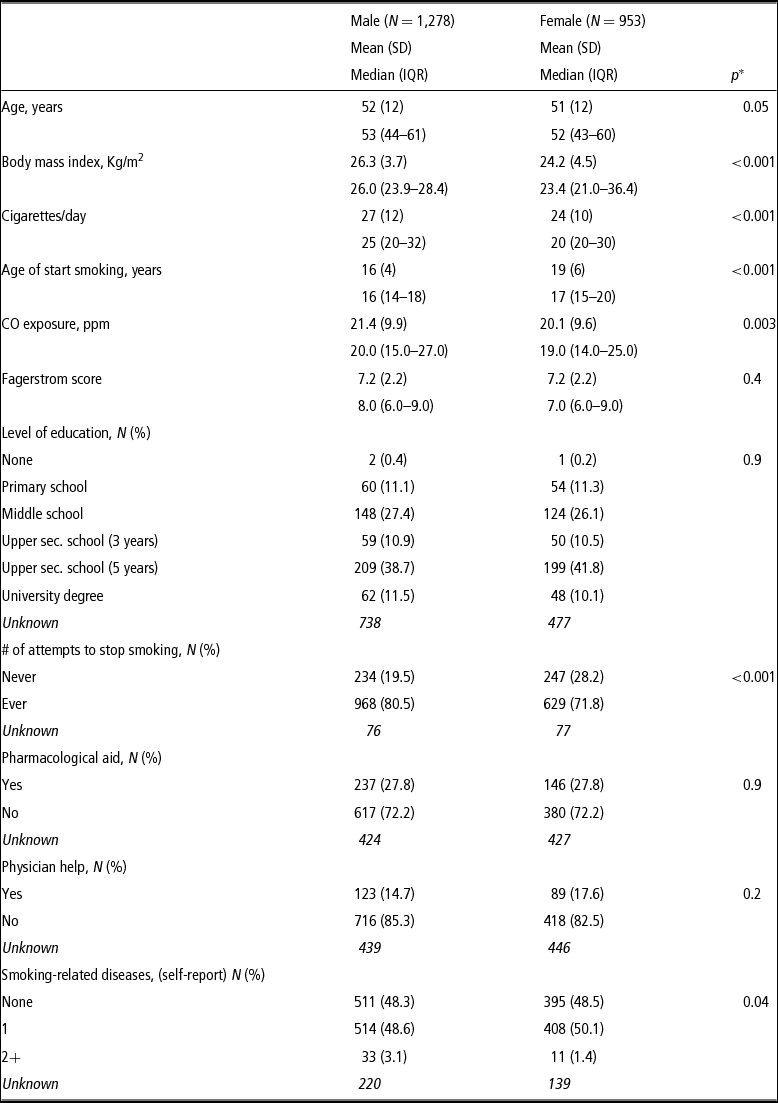
The main subjects’ characteristics at baseline by gender are depicted in Table 1. There were no gender-related differences in age, FNTD score (mean 7.2 ± 2.2 in both sexes), education, number of pharmacological and physician supported attempts and presence of smoking-related diseases. However, in our population, there were important differences by gender: men had a higher BMI than women (mean 26.3 Kg/m2 ± 3.7 versus 24.2 ± 4.5, respectively; p < 0.001), smoked more cigarettes per day (mean 27±12 versus 24 ± 10; p < 0.001), and had a higher expired-CO levels (mean 21.4 ± 9.9 versus 20.1 ± 9.6, p = 0.003). Furthermore, men started smoking earlier than women (16 ± 4 versus 19 ± 6 years old, respectively, p < 0.001) and had more previous quitting attempts before entering our programme, 81% versus 72% (p < 0.001).
Main subject characteristics at baseline

Abbreviations: SD = standard deviation; IQR = interquartile range; CO = Carbon monoxide; ppm: part per million; *Independent samples t-test or Pearson chi-square/Fisher exact test.
Regarding differences over time, there was a significant increase in the number of women applying for treatment to our centre for tobacco control, from 37.5% during 2001–2003 to 46.9% during 2010–2013 (p = 0.003). The mean age at baseline visit also increased over time: 50 ± 11.8 in 2001–2003 versus 52.7 ± 12.2 years in 2010–2013 for both gender (p = 0.001), with a greater increase in women (from 49.3 ± 11.3 to 52.4 ± 12.3, p = 0.002). BMI also tended to increase more in women, from 23.9 ± 4.9 in 2001–2003 to 24.6 ± 4.5 in 2010–2013 in women (p = 0.062); whereas in men was stable in time (26.4 ± 3.7 from 2001 to 2013) (data not shown in tables).
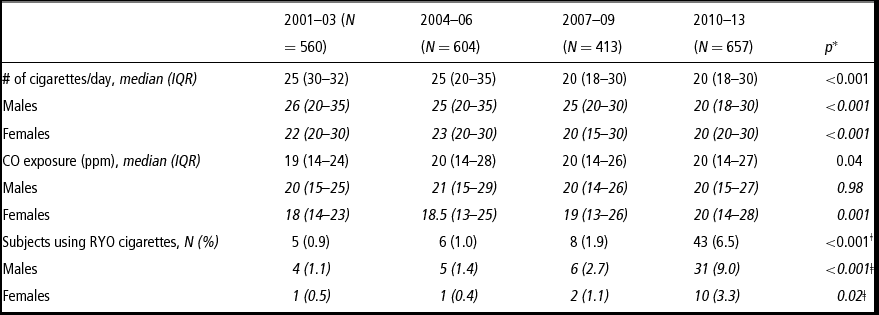
There was a decreasing trend over time in the median number of cigarettes per day, starting from an average of 25 cigarettes/day in 2001–2006 (IQR: 20–35) to 20 (18–30) in 2007–2013 (p < 0.001, Figure 1, panel A). The decrease was more marked in men, who smoked 26 (20–35) cigarettes/day in 2001–2003 down to 20 (18–30) cigarettes/day in 2010–2013 (p < 0.001, Table 2). Although expired-CO median levels were higher in men than in women, 20 (IQR: 15–27) versus 19 (14–25) ppm, respectively (p = 0.003), a trend to an increase over time for expired-CO level was observed only in women, whereas men exhibited plateau levels over time (insert Figure 1 here, panel B). In men, the median (IQR) levels were 20 ppm (15–25) in 2001–2003 and 20 ppm (15–27) in 2010–2013, whereas they increased from 18 ppm (14–23) in 2001–03 to 20 ppm (14–28) in 2010–13 in women (p = 0.001, Table 2).
Boxplots of # of cigarettes/day (panel A) and CO exposure (panel B) by gender and over time (between 2001 and 2013).

Number of cigarettes/day and CO exposure by time, according to gender, and number of subjects using roll-your-own (RYO) cigarettes by time

Abbreviations: SD = standard deviation; IQR = interquartile range; CO = Carbon monoxide; ppm: part per million; *p for trend over time; ǂ chi-square p-value.
From 2001 to 2013, the number of subjects who attempted to quit smoking at least one time before being referred to our CTC increased from 68.1% in 2001–2003 to 89.5% in 2010–2013.
In the last 3 years of analysis (2010–2013), there was an increased number of RYO smokers compared to 2001–2003 (from 0.9% to 6.5%) (insert Table 2 here), with a stronger increase in men (from 1% in 2001–03 to 9% in 2010–13). Moreover, the median number of cigarettes/day was significantly higher in smokers of factory-made cigarettes (FM) than RYO, but there was no difference in terms of Fagerstrom score and, more importantly, in expired-CO between FM versus RYO cigarettes (data not shown).
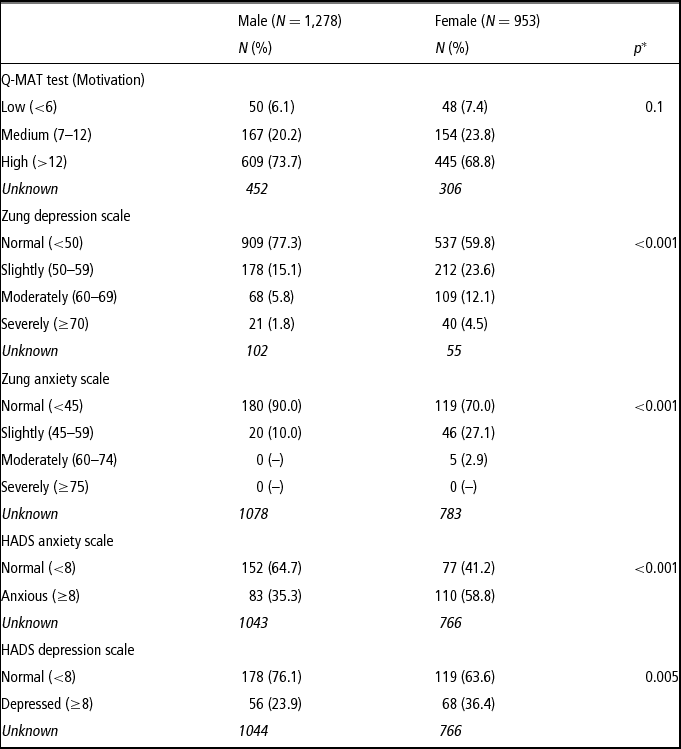
From 2010 to 2013, we started to collect the main psychological characteristics of our population at baseline, which are summarised in Table 3 (insert Table 3 here). Women showed more symptoms of depression than men. According to Zung depression scale, assessed in 32% of subjects, 12.1% of women had a moderate score (60–69) compared with the 5.8% in men and 4.5% of women had a severe score (>70) compared with the 1.8% in men (p < 0.001). Considering Zung anxiety scale, assessed in 16% of smokers, women were also more anxious than men, with the 2.9% of them reaching the highest score (between 60–74) compared with the 0% of men (p < 0.001).
Psychological characteristics at baseline by gender

*chi-square p-value
The HADS anxiety and depression test was assessed in 19% of the participants and showed that women reported anxiety and depression symptoms more frequently. Overall, 58.8% of women resulted anxious (HADS anxiety score> 8) versus 35.3% of men (p < 0.001) and 36.4% of women had an HADS depression score > 8 versus 23.9% of men (p = 0.005). No differences were observed over time in both sexes (data not shown).
Finally, no significant differences were observed in the QMAT motivation test (tested in 66% of subjects): 609 men (73.7%) versus 445 women (68.8%) had a high motivation to quit (score >12, p = 0.1).
Discussion
Our study provides valuable real-life information on characteristics of smokers attending a large smoking cessation programme provided by the National Health System in Genoa, an urban area of Northern Italy with middle-high income and a high prevalence of an elderly population, with a focus on gender differences, time trends and psychological characteristics. The population involved heavy smokers, with a median of 22 cigarettes/day, a number significantly higher than the median daily-consumption reported in Italy, i.e., 12.9 in 2013 according to the National Institute of Statistics, Italy. Moreover, this was a very hard core smoking population with a high nicotine dependence (FTND = 7.2), high prevalence of mental disorder symptoms and significant number of previous unsuccessful attempts to quit smoking, mainly without medical assistance, drugs therapy or support of a centre for tobacco control. Therefore, smoking cessation in this population is challenging and requires intensive highly specialised tailored interventions.
Over the 13 year time span of the present study, relevant changes have occurred in the smoking behaviour in many western countries. Importantly, Italy was one of the first European countries to ban smoking in public places in 2003. This might partly explain a trend to a reduced number of daily cigarette consumption and an increase in quitting attempts. Of note, expired-CO increased over the years in women despite a stable daily cigarette consumption. Conversely, in men, there was a reduction in daily cigarette consumption but the amount of expired-CO was stable. These trends likely reflect a change in the smoking pattern such as the increased popularity of RYO cigarettes in young people and male smokers which was observed in our as well as in other previous studies (Lugo et al., Reference Lugo, Asciutto, Pacifici, Colombo, La Vecchia and Gallus2015; 23). Importantly, this changing habit may have a negative impact on smokers’ beliefs which can obstacle the decision of quitting smoking and eventually seeking help to a centre for tobacco control in as much as RYO cigarettes are perceived as more natural and less dangerous cigarettes (Young et al., Reference Young, Borland, Hammond, Cummings, Devli and Yong2006). However, our study like prior studies (Laugesen, Epton, Frampton, Glover, & Lea, Reference Laugesen, Epton, Frampton, Glover and Lea2009) shows that the increasing use of RYO cigarettes could reduce the average number of daily cigarettes but do not result in a reduction of smoke exposure. This is corroborated by the unchanged amount of expired-CO level despite the apparently reassuring reduction in the number of cigarettes smoked per day in the RYO cigarette smokers compared to the FM cigarette smokers group.
Our findings show that the characteristics of smokers who spontaneously applied to our smoking cessation programme have changed significantly over a 13-year period. Perhaps, more importantly, there were remarkable differences by gender. In our series, men smoked more than women with a higher number of daily cigarettes and a higher expired-CO levels. Men started smoking earlier and reported one or more smoking-related diseases more frequently. However, men attempted more frequently to quit, were more motivated than women and, in the last few years, reduced the number of daily cigarettes more than women. A tendency to a more addicted behaviour of smoking in women is also reflected by the increased expired-CO observed in women compared with men in the most recent years.
Importantly, according to all different score systems (HADS and Zung depression and anxiety scale), women more frequently reported depression and anxiety symptoms. This finding is in line with prior data demonstrating a stronger association between smoking and major depressive disorders in women compared with men (Berlin et al., Reference Berlin, Hakes, Hu and Covey2015; Goldenberg et al., Reference Goldenberg, Danovitch and IsHak2014; Luger et al., Reference Luger, Suls and Vander Weg2014). It is known that female smokers differ from males in several aspects, including the biological substrates underlying drug reinforcement mechanisms (Cosgrove et al., Reference Cosgrove, Wang, Kim, McGovern, Nabulsi and Gao2014), cultural and social meaning of smoking (Sieminska & Jassem, Reference Sieminska and Jassem2014), prevalence of depression and anxiety symptoms (Greaves, Reference Greaves2015), different mechanisms of relapse after quitting (Nakajima & al'Absi, Reference Nakajima and al'Absi2012) and increased difficulty in quitting (Smith et al., Reference Smith, Kasza, Hyland, Fong, Borland and Brady2015). Smokers with depressive symptoms have lower rates of attempts to quit smoking and suffer from negative mood changes after quitting more than people with no history of depression (Luger et al., Reference Luger, Suls and Vander Weg2014). This could negatively affect cessation rates due to the use of psychoactive substances as well. In our data, there are significant differences between HADS and Zung scale results: in HADS scale, a largest percentage of women and men seems anxious and depressed; likely because these scale differ in test questions and have a different sensitivity. However, women resulted more anxious and depressed in both scales according to literature data. We decided to use both scales to avoid treating smokers without knowing a possible psychiatric problem.
Our findings suggest the need for different smoking cessation strategies according to specific subgroups of adult smokers. Specific support strategies and a pharmacological intervention for smokers who suffer from psychiatric disorders and with a high level of tobacco dependence seems to be the most appropriate. Considering the large number of subjects with a significant level of depression or anxiety symptoms prior to the quitting attempt and the risk of worsening of these symptoms due to smoking cessation, it is essential that any treatment programme pays special attention to this population. Two European studies with 385 smokers (Nerin, Crucelaegui, Mas, & Guillén, Reference Nerín, Crucelaegui, Mas and Guillén2003) and 870 smokers (Becona, López-Durán, Fernández del Río, & Martínez, Reference Becoña, López-Durán, Fernández del Río and Martínez2014) described the same population in Spain reporting similar findings. Specifically, Becona et al. analysed the changes in the characteristics of Spanish smokers between the years 2001 and 2010 and found that smokers who received psychological treatment in the last years (2006–2010) were less motivated and more depressed compared to 2001–2005. Furthermore, there was a reduction in the effectiveness of the treatment in the last years despite the decrease in the number of cigarettes smoked daily. The authors concluded that, given the increase in numbers of smokers with depressive antecedents, is important to adapt smoking cessation treatment for this type of smokers.
Our study has several limitations, including the later implementation of psychological tests and consequently limited number of subjects submitted to these tests.
Finally, given the robust evidence of efficacy for pharmacological and non-pharmacological interventions derived from trials (Fiore, Jaen, & Baker, Reference Fiore, Jaen and Baker2008), we intend to assess the effects of these interventions in the real-life clinical setting.
In conclusion, we showed in our large series of heavy smokers a decrease in the number of daily cigarettes with time, but an increase of expired-CO in women who are also more depressed and anxious than men. A personalised approach to specific subgroups of smokers, with special emphasis to a psychological support in women, is warranted.
Acknowledgements
None.
Financial Support
This research received no specific grant from any funding agency, commercial or not-for-profit sectors.
Conflict of Interest
None.
Ethical Standards
The authors assert that all procedures contributing to this work comply with the ethical standards of the relevant national and institutional committees on human experimentation and with the Helsinki Declaration of 1975, as revised in 2008.