I. INTRODUCTION
Orthogonal frequency division multiplexing (OFDM) is considered as an effective approach for the high-speed wireless multimedia communication systems due to its robustness against the multipath delay spread, feasibility in hardware implementation, flexibility in subcarrier allocation, and adaptability in the subcarrier modulation [Reference Nee and Prasad1, Reference Dwivedi and Singh2]. The basic principle of OFDM communication system is to split the high-rate data stream into the number of lower-rate data streams, which are transmitted simultaneously over a number of subcarriers. Unfortunately, the integrity of digital communication in various mobile applications is subject to detrimental effects of multipath fading as an intrinsic characteristic of most wireless channels. Diversity combining is an effective technique for improving the performance of radio communication system in the multipath propagation environment, therefore the performance of diversity schemes has recently received considerable research efforts [Reference Hui3–Reference Brennan26]. The widely used signal processing techniques in diversity schemes are the maximal ratio combining (MRC), equal gain combining and selection combining algorithms. The MRC diversity is always performing better than either selection diversity or equal gain combining because it is an optimum combiner. Moreover, all the branches are weighted by their respective instantaneous signal to-noise ratios (SNRs) and then co-phased prior to summing to insure that all the branches are added in phase for maximum diversity gain. The summed signals are then used as the received signal and connected to the demodulator. The information on all channels is used with this technique to obtain more reliable received signal. The study of MRC diversity first addressed the case of dual diversity combining with correlated branches and the Nakagami-m distributed SNR [Reference Miyakgaki, Morinaga and Namekawa4, Reference Fedele, Izzo and Tanda5]. The higher diversity orders with independent branches have been discussed in [Reference Al-Hussaini and Al-Bassiouni6, Reference Beaulieu and Abu-Dayya7]. Aalo [Reference Aalo8] has presented the error performance of multi-branch diversity with a special covariance matrix for the diversity branches for pre-detection MRC diversity. The first work on pre-detection MRC diversity with the correlated and unbalanced branches was presented by Lombardo et al. [Reference Lombardo, Fedele and Rao9]. They used a closed-form expression of the multivariate gamma moment generating function (MGF) to derive the average error probability for pre-detection differentially coherent phase shift keying and non-coherent frequency shift keying.
The effect of correlated fading on the performance of a diversity combining receiver has received a great deal of research interest. In [Reference Salz and Winters10, Reference Adachi, Feeney, Parsons and Wllamson11] the Rayleigh distribution to model the fading statistics of the channel has been discussed. Recently, there has been a continued interest in modeling of the various propagation channels with the Nakagami-m distribution [Reference Nakagami and Hoffman12], which includes Rayleigh as a special case for unit fading parameters. It is also a good approximation for the Rice distribution when fading parameter is greater than unity [Reference Abu-Dayya and Beaulieu13]. In the literature, early studies on the performance of a maximal-ratio combiner in the correlated Nakagami environment concentrated either on dual-branch diversity [Reference Fedele, Izzo and Tanda5] or on arbitrary diversity order with simple correlation models. The closed-form expressions for the error probability in the Nakagami fading channels with a general branch correlations are discussed in [Reference Fedele, Izzo and Tanda5] by taking into account the average branch SNR imbalance. Although the results are general for any diversity order and arbitrary branch correlation model, the effect of antenna spacing and the operating environment on the bit-error-rate (BER) performance cannot be evaluated from [Reference Fedele, Izzo and Tanda5] due to the lack of general expression of the spatial cross-correlation coefficient.
Recently, it has been recognized that the MGF is a powerful tool for simplifying the analysis of diversity communication systems, which leads to simple expression for the average BER and symbol error rate (SER) for wide variety of digital signal schemes on fading channels including multichannel reception with correlated diversity [Reference Bithas and Mathiopoulos14]. The performance analysis of switch and stay combining diversity receivers operating over the correlated Ricean fading satellite channels can be found in [Reference Bithas and Mathiopoulos14], where the performance is evaluated based on a bunch of novel analytical formulae for the outage probability, average symbol error probability, channel capacity, the amount of fading, and the average output SNR obtained in infinite series form. The similar performance analysis of the switched diversity receivers operating over the correlated Weibull fading channels in terms of the outage probability, average symbol error probability, moments, and MGF can be found in [Reference Bithas, Mathiopoulos and Karagiannidis15]. Bandjur et al. [Reference Bandjur, Stefanovic and Bandjur16] have studied the performance of a dual-branch switch and stay combining diversity receiver with the switching decision based on the signal-to-interference ratio operating over the correlated Ricean fading channels in the presence of correlated Nakagami-m distributed co-channel interference. Earlier work presented in [Reference Scaglione, Barbarossa and Giannakis17–Reference Aalo and Zhang19] has assumed that the frequency domain channel response samples are also the Nakagami-m distributed with the same fading parameters as the time domain channel. Kang et al. [Reference Kang, Yao and Lorenzelli22] have shown that the magnitude of the frequency responses is well approximated by the Nakagami-m random variables with new parameters by considering only the dual diversity at receiver. Rui et al. [Reference Rui, Lin and Yang23] have considered the diversity at transmitter and receiver both without correlation between them but when antennas are closely spaced then signal are correlated. Du et al. [Reference Du, Cheng and Beaulieu24, Reference Du, Cheng and Beaulieu25] have analyzed the performance of OFDM system over frequency selective fading channel but they have not discussed the effect of correlation on the performance of OFDM system.
In this paper, we have presented a novel method for the BER, SER, and outage probability analysis of the correlated Nakagami fading channel by using the MRC diversity. We consider the MRC diversity (M ≥ 2) at the receiver and analyzed the OFDM performance for various modulation schemes. The performance of this proposed system is much better than [Reference Kang, Yao and Lorenzelli22] and for M = 2, the proposed result is similar with that of [Reference Kang, Yao and Lorenzelli22]. The organization of the paper is as follows. Section II discusses about the mathematical analysis of the BER, SER, and outage probability for the correlated Nakagami-m fading channel for the OFDM communication system. Section III discusses the numerical results of the proposed analysis. Finally, Section IV concludes the work.
II. ANALYSIS
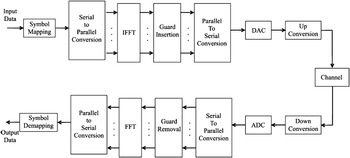
In this section, we briefly summarize the OFDM transceiver and channel model for the wireless communication. A simplified schematic of the proposed OFDM transceiver is shown in Fig. 1 [Reference Nee and Prasad1].
Schematic of the OFDM communication systems.

A) BER analysis
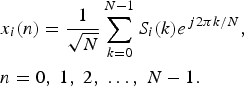
Let S i (k) is the kth OFDM data block which has to be transmitted with the N subcarriers. The incoming serial bits are converted into the parallel streams by using the serial-to-parallel converter block. There after these parallel streams are subjected to the inverse fast Fourier transform (IFFT) as shown in the block diagram of the OFDM transceiver in Fig. 1. The IFFT block is used to modulate the input signal and after modulation the signal can be represented as
The cyclic prefix is inserted after the IFFT modulation, which will be removed before the demodulation at OFDM receiver. The resultant signal is up converted before the transmission and the down converted at the receiver end. The received signal after removal of the cyclic prefix is demodulated by using the FFT. The output of FFT is represented as
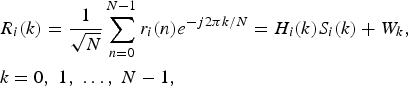
where r i(n) is received signal at the receiver. W k is an additive complex Gaussian noise with zero mean, and H(k) is frequency domain channel impulse response expressed as

In equation (3), the h i (n) is the Nakagami-m distributed random variable and

where T is the transpose of matrix. We consider that the average power signal and fading parameters in each M channels of a maximal ratio combiner system that are identical. The assumption of identical power is reasonable if the diversity channels are closely spaced and the gain of each channel is such that all the noise power are equal as discussed in detail in [Reference Pierce and Stein20]. The SNR at the output of MRC diversity is given by [Reference Brennan26]

where E s is the symbol energy and σ 2 is the variance of the zero-mean complex mean Gaussian noise. When the receiving antennas are closely spaced then receiving signals are correlated and the SNR of received signal γ 1, γ 2,….,γ M cannot be considered as independent random variable. The correlation coefficient between the two receiving antenna is (by assuming equal correlation (ρ) between antennas ρ) given by [Reference Kang, Yao and Lorenzelli22]

The probability density function of γt is given as [Reference Aalo8]

where m is the fading parameter as defined in [Reference Kang, Yao and Lorenzelli22, Reference Du, Cheng and Beaulieu24, Reference Du, Cheng and Beaulieu25]. If m ≥ 1/2, represents the severity. The smaller values of m represent the more fading in the channel. The  is confluent hyper-geometric function as given in [Reference Gradshteyn and Ryzhik27]. On the other hand, recent advances on the performance analysis of digital communication systems in fading channel have recognized the potential importance of the MGF as a powerful tool for simplifying the analysis of diversity communication systems. This has led to simple expressions for the average BER and SER rate for variety of digital signaling schemes on fading channels, including multichannel reception with correlated diversity. The MGF is one of most important characteristics of any distribution function, because it helps in the BER performance evaluation of the wireless communication systems. The MGF is defined as [Reference Dacosta and Yacoub28, Reference Alouini and Goldsmith29]

The MGF given in equation (6) is a versatile closed-form measure, which can be used for the performance evaluation of various modulation schemes. It is also usable for both pre-detection and post-detection combining with varying ease of use. By substituting equation (5) into equation (6) and by using the Equation [7.621.5] from [Reference Gradshteyn and Ryzhik27], the MGF of equation (5) is as follows:
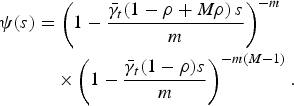
If two independent diversity combiners are considered at receiver (M = 2), then

Equation (8) is similar with equation (9) as given in [Reference Kang, Yao and Lorenzelli22]. The conditional probability error function for coherent binary phase-shift keying (BPSK) and for coherent orthogonal binary frequency-shift keying (BFSK) is given by Alouini and Goldsmith [Reference Alouini and Goldsmith29] as
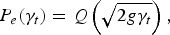
where g = 1/2 for BFSK, g = 1 for BPSK, and g = 0.715 for coherent BFSK with minimum correlation [Reference Dacosta and Yacoub28, Reference Alouini and Goldsmith29], Q(x) is the Gaussian Q function defined by

The average BET can be expressed as [Reference Alouini and Goldsmith29]
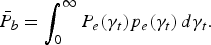
By substituting the value of  from equation (9) to equation (11), we obtain

Another form to represent the Gaussian Q function is

By substituting the value Q(x) in equation (12), we obtain

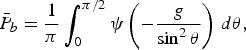
where

From equations (15) and (7), we obtain
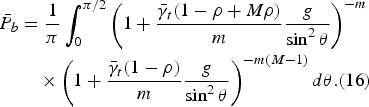
By substituting t = cos2(θ) and after some mathematical manipulation, equation (16) can be expressed as
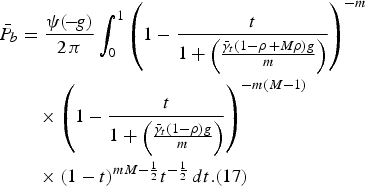
From [Reference Gradshteyn and Ryzhik27], equation (17) can be expressed as
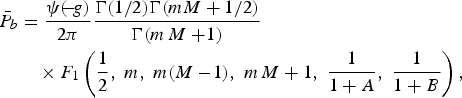
where F 1 (·) is the Appell hyper-geometric function as given in [Reference Erdelyi30], where
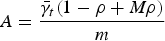
and
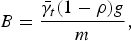
where  is SNR and Γ (•) is the Gamma function as given in [Reference Gradshteyn and Ryzhik27]. The total average BER of multiple received antenna OFDM system can be expressed as

B) SER analysis
The average SER for coherent square M-QAM signals is given by [Reference Alouini and Goldsmith29]
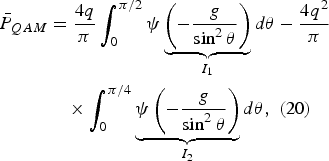
where  , and constellation size is given by P = 2ν with ν being the even number. Integrals I 1 and I 2 are solved separately, by substituting s = −g/sin2θ in equation (7). The integrals I 1 and I 2 can be written as
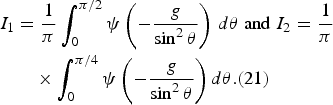
After some mathematical manupulation from [Reference Gradshteyn and Ryzhik27], equation (21) can be expressed as:
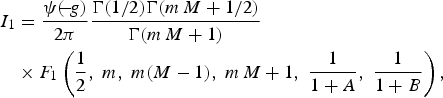

By substituting I 1 and I 2 in equation (20), then the resultant average SER is
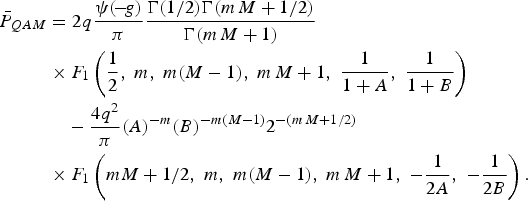
The total average SER of multiple received antenna OFDM system can be expressed as

Depending on the particular application, the error probability can be BER or SER and is consistent with the conditional error probability.
C) Outage probability
The outage probability is an important performance parameter which measures the probability when the instantaneous SNR falls below a specified threshold. In a fading radio channel, it is likely that a transmitted signal will suffer deep fade that can lead to a complete loss of the signal or outage of the signal. Therefore, it is another standard performance criterion of communication systems operating over the fading channels. It is measure of the quality of the transmission in a mobile radio channel and defined as the probability that the instantaneous error rate exceeds a specified value or equivalently that the (instantaneous) combined SNR falls below a certain specified threshold,  [Reference Lombardo, Fedele and Rao9]. Hence, the outage probability is given by
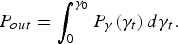
From equation (5) it can be evaluated as
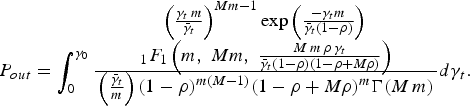
By expanding the 1F 1(.) from [Reference Gradshteyn and Ryzhik27] and after some mathematical manipulation, equation (27) can be expressed as

where
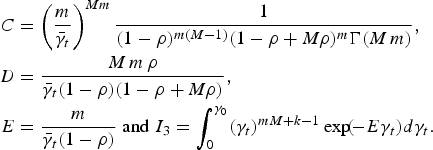
By expressing  from [Reference Gradshteyn and Ryzhik27] and by using the equation (7.811.2) of [Reference Gradshteyn and Ryzhik27], equation (29) can be expressed as

By substituting I 3 in equation (28), the outage probability (P out) can be expressed as
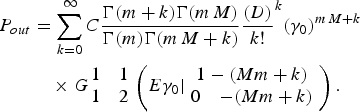
The expressions involve the Meijer G-function, which, although easy to evaluate by itself using the modern mathematical packages such as Mathematica and Maple.
III. RESULTS AND DISCUSSION
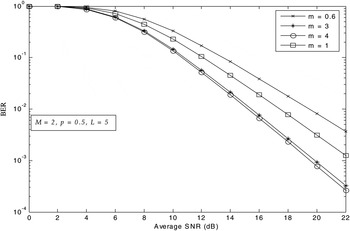
In general, it is well known that the performance of any communication system in terms of the BSE, SER, and signal outage probability depends on the statistics of the SNR. The BET is an important property for all the digital communication systems which provides a base line for the amount of information transferred and the design depends heavily on type of channel and type of modulation. All the BER calculations depend fundamentally on the SNR at the receiver. The BER performance of the OFDM with received diversity over the correlated Nakagami-m fading channel is analyzed and simulated. When the antennas are closely spaced, the received signals are correlated. Figure 2 depicts the total average BER characteristics with average SNR for various values of arbitrary chosen fading parameters. As the value of fading parameter increases, the BER performance of the BPSK OFDM system is improved for the chosen given value of the SNR. The BER performance of the system also improves with the increase of SNR after a certain value and this improvement is much better with the increase of the fading parameters.
The average BER characteristics with respect to the average SNR of BPSK OFDM system over the correlated Nakagami-m fading for various values of the fading parameter.

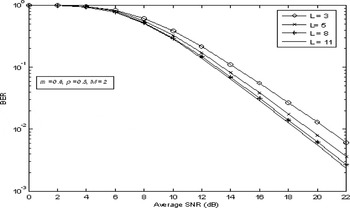
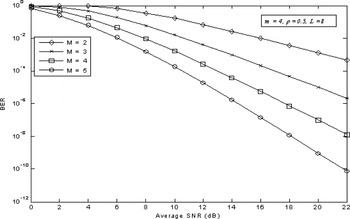
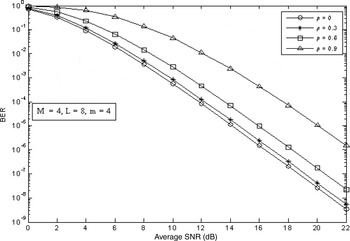
Figure 3 shows the effect of channel length (L) as discussed in [Reference Du, Cheng and Beaulieu24, Reference Du, Cheng and Beaulieu25] on the average BER characteristics with respect to SNR, which is improved with the increase of the channel length (L) for a given value of SNR, but it is not much effective in comparison to the fading parameter. Figure 4 depicts the effect of diversity of receiver (M) on the average BER performance of the OFDM system. As the diversity of receiver is increased, the average BER performance of the OFDM system is improved significantly.
The average BER characteristics with respect to the average SNR of the BPSK OFDM system over the correlated Nakagami-m fading for various values of the channel length.

The average BER characteristics with respect to the average SNR of the BPSK OFDM system over the correlated Nakagami-m fading for various values of the diversity receivers.

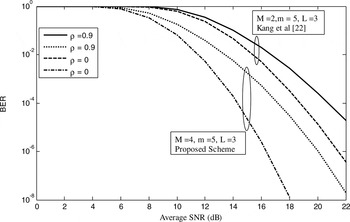
Figure 5 shows the effect of correlation on the BER characteristics with respect to SNR of the OFDM system, as the correlation coefficients increase the BER performance of OFDM system decreases. Figure 6 shows the comparison of the average BER characteristics with respect to SNR of the proposed OFDM system with the Kang et al. [Reference Kang, Yao and Lorenzelli22]. The MGF, as given in equation (7), at the value of diversity receiver (M = 2) is same as that of the Kang et al. [Reference Kang, Yao and Lorenzelli22]. Thus, equation (7) is a general expression of the MGF whereas the Kang et al. [Reference Kang, Yao and Lorenzelli22] MGF is valid only for M = 2. As the value of M increases the average BER performance of proposed method improved significantly.
The average BER characteristics with respect to the average SNR of the BPSK OFDM system over the correlated Nakagami-m fading for the various values of correlation coefficients.

Comparison of the BER characteristics with respect to the average SNR of the proposed scheme for BPSK OFDM system to the Kang et al. [22] scheme.

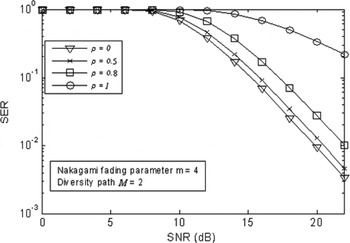
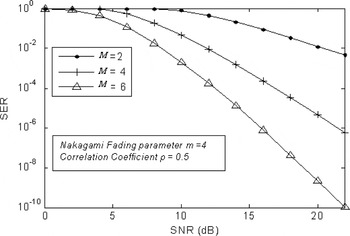
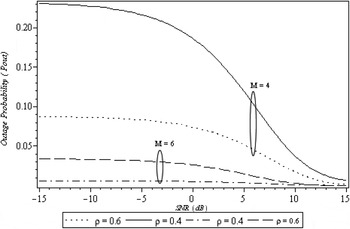
Figure 7 shows the SER probability of MRC over the correlated Nakagami fading channel with 4-QAM modulation for various correlation parameters. At ρ = 1, the SER approaches 10−1 for 20 dB SNR and ρ = 0 the SER approaches 10−3 for 20 dB SNR. As the correlation coefficients increase the SER performance of system is decreased. Figure 8 shows the SER probability with respect to SNR of the MRC over correlated Nakagami fading channel with 4-QAM modulation for different values of the receiver diversity M with the chosen values of the Nakagami fading parameter and correlation coefficient that is m = 4 and ρ = 0.5, respectively, for the analysis. The SER performance is improved as the number of diversity paths is increased. Figure 9 shows the outage probability with respect to the average SNR for M = 4 and 6 at γ 0 = 10 dB. From the figure, it is clear that as the receiver diversity M increases, the outage probability (P out) improves significantly.
The SER characteristics with respect to the SNR of MRC diversity receiver over the correlated Nakagami-m fading for 4-QAM OFDM system for various correlation coefficients.

The SER characteristics with respect to the SNR of the MRC diversity receiver over the correlated Nakagami-m fading for 4-QAM OFDM system for the various combined paths.

The outage probability with respect to the SNR for the several values of correlation coefficients.

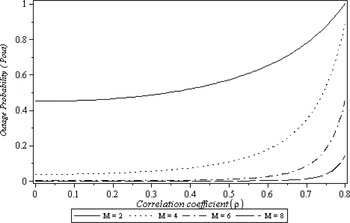
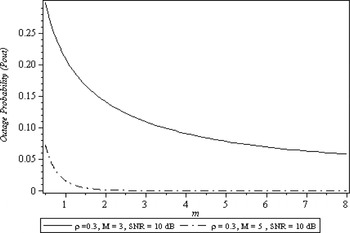
Figures 10 and 11 show the effect of correlation coefficient (ρ) and the Nakagami fading parameter, m, on the outage probability for different values of diversity. From Figs 10 and 11, it is clear that as the correlation coefficient increases, the outage probability decreases and it improves as m increases significantly. In general, for the lower values of the correlation coefficients the infinite series converges quickly and the truncation error will be small.
The outage probability characteristics with respect to the correlation coefficient for the various values of the diversity.

The outage probability characteristics with respect to the Nakagami-m fading parameter for different diversity.

The Nakagami fading parameter (m) determines the severity of fading channels. Two special values of m are of particular interest. In the case of m = 1, the sum of independent zero-mean complex Gaussian random variables provides a zero-mean complex Gaussian random variables with its envelop following the Rayleigh distribution exactly and thus the Nakagami-m fading specializes to the Rayleigh fading. In the limiting case when m = 0, the Nakagami-m fading channel approaches a static channel.
IV. CONCLUSION
In this paper, we have investigated the MGF-based approach for the average BER, SER, and outage probability performance analysis of the OFDM communication system over the correlated Nakagami-m fading channel by using the MRC diversity at the receiver. In this proposed method, a closed-form mathematical expression for the average BER for BPSK and SER for M-QAM is derived. In the proposed analysis, we have considered the diversity path (M ≥ 2) greater than two at the receiver hence the average BER and SER performance of the OFDM system is improved significantly. Moreover, we have also derived a mathematical expression for the outage probability. The proposed mathematical analysis is used to study various novel performance evaluations with parameters of interest such as fading severity and correlation coefficients, which is very significant for the design consideration of the OFDM communication systems.
ACKNOWLEDGEMENTS
Authors are sincerely thankful to the potential reviewers for their decisive time to review this article and critical comments and suggestions to improve the quality of the manuscript.
 Vivek Kumar Dwivedi received B.E. degree from the RGPV, Bhopal, India in 2003 and master of engineering from the Birla Institute of Technology, Mesra, Ranchi, India in 2006. Currently, he is pursuing his Ph.D. in electronics and communication engineering from the Jaypee University of Information Technology, Waknaghat, Solan, India. He is a Senior Lecturer, in the Department of Electronics and Communication Engineering at Jaypee Institute of Information Technology, Noida, India. He has authored more than 15 research papers of referred Journals and International and conferences. His area of interest is OFDM systems, fading in wireless channel, and mobile communication.
 Ghanshyam Singh received Ph.D. degree in the electronics engineering from the Institute of Technology, Banaras Hindu University, Varanasi, India, in 2000. He was associated with Central Electronics Engineering Research Institute, Pilani, and Institute for Plasma Research, Gandhinagar, India, respectively, where he was Research Scientist. He had also worked as an Assistant Professor at Electronics and Communication Engineering Department, Nirma University of Science and Technology, Ahmedabad, India. He was a Visiting Researcher at the Seoul National University, Seoul, S. Korea. Presently, he is Associate Professor with the Department of Electronics and Communication Engineering, Jaypee University of Information Technology, Wakanaghat, Solan, India. He is an author and co-author of more than 145 research papers of the refereed Journal and International/National Conferences. His research interests include relativistic electronics, surface-plasmons, electromagnetics and its applications, nanophotonics, microwave/THz antennas, and its potential applications.