
Introduction
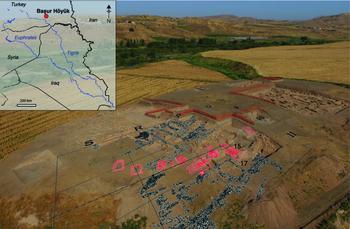
The Early Bronze Age cemetery of Başur Höyük, in the province of Siirt in Turkey, holds a series of unique burials (Figure 1). These provide evidence of large-scale social and political changes in the crucial interval between the contraction of the first Mesopotamian interregional networks and the formation of early states in South-west Asia. Excavation of the cemetery in 2014 uncovered a large, stone cist tomb that contained multiple burials. These had been deposited in a single event, and furnished with an unprecedented number of high-status grave goods for the period and the region. Accompanying this remarkable deposit was the interment of several individuals immediately outside the tomb to the east, buried with elaborate personal ornaments and grave goods. The burial has remarkable similarities to the ‘sacrifice’ interment at the contemporaneous site of Arslantepe (Frangipane Reference Frangipane, Bartoloni and Benedettini2006), to the north, and functions as evidence of a new urban culture, with distinct local characteristics, filling the vacuum left by the previous Uruk-period occupation. It may also have parallels in the elaborate sacrificial burials of the Royal Cemetery at Ur, some 500 years later (Woolley Reference Woolley1934; Baadsgaard et al. Reference Baadsgaard, Monge, Cox and Zettler2011). The bioarchaeological evidence for the introduction of burials of victims of human sacrifice to the Upper Tigris are examined here as part of a larger phenomenon of shifting patterns of social and political organisation across the Mesopotamian sphere of influence in the fourth and third millennia BC.
The mound site of Başur Höyük, with the archaeological plan of the Early Bronze Age cemetery. Graves are outlined in red, Uruk-period architecture in black. Each grid square is 10 × 10m.

The discovery of sacrificial burials attending a ‘royal’ burial in a cist tomb at Early Bronze Age Arslantepe in Anatolia (Frangipane Reference Frangipane, Bartoloni and Benedettini2006; Erdal Reference Erdal2012) has dramatically broadened the known range of social responses to the political upheaval of the early third millennium BC. Following the longstanding interpretation of human sacrifice at the Royal Cemetery of Ur just a few hundred years later (Woolley Reference Woolley1934), this raises new questions about the role of human sacrifice in processes of early state formation (Sürenhagen Reference Sürenhagen and Werr2002; Croucher Reference Croucher2012). Power over the physical bodies of a population to the point of death has been associated with the hierarchical social structures that accompanied early state-formation processes across the globe (Watts et al. Reference Watts, Sheehan, Atkinson, Bulbulia and Gray2016). There is, however, considerable variation in the practice. Sacrifice can be employed variously to achieve spiritual, ritual, political, martial or even economic ends (see Bremmer Reference Bremmer2007; Turchin Reference Turchin2016), and the role of human sacrifice in ancient Near Eastern burial practices remains unclear (Porter & Schwartz Reference Porter and Schwartz2012).
Previous interpretations of the sacrificial burial of ‘retainers’, or grave attendants, in third-millennium Mesopotamia, focused on the creation of new allegiance groups or ‘households’ associated with religious authority (Pollock Reference Pollock1991, Reference Pollock and Laneri2007), or on the need to consolidate power through cowing a population with theatrics (Dickson Reference Dickson2006; Schwartz Reference Schwartz, Porter and Schwartz2012). New research argues instead that many of the ‘sacrifice’ victims may in fact be secondary deposits, misinterpreted by the sensationalism of nineteenth-century archaeology (Sürenhagen Reference Sürenhagen and Werr2002; Recht Reference Recht2010; Croucher Reference Croucher, Renfrew, Boyd and Morley2015).
Başur Höyük in the world of Mesopotamia, Anatolia and the Caucasus
The mound sits adjacent to the Başur River, an offshoot of the Tigris. It commands a key intersection of riverine and overland trading routes that cross from the Zagros Mountains over to Anatolia, the Caucasus and Mesopotamia. A number of sites along the Upper Tigris River were excavated as part of the Ilisu Baraji rescue archaeology operation in advance of dam construction, and the analysis of the human remains from the Early Bronze Age (EBA 1 period) cemetery began in 2015. Başur Höyük is notable for the quantity of southern Mesopotamian cultural material dating to the fourth millennium BC. The presence of a complete suite of Uruk-style ceramics (Sağlamtimur & Kalkan Reference Sağlamtimur and Kalkan2015), including the ubiquitous bevel-rimmed bowls, indicate that it was home to one of the ‘Uruk colonies’, as originally described by Algaze (Reference Algaze1993). The 16 stone cist tombs excavated thus far were cut into backfilled, Uruk-period rectangular structures that abutted the large city wall along the south-eastern limit of the mound. They are dated to approximately 3100–2800 cal BC through the presence of Nineveh V ceramics and closely overlapping radiocarbon dates from organic material within the tombs (Saǧlamtimur Reference Sağlamtimur, Aytaçlar, Abay, Dedoǧlu and Erdoǧan2017).
Burial contexts 15 and 17
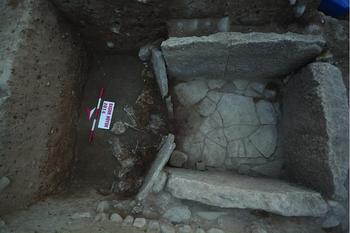
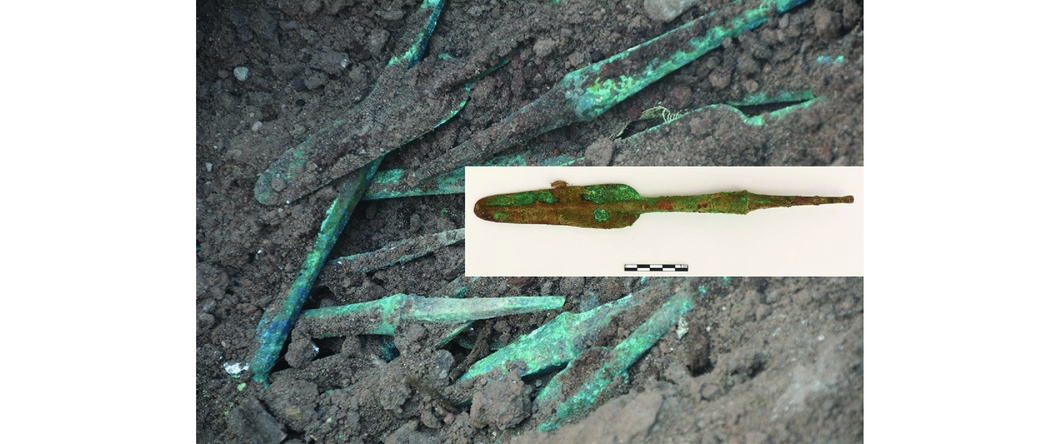
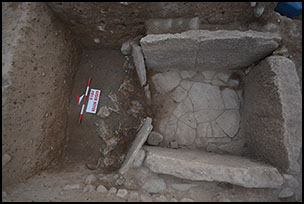
The largest tomb so far uncovered in the Early Bronze Age cemetery contains two separate burial contexts: an inner chamber within a stone-slab-sided tomb (grave 15), and an external portico immediately adjacent to, and at the same level as, the stone structure (grave 17) (Figure 2). The contents were remarkable both in number and quality: hundreds of bronze objects, thousands of beads of local and exotic origin, and diverse ceramics (Sağlamtimur Reference Sağlamtimur2009; Sağlamtimur & Kalkan Reference Sağlamtimur and Kalkan2015; Sağlamtimur & Massimino Reference Sağlamtimur and Massimino2015). Large numbers of ceramics and even a bundle of bronze pins still retaining traces of their original textile wrapping were deposited in clusters (Figure 3). The human remains within the tomb were badly degraded, but three separate clusters of human remains were identified. Two individuals were most probably buried in a flexed (hocker) position near the centre of the grave, with the head to the east and the feet to the west. The capstone also covered the second burial context (grave 17) immediately abutting the eastern edge of the stone chamber. Both contexts were constructed simultaneously, delimited by a series of smaller thin stone slabs placed between them and sealed only after the deposition of the burials in the external eastern area.
Grave 15 (interior)/17 (exterior), a ‘large cist tomb’ with the commingled remains of skeletons 36, 37, 38, 40, 42, 43, 43a and 44 visible along the edge of the eastern exterior of the tomb (grave 17). Photograph by permission of the Başur Höyük Research Project.

Bronze spearheads retaining trace textiles from bundling, from the more than 100 found distributed throughout the internal chamber. Photograph by permission of the Başur Höyük Research Project.

Bioarchaeological identification of the burials
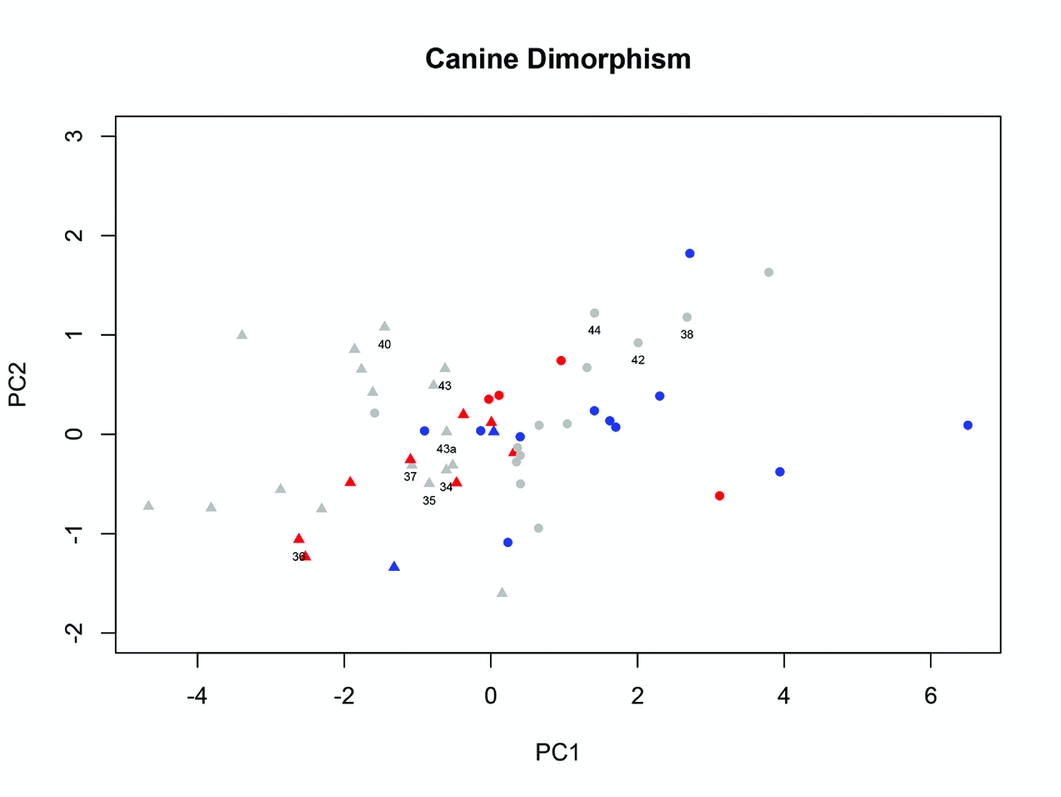
The fragmentary nature of the remains, combined with the varying stages of skeletal development that were present, necessitated a multifactorial approach to estimating age and sex. The permanent canine teeth are sexually dimorphic from formation, and can be used to estimate sex in younger individuals when taken as part of a population-specific distribution of male and female canine sizes (Hassett Reference Hassett2011). Two separate approaches were employed using the statistical language ‘R’ to explore sexual dimorphism based on tooth size in the sample. These were necessary owing to the large number of missing measurements and the strong probability that the dentitions may have been mixed during recovery. The first is a single-variable linear discriminant analysis, which produces an estimated group membership for each dental diameter. These scores were averaged for all dental measurements taken for a single individual in order to achieve an overall estimate of group membership, in this case a ‘male’ group or a ‘female’ group. While there are some misclassifications, a second principal components analysis that substitutes mean scores for missing measurements supports the tentative estimation of sex based on measures of canine dimorphism (Figure 4).
Principal component analysis of canine sexual dimorphism. Shapes indicate estimates from linear discriminant analysis (circle = female, triangle = male), and colour indicates estimates from skeleton (red = male, blue = female).

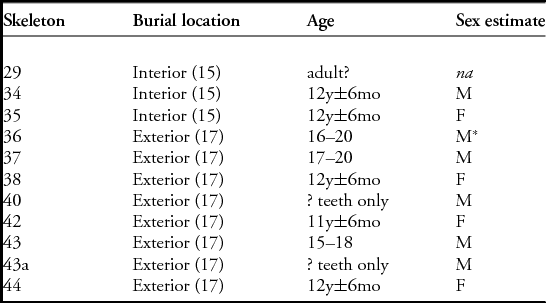
The estimation of sex in adolescents can also provide information regarding the age of individuals because of the average two- to four-year male/female difference in the commencement and completion of fusion in the epiphyseal centres of growth in the human skeleton (Scheuer et al. Reference Scheuer, Black and Christie2000). Table 1 gives the approximate age and sex estimates for the remains found within and without the large stone cist.
Sex and age estimation for each of the burials identified within graves 15 and 17.

* Estimation of sex was made with reference to some dimorphic skeletal features in addition to dental measurements.
Inner chamber: context 15
The inner chamber, designated ‘grave 15’, contains at least three individuals, but preservation is very poor due to the collapse of the roof. One of the individuals, skeleton 29, is that of an adult and is represented by partial cranial fragments and teeth that were excavated together. From dental and skeletal development, the remaining individuals were approximately 12 years of age, give or take 6 months (Schour & Massler Reference Schour and Massler1941). Excavation records suggest that skeleton 34 was buried in a flexed position, on an east–west orientation in the centre of the tomb, but the position and orientation of the other burials remain unknown. No pathologies were observed on the skeletons.
Exterior area (portico): context 17
Seven skeletons were identified during excavation of the external burial context termed ‘grave 17’, but the minimum number of individuals calculated from several different tooth types clearly indicated that no fewer than eight individuals were interred. The overlapping burial position of the skeletons resulted in considerable intermingling, to the extent that the dentition of skeleton 37 had to be reconstructed through reference to excavation photos. The individuals were all either adolescents or in early adulthood (between the ages of 10 and 20), meaning that many of the isolated elements could be matched to individual skeletons by comparing stages of dental development, fusion of the hand and foot phalanges, and fusion of the pelvis and long bone epiphyses. In some cases it was possible to reconstruct individual bones by matching broken ends of the isolated elements to those associated with particular individual skeletons.
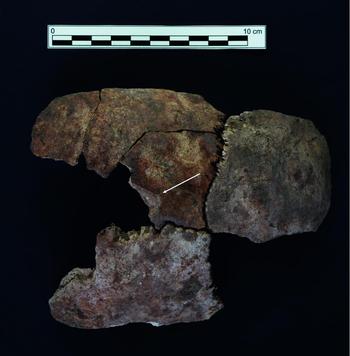
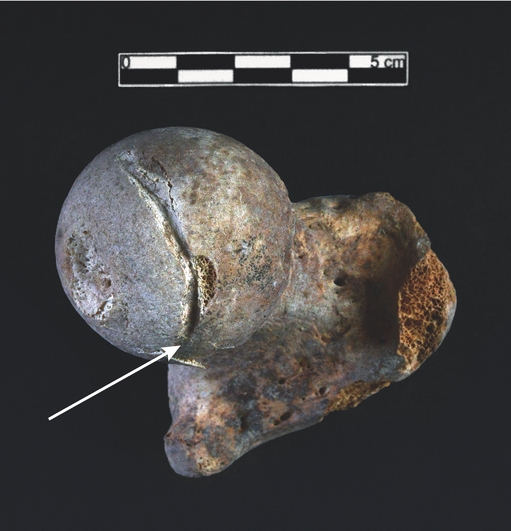
The burials in the external part of the large cist tomb comprised mixed male and female adolescents alongside two almost adult males. Although the burials were commingled to some extent due to having been deposited one on top of the other in the grave, it seems evident that the two late teenage or young adult males (skeletons 36 and 37) were buried last as these lay on top of the other interments. The cranium of skeleton 36 is highly fragmented, with evidence of taphonomic damage in the form of linear, right-angled fractures and a clear difference in colour between the inner table of the skull and the external surface. On the left parietal, however, approximately 30mm posterior to the frontal suture and 6mm lateral of the midline, a chip or gouge has created a circular defect 10mm in diameter with inwardly bevelled edges that penetrated the diploe but left the inner table intact. The edges of this defect extend towards the posterior or back of the skull where the bone is fully perforated. Associated with this is a straight-line fracture that is obscured by a subsequent taphonomic break, but that appears to have been made in relatively plastic, i.e. living, bone. A second skull fragment with a similar puncture impact evidenced on the far edge suggests that a pointed implement was driven down and back into the skull (Figure 5). Skeleton 36 also shows a more perplexing perimortem trauma, with a clearly defined groove, 2.87mm wide, incised by a bladed or sharply pointed implement, running for 33mm along the superior surface of the right femoral head (Figure 6). The injury is angled from the front of the body to the back, with a small flake of bone at the posterior edge indicating that it was also made in relatively plastic bone. Cuts of this type are more commonly associated with dismemberment practices, as the femoral head is normally partially contained within the acetabulum of the pelvis, but the individual was fully articulated when buried. The right pelvis survives only in fragments, and while the damage may have been the result of a stabbing attack to the hip region, it is not possible to account for the position of the weapon or the body when the wound would have been inflicted.
Evidence of the penetrating trauma observed in the crania of skeleton 36. White arrow marks point of impact and shows probable direction of force. Skull posterior is to left. Photograph by Zuhal Özel.

Sharp force trauma. White arrow marks end of incisive wound on posterior aspect of right femoral head of skeleton 36. Photograph by Zuhal Özel.

Skeleton 37 also has a small ovoid depression in the same location on the right femur, but given the state of preservation this may be the result of taphonomic factors rather than the result of an attack. Reconstruction of the cranium associated with this individual was problematic due to the circumstances of its recovery, but a fracture to the left parietal is visible in excavation photos, with radiating lines and crushing at the margins that may also indicate a penetrating skull wound responsible for the death of the individual (Figure 7). Although the radiating fracture lines were identifiable in the laboratory, the margins of the fracture were not.
In situ image of skeleton 37, showing possible cranial trauma. Photograph by Zuhal Özel.

The biosocial identification of the ‘royal’ burials
The burials within the large cist tomb are remarkable for the youth of the interred individuals, their number and the wealth of objects that accompany them. Burials of women and children with grave goods in cist tombs are not unknown from Mesopotamia, but the accompanying objects are typically interpreted as personal belongings (Sertok & Ergeç Reference Sertok and Ergeç1999; Şenyurt Reference Şenyurt, Tuna, Grenhalgh and Velibeyoğlu2002; Helwing Reference Helwing2012). They do not approach the quantity seen in grave 15. The burial of two 12-year-old children, a male and a female, alongside the fragmentary remains of an adult, suggests that these individuals do not merely represent an unfortunate family, but rather that these adolescents' deaths were a significant event in the life of the community. Their simultaneous interment, confirmed for at least the younger individuals, and the elaborate symbolic treatment after death demonstrate that these youths held an important biosocial status. The investment of considerable social capital in the funerary ritual of these individuals suggests that they held a privileged position in life.
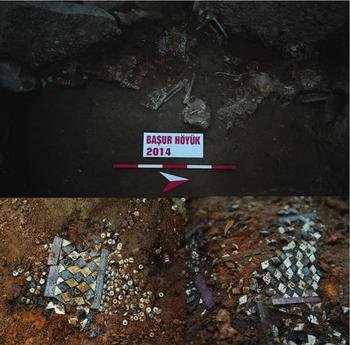
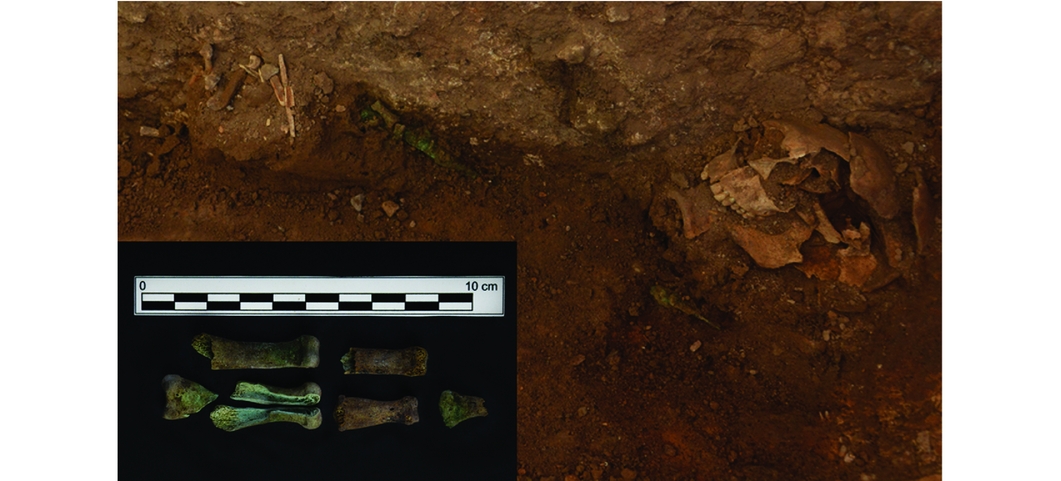
Beyond the material wealth embodied in the buried bronze and sheer quantity of grave goods, the status of the two youths in ‘grave 15’ was further indicated by their separation from the external burials. The individuals interred outside the cist were also buried with rich personal adornment and large caches of ceramics, but they lack the bronzes found with the cist tomb burials. Elaborate beaded chest plates, which may have formed part of decorated textiles, were found in situ on the chests of several of the individuals (Figure 8), and skeleton 36 was buried with two very large bronze pins across the thorax. This skeleton is clearly identifiable in the photographic record of the excavation, lying in a semi-crouched position with the skull to the north and feet to the west, pressed up against the stone slabs that separate graves 15 and 17 (Figure 9). The index finger of the right hand remains curled around the first of two very large bronze pins that lie across the skeleton's chest, clearly visible in excavation photographs (Figure 9: bottom left and right). These may be similar in type to the crossed pins securing the mantles of two women visible in a much later second-millennium depiction from Mari, and serve the same function of personal adornment. Skeleton 37, the other possible victim of head trauma, was buried with an elaborate placket of flat, diamond-shaped black and white beads in a geometric design across the chest, potentially part of a textile.
Retainer burials with beadwork adornment shown in the close up in the bottom left and right images. Photographs by permission of the Başur Höyük Research Project.

Large bronze pins found with skeleton 36; inset: bronze staining on the finger bones. Photographs by Zuhal Özel.

The astonishing wealth of decorative beading and metalwork found in the burials outside the cist indicates biosocial identities for the external burials that are worthy of considerable community investment in funerary ritual, but, critically, less investment than the youths (and fragmentary adult) in the cist itself. The clustered deposition of the bodies outside of the tomb and their deviation from the traditional east–west burial orientation clearly indicate that these individuals were positioned in death to reflect their relationship to the individuals buried within the cist. The external burials are accompanied by piled ceramics, which may indicate that ritual feasting and drinking took place during the associated funerary rituals. Their important biosocial status is clearly marked by their personal ornaments, but their burial position indicates that this status was secondary to their relationship to the burials in the stone chamber. At least four of the individuals buried outside the cist are older than the central occupants, and two of them are significantly older. The presence of two males, almost fully adult, at least one of whom died violently, in a position where their most important role is clearly defined in relationship to the occupants of the inner chamber, suggests a hierarchy of social status that was not defined solely by biological age or sex.
Discussion
The fragmentation of the remains prevents a forensic reconstruction of perimortem trauma in the vast majority of the skeletal material. Even where preservation is good, it is often difficult to identify evidence of violent death in forensic or archaeological skeletal material. Killing blows are frequently aimed at soft tissue, and many forms of violent death leave no trace on the human skeleton (Walker Reference Walker2001). This makes the perimortem trauma identified on the skeletons from the large cist all the more unusual, and allows us to be confident in asserting that some of the individuals did not die a natural death. In particular, skeleton 36, the late teenage or young adult male with cranial and hip trauma, seems to have been a casualty of violent conflict. The penetrating wounds to the head of this individual bear marked similarities with the reconstructions of skull trauma observed in the sacrificial burials at the Royal Cemetery of Ur (Baadsgaard et al. Reference Baadsgaard, Monge, Cox and Zettler2011).
The nature of the burials and the identities of the dead are important factors in evaluating whether this feature at Başur Höyük represents the burial of sacrificed ‘retainers’. If so, it might be comparable to Arslantepe, where human lives were sacrificed by the community for the glorification of a high-status individual or the lineage or power that the individual represented. Many men, women and children from this region met violent ends, and difficulties in ascertaining the precise manner of death for the individuals in question prohibits absolute confidence in their interpretation as human sacrifices. For example, mass graves at Tell Majnuna, very near Tell Brak and dating several hundred years earlier than the cemetery at Başur Höyük, have been argued to represent the burial of victims of a community-scale massacre (McMahon et al. Reference McMahon, Sołtysiak and Weber2011).
The large cist tomb at Başur Höyük, by contrast, does not comprise an entire community, and the bodies had not decayed before being ritually entombed. A mass grave has indeed been found at the site, and anthropological analysis is still ongoing, but those burials are completely different in character.
Future work will clarify the wider range of burial practices at the site, but for the moment we have a very clear and contained example of a retainer burial. The large cist tomb hosts a specific part of the community—two children inside the tomb and eight young people buried at their feet—with a thin barrier of stone separating them. They were carefully positioned by the community who buried them, and adorned with valuable goods and elaborate decoration in a deliberate display of social value.
The key argument against identifying this burial as a human sacrifice lies in the difficulty of ascertaining the cause of death from fragmentary skeletal remains. The penetrating wound to the skull of skeleton 36 is, however, almost exactly akin to those described on the skulls found at the later Royal Cemetery of Ur. It is still possible to posit a scenario wherein all those buried in and around the large cist tomb, both internal and external, were killed in some violent incident unrelated to human sacrifice; the presence of a second wound to the hip would seem to indicate on the part of skeleton 36 that death did not come simply through a blow to the head.
It is, however, unlikely that a massacre could have carried off two high-status children (and possibly the fragmentary adult), as well as a mixed-sex group of roughly the same age, and their two well-dressed older male companions or retainers. The expensive and elaborate burial treatment suggests that the community who buried them was not struggling to cope with the deaths of a substantial portion of their teenage population. The cist grave, the careful positioning of the external burials in relation to those inside the chamber and the evidence of violent death all indicate that these burials fit the same pattern of human sacrifice seen at Arslantepe and Ur, but at a scale intermediate between the two.
Wengrow draws an interesting distinction between “sacrificial” and “archival” ritual economies, using metal finds from the much wider context of the Eurasian Bronze Age (Wengrow Reference Wengrow, Wilkinson, Sherratt and Bennet2011: 137). For Wengrow, the ‘sacrificial’ deposit of metal work, particularly in burial contexts, indicates a system of metal exchange that is most frequently found on the edges of more complex, centrally administrated urban exchange systems. Metalwork serves here to consolidate and display personal wealth rather than as a standardised commodity for equitable exchange. Wilkinson has highlighted the role of shifting economic modes in marking social change, observing such a transition in ritual-economic systems in the Early Bronze Age Trans-Caucasian sphere of influence that stretched from Anatolia to Iran (Wilkinson Reference Wilkinson2014). The bronze objects buried at Başur Höyük fall into a pattern of ritual deposits that clearly mark Early Bronze Age funerary rituals as locations for the communication of wealth and status (Sağlamtimur & Massimino Reference Sağlamtimur and Massimino2015). The importance of that display is not diminished by the presence of administrative artefacts such as the cylinder seals and ceramics marked with seal impressions that were also found inside the cist tomb. The material culture of the Early Bronze Age cemetery at Başur Höyük demonstrates connections to the Anatolian world, with clear Trans-Caucasian links similar to those found along the Euphrates, and also to the southern, urban networks of the Mesopotamian core.
The deposition of high-value objects in cist tombs, including long-distance trade goods such as lapis lazuli beads from Afghanistan and shell beads from the Red Sea (Emma Baysal pers. comm.), is not unique to Başur Höyük. Such goods appear to have spread in a wave down the Euphrates in the third millennium BC. The elaborate burials of adults in the cist tombs that make their appearance throughout the Euphrates and Tigris regions in the early third millennium demarcate a new political structure that recognised individual status with a specific new form of burial. The presence of two small stone cist tombs elsewhere in the cemetery that are well provisioned with ceramics and bronze goods but totally devoid of human remains may point towards the development of a funerary rite that surpassed the need for an actual interment. Ritual depositions of wealth in the service of the community may have become more important than any actual burial itself by the period of the construction of these two small tombs. Individual wealth in the third millennium was not, however, limited to buried collections of bronze and beads. The demonstration of power at the transition to the third millennium BC at Başur Höyük was also reflected in the treatment of the dead.
It is axiomatic of burial archaeology that the dead play a considerable role in the structuring of the living society (Parker Pearson Reference Parker Pearson1999), and there has been considerable discussion recently on the role that the sacrificed dead have to play in constructing, consolidating and legitimising social authority (Turchin Reference Turchin2016; Watts et al. Reference Watts, Sheehan, Atkinson, Bulbulia and Gray2016). Human sacrifice has been argued to be a short-term response to social instability, a grand gesture of wealth sacrifice, embodied not just in material goods but in human life, in a way that demonstrated centralised political authority and legitimised control over society (Watts et al. Reference Watts, Sheehan, Atkinson, Bulbulia and Gray2016). The instability of a social hierarchy that requires human lives to be sacrificed is borne out, in this theory, by the fact that many of the earliest centrally organised polities practised human sacrifice in the early stages of their consolidation but later abandoned it. That has been argued for Cahokia (Redmond & Spencer Reference Redmond and Spencer2012) and the chiefdoms of Papau New Guinea (Watts et al. Reference Watts, Sheehan, Atkinson, Bulbulia and Gray2016). As with the metal economies described by Wengrow (Reference Wengrow, Wilkinson, Sherratt and Bennet2011), in this conceptualisation, sacrifice is a practice linked to the fringes, to instability and to the need to display power in order to wield it.
The utility of such sacrificial gestures waned as other means of social control and power display were brought to bear by an administrated, ‘archival’ economy that did not require the sacrifice of its human subjects. In some cases, however, human sacrifice never falls out of fashion, as has been argued for the Aztec (Turchin Reference Turchin2016). As with other aspects of human culture, the value of human sacrifice to the practitioner seems unlikely to be truly universal; the variety of cases and sometimes explicitly stated justifications in the past seem to belie any purely functional interpretations (cf. Schwartz Reference Schwartz, Porter and Schwartz2012). In the vacuum of political centralisation that followed the withdrawal of Uruk material culture in the Mesopotamian sphere, we see precisely the instability among smaller polities that would be expected to underlie the introduction of human sacrifice. In the vast administrative state systems that rose up in southern Mesopotamia in the next millennium, it disappears again from the archaeological record and it is not unreasonable to see in this pattern an implication for the value and economy of human life during the formation of early states. A sacrificed life, like a sacrificed bronze knife, holds a value that is non-exchangeable, non-renewable and can only be fully valorised by removing it from circulation. In the states that followed, those same lives became something very different—an easily exchangeable commodity.
Acknowledgements
The authors gratefully acknowledge the support of the Ilisu Baraji project, the Turkish Ministry of Culture and the British Institute at Ankara. Particular thanks are due to Zuhal Özel for the forensic photography, and to Metin Batıhan for assistance with the site archive.