Introduction
The ambrosia beetle Trypodendron betulae Swaine (Coleoptera: Curculionidae: Scolytinae) infests paper birch, Betula papyrifera Marshall and B. lenta Linnaeus (Betulaceae) (Wood Reference Wood1982). In British Columbia, Canada, it attacks only the former species and occurs sympatrically with native T. retusum (LeConte), which attacks Populus Linnaeus (Salicaceae) species and two native conifer-infesting species, the striped ambrosia beetle, T. lineatum (Olivier), and T. rufitarsus (Kirby) (Wood Reference Wood1982). A fourth sympatric species, T. domesticum (Linnaeus), is introduced from Europe and attacks mainly red alder, Alnus rubra Bongard (Betulaceae) in British Columbia (Humble Reference Humble, E., K., S., K.S.S., H. and A.2001). Very little is known about the natural history of T. betulae and it is not considered to be a pest.
Ambrosia beetles exhibit strong primary attraction to available hosts, employing ethanol as a kairomonal indicator of stressed or dying trees (Graham Reference Graham1968; Cade et al. Reference Cade, Hrutfiord and Gara1970; Moeck Reference Moeck1970; Kelsey and Joseph Reference Kelsey and Joseph1999, Reference Kelsey and Joseph2003; Ranger et al. Reference Ranger, Reding, Persad and Herms2010, Reference Ranger, Tobin and Reding2015). For conifer-infesting ambrosia beetles, α-pinene, an indicator of conifer hosts, may interact with ethanol to increase attraction (Nijholt and Schönherr Reference Nijholt and Schönherr1976; Vité and Bakke Reference Vité and Bakke1979; Borden et al. Reference Borden, Lindgren and Chong1980; Shore and McLean Reference Shore and McLean1983).
Trypodendron Stephens species are in the Tribe Xyloterini and are characterised by having haplodiploid reproduction and secondary attraction to new hosts mediated by aggregation pheromones acting in concert with host volatiles. The discovery that secondary attraction (Chapman Reference Chapman1966) in T. lineatum was mediated by a female-produced aggregation pheromone (Rudinsky and Daterman Reference Rudinsky and Daterman1964) was followed by identification of the pheromone as 3,3,7-trimethyl-2,9-dioxatricyclononane (lineatin) (MacConnell et al. Reference MacConnell, Borden, Silverstein and Stokkink1977). The active enantiomer was determined to be 1R,4S,5R,7R-(+)-lineatin (Slessor et al. Reference Slessor, Oehlschlager, Johnston, Pierce, Grewal and Wickremesinghe1980). Lineatin occurs in European T. domesticum and T. signatum (Fabricius) (Schurig et al. Reference Schurig, Weber, Klimetzek, Kohnle and Mori1982) and has a similar function (Klimetzek et al. Reference Klimetzek, Vité and König1981). In British Columbia, T. rufitarsus and T. retusum, but not T. betulae, were also found to respond to (+)-lineatin (Hoover et al. Reference Hoover, Lindgren, Keeling and Slessor2000; Lindgren et al. Reference Lindgren, Hoover, MacIsaac, Keeling and Slessor2000), but production of (+)-lineatin was not verified.
Our objectives were to identify the aggregation pheromone of T. betulae and to determine if response to the pheromone is synergised by host volatiles.
Methods
One paper birch log newly infested by T. betulae was collected from Mission, British Columbia on 28 April 1998, and another from Maple Ridge, British Columbia on 6 April 1999. The logs were cut into 5-cm-thick discs, and beetles just beginning to establish galleries were exposed and excised alive using a chisel and hammer. Beetles were sorted by sex using sexual dimorphism of the frons, yielding 92 females and 100 males in 1998 and 56 females and 55 males in 1999. Beetles were held in plastic Petri dishes with moist filter paper for a maximum of four hours in a cool, shaded place or in a refrigerator at 5 °C, and then most females and males in each year were placed in separate Pyrex glass tubes (1.2 cm outside diameter × 18 cm long) containing moist tissue paper. Using a water aspirator, charcoal-filtered air was drawn at 1.5 L/minute through the tubes containing the beetles and then through a glass column (6 mm outside diameter × 15 cm long) containing Porapak Q (50–80 mesh, Waters Association, Milford, Massachusetts, United States of America) (Byrne et al. Reference Byrne, Gore, Pearce and Silverstein1975; Gries et al. Reference Gries, Gries and Borden1992). Aerations were conducted at 23 °C for 3–7 days. Captured volatiles were recovered by elution of the Porapak Q with 150 mL of distilled pentane (Pierce et al. Reference Pierce, Borden and Oehlschlager1981).
An uninfested paper birch was felled in January 1998 at Mission, British Columbia, cut into bolts 60–100 cm long and held for approximately one month at −12 °C. After allowing the bolts to thaw, bark and adhering sapwood were removed with an axe, resulting in pieces 5–20 cm long and 1–5 cm thick; 3–4 kg of these pieces were placed in airtight, 10 L plastic chambers. Charcoal-filtered air was drawn through the chamber for three days at 3–4 L/minute at 23 °C using a water aspirator. Volatiles were captured and eluted as described above.
The ability of male and female beetles to detect beetle-produced and host-produced volatiles was analysed by coupled gas chromatographic-electroantennographic detection (GC-EAD) analysis (Arn et al. Reference Arn, Städler and Rauscher1975) using detached antennae with a glass microelectrode inserted into the antennal club and the base submerged in saline. Analyses were carried out using a Hewlett Packard 5890 gas chromatograph (GC) equipped with a fused silica column (30 m × 0.32 mm inside diameter) coated with DB-5 or DB-210 (J&W Scientific, Folsom, California, United States of America) under splitless conditions using helium as the carrier gas and different GC oven temperature programmes for selected analyses. A custom-built amplifier with a passive low-pass filter and cut-off frequencies below approximately 0.02 Hz and 10 kHz was used to amplify antennal responses. Compounds eliciting an antennal response were subjected to gas chromatographic-mass spectrometric analysis (GC-MS) (Varian Saturn Ion Trap, Varian, Lake Forest, California, United States of America). Spectral comparison with authentic standards and calculated retention indices (van den Drool and Kratz Reference van den Drool and Kratz1963) were used to identify compounds. The enantiomeric ratio of chiral linalool oxide pyranoid (6-ethenyl-2,2,6-trimethyloxan-3-ol), the putative aggregation pheromone, was determined using a Cyclodex B column (30 m × 0.25 mm inside diameter, J&W Scientific) and a temperature programme of either 80 °C kept for one minute rising 5 °C per minute to 120 °C and then held for 20 minutes isothermally, or starting with 110 °C held for 11.5 minutes then rising 5 °C per minute to 120 °C and held for 20 minutes isothermally. We used split analyses with a split ratio of 10 to one. Peaks in aeration extracts were compared to standards obtained from commercial or natural sources.
The four stereoisomers of linalool oxide pyranoid, that is, (3R,6S)-trans-6-ethenyl-2,2,6-trimethyloxan-3-ol, (3S,6R)-trans-6-ethenyl-2,2,6-trimethyloxan-3-ol, (3S,6S)-cis-6-ethenyl-2,2,6-trimethyloxan-3-ol, and (3R,6R)-cis-6-ethenyl-2,2,6-trimethyloxan-3-ol (hereafter, respectively, referred to as SR-, RS-, RR-, and SS-linalool oxide pyranoid) were synthesised according to the method of Klein et al. (Reference Klein, Farnov and Rojahn1964) and Méou et al. (Reference Méou, Bouanah, Archales, Zhang, Guglielmetti and Furtoss1991). Syntheses of the four stereoisomers of linalool oxide pyranoid were performed by E. Czyzewska, G.G.S. King, and H.D. Pierce (Department of Chemistry, Simon Fraser University, Burnaby, British Columbia, Canada).
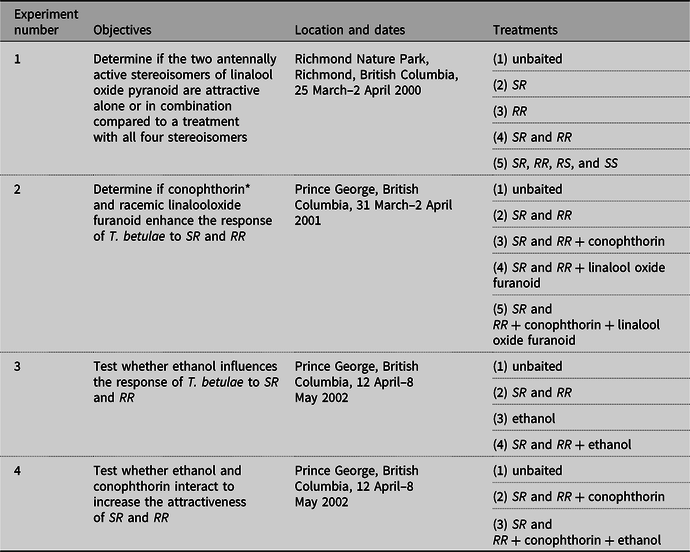
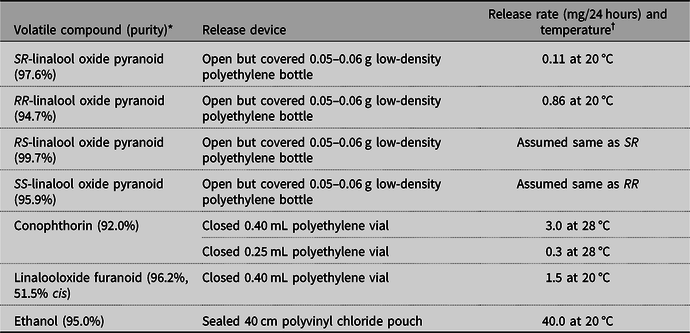
Field-trapping experiments used 12-unit multiple-funnel traps (Lindgren Reference Lindgren1983) (Phero Tech, Delta, British Columbia, Canada) deployed 15–20 m apart in 10 randomised complete blocks along logging roads and trails in forests containing a significant component of paper birch. Treatments in each of four experiments (Table 1) comprised an unbaited control trap and several experimental compositions. Devices containing test compounds (Table 2) were hung on funnel numbers 4–6 within the central space of the funnel column to provide an optimal odour plume (Lindgren Reference Lindgren1983). A small block of dichlorvos-impregnated plastic (Vapona No-pest Strip, Monsanto Canada, Mississauga, Ontario, Canada) was placed in each collecting cup to minimise escape by and predation on captured beetles. Captured beetles were collected and held frozen until separated by sex and counted.
Description of four field-trapping experiments in British Columbia, with objectives, study site, and treatments. n = 10 replicates. See Table 2 for semiochemical information. The four stereoisomers of linalool oxide pyranoid are referred to as SR, RR, RS, and SS.

*(E)-7-methyl-1,6-dioxaspiro[4.5]decane.
Compounds, purity, release devices, and release rates of test materials in the four field-trapping experiments listed in Table 1.

* Conophthorin, linalooloxide furanoid, and ethanol obtained from Phero Tech, Delta, British Columbia.
† Release rates determined by the following: linalool oxide pyranoid stereoisomers, R.G.; linalool oxide furanoid, R.G.; conophthorin, D.P.W. Huber, Department of Biological Sciences, Simon Fraser University; ethanol, Phero Tech, Delta, British Columbia.
To improve normality and reduce heteroscedasticity, all catch data were transformed by log10(x + 1) prior to being subjected to analysis of variance (PROC GLM, version 6.0, SAS Institute, Cary, North Carolina, United States of America) followed by comparison of means by the Ryan–Einot–Gabriel–Welsch (REGW) multiple-range test (Day and Quinn Reference Day and Quinn1989) (REGWQ procedure, SAS Institute, Cary, North Carolina, United States of America). In all cases, α = 0.05.
Results
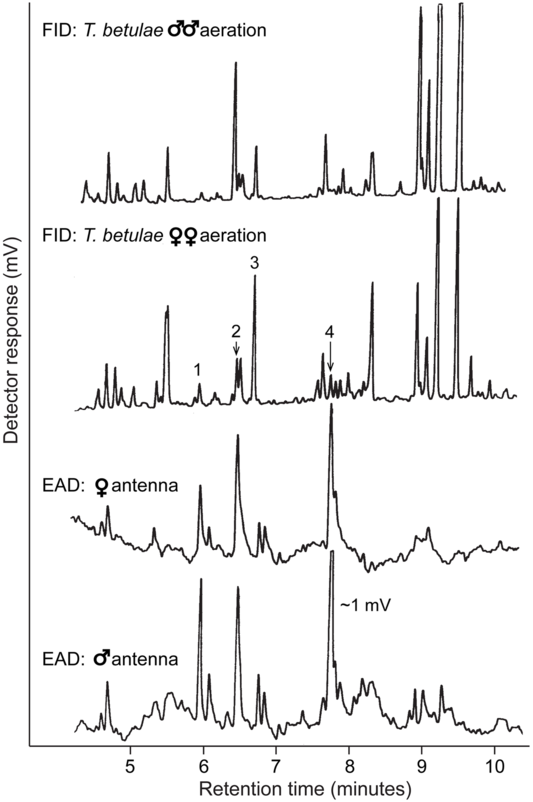
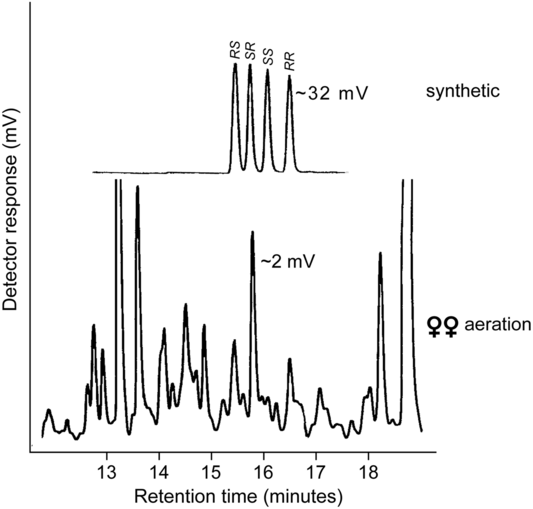
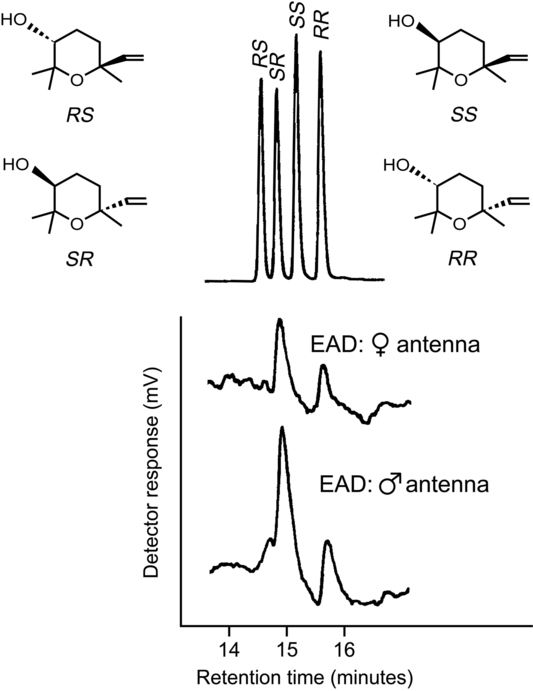
Gas chromatographic-electroantennographic detection of female and male antennal responses to captured volatiles from T. betulae females excised from host logs revealed four active compounds (Fig. 1). These were identified as conophthorin, linalool oxide furanoid [2-(5-ethenyl-5-methyloxolan-2-yl)propan-2-ol], nonanal, and linalool oxide pyranoid. We focussed on linalool oxide pyranoid because it elicited the strongest antennal response despite the relatively small amount in the total composition, plus the fact that it is found in another scolytine beetle (Chikashita et al. Reference Chikashita, Hirao and Itoh1993) and has been identified as a sex pheromone in a tropical moth (Lepidoptera: Pyralidae) (Sasaerila et al. Reference Sasaerila, Gries, Gries, Khaskin, King, Takács and Hardi2003). The next most prominent antennal responses occurred to linalool oxide furanoid and conophthorin; nonanal elicited consistently low response. Production of SR-linalool oxide pyranoid and RR-linalool oxide pyranoid by female T. betulae (Fig. 2) could be determined from the captured volatiles, because the elution order on a Cyclodex B column of all four stereoisomers had previously been reported (Wang et al. Reference Wang, Ando, Morita, Kubota and Kobayashi1994; Borg-Karlson et al. Reference Borg-Karlson, Unelius, Valterova and Nilsson1996). The mass spectra of SR-linalool oxide pyranoid and RR-linalool oxide pyranoid (C10H18O2, MW = 170) were consistent with those of Méou et al. (Reference Méou, Bouanah, Archales, Zhang, Guglielmetti and Furtoss1991). Mass spectra and their interpretation are presented in Kühnholz (Reference Kühnholz2004). When all four stereoisomers of synthetic linalool oxide pyranoid were analysed by GC-EAD with a chiral column (Fig. 3), antennae of both sexes responded only to the SR and RR stereoisomers. These results suggested that the two stereoisomers together constitute a promising aggregation pheromone.
Flame ionisation detector (FID) analysis of Porapak Q-captured volatiles from log-excised female and male Trypodendron betulae and electroantennographic detector (EAD) response to volatiles from females by female and male T. betulae, chromatographed on DB-5 (0.32 mm inner diameter) column, temperature programme: one minute at 50 °C rising at 10 °C/minute to 280 °C, splitless injection. Electroantennographic-detector-active compounds 1–4 were identified as: 1, conophthorin (retention time 6.04), 2, linalool oxide furanoid (retention time 6.55), 3, nonanal (retention time 6.78), and 4, linalool oxide pyranoid (retention time 7.82).

Flame ionisation detector analysis of four stereoisomers of linalool oxide pyranoid (RS, SR, SS, RR, respectively) on a Cyclodex B chiral column fitted with a splitless injector and run with a temperature programme of one minute at 80 °C rising at 5 °C/minute to 120 °C isothermal, with a corresponding analysis of captured volatiles from Trypodendron betulae females showing natural production of only SR and RR stereoisomers.

Flame ionisation detector response (top) to the four synthetic stereoisomers of linalool oxide pyranoid (RS, SR, SS, RR), their chemical structures, and (bottom) electroantennographic detector (EAD) responses by female and male Trypodendron betulae antennae showing detection of only SR and RR stereoisomers. Chromatography: Cyclodex B chiral column fitted with a splitless injector and run with a temperature programme of 11.5 minutes at 110 °C rising at 5 °C/minute to 120 °C.

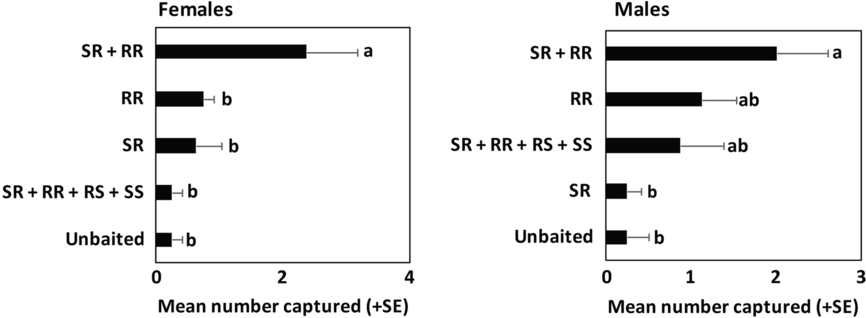
Catches of female T. betulae in Experiment 1 were significantly higher in multiple-funnel traps baited with SR-linalool oxide pyranoid and RR-linalool oxide pyranoid in combination than with either stereoisomer alone or all four together (Fig. 4) (F 4,28 = 3.47, P = 0.02). This trend was reflected in catches of males (F 4,28 = 3.96, P = 0.01), but a significant difference occurred only between catches in traps baited with SR-linalool oxide pyranoid and RR-linalool oxide pyranoid in combination and those in unbaited traps or traps baited with only the SR enantiomer.
Ranked mean catches of Trypodendron betulae females and males in Experiment 1 in multiple-funnel traps baited with antennally active stereoisomers SR-linalool oxide pyranoid and RR-linalool oxide pyranoid alone (SR and RR), together (SR + RR), or together in combination with the two antennally inactive RS-linalool oxide pyranoid and SS-linalool oxide pyranoid (SR + RR + RS + SS). For each sex, bars with the same letter are not significantly different, Ryan–Einot–Gabriel–Welsch multiple-range test, P < 0.05.

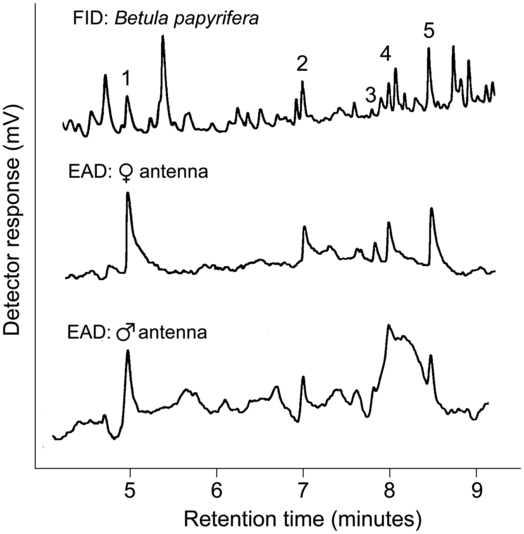
Analysis of paper birch volatiles by GC-EAD disclosed five antennally active compounds in both sexes of T. betulae (Fig. 5), three of which were identified as conophthorin, nonanal, and methyl eugenol. The strongest antennal response to conophthorin, as well as its prevalence in the bark volatiles of paper birch (Huber et al. Reference Huber, Gries, Borden and Pierce1999), suggested that it could be an attractive host kairomone.
Flame ionisation detector (FID) analysis and electroantennographic detector (EAD) responses by female and male Trypodendron betulae antennae to volatiles captured from paper birch on Porapak Q chromatographed on a DB-210 column (30 m × 0.32 mm inner diameter); temperature programme 0.5 minutes at 50 °C rising 10 °C/minute to 220 °C, splitless injection. Electroantennographic-detector-active compounds 1–5 identified as: 1, conophthorin, 2, unidentified, 3, nonanal, 4, methyl eugenol, and 5, unidentified.

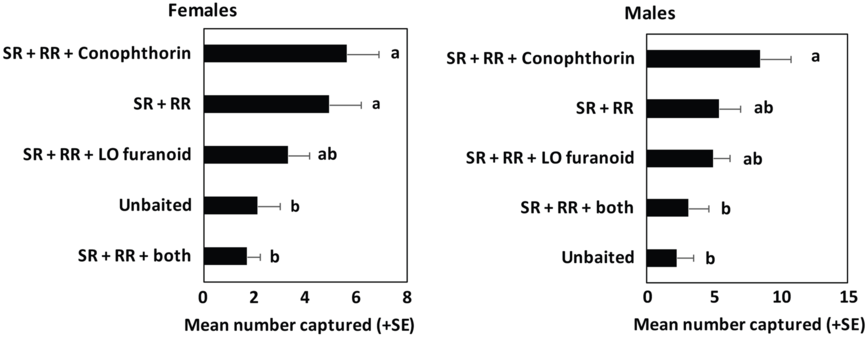
When conophthorin and racemic linalool oxide furanoid were added alone or together to SR-linalool oxide pyranoid and RR-linalool oxide pyranoid in Experiment 2, a differential response occurred (Fig. 6) (females F 4,36 = 5.32, P = 0.002; males F 4,36 = 3.97, P = 0.009). The response by females was similar to that in Experiment 1 (Fig. 4), with catches in traps baited with SR-linalool oxide pyranoid and RR-linalool oxide pyranoid higher than in unbaited traps, regardless of the presence of conophthorin. For males, however, a higher catch than in unbaited traps occurred only when conophthorin was present. In contrast, when linalooloxide furanoid was added to SR-linalool oxide pyranoid and RR-linalool oxide pyranoid and conophthorin, it had a repellent effect in both sexes (Fig. 6).
Ranked mean catches of Trypodendron betulae females and males in Experiment 2 in multiple-funnel traps baited with a blend of SR-linalool oxide pyranoid and RR-linalool oxide pyranoid alone (SR + RR) or in combination with conophthorin and linalool oxide furanoid (LO furanoid) separately or together. For each sex, bars with the same letter are not significantly different, Ryan–Einot–Gabriel–Welsch multiple-range test, P < 0.05.

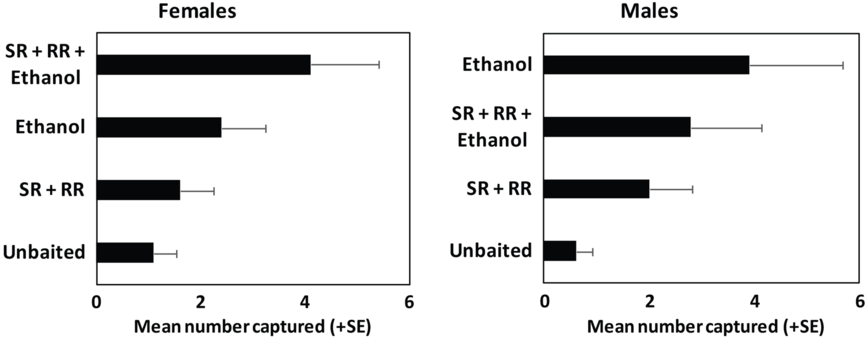
When ethanol was added in Experiment 3 to SR-linalool oxide pyranoid and RR-linalool oxide pyranoid, neither sex was more attracted than when traps were baited with SR-linalool oxide pyranoid and RR-linalool oxide pyranoid alone (Fig. 7) (females F 3,27 = 2.45, P = 0.09; males F 3,27 = 1.8, P = 0.17).
Ranked mean catches of Trypodendron betulae females and males captured in Experiment 3 in multiple-funnel traps baited with SR-linalool oxide pyranoid and RR-linalool oxide pyranoid alone (SR + RR) or in combination with ethanol.

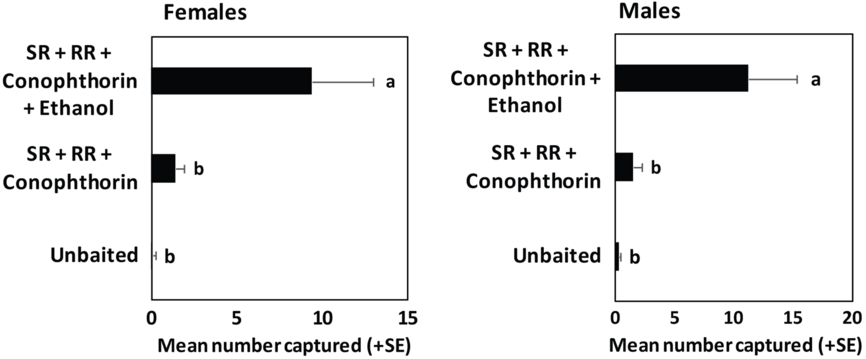
In Experiment 4, adding conophthorin and ethanol to SR-linalool oxide pyranoid and RR-linalool oxide pyranoid induced a strong synergistic effect for both sexes (females F 2,18 = 13.76, P = 0.002; males F 2,18 = 9.53, P = 0.002), with catches over seven times higher than in traps baited with SR-linalool oxide pyranoid and RR-linalool oxide pyranoid with conophthorin (Fig. 8).
Ranked mean catches of Trypodendron betulae females and males in Experiment 4 in multiple-funnel traps baited with a blend of SR-linalool oxide pyranoid and RR-linalool oxide pyranoid (SR + RR) in combination with conophthorin or in combination with conophthorin and ethanol. For each sex, bars with the same letter are not significantly different, Ryan–Einot–Gabriel–Welsch multiple-range test, P < 0.05.

Discussion
Our results indicate strongly that a blend of SR-linalool oxide pyranoid and RR-linalool oxide pyranoid is the female-produced aggregation pheromone of T. betulae. The relatively low mean numbers captured at both experimental sites reflect the low incidence of T. betulae in nature, as judged by the difficultly we encountered in locating infested logs. However, when conophthorin and ethanol were combined with SR-linalool oxide pyranoid and RR-linalool oxide pyranoid, substantial numbers of beetles were captured (Fig. 8).
This is the third recorded incidence of linalool oxide pyranoid in insects. SS-linalool oxide pyranoid is a sex pheromone component produced by male Tiratheba mundella Walker (Lepidoptera: Pyralidae) (Sasaerila et al. Reference Sasaerila, Gries, Gries, Khaskin, King, Takács and Hardi2003). SS-linalool oxide pyranoid and RR-linalool oxide pyranoid were isolated from Pteleobius vittatus (Fabricius) (Coleoptera: Curculionidae: Scolytinae) (Mori and Puapoomchareon Reference Mori and Puapoomchareon1988; Chikashita et al. Reference Chikashita, Hirao and Itoh1993), but their behavioural role was not elucidated. SR-linalool oxide pyranoid and SS-linalool oxide pyranoid are also present in the shrub Daphna mezerum Linnaeus (Tymelaceae) and may attract solitary bees (Hymenoptera) (Borg-Karlson et al. Reference Borg-Karlson, Unelius, Valterova and Nilsson1996). The antennae of T. betulae responded to RR-linalool oxide furanoid, SS-linalool oxide furanoid, and SR-linalool oxide furanoid (data not shown), and only the racemate was tested in the field. Further work testing the individual antennally active stereoisomers alone and in combination is needed to explain the slight repellency of the racemate in Experiment 2 (Fig. 6).
Plettner (Reference Plettner2002) hypothesised that synthetic analogues of pheromones could be found that would interfere with olfactory responses by blocking the pheromone-binding protein or the transmembrane site. RS-linalool oxide pyranoid and SS-linalool oxide pyranoid are not perceived by T. betulae antennae (Figs. 2–3), and thus could not be repellents. Yet, when combined with the SR and RR stereoisomers, they significantly reduced the catch of both sexes to a level not significantly different from that to unbaited control traps (Fig. 4). This appears to be an authenticated example of pheromone olfaction inhibitors as postulated by Plettner (Reference Plettner2002) based on a combination of olfactory and behavioural evidence.
Conophthorin was chosen for field testing over nonanal, which elicited far weaker antennal responses (Fig. 1). Conophthorin was identified in the volatiles of both sexes of T. betulae (Fig. 1), as well as in those from paper birch (Fig. 5), supporting the finding by Huber et al. (Reference Huber, Gries, Borden and Pierce1999) that conophthorin constitutes 12% of the volatiles in paper birch.
Conophthorin was first identified in the abdominal glands of social wasps (Hymenoptera: Vespidae) (Francke et al. Reference Francke, Himdorf and Reith1979). It has since been shown to have variable functions in diverse plant and animal taxa, for example, male-produced antiaggregation pheromone in cone beetles, Conophthorus Hopkins (Coleoptera: Curculionidae: Scolytinae) species (Birgersson et al. Reference Birgersson, DeBarr, de Groot, Dalusky, Pierce and Borden1995), inhibition of the response of longhorned beetles (Coleoptera: Cerambycidae) to attractive bark beetle (Coleoptera: Curculionidae: Scolytinae) pheromones (Morewood et al. Reference Morewood, Simmonds, Gries, Allison and Borden2003), attraction of Amyelois transitella (Walker) (Lepidoptera: Pyralidae) to the husks of almonds (Prunus dulcis (Miller) Webb; Rosaceae) (Beck Reference Beck2013), differential attractant, repellent, and neutral effects on several species of ambrosia beetle (Miller et al. Reference Miller, Dodds, Hoebeke, Poland and Willhite2015), and induction by Eurosta solidaginis (Fitch) (Diptera: Tephritidae) of antibiosis resistance in goldenrod plants, Solidago altissima Linnaeus (Asteraceae) (Helms et al. Reference Helms, De Moraes, Tröger, Alborn, Francke, Tooker and Mescher2017). In T. betulae, conophthorin apparently acts both as a female-produced aggregation pheromone and as an attractive host kairomone. However, it is not known whether it is sequestered by T. betulae females from host plant tissue or is synthesised de novo.
Neither conophthorin nor ethanol, a ubiquitous kairomonal indicator of stressed hosts undergoing anaerobic metabolism (Kelsey Reference Kelsey1994), had a pronounced effect on trap catches when added individually to linalool oxide pyranoid (Figs. 6–7). However, when combined, they acted synergistically with SR-linalool oxide pyranoid and RR-linalool oxide pyranoid (Fig. 8). This blend of semiochemicals, with different origins and individual functions, conveys an apparently unique species-specific message used by T. betulae to locate hosts and attract mates. The characteristic of employing linalool oxide pyranoid as an aggregation pheromone would reproductively isolate T. betulae from sympatric T. lineatum, and T. domesticum, which use lineatin (MacConnell et al. Reference MacConnell, Borden, Silverstein and Stokkink1977; Klimetzek et al. Reference Klimetzek, Vité and König1981), and probably also from T. retusum, and T. rufipennis, which appear to do so (Hoover et al. Reference Hoover, Lindgren, Keeling and Slessor2000; Lindgren et al. Reference Lindgren, Hoover, MacIsaac, Keeling and Slessor2000).
Acknowledgements
We thank Stuart Campbell, Kathy Simmonds, and Petra Morewood for assistance. We also thank the Natural Sciences and Engineering Research Council of Canada for its financial support through an Industrial Research Chair and a Cooperative Research and Development Grant. Additional Financial support was granted by Forest Renewal British Columbia, British Columbia Forestry Innovation Investment, and the following industrial sponsors: Abitibi Consolidated, Ainsworth Lumber, British Columbia Hydro and Power Authority, Bugbusters Pest Management, Canadian Forest Products, Gorman Bros., International Forest Products, Lignum, Manning Diversified Forest Products, Millar-Western Forest Products, Phero Tech, Riverside Forest Products, Slocan Forest Products, Tembec Forest Industries, TimberWest, Tolko Industries, Weldwood of Canada, West Fraser Mills, Western Forest Products, and Weyerhaeuser Canada.