Sometime in the afternoon of Wednesday, August 22, 1781, in one of the narrow houses along the Jewish lane (Judengasse) in Frankfurt am Main, Gumpert (Gumperz, in Hebrew sources, Gumpel) Aaron May (Mai)Footnote 1 prepared himself to go out to attend to some business matters.Footnote 2 Like many of his contemporaries involved in trade, Gumpert's business activities did not focus on just one line of work; he did his best to turn a profit in a number of ways, including selling wine and lending money at interest.Footnote 3 Gumpert, who was in his thirties or perhaps even early forties, wore underneath his shirt a fringed garment (ẓiẓit, see Num. 15:37–41), as religious custom obligated Jewish males to do.Footnote 4 His green jacket had silver clasps and his partially bald pate was covered by a wig with two curls in the back, topped by a hat.Footnote 5 His elegant appearance made it clear to all observers that he was from a well-situated family, and that he had adopted some of the modes of contemporary fashion. Indeed, Gumpert came from what would soon be, if it was not already, one of the wealthiest Jewish families in Frankfurt.Footnote 6
With his business papers, a Hebrew calendar, watch, pen and paper, toothpicks, a small, heart-shaped tobacco box, keys, a monogrammed handkerchief, and sundry other items in his pockets, Gumpert walked down the stairs and out of the house.Footnote 7 Turning into the lane, he continued through the gates that had divided the Judengasse from the rest of Frankfurt since the fifteenth century, and went into the city. Gumpert could hardly have known that he would never return home. Later that afternoon he was murdered, a victim of what was by all accounts a grisly crime.
Although there was a clear spiritual and physical divide between Christians and Jews in late eighteenth-century Frankfurt, the investigation into Gumpert's murder evinces that the predominant tenor of daily relations between the two groups was that of neighborliness and acquaintanceship. Frequent mutually beneficial collaborations appear to have been the norm. Testimonies gathered in the course of the criminal inquiry reflect that such contacts sometimes led to social relations, and, perhaps, even to sexual encounters. Indeed, the evidence suggests that this amicable environment is what facilitated Gumpert's murder. Despite generally harmonious relations, a number of events, particularly the memorialization of Gumpert by the Jewish community, indicate that Jews continued to accentuate differences by labelling their coreligionists who were killed by Christians under almost any circumstance, including those executed according to the rule of law, as martyrs.
Let us return to Gumpert's final hours in late August 1781.Footnote 8
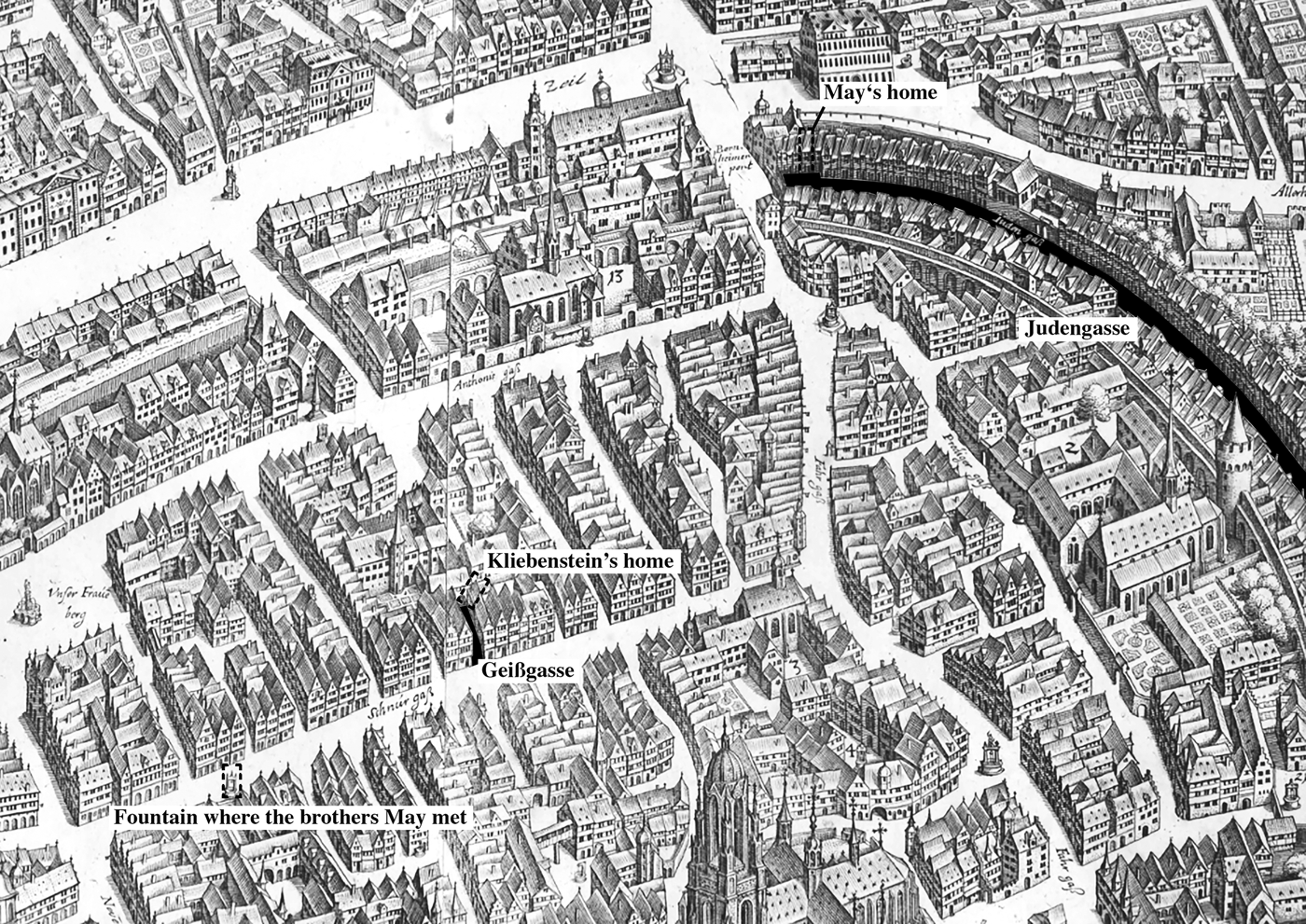
Around 3:30 p.m., Gumpert met his brother, Benedict Aaron May, at a fountain on Schnurgasse in the inner city of Frankfurt, reportedly to chat about the business of the day.Footnote 9 Apparently Gumpert did not tell Benedict where he was headed next. As it turned out, when they finished talking, Gumpert appears to have gone just a couple of blocks away to Geißgasse, where one of his customers, Johann Georg Kliebenstein, an unemployed brewer from nearby Sachsenhausen, rented living space from the Huber family. The Hubers occupied the lower section of the house, and Kliebenstein, their sole tenant, had rooms upstairs.
In his later testimony, the master carpenter Georg Philipp Huber stated that he himself had left the building around 4 p.m. that day, just before Gumpert was thought to have entered the house and gone up to see Kliebenstein.Footnote 10 Huber's wife, Catharina Henrietta Huber, claimed she had been working downstairs in her living room with her maid, Maria Margaretha Bergem, at the time. Though the two women maintained that they generally kept a close eye on the comings and goings of Kliebenstein's guests, in this instance, both said that they had not seen Gumpert enter the premises.Footnote 11 They noted that Kliebenstein often had visitors, typically Christian apprentices who came for coffee or tea, but Jews too stopped by, though generally two at a time, not alone.Footnote 12
Gumpert does not appear to have come to Kliebenstein's residence for a drink. Three months earlier Gumpert had lent Kliebenstein 100 florins (gulden), a significant sum given that at the time five pounds of rye bread cost approximately 8 kreuzer and a pound of meat around 7 kreuzer. It seems that he had now come to collect his debt.Footnote 13
The Inner City of Frankfurt am Main.
Map detail, based on “Vogelschauplan.” Copper engraving, Matthäus Merian, 1628.

Less than an hour after arriving at Kliebenstein's home, Gumpert was dead, beheaded and dismembered, apparently with Mrs. Huber's meat cleaver. (She later requested it be returned to her.)Footnote 14 No one admitted to having seen or heard anything.Footnote 15
Around 5 p.m., Kliebenstein reportedly asked the maid if she could bring him some chalk (Kreide) for cleaning, and then some candles, sugar, and beer. Nothing seemed out of the ordinary to the maid except that Kliebenstein did not let her bring the items to his room as usual but rather took them from her on the stairs.Footnote 16 Huber's son, Christoph, later said that he had seen Kliebenstein leaving the house at nightfall with a packet under his arm. Christoph could never have imagined that inside the bundle were Gumpert's head and extremities, which Kliebenstein, according to his own admission, was carrying to a nearby bridge to toss into the Main River.Footnote 17 The remainder of Gumpert's body was in a suitcase in the small attic in Kliebenstein's quarters, apparently awaiting a similar fate.
Back in the Judengasse, Gumpert's family was concerned that he had not returned home. With an average of about one homicide per year, murder was not common in Frankfurt in the last decades of the eighteenth century. Thus, murder was unlikely to have been Gumpert's family's immediate concern.Footnote 18 Gumpert's brother, Benedict, later told the authorities that at around 8:00 p.m. that night, Gumpert's wife, Yachet, sent someone to see if Gumpert was with him. Since he was not, Yachet must have been worried, and likely continued to inquire after her husband's whereabouts.Footnote 19 Around 11:00 p.m., she reportedly heard from someone that Gumpert would be spending the night in nearby Offenbach, about eight kilometers away.Footnote 20 Apparently quieted, the family probably retired for the night.
The following morning, with Gumpert still not back in the Judengasse, Benedict, as he later recounted, sent two messengers to Offenbach to inquire after Gumpert's whereabouts, while he himself went to see one of their brothers, Michael.Footnote 21 Together with Yachet, the brothers, Benedict and Michael, went through Gumpert's papers to see what bills of exchange (Wechsel) were missing.Footnote 22 According to Benedict, they discovered that a note from the widow of a local smith, Anna Margaretha Korbek, was not there, suggesting that Gumpert had taken it and gone to collect payment.Footnote 23 Benedict immediately went to the house of the widow, but she told him that she was not the debtor but rather the guarantor of the note. It was her late husband's godchild, Johann Georg Kliebenstein, who had taken the loan from Gumpert. Mrs. Korbek told Benedict where Kliebenstein lived and, together with one of the sons of Ziskind Stern, who seems to have accompanied him, Benedict went off to find him.Footnote 24
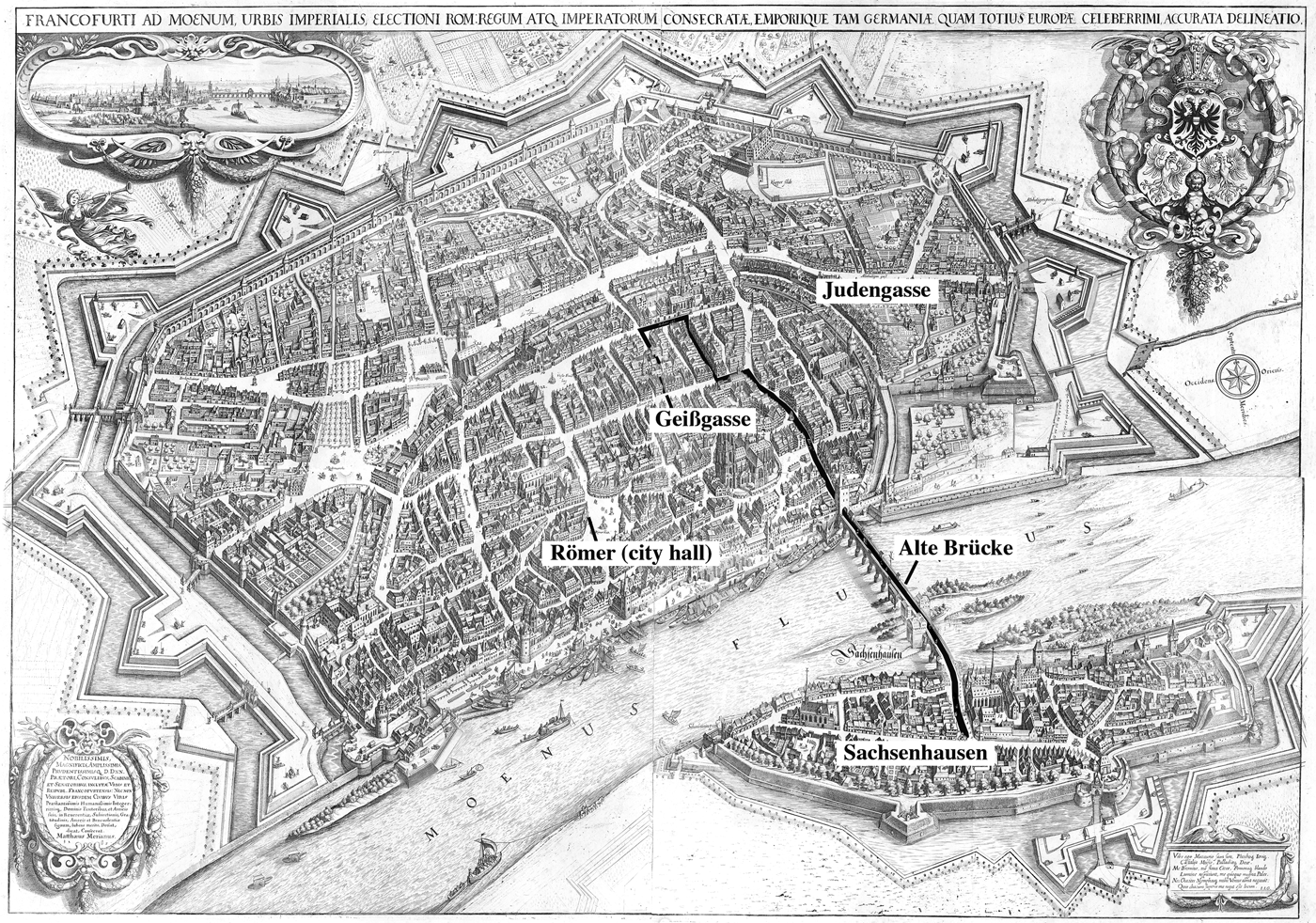
Although a life-long resident of Frankfurt, Benedict appears to have been unfamiliar with the back lanes of the town, and had to ask for directions to Kliebenstein's quarters on Geißgasse.Footnote 25 Once there, Benedict reported seeing a man standing in front of the door doing laundry. He asked the stranger his name, and Kliebenstein identified himself. When asked about Gumpert's whereabouts, Kliebenstein looked shaken and frightened, and replied in what Benedict perceived to be a confused manner that he had last seen Gumpert the previous Thursday.Footnote 26 This must have heightened Benedict's suspicions, and he sent his companion Stern back to the Judengasse to get help.Footnote 27 Kliebenstein quickly returned to his rooms, and, according to Benedict's account of the events, Benedict was soon trying to force his way in the door. Unable to enter, he peeked through a hole in the wall, and, as he later told investigators, could see that Kliebenstein was busy cleaning the floor and spreading sand over it.Footnote 28 Kliebenstein must have been aware that trouble was brewing, for he ran upstairs to the attic, took his shirt and jacket, and came back downstairs. Benedict seized the opportunity to open the door to Kliebenstein's rooms and peek inside. Blood was apparent everywhere. Meanwhile, according to all accounts—that of Benedict, Kliebenstein, and the maid—Kliebenstein grabbed a rope hanging down the stairwell, let himself down to the ground floor, and fled.Footnote 29 Benedict then ran down the stairs after Kliebenstein, and, according to Benedict's account, a chase ensued through the streets of Frankfurt. Benedict shouted, “Murderer! Fire!” (Moerder! Feuer!), but Kliebenstein cleverly also shouted out “murderer,” leaving bystanders in confusion about who was fleeing whom, or whether both men were in fact chasing someone else.Footnote 30
Route of the chase through the streets of Frankfurt am Main.
Map detail, based on “Vogelschauplan.” Copper engraving, Matthäus Merian, 1628.
Ultimately Kliebenstein succeeded in eluding Benedict. He fled through the Affentor Gate, over the Old Bridge that spanned the Main River, and into Sachsenhausen, and from there, he headed due south to Neu-Isenburg, about eight kilometers away. The route he took was not accidental. Apparently Kliebenstein headed directly to the Lӧwen tavern in Neu-Isenburg, where a Hessian army recruiter was looking for men to hire out to the English army.
Apparently seeking refuge from the law by becoming an auxiliary for the British in North America, Kliebenstein was said to have specifically asked for the recruiter hiring for the English army.Footnote 31 According to Kliebenstein's own account, he told the recruiter his story and asked whether his induction into the army could be expedited. The recruiter, who had a financial interest in accepting each new recruit, assured him that once he became a member of the army he would be safe from his legal problems, and urged him to change his clothes so that he would not be easily recognized.Footnote 32 Kliebenstein later recounted that the local commander too had reassured him that he should have no legal worries for he had “only” murdered “a rascal, a Jew” (ein Spitzbub, ein Jude).Footnote 33 Under the cover of night, Kliebenstein was transferred to Gleiburg in the area of Gießen, about seventy kilometers north of Frankfurt.Footnote 34
The Löwen tavern in the town of Neu-Isenburg (today the municipal museum).
Meanwhile, back in Frankfurt, as Benedict later reported, when Benedict had lost track of Kliebenstein, he ran to the city hall (Rӧmer). There, out of breath, and apparently not knowing the exact name of the suspect, Benedict shouted that someone named “Lӧwenstein or Libenstein” had murdered his brother. City officials immediately gave an order to those manning the city gates to be on the lookout for anyone with these names, but it soon became clear that the person whom they were after was none other than the son of the blacksmith from Sachsenhausen, Kliebenstein. The city sent two officials with Benedict to Kliebenstein's rooms to investigate.Footnote 35
Upon entering Kliebenstein's room, as the two municipal officials later recounted, they immediately saw blood on the floor. In addition, in the attic one floor up, they found a decapitated and dismembered torso stuffed into a suitcase. With a murder now confirmed, the alarm was sounded and the city gates were closed. Municipal officials prepared Wanted signs to be posted in the town and alerted citizens to be on the lookout for Kliebenstein.Footnote 36 As for the torso, it was to be given to the physicat, an official with duties similar to a present day coroner, for a postmortem medical examination as part of the now criminal inquiry.
While the two officials were still investigating Kliebenstein's residence, a crowd of Jews gathered at the site. It would seem that the messenger whom Gumpert's brother Benedict had sent to the Judengasse had called Jews to the scene. The city officials said that the Jews sought to prevent hospital clerks from moving what were assumed to be Gumpert's remains.Footnote 37 While both Jews and non-Jews wanted to apprehend the murderer, Jews were concerned that in the course of their examination of the body, city officials might wash Gumpert's remains and in so doing dispose of his blood, which Jewish law mandates to be buried.Footnote 38 Jews were anxious to maintain control of Gumpert's body for religious reasons; the municipal authorities wanted the body for a criminal investigation. To solve this impasse, two Jewish communal leaders, Abraham Schnapper and Abraham David Wimpfen, headed to the mayor's office to ask that Gumpert's body and any of his blood be brought directly to the Jewish cemetery.Footnote 39
The choice of Schnapper and Wimpfen to represent the Jewish community was hardly random. Schnapper was Benedict May's father-in-law, but he had also been involved in dealings between the community and the authorities for about twenty years.Footnote 40 Presumably he had learned the ins and outs of the legal and political system and was well known to city officials. Wimpfen was also a communal leader (parnas) and a member of the local Jewish burial society (ḥevra kaddisha).Footnote 41 Together they made a good team—an experienced lobbyist and a person who represented the religious sensibilities of the community—to go to the authorities to press to have Gumpert's remains turned over to the Jewish community for burial rather than taken by city officials to a municipal site for examination.
Though Christian authorities showed sensitivity to Jewish ritual needs and granted the request, they did so on condition that the Jewish community guarantee that the body not be tampered with and be available for the city's doctors to examine.Footnote 42 Schnapper and Wimpfen accepted these conditions, which they seem to have negotiated.Footnote 43
Accordingly, the hospital clerks put the torso on a stretcher, covered it with a sheet and, accompanied by twelve soldiers, brought it to the Totentisch (lit., “table of the dead”) in a house on the edge of the Jewish cemetery.Footnote 44 On this day the Totentisch was transformed from the place where the Jewish burial society washed and then wrapped the dead in shrouds in preparation for burial into an autopsy table for a postmortem examination performed by non-Jewish doctors.
The physicians who performed the autopsy described Gumpert as having been a strong Jewish male, about thirty years old, who died from severe wounds that resulted in hemorrhaging. In their estimation, he was killed by “a murderer from whom humanity shivers” (Mörder, vor dem die Menschheit zittert).Footnote 45 After the autopsy Gumpert's torso was turned over to the Jewish community for burial. On Friday, August 24, 1781, two days after the murder, Gumpert's remains were interred in the section of the local Jewish cemetery reserved for martyrs (kedoshim).Footnote 46
Meanwhile, city officials began to interrogate possible witnesses to the murder. Kliebenstein's landlord, Mr. Huber, his wife, and their maid were among the first of the sixty-three witnesses called. Kliebenstein's friends, including some apprentices, were also questioned. These witnesses reported that from time to time they had seen Kliebenstein with Jews. None saw Kliebenstein's encounters with Jews as exceptional, for many were themselves involved in small business dealings with Jews. Such relationships appear to have been common in Frankfurt in the second half of the eighteenth century.Footnote 47
Despite the fact that Jews had to live in the Judengasse, they were hardly sequestered. During the day Jews and non-Jews could intermingle throughout the city. They would meet in homes of non-Jews, on the streets of Frankfurt, or in the Judengasse. Kliebenstein himself said that in the past he had summoned Jewish peddlers into his home to buy socks, shoelaces, lottery tickets, and the like, while chatting and exchanging the latest news with them.Footnote 48 Jews advertised in local newspapers, publicly inviting readers into the Judengasse to purchase lottery tickets.Footnote 49 Jewish witnesses reported that Christians—like Kliebenstein—would ask them directly on the street for a certain sum of money. They would then accompany the person home or visit him/her later to close the deal.Footnote 50 Kliebenstein himself later acknowledged that he had left pledges of clothes or small personal items with Jewish pawnbrokers to obtain quick cash.Footnote 51 These transactions demanded personal interaction, yet none of those interrogated, Jew or non-Jew, felt the need to distance themselves from such everyday relationships.Footnote 52
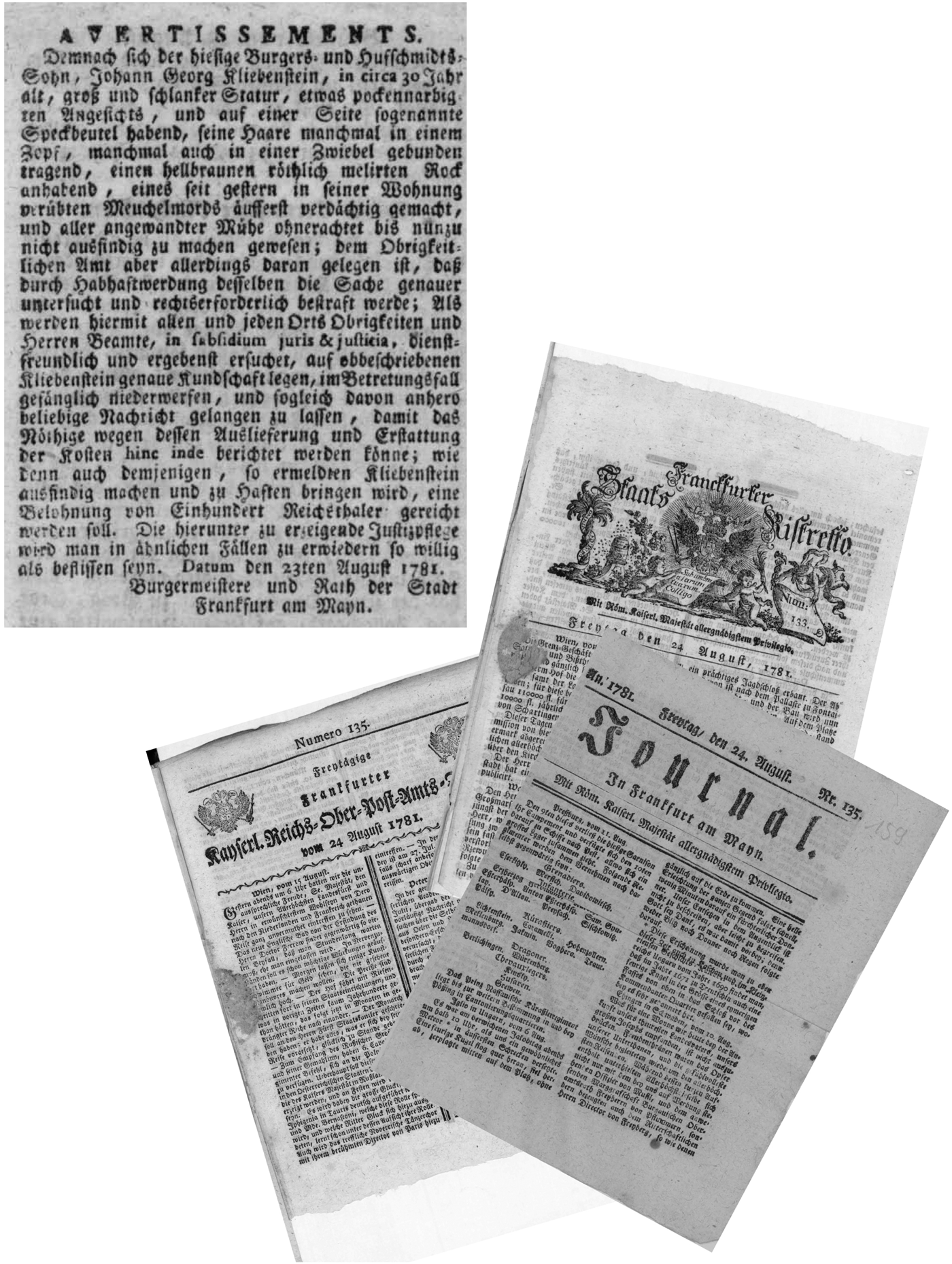
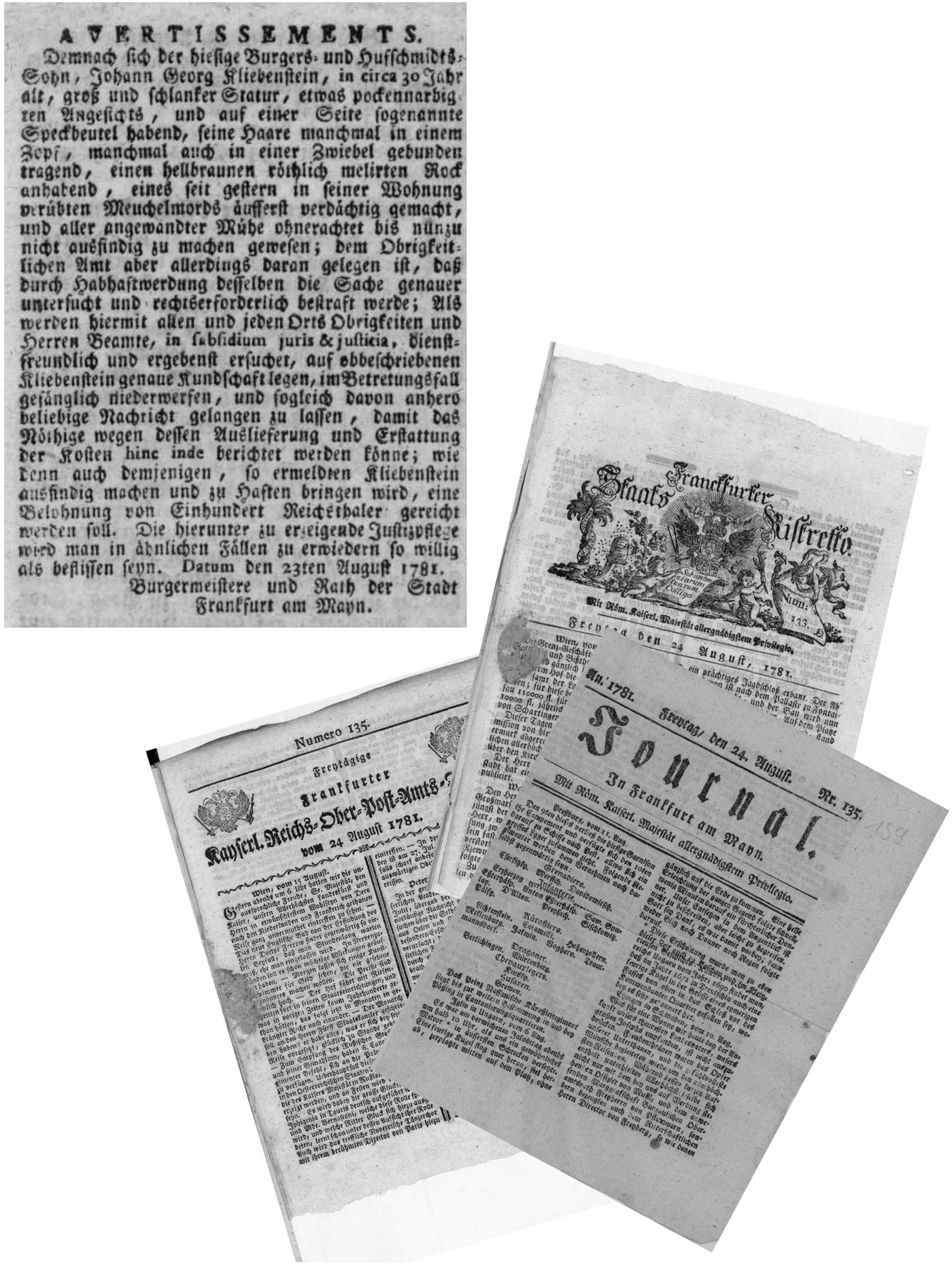
As the search for Gumpert's other remains continued, the city sent ditch diggers (Grabenfeger) to look for Gumpert's severed body parts in the local sewers; they found nothing. Concurrently, the city dispatched a search party on horseback to look for Kliebenstein. Advertisements with a physical description of Kliebenstein—a tall, thin man with facial scars, a ponytail, and visible abdominal swelling—were placed in several local newspapers, and search warrants were sent to all major cities in the Holy Roman Empire.Footnote 53 City officials also directly turned to the authorities in surrounding areas such as Detmold, Weilburg, and the Princedoms of Isenburg and Wertheim, for assistance in the search for the suspect.
The Frankfurt municipality was not alone in searching for Gumpert's body. The Frankfurt Memorbuch, a record book of the Jewish community where many memorialized family members, stated that after the interment of Gumpert's torso that Friday, Gumpert's brother, presumably Benedict, went out “to fulfill the commandment of redeeming the blood” of his family member.Footnote 54 The private search, seemingly without any legal sanction, supplemented the municipal one, something that may or may not have been common for families of means.Footnote 55 From a religious standpoint, the obligation to search out Gumpert's killer fell on the family, especially since it had the financial wherewithal to do so.Footnote 56
Jewish travelers on their way out of Frankfurt appear to have been alerted to the search for Kliebenstein, likely by the Jewish community, and they too spread word about the manhunt throughout the region, interviewing the people around them, chatting with children, soldiers, tavern guests, and other travelers. When the Frankfurt sergeant later arrived in Friedberg (about thirty kilometers north of Frankfurt), he learned that a Jew from Korfdorf had already spoken with a local army officer, and let him know about the search. According to the sergeant, some Jews had told him about a recruiting station in Braunfels and suggested that he check it. Jews in Gleiberg interviewed people and waited for officials from Frankfurt to arrive so they could pass whatever information they had gleaned to the authorities. A Jewish girl took another officer to a Prussian army recruiter who she thought knew something about Kliebenstein.Footnote 57 News of the search had spread quickly and Kliebenstein himself seems to have heard of this; later he said that he had been told that the Jews were looking for him.Footnote 58
Newspaper search announcements.
Institut für Stadtgeschichte, Karmeliterkloster, Frankfurt am Main (Criminalia 9304, fols. 149r-161r).
Although Kliebenstein was last seen heading south from Frankfurt, Benedict must have received information about Kliebenstein's whereabouts, for he knew to head north in search of him. On the very Friday of the burial, August 24, Benedict arrived at an army base in Gleiburg, the exact place to which Kliebenstein had been swept away from Neu-Isenburg. Benedict later said that he had asked the local commander about Kliebenstein but was told that no one meeting Kliebenstein's description was among the fourteen new recruits. The commander even marched the recruits out in front of Benedict to prove his point. Not satisfied, Benedict further inquired with local farmers and the commander's children, who revealed that there was in fact a fifteenth recruit who matched Kliebenstein's description. Armed with this information, Benedict returned to the commander, who, when confronted, admitted that there was indeed a fifteenth recruit.
Benedict did not attempt to apprehend the suspect himself; this he left to the authorities, but he paid the soldiers to make sure that the man who he believed to be Kliebenstein would not flee.Footnote 59 Then Benedict and two family members, Isaac and Meyer Yuda Kulp, who had accompanied him on the search for Kliebenstein, reportedly gave a local army commander one piece of gold to let them eat and stay that Friday night in his house.Footnote 60
It appears that Jews in Gleiberg were alerted to the possibility that Kliebenstein might be present at the base, for when the sergeant from Frankfurt arrived there, city officials told him that local Jews had noisily gathered around the military installation.Footnote 61 With the arrival of the Frankfurt sergeant and his soldiers on Saturday, August 25, Kliebenstein was seized, bound, and taken back to Frankfurt on a wagon.Footnote 62
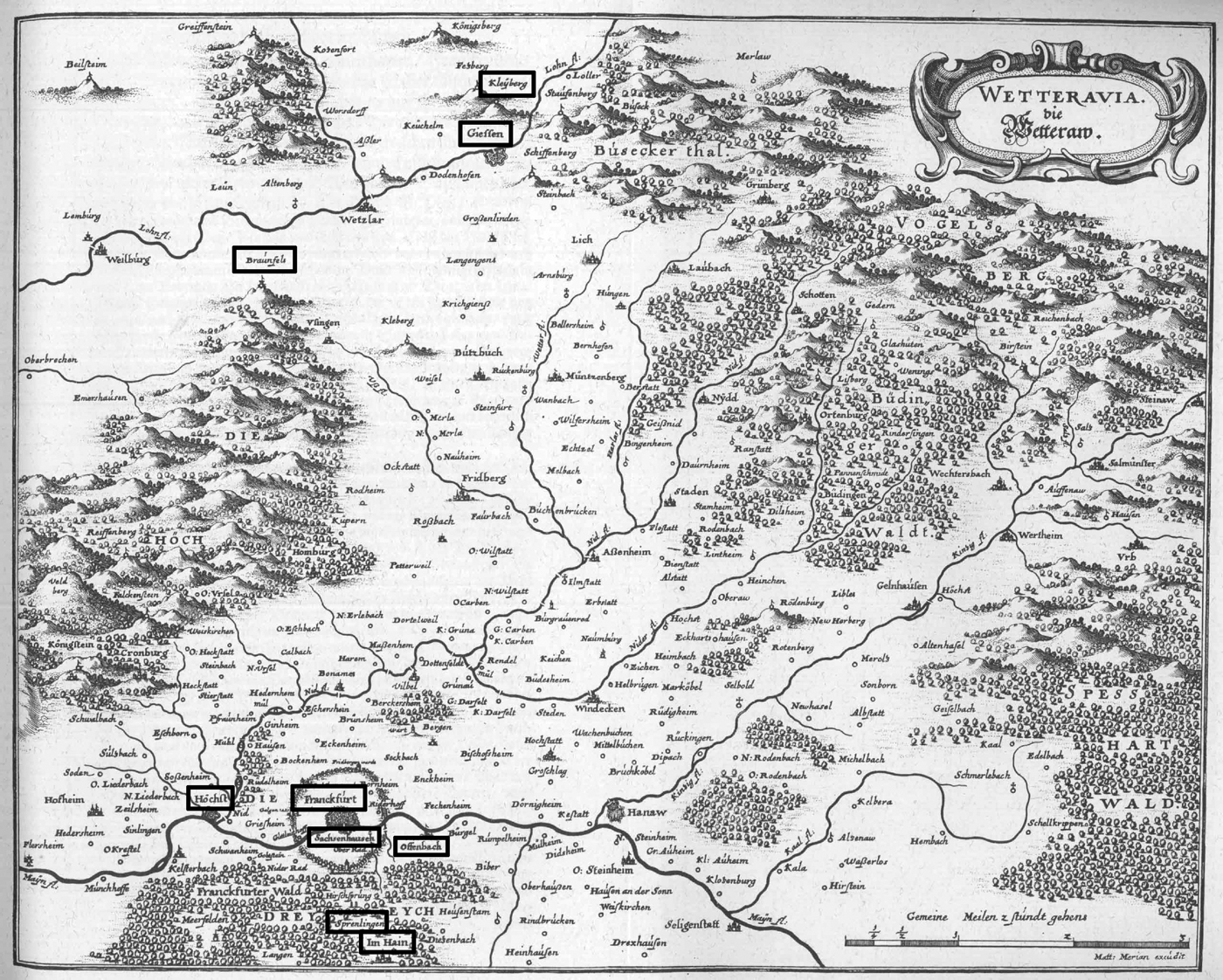
After Kliebenstein's apprehension, Gumpert May's family turned its attention to finding his body parts, in order to give them a proper burial, but perhaps also to aid in the collection of evidence against Kliebenstein. Searchers from the Jewish community appear to have spread out at various points down the Main River, going westward from Frankfurt toward the Rhine. On August 27, five days after the murder, Gumpert's head and three of his limbs were discovered in the Main by fishermen. They were brought to the customs clerk in nearby Höchst, about twelve kilometers west of Frankfurt. Two Jewish travelers were said to be present at the tollbooth. One of them—none other than the aforementioned Isaac Kulp, the half-brother of Gumpert's widow, who had accompanied Benedict May on the search for Kliebenstein—was able to identify the head as that of Gumpert. Kulp may have been involved in the search for Gumpert's body parts, which would explain his presence in Höchst.Footnote 63
The Wetterau region around Frankfurt am Main.
Map detail, “Wetterau.” Copper engraving, Matthäus Merian, 1655.
According to the customs clerk, the two Jews offered the fishermen 1,000 gulden—an extraordinary and perhaps exaggerated sum—if they would turn over the body parts directly to them. But the fishermen, apparently hoping for a reward from the city of Frankfurt and perhaps wary of handing over body parts to individuals, refused, and instead turned the head and extremities over to the city officials and Gumpert's brother, Benedict May. Informed about the find, they had rushed together to Höchst.Footnote 64
Gumpert's remains were transported back to the hospital in Frankfurt for forensic examination. The compromise reached the previous week regarding the examination of Gumpert's torso at the Jewish cemetery did not seem to apply here.Footnote 65 Three days later, on Thursday, August 30, 1781, Gumpert's head, arms, and right leg were buried next to his torso.Footnote 66 His left leg was never found.
The Trial
Kliebenstein's trial (Inquisitionsprozess) started almost immediately after he was returned to Frankfurt. As was customary, the trial was not a public proceeding but a secretive investigation carried out by a special committee of four or five people appointed by the deputy mayor (jüngerer Bürgermeister) of Frankfurt, who was responsible for the office of criminal investigations (Peinliches Verhöramt).Footnote 67 The committee's responsibilities included interrogating the accused murderer's circles of relatives, friends, acquaintances, and colleagues as well as examining the personal background and conduct of the accused.Footnote 68 The committee was to inspect the crime scene, arrange for an autopsy of the victim's remains, and collect all forms of evidence, including the personal belongings of both the accused and the victim.
The goal of an inquisitional trial was to obtain a confession from the suspect. Although this was sometimes induced using force, there is no indication that Kliebenstein was ever tortured.Footnote 69 In fact, it was not necessary to obtain Kliebenstein's confession, for already on the way back to Frankfurt Kliebenstein had told the sergeant who escorted him that he had killed Gumpert. However, during questioning by the committee, Kliebenstein's account of the events constantly changed. Only after two months of repeated interrogations did committee members hear what seemed to them to be the most accurate story. According to his final confession, Kliebenstein's motive for murdering Gumpert was his inability to pay back the loan and his concomitant fear of being embarrassed before his godmother, Anna Margaretha Korbek, and his landlord, Georg Philipp Huber. Perhaps Kliebenstein naively believed that if he destroyed the debt note nobody would have made the connection between him and Gumpert May. If so, Kliebenstein must not have considered the possibility that Gumpert kept a separate record book of his loans, and that the guarantee that his godmother had signed would lead the search back to him. Of course, Kliebenstein's final avowal may only have been what the investigative committee wanted to hear rather than what may have been the real reason for Gumpert's murder.
The loan may not have been the only connection between Kliebenstein and Gumpert. While being questioned, Kliebenstein declared that there had been a homosexual—or “sodomitic” as it was called at the time—relationship between them.Footnote 70 The murder, as Kliebenstein described it in his final version of the story, happened right after he and Gumpert had intimate relations with one another in Kliebenstein's room. Kliebenstein told the committee that while Gumpert was still resting with his eyes closed and leaning against his shoulder, Kliebenstein reached out for his shaving knife and slit Gumpert's neck.Footnote 71 Kliebenstein admitted that he had previously used sexual relationships with men from diverse social backgrounds to get money or other things from them.Footnote 72 He appears to have tried the same strategy with Gumpert, who was a well-to-do merchant, but when Gumpert failed to forgive the loan, Kliebenstein, by his own admission, killed him.
Kliebenstein's allegations cannot simply be dismissed as an attempt of an accused man to indict his victim. For the legal professionals who dealt with the case at the time, there was a convincing piece of evidence to support Kliebenstein's version of the events: despite being murdered with a knife, Gumpert's clothes were perfectly clean.Footnote 73 He was clearly undressed when he was killed. Furthermore, during the interrogations, an accusation was raised against Gumpert that lent credence to Kliebenstein's claim.
Johann Friedrich Barthel, then a thirty-one-year-old wig maker's apprentice, inculpated Gumpert of having physically molested him some years earlier in Gumpert's own house in the Judengasse while Gumpert's wife was in childbed next door.Footnote 74 For the jurists involved in the case, this demonstrated that Gumpert was “capable of the sexual lust that the suspect mentioned” and suggested that Gumpert was homosexually active.Footnote 75
The examination committee did not pursue Gumpert's sexual preferences any further. Gumpert was dead and was not about to be punished postmortem. In general there was little investigation into the personal circumstances, family, or vita of the victim. The personal and business relations between victim and murderer were never raised with Jewish witnesses. Although officials wanted to question Gumpert's brother Benedict immediately after the murder, he brushed them off, saying that he was emotionally devastated. Later, Benedict was examined regarding the search for the murderer and the identification of his brother's body and belongings. Benedict was the only family member whom the authorities questioned. Four other Jews who had discussed possible business dealings with Kliebenstein in his home were only queried concerning their encounters with him; they gave descriptions of Kliebenstein's appearance and living quarters, nothing more.Footnote 76
Why the committee did not investigate Gumpert's personal life is unclear. Did it not want to disturb members of a well-to-do family from the Judengasse? Were officials bribed to leave Gumpert's family alone and/or not investigate homosexual activity within the Jewish community? Was there a reticence to interfere in the semiautonomous Jewish community? Whatever the reason(s) for not investigating Gumpert's life, it had nothing to do with an inability to communicate with individual Jews, as the many interfaces between Jews and non-Jews in this case make clear.
Conversely, the authorities keenly focused their examination on Kliebenstein's homosexual relations, which at the time were seen as a severe moral crime independent of Gumpert and his status as a Jew.Footnote 77 Yet ultimately any possible sexual connection between Kliebenstein and Gumpert was not taken into consideration as a factor in the murder. The committee concluded that the motive for the murder was nothing other than greed.
With the investigation completed, the committee's findings were sent to the city council (Schöffenrat), which served as the municipal high court. The city council was mainly composed of members of the social and financial elite of Frankfurt, who did not necessarily have legal backgrounds, but there were some Syndici among them. These jurists worked for the city and had legal experience writing reviews of cases and proposing possible punishments.Footnote 78 The judicial procedure of the day called on the Schöffenrat to pass judgment solely on the basis of this documentation without ever seeing or hearing the defendant. The findings were also sent to a defender who was allowed to submit a written brief on behalf of the accused.
The defender who entered a legal brief on Kliebenstein's behalf attempted to deflect responsibility from Kliebenstein onto Gumpert. He explicitly blamed Gumpert for Kliebenstein's continued debauchery, yet this line of defense was not accepted.Footnote 79 Moreover, the Schöffenrat never considered that Kliebenstein had acted in self-defense against Gumpert's sexual advances, a claim that Kliebenstein had made to the investigative committee.Footnote 80 On the contrary, one of the five Syndici who reviewed the case condemned Kliebenstein's exploitation of this “secret bosom friendship” as particularly heinous, for by killing Gumpert, Kliebenstein had betrayed the “special trust” that Gumpert had placed in him. Such a sympathetic view on interreligious same-sex relations is surprising given that heterosexual relations between Jews and Christians were prosecuted.Footnote 81 It is even more astonishing considering that §116 of the criminal law codex of the empire from 1532, the Constitutio Criminalis Carolina, defined same-sex relations as “against nature” and declared that those who engaged in them “forfeited their lives.”Footnote 82 Although there was no mention of same-sex relations between religious groups in this article of the Carolina—probably because it was not a common occurrence—there was no legal rationale to support the sentiments of this individual Syndicus.
As in most cases, the council followed the suggestions of the Syndici, who unanimously recommended that Kliebenstein be found guilty of murder. They further noted that although the proper punishment for this crime was execution with the wheel, a form of execution used in cases of aggravated murder and almost only on males, they suggested a more lenient sentence: decapitation by sword, a punishment thought to be more honorable, as the victim was not bound and remained upright until felled by the sword.Footnote 83 The reasons for lenience given by each Syndicus varied, but one feared that use of the wheel would raise the ire of the people of Frankfurt against the Jews. He explained that many people had misconceptions (sehr irrige Begriffe) about the permissibility of assaulting Jews, believing that violence could be used against those whom they considered “God's rejected people.”Footnote 84 Presumably such individuals did not see Kliebenstein's crime as particularly grave, and the Syndicus feared that a public execution with the wheel might have been seen by such people as too harsh, leading to further violence.
On February 12, 1782, the council accepted the recommendations of the Syndici and convicted Johann Georg Kliebenstein of the murder of Gumpert May. The council ordered that after beheading by the sword Kliebenstein's head be placed on a spike for that day only rather than for an extended time.Footnote 85 The execution was to be carried out soon (demnächst) so that it may serve as an example to others.Footnote 86
The execution took place on February 21, 1782, about half a year after the murder. It attracted such a large crowd that the authorities had trouble bringing Kliebenstein to the so-called Rabenstein (raven stone) where the sentence was to be carried out. Ostensibly to prevent any anti-Jewish outbursts, Jews were not allowed to attend the execution, but were required to stay in the Jewish lane throughout the day until Kliebenstein was buried.Footnote 87 As ordered, Kliebenstein's head was placed on a spike for everyone to see until the afternoon of that day, and then it was buried together with the rest of his body.Footnote 88 The execution and subsequent public dishonoring of Kliebenstein's remains must have brought some satisfaction not only to the May family but to the Jewish community as well, as the swift and decisive judgment reaffirmed the municipality's commitment to protecting all its residents from murderous violence.
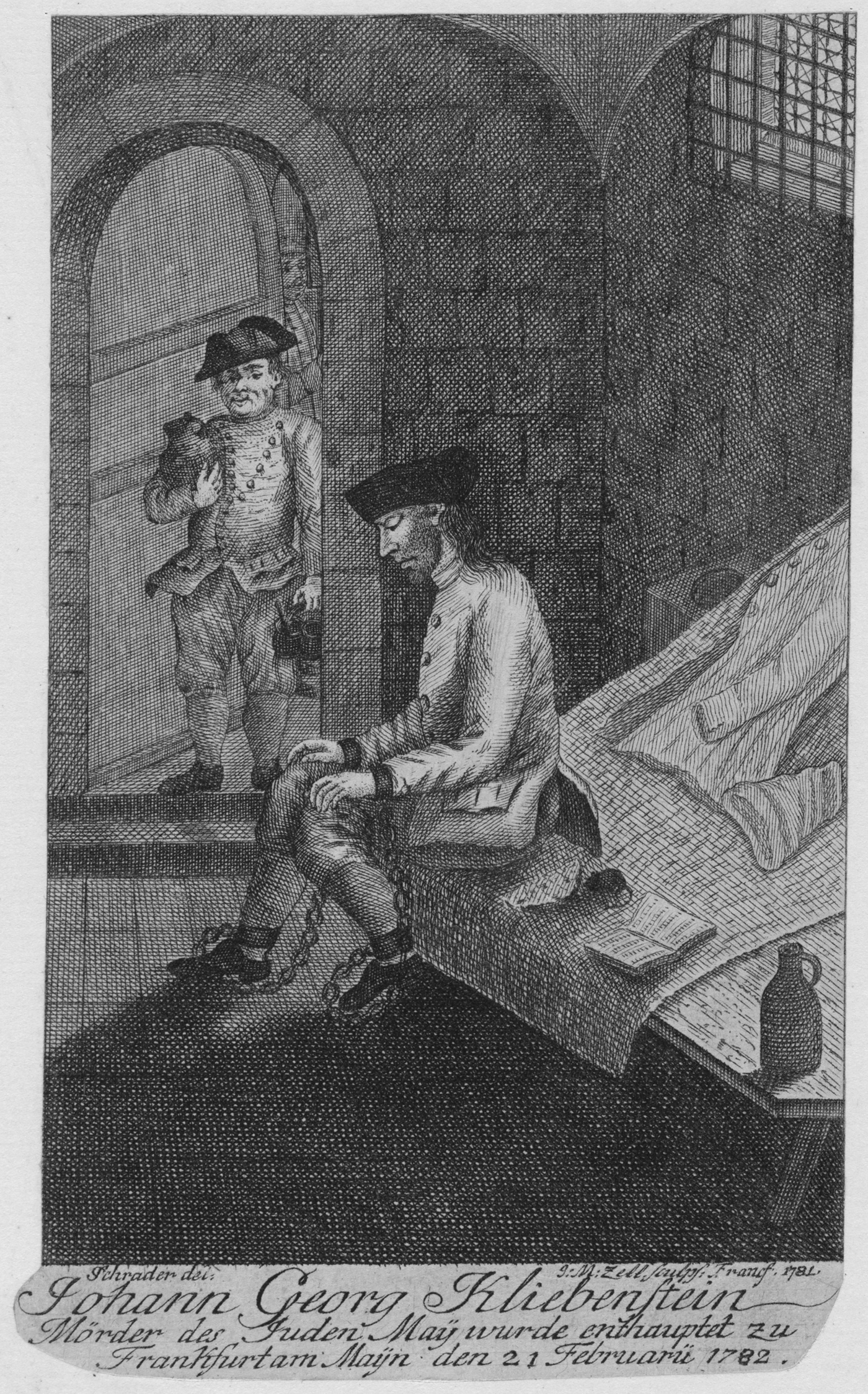
Kliebenstein in prison.
Copper engraving by Johann Michael Zell, 1782.
Historical & Special Collections, Harvard Law School Library
(Art 26.218G)
The handling of the search and trial by the Christian authorities belied no evidence of anti-Jewish prejudice.Footnote 89 The efficiency of the authorities in organizing interrogations, warrants, and a search party, conducting autopsies, and analyzing the evidence showed no religiously motivated discrimination. No one wanted a murderer in their midst.
Gumpert May's murder and its aftermath suggest, paradoxically, that relationships between Christians and Jews were generally harmonious in late eighteenth-century Frankfurt. If Kliebenstein and Gumpert did indeed have an intimate relationship, they were able to do so, in part, because Christians and Jews mingled in daily life. Jews and Christians entered each other's homes, often for business and apparently sometimes for pleasure as well. Gumpert's murder was the exception to the tenor of daily life. Municipal officials not only showed tolerance for the demands of Jewish burial rituals but also compromised to allow Jews to follow their way of life. Yet the lessons of the case should not be overstated. Barriers between the groups were significant. As noted, Christian society severely punished sexual relations between Christians and Jews, and the living quarters of the two groups were physically divided by a wall at the insistence of the Christian community. Still, from a socioreligious perspective, it may have been easier for a Jew to have forbidden sexual encounters with non-Jews who lived beyond the Judengasse than to do so with another Jew. One could be caught having a sexual encounter anywhere, but in some ways it may have been safer to have sexual relations with an outsider. This does not imply an acceptance of Christians by Jews. As will soon be shown, the definition of death at the hands of a non-Jew as a martyr's death in the popular consciousness of Frankfurt's Jews, even in a case where capital punishment appears to have been imposed fairly according to the law of the day, shows that for Jews too congeniality had its limits.
Memorializing Gumpert May
The public disgrace of Kliebenstein by the Frankfurt community during his execution contrasts sharply with the honor bestowed on Gumpert by the Jewish community, which buried Gumpert's remains in the martyrs' section of the Frankfurt Jewish cemetery. The epitaph on Gumpert's gravestone proclaimed with words what the placement of the grave made clear: “the beloved and distinguished, ha-kadosh, the honorable Gumpel son of the late warden of charitable funds, the honorable, our master, Rabbi Aaron May Segel, who was murdered by a murderer and his two legs were cut off . . . .”Footnote 90
The term kadosh could certainly have had another meaning—“holy” or “saintly.” That was the meaning of the word on the tombstone of Rabbi Nathan Adler, who died in Frankfurt in 1800 of natural causes. Adler's epitaph included words such as “the pious and the humble, the ascetic” (he-ḥasid ve-he-‘anav ha-parush). In the context of Adler's life, the word kadosh meant “holy” or “saintly.”Footnote 91 Gumpert's gravestone portrayed him as devout, just as other contemporary epitaphs did. Yet a pious lifestyle is not what made Gumpert kadosh. The placement of Gumpert's grave, and the fact that Gumpert's gravestone called on God to avenge Gumpert's blood made clear to all observers that the circumstances of his death made him a different type of kadosh—a martyr.Footnote 92
An entry in the Frankfurt Memorbuch, paid for by Gumpert's relatives, told of Gumpert's piety and expanded on the story of his demise (see Appendix 1). There too, Gumpert May was explicitly called a martyr.Footnote 93
In none of these sources was there mention of a possible “blot” on Gumpert's reputation based on his sexuality. This is not surprising; after all, family members not only paid for but likely also had a hand in composing the entry in the Memorbuch and the text of the gravestone. It is possible that the Jewish community was never informed of the claims about Gumpert's (homo)sexual relations, but even if it was, these epitaphs may well have been put in place before information from the interrogations became known.Footnote 94 He had certainly been buried in the martyr's section of the cemetery before Kliebenstein was questioned. Thus Gumpert's memory was ensconced as a martyr before his name could have been sullied in the eyes of those who survived him.Footnote 95
Considering that the fact that Gumpert was a Jew seems to have played no role in either his murder or Kliebenstein's trial, one may ask why the Jewish community chose to categorize him as a martyr, a term generally reserved for someone who died for the sanctification of God's name. In its classical formulation as put forward by Moses Maimonides (1135/8–1204, Egypt), author of what was by the eighteenth century a canonical code of Jewish law, martyrdom involved a situation in which a non-Jew ordered a Jew to violate one of three commandments—idolatry, murder, and/or adultery—or be killed. Similarly, if a non-Jew forced a Jew to violate any of the commandments in public or at a time of religious persecution, the Jew was obligated to be killed and thereby sanctify God's name. While this is a simplified presentation of the paradigm, martyrdom had a component of being killed while standing up for a principle, or making, generally in public, a statement as to the “truth” of Judaism.Footnote 96 According to all accounts, these were not the circumstances of Gumpert's murder and his martyr label requires clarification.
A different murder case that took place in the Judengasse some sixteen months after Gumpert's death sheds some light on contemporary Frankfurt Jewry's definition of martyrdom. Early in the morning of December 23, 1782, Schönle, widow of Wolf Maas, was found dead in her house in the Judengasse. According to her entry in the Frankfurt Memorbuch (see Appendix 2), a fire brought people to her room, where they found her body. The Frankfurt authorities were summoned and an investigation ensued.
Schönle was buried within hours of her body being found.Footnote 97 Since the autopsy determined that Schönle had been murdered, the community decided to bury her, like Gumpert, in the martyr's section of the cemetery.Footnote 98 Her gravestone referred to her as “the woman martyr” (ha-'ishah ha-kedoshah) but without reference to the circumstances of her death.Footnote 99 Schönle's family also paid for an entry in the Memorbuch. Written more than ten months after Schönle's murder, the entry recorded not only the circumstances of Schönle's death but also the name and fate of her murderer.
The Frankfurt authorities determined that Schönle was killed in her own home by her teenage Jewish servant, Frommet of Dreieichenhain, a village about fifteen kilometers due south of Frankfurt. According to the records of the criminal investigation, Frommet felt that she had been mistreated by Schönle. Late one night she retaliated by striking her mistress with an axe, and apparently also stabbing her to be sure that she was dead. In the dark, unsure as to whether she had actually killed Schönle, Frommet lit something to provide some light and in so doing inadvertently started a fire.Footnote 100 She then fled the scene, while the fire burned on, triggering an alarm that brought people to the room.
By the time that the entry in the Memorbuch was written, Frommet had been found guilty of the murder and executed.Footnote 101 While Schönle was buried in the martyr's section of the cemetery and her gravestone declared her a martyr, the entry in the Memorbuch failed to label her as someone who died for the sanctification of God's name. Schönle appears to have lost her status as a martyr, and simply became the victim of a crime. Paradoxically, according to the entry, it was Frommet who was said to have “sanctified the Name” through her death at the hands of the Frankfurt authorities, a punishment for her murder of Schönle, and nothing indicates that she was pressured to convert.Footnote 102 In the Memorbuch, the murderess became the martyr, and the victim's family paid for it!
This change in Schönle's status and Frommet's paradoxical designation as a martyr suggests that the term “martyr” was applied to Jews who were killed by non-Jews, even if their death was a result of their crime and they were executed according to local laws, as Frommet was.Footnote 103 Martyrdom, thus, was not limited to those who died in the midst of religious persecution.
The use of the term kadosh to mean “martyr” for those who died at the hands of non-Jews, but not specifically in the context of standing up for their faith, did not begin in Frankfurt in the late eighteenth century, nor was it unique to the city. When Ḥanokh ben Judah Gedalyes was apparently killed instantly in late July 1648 by the explosion of a mortar during attacks by the Swedes on Prague, he was described in a local memorial book as “one who sanctifies the Special Name” (ha-mekadesh shem ha-meyuḥad).Footnote 104 His gravestone, too, labeled him a martyr (ha-kadosh). There is nothing to suggest that Ḥanokh ben Judah Gedalyes's death, or that of any of the other six Jews killed during the attacks on Prague who were also called martyrs, was connected to their Jewishness.Footnote 105 They appear to have been casualties of war rather than those who died proclaiming their faith.
In 1683, Abraham Metz, a money changer who had gone out to trade carrying cash, was murdered in a tavern in Hamburg, which he and other Jewish businessmen frequented. His body was dumped into a deep hole in a cheese storage room in the murderer's father's inn.Footnote 106 Metz's body was found only four years later, after the same non-Jew was implicated in the death of a second Jew and confessed under torture to having killed Metz as well. Metz was labeled a martyr not only on his gravestone but also in the memoirs of his contemporary and relative by marriage, Glikl of Hameln (1646–1724, Hamburg, Metz). While Metz may have been singled out as an easy target because of his Jewishness, according to Glikl, Metz was killed for his money, not his religious beliefs. Nevertheless, he was viewed as a martyr.Footnote 107 So too, in late seventeenth-century Frankfurt, Jews killed under circumstances apparently not tied to their religious beliefs were considered martyrs. This was the case of leaders of the Frankfurt community who were traveling and killed during the siege of Klosterneuburg in September 1683; they were said to have died martyrs' deaths.Footnote 108 Six years later, in August 1689, a certain Me'ir Hausen was killed by soldiers at the Siege of Mainz.Footnote 109 Though his death had no apparent connection to his Jewishness, he too was specifically described in the Frankfurt Memorbuch as having died for the sanctification of the Name (neherag ‘al kiddush ha-shem).Footnote 110
The use of the term “martyr” for those who died at the hands of non-Jews but not in the context of a religious struggle was not the traditional practice in German Jewish communities. Entries in the Memorbuch of Nürnberg from the late thirteenth and fourteenth century include forty-three deaths due to unnatural causes.Footnote 111 Among them were cases of drowning, strangulation resulting from being caught in a mill wheel, and one death by apparent torture. Most such entries simply listed the person as having been killed (neherag).Footnote 112 Some of these people were likely killed by non-Jews but no further information was given regarding the circumstances of their deaths.Footnote 113 In contrast, entries for martyrs were more specific. The Memorbuch listed “the martyr [ha-kadosh] Jacob ben R. Isaac, who gave himself to burning [she-masar ‘aẓmo le-serefah] for the sanctification of the Name.”Footnote 114 This does not appear to be a simple case of homicide. Similarly, the entry for “the martyr [ha-kadosh] R. Joseph son of R. Isaac who was horribly tortured for the sake of unification of the Name” (she-nityasar be-yisurin kashim ‘al yiḥud ha-shem) implies that his death was for a cause.Footnote 115 Martyrdom appears to have been connected to dying for one's beliefs.Footnote 116 Moreover, each entry that was placed in the Memorbuch for a person who was “simply” killed (neherag) was accompanied by a charitable contribution to the community. Those who died martyrs' deaths were ensconced in the Memorbuch without any payment. The magnitude of their self-sacrifice granted them entrance into the book.Footnote 117
Jews who proclaimed the truth of Judaism through their deaths were still considered martyrs. However, as the early modern period progressed, the definition of kiddush ha-shem expanded to include Jews killed by non-Jews in many, if not any, circumstances, even if the death, as in the above-mentioned case of the Jewish maidservant Frommet, was in keeping with the laws of the state. This change was not unique to the German lands. In the sixteenth century on the Italian peninsula and in mid-seventeenth-century eastern Europe as well, the ideal of kiddush ha-shem remained, but the definition of who fit the description expanded.Footnote 118 The evolving definition of martyrdom had limits, at least in Frankfurt. When two Jews died in the fire that engulfed the Frankfurt Judengasse in January 1711, they were not claimed as martyrs.Footnote 119 In Frankfurt, one had to be killed by non-Jews to be declared a martyr.
The categorization of those who died at the hands of non-Jews as martyrs does not seem to have gone unnoticed, particularly not by members of the rabbinic elite. Already in the mid-seventeenth century, Rabbi Gershon Ashkenazi (1618–93), probably writing from Moravia soon after the spring of 1652, received a question regarding the legal status of a woman whose husband was presumed to have been killed during the Khmelnytsky Uprising in 1648. Ashkenazi was asked to decide whether there was sufficient evidence to declare the husband dead and allow the woman to remarry. One of the witnesses testified that the husband had been killed by non-Jews “for the sanctification of the Name like other martyrs [kedoshim] who are killed for the sanctification of the Name,” yet Ashkenazi did not think that this meant that the victim had been given the choice between life as a Christian or death as a Jew and had chosen death. Ashkenazi perceived that the witness had said that the victim had been killed as a Jew but not while proclaiming the truth of Judaism.Footnote 120 Ashkenazi appears to have been aware of a popular definition of martyrdom that was different from the classic paradigms.
After Gumpert's death, the chief rabbi of Frankfurt, Pinḥas Horowitz (d. 1805), wrote a responsum in which he dealt with the legal status of Gumpert's widow.Footnote 121 Although it appeared to all that Gumpert had been murdered and his remains had been buried as those of “Gumpert May,” from the perspective of Jewish law, a tighter connection had to be established between the recovered remains and Gumpert the person before his widow could remarry. The torso that was found the day after the murder was headless. It had to be proven that it belonged to Gumpert May. The severed head found days later in the river had been in the water so long that it might have become bloated and deformed until it was legally inadmissible as evidence.Footnote 122 Jewish law imposed a higher legal standard of proof of death to permit a married woman to remarry than it did to inter remains under someone's name, even in the martyr's section of the cemetery, which required no specific legal procedure.
Horowitz's responsum provides additional information about Gumpert's case, as he cited a number of testimonies that had been entered before the Frankfurt rabbinic court by those who had seen Gumpert both in life and death. Some of these witnesses could speak with certainty about identifying signs on the body such as birthmarks. Some of them spoke of Gumpert, calling him “the martyr” (ha-kadosh). Though Horowitz's response includes Yiddish-language testimonies, when he referred to Gumpert May in his own language and not through direct quotes, this outstanding rabbinic scholar simply called him “Gumpel May.” Perhaps for Horowitz, not a native of Frankfurt, arriving from eastern Europe as a mature person around forty years old, the local appellation of martyrdom was not in accordance with his own understanding of the term.Footnote 123 When writing his own work, Horowitz may have rejected popular perceptions and reserved the martyr label for those who met the requirements of the classic paradigm of martyrdom in Jewish law. However, Horowitz was not alone. Another rabbi too, this one a native Frankfurter, did not declare Gumpert a martyr.
In late 1781 and early 1782, a dispute regarding Gumpert's estate was brought before the Frankfurt rabbinic court. One of the judges who heard the case, Rabbi Ḥayyim Gundersheim, recorded details of the arguments and decisions in his court diary. In each of his two summaries, Gundersheim, who was born and raised in Frankfurt, referred to Gumpert as “the late Mr. Gumpel May [Segel] of blessed memory” or “the deceased of blessed memory,” without any mention of martyrdom or call for avenging Gumpert's blood. Gundersheim's references to Gumpert followed the same format as those to other deceased individuals.Footnote 124 Apparently, rabbis had a different perception of Gumpert's death, yet they did not approve epitaphs or inscriptions in the Memorbuch, and so, in these records, popular usage reigned.
The expanding definition of Jewish martyrdom in Frankfurt was exemplified by the designation of Gumpert May as a kadosh. Not one interpretation of the circumstances of his death fit the paradigm of classical Jewish martyrdom, and yet Gumpert was labelled a martyr by his place of burial, the epitaph on his gravestone, his entry in the Frankfurt Memorbuch, and in the daily speech of his friends and family in Frankfurt who survived him, as reflected in oral testimony in Yiddish. For the Jews of Frankfurt, being forced to choose between Christianity and death was not a common occurrence, certainly not at the end of the eighteenth century. This does not mean that there were no attacks on Jews or that Jews could not be killed for being Jews, but no one was forcing the Jews of Frankfurt to choose between conversion and death.
Lack of the proper circumstances did not mean that martyrdom became a remnant of the past; quite the contrary. The case of Gumpert May, as well as those of others, shows that the definition of martyrdom expanded in early modern—and perhaps earlier—German communities and took on new meaning. Rabbis steeped in talmudic paradigms may not have concurred with this, but the evidence from the Memorbuch and gravestones makes it clear that martyrdom was very much present in a new form.
Appendix 1 The Entry for Gumpert May
The Frankfurt Memorbuch
Heb. MS. 1092, The National Library of Israel, Jerusalem, fol. 276v
May God remember the soul of the martyr [ha-kadosh], the beloved and distinguished, he who feared [God] and dreaded sin, the honorable Mordekhai Gumpel, may God avenge his blood, son of the warden of charitable funds, the honorable, our master, Rabbi Aaron May Segel of blessed memory, who was murdered for the sanctification of God's Name on Wednesday, Rosh Ḥodesh [New Moon = 1] Elul 541Footnote 125 according to the small count.Footnote 126 After noon, he went from his house to the place [i.e., the city] to deal with his business matters and never returned home. And all night, his wife, children, relatives, and his family, were aghast with deferred hopeFootnote 127 until the next day, Thursday, 2 ElulFootnote 128 when his brother went here and thereFootnote 129 looking for him. Finally, he came to Geißgasse, to the house of the uncircumcised one named Johann Georg Kliebenstein. And he spoke with the aforementioned uncircumcised one regarding his martyred brother, the honorable Gumpel, may God avenge his blood. And he [i.e., Kliebenstein], responded in a confused manner and he [the brother] also saw on the floor of the very room what appeared to be blood. And he [the brother] tried to grab him and called out in a loud voice and the murderer immediately ran out of the gates of the city. And the matter was made known to the authorities, may their glory be exalted, and they sent to search in the aforementioned murderer's house and they found in the rooms all the clothes and the tunic of the aforementioned martyr. The authorities immediately checked in every nook and cranny and found the corpse and body of the aforementioned martyr lying in a small box without head, arms, or legs. And the matter was delayed until after noon of the aforementioned day when they carried the holy body to the purification house. And on Friday, 3 Elul,Footnote 130 the body of the aforementioned martyr was buried in the place [i.e., section of the cemetery] of other martyrs. And on that very day, the aforementioned martyr's brother went out to fulfill the commandment of avenging the blood.Footnote 131 And he caught up with him [Kliebenstein] and found him in the village of Kleberg [Gleiburg] near the town of Gießen, about fourteen hours from here. And there he was apprehended by the local authorities, may their glory be exalted, and from there he was brought to here shackled and well guarded. And in the aforementioned village, immediately after he was apprehended, he admitted that he tossed the head and the arms and the legs of the aforementioned martyr into the Main River. And indeed, the head and two arms and one leg—the right one—were found in the Main River near the town of Höchst, two hours from here. And they were brought here by the authorities, may their glory be exalted, and they too were given over [to the community] and buried on Thursday, 9 ElulFootnote 132 next to the burial place of the body of the aforementioned martyr, may God avenge his blood [and that of] all those murdered and killed for the sanctification of His great Name. On account of this and because his heirs gave twenty-one gulden to charity, may his soul be bound up in eternal life with the souls of Abraham, Isaac, Jacob, Sarah, Rebecca, Rachel, and Leah and with the souls of the rest of the righteous in the Garden of Eden [i.e., paradise]. Amen.
He was called by everyone Gumpel May, may God avenge his blood, of Vorder Pfann.Footnote 133
Appendix 2 The Entry for Schönle Maas
The Frankfurt Memorbuch
Heb. MS. 1092, The National Library of Israel, Jerusalem, fol. 286v
May God remember the soul of the important, praised woman, the most blessed of tent-dwelling women,Footnote 134 the matron Schönle, daughter of the prominent and eminent parnas [a specific lay leadership position within the community] and leader, the honorable Rabbi Wolf Oppenheim, wife of the learned in Torah [lit., ha-torani], the honorable Rabbi Wolf Maas of blessed memory, because she was murdered by her Jewish maidservant, who was seventeen years old, during the night, after midnight and before daybreak.Footnote 135 The aforementioned maidservant fled. There was the sound of a fire alarm in the house of the aforementioned woman and they went and opened the room in which she lay and they found it full of smoke and she lay there on the bed, dead. And the bed was burned and so was the woman's hair. And they sent to the authorities, may their glory be exalted, and they sent policemen ['anshei milḥamah] and officials to investigate the matter to see if she died due to the fire. And they found that she had been murdered. And she was buried according to tradition, as is appropriate. And after some time, by way of calls and inquiries [korʾim ve-derushim] by the authorities from here [Frankfurt], may their glory be exalted, they caught her [Frommet] and she admitted that she had murdered her [Schönle] at night, after midnight with an axe. Later, in the morning, she [Frommet] saw that she [Schönle] was not really dead so she stabbed her with a knife in her mouth and in her heart. And this maiden was held for almost half a year and later she was executed by the sword at the place that is called Roβmarkt.Footnote 136 And at the time that she was executed she admitted and repented of what she did and she sanctified the Name. As a reward for this and as a reward for her [Schönle's] heirs giving a certain amount to charity, may her [Schönle's] soul be bound up in everlasting life with the other righteous men and women in the Garden of Eden. Amen. Selah.
She [Schönle] died and was buried on Monday 18 Tevet 543Footnote 137 according to the small count.
And she was called by everyone Schönle Maas.