If interest groups have significant advantages over government officials because they have more information regarding the consequences of policy decisions, does that mean these officials are always at the mercy of lobbyists? More specifically, if one interest group lobbying for public resources is a really good investment of those resources, but a second group competing for those same resources is not, can public officials tell the difference and make the most efficient decision? Can they structure their allocation process so that lobbyists for competing interests are compelled to reveal truthfully how good of a fit their members’ interests and capabilities are with the needs of government? These are important questions because the political arena is becoming congested with ever-more groups lobbying for a diminishing pool of resources (Lux et al., Reference Lux, Crook and Woehr2011).
We explore these questions by developing a signaling model of lobbying by benefit-seeking interest groups that includes a strategic response by revenue-maximizing government officials. Groups with interests that may be similar or dis-similar compete against each other in the model for a limited pool of public resources that officials must decide how to allocate. For the first time in the literature, we explicitly model how the extent of group interest similarity or dissimilarity can influence their lobbying strategies and the allocation decisions of government officials. Lobbyists, we assume, seek to convince officials to provide them with resources. In return, interest groups’ members will use these resources to produce benefits that will ultimately yield increased tax revenues and, consequently, social welfare. It is this public benefit that government officials seek to promote when they decide if and how to allocate resources to interest groups. Interest groups that cannot efficiently use these resources to produce significant returns may still try to mis-represent themselves by exaggerating the public benefits they will deliver if they received an allocation, using the information advantage they have over government officials.
We derive an equilibrium in our model where lobbyists strategically exaggerate the benefits of giving resources to their members, while agency officials design allocation rules to exploit the apparent similarities of the competing interest groups in order to learn their real capabilities. The information asymmetry that seemingly gives lobbyists an advantage over agency officials actually makes it more likely that lobbyists will be truthful and officials can make better-informed decisions. In other words, the most innovative feature of our model is showing how public officials can use group competition to turn lobbyists’ information advantages against them.
Lobbying and the misrepresentation of interests
The popular view of interest group lobbying tends to emphasize corruption and deceit (e.g., Birnbaum, Reference Birnbaum1992; McKean, Reference McKean2004), but scholars have been more reserved in their evaluations. Many argue that the incentive to lie, or even exaggerate, is actually quite weak. Lobbyists, of course, are employed to push the demands of particular economic and social groups, using the tools of influence at their disposal. Government policymakers often want to satisfy these demands in return for electoral support, to keep political superiors happy, and even to improve overall social welfare (Ainsworth and Sened, Reference Ainsworth and Sened1993; Lohmann, Reference Lohmann1998; Boehmke et al., Reference Boehmke, Gailmard and Wiggs Patty2005). Yet officials are bombarded with so many demands from so many interests that it is often difficult for them to determine what the real impacts of their policy decisions will be on key constituencies, or what the economic and social returns will be for providing interest groups with public money (Wright, Reference Wright1996). Thus, they end-up relying on lobbyists to provide honest assessments of member interests and what will be gained by serving these interests (Austen-Smith, Reference Austen-Smith1993).
Such reliance presumably provides lobbyists an opportunity to take advantage of government officials. Certainly, the incentive to do so appears great. Lobbyists, after all, are only successful when they can procure the policy benefits their members demand (Browne, Reference Browne1990; Gray and Lowery, Reference Gray and Lowery1997). The sheer number of interest groups in democratic nations such as the United States (Baumgartner and Leech, Reference Baumgartner and Leech2001; Lux et al., Reference Lux, Crook and Woehr2011), and in federations such as the European Union (Greenwood, Reference Greenwood1997; Cohen and Richardson, Reference Cohen and Richardson2009), all competing for a slice of a small and fixed set of political resources, arguably places even greater pressure on lobbyists to win benefits for their members any way they can, even if it means exaggerating the benefits the government will realize if their members’ demands are met. It is government officials, though, who hold the keys to influence in political institutions. What they lack in information, they can make-up in control of access and the distribution of policy benefits. Indeed, Ainsworth (Reference Ainsworth1993) argues that the very existence of so many competing groups actually pressures lobbyists into providing honest information regarding the needs and capabilities of their members because those who are found to be less than truthful can be easily replaced. Competition, Austen-Smith and Wright (Reference Austen-Smith and Wright1992, Reference Austen-Smith and Wright1994) argue, further weakens the positions of lobbyists because officials are often alerted to misrepresentation when lobbyists present conflicting claims regarding the provision of benefits to particular industries and will punish liars by cutting off their access. Lobbyists know this can happen, so their equilibrium strategy is to tell the truth. This may jeopardize their short-term ability to deliver benefits to members, but it preserves their long-term credibility and influence (Wright, Reference Wright1996).
Most of the prior research on how competitive lobbying leads to truth-telling strategies in equilibrium was developed primarily in the context of lobbyist-elected legislator relationships. Implementing agency officials, though, have the final responsibility for actually distributing public resources. While they hear from lobbyists through advisory committees (Priest et al., Reference Priest, Sylves and Scudder1984; Petracca, Reference Petracca1986) and written comments on proposed rules (Yackee, Reference Yackee2006), their information needs are often different from those of elected officials (Balla and Wright, Reference Balla and Wright2001). Agency officials want to maintain their independence from legislators (Balla, Reference Balla1998; Shipan, Reference Shipan2004), increase their revenues (Downs, Reference Downs1967), and even pursue policies that benefit society (Brehm and Gates, Reference Brehm and Gates1997). They often need information from key stakeholder groups to achieve these goals. But can they compel lobbyists to provide this information truthfully? After all, legislators are closer to their key constituencies, so it is easier for them to verify the information they receive from lobbyists. What can agency officials do?
We argue that agency officials can compel lobbyists to provide truthful information because they can design resource-allocation rules that require competing lobbyists to present arguments as to how their members, should they be allocated benefits, will provide a return to the public treasury in terms of increased tax revenue and improved social welfare. Interest groups, we assume, compete against each other to receive public resources, but some of the group members, the actual beneficiaries of these resources, are better able to use these resources in the public interest than others. Agency officials only want to allocate resources to interest groups whose members’ abilities are highly compatible with the agency's needs. Yet nothing spurs imitation like success, and often the differences between competing interests are not so great, or so zero-sum, that where one matches the agency's needs the other is entirely incompatible (Holyoke, Reference Holyoke2009). Lobbyists for a less compatible group may be able to ‘mimic’ the more compatible group in order to gain a slice of public resources. Interestingly, none of the existing literature explores this point, even though lobbyists often respond to the strategies of their competitors by reframing their members’ interests as the situation warrants (Heaney, Reference Heaney2004).
For example, in return for access to public lands and financial subsidies, many mining companies may claim that they will create new jobs and grow the public treasury through greater tax revenue, even though only some of them are actually well positioned in the market to realize these profits. A public lands agency must find a way to dismiss the mimicking company's claim. Similarly, if an environmental protection agency wants to give grants to interest groups that can restore natural habitats and monitor corporate pollution levels, then many environmental groups may compete for these grants even if some are not actually capable of efficiently delivering the agency's desired results. Yet the promises mining companies and environmental groups are required to make to agency officials also provide these officials with a base-line against which the groups’ claims can be judged. If they meet or exceed the promises, they should be able to hand officials a record demonstrating this success. If a lobbyist makes a claim that ultimately cannot be verified because they cannot produce the public benefits the agency required after promising it, then the agency has an incentive to cut-off the interest group. Knowing this, the lobbyist will not lie.
Model assumptions, stages, and notation
While Bernhagen and Brauninger (Reference Bernhagen and Bräuninger2005) explicitly model the risk of being caught exaggerating to lawmakers and its implications for group–government interactions, our approach is rooted more in the game-theoretic literature on political contests involving lobbyists and lawmakers developed by Grossman and Helpman, as well as Epstein and Nitzan, as this has emerged as the foundational work on the political economy of interest group influence. In these games, candidates set policies to increase the likelihood of winning elections, which often involves finding compromises between group demands and the welfare of informed voters. For instance, in multi-party democracies major parties weigh the concerns of interest groups heavier than underdog parties, leaving the platform of an underdog closer to the bliss point of informed voters (Grossman and Helpman, Reference Grossman and Helpman1996). Lobbying, on the other hand, may lead to more extreme policies than those the groups originally propose when lobbyists undertake the dual role of principal and agent in the policy-setting processes (Epstein and Nitzan, Reference Epstein and Shmuel2006). Interest groups often influence party candidates through public endorsements, signaling to members whom they should support in an election. It is the heated competition between parties for an interest group's backing that can lead to over-representation of some interests, policies favoring these interests, and, consequently, diminished social welfare (Grossman and Helpman, Reference Grossman and Elhanan1999). All of these strategies of interest groups and public officials are shaped by their relative advantage in public contests (like information asymmetry), the policy demands of interest groups, the needs of government officials, and the prevailing political culture (Epstein and Nitzan, Reference Epstein and Shmuel2007).
Our fundamental assumption is that information asymmetry exists between lobbyists and government officials regarding what different groups and industries can do if served with policy benefits. This asymmetry favors the lobbyists and makes agency officials dependent on them for information, potentially leading to a highly inefficient distribution of public resources favoring some economic or social interests at the expense of others or the public interest (Coates and Morris, Reference Coates and Morris1995; Acemoglu and Robinson, Reference Acemoglu and Robinson2001). Dixit et al. (Reference Dixit, Grossman and Helpman1997), however, argue that lobbying for public resources can actually help government officials realize distributional efficiencies, though they do not model actual lobbying strategy. We develop such a model in a signaling game between lobbyists and agency officials where the latter have only imperfect information regarding the interests and capabilities of the groups soliciting them.
Our model comprises four stages:
Stage 1: Here we assume that agency officials want to maximize the return from all public resource investments.Footnote 1 There are two sources of investment return: tax revenue generated by interests served with public resources and alternative sources from risk-free investments when resources are not allocated to an interest group.Footnote 2 Officials seek to maximize the sum of all investment returns from these sources.Footnote 3 We also assume that the resources an agency has which may be transferred to an interest group are fixed and finite.Footnote 4 Agency officials must decide which group, if any, will receive some or all of these resources. For simplicity, we assume that there are only two interest groups, i = 1, 2, who both desire to obtain as much of this limited supply as possible. Each group's use of resources will contribute to at least a marginal increase in agency revenue, which, because the agency acts in the public interest, means a corresponding increase in social welfare by vi, the return from resource allocation.
Stage 2: In the second stage, only lobbyists observe their interest group's type, whether their members’ interests are compatibility with the agency's needs, si. Lobbyists know whether their members are highly compatible with the agency, s = H, or whether compatibility is low, s = L. Agency officials do not know. This asymmetry means our model is a subset of Bayesian games where some players (agency officials in this case) do not know for certain what their payoffs will be before allocating resources.Footnote 5 We set the informational structure of our lobbying game model as follows. First, parameter p denotes the extent of correlation between compatibility (i.e. type, si) and return (vi). Formally, we set: Pr(si = vi) = p ≥ 1/2 ≥ Pr(si ≠ vi) = 1–p. If compatibility is high (si = H), then that group's members are more likely to produce the service government officials require (vi = H) than the group with low compatibility (si = L); that group's members generate higher expected returns for the allocated public resources, which will eventually increase social welfare (the utility of agency officials). The greater is p's value, the more accurate is the compatibility (type) to predicted future return.
The other crucial parameter in our model is the potential similarity of the interests of the two groups lobbying the agency. We capture this potential similarity of interests as q such that (Pr(s 1= s 2) = q ∈ [0,1]). If q > ½, the interests of the groups are increasingly similar (if q = 1, both would represent exactly the same interest). So if q > ½, and the interests of one group are highly compatible with the agency's needs, then the second group's interests are also highly compatible; both can generate high returns. If q < ½, the interests of the two groups are dissimilar, so if the interests of one group are highly compatible with the agency's needs, then the second group's interests are less compatible. Thus, if one can generate a high return to the agency, the other is unlikely to be able to do so.Footnote 6
Stage 3: Now both groups lobby the agency, each sending signal sil regarding si, the compatibility of their members’ interests with the agency and the return they can provide the agency. Let bi(●) be the allocation group i actually receives as a result of lobbying. The pre-tax benefit that group i generates is ui(yi,c) ≡ yi – Ic, where yi is the group's share of gross benefits (before tax) when its agenda is served. Because vi is the return per allocation, we have yi = bi(●)vi. Now c is the loss in the lobbyist's credibility if he or she is found by agency officials to have misrepresented the compatibility of interests with the value of vi. I is an indicator function such that I = 0 if sil = vi and I = 1 > 0 if sil ≠ vi. It denotes the difference between what a lobbyist claims his or her group members could do and what they actually can produce in exchange for resources.
After receiving the two group's lobbying signals sl 1 and sl 2, agency officials respond with an allocation of resources between the two,bi(sl 1, sl 2), in a way they believe will maximize their revenue return (Echenique and Eguia, Reference Echenique and Eguia2007). The total resources the agency has is 2B and officials may choose to provide all of it to both groups subject to the constraint that  $\sum\nolimits_{i = 1,2} {b_i ( \bullet ) \le 2B}$, give it all to one, allocate only part of it to one or both, or give nothing to either. Anything not distributed is invested for a risk-free return of Rf (often called the ‘outside option’).
Remember that prior to any lobbying, agency officials have no information about the compatibilities of group interests with their own needs. From their perspective, either group is highly or minimally compatible with equal chances (Pr(si = H) = Pr(si = L) = ½). The value of p, however, is common knowledge to all players in the game. Thus, if lobbying is truthful (sil = si), officials prefer allocating resources to a highly compatible group in order to increase their utility because si = H means vi = H with probability p > ½.
It is important to be clear that agency officials do not necessarily require lobbyists to specifically predict a priori the exact amount of revenue they can generate. Instead, they require lobbyists to reveal how they can meet the agency's requirements. The lobbyists can provide any information on interest compatibility they choose, and may exaggerate their members’ ability to do what the agency needs. They may even make mistakes – random and unanticipated events always interfere with the best efforts to make economic forecasts. The effect of any random errors is captured in the parameter p, the serial correlation between signal and output.Footnote 7
Stage 4: In the final stage, group members use the resources they are allocated (if any) to generate returns. Depending on their true interest compatibility (si), and the accuracy of the compatibility in estimating the future return (p), these benefits per allocation can be high (v i = H) or low (v i = L). For simplicity, we conceive of returns to the agency as increased tax revenue with a flat rate τ where 0 ≤ τ ≤ 1, meaning the rate is not a function of taxable income. We also assume that τH/2 < Rf, meaning the agency cannot implement its own agenda without interest group aid, and pτH > Rf so that it is better for agency officials to invest in groups with highly compatible interests (s i = H) than to simply hold on to resources at the risk-free rate. This is why the agency is willing to work with interest groups in the first place.Footnote 8
To summarize, agency officials determine the functional form of bi(●) in order to maximize the revenue from resource investment conditional on the outside option, its total resource (2B), information structure (specified as time parameter p and cross-sectional parameter q), and the signals they receive from the lobbyists on whether their groups’ interests are highly (s il = H) or minimally (s il = L) compatible with their own. Group i's lobbyist determines his or her signal s il in order to maximize ui minus tax under the rule that agency officials design.Footnote 9
The benchmark model
To demonstrate the importance of information asymmetry in our model, we first present a version without it. Here officials know exactly whether the interests of any lobbying group are compatible with their needs so that no information through lobbying s il is needed. We make this even simpler by assuming that L = 0, that the agency receives no benefit at all from allocating resources to a low compatibility group (without loss of generality). We also assume that officials are risk-neutral with respect to how they allocate their resources (without loss of generality because we can change the values of the high compatibility group by transforming a risk-averse world into a risk-neutral one per Hull, Reference Hull2008). The agency's optimization problem is
 \begin{equation}
\max _{b_i ( \bullet )} E\left[ {\tau \left( {\sum\limits_{i = 1,2} {b_i (s_i ,s_{ - i} )v_i } } \right) + R_f \left( {2B - \sum\limits_{i = 1,2} {b_i (s_i ,s_{ - i} )} } \right)} \right]\end{equation}
subject to budget constraints bi(•) ⩾ 0 and  $\sum\nolimits_{i = 1,2} {b_i ( \bullet ) \le 2B}$
This shows agency officials seeking to maximize their returns from risk-free savings and tax on the product of interest group members. Revenue is the tax rate τ multiplied by the returns from each group (bi(si,s–i)vi) summed over the two,  $\sum\nolimits_{i = 1,2} {\tau b_i (s_i ,s_{ - i} )v_i }$ The payoff from not allocating any portion of the agency's budget to interest groups is the product of the risk-free rate Rf and amount saved,
 $2B - \sum\nolimits_{i = 1,2} {b_i (s_i ,s_{ - i} )}$ The agency needs to solve a constraint maximization problem because it cannot allocate a negative amount to the groups, bi(•) ≥ 0, and can only use the resources within its budget,
 $\sum\nolimits_{i = 1,2} {b_i ( \bullet ) \le 2B}$ Thus, the agency's solution in the benchmark model is (with group subscripts dropped due to symmetry and all proofs in Appendix 1):
Theorem 1: The optimal allocation of agency resources when there is no information asymmetry is b(HH) = B, b(HL) = 2B, b(LH) = b(LL) = 0. Then the optimized revenue of the agency is B(q(Rf−pτH)+2pτH).
When both interest groups are of high compatibility types, meaning both of their members’ collective interests are aligned with the agency's needs, all of resources 2B are allocated to them. How this is divided between the two does not change the result, so we can examine just b(HH) = B without any loss of generality. When both groups have interests incompatible with agency needs, neither receives anything so b(LL) = 0. When one group has highly compatible interests but the other's compatibility is low, the agency allocates all of its resources to the highly compatible group, b(HL) = 2B, and none to the other, b(LH) = 0.
Because everyone in the benchmark model knows whether the groups are aligned with agency needs, neither lobbyist has any incentive to exaggerate compatibility by claiming that his or her group's interests align when they do not. Lying means they incur credibility cost c with nothing gained so truthful lobbying is a weakly dominant equilibrium strategy. Agency officials also have a clear choice: they will allocate resources to a group if there is one whose interests match their own, and hold on to their resources otherwise. Either way their choice is efficient given the circumstances. Lemma 2, however, does reveal an interesting result:
Lemma 2: Under the no information asymmetry condition, the greater the similarity of the two groups’ interests, higher values of q, the lower the revenue level returned to the agency.
Without information asymmetry Lemma 2 implies that agency officials prefer a game in which groups with very different interests are competing for public resources. Intuitively, when the compatibilities of interest groups are divergent (low q), the agency has the option to choose the better one and reject the other. If the compatibilities of both groups are similar (high q), the option of the agency to choose a better one becomes irrelevant. Thus, the lower the similarity (q), the higher is the value of the option to choose and, as a result, the revenue to the agency.
The main model
Now we alter the benchmark model by introducing information asymmetry between interest groups lobbyists and agency officials. The official's optimization problem is still the same and subject to budget constraints bi(•) ≥ 0 and  $\sum\nolimits_{i = 1,2} {b_i ( \bullet ) \le 2B}$, but now we need to take into account the fact that information asymmetry allows lobbyists to consider more strategic choices: they can exaggerate the type of their group (si) so that sil ≠ si can hold.
Strategies of agency officials and lobbyists
We first explore the choice that each group's lobbyist faces. His or her optimization problem is to maximize the expected utility of the interest group represented with respect to their lobbying signal to agency officials sil. Expected utility E[ui(sli = si, s − i) − .tax|si] results when he or she presents officials with a truthful argument for agency benefits that does not exaggerate member abilities, or E[ui(sli ≠ si, s − i) − .tax|si] when he or she tries to mislead the agency. Thus a lobbyist is only honest if E[ui(sli = si, s − i) − .tax|si] is not less than E[ui(sli ≠ si, s − i) − .tax|si]. With this notation, we can now state the agency's optimization problem as
 \begin{equation}
\max _{b_i ( \bullet )} E\left[ {\tau \left( {\sum\limits_{i = 1,2} {b_i (s_i ,s_{ - i} )v_i } } \right) + R_f \left( {2B - \sum\limits_{i = 1,2} {b_i (s_i ,s_{ - i} )} } \right)} \right]\end{equation}
subject to the agency's budget constraint bi(•) ⩾ 0 and  $\sum\nolimits_{i = 1,2} {b_i ( \bullet ) \le 2B}$ and the lobbyist's optimization problem, i.e. max E[ui(sli, s − i) − .tax|si]with respect to sli.
To solve this problem easily, we apply Myerson's (Reference Myerson1981) Revelation Principle. This allows us to focus on administrative rules for allocating resources that give lobbyists an incentive to reveal the types of member capabilities truthfully. It means we can replace the constraint regarding group i's optimization problem (max E[ui(sli, s − i)si] with respect tosli) with the honest lobbying condition E[ui(sli = si, s − i)|s.i] ⩾ E[ui(sli ≠ si, s − i)|s.i], which we can do without any loss of generality under the Revelation Principle. In Appendix 2, we provide more information about the Revelation Principle and its role in our model.
Given the symmetry between the two groups in our model, we can drop the subscript i. We denote wL ≡ b(HL) – b(LL), wH ≡ b(HH) – b(LH), c 0 ≡ c(2p – 1)/(H(1–τ)) > 0 and define TRUTH(L) and TRUTH(H) as the conditions under which a lobbyist for a group whose interests are highly (i.e. high type: s i = H) or minimally compatible (i.e. low type: s i = L) with the agency's needs (only known to the lobbyist) will lobby truthfully or exaggerate interest compatibility. The truthful lobbying conditions given either of these types of member interest compatibility are:
Honest lobbying when compatibility is low, or TRUTH(L): qwL + (1 – q)wH ≤ c 0 / (1 – p)
Honest lobbying when competitive is high, or TRUTH(H): qwH + (1 – q)wL ≥ − c 0 / p
(wL ≡ b(HL)−b(LL),wH ≡ b(HH) − b(LH), c 0≡ c(2p – 1) / (H(1 – τ)))
TRUTH(L) and TRUTH(H) have important implications for the allocation of agency resources. Terms wL and wH show the extent to which an official's allocation is sensitive to his or her valuation of a lobbyist's claims when the interest compatibility of the competing group is low and highly compatible respectively. Intuitively, officials want to maximize wL and wH in order to discriminate between low and high compatibilities so they can allocate as much as possible to highly compatible groups. However, since lobbyists can exaggerate the interest compatibility signals, officials cannot increase wL and wH much and should limit them as per TRUTH(L) and TRUTH(H). For instance, if wL is large, a low compatibility group lobbyist has an incentive to exaggerate its type in order to receive more resources.
Both of these conditions, TRUTH(L) and TRUTH(H), have intuitive interpretations. In TRUTH(L), (wL, wH) denotes how much more a low compatibility group can expect to receive if its lobbyist exaggerates its compatibility given the fact that a competing group is of either high or low compatibility respectively. Recall that the two groups’ member interests are the same with probability q and different with probability 1 – q, so qwL + (1 – q)wH is the expected value of how much the agency allocates if a low compatibility group's lobbyist exaggerates. Similarly, (qwL+(1 – q)wH)H(1–p) is the expected change of return from the exaggeration because a low compatibility group can generate a high return (H) with probability (1 – p) and a low return (L = 0) with probability p. Since the group's members pay fraction τ to the government in tax, the final incremental return from a low compatibility group becomes (qwL + (1 – q)wH)H(1–p)(1–τ) when it exaggerates. On the other hand, exaggeration also generates lobbyist credibility costs. If a lobbyist for a low compatibility group exaggerates, his or her expected credibility cost is cp because low returns occur with probability p. If he or she is truthful, the cost is c(1–p) because high returns occur with probability 1–p. Thus, exaggeration generates expected credibility cost c(2p – 1). A low compatibility group lobbyist decides whether or not to exaggerate by comparing this incremental cost with the incremental return of exaggeration. He or she lobbies truthfully if (qwL + (1 – q)wH)H(1–p)(1–τ) ≤ c(2p – 1).
Similarly, in TRUTH(H), (–wL, –wH) denotes how much a high compatibility group will receive in agency resources by understating its interest compatibility given that the competitor group is low and high compatibility respectively. The expected change in resource allocation when a lobbyist for a highly compatible group understates this compatibility is –(qwH + (1 – q) wL). Since it generates a high return (H) with probability p, the change in after tax return for this understatement is –(qwH + (1 – q) wL)pH(1 – τ). Understated lobbying will also incur credibility cost by c(2p – 1), so a high compatibility group lobbyist is truthful if –(qwH + (1 – q) wL)pH(1 – τ) ≤ c(2p – 1), which is equivalent to TRUTH(H). These truthful lobbying conditions for low or highly compatible groups (TRUTH(L) and TRUTH(H)) implies Theorem 3, which shows how agency officials change the allocations as the parameters in our model vary.
Theorem 3: The optimal combination of wL and wH, given q, is a non-decreasing function of the credibility cost of exaggeration c, tax rate τ, and correlation between compatibility and return p, but a non-increasing function of the upside potential of an agenda H.
The intuition of Theorem 3 is closely related to the incentive of lobbyists to misrepresent their group's compatibility with agency needs. Terms wL and wH measure the degree to which the agency's allocation is sensitive to its valuation of the group's capabilities as presented by the lobbyist. In the benchmark case of no information asymmetry, we have wL = 2B and wH = B. In the asymmetry case, strategic exaggeration by lobbyists limits wL and wH. The greater the difference in the amount allocated between high and low compatibility groups (wL and wH), the greater the incentive to exaggerate. The incentive to misrepresent decreases with the cost of credibility (c), tax rate (τ), and the correlation between group and agency compatibility and return to the public treasury (p), but increases when agency officials perceive a greater potential in serving a highly compatible group (H).
Intuitively, if a lobbyist's credibility cost c is low, then he or she faces a smaller cost even if the misrepresentation is caught. If tax rate τ is low, or the potential of serving the group's members is high, a lobbyist can expect higher returns from exaggeration. If the correlation p between group and agency compatibility and return to the agency is low, it is more likely to generate a high return accidently, so that the lobbyist can actually avoid being caught and losing credibility. Lemma 4 summarizes this:
Lemma 4: A low compatibility (high compatibility) interest group has a larger incentive to overstate (understate) its signal with the decrease of the credibility cost of exaggeration (c), tax rate (τ), or correlation between compatibility and return (p), but with the increase of the upside potential of an agenda (H).
Imposing restrictions wL ≥ 0 and wH ≥ 0 are also realistic because it is unlikely that agency officials would announce ex-ante that an interest group will receive a larger share of resources if its lobbyist argues that the group's interests are minimally compatible with the agency’s. This allows condition TRUTH(H) > 0 to always hold true, and at least TRUTH(L) ≥ 0 to hold true as well. Thus, a lobbyist for an interest group likely to produce a high return for its efforts (high type: s i = H) is rewarded for lobbying honestly because the equilibrium payoff for truth in this realistic mechanism is greater than the payoff for misrepresenting, the payoff increase being (qwH + (1 – q)wL)pH(1−τ)+c(2p – 1). By contrast, in equilibrium a lobbyist representing a group with minimally compatible interests may be indifferent between honest or exaggerated lobbying strategies.
Government revenue and social welfare
We can now show how agency revenue varies as the similarity of the interests of both groups varies:
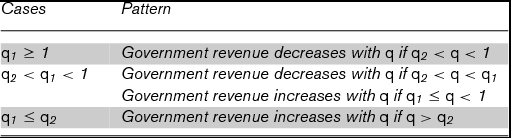
Theorem 5: Let us denote q 1 ≡ (c(pH – Rf/τ) / ((1 – p)B))1/2H −1and q 2 ≡ c 0/(B(1 – p)). The revenue return to government officials is the function of q as displayed in Table 1.
Social welfare implication of correlated interest
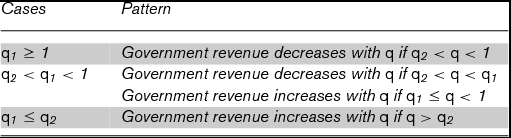
Government revenue is a constant function of q if q ≤ q 2. ‘q’ denotes the extent of correlation (or similarity) between the interests of interest groups (Pr(s 1= s 2) = q ∈ [0,1]). q 1 ≡ (c(pH – Rf/τ) / ((1 – p) B))1/2H −1, q 2 ≡ c 0/(B(1 – p)) and c 0 ≡ c(2p – 1)/(H(1 – τ))).
Information asymmetry between agency officials and lobbyists changes the way the similarity (or lack thereof) of the interests of the two groups affects the choices of agency officials and, ultimately, revenue returned to the agency. When there is no asymmetry, agency revenue is a decreasing function of how similar the interest of one group is to the other, measured by q. In contrast, Theorem 5 shows that the agency's revenue is not a monotonic function of this interest similarity anymore, but, as we lay out in Table 1, closer to a U-shaped function (q 2 < q 1 < 1), or increasing function (q 1 ≤ q 2), or even unrelated (q ≤ q 2).
There are two countervailing effects that this similarity creates for overall social welfare. First, lower similarities (lower values of q) mean greater differences between the capabilities of the two groups. When this occurs the agency can expect to see greater revenue generated by optimally allocating more resources to the group whose interests are most similar to its own and less to the other. Serving the group that can actually do what the agency needs generates greater tax revenue and, as we shall see, social welfare. When both groups tend to perform similarly due to highly similar interests, valuing interest groups and allocating resources to any of them does not generate any benefit. Only when at least one group has interests similar to the goals of the agency will officials focus their resources towards a group rather than hold on to them in a risk-free investment. When one group's interests are not similar to the other, then there is a high chance that at least one of the two has interests compatible with the agency’s. As a result, the more dissimilar are the interests of the two groups from each other, the more efficient the agency's allocative function because it will still give to a group with highly compatible interests.
Second, in contrast, if the groups have similar interests, agency officials can collect information from one group's lobbyist and apply it to their assessment of the competitor group. They can do this by designing an administrative rule that collects information on the interest group, crosschecks it with the information received from the competing group, and uses these informational signals to update their estimation of the compatibilities of both (for more on such efficient rulemaking see Cremer and McLean, Reference Crémer and McLean1985, Reference Crémer and McLean1988; McAfee et al., Reference McAfee, McMillan and Reny1989; and McAfee and Reny, Reference McAfee, McMillan and Reny1992). Thus, the greater the similarity of the two groups’ interests to each other, the better agency officials can estimate their true compatibilities, i.e. the larger the informational efficiency.
In sum, when interest similarity is low, the agency's allocation can generate a large payoff, but misallocation is likely. When it is high, how well officials allocate resources may not be so important in generating high returns, but misallocation and information collection in rulemaking becomes more efficient. Lemma 6 and Lemma 7 summarizes this:
Lemma 6: (1) Agency revenue is more likely to be a U-shaped function of the similarity of interests than an inverted U shape. (2) The more extreme (i.e. very high or very low) the similarity of the interests of the two groups becomes, the higher the returns from allocations to these groups. (3) The lower (larger) q 1is, the larger (lower) the benefit created by the interest groups if their interests are very similar (q 1≡ (c(pH – Rf / τ) / ((1 – p)B))1/2H −1).
Lemma 7: We define social welfare as the sum of agency revenue and the payoffs interest groups receive from lobbying. Both the payoffs to interest groups for sending information signals and social welfare therefore exhibit the same pattern as increases or decreases in government revenues due to the variation in the similarity in the two groups’ interests.
Surprisingly, one might suspect that the countervailing effect of interest similarity (allocative efficiency vs. informational efficiency) would lead to an optimal level of similarity at an intermediate point, but we find the opposite pattern. At moderate levels of q, neither agency officials nor the interest groups enjoy the benefits of an efficient allocative function in doling out resources to the compatible group, or any efficient informational function in estimating the compatibilities of groups to reduce misallocation. The agency's revenue, groups’ lobbying payoffs, and social welfare are thus not an inverted U-shaped function of interest similarity; they are a U shape or monotonic function of it. Optimality arises at the extreme values of q and the more extreme the values of interest similarity or dissimilarity, the greater is the return to the agency. The same is true of the groups’ lobbying payoffs as well as social welfare. And agency revenue is at a minimum at q 1 ≡ (c(pH – Rf / τ) / ((1 – p)B))1/2H −1. Thus, the smaller (larger) is q 1, the more (less) attractive similar interests become to both officials and lobbyists. This arises because a small (large) q 1 implies a larger (smaller) area in which welfare increases with q.
Finally, given this optimal scheme of agency allocation in response to lobbying, we can explore how the similarity of the two groups’ interests to each other, q, influences their lobbying strategies visa vie each other. We know the payoffs from over- and understatement by incompatible and compatible interest groups are (qwL+(1−q)wH)H(1−p)(1−τ) and −(qwH+(1− q)wL)pH(1−τ) respectively. Plugging in the optimal agency allocations specified in Theorem 5, we have the following Lemma:
Lemma 8: If q < c 0/(B(1 – p)), then the greater the dissimilarity of the two groups’ interests, the greater the incentive for their lobbyists to exaggerate interest compatibility with the agency's needs regardless of true compatibility. The similarity otherwise is irrelevant to the incentives for lobbyists to misrepresent their members’ capabilities.
To rephrase, when the competing groups are very different (q < c 0/(B(1 – p))), as q decreases lobbyists are more likely to misrepresent their group's interests to agency officials. On the other hand, when the competing groups are very similar (q ≥ c 0/(B(1 – p))), it does not influence their lobbying strategies at all.
Government allocation under information asymmetry in practice
Readers may feel that while our model is logically consistent, it may not be tied to reality. Do agency officials really use administrative rulemaking procedures to press lobbyists into making claims about the benefit of serving their member industries that can be subsequently evaluated? The following examples suggest that they do.Footnote 10
Our primary example regards the standard public resource allocation process in Korea. It presumes an agency is engaged in a public–private partnership, but this is not essential to our model. It is applicable to any agency as long as they deal with interest groups competing for limited resources under conditions of asymmetric information. First, agency officials send out a request-for-proposals (RFP) to four or five firms about a project. Second, these firms’ representatives send their proposals back to the agency (often via email). Third, officials assign grades or scores to these firms based on the proposals. This is called first-stage assessment. Fourth, officials convene a committee composed of internally recruited agency staff and external experts recruited from academia, research institutes, and law firms. Fifth, the committee invites the lobbyists or other representatives from each firm to come in and give a 40 minute presentation and then answer questions for about 30 minutes, all of which occurs the same day. Sixth, the committee does a second-stage assessment. There are five criteria: business, people, process, performance, and service. All of these criteria, especially performance and service, are used to assess the firm's stated capabilities as well as their past performance in related projects. Finally, the committee members combine the first- and second-stage assessments to rank the firms. Depending on the gaps between their scores, they select one to three firms for a project.
There are multiple similarities between this procedure and the process we modeled. First, the firms know the rules of the game. Agency officials describe through the RFP how selections will be made (and most firms have been through it before). Second, firms are clearly competing to obtain governmental resources. Third, firm lobbyists can exaggerate project outputs when they write their proposal and at the presentation. Fourth, the types of firms are similar in that they all have some capacity to complete the project, but can offer different services. Thus, what they offer in the proposals and presentations varies from firm to firm and project to project. Fifth, firm representatives cannot observe their competitors because the proposals and presentation are strictly confidential (and information sharing and collusion are prohibited). Sixth, what matters in the end is relative quality, i.e. ranks of firms. Agency officials thus allocate resources with expectations of the benefits they will receive from a completed project. Finally, firms failing to complete the projects satisfactorily or to provide all of the benefits they promised will be disadvantaged the next time a project is offered because past performance is part of the criteria.
The connection between our theoretical model, along with its incentive-compatible direct-revelation mechanism, and government project allocations in Korea should now be clear. First, similar to the signaling stage in our model (stage 3 in our model), firms signal how efficiently they can complete a public project that will be evaluated later (stage 4 in our model). This is a version of the direct-revelation mechanism used in the Revelation Principle that requires sending a message about each firm's type (stage 1 in our model). Agency officials are able to estimate the firm's true type by comparing the signals (stage 3 in our model). Thus, they identify the amount of exaggeration, which is simply the difference between what the firm claims it can do and what it actually can do. Learning the extent of this exaggeration allows officials to construct a one-to-one mapping between signaling and true type (i.e. direct revelation mechanism). Comparing proposals from competing firms helps agency officials to identify the true types of firms (stage 3 in our model and Revelation Principle). As this procedure is common knowledge to all players, the signaling strategy of firms or any other group can be transformed into an incentive-compatible direct-revelation mechanism.
A potential example of the U-shaped return for allocating resources to competing interests can be seen in efforts of members of the United States Congress to force the Department of Defense (DOD) to contract out a second, alternate engine for the new Joint Strike Fighter (JSF).Footnote 11 Firms Pratt & Whitney and General Electric–Rolls Royce (GE–RR) competed fiercely for the project, with the former winning the engine contract in 2001. Many members of Congress, however, believed that there was value in the DOD allocating resources to GE–RR to develop an alternative JSF engine. GE–RR argued that this competition would drive down the price of the engine, saving DOD money in the long run, and thus improving US security (increasing social welfare). Moreover, GE–RR argued that they would produce a superior product, an engine capable of handling a wider operating temperature range and delivering a greater thrust. This suggests two interests with similar capabilities providing a greater return to the agency, DOD in this case, for the investment, which would ultimately lead to greater social welfare for Americans in the form of a superior air force.Footnote 12 The ‘dual-source’ approach had also saved money overall in the past for DOD.Footnote 13
By 2006, though, DOD began to suspect that this was not going to be the case, that continuing to fund GE–RR was going to hurt the entire JSF program, and started to insist on more information disclosure from GE–RR before they received any more money. From this, they began to realize that GE–RR's engine was not going to be as good as its lobbyists had claimed and DOD was going to lose money.Footnote 14 Officials at GE–RR admitted that they were also behind schedule in production and testing (though Pratt & Whitney had been given a considerable head-start and was also behind schedule). Fearing an even greater cost over-run than the JSF project was now running, Congress stripped additional funding for GE–RR's contract out of an appropriations bill in March 2011, effectively ending government support for it. The firm tried to finance the project itself, but ultimately called it quits in December of 2011.Footnote 15 By forcing the firms to disclose considerable information on what they could really do, DOD appears to have saved US taxpayers a significant amount of money.
Remarks and extension possibilities
Not only is the sheer number of corporate interests in democratic nations lobbying for public benefits increasing, but so too is the marginal payoff they receive for doing so. Lobbying for public benefits often produces enough returns to give a private interest a decisive edge over non-lobbying competitors. This means first that the kind of agency lobbying we describe in this paper is no mere abstraction. Second, and perhaps more importantly, the competitive pressure on interest groups to lobby and receive financial and other benefits from government is becoming enormous, lest a company lose a competitive advantage. Therefore, the pressure on lobbyists to exaggerate interests, misrepresenting what a company or sector of companies can do with public resources has become similarly large.
Our results demonstrate how these pressures to exaggerate can be optimally taken into account by agency officials and how it is in their interests to do so. Specifically, we show how the extent of similarity between competing interest groups can drastically affect the efficiency of governmental resource allocation, social welfare, and the incentives of lobbyists to misstate the true types of interests they represent. In our signaling game, agency officials use administrative rulemaking to account for the information dispersed among the players in the game and to extract information about the true interests and capabilities of the groups lobbying them. This allows agency officials to estimate who is best to serve in order to maximize revenue. Lobbyists may try to exaggerate the real compatibility of their organization's interests with that of the government in order to maximize their payoffs, but an agency can take such strategy into account and implement an optimal regulatory mechanism. Of course, a poorly designed rule can let a lobbyist deceive the agency when the credibility of lobbyists is less likely to be damaged by the manipulation. Legislators who want an interest group served may even pressure agency officials into writing a rule that favors that group even though serving it will not produce an optimal return and increased social welfare. These would be rich topics for future research.
Finally, while all players compete against each other, they may also have a surprising incentive to cooperate. They all have a common interest in that an efficient allocation mechanism would enhance future budget surpluses so that everyone can receive a larger future payoff. In other words, while all players compete in order to take bigger slices of the public pie (i.e., the surplus government resource allocation creates), they have the common incentive to also increase the size of that pie. We did not explore this interesting intersection of competition and cooperation, but such possibilities of ‘co-opetition’, as Brandenburger and Nalebuff (Reference Brandenburger and Nalebuff1997) call it, would also be ideal for future research.
About the authors
Hyoung-Goo Kang is an assistant professor of the department of finance at Hanyang University Business School in Seoul, Korea. He received his Ph.D. and MA from the Fuqua School of Business at Duke University, his MA from the economics department at University of Virginia, and his BA from the economics department at Seoul National University. He has worked at Lehman Brothers Quantitative Research, Samsung Asset Management, International Monetary Fund, Accenture Management Consulting, and Republic of Korea Air Force. He is also a non-resident research fellow of the Edmond J. Safra Center for Ethics at Harvard University.
Thomas T. Holyoke is associate professor of political science at California State University, Fresno. His Ph.D. is from George Washington University, and he is the author of Competitive Interests (2011) and Interest Groups and Lobbying (2014), as well as numerous journal articles.
Appendix I: Proofs
Proof of Theorem 1: The government agency knows the compatibilities of interest groups and designs an administrative rule to deal with each group's compatibility. Step 1: When both interest groups are of high compatibility (HH), government conducts constraint maximization [b 1(HH) + b 2(HH)pτH + Rf(2B–(b 1(HH) + b 2(HH)))]. Taking the derivative with respect to bi(HH), we have pτH – Rf > 0 for both i = 1,2. Thus, any allocation is optimal and the same if b 1(HH) + b 2(HH) = 2B. Since we are interested in symmetric allocations, we have b 1(HH) = b 2(HH) = B. Step 2: When both interest groups are of a low compatibility (LL), the government conducts constraint maximization b 1(LL) + b 2(LL) (1−p)τH + Rf(2B – (b 1(HH) + b 2(HH))). Taking the derivative with respect to bi(LL), we have (1 – p)τH – Rf < τH/2 – Rf < 0 for both i = 1,2. Thus, the government minimizes b(LL) for both interest groups. Since b must be non-negative, b 1(LL) = b 2(LL) = 0. Step 3: When only one interest group is a high compatibility (HL), the government conducts constraint maximization b 1(HL)pτH + b 2(LH)(1 – p)τH + Rf(2B – (b 1(HL) + b 2(LH))). Taking the derivative with respect to b(HL) and b(LH), we have pτH – Rf > 0 and (1 – p)τH – Rf < 0 respectively. Thus, the government maximizes b(HL) and minimizes b(LH). Given the resources constraint, we have b(HL) = 2B and b(LH) = 0. Also, (HH) and (LH) occur with probability q/2 respectively, and (HL) and (LH) occur with probability (1 – q)/2 respectively. To sum up the payoff to government with probability weights, the optimized revenue to government is B(q(Rf – pτH) + 2pτH). Q.E.D.
Proof of Lemma 2: Theorem 1 shows that the revenue for government is B(q(Rf−pτH)+2pτH), which is a decreasing function of q given the assumption that Rf < pτH. Q.E.D.
Proof of Theorem 3: Straightforward from TRUTH(L) and TRUTH(H). Theorem 5 provides exact solution of the allocations. Q.E.D.
Proof of Lemma 4: (wL, wH) denotes how much more resources a low compatibility interest group expects to receive from the government official by exaggerating its signal given that the other interest group is low compatibility and high compatibility respectively. (–wL, –wH) denotes how much a high compatibility interest group receive more resources from the government official by understating its signal given that the other interest group is low compatibility and high compatibility respectively. Then, low compatibility group's incentive to exaggerate is (qwL + (1 – q)wH)H(1–p)(1–τ)–c(2p – 1). High compatibility group's incentive to understate is q(–wH)+ (1 – q)(–wL)pH(1–τ)–c(2p – 1). They increase with the decrease of the credibility cost of exaggeration (c), tax rate (τ), or correlation between compatibility and return (p), but with the increase of the upside potential of an agenda (H). Q.E.D.
Proof of Theorem 5: To differentiate objective function of the government official with q, we have: (b(LH) – b(LL)) (Rf/τ – (1 – p) H) + (b(HH) – b(HL)) (pH – Rf/τ). Thus, exploiting symmetry and restrictions, we have: b(LL) = 0, b(HH) = B, b(LH) = B. To solve b(HL), we plug TRUE(L) into objective function. Then, given the resource constraint, we have: b(HL) = min (B, c 0/(q(1 – p))), where c 0 ≡ c(2p – 1)/(H(1–τ))). Let q 1 ≡ (c(pH – Rf/τ) / ((1– p)B))1/2H −1 and q 2 ≡ c 0/(B(1– p)). Then, the objective function has three properties. (1) It is positive when q = 0. (2) It is convex function of q up to q < q 2. (3) It has minimum at q = q 1. Therefore, we have: If q < q 2, q is irrelevant. Else if q 1 ≥ 1, the welfare is decreasing function of q. Else if q 2 < q 1 < 1, U-shaped function emerges in which welfare is minimum at q = q 1. Else if q 1 ≤ q 2, it is increasing function of q. This proves theorem. Q.E.D.
Proof of Lemma 6: Straightforward from Theorem 5. Q.E.D.
Proof of Lemma 7: Tax is a profit-sharing linear contract between an interest group and the agency, so the lobbying payoff must follow the same pattern as revenue to the agency. In addition, since social welfare is the sum of government revenue and interest group lobbying payoffs, social welfare must also display this same pattern because of variation in groups’ interest similarity q. Q.E.D.
Proof of Lemma 8: The gross payoffs from over- and understatement by incompatible and compatible interest groups are (qwL+(1−q)wH)H(1−p)(1−τ) and −(qwH+(1 – q)wL)pH(1−τ) respectively. We can plug optimal values of (wL, wH) computed at Theorem 5 to prove the result. Q.E.D.
Appendix II: Technical explanation of the revelation principle
Myerson's (1981) Revelation Principle states that any equilibrium under a Bayesian game can be characterized with incentive-compatible direct-revelation mechanisms without loss of generality. A mechanism is simply an administrative rule that agency officials write in order to allocate budgeted resources to interest groups in our model. A ‘direct-revelation mechanism’ limits the message space of lobbyists into type spaces: agency officials require lobbyists to announce the types of interest groups they represent. A direct-revelation mechanism is ‘incentive-compatible’ if no lobbyist can be made better off by misrepresenting the type of interest group. Applying the Revelation Principle does not involve an assumption that lobbyists use a particular strategy, or that agency officials design any specific type of rule. Whatever equilibrium is observed in a Bayesian game, it is always possible to map actual practice in rule design, such as rules requiring lobbyists to make claims about the compatibility of their members’ interests with agency needs, into the incentive-compatible direct-revelation mechanism.
Many people have questioned whether it is realistic that other lobbyists are honest and, regardless of this, is it realistic that lobbying expects their peers to be honest. To iterate our prior argument, we introduce incentive-compatible direct-revelation mechanism based on Revelation Principle. The principle proposes whatever strategies (e.g. dishonest lobbying) lobbyists employ, we can rephrase the equilibrium in terms of incentive-compatible direct-revelation mechanism. Therefore, our framework takes into account realistic strategies of lobbyists well.
Heuristically, we argue that the agency can identify a lobbyist's misrepresentation because it knows the lobbyist's optimal strategy given a mechanism design. The Revelation Principle is general in that it applies to all lobbying strategies. Suppose v is true information and f(v) is a lobbyist's misrepresentation where f(∙) is an optimal misrepresentation function that maps true type (v) to signal s = f(v). Then, since officials know the lobbyist's optimal strategy (i.e. f), officials can know v upon receiving f(v) and taking inverse function, f −1(f(v)). The Revelation Principle states that the design mechanism for s = f(v) is identical to the design mechanism simply about the true value v, and we can take inverse function f −1 on the signal from the lobbyist.
Finally, the Revelation Principle allows us to analyze agency rules or procedures that emphasize the comparison of information of competing interests (their signals) to discourage untruthful ones. Then, it is possible to ask why an agency would have a capacity to exactly do this when it suffers from information asymmetry in the first place. Information asymmetry tends to result from a lack of resources (staff, budget, etc). Sufficient resource capacity seems a prerequisite for comparing and evaluating signals from similar or dissimilar interests in an agency's constituency. However, it is important to note that we do not assume any capability of officials to figure out hidden information. To the contrary, we assume what officials can do is to compare proposals of interest groups in their desktop merely in order for cross checking. This is also core of our research question: how an agency official design the resource allocation mechanism and exploit the ex-ante similarity of interest groups without information about groups’ type.
In addition, while we assume that agency officials design rules that pit signals of similar or dissimilar groups against each other, we do not assume that they can punish those that are untruthful or that ultimately an agency has the capacity to retaliate, either by denying access or by imposing sanctions. We merely assume that there exist the costs of being untruthful and caught. The costs are not necessarily imposed by officials, but possibly come from reputation, public opinion, or any deterioration of social capital. More importantly, we investigate how the system of budget allocation and social welfare vary as the reputation costs vary. Thus, our model considers either when agency officials have capacity to punish interest groups or not.