Introduction
Common chickweed [Stellaria media (L.) Vill.] is present in all but the most extreme habitats. This plant is native to Europe and is now nearly cosmopolitan, being found on every continent. Its range extends from Arctic and sub-Antarctic regions to warmer temperatures of the Equator, although it generally prefers cool temperatures (Turkington et al. Reference Turkington, Kenkel and Franko1980). Stellaria media is found from coast to coast in Canada and is more common in British Columbia and in eastern Canada than in the prairies (Turkington et al. Reference Turkington, Kenkel and Franko1980). The plant will flower and set seed throughout the year. The seeds produced will germinate at any time during the year when conditions are suitable; however, most germinate in early spring or late autumn. For that reason, plants of all ages can be found in the field. Turkington et al. (Reference Turkington, Kenkel and Franko1980) reported that an S. media plants can produce from 500 to 2,500 seeds, whereas Lutman (Reference Lutman2002) described reports of up to 15,000 seeds plant−1.
Stellaria media is cleistogamous, essentially homogamous, self-pollinated and self-fertilized (Mulligan and Findlay Reference Mulligan and Findlay1970; Mulligan and Kevan Reference Mulligan and Kevan1973; Salisbury Reference Salisbury1974). Anther dehiscence takes place in the bud before the flower opens, thus ensuring self-fertilization under the most favorable circumstances with complete protection from the weather (Bennett Reference Bennett1869). This inbreeding mechanism limits the amount of genetic exchange passed on through reproduction. The capacity of the plant to adapt to a wide range of growing conditions is attributed to an intrinsic variability that is attested by its polymorphic characteristics (Salisbury Reference Salisbury1974). A chromosome count of 20 (2n=40) has been described, but counts of 28, 36, 40, 42, and 44 have also been reported (Turkington et al. Reference Turkington, Kenkel and Franko1980). Scholte (Reference Scholte1978) reported that S. media is a allotetraploid (2n=44) with a subsequent loss of chromosomes (Sobey Reference Sobey1981; Verkleij et al. Reference Verkleij, de Boer and Lugtenborg1980).
While there are some beneficial uses of S. media in maintaining soil structure and as animal feed, it is mostly considered a weed of grain fields and cultivated areas. The growth of young crop seedlings will be stifled by the mat-like growth of S. media canopy and competition for light and nutrients (Turkington et al. Reference Turkington, Kenkel and Franko1980). For example, although increasing the density of barley (Hordeum vulgare L.) planting in pots reduces losses due to S. media competition, the costs caused by the weed amount to nearly four-fifths of the grain yields in closely planted fields (Mann and Barnes Reference Mann and Barnes1950). When barley is more sparsely seeded, its growth may be reduced to less than 10% of its normal growth in the absence of the weed (Mann and Barnes Reference Mann and Barnes1950). Stellaria media has the potential to release water-soluble compounds into its rhizosphere that may cause allelopathic interference to the seedling growth of wheat (Triticum aestivum L.) (Inderjit and Dakshini Reference Inderjit1998). Cover crops (white mustard [Sinapis alba L.], radish [Raphanus sativus L.], common vetch [Vicia sativa L.], and mixtures) have been shown to reduce the plant density of S. media (Sturm et al. Reference Sturm, Kunz and Gerhards2016).
Acetolactate synthase (ALS) inhibitors (WSSA Group 2 herbicides) are used to control S. media. Resistance to ALS inhibitors in S. media has been described and attributed to two mutations in the ALS gene in codons 197 and 574 (codon numbers according to the Arabidospsis thaliana ALS gene sequence [Genbank Accession AY124092]) (Kudsk et al. Reference Kudsk, Mathiassen and Cotterman1995; Marshall et al. Reference Marshall, Hull and Moss2010). The Pro-197-Gln mutation confers resistance to sulfonylureas, whereas the Trp-574-Leu mutation confers resistance to both sulfonylureas and triazolopyrimidines (Heap Reference Heap2018). The mechanism of resistance is a conformational change in protein structure following amino acid substitutions at codons 197 and 574, which impairs herbicide binding while allowing for protein function to be maintained (McCourt et al. Reference McCourt, Pang, King-Scott, Guddat and Duggleby2006). Other cases of Group 2 herbicide–resistant S. media have been reported in Canada, China, Denmark, Ireland, New Zealand, Norway, South Africa, and the United States with no mention of the mechanism conferring resistance (Heap Reference Heap2018; Kudsk et al. Reference Kudsk, Mathiassen and Cotterman1995; O’Donovan et al. Reference O’Donovan, Jeffers, Maurice and Sharma1994). Resistance in biotypes from Belgium, Latvia, Germany, and Finland is said to be due to an altered target site, but no further information is available (Heap Reference Heap2018; Uusitalo et al. Reference Uusitalo, Saarinen and Mäkelä2013). It has been reported that a biotype from France is resistant to Group 2 herbicides due to a Trp-574-Leu mutation in the ALS gene (Heap Reference Heap2018). Resistance to mecoprop (WSSA Group 4) was first reported by Lutman and Lovegrove in Reference Lutman and Lovegrove1985, but the mechanism of resistance remains elusive (Lutman and Heath Reference Lutman and Heath1990). Kees (Reference Kees1978) reports an S. media biotype resistant to atrazine (WSSA Group 5), but again there is no known information about the mechanism of resistance (Heap Reference Heap2018).
In 2016, an S. media biotype resistant to a mixture of thifensulfuron-methyl/tribenuron-methyl was reported in a wheat field in Saint-Camille-de-Lellis, QC, Canada. The objectives of the following research were: (1) to confirm resistance and determine the resistance index to Group 2 (WSSA) herbicides, (2) to detect resistance-conferring mutations, and (3) to provide a quick genetic test to rapidly diagnose the presence of herbicide-resistant S. media.
Materials and Methods
Plant Material
Six small leaves of S. media plants suspected to be resistant to Refine® M (E.I. du Pont Canada, Mississauga, ON, Canada), a combination of Groups 2 and 4 herbicides, were collected and sent to the Agriculture and AgriFood Canada (AAFC) Research and Development Center in Saint-Jean-sur-Richelieu for investigation. These samples were collected from different locations within a wheat field in Saint-Camille-de-Lellis, QC, Canada. The ALS gene sequencing revealed the presence of two mutations: Pro-197-Gln and Pro-197-Ser. Stellaria media seeds were thereafter collected from individual plants still growing in the same field. For negative controls, seeds from plants outside the field were also collected. Susceptibility for these seeds was not confirmed. Stellaria media seeds from the AAFC collection were also used as negative controls.
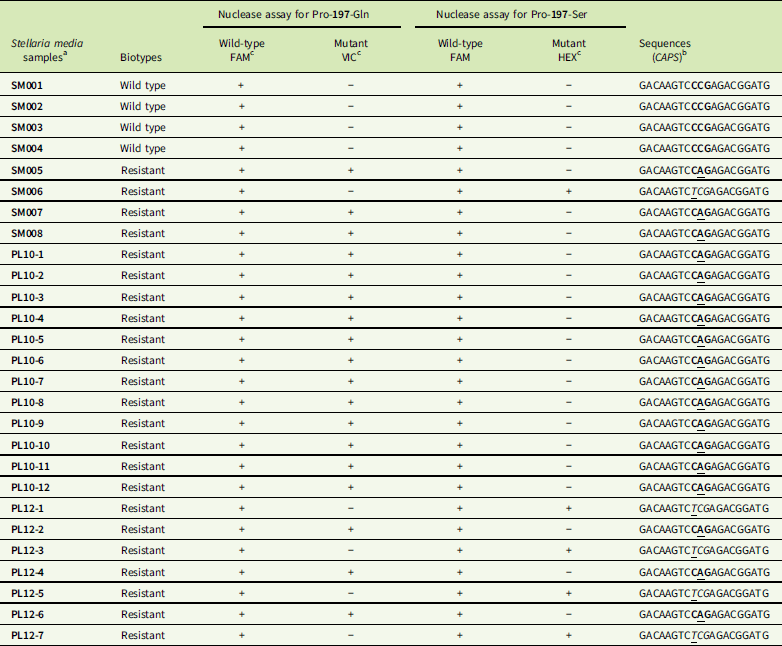
Plants were grown from AAFC negative control seeds (SM001 to SM004), seeds from samples located outside the field (SM005 to SM008), seeds from field plant 10 (PL10-1 to PL10-12), and seeds from field plant 12 (PL12-1 to PL12-7) (Table 1). These plants were genetically characterized for the presence of the resistance-conferring mutations. Because plant PL10-12 was positive for the Pro-197-Gln mutation and plant PL12-7 was positive for the mutation Pro-197-Ser, additional seeds were collected from these individuals to perform the dose–response assay and to characterize the level of resistance.
Correspondence between sequencing results and genetic tests (nuclease assays and cleaved amplified polymorphic sequence [CAPS] method).

a SM001 to SM004: susceptible controls from Agriculture and AgriFood Canada collection; SM005 to 008: suspected susceptible biotype from the Saint-Camille-de-Lellis field; PL10-1 to PL10-12 and PL12-1 to PL12-7: plants from seeds collected from suspected resistant biotypes PL10 and PL12, respectively.
b Sequences were determined using the dideoxynucleotide methodology described by Sanger et al. (Reference Sanger, Nicklen and Coulson1977); CAPS fragments are italicized.
c Fluorescent dies used to label the TaqMan probes.
All plants were grown under the following conditions: day (23 to 25 C) and night (17 to 19 C) temperatures, photoperiod of 16 h, and relative humidity of 50%. When plants reached the early seedling stage, a small leaf was cut and used for DNA extraction.
DNA Extraction, ALS Gene Amplification, and Sequencing
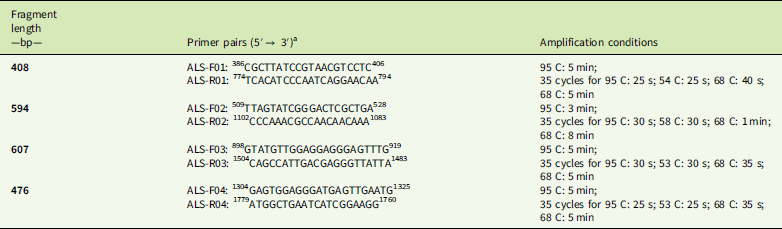
Genomic DNA of 27 S. media plants was extracted using Qiagen DNeasy Plant Mini Kit (Qiagen, Mississauga, ON, Canada) according to the manufacturer’s instructions. The different regions of the ALS gene where previous mutations have been reported were amplified using four different primer pairs, ALS-F01/R01, ALS-F02/R02, ALS-F03/R03, and ALS-F04/R04, designed based on ALS gene sequences of S. media and water starwort [Myosoton aquaticum (L.) Moench] (GenBank accession numbers: HE998774 and KF589891, respectively). A polymerase chain reaction (PCR) amplification was performed using the Titanium Taq PCR kit from Clontech Laboratories (Takara Bio USA, Mountain View, CA, USA). The primer pair sequences and the amplification conditions of each primer pair are indicated in Table 2. The PCR-amplified products were visualized on a 1% agarose gel, and the amplicons were sequenced by the dideoxynucleotide chain–termination method (Sanger et al. Reference Sanger, Nicklen and Coulson1977) at the Genome Quebec Innovation Centre, Montreal, QC, Canada. The sequence alignment and mutation visualization were performed using MEGA (Molecular Evolutionary Genetics Analysis v. 5.05 ) and the Staden Package (Bonfield et al. Reference Bonfield, Smith and Staden1995).
Acetolactate synthase (ALS)–specific primer pair sequences and amplification conditions used in this study.

a The superscript numbers indicate the nucleotide position respective to the start codon of the ALS gene in Myosoton aquaticum (GenBank accession number KF589891).
Detection of Pro-197-Gln Using Nuclease Assay
The Pro-197-Gln mutation in S. media–resistant biotypes has been previously reported to confer resistance to metsulfuron (Marshall et al. Reference Marshall, Hull and Moss2010). A first nuclease assay (TaqMan®) was therefore designed and used to discriminate between S. media wild type and the resistant biotype Pro-197-Gln (Holland et al. Reference Holland, Abramson, Watson and Gelfand1991). Primers and probes (Thermo Fisher Scientific, Cambridge, MA, USA) were designed based on the S. media ALS gene sequence generated through sequencing. The two primers (ALS-F: 5′-543GGTCCCGATCGTTGCAATTAC563-3′; ALS-R: 5′-604GGAAAGCATCAGTCCCGATCATC582-3′) were designed to amplify a 62-bp fragment containing the single-nucleotide polymorphism (SNP). Two TaqMan® probes were designed and labeled with florescent dies to detect either the wild type (FAM-labeled: 567ACAAGTCCCGAGACG581) or the resistant biotype Pro-197-Gln (VIC-labeled: 567ACAAGTCCAGAGACG581). Once the S. media ALS gene sequence is aligned with its homologous gene in a closely related species (M. aquaticum), the position of the oligonucleotides S. media ALS gene sequence refers to their positions relative to the start codon in the M. aquaticum ALS gene sequence. The SNP genotyping PCR reaction (10 µl) contained 5 µl of 2X ABI TaqMan® Genotyping Master Mix, 0.25 µl of 40X ABI Custom Assays (a mix of primers and the two probes), 4.25 µl of sterilized water, and 0.5 µl of genomic DNA. The amplification was performed under the following conditions: 10 min at 95 C; followed by 40 cycles of 15 s at 95 C and 1 min at 60 C in AriaMx Real-Time PCR System (Agilent Technologies, Santa Clara, CA, USA). The nuclease assay SNP genotyping method was tested for 27 S. media samples, and the results were compared with the ALS gene sequence analysis.
Detection of Pro-197-Ser Mutation Using CAPS Method or Nuclease Assay
The sequencing results of the ALS gene revealed the presence of a new mutation, Pro-197-Ser (proline to serine), in some S. media resistant biotypes. This new ALS mutation (Pro-197-Ser) can be distinguished from the other resistant biotypes (Pro-197-Gln) using either the cleaved amplified polymorphic sequence (CAPS) method or a nuclease assay (Konieczny and Ausubel Reference Konieczny and Ausubel1993).
The single nucleotide mutation that occurred in the resistant biotype Pro-197-Ser (C C CGAG to C T CGAG) created a XhoI restriction enzyme site. This enzyme recognizes the nucleotide sequence CˆTCGAG and cuts between the cytosine and thymine codons. To validate this CAPS method, the mutation-containing region of the ALS gene in the three biotypes (wild type, Pro-197-Gln, and Pro-197-Ser) was amplified using the primer pair ALS-F01/R01 under the conditions indicated in Table 2. The amplicons were digested by mixing 5 µl of PCR product with 10 µl of sterilized deionized water, 2 µl of enzyme buffer (10X), and 3 µl of XhoI (New England BioLabs, ON, Canada). After incubation at 37 C for 2 h, the product of the digestion was visualized on a 2 % agarose gel (Figure 1).
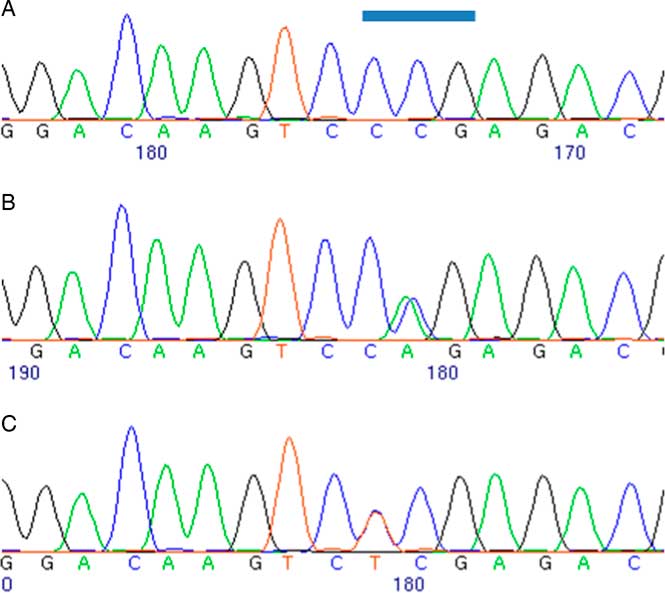
Acetolactate synthase gene sequencing chromatograms. Codon 197 is under the blue bar; (A) wild type is CCG=proline; (B) PL10-12 has two different codons: CCG=proline and CAG=glutamine; and (C) PL12-7 has two different codons: CCG=proline and TCG=serine.

For the nuclease assay, the two primers (ALS-F: 5′- 508TTAGTATCGGGACTCGCTGA527-3′; ALS-R: 5′-623TCGACAATTGGCGTTTCCT604-3′) were designed to amplify a 116-bp fragment containing the nucleotide mutations. Two custom nuclease assay probes were designed (Integrated DNA technologies, Coralville, IA, USA) to detect either the wild type (FAM-labeled: 567CAAGTCCCGA577) or the resistant biotype Pro-197-Ser (HEX-labeled: 581CAAGTCTCGAGA569). The SNP genotyping PCR reaction was performed using QuantiNova Multiplex PCR Kit (Qiagen). The 10 µl of reaction contained 2.5 µl of 4X Multiplex PCR Master Mix, 0.4 µl of each primer (ALS-F and ALS-R) at 10 µM, 0.4 µl of each probe at 8 µM, 4.9 µl of sterilized water, and 1 µl of genomic DNA. The amplification was performed under the following conditions: 2 min at 95 C; followed by 40 cycles of 5 s at 95 C and 30 s at 60 C in an AriaMx Real-Time PCR System (Agilent Technologies).
Resistance Evaluation and Dose Response
Following the identification of a new mutation by sequencing, dose–response experiments were performed in a greenhouse at AAFC’s Saint-Jean-sur-Richelieu Research and Development Center. For each of the three populations (susceptible, resistant Pro-197-Gln [P10-12 population], and resistant Pro-197-Ser [P12-7 population]), two groups of nine individuals were treated with each dose of the herbicides in a randomized complete block design. This entire experiment was repeated three times for a total of 54 plants per treatment. Plants from susceptible and suspected resistant biotypes were treated using a DeVries Manufacturing (Hollandale, MN, USA) moving-nozzle cabinet sprayer equipped with a 8001E-VS even-banding nozzle calibrated to deliver 180 L ha−1 of spray solution at 207 kPa. Doses of 0, 0.5, 1, 2, and 4 times the recommended dose for each of the three herbicides tested were applied. The recommended doses for foramsulfuron, flumetsulam, and imazethapyr were 35.1, 87.5, and 100.8 g ai ha−1, respectively. Shoot dry biomass was collected and weighed 28 d after treatment. Log-logistic dose–response analysis was performed as described by Seefeldt et al. (Reference Seefeldt, Jensen and Fuerst1995), where the response in dry biomass (Y), expressed as a percentage of untreated control, is related to the herbicide dose (x) and used to determine the value of the slope (b) and GR50 value that would best fit the distribution of the values according to Equation 1 (C, lower asymptote; D, upper asymptote; GR50, dose generating a 50% reduction in dry biomass).
 $$Y{\,\equals\,}C{\plus}\left\{ {\left( {D{\minus}C} \right)/\left[ {1{\plus}\left( {x/{\rm GR}_{{50}} } \right)^{b} } \right]} \right\}$$
The resistance factor was calculated by dividing the GR50 value of the resistant biotype by the GR50 value of the susceptible biotype. Dose–response calculations were performed in SigmaPlot (Systat Software, San Jose, CA, USA).
Results and Discussion
To investigate the possible resistance mechanism allowing the collected S. media biotype to survive field application of thifensulfuron-methyl/tribenuron-methyl, seeds from different plants suspected to be resistant and from a susceptible biotype were sown and genomic DNA extracted from plantlets. Four fragments totaling 1,361 bp of the ALS gene were amplified using four primer pairs (Table 2) and sequenced (Figure 1). As expected, a CCG codon (Figure 1A), coding for proline was found in the wild type at position 197. For seeds collected from the PL10 population, several individuals (PL10-12 shown in Figure 1B) were polymorphic (A/C) for the second nucleotide of the codon. This polymorphism creates two different codons, CCG and CAG coding for proline and glutamine, respectively. The mutation giving rise to a glutamine-197 is known to confer resistance to sulfonylureas as reported by Marshall et al. (Reference Marshall, Hull and Moss2010). Seedlings from PL12 were also polymorphic at codon 197, where the first base was heterozygous (C/T), again giving rise to the proline codon CCG but also a serine codon TCG (PL12-7 shown in Figure 1C). This transition was the only nonsynonymous mutation found in this allele (unpublished data). A serine at position 197 has been reported to confer resistance in a plethora of species: kochia [Bassia scoparia (L.) A. J. Scott], low falsepimpernel [Lindernia dubia (L.) Pennell], Lindernia micrantha D. Don, common falsepimpernel [Lindernia procumbens (Krock.) Philcox], prostrate pigweed (Amaranthus blitoides S. Watson), wild radish (Raphanus raphanistrum L.), corn poppy (Papaver rhoeas L.), ripgut brome (Bromus diandrus Roth), crown daisy [Glebionis coronaria (L.) Cass. ex Spach], monochoria [Monochoria vaginalis (Burm.f.) C. Presl ex Kunth], wild mustard (Sinapis arvensis L.), rock bulrush [Schoenoplectus juncoides (Roxb.) Palla], hare barley [Hordeum murinum ssp. leporinum (Link) Arcang.], rigid ryegrass (Lolium rigidum Gaud.), shepherd’s-purse [Capsella bursa-pastoris (L.) Medik.], flixweed [Descurainia sophia (L.) Webb ex Prantl], mayweed chamomile (Anthemis cotula L.), horseweed (Erigeron canadensis L.), silky windgrass [Apera spica-venti (L.) Beauv.], M. aquaticum, threeleaf arrowhead (Sagittaria trifolia L.), common groundsel (Senecio vulgaris L.), annual sedge (Cyperus compressus L.), smallflower umbrella sedge (Cyperus difformis L.), turnipweed [Rapistrum rugosum (L.) All.], and Palmer amaranth (Amaranthus palmeri S. Watson); but this is the first report for S. media (Heap Reference Heap2018).
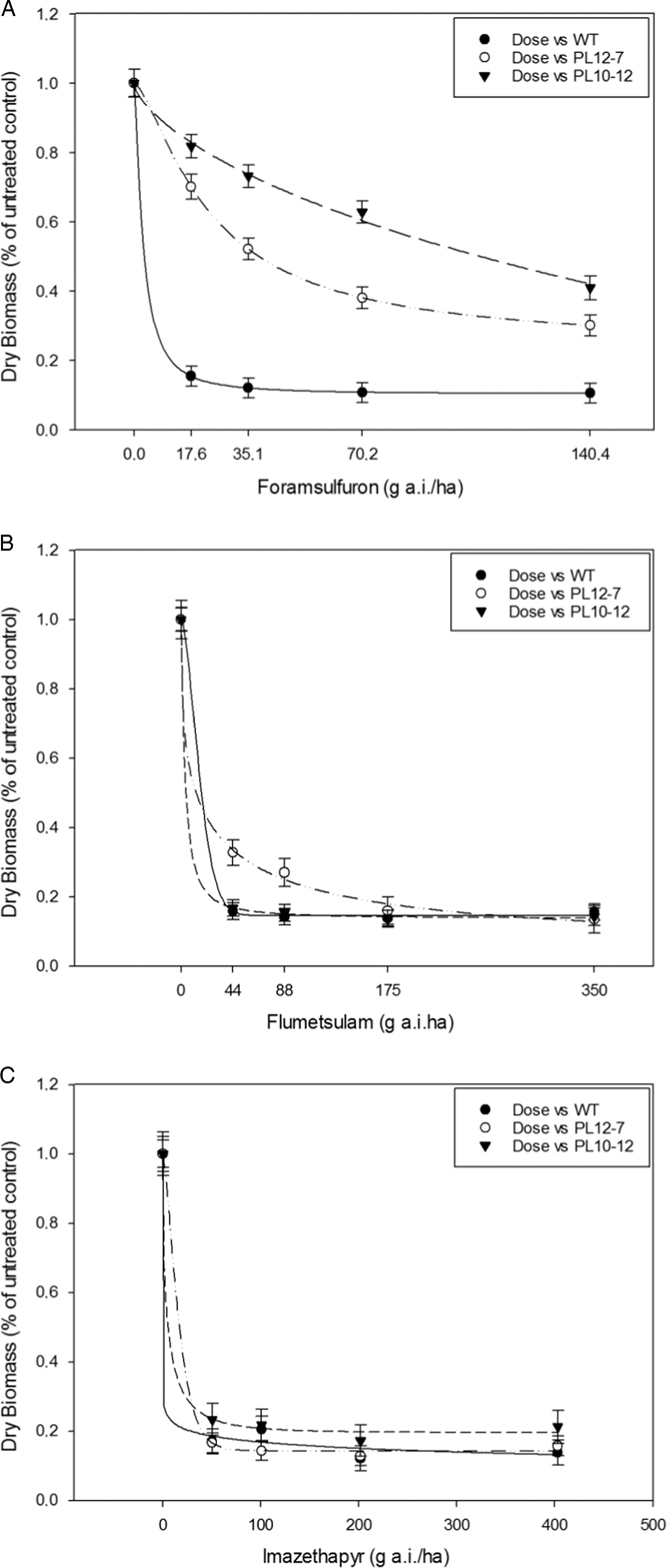
A dose–response experiment was conducted to determine the level of resistance to three families of Group 2 herbicides conferred by this new Pro-197-Ser mutation, in comparison to a susceptible biotype and the Pro-197-Gln population of S. media (Figure 2). After it was determined that S. media was on the label of the commercial products, herbicides from three different chemical families were chosen: triazolopyrimidines (flumetsulam), sulfonylureas (foramsulfuron), and imidazolinones (imazethapyr). Both flumetsulam and imazethapyr were able to control all biotypes effectively; the calculated resistance factors for biotypes Pro-197-Ser and Pro-197-Gln were close to or below 1 (Table 3). Population PL10-12 had a lower resistance factor value when compared with the biotype PL12-7 when treated with both flumetsulam and imazethapyr (0.2 vs. 0.6 and 0.2 vs. 1.1, respectively, Table 3). This result indicates that PL10-12 is more susceptible to the herbicide treatment than the biotype PL12-7 and the susceptible control (because values are <1). It is unknown whether this difference in susceptibility is due to the mutation per se or other genetic factors influencing the outcome of this experiment. This difference could also be attributed to the data used for the regression. A treatment with 0.25 times the label rate might have changed the log-logistic regression in a way that would have reduced this apparent difference in susceptibility. In either case, it is clear that the label rate of flumetsulam and imazethapyr is more than sufficient to control all three biotypes. When treated with foramsulfuron, the PL10-12 and PL12-7 biotypes show resistance factors of 231.3 and 24.2, respectively. The results obtained for the Pro-197-Gln population (PL10-12) agrees with those reported by Marshall et al. (Reference Marshall, Hull and Moss2010), although a different herbicide of the same chemical family was used in that study. The authors reported that this mutation conferred a resistance factor greater than 48 for metsulfuron, another sulfonylurea. It is also interesting to note that the Pro-197-Ser biotype is almost 10 times less resistant to foramsulfuron than the Pro-197-Gln biotype. Again, it is unclear whether other genetic factors change the resistance factor positively for the Pro-197-Gln biotype where our results suggest that the identity of the changed codon impacts the level of resistance. Such an observation for codon 197 was made for P. rhoeas, A. cotula, and S. vulgaris treated with either triazolopyrimidines or imizadolinone (Heap Reference Heap2018). In addition, we report here that none of the codon 197 mutations tested so far (Pro-197-Ser and Pro-197-Gln) confer resistance to one imizadolinone herbicide, imazethapyr. Marshall et al. (Reference Marshall, Hull and Moss2010) also reported that a Trp-574-Leu amino acid change confers broad-spectrum resistance to Group 2 herbicides. This example clearly illustrates the importance of knowledge about the resistance-conferring mutation. In our study the use of Group 2 herbicides not belonging to the sulfonylurea family will provide control of the resistant S. media biotype, and this information should be directly applicable in the field.
Dose–response curves for susceptible (dark points), Pro-197-Ser (light points), and Pro-197-Gln (dark triangles) Stellaria media biotypes treated with three different Group 2 herbicides [(A) foramsulfuron, (B) flumetsulam, and (C) imazethapyr] at five different concentrations (0×, 0.5×, 1×, 2×, and 4× times the label rate). Dry biomass was collected at 28 d after treatment.

Dose required to reduce dry biomass by 50% (GR50) for the susceptible biotype and the two resistant biotypes PL10-12 and PL12-7 treated with foramsulfuron, flumetsulam, and imazethapyr.

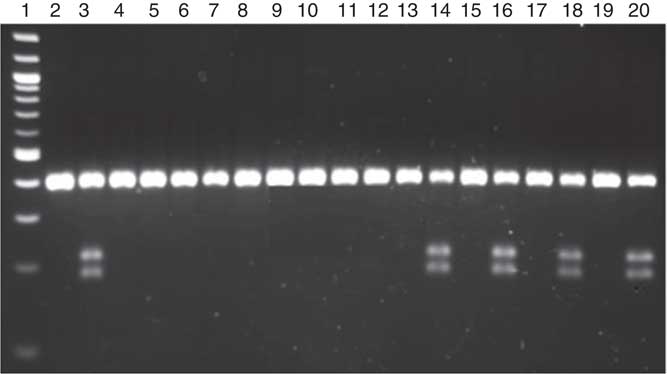
Resistance confirmation is the first step to undertake in order to select management practices to control weeds, and genetic tests provide a quick method to identify resistant biotypes for which the mechanism of resistance is known. For this purpose, we have developed assays to identify both Pro-197-Ser and Pro-197-Gln mutations. Table 1 summarizes results obtained with the nuclease assay for both mutations and the CAPS created for the Pro-197-Ser (Holland et al. Reference Holland, Abramson, Watson and Gelfand1991; Konieczny and Ausubel Reference Konieczny and Ausubel1993). The nuclease assay for Pro-197-Gln can identify resistant biotypes that have the nonsynonymous mutation Pro-197-Gln. Similarly, the nuclease assay for Pro-197-Ser can discriminate between the susceptible biotype and resistant biotypes that have the nonsynonymous mutation Pro-197-Ser (Supplementary Material). Figure 3 shows restriction results of a fragment amplified from 19 different individuals from susceptible, Pro-197-Ser, and Pro-197-Gln populations. The amplified fragment is 408-bp long, and there are two digested fragments of 188 and 220 bp. Individuals in lanes 2, 14, 16, 18, and 20 have three bands indicating the presence of a XhoI restriction site and, therefore, the Pro-197-Ser mutation. All other samples have the wild-type allele or bear the Pro-197-Gln mutation; the assay cannot discriminate between the two. The CAPS assay and the two nuclease assays have produced results that are in perfect agreement with Sanger sequencing results (Table 1). The results of sequencing, CAPS, and nuclease assays always indicate the presence of the wild-type allele.
Agarose gel electrophoresis of uncleaved and cleaved amplicons by XhoI restriction enzyme of ALS gene in Stellaria media biotypes. Lanes: 1, 100-bp DNA ladder; 2, SM001; 3, SM006; 4, PL10-3; 5, PL10-4; 6, PL10-5; 7, PL10-6; 8, PL10-7; 9, PL10-8; 10, PL10-9; 11, PL10-10; 12, PL10-11; 13, PL10-12; 14, PL12-1; 15, PL12-2; 16, PL12-3; 17, PL12-4; 18, PL12-5; 19, PL12-6; and 20, PL12-7. The cleaved amplicons are harboring the Pro-197-Ser mutation. The uncleaved amplicons might be wild type or Pro-197-Gln mutants.

Diploid Mendelian segregation indicates that at least five samples were expected to be homozygous for the mutation out of the 23 resistant plants tested, but we found none in our populations (Table 1). This result is expected, because S. media is autogamous, the plants tested are allotetraploids, and there are two copies of the ALS gene, one in each parent genome. It is impossible, with our results, to determine whether the two resistance-causing mutations are found in the same copy of the gene.
It is interesting to see two separate selection events occurring in the same field under the same selective pressure. Because not all resistance cases have been studied in depth, it is impossible to determine at which frequency this convergent evolution takes place. Westwood and Weller (Reference Westwood and Weller1997) have identified field bindweed (Convolvulus arvensis L.) biotypes from the same field that vary in their level of tolerance to glyphosate, and those authors propose that the mechanisms can combine to achieve higher tolerance factors. Similarly, there are two different mechanisms of resistance to glyphosate for L. rigidum (altered translocation and a target-site mutation), and both can be seen in the same field (Preston et al. Reference Preston, Wakelin, Dolman, Bostamam and Boutsalis2017). Because L. rigidum is an outcrosser, it is likely that individuals show either or both resistance mechanisms. Alarcon-Reverte et al. (Reference Alarcon-Reverte, Garcia, Watson, Abdallah, Sabate, Hernandez, Dayan and Fischer2015) also suggest that multiple mechanisms can be present in a glyphosate-resistant junglerice [Echinochloa colona (L.) Link] population. These examples, along with the S. media biotypes described in this paper, argue that plants will try to adapt in every way they can to herbicide selection, and all mechanisms can be tested in parallel. Selection of the fittest biotypes continues for as long as there is herbicide pressure.
The two mutations occurred in the same codon, which is surprising, because there are at least eight bases in the ALS gene known to confer resistance once mutated (Beckie and Tardif Reference Beckie and Tardif2012). There are 86 mutations in codon 197 out of a total of 171 mutations reported on WeedScience.org, which suggests that this locus is highly variable (Heap Reference Heap2018). We can only speculate on the reasons why this region is so inclined to mutate; maybe the methylation level at this site is lower than for the rest of the gene. A relationship between methylation state and mutation rate has been observed for humans (Xia et al. Reference Xia, Han and Zhao2012).
We report here a new mutation that confers resistance to Group 2 herbicides to S. media, Pro-197-Ser. This mutation was identified in a field biotype growing alongside another Group 2–resistant biotype harboring a Pro-197-Gln mutation. Genetic tests, based on the nuclease assay and on CAPS, can be used to rapidly provide information about the presence of resistance alleles in a field population. Dose–response experiments show that the new mutation confers intermediate resistance to sulfonylureas but the biotype is susceptible to imizadolinone and triazolopyrimidines.
Supplementary material
To view supplementary material for this article, please visit https://doi.org/10.1017/wsc.2018.26
Acknowledgments
The authors thank Francine Bond for her help in collecting the S. media biotypes, Luc Marchand and Sylvain Fortin for their help running dose–response experiments, and Marie-Josée Simard and Eric Page for discussions and reviews of this paper. This work was funded by AAFC (Project #J-001324). The authors declare that there are no conflicts of interest.