Infection prevention and control (IPC) practitioners and antimicrobial stewardship (AMS) program leads operate at the intersection of evidence-based medicine and institutional culture. Their daily work demands far more than microbiological expertise: they must persuade prescribers to de-escalate antibiotics, gain administrator support for surveillance initiatives, and align multidisciplinary teams behind evidence-based protocols. These are fundamentally negotiation challenges. Despite this reality, published competency frameworks for IPC and AMS professionals have historically emphasized technical, clinical, and epidemiological skills while leaving interpersonal influence and conflict resolution largely unaddressed.
Recent evidence suggests this gap has measurable consequences. A multicenter stepped-wedge randomized controlled trial (RCT) across nine children’s hospitals demonstrated that facilitation workshops covering communication style awareness, relationship-building, and conflict resolution strategies produced significantly more completed antibiotic order-set changes and greater elimination of unnecessary postoperative antibiotics than technical implementation alone. Reference McKay, Malone and Tetteh1 A national project using real AMS–prescriber scenarios found that structured negotiation strategies—generated with artificial intelligence coaching—significantly increased expert-rated likelihood that prescribers would accept stewardship recommendations (P < .0001). Reference Webb, Buckel and Childress2 These findings underscore a compelling case for formalizing negotiation and conflict resolution as core competencies in IPC/AMS professional development.
The evidence base
Evidence linking soft-skill training to IPC/AMS effectiveness spans multiple study designs and settings. Bryant et al documented that physician-led IPC programs underpinned by cross-disciplinary leadership and structured communication had lower healthcare-associated infection (HAI) rates, highlighting formal leadership and teamwork competencies as foundational to program success. Reference Bryant, Harris and Gould3 Kaye et al., in guidance on healthcare epidemiologist skills, explicitly identified leadership and communication proficiency as essential alongside clinical competencies, noting that translating evidence into practice requires the ability to lead diverse teams and negotiate change across professional boundaries. Reference Kaye, Anderson and Cook4
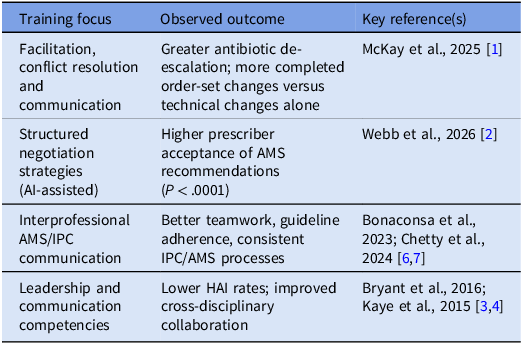
Training that incorporates skills rather than knowledge alone shows consistent advantages. Turner et al., applying the Capability, Opportunity, Motivation, Behavior (COM-B) model to AMS education in UK hospitals, identified organizational context, role clarity, and interprofessional dynamics as principal determinants of whether training translated into sustained practice change. Reference Turner, Hart and Ashiru-Oredope5 Surveys across nursing and mixed cadres confirm that AMS and IPC training programs that build communication skills—not just antimicrobial knowledge—generate greater stewardship engagement and interprofessional collaboration. Reference Bonaconsa, Mbamalu and Surendran6,Reference Chetty, Swe-Han, Mahabeer, Pillay and Essack7 Table 1 summarizes key evidence linking soft-skill training to IPC/AMS outcomes.
Evidence linking soft-skill training to IPC/AMS program outcomes

Table 1. Long description
A table with four rows and three columns. The columns are labeled Training focus, Observed outcome, and Key reference(s). The rows are as follows: Row 1: Training focus, Facilitation, conflict resolution and communication; Observed outcome, Greater antibiotic de-escalation; more completed order-set changes versus technical changes alone; Key reference(s), McKay et al., 2025 [1]. Row 2: Training focus, Structured negotiation strategies (AI-assisted); Observed outcome, Higher prescriber acceptance of AMS recommendations (P <.0001); Key reference(s), Webb et al., 2026 [2]. Row 3: Training focus, Interprofessional AMS/IPC communication; Observed outcome, Better teamwork, guideline adherence, consistent IPC/AMS processes; Key reference(s), Bonaconsa et al., 2023; Chetty et al., 2024 [6,7]. Row 4: Training focus, Leadership and communication competencies; Observed outcome, Lower HAI rates; improved cross-disciplinary collaboration; Key reference(s), Bryant et al., 2016; Kaye et al., 2015 [3,4].
AMS, antimicrobial stewardship; HAI, healthcare-associated infection; IPC, infection prevention and control.
Current competency frameworks: a gap analysis
Existing IPC and AMS competency documents have made important strides. Kaye et al. identify communication and leadership broadly but stop short of specifying negotiation techniques, interest-based bargaining, or structured approaches to resolving professional disagreement. Reference Kaye, Anderson and Cook4 Recent curricula, including the Society of Healthcare Epidemiology of America (SHEA) infectious diseases fellows’ curriculum published by Martin et al., Reference Martin, Cichon and Choudhury8 address infection prevention and healthcare epidemiology competencies comprehensively, yet negotiation and principled conflict resolution remain underspecified within their interprofessional communication domains. National and international AMS frameworks similarly enumerate clinical knowledge domains without equivalent specificity for the interpersonal skills required when a surgeon disagrees with a perioperative prophylaxis recommendation or a ward physician resists IV-to-oral switching.
This omission is not merely academic. Surveys consistently show that IPC and AMS practitioners identify prescriber resistance, hierarchy, and interprofessional conflict as primary barriers to implementing evidence-based recommendations. Reference Turner, Hart and Ashiru-Oredope5 Training programs that address knowledge without building the skills to navigate resistance leave practitioners technically equipped but relationally underprepared for clinical reality.
A call to action
We propose that professional societies, accrediting bodies, and hospital training programs take the following steps:
Revise IPC and AMS competency frameworks to include explicit domains for negotiation, principled conflict resolution, and stakeholder engagement alongside existing clinical and epidemiological competencies.
Develop and validate training curricula that incorporate simulation-based negotiation scenarios drawn from real IPC/AMS practice contexts—perioperative prophylaxis discussions, isolation precaution disagreements, and antibiotic approval conversations—enabling practitioners to rehearse these skills before high-stakes encounters.
Adopt train-the-trainer models that enable local champions to deliver and sustain negotiation skill development across institutions, particularly in resource-limited settings where centralized training may be inaccessible.
Evaluate outcomes rigorously using mixed methods that capture both quantitative measures (antibiotic use, HAI rates, recommendation acceptance rates) and qualitative accounts of interprofessional dynamics.
The evidence base, while consistent, has important limitations: randomized evidence directly isolating negotiation training as an independent driver of improved IPC/AMS outcomes remains sparse, and most studies evaluate bundled interventions. Organizational context and resource availability substantially mediate training impact, Reference Turner, Hart and Ashiru-Oredope5 and training without complementary structural supports—protected time, data feedback, and leadership endorsement—is unlikely to yield sustained change. Reference Bryant, Harris and Gould3,Reference Kaye, Anderson and Cook4
Conclusion
Infection prevention and AMS are fundamentally relational disciplines. The practitioner who cannot negotiate effectively with a resistant prescriber, build consensus among competing stakeholders, or manage interprofessional conflict is constrained in their ability to protect patients regardless of technical expertise. Converging evidence from RCTs, qualitative research, and program evaluations supports formalizing negotiation and conflict resolution as explicit competencies within IPC/AMS professional development. Incorporating these skills into competency frameworks, training curricula, and institutional programs will strengthen the human infrastructure upon which effective infection prevention and AMS ultimately depend.
Financial support
None declared.
Competing interests
None declared.