BACKGROUND
Methicillin-resistant Staphylococcus aureus (MRSA) has become a major problem for US healthcare facilities during the past 20 years.1, Reference Klein, Smith and Laxminarayan2 MRSA colonization is associated with increased risk of infection even after hospital discharge,Reference Huang and Platt3 worse clinical outcomes,Reference Cosgrove, Sakoulas, Perencevich, Schwaber, Karchmer and Carmeli4–Reference Reed, Friedman and Engemann8 and higher costs of care.Reference Engemann, Carmeli and Cosgrove5–Reference McHugh and Riley9 Healthcare-associated infections have been identified as a focus area in Healthy People 2020, with reduction of invasive healthcare-associated MRSA infections named as a top priority.10
Many strategies can be used to reduce the risk of MRSA transmission and infection. Active surveillance cultures (ASC) can be used to screen patients, with isolation of identified MRSA carriers. This strategy can be combined with decolonization of patients with chlorhexidine gluconate (CHG) baths, with or without mupirocin to the nares, to further reduce the risk of transmission and infection within carriers. At the other extreme, depending on factors such as the prevalence of MRSA among patients entering a particular hospital, a more effective strategy might be to simply isolate and/or decolonize all patients who enter a hospital regardless of MRSA status.
Decision makers are thus faced with a wide variety of strategies while considering the cost and effectiveness of each strategy. Decision analytic models have increasingly been used to evaluate the potential impact of health policy questionsReference Kim and Goldie11–Reference Stout, Rosenberg, Trentham-Dietz, Smith, Robinson and Fryback13 by comparing the projected outcomes and costs of alternative strategies.Reference Weinstein and Fineberg14 Models are particularly useful when it is impractical to support multiple clinical trials to compare a range of strategies. In real world settings where healthcare facilities consider a range of strategies under constrained resources, a comprehensive model that brings together all available strategies would aid decision making at both the local and national levels. We created a national policy model to evaluate the projected cost-effectiveness of multiple hospital-based management strategies to prevent MRSA transmission and infection.
METHODS
Natural History Model
We developed a Markov microsimulation model using TreeAge Pro (TreeAge) for a hypothetical cohort of 10,000 patients admitted to intensive care units (ICUs) in the United States. The model yields a hospital perspective analysis as the cohort moves through hospitalization and after discharge. We simulate the natural history of MRSA colonization and infection using a sequence of daily transitions among health states (Figure 1) over a 1-year time horizon. MRSA colonization is defined as a health state in which a patient carries the bacteria but has no clinical infection. MRSA infection occurs when a patient develops an invasive infection.
Natural history model. Acquisition of methicillin-resistant Staphylococcus aureus (MRSA) colonization and subsequent infection can be interrupted at the transition indicated by A (by contact precautions preventing transmission of MRSA, and/or by decolonization decreasing colonization pressure). MRSA infections can also be interrupted at the transitions indicated by B (by decolonization with mupirocin and/or chlorhexidine gluconate preventing infections that would have resulted from colonization in already colonized patients). CAUTI, catheter-associated urinary tract infection; CLABSI, central line-associated bloodstream infection; ICU, intensive care unit; SSI, surgical site infections; VAP, ventilator-associated pneumonia

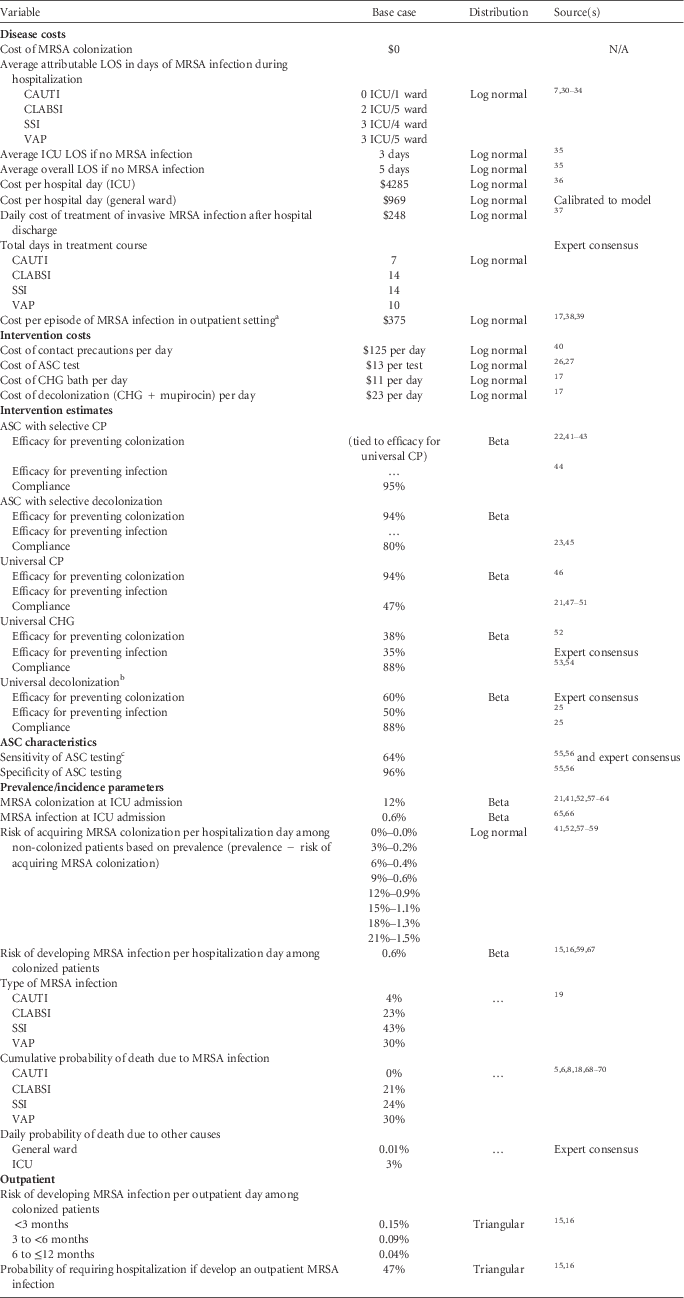
Some patients are colonized and/or infected with MRSA at admission (Table 1), whereas others face a daily risk of acquiring MRSA colonization based on the prevalence of MRSA in the ICU. As overall MRSA colonization prevalence increases, we assume a higher risk of acquiring MRSA colonization among noncolonized patients. In our base case analysis, we assume that the average ICU prevalence is 12% (Table 1); we also consider the impact of lower (5%) and higher (20%) prevalence in alternative analyses.
Model Variables: Baseline Values and Ranges Used in Sensitivity Analyses
Note. ASC, active surveillance cultures; CAUTI, catheter-associated urinary tract infection; CHG, chlorhexidine gluconate; CLABSI, central line-associated bloodstream infection; CP, contact precautions; ICU, intensive care unit; LOS, length of stay; MRSA, methicillin-resistant Staphylococcus aureus; SSI, surgical site infections; VAP, ventilator-associated pneumonia.
a Based on cost of skin and soft tissue infections.
b We based the estimates for efficacy for preventing infection and compliance with the intervention from the trial from reference Reference Huang, Septimus and Kleinman25 (extrapolating from the effectiveness result presented in the trial). We then used expert consensus to judge the possible efficacy for colonization based on these estimates.
c We assume that patients are receiving nares swabs only. Per expert consensus, we took an estimate of 92% from the literature for detection of MRSA from culture under perfect conditions, and multiplied that by 70% to reflect the sensitivity of nares swabs to detect MRSA colonization.
Patients with MRSA infection either die or remain persistently infected until treatment is complete. If infected patients complete treatment, they are no longer colonized but can be recolonized and reinfected. Any patients who are discharged from the hospital and who are still colonized (owing either to persistent colonization or because of recolonization) can remain uninfected or develop an MRSA infection after discharge.Reference Datta and Huang15, Reference Huang, Hinrichsen and Datta16 Patients who develop a postdischarge infection either are treated as an outpatient or may require readmission (for MRSA bacteremia, for example).
Strategies
We assume a baseline approach of standard precautions (including hand hygiene) plus contact precautions for patients known to be MRSA colonized or infected, and we compare 7 distinct ICU-based strategies: (1) ASC on ICU admission (includes contact precautions if found to be MRSA colonized); (2) ASC+selective decolonization for identified MRSA carriers; (3) universal contact precautions (UCP); (4) universal CHG baths; (5) universal decolonization (CHG baths and nasal mupirocin); (6) UCP+universal CHG baths; and (7) UCP+universal decolonization. The first 5 strategies were chosen after reviewing the literature and seeking expert guidance to reflect the most common strategies in ICUs. The latter 2 strategies consist of combinations (UCP+CHG baths; UCP+decolonization) to provide insight into the utility of the most aggressive approaches to MRSA control.
For ASC strategies, cultures are obtained on ICU admission and weekly thereafter as long as the patient remains in the ICU. We assume use of a standard swab of the nasal mucosa plated to chromogenic agar with results available within 1 to 2 days (to allow time for the laboratory to receive the swab, process it, and report results). If patients screen positive, they are placed on contact precautions (healthcare workers wear gloves and gowns). With selective decolonization, those who screen positive undergo daily CHG baths and twice daily mupirocin ointment applied to the nares for a maximum of 5 days or until discharge from the ICU, whichever occurs first. In contrast, universal strategies are applied to all ICU patients. If the universal CHG strategy is selected, we assume all patients are bathed daily with CHG for the duration of their ICU stay. UCP refers to the practice where gowns and gloves are used routinely for all patients while in the ICU unless they are known MRSA carriers, which results in the use of contact precautions throughout hospitalization.
For each strategy, both efficacy and compliance are considered. Efficacy is the strategy’s ability to reduce the risk of MRSA colonization or infection under ideal circumstances. Less-than-perfect compliance mitigates the overall effectiveness of each intervention, reflecting real-world conditions. We consider 3 types of efficacy in our model (Fig 1). For barrier-based strategies that use contact precautions, we assume a lower risk of transmission from carriers to noncarriers, which lowers colonization pressure and reduces the risk of MRSA acquisition. Barrier-based strategies are assumed to have no impact on either colonization or infection among individuals with preexisting colonization. For decolonization-based strategies, we assume a reduction in the probability of ongoing colonization and subsequent infection in previously colonized individuals. We also assume decolonization-based strategies reduce the risk for MRSA acquisition among noncolonized patients by lowering overall MRSA colonization prevalence. For strategies that rely on ASC, we assume that contact precautions with or without selective decolonization are implemented when test results are available. False-negative test results and the delay in implementation both lead to lower estimates of efficacy compared with empiric strategies such as UCP and universal decolonization.
Costs
We consider the following costs in the model: (1) inpatient medical costs attributable to MRSA infection; (2) outpatient medical costs attributable to MRSA infection (both for outpatient treatment of inpatient infection, as well as for outpatient treatment of infections that occur after hospitalization owing to colonization acquired while hospitalized); and (3) intervention costs. We estimated costs and attributable length of stay due to infection on the basis of literature review and the model was calibrated accordingly. If a patient develops a postdischarge infection and is then readmitted, all subsequent hospital costs are considered attributable to MRSA. Outpatient costs for MRSA infection include the cost of an outpatient visit (average, 1.5 visits) and cost of oral antibiotic therapy (trimethoprim-sulfamethoxazole, clindamycin, or doxycycline for an average duration of 7 days). Cost estimates are based on dollar values from 2013 by using the medical care component of the consumer price index to account for inflation.17 Future costs are discounted at an annual rate of 3%.
Outcomes
Outcomes of interest are (1) cases of colonization averted, (2) cases of infection averted, (3) incremental cost per colonization averted, and (4) incremental cost per infection averted. The number of cases of colonization averted includes those patients who were colonized on admission to the ICU and subsequently became decolonized. The number of cases of infection prevented includes those infections avoided within a colonized patient (through decolonization), as well as those prevented by decreasing colonization pressure (through either decolonization or contact precautions). The incremental cost per case of colonization or infection averted is calculated as the cost difference for a given strategy compared with the cost of the next least expensive strategy, divided by the difference in the number of cases (of colonization or infection) prevented by the 2 strategies.
Uncertainty
Estimates used for model parameters were based on the best available estimates in the literature (Table 1). We also sought input from key experts through the Centers for Disease Control and Prevention (CDC) Prevention Epicenters program at their meeting on August 18, 2010. We presented estimates for key parameters, including MRSA transmission rates, infection rates, efficacy of interventions, compliance, and costs, and sought their feedback. We also convened a smaller formal expert panel in order to seek further input and validate our estimates.
To account for first order uncertainty, we use a microsimulation model to capture the stochastic nature of events among individuals in the cohort. We also consider second order uncertainty, or parameter uncertainty, by using probabilistic sensitivity analysis to vary the following parameters concurrently: (1) probability of colonization and infection at admission, (2) probability of acquiring colonization per day if not colonized, (3) attributable length of stay due to infection as well as baseline length of stay in uninfected patients, (4) efficacy of each intervention, (5) risk of postdischarge infection if colonized, (6) cost of infection, and (7) cost of each intervention strategy. We use beta distributions for probabilities, log normal distributions for length of stay and cost, and triangular distributions for risk of postdischarge infection. Our Markov microsimulation model was run for 10,000 cohorts with 10,000 patients each to evaluate the robustness of our findings for the cost-effective strategies. Incremental costs and effectiveness estimates for each of the 10,000 cohorts are depicted on a scatterplot. We also calculated a proportion for how often the strategy of interest was more effective and cost saving compared with the next most expensive strategy.
RESULTS
Base Case Scenario
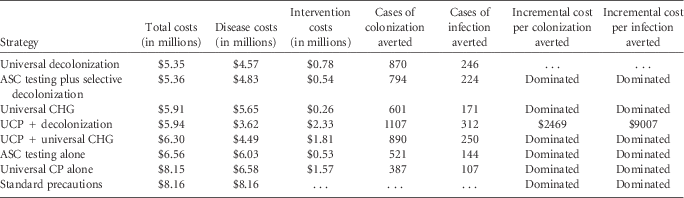
In the absence of MRSA prevention strategies, 1989 cases of colonization and 544 invasive infections occurred in a cohort of 10,000 patients admitted to ICUs. Strategies involving UCP paired with another intervention were the most effective. UCP+decolonization averted the greatest number of cases of MRSA colonization (1107, or 56%) and infection (312, or 57%) per 10,000 patients, while UCP+universal CHG was the next most effective strategy (890 cases of colonization and 250 infections averted, or 45% and 46%, respectively), compared with standard precautions (which includes contact precautions for known MRSA carriers) (Table 2).
Incremental Cost per Colonization and Infection Averted per 10,000 Intensive Care Unit Admissions for Alternative Strategies Using Base Case Assumptions
Note. Under standard precautions, 1989 and 544 cases of MRSA colonization and infection would occur, respectively. ASC, active surveillance cultures; CHG, chlorhexidine gluconate; CP, contact precautions.
Strategies without decolonization—meaning ASC+selective contact precautions or UCP alone—were the least effective strategies. Among strategies involving decolonization (with chlorhexidine+/−mupirocin), ASC testing+selective decolonization of MRSA carriers, universal CHG, and universal decolonization prevented more cases of MRSA than standard precautions but were not the most effective strategies.
The total medical cost associated with MRSA infection in this hypothetical cohort of 10,000 patients admitted to the ICU was $8.16 million (we assume that colonization itself does not result in higher medical costs in the absence of prevention strategies). Strategies without decolonization—UCP or ASC+selective contact precautions—were the most expensive, with net costs of $8.15 million and $6.56 million respectively. The next most expensive were UCP+CHG, UCP+decolonization, and universal CHG. Universal decolonization alone had the lowest net cost ($5.35 million), including intervention cost ($0.78 million) and costs saved owing to MRSA infection prevention ($3.59 million). ASC testing plus selective decolonization resulted in decreased intervention costs but also decreased savings owing to less effective disease prevention.
Universal decolonization was cost saving overall and prevented 44% of cases of colonization and 45% of cases of infection. The next best strategy was UCP+decolonization, which resulted in incremental cost-effectiveness ratios of $2469 per colonization averted and $9007 per infection averted compared to universal decolonization. All other strategies were dominated (more costly and less effective).
Impact of MRSA Colonization Prevalence
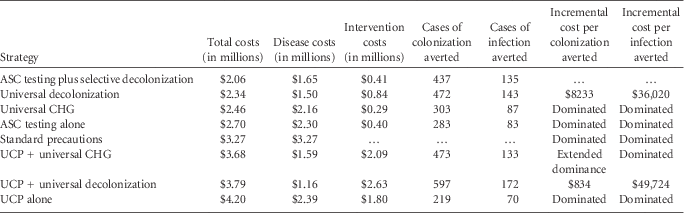
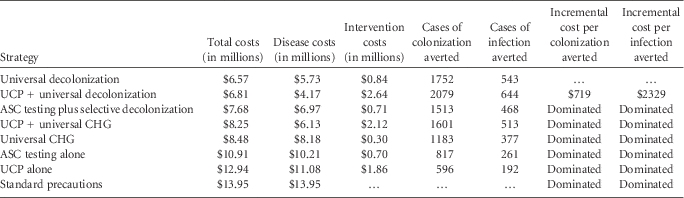
If MRSA prevalence were lowered to 5%, the least expensive and reasonably effective strategy became ASC+selective decolonization (Appendix A). Universal decolonization was slightly more expensive and could prevent an additional 35 cases of colonization and 8 cases of infection. UCP+decolonization remained the most effective strategy to prevent both colonization and infection, with incremental cost-effectiveness ratios of $834 and $49,724, respectively. At a higher prevalence of 20%, results were very similar to the main model, with universal decolonization again being the least costly strategy (Appendix B). UCP+universal decolonization was the next best strategy with incremental cost-effectiveness ratios of $719 and $2329 per additional case of colonization and infection prevented. All other strategies were dominated.
Probabilistic Sensitivity Analysis
Universal decolonization is more effective and cost saving compared with standard precautions 85% of the time for MRSA colonization and infection (Figures 2 and 3). When UCP+decolonization is compared with universal decolonization, 24% of the model runs result in estimates that are more effective and cost saving for colonization and infection. Furthermore, 95% yielded incremental cost-effectiveness ratios that were less than $2500 per colonization averted and less than $9000 per infection averted.
Probabilistic sensitivity analyses of cost per case of colonization prevented under different strategies. CP, contact precautions. Panel A – Universal decolonization versus standard precautions Panel B – Universal CP+decolonization versus universal decolonization
Probabilistic sensitivity analyses of cost per case of infection prevented under different strategies. CP, contact precautions. Panel A – Universal decolonization versus standard precautions Panel B – Universal CP+decolonization versus universal decolonization
DISCUSSION
We developed a national policy model to evaluate the cost-effectiveness of strategies to prevent MRSA colonization and infection. Assuming 4 million ICU visits per year in the United States, our model estimates that 218,000 MRSA infections would occur in the absence of any intervention (i.e., standard precautions) at a cost of approximately $3.3 billion, similar to previously published national estimates.Reference Klevens, Morrison and Nadle18–20 Our model predicts that universal decolonization would prevent 44% of MRSA infections and reduce overall costs by 34% (i.e., by $1.11 billion). UCP+decolonization was more effective than universal decolonization and may be worth considering if the willingness-to-pay threshold is at least $2400 per colonization averted or $9000 per infection averted. Universal decolonization was more effective and less expensive compared with standard precautions, nondecolonization strategies, or use of universal CHG alone. Decolonization-based strategies that utilize both intranasal mupirocin and CHG baths were preferred over other strategies even when we varied assumptions about disease probabilities, efficacy, and costs.
Our US-based policy model is one of the first to compare all ICU-based strategies head-to-head. Other models have typically evaluated a single intervention,Reference Huskins, Huckabee and O'Grady21–Reference Fraser, Fatica and Scarpelli23 which limits the utility for decision makers who may want to optimize their investment among a range of available strategies. A model based in the United Kingdom also evaluated a wide range of strategies and found that universal nasal mupirocin alone was the most cost-effective strategy.Reference Robotham, Graves and Cookson24 However, universal decolonization with both mupirocin and CHG was not considered, which is relevant for decision makers in the United States. We consider not only the costs and outcomes associated with MRSA during the initial hospital admission but also the subsequent impact after discharge. This is critically important since much of the infection burden following acquisition of MRSA occurs after discharge from the hospital.Reference Datta and Huang15, Reference Huang, Hinrichsen and Datta16
Our findings are based on a theoretical model and are remarkably in line with results from recent trials on MRSA control strategies. Huang et al.Reference Huang, Septimus and Kleinman25 demonstrated that universal decolonization of ICU patients was the most effective strategy to decrease bloodstream infections (across all pathogens) and reduce MRSA clinical isolates. Our model provides further support to this approach by demonstrating that it is cost-saving in addition.
Though we conducted a robust set of sensitivity analyses, there are several limitations to consider. First, our model applies to an “average” hospital based on average US estimates. Individual healthcare facilities may wish to reconsider the full range of strategies using alternative assumptions about MRSA prevalence, costs, and compliance based on local data. For example, when we changed the MRSA prevalence to 5%, we found that ASC plus selective decolonization became the least expensive strategy. Furthermore, hospitals may be constrained by the resources needed for interventions that may not be directly reimbursed by payers. However, shorter lengths of stay, lower readmission rates, and improved outcomes provide a counterbalancing financial incentive from the hospital perspective. The ability of hospitals to invest in prevention efforts may vary depending on their calculated return on investment.
Second, we did not explicitly consider the horizontal impact of these interventions on reducing transmission of other common pathogens, such as vancomycin-resistant enterococci. The added benefit of strategies using CHG in preventing transmission and infection by organisms other than MRSA would improve the overall cost-effectiveness and further incentivize investment of resources for infection prevention.
Third, our model assumes that all patients return to the same hospital for readmissions. In reality, patients are often admitted to other facilities that subsequently benefit from the cost savings of interventions. This also means that we could not formally consider the potential for decolonization-based strategies to reduce spread of MRSA to other healthcare facilities. Such strategies could be tested in community-based modelsReference Lee, Singh and Bartsch26, Reference Lee, Wong and Bartsch27 that capture the synergistic effect of coordinated regional efforts to minimize MRSA transmission.
Fourth, our model did not incorporate mupirocin or CHG resistance. One approach to incorporate the possibility of resistance would be to decrease the overall efficacy of decolonization-based interventions over a longer time horizon. Prolonged mupirocin use would very likely lead to the emergence of resistance, which would mitigate the overall cost-effectiveness of these interventions unless alternative options such as retapamulin became readily available.
Our model did not consider other MRSA infections during the initial admission, such as MRSA bacteremia that was not associated with a central line, which could contribute substantially to morbidity and costs.Reference Dantes, Mu and Belflower28, Reference Epstein, Kallen and Bellflower29 However, it did account for postdischarge MRSA bacteremia and subsequent readmissions. Finally, our model was not designed to be a dynamic model of MRSA transmission, though we did incorporate estimates for increased risk of MRSA transmission as hospital-wide prevalence increases.
In conclusion, our national policy model compares multiple strategies to prevent MRSA colonization and infection in an ICU cohort. Universal decolonization is more effective and cost saving compared with all other strategies, except for UCP+decolonization. UCP+decolonization may be more effective than universal decolonization alone if decision makers are willing to pay approximately $2400 per case of MRSA colonization averted or approximately $9000 per case of MRSA infection averted. ICUs with a high prevalence of MRSA colonization that are not currently using strategies to control MRSA beyond standard precautions may wish to consider universal decolonization with or without UCP, depending on local factors such as the baseline prevalence of MRSA colonization and the availability of resources.
Acknowledgments
We thank the following individuals for their invaluable assistance with this work: Marc Lipsitch and Joshua Salomon (Harvard School of Public Health), Anthony Harris (University of Maryland), Lauren Hunter (RAND Corporation), Melisa Rett, Michael Murphy, and Julie Lankiewicz (Harvard Pilgrim Health Care Institute). We also thank our colleagues from the CDC Prevention Epicenters who provided input on key estimates.
Financial support. CDC (grant 1U01CI000344 for the Epicenters Program); National Institute of General Medical Sciences (award U54GM088558).
Potential conflicts of interest. S.S.H. reports that she is conducting a clinical trial in which participating hospitals are receiving contributed product from Sage Products and MoInlycke. All other authors report no conflicts of interest relevant to this article.
The findings and conclusions in this presentation are those of the authors and do not necessarily represent the views of the CDC. The content is solely the responsibility of the authors and does not necessarily represent the official views of the National Institute of General Medical Sciences or the National Institutes of Health.
Incremental Cost per Colonization and Infection Averted per 10,000 Intensive Care Unit Admissions for Alternative Strategies under Assumption that Methicillin-Resistant Staphylococcus aureus Prevalence Is 5%
Incremental Cost per Colonization and Infection Averted per 10,000 Intensive Care Unit Admissions for Alternative Strategies under Assumption that Methicillin-Resistant Staphylococcus aureus Prevalence Is 20%