Introduction
In March 1919, a remarkable wave of demonstrations – the March First Movement – swept across the Korean peninsula as citizens rose in protest against Japanese colonial rule, which had begun in 1910. Among the demonstrators were not only male students, intellectuals, and religious leaders but also a substantial number of women. According to the March First Movement Database, approximately one million participants were involved in the movement, out of Korea’s total population of 16 million (National Institute of Korean History 2019). At that time, only 1.5 percent of Koreans were Protestant. Nevertheless, Protestant organizations are estimated to have accounted for roughly a quarter of the groups active in the March First demonstrations (Ryu Reference Ryu2017; So Reference So2019). Japanese authorities arrested 19,525 individuals, including 471 women – a remarkable figure in a society where female political participation had been virtually absent before 1919. According to arrest records in the March First Movement Archives, approximately 60 percent of detained women identified as Protestants (Ko Reference Ko2019). While women constituted only about 5 percent of those arrested, their presence was nonetheless significant. These figures underscore the disproportionate role of Christianity – especially Protestant missions – in opening pathways for women’s political participation in early twentieth-century Korea.
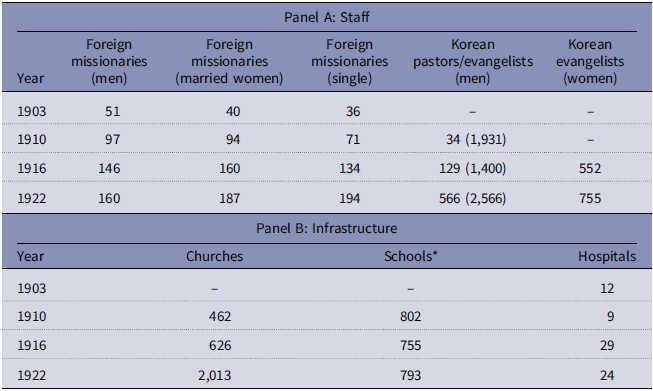
During the late Joseon dynasty, women had been largely invisible in public life – confined to households, constrained by strict patriarchal norms, and broadly denied individual identity through the practice of withholding personal names (Kim Reference Kim2021; Kim Reference Kim2019; Ryu Reference Ryu2017). The few exceptions were typically from elite households, yet even these women rarely appeared as independent actors. Explaining this transformation requires distinguishing between political participation and formal suffrage. During colonial rule, no Koreans possessed voting rights. Women’s political emergence, therefore, occurred through extra-institutional channels: independence activism, mission-organized networks, and public demonstrations – forms of participation that required neither suffrage nor formal political rights. This study argues that Protestant influence, introduced after Korea’s opening to the Western world in 1884, provided pathways for women’s education and political engagement. Western female missionaries – the vast majority of whom came from the United States – established the first modern schools for girls, introduced literacy and biblical study, and, more importantly, potentially served as living examples that women could take on public roles beyond the household. Equally important were their Korean counterparts, known as “Bible women,” who worked alongside Western missionaries as catechists, educators, and advocates for women’s empowerment. Together, Western female missionaries and Bible women created unprecedented social spaces for women, enabling them to acquire literacy, engage in discussions, and ultimately participate in political movements. By 1922, there were 381 Western female missionaries and 755 Korean female evangelists active in Korea (see Table 1), with 732 female missionaries having served cumulatively in the Korean peninsula during the colonial period (see Table A1 in the Supplementary material).
Protestant staff and infrastructure in Korea, 1903–1922

Table 1 Long description
The table is divided into two panels: Panel A and Panel B. Panel A focuses on staff, listing the number of foreign missionaries (men, married women, and single) and Korean pastors/evangelists (men and women) for the years 1903, 1910, 1916, and 1922. Panel B focuses on infrastructure, listing the number of churches, schools, and hospitals for the same years. Panel A has five columns: Foreign missionaries (men), Foreign missionaries (married women), Foreign missionaries (single), Korean pastors/evangelists (men), and Korean evangelists (women). Panel B has three columns: Churches, Schools, and Hospitals. Each panel has four rows corresponding to the years 1903, 1910, 1916, and 1922. Notable trends include an increase in the number of foreign missionaries and Korean pastors/evangelists over the years, as well as an increase in the number of churches, schools, and hospitals.
Note: Data from Beach (Reference Beach1903: 19), Dennis et al. (Reference Dennis, Beach and Fahs1911: 87, 103, 115), Beach and Burton (Reference Beach and Burton1916: 62, 78, 95), and Beach and Fahs (Reference Beach and Fahs1925: 76, 98). For Korean Pastors/Evangelists: numbers without parentheses are ordained pastors; numbers in parentheses are evangelists (formally appointed church workers with evangelistic duties). “Korean Evangelists (Women)” is a broader category than “Bible women”; the Index of Bible Women reports 708 actively serving in 1930. Because missionaries departed due to illness, family obligations, or retirement, the cumulative number who served over the entire period substantially exceeds these annual snapshots. As shown in Table A1 in the Supplementary material, approximately 732 female missionaries served in Korea cumulatively from 1884 to 1930, compared to 381 present in 1922 alone. *Schools refer to elementary schools.
The Korean case offers a unique opportunity. It allows us to explore an underexamined dimension of missionary legacy: political participation. Korea during Japanese colonial rule (1910–1945) is especially well suited to studying this question for three reasons. First, the baseline level of gender inequality was severe: Confucian norms excluded women from education and denied them public voices. Second, the pace of change was dramatic: within three decades of missionary arrival, women emerged as political leaders. Third, unusually rich archival records exist: biographical data on female missionaries and Bible women, lists of independence activists recognized by the South Korean government, and detailed census and institutional data from the colonial period. Importantly, because Korea was not a European colony, this study distinguishes between missionary effects and colonial education policies imposed by Japanese authorities, allowing us to isolate the specific impact of Christian missions.
A rapidly growing literature explores how Christian missionaries shaped gender relations during the colonial period, with markedly different effects across contexts. Studies from African colonies document missionaries’ complex impact: Catholic missions often widened gender gaps in education (Montgomery Reference Montgomery2017), while overall missionary presence increased schooling and reduced fertility, particularly for women and Muslims (Okoye and Pongou Reference Okoye and Pongou2024). These effects extended beyond education to marriage patterns – delaying first marriage and reducing polygyny (Kudo Reference Kudo2017) – though denominational differences diminished over time (Chiseni and Bolt Reference Chiseni and Bolt2024). This African evidence builds on Nunn (Reference Nunn2010) and Nunn et al. (Reference Nunn, Akyeampong and Robinson2014) and related studies demonstrating long-run effects of missionary activity on human capital and social outcomes, including literacy acquisition (Fourie et al. Reference Fourie, Ross and Viljoen2014) and the decline of female genital cutting (Congdon Fors et al. Reference Congdon Fors, Isaksson and Lindskog2024), while also considering methodological concerns about the endogeneity of mission locations (Jedwab et al. Reference Jedwab, Moradi and Meier zu Selhausen2021).
Beyond Africa, missionaries showed comparable effects in India (Calvi et al. Reference Calvi, Hoehn-Velasco and Mantovanelli2022), Turkey (Amasyalı Reference Amasyalı2022), China (Ma et al. Reference Ma, Yan and Yiling2023), and Korea (Becker and Won Reference Becker and Won2021, Reference Becker and Won2024; Izumi et al. Reference Izumi, Park and Yang2023), consistently expanding female education, though with varying impacts on women’s broader status. Yet mission schools’ impact on gender equality was ambiguous. While Becker and Woessmann (Reference Becker and Woessmann2008) show that Protestant areas in Prussia achieved smaller educational gender gaps, mission schools in colonial contexts often reinforced gender hierarchies – preparing boys for professional careers while directing girls toward domestic skills (Baten et al. Reference Baten, De Haas, Kempter and Meier zu Selhausen2021; De Haas and Frankema Reference De Haas and Frankema2018; Meier zu Selhausen and Weisdorf Reference Meier zu Selhausen and Weisdorf2016). At the curricular level, Korean mission schools followed this pattern, explicitly aiming to produce “good mothers and good wives” through coursework emphasizing sewing and cooking alongside basic literacy (Choi Reference Choi2020; Ryu Reference Ryu2017). Thus, missions left mixed legacies across contexts, and the crucial question – whether they could transcend educational goals to empower women in political domains – remains empirically untested.
This article fills that gap by providing systematic evidence linking female missionary activity to women’s political participation before suffrage. The analysis draws on three main sources. First, the database of the Ministry of Patriots and Veterans Affairs provides detailed information on independence activists active during the colonial period (1910–1945) who later received posthumous honors. Second, the indices of Western female missionaries and Bible women compiled by the Institute of the History of Christianity in Korea provide county-level information on these key actors. Third, colonial census data from 1930 offer demographic, economic, and educational controls at the county level.
The empirical strategy distinguishes between general Protestant effects and those specific to women. Regression results reveal that the number of Protestant churches, Catholic cathedrals, and even the overall number of missionaries is not significantly associated with male political activism. By contrast, female political activism responded specifically to exposure to female missionaries. This pattern indicates that men’s participation in the independence movement was shaped by factors other than religious exposure, whereas women’s political engagement depended on the specialized channels provided by female missionaries.
The findings remain robust across multiple specifications and strategies. Ordinary least squares (OLS) regressions reveal a positive relationship between exposure to female missionaries and female activism, controlling for demographic, geographic, educational, and economic variables. Instrumental variable analyses use the number of missionaries’ children as an instrument, leveraging the quasi-random impact of childcare responsibilities on missionary labor supply. Additional robustness checks restrict the sample to activists born after certain dates and exclude missionaries who arrived late in the colonial period.
A further contribution of this study is to demonstrate persistence. Using data on female lawmakers in the National Assembly since 1948, the analysis shows that counties with greater exposure to female mission workers during the colonial era produced more female lawmakers in subsequent decades. This suggests that the pathways opened by female missionaries created lasting legacies for women’s political leadership.
The contributions of this article are threefold. First, it introduces new data that allow for the first systematic empirical test of the relationship between Protestant female mission work and women’s political activism. Second, it shows that the observed effects are gender-specific: men did not respond to churches, whereas women responded to female missionaries. Third, it shows that these effects persisted, shaping modern patterns of female political representation.
Particularly relevant to this study are Calvi et al. (Reference Calvi, Hoehn-Velasco and Mantovanelli2022) and Becker and Meier zu Selhausen (Reference Becker and Meier zu Selhausen2025), who empirically tested the effects of Christian missions beyond educational outcomes, examining impacts on gender equality and women’s empowerment in India and sub-Saharan Africa. These studies examine various aspects of women’s lives, including age at marriage, divorce rates, and fertility decisions, illustrating that missionary influence extended into both personal and social spheres. While these studies provide important insights into missionary impacts on women’s empowerment, they leave several gaps that the Korean case can uniquely address. First, because Korea was colonized by Japan rather than a Western power, Christian missionaries operated independently of the colonial administration. This differs fundamentally from Africa and India, where Western missionaries often worked alongside European colonial governments. This separation enables us to isolate the specific effects of missionary activity from broader colonial education policies. Second, while existing studies examine demographic and social outcomes, the effects on women’s political engagement remain largely untested in both short-term and long-term contexts. Third, while recent studies have incorporated temporal dimensions – such as measuring years since mission station establishment (Becker and Meier zu Selhausen Reference Becker and Meier zu Selhausen2025) – previous research has not systematically tracked individual missionaries’ complete service trajectories. This study traces every individual female missionary from arrival to departure or death, capturing workforce turnover, varying service durations, and cumulative exposure intensity, rather than relying on station-level measures. Finally, these methodological improvements enable us to examine political empowerment as an outcome variable – a crucial dimension that has not been systematically analyzed in the missionary literature.
The remainder of the article proceeds as follows. The next section provides historical background on women’s status in Korea, the role of Protestant missions, and the activities of Western female missionaries and Bible women. The next section describes the data sources and variables, followed by a section outlining the empirical strategy, including identification concerns and instrumental variable approaches, and presents the results, distinguishing general Protestant effects from female-specific ones. The final section concludes.
Historical background
Missionaries in Korea from the Western world
The first Protestant mission in Korea began in 1884, led by missionaries from the United States. Prior to this, Korea – known as the “Hermit Kingdom” – had restricted foreign entry until treaties with Western powers in the 1880s opened the country to foreign residence and religious activity. During the late Joseon period, Confucianism dominated official life while Buddhism had been marginalized. Western observers perceived this lack of institutional worship as a “religious vacuum,” a condition that church historians suggest was favorable to Protestant evangelization (Hulbert Reference Hulbert1906; McKenzie Reference McKenzie1908; Min Reference Min2007).
Horace G. Underwood and Horace N. Allen, both US Presbyterians, are widely recognized as the first Protestant missionaries in Korea. In 1885, Mary F. Scranton, a Methodist, arrived and was recognized as the first female missionary. Female missionaries rapidly became key figures in women’s education, establishing several of the earliest modern schools for girls. According to denominational reports from the Methodist Episcopal Church and the Presbyterian Church – by far the two largest Protestant denominations in colonial Korea – by the early 1920s, there were approximately 150 mission schools for girls enrolling nearly 17,000 female students (Methodist Episcopal Church 1921: 49; Presbyterian Church of Joseon 1921: 135). Beyond mission schools, women gained access to Sunday schools, Bible study groups, and evening classes – educational opportunities previously unavailable to Korean women.
In the early stages, married female missionaries outnumbered single women from the Western world. Single women often had training in education or medicine but faced overwork, isolation, and tough living conditions; some returned home early, while others fell ill. To reduce these risks and ensure stable mission operations, mission boards preferred sending married couples, assuming that missionary wives could connect with local women through household and childcare work (Kang Reference Kang2003; Lee Reference Lee2007; Kim Reference Kim2021). However, this arrangement placed heavy burdens on married women and created a need for single female missionaries who could focus solely on teaching and evangelism. As the need for women’s work expanded, single female missionaries became increasingly important, assuming primary responsibility for teaching, preaching, and outreach.
The prominence of Protestant female missionaries becomes even more striking when compared with Catholic missions. By contrast, Catholic influence remained limited due to repeated persecutions under the Joseon dynasty (Lee Reference Lee1989; Park Reference Park2000; Rausch Reference Rausch and Sunagawa2017). By 1930, there were only 100 Catholic cathedrals and 37 sisters compared to approximately 2,000 Protestant churches and 381 female missionaries – a 10-fold disparity (Kyung-sung Catholic Youth Association 1931).
Table 1 demonstrates the expansion of Protestant infrastructure and personnel during the colonial period. It is important to note that these figures represent point-in-time snapshots. Because missionaries left their posts due to health issues or death, and mission boards continuously sent replacements, the cumulative number of missionaries who served throughout the period was substantially larger. By the early twentieth century, there were roughly 462 Protestant churches across the peninsula, and this number increased to approximately 2,000 by the 1930s. The number of single female missionaries also grew substantially over time, eventually surpassing that of married female missionaries.
Compared to Africa, where Becker and Meier zu Selhausen (Reference Becker and Meier zu Selhausen2025) report that 55 percent of Protestant missionary staff were female in 1922, Korea achieved even higher feminization rates at 70 percent. By 1922, female missionaries (both married and single) numbered 381 compared to 160 men among foreign missionaries. In terms of Korean staff, the female share was 29 percent, significantly larger than Africa’s 6 percent. In short, the feminization of Protestant missions in Korea was more pronounced than in other major missionary fields such as China (42 percent) and India (20 percent) (Beach and Fahs Reference Beach and Fahs1925: 76). This exceptionally high feminization rate reflected both Korea’s late opening to Western missions (1884) – by which time female missionary recruitment had already become institutionalized in Western sending societies – and the particular emphasis on girls’ education in the Korean mission field.
In addition, the missionary atlases (Beach Reference Beach1903; Beach and Burton Reference Beach and Burton1916; Beach and Fahs Reference Beach and Fahs1925; Dennis et al. Reference Dennis, Beach and Fahs1911) document staff turnover, as mission boards continuously sent additional missionaries to fill positions over time. As shown in Table A1 in the Supplementary material, the cumulative number of female missionaries who served in Korea across all Protestant denominations from 1884 to 1930 was approximately 732 – nearly double the 381Footnote 1 present in 1922 alone.
Female status in Korea (Joseon)
When the Joseon dynasty (1392–1897) replaced Goryeo (918–1392) and adopted Neo-Confucianism as its governing ideology, women suffered a significant deterioration in their social and legal status. While Goryeo women had also been excluded from the civil service examination system and political office, they possessed substantial property rights, including equal inheritance with brothers and the practice of uxorilocal marriage (where husbands lived with wives’ families). The Joseon dynasty systematically dismantled these rights. The doctrine of three obediences (sam-jong) required women to obey their fathers, husbands, and sons, denying them independent legal standing. The principle of inner-outer separation physically confined elite women to the inner quarters (anbang), and lower-class women’s economic labor came to be redefined as domestic rather than public work. Women retained given names, but their public and legal identities were subsumed into relational categories – “wife of [surname],” “mother of [name],” or “daughter of [surname]” – obscuring individual personhood in official records and social recognition. Over five centuries, these restrictions intensified: daughters lost inheritance rights entirely, uxorilocal marriage disappeared, and widows faced mounting pressure against remarriage (for comprehensive analysis, see Chang Reference Chang1999; Deuchler Reference Deuchler1992: 231; Yun Reference Yun2013).
By the late nineteenth century, political participation in Joseon society was defined exclusively through Confucian classical education, civil service examination success, and official appointments – all categorically closed to women. Women were not merely excluded from specific political institutions; they were effectively positioned outside the category of political beings. This represented not a timeless “Korean” tradition but a Neo-Confucian intensification of patriarchal restrictions over the Joseon period. Although female missionaries from the United States held conservative views by Western standards and largely adhered to Victorian domestic ideals (Choi Reference Choi2009; Ryu Reference Ryu2017; see also Kang Reference Kang2003; Kim Reference Kim2019; Kim Reference Kim2021), the opportunities they introduced represented a marked expansion from those previously available to Korean women. Before 1884, there were virtually no formal educational institutions for women in Korea (Lee Reference Lee2007; Ryu Reference Ryu2017).
Despite limitations in Western observers’ perspectives, Korean women possessed far fewer legal rights and public roles than their Western counterparts. Nineteenth-century Confucian norms restricted women’s participation in public life and constrained property rights and freedom of choice; women’s influence in the household and society declined over time (Deuchler Reference Deuchler1992). Western female observers repeatedly emphasized this gap. Western observers consistently documented these restrictions. Isabella Bird Bishop (Reference Bishop1898: 340–43) noted that women received no intellectual training, had virtually no access to schooling, and were rigorously secluded from age seven. Other contemporary accounts corroborated this portrait of severe gender inequality (Wagner Reference Wagner1911; Tayler Reference Tayler1904).
Western female missionaries’ contribution and the role of Bible women
Throughout this study, the term female missionaries refers collectively to Western single female missionaries and Korean Bible women, as both groups constituted the primary channels through which Protestant missions empowered Korean women.
The arrival of Western female missionaries in 1885 marked a significant shift from the Confucian exclusion of women from public roles. Their contributions operated through three main channels. First, they served as visible role models of women’s participation in public life – teaching, preaching, and providing medical services – roles systematically denied to Korean women. Second, they established and staffed schools for girls; by the early twentieth century, nearly all modern girls’ schools on the peninsula were Protestant mission institutions. Notably, comprehensive histories of mission education in Korea contain no record of male missionaries independently founding girls’ schools (Jang Reference Jang2008; Lee Reference Lee2007; Ryu Reference Ryu2017). Third, these mission schools created new public spaces for women (Kim Reference Kim2021; Lee Reference Lee2007), organizing athletic meets, music recitals, and other events that enabled young women to appear in public and gain confidence outside the domestic sphere. Collectively, these activities challenged entrenched Confucian norms and gradually expanded women’s participation in society.
However, not all female missionaries contributed equally. Married female missionaries faced challenging conditions, balancing mission work with household obligations, and had limited autonomy – they held no vote in mission board decisions (Anonymous 1920; Anonymous 1921; Kang Reference Kang2003; Lee Reference Lee2007). By contrast, single female missionaries acted more independently and participated directly in mission board deliberations, providing clearer models of female autonomy and leadership for Korean women.
Equally crucial were the Korean Bible women, who acted as cultural intermediaries between missionaries and local communities. First introduced by Mary F. Scranton in 1898, this model quickly spread across denominations (Kim and Kim Reference Kim and Kim2015). Bible women were often widows, unmarried women over 30, or women abandoned by their husbands (Jang Reference Jang2008; Kim Reference Kim2021). Crucially, they were not simply female converts but formally appointed workers within mission organizations. Churches gave Bible women official titles and assigned them distinct responsibilities as evangelists and teachers, distinguishing them from ordinary lay converts (Kim Reference Kim2021; Jang Reference Jang2008). Typically possessing more than elementary education or short theological training, they worked primarily with Methodist and Presbyterian missions. While formally considered pastoral assistants, they frequently functioned as front-line evangelists, entering the women’s quarters (anbang) and rural households inaccessible to foreigners.
Their influence was substantial. Bible women organized Bible study groups, taught literacy, and occasionally established local classes or schools (Chou Reference Chou1978; Jang Reference Jang2008; Kim Reference Kim2019). For instance, the Korea Mission Field reported that in November 1911, female missionaries and Bible women together held 106 Bible study sessions in Pyeongannam Province, with total attendance reaching 3,920 (Best Reference Best1911). Although precise counts are lacking, the dataset records 708 Bible women. A conservative estimate suggests their substantial reach: if each taught only 20 students annually for a decade, they would have reached approximately 140,000 women – a scale consistent with considerable social impact. Importantly, free Bible classes often attracted non-Protestant participants, broadening their reach beyond the church.
Bible women thus exemplified the full scope of women’s work in Protestant missions. Their presence implied more women’s groups, wider educational opportunities, and greater female visibility in the public sphere. They taught in both formal and informal schools, created supportive networks, and served as role models. Western missionaries themselves regarded them as indispensable collaborators. Their activities not only advanced evangelization but also provided Korean women with organizational skills, leadership experience, and pathways into public life (Choi Reference Choi2009). As I show in the Results section, these networks contributed to women’s later participation in the independence movement.
In sum, this study focuses on the combined number of Western single female missionaries and Bible women to estimate their direct contributions to women’s work in Korea. These two groups were primarily responsible for teaching, preaching, and direct outreach to Korean women and thus provided the most accurate measure of female missionary influence. Married missionaries made important contributions, particularly in initiating women’s work during the early years and in advocating for the deployment of single female missionaries to Korea. Nevertheless, their highly variable roles – ranging from assisting their husbands to pursuing independent engagement – make systematic evaluation of their impact difficult. For this reason, the empirical analysis focuses on the activities of single female missionaries and Bible women, who together constituted the primary channels through which Protestant missions empowered Korean womenFootnote 2 (Lee Reference Lee2007; Kim Reference Kim2019; Choi Reference Choi2020).
Independence movement in colonial Korea
The outcome variable is women’s participation in the independence movement. All individuals in the dataset were convicted under Japanese national security laws from 1910 to 1945, indicating active involvement in political resistance. Because formal political participation (such as voting or holding office) was unavailable to any Koreans under colonial rule, we interpret this outcome as a proxy for women’s political engagement and empowerment.
Why did exposure to female missionaries foster political activism? Mission-school curricula were not substantially different from those of Japanese public schools aside from Bible instruction. Students studied literacy, arithmetic, physical training, and practical skills, including sewing, needlework, and cooking. Historians emphasize that a key factor was not the curriculum itself but the opportunities and role models that mission schools provided (Choi Reference Choi2009; Kim Reference Kim2021; Kim Reference Kim2019; Ko Reference Ko2019; Lee Reference Lee2007). Mission schools created spaces where Korean girls interacted with female teachers – Western missionaries as well as Korean Protestant women – who modeled public participation and demonstrated that women could exercise authority and leadership. In contrast, Japanese public schools typically relied on male or Japanese instructors, reinforcing hierarchical authority structures and offering few role models for Korean girls (Park Reference Park2000). More fundamentally, Korean female teachers in mission schools could discuss colonial policies and their impact on Korean families in ways that Japanese teachers in public schools could not or would not. Japanese public schools were also financially less accessible, as tuition fees were considerably higher than those of mission schools (Kim and Lee Reference Kim and Lee2004; Park Reference Park2006).
Beyond these observable similarities in curricula, however, the institutional context of mission schools created crucial differences. After Japan annexed Korea, the colonial government required all schools to use authorized textbooks and restricted religious instruction in regular coursework, aiming to prevent mission schools from teaching Bible-related topics (Park Reference Park2012). In response, some mission-run schools complied with these regulations to obtain authorization from the colonial government, while others continued teaching Christian topics without official approval. Denominational records from the Methodist and Presbyterian churches include both authorized and unauthorized schools. Comparing denominational records with Japanese colonial statistics reveals a significant discrepancy: denominational records report approximately 700 Methodist and Presbyterian elementary schools in the early 1920s, while Japanese colonial statistics list only around 200 – a gap of roughly 500 schools. This indicates that the majority of mission schools operated informally, without Japanese government authorization.
While the denominational records do not distinguish between authorized and unauthorized schools, the aggregate data reveal that mission schools enrolled substantially higher proportions of female students – roughly 30–45 percent according to Methodist Episcopal Church (1919–1921) and Presbyterian Church of Joseon (1921) records (see Table A5 in the Supplementary material) – compared to only about 15 percent in Japanese public schools in 1920 (Chōsen Government-General 1932b). Importantly, unauthorized mission schools – operating outside government supervision – provided environments where Korean teachers could openly discuss how Japanese policies affected Korean families, critique colonial injustices, and foster nationalist consciousness among students. This combination of literacy education, female role models, and relatively protected spaces for political discussion helps explain why Korean women influenced by Protestant missions were able to engage in political movements.
Importantly, my analysis captures intergenerational influence. Figure A1 (in the Supplementary material) shows that female missionaries had average birth years in the 1880s, while female activists averaged around 1900, reflecting a 20-year age difference. This indicates that the regression coefficients capture the intergenerational transmission of influence: older female missionaries (born in the 1880s) shaped the political consciousness of younger Korean women (born around 1900) who came of age during the March First Movement (1919) and subsequent independence struggles. The missionaries influenced women who were children or adolescents during their formative missionary work, precisely the age when political socialization occurs.
I argue that independence activism constitutes the most suitable indicator for women’s political engagement in colonial Korea. First, it directly reflects the influence of female missionaries on women’s public participation. Second, actions were documented in colonial legal proceedings, ensuring both accessibility and reliability. Third, independence activism represents unambiguous political behavior, in contrast to pro-Japanese collaboration, which is difficult to classify as voluntary. Finally, alternative measures of empowerment – such as suffrage, voting behavior, or household financial control – were either unavailable or inapplicable in colonial Korea. For these reasons, independence activism provides the most transparent and robust indicator of women’s political engagement during this period. The following analysis examines how exposure to female missionaries shaped these patterns of political participation.
Data
Data sources
I draw on five primary sources of data: (1) the Web Archive of the Ministry of Patriots and Veterans Affairs (2024), which provides information on female independence activists who participated in the independence movement during the colonial period (1910–1945); (2) the Index of Bible Women (Institute of the History of Christianity in Korea 1999), which records the activities of Bible women; (3) The Comprehensive Survey of Missionaries from 1884 to 1984 (Institute of the History of Christianity in Korea 1984), which provides documentation on foreign female missionaries; (4) the conviction lists from the National Institute of Korean History (2024), which document arrests under Japanese colonial law during the colonial period (1910–1945) and are used to validate the reliability of the activist data; and (5) data on Protestant churches and Catholic cathedrals, drawn from the yearbooks of the Presbyterian Church (Presbyterian Council of Korea 1941) and the Methodist Church (Methodist Council of Korea 1931) and from the History of Catholicism in Korea (Kyung-sung Catholic Youth Association 1931). Detailed descriptions of each data source, including its construction, coverage, and temporal range, are provided in Supplementary material A1.
For control variables, I use the 1932 Korean census (Chōsen Government-General 1932a) and several integrated datasets compiled by other researchers. The analysis is primarily cross-sectional, with the baseline year set to 1930. Missionary, church, and control variables are measured as of 1930, while activist data cover the full colonial period (1910–1945). This focus on 1930 as the baseline year is justified for several reasons. First, a wide range of control variables is available for 1930. Second, since the colonial period ended in 1945, individuals born after 1930 had little opportunity to participate in the independence movement; in practice, such cases are rare. Third, the period 1884–1930 is reasonable for measuring exposure, given that the databases on Bible women and missionaries cover the years 1884–1970. Accordingly, I construct measures of exposure to female missionaries for the period 1884–1930. For robustness checks examining temporal dynamics (see the “Independence activists with different timing” section), I also construct exposure measures for benchmark years such as 1910 and 1920.
Basic descriptive statistics
When analyzing the effect of female missionaries, this study includes control variables that may influence women’s empowerment, classified into four categories. First, demographic variables (population size and density) capture urbanization levels. Second, geographic factors (latitude, longitude, distance to Seoul, borders, coastlines, rivers, railway stations, treaty ports, and urban status) influence development and exposure to new knowledge. Third, educational variables include the number of public schools and teachers under Japanese administration. Fourth, economic variables (tenant ratio and share of employment outside agriculture) reflect living standards. By including these controls, this study aims to ensure that results are robust and not driven by omitted variable bias.
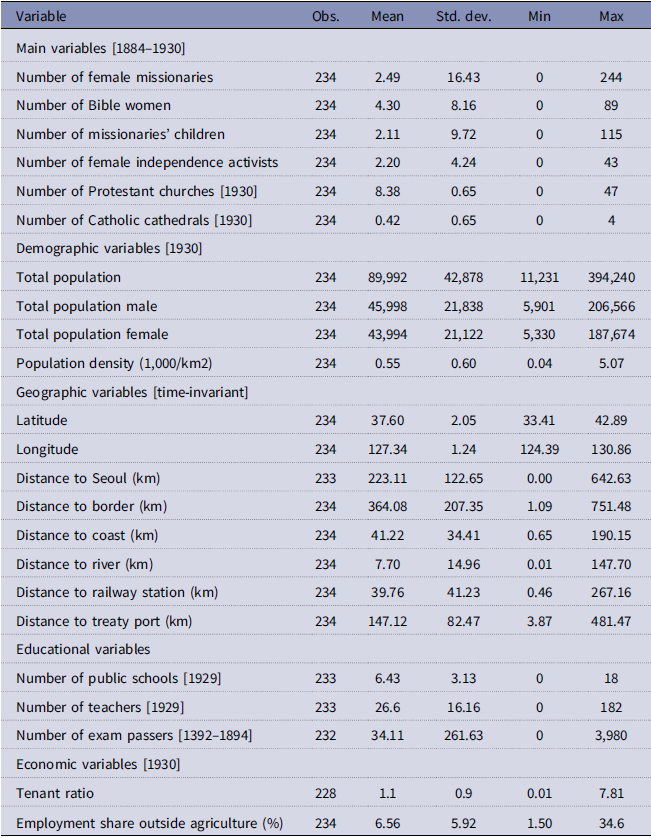
Table 2 presents descriptive statistics for the main variables. During the colonial period, Korea had 234 counties. On average, each county received 2.49 Western female missionaries, 4.3 Bible women, and experienced 2.2 female independence activists over the period 1884–1930. For education, I include the number of public schools and teachers established by Japanese authorities and the number of individuals who passed the government office exam during the Joseon dynasty (1392–1910), which serves as a proxy for historical human capital. The tenant ratio is defined as the number of tenant households divided by the sum of self-farming households and landowner households. Figures 1 and 2 present the geographic distribution of female missionary workers and independence activists. Female missionaries were actively engaged in the mid and western coastal areas, while female independence activists were primarily concentrated in the western coastal area. The maps reveal a clear spatial relationship between the two variables. When we decompose female missionaries into Western female missionaries and Bible women (Figure 2), the distribution reveals that Bible women reached rural areas more extensively than their Western counterparts, suggesting that missions expanded to rural regions primarily through Bible women’s efforts.
Descriptive statistics

Table 2 Long description
A table with 234 observations and 23 variables, presenting descriptive statistics for the colonial period in Korea. The table includes main variables such as the number of female missionaries, Bible women, missionaries' children, female independence activists, Protestant churches, and Catholic cathedrals. Demographic variables include total population, total population male, total population female, and population density. Geographic variables include latitude, longitude, distance to Seoul, distance to border, distance to coast, distance to river, distance to railway station, and distance to treaty port. Educational variables include the number of public schools, teachers, and exam passers. Economic variables include tenant ratio and employment share outside agriculture. Each row lists the observation count, mean, standard deviation, minimum, and maximum values for each variable.
Note: All demographic and economic variables are from the 1930 colonial census. Main variables (missionaries, Bible women, independence activists) represent cumulative counts of individuals for the period 1884–1930. For regression analysis, these are converted to exposure measures in the case of female mission workers (cumulative person-years). Geographic variables (distances) are time-invariant measures calculated from geographic coordinates. Educational variables: The number of public schools and teachers refers to public schools established and operated by Japanese colonial authorities in 1929 (Hong and Paik Reference Hong and Paik2018; based on Watanabe and Abe Reference Watanabe and Abe1987). The number of exam passers represents cumulative civil service examination passers during the Joseon dynasty, 1392–1894 (Hong and Paik Reference Hong and Paik2018). All variables were measured at the county level (234 counties).
Female missionaries and independence movement. (a) Female missionaries. (b) Female independence activists.
Note: The figures show the number of female missionaries in 1930 and the number of female independence activists during the colonial period (1910–1945). The data reveal similar patterns along the West Coast.

Women in Protestant missions by type. (a) Single female missionaries. (b) Bible women.
Note: The figure illustrates the geographical distribution of single female missionaries and Bible women. Bible women show a more widespread distribution across regions compared to single female missionaries.

Result
Female missionaries and independence activity
This study begins by examining the association between female missionaries and women’s independence activities using county-level data. First, I test which Christianity-related factors – including female missionaries, Protestant churches, and Catholic cathedrals – are associated with female independence activities. The analysis begins with regression to establish these associations. To move beyond correlation and demonstrate causality, I then employ a two-stage least squares (2SLS) approach using missionaries’ children as an instrumental variable. I include comprehensive geographic, demographic, and economic controls to address potential endogeneity in mission station placement. Subscript i refers to the county. Exposure to female mission workers is defined as the sum of years that female missionaries stayed in each county, covering 1884 to 1930.
 $$\begin{align}{\rm{log}}&{\left( {Number\;of\;Female\;Independence\;Activists} \right)_i} \\= &\,a + {\beta _1}{\rm{log}}{\left( {Exposure\;to\;Female\;Mission\;Workers} \right)_i} + {\beta _2}{\rm{log}}{\left( {Prot} \right)_i} \\&+ {\beta _3}{\rm{log}}{\left( {Cath} \right)_i} + \gamma {{\rm{X}}_i} + {\varepsilon _i}\end{align}$$
I hypothesize that exposure to female mission workers is associated with women’s empowerment in colonial Korea. Female missionaries played a critical role in encouraging Korean women’s participation in the independence movement, which serves as a key indicator of political engagement and empowerment. To account for general denominational effects, I include Prot (number of Protestant churches) and Cath (number of Catholic cathedrals). Protestant churches totaled around 2,000 across Korea. The number of Protestant churches captures the general Protestant effect, whereas exposure to female mission workers captures the specifically female-oriented dimension. All variables in Equation (1) are in natural logarithms, allowing the coefficients to be interpreted as elasticities – the percentage change in female independence activists associated with a 1 percent change in the independent variables.
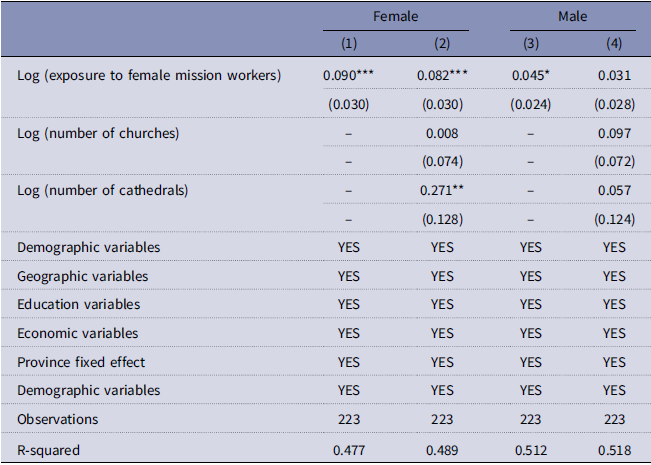
Table 3 demonstrates a strong association between exposure to female mission workers and female independence activism. A 1 percent increase in exposure to female mission workers is associated with approximately a 0.09 percent increase in the number of female independence activists. Thus, doubling exposure (a 100 percent increase) corresponds to about a 6.5 percent rise in the number of female activists – roughly 0.14 additional activists in an average county that had 2.2 female activists. Although modest in magnitude, this elasticity is statistically strong and historically meaningful, given the extremely low baseline of women’s political participation in colonial Korea. This coefficient remains stable across various model specifications, suggesting that female mission workers played a crucial role in fostering political engagement.
The association between female mission workers and independence activists: ordinary least squares

Table 3 Long description
A table with four columns and six rows, comparing the association between female mission workers and independence activism. The columns are labeled Female (1), Female (2), Male (3), and Male (4). The rows include Log (exposure to female mission workers), Log (number of churches), Log (number of cathedrals), Demographic variables, Geographic variables, Education variables, Economic variables, Province fixed effect, Demographic variables, Observations, and R-squared. Each cell contains numerical values or indicators such as YES. For example, the first row shows values 0.090***, 0.082***, 0.045*, and 0.031 with standard errors in parentheses. The table also includes observations and R-squared values at the bottom.
Note: Exposure of female mission workers is calculated by summing the total years that Bible women and single female missionaries spent in each county. For example, if a Bible woman served in County A for 10 years and two single female missionaries each served for 5 years, the total exposure in County A would be 20 years. Robust standard errors are shown in parentheses. *p < .1. **p < .05. ***p < .01.
The results reveal important denominational differences. Protestant churches show no statistically significant effect on independence activism for either gender, indicating that general Protestant presence alone did not drive political participation. This finding suggests that women-specific activities, rather than Protestant infrastructure per se, were the crucial factor. Results for male independence activism reinforce this interpretation: exposure to female mission workers has no significant effect on men, serving as an effective placebo test.
Catholic cathedrals appear to have a positive effect on female independence activities, but this finding should be interpreted carefully. Catholic cathedrals were few and mostly located in urban areas. Additionally, the cathedral data are from 1930, while most independence activities took place before 1930. When using 1913 cathedral locations (see Table A2 in the Supplementary material), the effect is no longer statistically significant, and it completely disappears in the instrumental variable estimation in the next section.
What specific activities of female missionaries encouraged Korean women to participate in political movements? The observed associations are consistent with two interconnected mechanisms: role models and informal educational networks.
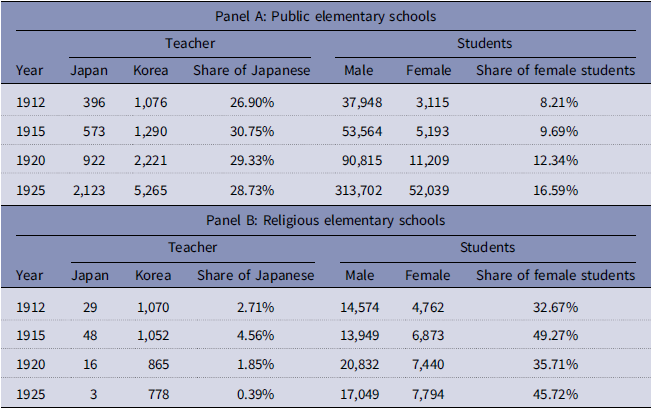
First, exposure to female mission workers may have provided young women with alternative role models. Western single female missionaries participated in mission board decision-making and visibly engaged in public activities – teaching, organizing events, providing medical services – behaviors strictly prohibited for Korean women under Confucian norms. Crucially, mission schools minimized Japanese staffing (0.39 percent Japanese teachers) compared to public schools (28.73 percent Japanese teachers) (Table 4), including Korean female teachers who exercised teaching authority and public leadership. Young women thus observed Korean women – not just foreign missionaries – assuming public roles, potentially making female public participation seem culturally accessible rather than a foreign abstraction.
Public vs. religious elementary schools: teachers and students, 1912–1925

Table 4 Long description
The table compares the number of teachers and students in public and religious elementary schools in Japan and Korea from 1912 to 1925. It is divided into two panels: Panel A for public elementary schools and Panel B for religious elementary schools. Each panel includes data on the number of Japanese and Korean teachers, the share of Japanese teachers, and the number of male and female students, along with the share of female students. Panel A: Public elementary schools. This panel has four rows and five columns. The columns are labeled Year, Teacher (with sub-columns Japan, Korea, and Share of Japanese), and Students (with sub-columns Male, Female, and Share of female students). The years listed are 1912, 1915, 1920, and 1925. For example, in 1912, there were 396 Japanese teachers and 1,076 Korean teachers, with 26.90 percent being Japanese. There were 37,948 male students and 3,115 female students, with 8.21 percent being female students. Panel B: Religious elementary schools. This panel also has four rows and five columns with the same structure as Panel A. For instance, in 1912, there were 29 Japanese teachers and 1,070 Korean teachers, with 2.71 percent being Japanese. There were 14,574 male students and 4,762 female students, with 32.67 percent being female students.
Note: Religious elementary schools encompassed institutions established by various religious groups, including Buddhism, Christianity, and Korean traditional religions. However, the number of schools founded by non-Christian groups was minimal. In practice, the majority of religious elementary schools were Christian.
Second, the observed pattern suggests that missionary influence operated primarily through informal educational networks rather than formal institutional structures. The 1914 Education Act required schools to follow Japanese-prescribed curricula and restricted religious instruction, prompting many Protestant educators to operate outside the official system. Denominational records report approximately 700 Methodist and Presbyterian elementary schools, yet Japanese colonial statistics list only 200 – a gap of 500 informal institutions. These informal networks – Bible classes in private homes, evening literacy programs, itinerant teaching by Bible women, and Sunday schools – reached women, particularly in rural areas, who never attended recognized mission schools. Within these informal spaces, Korean teachers could discuss colonial policies and their impact on Korean families in ways Japanese teachers in government schools could not or would not.
This pattern helps explain why the number of formal girls’ schools does not significantly predict female independence activism (Table A4 in the Supplementary material): formal school infrastructure per se does not appear to have been the decisive factor. Rather, the exposure measure – cumulative person-years of female missionary presence – captures activities consistent with the mechanisms that appear to have mattered most: role models provided by female missionaries and Korean female teachers, combined with diffuse informal educational networks that operated largely outside colonial supervision. Where formal mission schools are associated with women’s activism, the relationship appears to operate not through their institutional structure but through the female role models they employed and the relatively protected spaces they provided for Korean teachers to foster political consciousness among students.
Endogeneity of female mission workers?
OLS regression models incorporate a comprehensive set of control variables to mitigate potential confounding from geographic, demographic, economic, and educational factors that could affect women’s empowerment. However, establishing a causal relationship requires addressing potential endogeneity issues and eliminating alternative explanations.
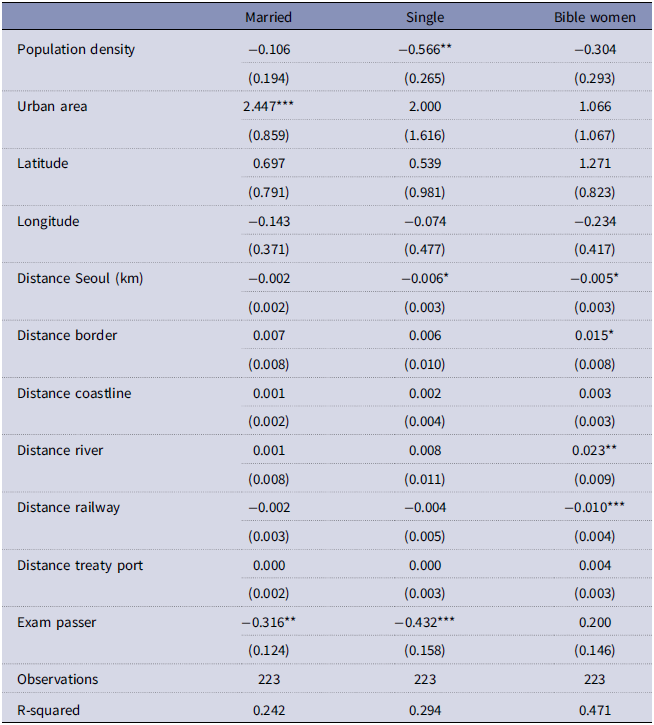
A first concern is that missionaries might have settled disproportionately in more developed or urbanized areas. To test whether missionary placement was systematically related to county characteristics, Table 5 regresses exposure to each type of female mission worker on demographic and geographic variables. If female missionaries preferred such locations, the observed associations could reflect urbanization rather than missionary influence. The results show that there are no systematic differences by type of missionary. In fact, single female Western missionaries were stationed in less densely populated areas. Regarding geographical factors, location patterns are similar across missionary types. In short, there is no strong evidence that missionaries preferred more developed areas. This finding aligns with Izumi et al. (Reference Izumi, Park and Yang2023), which reports that the location of mission stations in Korea was not systematically biased toward more developed areas.
Determinants of female missionaries of stations by type

Table 5 Long description
A table with 12 rows and 5 columns comparing determinants of female missionaries by type. The columns are labeled Married, Single, and Bible women. The rows are labeled Population density, Urban area, Latitude, Longitude, Distance Seoul (km), Distance border, Distance coastline, Distance river, Distance railway, Distance treaty port, Exam passer, Observations, and R-squared. Each cell contains numerical values and standard errors in parentheses. Notable trends include significant negative values for Population density in the Single column and Exam passer in both Married and Single columns. The Urban area row shows a significant positive value in the Married column.
Note: Columns show log(exposure) for each missionary type, where exposure is measured as cumulative person-years 1884–1930. Married refers to married Western female missionaries; Single refers to single Western female missionaries; Bible women refers to Korean Bible women. Province fixed effects included. Robust standard errors in parentheses. *p < .1. **p < .05. ***p < .01.
Although this study considers these factors, a primary endogeneity concern arises from the potential for unobserved county-level differences in educational or economic conditions that influence Protestant adoption. While proxy variables, such as tenant ratio and nonagricultural employment share, act as indicators for income, their exact influence remains difficult to isolate.
Instrumental variable estimation
The number of missionary children is used as an instrumental variable for women’s missionary presence in order to address endogeneity and establish causality. The logic is straightforward: missionaries who began their work in Korea in 1884 often had children while stationed there. Caring for infants demanded significant time and effort, leaving married female missionaries with fewer hours for mission work. As a result, each birth increased the demand for additional labor support. This gap was typically filled by Bible women or by recruiting single female missionaries. Thus, the number of missionary children should be positively correlated with the number of women on mission, particularly single women who did not face the same domestic constraints.
Historical evidence supports this mechanism. Kang (Reference Kang2003) notes that missionary wives, burdened with childcare and household responsibilities, were unable to devote themselves fully to “women’s work,” creating demand for auxiliary female workers. Missionary correspondence confirms this pattern. William Baird’s letters document his wife’s exhaustion from child-rearing: “Annie is considerably worn. She is so large and heavy and requires so much milk that Annie is kept pretty well tried out. This climate is very enervating and seems to take the energy out of all of us … this with the isolation, esp. the most of the trials of the mission life” (W. Baird, letter dated 1892, in Kim Reference Kim2021a: 518; Lee Reference Lee2022).
After childbirth, Annie Baird’s mission work was temporarily suspended and required substitutes. Her 1901–1902 annual report reveals: “Beyond helping somewhat in planning for it, I was not able to take a part in the winter class for country women, and was very glad to avail myself of Miss Chase’s presence in the station to secure her service as a substitute” (A. Baird 1901–1902, in Kim Reference Kim2021b: 320; Lee Reference Lee2022). Similar labor shortages appear throughout missionary records, with mission boards responding by recruiting additional female workers (Choi Reference Choi2009; Ryu Reference Ryu2017; Swallen Reference Swallen1923: 5, 10).
Quantitative analysis confirms this pattern: a 1 percent increase in missionary children in a given year is associated with a 0.47–0.71 percent increase in female mission workers five years later, with all coefficients statistically significant (see Table A6 in the Supplementary material). At the same time, childbirth can reasonably be viewed as quasi-random with respect to Korean women’s political activism. While fertility might be related to missionaries’ personal circumstances, it bears no direct relationship to the independence movement, affecting only the demand for women in the mission. The instrument, therefore, satisfies both the relevance criterion and the exclusion restriction.
Finally, the empirical implementation draws on annual county-level variation between 1884 and 1930. The number of missionary children in each county is used as an instrument for female mission workers. Building on this relationship, a 2SLS model is employed to estimate the causal effect of women’s missionary presence on female political activism.
First stage:
 $$\begin{align}\log &\left ( {Exposure\;to\;Female\;Mission\;Worker{s_i}} \right) \\&= a + \;{\beta _4}{\rm{log}}\left( {Missionaries {^\prime}\;Childre{n_i}} \right) + \theta {{\rm{X}}_i} + {\rho _i}\end{align}$$
Second stage:
 $$\begin{align}{\rm{log}}&\left( {Number\;of\;Female\;Independence\;Activist{s_i}} \right) \\&= a + {\beta _5}log({\widehat {Exposure\;to\;Female\;Mission\;Workers_i}}) + \vartheta {{\rm{X}}_i} + {\tau _i}\end{align}$$
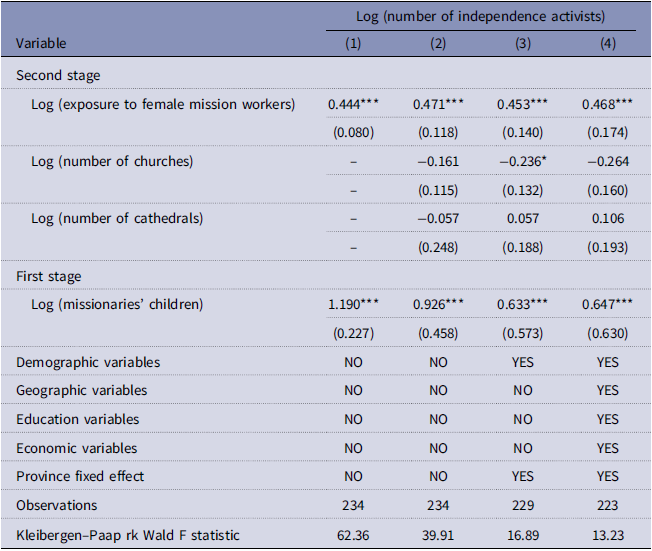
Table 6 reports the 2SLS estimates. Across specifications, the elasticity of female missionary exposure ranges from 0.44 to 0.47, implying that a 1 percent increase in exposure leads to about a 0.5 percent rise in female independence activism. The coefficients are roughly five times larger than the OLS estimates, suggesting that measurement error or negative selection previously attenuated the relationship.
The effect of female mission workers on independence activists: two-stage least squares

Table 6 Long description
A table with four columns and eight rows, detailing the effect of female mission workers on independence activists using two-stage least squares estimates. The columns are labeled as Variable, Log (number of independence activists) with sub-columns (1), (2), (3), and (4). The rows include Second stage and First stage variables. The Second stage variables are Log (exposure to female mission workers), Log (number of churches), and Log (number of cathedrals). The First stage variable is Log (missionaries’ children). Demographic, Geographic, Education, and Economic variables are included in some specifications. Province fixed effect and the number of observations are also noted. The Kleibergen–Paap rk Wald F statistic is provided at the bottom. Row 1: Log (exposure to female mission workers), 0.444***(0.080), 0.471***(0.118), 0.453***(0.140), 0.468***(0.174). Row 2: Log (number of churches), -, -0.161 (0.115), -0.236* (0.132), -0.264 (0.160). Row 3: Log (number of cathedrals), -, -0.057 (0.248), 0.057 (0.188), 0.106 (0.193). Row 4: Log (missionaries’ children), 1.190***(0.227), 0.926***(0.458), 0.633***(0.573), 0.647***(0.630). Row 5: Demographic variables, NO, NO, YES, YES. Row 6: Geographic variables, NO, NO, NO, YES. Row 7: Education variables, NO, NO, NO, YES. Row 8: Economic variables, NO, NO, NO, YES. Row 9: Province fixed effect, NO, NO, YES, YES. Row 10: Observations, 234, 234, 229, 223. Row 11: Kleibergen–Paap rk Wald F statistic, 62.36, 39.91, 16.89, 13.23.
Note: All regressions include demographic, geographic, educational, and economic controls as specified in the main text. Robust standard errors in parentheses. Kleibergen–Paap rk Wald F statistic reported. *p < .1. **p < .05. ***p < .01.
The validity of the instrumental variable strategy depends on relevance (missionary children predict female missionary presence) and exclusion (missionary children affect activism only through female missionary labor supply). Several limitations warrant acknowledgment. First, I cannot directly observe hiring decisions – while mission correspondence documents requests for additional female workers following childbirth, whether each request resulted in recruiting Western missionaries or Bible women remains partially unobserved. Second, the exclusion restriction could be violated if missionary children correlate with unobserved county characteristics, such as mission boards assigning families to safer stations. Third, fertility could be endogenous if families in more stable environments had more children.
Despite these limitations, three pieces of evidence support the identification strategy. First, relevance is clearly satisfied: first-stage results (Table 6) show strong correlations, and missionary children in year t consistently predict increased female missionary presence in year t+5 (Table A6 in the Supplementary material). Second, mission assignment patterns suggest limited endogeneity – missionaries rarely relocated once assigned (averaging only 0.5 moves), and of 220 who relocated, only 21 percent moved to major cities, indicating that families with children were not systematically placed in more favorable locations. Third, sensitivity analyses (Figures A5 and A6 in the Supplementary material) demonstrate that positive effects remain significant even when allowing for potential violations of the exclusion restriction.
In sum, while I cannot definitively rule out all violations of the exclusion restriction – particularly regarding unobserved hiring decisions and potential fertility endogeneity – the preponderance of evidence suggests that the instrument variable operates primarily through the hypothesized female missionary labor supply channel rather than through correlated local characteristics. Taken together, these three tests support the validity of my identification strategy, even though the inherent limitations of historical data preclude definitive proof of exogeneity.
Additional analyses
Independence activists with different timing
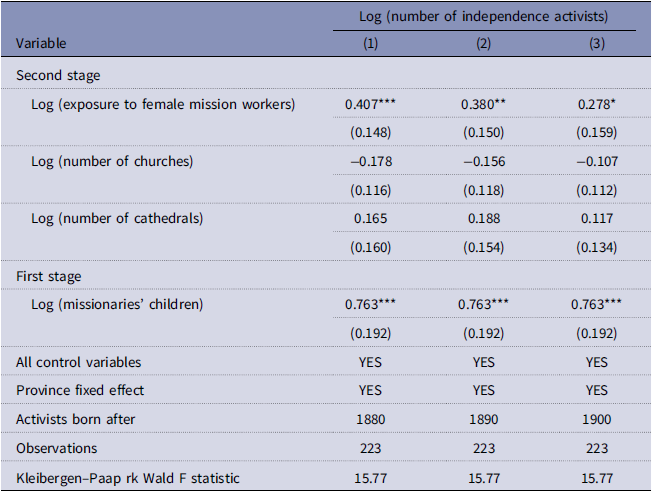
Another important concern is reverse causality. In the Results section, all female mission workers and independence activists are included in the main regression. While I use an instrumental variable to address this issue, I can further refine the approach to eliminate any remaining concerns. Specifically, I identify the periods when female mission workers were active and the birth years of female independence activists. Using this information, I choose an appropriate time window to ensure that reverse causality cannot drive the results. Since there is no fixed standard for selecting the relevant time range, I systematically examine the birth years of female independence activists. To eliminate potential reverse causality, I exclude those who were already adults (over 20) when missionaries first arrived. To ensure robustness, I apply the following criterion: (1) Female independence activists must have been under 20 when missionary work began, meaning they should have been born no earlier than 1865. Additionally, I exclude missionaries who began their work during the later colonial period. Japanese rule over Korea lasted from 1910 to 1945. Since most independence activism emerged during and after the March First Movement in 1919, I restrict the analysis to female mission workers who began their activities before 1919 (i.e., through 1918), ensuring that their influence preceded the primary wave of political mobilization. In summary, the focus is on mission work before the March First Movement in 1919, considering only women born after 1900. This results in a limited overlap of just 20 years. During this period, female independence activists were under 18 or had not yet been born when missionary work was ongoing. These strict criteria effectively rule out any possibility that the women’s independence movement influenced female mission work. To test different time windows, the dependent variable is set based on birth years: after 1880, 1890, and 1900, respectively. For female mission workers, activity is tracked until 1918, before the March First Movement. Since the years of activity of women mission workers serve as a reference, those who began their work earlier naturally have higher values. In short, the measurement of female mission workers assigns greater weight to those who served for a longer duration. This approach is justified because longer service tends to have a greater influence, and appropriately assigns less weight to those with shorter service periods. Regarding missionary children in the first stage, exposure to female mission workers is estimated by using the distribution of missionary children until 1918.
Table 7 indicates that even when the time window for the birth year of female independence activists is redefined, the positive effect remains. This finding suggests that women mission workers played a role in encouraging young women to pursue education and political participation. All estimated impacts are statistically significant, regardless of the control variables used. In short, these results suggest that women mission workers influenced the political engagement of the next generation of women, which can be interpreted as a sign of women’s empowerment.
The effect of female mission workers on independence activists with a time window

Table 7 Long description
A table with three columns and eight rows, showing the effect of female mission workers on independence activists with a time window. The columns are labeled 'Variable', 'Log (number of independence activists) (1)', 'Log (number of independence activists) (2)', and 'Log (number of independence activists) (3)'. The rows include 'Second stage', 'Log (exposure to female mission workers)', 'Log (number of churches)', 'Log (number of cathedrals)', 'First stage', 'Log (missionaries' children)', 'All control variables', 'Province fixed effect', 'Activists born after', 'Observations', and 'Kleibergen-Paap rk Wald F statistic'. Each row contains specific values and standard errors for the variables measured.
Note: To eliminate reverse causality, female mission workers’ exposure is restricted to 1884–1918 (before the March First Movement), while activists are restricted by birth year: column (1) includes activists born after 1880; column (2) includes activists born after 1890; and column (3) includes activists born after 1900. This ensures activists were children or not yet born during the missionary exposure period, ruling out any possibility that independence activism influenced missionary placement. Robust standard errors in parentheses. *p < .1. **p < .05. ***p < .01.
Long-term persistence effects
This study has thus far examined the relationship between female mission workers and female independence activists during Korea’s colonial period. A natural extension is to ask whether these effects persisted beyond the colonial era. The literature on institutional persistence suggests that historical interventions can leave durable imprints on social and cultural norms (Acemoglu et al. Reference Acemoglu, Johnson and Robinson2001; Nunn Reference Nunn2008). Building on this framework, this section examines whether exposure to female mission workers shaped patterns of female political leadership in modern Korea.
To assess persistence, I compiled data on female lawmakers who have served in the National Assembly since 1948, representing the highest level of women’s political leadership in the democratic era. Using birthplace information, I test whether counties with greater historical exposure to female mission workers produced more female lawmakers.
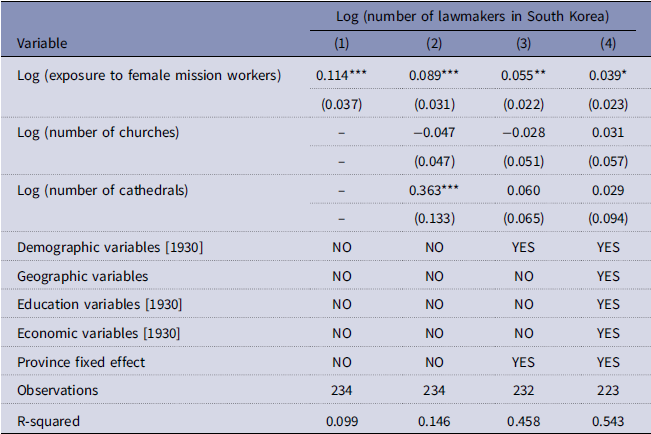
The estimates reveal a positive association: historical female missionary exposure shows a positive association with the number of female lawmakers by birthplace in the post-1948 period (Table 8). While the association is modest in magnitude and only marginally significant in some specifications, the consistent positive pattern across models suggests some degree of persistence.
The effect of female mission workers on the lawmakers of South Korea

Table 8 Long description
A table with four columns and six rows, showing the effect of female mission workers on the number of lawmakers in South Korea. The columns are labeled as follows: Variable, Log (number of lawmakers in South Korea) (1), Log (number of lawmakers in South Korea) (2), Log (number of lawmakers in South Korea) (3), and Log (number of lawmakers in South Korea) (4). The rows are labeled as follows: Log (exposure to female mission workers), Log (number of churches), Log (number of cathedrals), Demographic variables [1930], Geographic variables, Education variables [1930], Economic variables [1930], Province fixed effect, Observations, and R-squared. Each cell contains numerical values or descriptive text indicating the presence or absence of variables. Notable trends include the positive association between log exposure to female mission workers and the log number of lawmakers across different models, with varying degrees of significance and magnitude.
Note: Dependent variable: log (number of female National Assembly members 1948–2024), aggregated by birthplace to colonial-era counties. Ordinary least squares with robust standard errors. *p < .1. **p < .05. ***p < .01.
These correlations should not be interpreted as causal. Contemporary political representation depends on numerous postcolonial factors – democratization policies, economic development, and evolving gender norms – which this historical analysis cannot fully capture. The persistence itself is somewhat surprising given Korea’s rapid transformation after 1945, and likely reflects complex interactions between colonial legacies and postcolonial institutions rather than simple path dependence. Moreover, my results speak only to national-level legislative representation, not to local political engagement or other forms of participation.
Nevertheless, contemporary patterns align with this interpretation. Mission-founded institutions such as Ewha Womans University remain influential centers of women’s education, and approximately 41 percent of female lawmakers are either Protestant or graduates of mission-established schools (see Table A9 in the Supplementary material). These descriptive facts highlight the continued salience of historical educational pathways. While the precise channels of persistence remain unclear, several plausible mechanisms may explain these correlations.
First, mission-founded institutions provided continuous pipelines for female leadership training from the colonial era through the present, as evidenced by the overrepresentation of Ewha graduates among female lawmakers. Second, counties with stronger traditions of female education may have fostered intergenerational transmission of educational aspirations, whereby mothers educated in mission schools encouraged daughters’ education and public participation – a mechanism documented in other contexts (Calvi et al. Reference Calvi, Hoehn-Velasco and Mantovanelli2022 for India). Third, single-sex mission schools provided girls with leadership opportunities in student organizations that might otherwise have been monopolized by male students. Comparative evidence supports this interpretation: Shirai (Reference Shirai2006) documents that transitions from single-sex to coeducational schools in Japan reduced female participation in student leadership, suggesting that girls’ schools created unique opportunities for leadership formation that persisted when graduates entered political life.
These mechanisms, however, remain speculative given the available data. Distinguishing whether persistence operates primarily through institutional continuity, intergenerational cultural transmission, or selection of initially progressive areas requires detailed post-1945 data beyond this study’s scope. I view these correlations as providing suggestive evidence that warrants future investigation rather than resolving mechanisms definitively. The consistent pattern across multiple specifications, combined with the institutional and demographic evidence presented, suggests that mission-founded educational pathways may have created lasting channels for female political participation – but establishing this conclusively would require data on post-1945 educational expansion, urbanization patterns, and evolving political opportunity structures that are beyond the scope of this study.
Conclusion
This study has examined how female missionaries – Western female missionaries and Korean Bible women – fostered women’s empowerment and political participation during the colonial period. By providing education, role models, and new social spaces, they enabled Korean women to move beyond domestic roles and engage in public and political life. The analysis shows that counties with greater exposure to female mission workers experienced higher female participation in the independence movement and that these effects extended into the postcolonial era through patterns of female political representation.
The findings underscore the transformative role of female missionaries as agents of social change. They created unprecedented opportunities for Korean women to develop leadership, acquire organizational skills, and participate in collective action. Their influence was both immediate – through activism during the colonial era – and enduring – through the institutional and cultural legacies they left behind.
Important limitations remain. The instrumental variable approach addresses endogeneity but cannot entirely eliminate identification concerns, and persistence analyses cannot isolate missionary influence from broader postcolonial forces. Additionally, analyzing activists by birthplace rather than location of activism may miss how missionary networks facilitated adult mobilization – a direction for future research. In sum, despite these limitations, the evidence suggests that female mission workers played a pivotal role in reshaping gender relations in Korea. Their work catalyzed a transition from domestic confinement to public leadership, leaving legacies that continued to shape women’s political participation well beyond the colonial period.
Supplementary material
The supplementary material for this article can be found at https://doi.org/10.1017/ssh.2026.10121.
Acknowledgments
I would like to thank the two anonymous reviewers and the editors of this journal for their valuable comments. I am also grateful to Sascha Becker, Paul Raschky, Changkeun Lee, Laura Panza, Umair Khalil, Chun Chee Kok, Van Anh Tran, In Sung Lee, and Myunghwan Na for their helpful comments. Special thanks go to the members of SoDa Labs for their feedback during the weekly PhD group supervision meetings. I also thank the participants at the Asia-Pacific Economic and Business History Conference 2023, AusCliometrics 2023, and the Asian Cliometrics Meeting 2025 for their constructive feedback. All remaining errors are my own.
Competing interests
The author declares none.
AI language tools were used for polishing, typo correction, and grammar checking. All research, analysis, and original content are the author’s own work.