Introduction
After the efficacy of cod-liver oil in rickets was recognized in 1782 and its isolation and synthesis were completed in the first decades of the last century, the mode of actions and functions of vitamin D were increasingly deepened. As a result, currently, it is considered a pleiotropic hormone regulating different biological processes in humans beyond the original calcium metabolism, which include cell differentiation and proliferation, immunomodulation, and even regulation of neurotransmission.
Vitamin D metabolizing enzymes and vitamin D receptors are common in the central nervous system (CNS) and are involved in the modulation of different brain activities and functions.Reference Jones, Strugnell and DeLuca1-Reference Landel, Stephan, Cui, Eyles and Feron6 As vitamin D also regulates tyrosine hydroxylase and tryptophan hydroxylase, the rate-limiting enzymes of the synthesis of, respectively, dopamine, noradrenaline, adrenaline, and serotonin (5-HT), it has been supposed that its deficiency might affect neurotransmission with emotional, behavioral, and psychopathological consequences.Reference Kaneko, Sabir and Dussik7 Again, different studies indicate that vitamin D would exert a neuro-protective activity in the CNS, given its down-regulation of pro-inflammatory cytokine levels.Reference Evans, Kim and Ling8 Therefore, vitamin D deficiency has been associated with an enhanced pro-inflammatory state, increased formation of amyloid β (Aβ) oligomers and reduced amyloid clearance in the hippocampus, underlying the cognitive decline typical of the elderly age and dementia.Reference Briones and Darwish9-Reference Khairy and Attia11 Supplementation with the active form of vitamin D would modulate the age-related changes in pro-inflammatory states, with an increase in the anti-inflammatory cytokine interleukin-10 (IL-10) and a decrease in the pro-inflammatory cytokine IL-1β.Reference Li, Zhang, Zhang and Yi12, Reference Spanier, Nashold, Nelson, Praska and Hayes13 Interestingly, in animal studies, vitamin D has been shown to promote gamma-glutamyl-transpeptidase gene expression, thereby stimulating the formation of glutathione (GSH), the main antioxidant that is involved in aging and several pathological conditions.Reference Garcion, Wion-Barbot, Montero-Menei, Berger and Wion14, Reference Wimalawansa15 More in general, vitamin D is supposed to play a crucial role in neuro-inflammation processes that, together with neurotransmitter and oxidative processes alterations, are currently hypothesized to be involved in the pathophysiology of different psychiatric disorders, such as major depression, bipolar disorders (BD), Autism Spectrum Disorder (ASD), schizophrenia, and obsessive-compulsive disorder (OCD) and related disorders.Reference Eyles, Burne and McGrath16-Reference Mucci, Marazziti and Della Vecchia20
OCD is a complex psychiatric condition, characterized by obsessions (intrusive thoughts, images, or impulses) and/or compulsions (repetitive behaviors frequently performed to reduce anxiety and distress caused by obsessions).Reference Angst, Hollander, Zohar, Marazziti and Olivier21, 22 The treatment of OCD, although quite improved in the last decadesReference Marazziti, Consoli, Baroni and Catena Dell’Osso23-Reference Marazziti26, still remains problematic, as a high percentage of patients does not satisfactorily respond to first-line (selective 5-HT reuptake inhibitors, SSRIs, and clomipramine or cognitive behavior therapy, CBT), or second-line treatments, or augmentation strategies, while showing a high rate of resistance/refractoriness and chronicity.Reference Van Ameringen, Simpson and Patterson24, Reference Pallanti, Hollander and Bienstock27, Reference Albert, Marazziti, Di Salvo, Solia, Rosso and Maina28 Therefore, there is a high need of novel pathophysiological models of OCD and innovative therapeutic approaches.Reference Albert, Marazziti, Di Salvo, Solia, Rosso and Maina28, Reference Marazziti, Albert, Mucci and Piccinni29 A few preliminary studies are available mainly in small sample of children and adolescents, suggesting the existence of a possible correlation between vitamin D deficiency and OCD.Reference Esnafoğlu and Yaman30-Reference Głąbska, Kołota, Lachowicz, Skolmowska, Stachoń and Guzek33 Similar findings have been also reported in those syndromes following beta-hemolytic streptococcal infection called “pediatric autoimmune neuropsychiatric disorders associated with streptococcal infections” (PANDAS), characterized by the presence of typical OCD symptoms and tics.Reference Swedo, Leckman and Rose34 For this reason, vitamin D supplementation has been supposed to possibly represent an alternative treatment of OCD, at least in children and adolescents.Reference Celik, Tas, Tahiroglu, Avci, Yüksel and Çam35-Reference Kuygun Karcı and Gül Celik39
There is evidence that serum 25-OH-D is the most accurate indicator to evaluate vitamin D in humans.Reference Giustina, Adler and Binkley40 The cut-off provided in the recent global consensus for disease prevention is 30 ng/mL,Reference Giustina, Adler and Binkley40 and the levels have been rated as sufficiency ≥ 50 nmol/L (or 20 ng/mL), insufficiency = 30 to 50 nmol/L (or 12-20 ng/mL) and deficiency ≤30 nmol/L (or <12 ng/mL). The recommended dietary allowance (RDA), as established by the Institute of Medicine, Food and Nutrition Board (IOMFNB) committee in 2011, is a value of 600 IU daily in adults, and 800 IU daily in elderly people, in absence of risk factors.Reference Giustina, Adler and Binkley40, 41
Given the meager information available and the possible involvement of vitamin D in the pathophysiology of OCD, the aim of the present paper was at evaluating and comparing vitamin D levels in a group of adult patients with OCD vs normative values. The correlations of vitamin D levels with specific clinical and psychopathological characteristics of the patients were also explored.
Subjects and methods
Subjects
A total of 50 OCD outpatients of both sexes, recruited in the period from January to May 2021, were included in the present study. All patients were at their first psychiatric consultation in our clinic and were suffering from OCD, as diagnosed according to the Diagnostic and Statistical Manual for mental disorders, fifth edition (DSM-5, APA).22 All subjects were first assessed by a clinical evaluation and the Structured Clinical Interview for DSM-5 (SCID-V), patient edition.Reference First, Williams, Karg and Spitzer42 Patients who were pregnant, with drug intoxication, severe comorbid psychotic disorders, or major medical illnesses were excluded.
The severity of OCD was assessed by the Yale-Brown Obsessive-Compulsive Scale (Y-BOCS).Reference Goodman, Price and Rasmussen43 The eventual presence and severity of depression were assessed by the Hamilton Rating Scale for Depression (HRSD).Reference Hamilton44
All this information was gathered from the medical history collected by some authors (D.M., F.M.B., B.B., and F.M.).
Following the approval of the study by he Ethics Committee at Pisa University, each patient signed a written infomed consent to take part to the study.
Psychopathological assessment
Yale-Brown Obsessive-Compulsive Scale
The Y-BOCS is a clinician-administered instrument to assess the presence and severity of obsessive-compulsive symptoms. It is divided into a symptom checklist and a severity scale. The symptom checklist includes 54 dichotomous items assessing the current or prior presence of specific obsessions and compulsions. The severity scale consists of 10 items that quantify the impact of obsessions and compulsions identified using the symptom checklist rated on 5-point Likert-type scales.
Hamilton Rating Scale for Depression
HRSD is a multiple-item questionnaire used to assess depression symptoms. The patient is rated on 17 to 29 items scored either on a 3-point or 5-point Likert-type scale. For the 17-item version, a score of 0 to 7 is considered to be normal, while a score of 18 or higher (indicating at least moderate severity) is usually required to entry into a clinical trial.
Plasma preparation for vitamin D assessment
Ten milliliters of venous blood were drawn from fasting subjects and transferred to plastic tubes for vitamin D measurement by common clinical chemical methods.
Statistical analyses
All demographic, clinical, and laboratory data were presented for continuous variables in terms of mean ± standard deviation (SD), variation range (minimum and maximum values), or medians, when required. Categorical variables were expressed as frequencies (number) and percentages.
The Kolmogorov-Smirnov test was used to determine normality of distribution of the variables. Comparisons for continuous variables were performed with the independent-sample Student’s t-test. Comparisons for categorical variables were assessed by the χ2 test (or Fisher’s exact test, when appropriate).
The correlations between different parameters and characteristics of the subjects or vitamin D levels were explored by calculating Pearson’s correlation coefficient or Spearman’s rank-order correlation.
In order to predict the probability of the eventual correlations, logistic regression was used.
All statistical analyses were performed by using SPSS 25.0 software (IBM Corp., Armonk, NY, 2017).
Results
Sociodemographic data
The total sample of 50 OCD patients (mean age ± SD: 31.84 ± 11.10 years) included 11 (22.00%) women (mean age ± SD: 36.91 ± 13.00 years), and 39 (78.00%) men (mean age + SD: 30.41 ± 10.25 years). Forty-three (86.00%) patients (7 women and 36 men) were unmarried, and 7 married. Twenty-five (50.00%) patients (18 men and 7 women) were employed, and 25 (50.00%) patients (21 men and 4 women) were unemployed (Table 1).
Demographic and clinical characteristics of 50 patients with Obsessive-Compulsive Disorder

Abbreviation: SUD, Substance Use Disorder.
Psychopathological data and assessment
The mean age of onset of OCD was 12.16 ± 9.82 years with a mean duration of illness of 12.36 ± 9.97 years; 32 patients (23 men and 9 women) referred a slow progressive onset with a chronic course, and 18 (12 men and 6 women) an acute onset with episodic course (Table 1).
Twenty-two patients (4 women and 18 men) were also suffering from BD (8 BD of type II, 14 cyclothymia), 6 (3 women and 3 men) from Generalized Anxiety Disorder, 5 (1 woman and 4 men) from Panic Disorder, 5 (all men) from Tic Disorder, and 3 (1 woman and 2 men) from ASD. Only 12 patients (3 women and 9 men) had no psychiatric comorbidity.
Thirty-six patients (8 women and 28 men) had obsessive-compulsive personality traits, 16 (4 women and 12 men) had referred at least one stressful life event, 15 (2 women and 13 men) had a history of perinatal traumas, and 7 (1 woman and 6 men) had a current or previous Substance Use Disorder (cannabis).
Thirty-four patients were medicated and 16 patients were drug-naive, as they had never taken psychotropic drugs. Thirty-four were taking antidepressants (ADs) (28: SSRIs, 6: clomipramine, a tricyclic AD), 25 ADs + mood stabilizers (lithium, valproate, carbamazepine, oxcarbazepine, and gabapentin), 13 ADs + first- and/or second-generation antipsychotics (FGAs and SGAs), and 6 benzodiazepines (diazepam, lorazepam, delorazepam, alprazolam, and clonazepam) (Table 1).
The Y-BOCS total score was 28.44 ± 6.36 (indicating moderate to severe symptoms), the obsession and compulsion subscales were, respectively, 14.52 ± 3.07 and 13.92 ± 3.58, with no difference between the two sexes.
The most common obsessions were aggressive (23 men and 9 women), followed by symmetry/exactness (17 men and 5 women), somatic (15 men and 4 women), contamination (14 men and 5 women), religious (6 men and 2 women), and sexual thoughts or images (7 men and 2 women). Thirty-nine patients (33 men and 6 women) reported miscellaneous obsessions.
The most common compulsions were the following: checking rituals (26 men and 10 women), repeating compulsions (21 men and 2 women), cleaning/washing (18 men and 7 women), ordering/arranging (9 men and 3 women), counting (6 men and 1 woman), hoarding/collecting (5 men and 1 woman), and other types (31 men and 8 women) (Table 2).
Y-BOCS total and subscale scores (mean + SD) in 50 patients with Obsessive-Compulsive Disorder (Panel A), and distribution of obsession and compulsive subtypes in the total sample and in two sexes (Panel B)

Note. Difference between women and men: nonsignificant.
Abbreviation: Y-BOCS, Yale-Brown Obsessive-Compulsive Scale.
No patients were depressed, as shown by the HRSD total scores that were <7 (data not shown).
Vitamin D
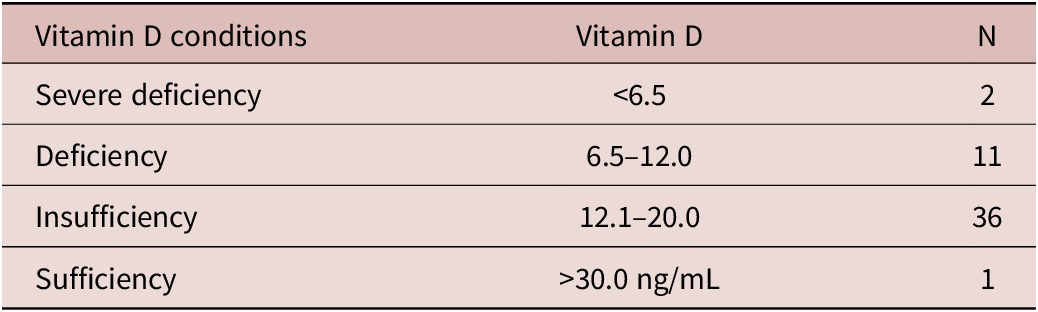
The vitamin D (mean ± SD, nmol/L) values in the total sample were 15.88 ± 3.97 with no significant differences between the two sexes (M = 15.78 ± 6.28, F = 16.23 ± 4.97). A statistically significant difference (t = −16.72 and P < .001) was detected between patients and the normative sufficient values (>50 nmol/L). Thirty-six (72 %) patients showed insufficient (12-20 nmol/L) vitamin D levels, 11 a critical deficiency (<12 nmol/L), 2 severe critical levels (<6.5 nmol/L), and only 1 optimal value (>50 nmol/L) (Table 3).
Vitamin D levels (nmol/L) in 50 patients with Obsessive-Compulsive Disorder

Four patients (2 men and 2 women) taking FGAs showed significantly lower vitamin D levels than those (9 women and 4 men) without these medications (9.48 ± 4.62 vs. 16.43 ± 5.78, t = 2.33, P = .024). No further differences were noted.
Correlation analyses
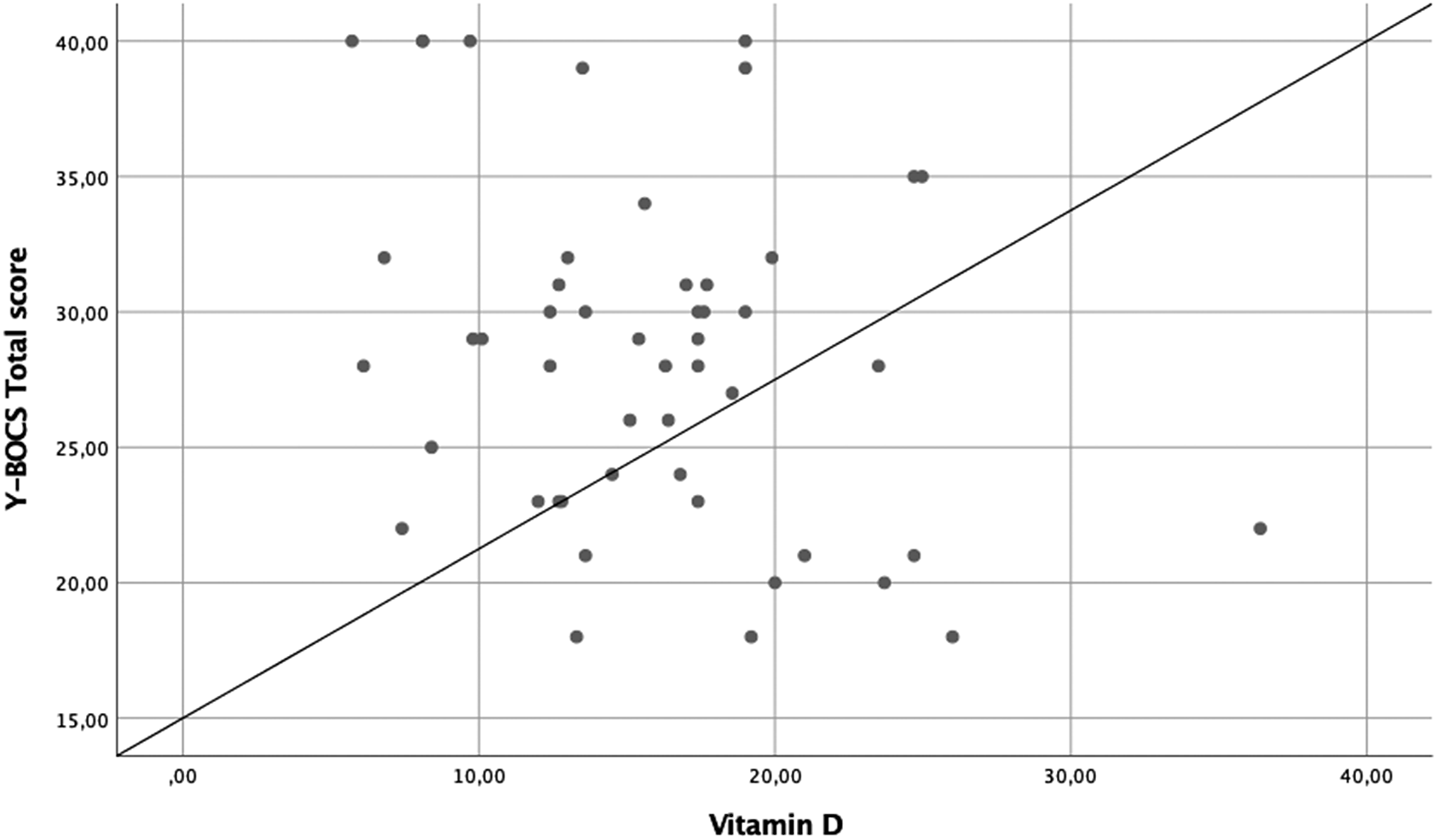
Negative and significant correlations were detected between vitamin D values and, respectively. The Y-BOCS total (r = −0.295, P = .038) and compulsion subscale (r = −0.299, P = .035) scores (Figure 1). The vitamin D values were also negatively related to the following Y-BOCS items: “interference from obsessions” (r = −0.321, P = .023), “distress associated with obsessions” (ρ = −0.305, r = 0.013), and “time spent on compulsions” (r = −0.387, P = .006).
Scatterplot of the correlation between vitamin D values (nmol/L) and Yale-Brown Obsessive Compulsive Scale (Y-BOCS) total score. r = −0.295, P = .038.

When the sample was divided into two sexes, some other significant correlations emerged. Women showed negative correlations between vitamin D values and the Y-BOCS compulsion subscale (r = −0.607, P = .048), the “resistance to compulsions” (r = −0.637, P = .035), “degree of control of compulsions” (r = −0.620, P = .042), and “insight” (r = −0.774, P = .005) item scores. Men showed significant and negative correlations between vitamin D values and the Y-BOCS “interference from obsessions” (r = 0.028 and r = −0.352), “distress associated with obsessions” (r = −0.381, P = .017), and “time spent on compulsions” (r = −0.357, P = .026) item scores (Table 4).
Correlations between Vitamin D values (ng/mL) and Y-BOCS total, scales, and items scores in the total sample and in two sexes

Abbreviations: r, Pearson’s correlation coefficient; Y-BOCS, Yale-Brown Obsessive-Compulsive Scale.
* Statistically significant.
No correlations between vitamin D values with age, age of onset, duration of illness, stressful lifetime events, perinatal traumas, type of psychiatric comorbidity, and different classes of psychotropic drugs were noted.
Discussion
The present study assessed vitamin D levels in a group of adult outpatients suffering from OCD, well characterized from the clinical point of view, in comparison with normative values. Further, we investigated the possible correlations between vitamin D values and the psychopathological characteristics of the patients.
The results showed that vitamin D levels of 49, out of a total of 50 patients were significantly lower (15.88 + 3.97 nmol/L) than those considered optimal ones (>50 nmol/L). The majority of patients (36) showed insufficient levels (12-20 nmol/L), 11 a critical deficiency (<12 nm/L), and 2 severe critical levels (<6.5 nm/L). One patient only showed optimal levels (>50 nmol/L). According to our knowledge, this is the first study carried out in a large sample of adult patients with OCD demonstrating a sharp decrease in vitamin D levels. Indeed, previous data are quite limited and mainly gathered in a few studies of children and adolescents with OCD.Reference Esnafoğlu and Yaman30-Reference Bond, Moll and Rosello32, Reference Balandeh, Karimian, Behjati and Mohammadi45 Interestingly, the first authors also reported a reduction of vitamin B12 and an increase in homocysteine levels.Reference Esnafoğlu and Yaman30 Again, it should be noted that Yazici et al.Reference Yazici, Percinel Yazici and Ustundag31 observed a decrease, albeit not significant of vitamin D levels. The most recent multicentre study,Reference Bond, Moll and Rosello32 that was carried out in a large cohort of children and adolescents with chronic tic disorder, reported no association between vitamin D and the presence or severity of tics, but rather with comorbid attention-deficit/hyperactivity disorder (ADHD). Lower levels of vitamin D were described in 33 young patients with PANDAS compared to 20 control subjects, although, even in this study, the difference did not reach the statistical significance.Reference Celik, Tas, Tahiroglu, Avci, Yüksel and Çam35, Reference Celikw, Tas, Varmıs, Tahiroglu and Avci36 In any case, vitamin D deficiency was related to antistreptolysin serum titer, age of onset, symptoms profile, and clinical severity. Another recent study revealed that patients with PANDAS showed a reduced level of vitamin D in comparison with healthy control subjects, independently from the seasons.Reference Stagi, Lepri, Rigante, Matucci Cerinic and Falcini38 Finally, a correlation between vitamin D and trichotillomania, an OCD-related disorder, was highlighted in 2 women who improved after a treatment with vitamin D supplementation.Reference Titus-Lay, Eid, Kreys, Chu and Malhotra46
In our sample, no differences in vitamin D levels were noted between men and women, or between medicated or unmedicated patients, or among patients with different comorbidities. We only observed that patients (13) taking SGAs showed higher vitamin D values than patients (4) taking FGAs. This finding is potentially important, as it warns of the potentially detrimental effects of FGAs on vitamin D, but it should be taken with caution, given the exiguity and different sizes of the two groups that weaken the significance of the statistical analysis.
The correlation analyses led to intriguing findings. In detail, we observed a negative and significant correlation between vitamin D levels and the Y-BOCS total and the compulsion subscale scores, that is to say, the lower the vitamin levels, the more severe OCD and compulsions were. The link between the severity of OCD and vitamin D values is also supported by the negative correlations between the biomarker and the Y-BOCS “interference from obsessions,” “distress associated with obsessions,” and “time spent on compulsions” item scores. Some sex-related correlations were also present. When the sample was divided into two sexes, some significant correlations emerged. Vitamin D values are negatively related to the Y-BOCS compulsion subscale, the “resistance to compulsions,” “degree of control of compulsions,” and “insight” item scores in women. On the contrary, men showed negative correlations between vitamin D values and the Y-BOCS “interference from obsessions,” “distress associated with obsessions,” and “time spent on compulsions” item scores. We would hypothesize with caution that, although vitamin D levels might be related to the overall severity of OCD, as assessed by the Y-BOCS, a certain dimorphism in the effects of vitamin D on the disorder might exist, depending on hormonal factors, or levels of one-carbon metabolism including vitamin B12, folic acid, and homocysteine that have been associated with some psychiatric disorders,Reference Atmaca, Tezcan, Kuloglu, Kirtas and Ustundag47, Reference Sharma and Biswas48 such as OCD.Reference Esnafoğlu and Yaman30
Our study suffers from some limitations that should be acknowledged. First, the majority of the subjects included in the study were men (39.86%). In any case, men and women had similar age, and no difference was noted in any sociodemographic characteristics or psychopathological features. Second, the comorbidity with different psychiatric conditions was quite common, and only 12 patients did not suffer from it. However, no difference in vitamin D values was assessed between patients with and without comorbidity. Third, only 16 patients were drug-free, while the remaining 34 were taken one or more psychotropic drugs, but even in this case, no difference in vitamin D levels was observed amongst the patients according to their therapeutic regimen. As already commented above, only patients taking FGAs showed lower vitamin D values than those taking SGAs. Fourth, the comparison of vitamin D was carried out between patients and normative values, given the difficulty in recruiting healthy controls during the lockdown due to COVID-19 pandemic. However, we will try to overcome this bias in future studies.
Our findings support the notion that vitamin D might be involved in the pathophysiology of OCD and that it might be related to both the severity of the disorder and some typical symptoms, with some sex-related peculiarities. However, the specificity of these findings requires to be deepened. Indeed, as similar to other proposed biological markers, it is plausible that vitamin D levels might be related to symptom clusters or dimensions, rather than to distinct nosological entities. Scattered data would indicate that low levels of vitamin D might be present not only in neuropsychiatric conditions characterized by OC symptoms, such as PANDAS, trichotillomania or tic disorders, but also in anxiety disorders,Reference Bičíková, Dušková and Vítků49 mood disorders,Reference Berk, Sanders and Pasco50-Reference Milaneschi, Hoogendijk and Lips52 schizophrenia,Reference Goksugur, Tufan and Semiz53-Reference Yang and Wu57 and ASD,Reference Cannell58, Reference Máčová, Bičíková, Ostatníková, Hill and Stárka59 possibly sharing common neuro-inflammatory patterns and 5-HT system abnormalities.
Given its pleiotropic functions (modulation of neurotransmitters, neuroplasticity and neuroprotection, anti-inflammatory, and antioxidant properties),Reference Berridge10, Reference Marazziti, Parra and Palermo19, Reference Jamilian, Amirani and Milajerdi60 that deserve to be increasingly investigated and clarified together with its dimorphism, vitamin D levels should be included amongst the routine laboratory tests of psychiatric patients for its easiness, cheapness, and potential diagnostic and therapeutic implications. Finally, further studies are urgently needed to evaluate the potential benefits of vitamin D supplementationReference Fond, Young and Godin61 either as an augmenting agent or as an alternative treatment for patients with OCD and with other psychiatric disorders.
Author Contributions
Conceptualization: D.M., L.D.O.; Data curation: D.M., F.M.B., B.B., M.G.C., E.P., L.M., A.D.V., F.M., A.A.; Formal analysis: D.M., L.F., M.G.C., E.P., C.T., A.D.V., A.A.; Investigation: F.M.B., S.P., L.M., C.T., F.M.; Methodology: D.M., B.B., M.G.C., E.P., S.P., L.M., C.T., F.M., A.A., L.D.O.; Project administration: D.M.; Software: M.G.C.; Supervision: D.M., L.F.; Validation: E.P., L.D.O.; Writing—original draft: D.M.; Writing—review and editing: D.M., F.M.B., L.F., B.B., E.P., S.P., L.M., C.T., A.D.V., F.M., A.A., L.D.O.
Disclosures
The authors declare none.