Introduction
Subordinate’s perception of authoritarian leadership has been defined as the subordinates’ perceptions of ‘leader’s behaviour that asserts absolute authority and control over subordinates and demands unquestionable obedience from subordinates’ (Cheng, Chou, Wu, Huang, & Farh, Reference Cheng, Chou, Wu, Huang and Farh2004: 91). The extant literature has depicted this leadership style as ineffective, that is prone to failure (Gabriel, Reference Gabriel, Bryman, Collinson, Grint, Jackson and Uhl-Bien2011; Harms, Wood, Landay, Lester, & Lester, Reference Harms, Wood, Landay, Lester and Lester2018). The main reason being that authoritarian leaders give little respect to their subordinates’ viewpoints which demotivates them and adversely impacts their performance (De Cremer, Reference De Cremer2006; Zheng, Huang, Graham, Redman, & Hu, Reference Zheng, Huang, Graham, Redman and Hu2020). This deleterious image of authoritarian leaders has been reinforced by studies that have empirically found a negative influence of subordinate’s perception of authoritarian leadership style on subordinate’s performance (such as Aryee, Chen, Sun, & Debrah, Reference Aryee, Chen, Sun and Debrah2007; Chan, Huang, Snape, & Lam, Reference Chan, Huang, Snape and Lam2013; Cheng, Huang, & Chou, Reference Cheng, Huang and Chou2002a, Reference Cheng, Shieh and Chou2002b; Chiang, Chen, Liu, Akutsu, & Wang, Reference Chiang, Chen, Liu, Akutsu and Wang2021; Liang, Ling, & Hsieh, Reference Liang, Ling and Hsieh2007; Shen, Chou, & Schaubroeck, Reference Shen, Chou and Schaubroeck2019).
A limited number of studies have reported a positive influence of subordinate’s perception of authoritarian leadership on subordinate outcomes (e.g., Chen, Eberly, Chiang, Farh, & Cheng, Reference Chen, Eberly, Chiang, Farh and Cheng2014; Cheng & Jen, Reference Cheng and Jen2005; Gu, Hempel, & Yu, Reference Gu, Hempel and Yu2020; Tian & Sanchez, Reference Tian and Sanchez2017; Wang & Guan, Reference Wang and Guan2018; Zheng et al., Reference Zheng, Huang, Graham, Redman and Hu2020), hence questioning this detrimental image of authoritarian leaders. These conflicting research findings and the current research attention on non-Western cultures where authoritarian leaders are still predominant (Chiang et al., Reference Chiang, Chen, Liu, Akutsu and Wang2021; Harms et al., Reference Harms, Wood, Landay, Lester and Lester2018; Pellegrini & Scandura, Reference Pellegrini and Scandura2008; Schuh, Zhang, & Tian, Reference Schuh, Zhang and Tian2013; Shen, Chou, & Schaubroeck, Reference Shen, Chou and Schaubroeck2019) call for a deeper investigation on the conditions under which authoritarian leaders influence subordinate’s task performance (e.g., Chan et al., Reference Chan, Huang, Snape and Lam2013; Gu, Wang, Liu, Song, & He, Reference Gu, Wang, Liu, Song and He2018; Pellegrini & Scandura, Reference Pellegrini and Scandura2008; Shen, Chou, & Schaubroeck, Reference Shen, Chou and Schaubroeck2019). The studies that have focused on the impact of subordinate’s perception of authoritarian leadership on subordinate performance have mainly investigated how and why authoritarian leaders instigate negative subordinate performance (Chan et al., Reference Chan, Huang, Snape and Lam2013; Harms et al., Reference Harms, Wood, Landay, Lester and Lester2018; Shen, Chou, & Schaubroeck, Reference Shen, Chou and Schaubroeck2019; Zhang & Xie, Reference Zhang and Xie2017). This dearth of research on the positive impact of authoritarian leaders calls for further examination of the psychological mechanisms and cognitive states that translate the positive influence of subordinate’s perception of authoritarian leadership on employee outcomes.
Furthermore, research that has examined the characteristics of the subordinates of the authoritarian leader in the analysis of the consequences of such a leader is quite sparse (e.g., Cheng & Jen, Reference Cheng and Jen2005; De Hoogh & Den Hartog, Reference De Hoogh and Den Hartog2008; Harms et al., Reference Harms, Wood, Landay, Lester and Lester2018; Kiazad, Restubog, Zagenczyk, Kiewitz, & Tang, Reference Kiazad, Restubog, Zagenczyk, Kiewitz and Tang2010; Kushell & Newton, Reference Kushell and Newton1986). However, the followership approach to leadership states that followers are an integral part of the leadership process that determines the leader’s influence on work outcomes (Carsten, Uhl-Bien, & Huang, Reference Carsten, Uhl-Bien and Huang2018). As leadership behaviours, such as subordinate’s perception of authoritarian leadership, are a subjective evaluation by the subordinates (Brees, Martinko, & Harvey, Reference Brees, Martinko and Harvey2016; Padilla, Hogan, & Kaiser, Reference Padilla, Hogan and Kaiser2007; Tepper, Simon, & Park, Reference Tepper, Simon and Park2017), subordinates of an authoritarian leader may differ in their attributions of the leader’s controlling behaviour. Hence, based on the overarching framework of the attribution theory, the primary objective of our study is to take a subordinate-centred approach by examining the role that subordinates’ attributions regarding their leader’s motive play in advancing the authoritarian leader’s impact on the task performance of subordinates.
The attribution theory states that when individuals develop causal attribution for others’ behaviour, they adjust their own behaviour accordingly (Heider, Reference Heider1958). The literature on negative leadership behaviours, mainly abusive supervision, has demonstrated that subordinates make attributions regarding their leader’s motive underlying the abuse which has an impact on the subordinates’ behaviour (Liu, Liao, & Loi, Reference Liu, Liao and Loi2012; Martinko, Moss, Douglas, & Borkowski, Reference Martinko, Moss, Douglas and Borkowski2007; Tepper, Reference Tepper2007). To the best of our knowledge, the literature on subordinate’s perception of authoritarian leadership has not investigated such an impact of subordinate attributions. Comprehending the role of subordinate attributions in the consequences of leadership behaviours is important as according to the attribution theory, subordinates do not respond to their leader’s behaviour, but to the attributed motives behind that behaviour (Weiner, Reference Weiner1985). Consequently, we propose that if subordinates attribute their authoritarian leader’s motive to performance promotion (i.e., enhancing the performance of subordinates), they will react positively to their leader’s actions, thus improving their own task performance.
However, we further propose that on their own subordinates will not attribute their leader’s controlling behaviour to a performance-driven motive. We investigate the moderating effect of subordinate’s perception of leader’s expert power in the relationship between subordinate’s perception of authoritarian leadership and subordinate-attributed performance promotion motive and its potential indirect effect in the relationship between subordinate-attributed performance promotion motive and subordinate’s task performance. We suggest that subordinate’s perception of their leader’s expert power can be an important influencing factor in the attributions that subordinates make regarding their leader’s motive. Leaders with relevant expertise are perceived as credible (Fedor, Rensvold, & Adams, Reference Fedor, Rensvold and Adams1992) and gain more acceptance from their subordinates (Mao, Chiang, Chen, Wu, & Wang, Reference Mao, Chiang, Chen, Wu and Wang2019). Thus, the expertise of an authoritarian leader may give the leader power in the eyes of the subordinates to dominate them. We postulate that when subordinates perceive an authoritarian leader to possess expert power, they will perceive their leader to be driven by the intent of performance promotion.
This study aims to make three meaningful contributions to the scholarly literature on subordinate’s perceptions of authoritarian leadership. The first main contribution of this study is to challenge this prevalent detrimental view of authoritarian leaders (Huang, Xu, Chiu, Lam, & Farh, Reference Huang, Xu, Chiu, Lam and Farh2015) by theoretically articulating and empirically testing the psychological mechanism in the positive relationship between subordinate’s perception of authoritarian leadership and subordinate task performance. The second theoretical contribution of this study is that it takes on a subordinate-centred perspective by examining the subordinate’s attributions of their leader’s motive in linking authoritarian leadership with subordinate’s performance. This should provide a more comprehensive understanding of how authoritarian leaders shape subordinate outcomes through subordinates’ own perceptions about their leader’s motive. Thirdly, our study emphasizes on the influence of a positive characteristic of authoritarian leaders, that is, their perceived expert power. Even the research on the antecedents of subordinate’s perception of authoritarian leadership has not explored the influence of a positive characteristic of the authoritarian leader on follower outcomes (Harms et al., Reference Harms, Wood, Landay, Lester and Lester2018).
Theoretical background and hypothesis development
Subordinate’s perception of authoritarian leadership and subordinate task performance
An authoritarian leader is perceived by subordinates to exert absolute control over them with the expectation of complete conformity from them, promising rewards for compliance while threatening to punish them for non-compliance (Farh & Cheng, Reference Farh, Cheng, Li, Tsui and Weldon2000; Pellegrini & Scandura, Reference Pellegrini and Scandura2008; Schaubroeck, Shen, & Chong, Reference Schaubroeck, Shen and Chong2017). Such a leader stresses personal dominance over subordinates, provides all the information and makes unilateral decisions regarding policies and procedures (Aryee et al., Reference Aryee, Chen, Sun and Debrah2007; Tsui, Wang, Xin, Zhang, & Fu, Reference Tsui, Wang, Xin, Zhang and Fu2004). Such behaviours assure the leader’s control over the direction of the subordinates and over desired outcomes and resources (Schuh, Zhang, & Tian, Reference Schuh, Zhang and Tian2013).
Empirical research has already found this leadership style to be negatively related to job performance and organizational citizenship behaviour (Aryee et al., Reference Aryee, Chen, Sun and Debrah2007; Chan et al., Reference Chan, Huang, Snape and Lam2013; Cheng, Huang, & Chou, Reference Cheng, Huang and Chou2002a; Reference Cheng, Shieh and Chou2002b; Chiang et al., Reference Chiang, Chen, Liu, Akutsu and Wang2021; Liang, Ling, & Hsieh, Reference Liang, Ling and Hsieh2007; Wang, Liu, & Liu, Reference Wang, Liu and Liu2019). A meta-analysis by Foels, Driskell, Mullen, and Salas (Reference Foels, Driskell, Mullen and Salas2000) shows that, in general, the followers of authoritarian leaders are less satisfied, thus reiterating the predominant view that authoritarian leaders fail to motivate subordinates (De Cremer, Reference De Cremer2006).
However, some empirical evidence suggests that authoritarian leaders may be effective, in certain circumstances. Subordinates with a high orientation towards authority, identified with and complied with their authoritarian leader (Cheng et al., Reference Cheng, Chou, Wu, Huang and Farh2004). The study by Cheng and Jen (Reference Cheng and Jen2005) found that authoritarian leaders with high managerial competence had a positive effect on subordinates’ job performance. Authoritarian leaders even outperformed transformational leaders for organizations operating in harsh economic environments (Huang et al., Reference Huang, Xu, Chiu, Lam and Farh2015). Another study by Wang and Guan (Reference Wang and Guan2018) demonstrated the positive impact of authoritarian leadership on subordinates’ performance through subordinates’ learning goal orientation. Authoritarian leaders have been found to deter employees from engaging in deviant behaviours by sending them clear signals potential punishments for non-compliance (Zheng et al., Reference Zheng, Huang, Graham, Redman and Hu2020). Hence, based on these limited empirical findings on the positive side of subordinate’s perception of authoritarian leadership, and the assertion of certain scholars that the impact of this leadership style on subordinate performance is likely to be impacted by a number of moderators (Bass & Bass, Reference Bass and Bass2009), we therefore aim to explore this relationship through the attributions of subordinates.
Attribution theory
The attribution theory states that individuals make causal justifications for the behaviours of others around them in their social environment and based on these justifications they adjust their behaviours (Liu, Liao, & Loi, Reference Liu, Liao and Loi2012; Martinko & Mackey, Reference Martinko and Mackey2019). Fritz Heider (Reference Heider1958) stated that attributions are causal ascriptions that are the result of fundamental cognitive processes by which individuals ascertain cause and effect. Kelley (Reference Kelly1967) and Weiner (Reference Weiner1985) further developed the work of Heider (Reference Heider1958) by adding the dimensions on which attributions are made, and they all established that attributions made regarding the motive behind an actor’s behaviour mediates the pathway between the behaviour and the observer’s response. Hence, individuals make sense of other’s behaviour through their perceptions of other’s motives (Hewett, Shantz, Mundy, & Alfes, Reference Hewett, Shantz, Mundy and Alfes2018; Thomas & Pondy, Reference Thomas and Pondy1977). They attempt to seek out information that would convey the intent behind the behaviour of others (Allen & Rush, Reference Allen and Rush1998). Thus, according to this theory subordinates have an innate intent to understand the causes behind their leader’s behaviours and these attributions act as a trigger in influencing their own reactions to the leader’s behaviour (Dasborough & Ashkanasy, Reference Dasborough and Ashkanasy2002).
Tepper (Reference Tepper2007) argued that subordinates’ reaction to negative leadership behaviours might differ based on their attributed motive of supervisor’s mistreatment. Leaders may mistreat subordinates either with the purpose of promoting their performance or with the purpose of harming subordinates (Tepper, Reference Tepper2007). Aycan (Reference Aycan, Yang, Hwang and Kim2006) stated that the underlying motive of authoritarian leader’s controlling behaviour could be that of promoting their subordinates’ welfare. Past studies have also indicated that the same behaviour can prompt positive or negative reactions of individuals depending on what they assume the underlying intention of the behaviour to be (Eastman, Reference Eastman1994; Grant, Parker, & Collins, Reference Grant, Parker and Collins2009). Studies have found that paranoid and sinister attributional tendencies define reactions to abusive supervisory behaviour (Bowling & Michel, Reference Bowling and Michel2011; Chan & McAllister, Reference Chan and McAllister2014). If negative attributional tendencies of employees define their reactions to negative leaders, by the same logic positive attributions should also influence subordinates’ reactions to such a leader. Liu, Liao, and Loi (Reference Liu, Liao and Loi2012) found that when subordinates attributed the motive behind the behaviour of their abusive supervisor to cause injury to them rather than improve their performance, their creativity level became low.
Subordinate’s perception of authoritarian leadership and subordinate-attributed performance promotion motive
Drawing on the numerous empirical findings on the detrimental influence of authoritarian leaders on individual attitudes and behaviours, we posit that on their own authoritarian leaders would not incite positive subordinate attributions. Subordinates would not attribute the motive behind the controlling behaviour of their leader to promote their performance as in general subordinates do not like highly dominant leaders (Van Vugt, Reference Van Vugt2006). The leadership literature has indicated a negative impact of such a controlling leadership on the attitudes and behaviours of subordinates, such as reduced trust in their leaders (Chen, Eberly, et al., Reference Chen, Eberly, Chiang, Farh and Cheng2014; Chen, Jing, & Lee, Reference Chen, Jing and Lee2014), lower self-esteem (Chan et al., Reference Chan, Huang, Snape and Lam2013), lower organization-based self-efficacy (Chan et al., Reference Chan, Huang, Snape and Lam2013) and reduced job satisfaction of subordinates (Smither, Reference Smither1993). The impersonal rules and procedures imposed by authoritarian leaders limit the subordinates’ autonomy (Bowen, Ledford, & Nathan, Reference Bowen, Ledford and Nathan1991), voice (e.g., Li & Sun, Reference Li and Sun2015; Zhang, Huai, & Xie, Reference Zhang, Huai and Xie2015) and allows minimal discretion for the subordinates to work independently and autonomously. This complete dependency on the leader to define their roles and the high hierarchical distance between the authoritarian leader and subordinates means that the subordinates do not get clarity regarding their work responsibilities and roles (Zhang & Xie, Reference Zhang and Xie2017). Authoritarian leaders might even provoke strong negative emotions in subordinates such as anger and fear towards their leader (Farh, Cheng, Chou, & Chu, Reference Farh, Cheng, Chou, Chu, Tsui, Bian and Cheng2014; Pellegrini & Scandura, Reference Pellegrini and Scandura2008). Hence, based on the previous research on subordinate’s perception of authoritarian leadership, this study suggests that due to the lack of autonomy given by the authoritarian leader, the leader’s complete disregard for subordinates’ concerns and the subordinates’ distrust of the leader, subordinates will not perceive the motive behind such a commanding style of leadership to be of their performance improvement. Therefore, we expect a negative influence of subordinate’s perception of authoritarian leadership on subordinate-attributed performance promotion motive.
Hypothesis 1. Subordinate’s perception of authoritarian leadership will be negatively related to subordinate-attributed performance promotion motive
Subordinate-attributed performance promotion motive and subordinate task performance
According to the attribution theory, the attributions that individuals make ultimately shape their emotional and behavioural responses (Weiner, Reference Weiner1985). Hence, instead of responding to the behaviour itself, the individuals actually respond to the attributed motives behind the behaviour (Ferris, Bhawuk, Fedor, & Judge, Reference Ferris, Bhawuk, Fedor, Judge and Martinko1995). This study thus, suggests that subordinates are the observers that make attributions regarding the intentionality behind their authoritarian leader’s behaviour. These attributions then play a critical role in determining their reactions to their leader’s actions (Dienesch & Liden, Reference Dienesch and Liden1986; Martinko & Gardner, Reference Martinko and Gardner1987; Martinko, Harvey, & Dasborough, Reference Martinko, Harvey and Dasborough2011). For example, the study by Sue-Chan, Chen, and Lam (Reference Sue-Chan, Chen and Lam2011) demonstrated that the attributions that subordinates made regarding the motives behind their supervisor’s coaching of them influenced the performance of the subordinates. Similarly, Xing, Sun, Jepsen, and Zhang (Reference Xing, Sun, Jepsen and Zhang2021) found that when subordinates attributed the motive of their supervisor’s negative feedback to their performance enhancement, the subordinates were more motivated to learn. The literature on abusive supervision, a detrimental leadership behaviour, states that the consequences of abusive supervision differ depending on its attributed motive (Kim, Atwater, Latheef, & Zheng, Reference Kim, Atwater, Latheef and Zheng2019; Liu, Liao, & Loi, Reference Liu, Liao and Loi2012). Therefore, drawing on the past empirical research on subordinate attributions, this study postulates that when subordinates attribute their leader’s behaviour to be driven by the motive of promoting their performance, the subordinates will react positively to their leader’s actions, hence enhancing their own task performance.
Hypothesis 2. Subordinate-attributed performance promotion motive will be positively related to subordinate’s task performance
Moderating role of subordinate’s perception of leader’s expert power
Power has been defined as the potential of an individual to exercise influence over others to change their behaviour, intentions, attitudes or emotions (Aguinis, Simonsen, & Pierce, Reference Aguinis, Simonsen and Pierce1998). Although a number of power typologies exist, perhaps the most influential is that of French, Raven, and Cartwright’s (Reference French, Raven and Cartwright1959) delineation of power sources. French et al. (Reference French, Raven and Cartwright1959) have identified five types of interpersonal power that individuals may possess: reward, coercive, legitimate, referent and expert. There are two elements of this power typology that are relevant to our paper. First, legitimate, reward and coercive powers are considered to be three sources of position power, i.e., power sanctioned by the organization or by the leader’s hierarchical position, while referent and expert power are sources of personal power that stem from the leader’s own individual attributes (French et al., Reference French, Raven and Cartwright1959). Hence, power is not just constrained to the formal position of the individual in the organization that dictates the control of resources and pay raises but may also be derived from one’s personal sources such as expertise. Secondly, we recognize that these personal sources of power may be a perception of the target and thus are subject to their interpretation.
Subordinate’s perception of leader’s expert power is defined as power ‘based on the perception that other has some knowledge or expertise’ (French et al., Reference French, Raven and Cartwright1959: 163). It refers to the subordinate’s belief that the leader has extensive knowledge and expertise in his/her field (French et al., Reference French, Raven and Cartwright1959; Yukl & Falbe, Reference Yukl and Falbe1991). According to past research leader’s expert power plays an essential role in subordinates’ evaluation of and impression formation of their leaders (Chen, Jing, et al., Reference Chen, Jing and Lee2014; Fiske, Cuddy, & Glick, Reference Fiske, Cuddy and Glick2006; Yuan, Zhang, & Tu, Reference Yuan, Zhang and Tu2018). Leaders who are perceived to be experts are more likely to be accepted as effective leaders and thus have greater leverage in influencing the perceptions and behaviours of their subordinates as compared to leaders who are not perceived as experts (Hollander, Reference Hollander1978; Podsakoff, Todor, & Schuler, Reference Podsakoff, Todor and Schuler1983). Such leaders gain the trust (Mayer, Davis, & Schoorman, Reference Mayer, Davis and Schoorman1995) and support (Price & Garland, Reference Price and Garland1981) of their subordinates. The subordinates of a competent leader feel more psychologically safe and thus perform better (Mao et al., Reference Mao, Chiang, Chen, Wu and Wang2019). According to research, perceived dominance of individuals has been found to result in positive social outcomes only for those individuals who are perceived to be competent (Chen, Jing, et al., Reference Chen, Jing and Lee2014). Leaders with technical and creative problem-solving skills gain credibility in the eyes of the subordinates which enhances the leaders’ influence (Mumford, Scott, Gaddis, & Strange, Reference Mumford, Scott, Gaddis and Strange2002). Consequently, subordinates who perceive their leader to be an expert will be more motivated and willing to accept the influence from their leader (Justis, Kedia, & Stephens, Reference Justis, Kedia and Stephens1978). Drawing from the past empirical findings, a leader’s expert power shapes the judgements of subordinates regarding the leader’s effectiveness.
The leader’s managerial competencies have been found to moderate the positive relationship between subordinate’s perception of authoritarian leadership and job effectiveness (Cheng & Jen, Reference Cheng and Jen2005); however, the questions still remain unanswered regarding why the perceived competencies of the authoritarian leader improve job effectiveness of subordinates and what is the role of the subordinates in this process. Our paper aims to answer these questions by clarifying the specific mechanism through which this effect takes place.
Based on the attribution theory, we argue that subordinates’ perception of expert power means subordinates perceive their authoritarian leader to possess control over a valued resource, i.e., his/her technical expertise, knowledge and skills. When the subordinates of an authoritarian leader perceive their leader to possess expert power, the leader gains acceptance and credibility in their eyes. This implies that when they believe that their authoritarian leader has the expertise to monitor their performance and get the job done, they may willingly accept the rules and procedures imposed by their leader (Aycan, Reference Aycan, Yang, Hwang and Kim2006). Thus, possession of expert power creates a positive image of the authoritarian leader and gains the respect of subordinates. These positive perceptions regarding their leader will result in subordinates making positive attributions regarding the motive behind their authoritarian leader’s behaviour. This study postulates that the subordinates will attribute the motive of their authoritarian leader with high expert power to be performance enhancement.
Hypothesis 3. Subordinate’s perception of leader’s expert power will moderate the relationship between subordinate’s perception of authoritarian leadership and subordinate-attributed performance promotion motive such that the relationship will be positive only when subordinate’s perception of leader’s expert power is high rather than low.
Leadership research has demonstrated the positive impact of expert power on organizational performance (Rahim, Reference Rahim, Tjosvold and Wisse2009; Rahim, Antonioni, & Psenicka, Reference Rahim, Antonioni and Psenicka2001). Leaders with technical expertise can effectively structure tasks and monitor the performance of subordinates (Byun, Dai, Lee, & Kang, Reference Byun, Dai, Lee and Kang2017; Fiorelli, Reference Fiorelli1988; Mumford et al., Reference Mumford, Scott, Gaddis and Strange2002). Most leadership-related literature posits that a leader’s expertise is an important predictor of leadership effectiveness and organizational and subordinate outcomes (Artz, Goodall, & Oswald, Reference Artz, Goodall and Oswald2017; Connelly, Gilbert, Zaccaro, Threlfall, Marks, & Mumford, Reference Connelly, Gilbert, Zaccaro, Threlfall, Marks and Mumford2000; Hollander, Reference Hollander1992; House & Baetz, Reference House, Baetz and Staw1979; Mumford et al., Reference Mumford, Scott, Gaddis and Strange2002; Podsakoff, Todor, & Schuler, Reference Podsakoff, Todor and Schuler1983). Hence, we speculate an indirect moderating effect of the subordinate’s perception of leader’s expert power on subordinate’s task performance.
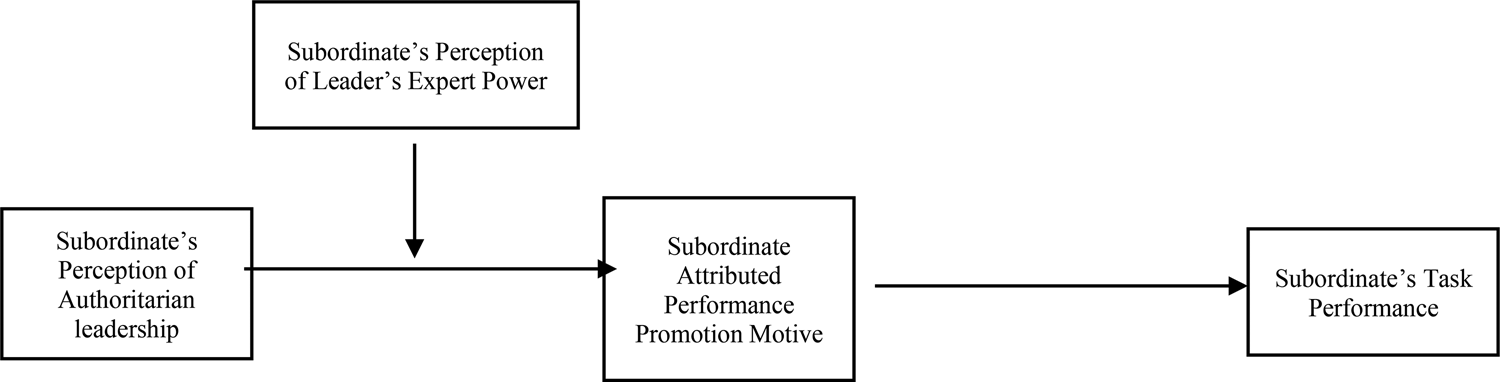
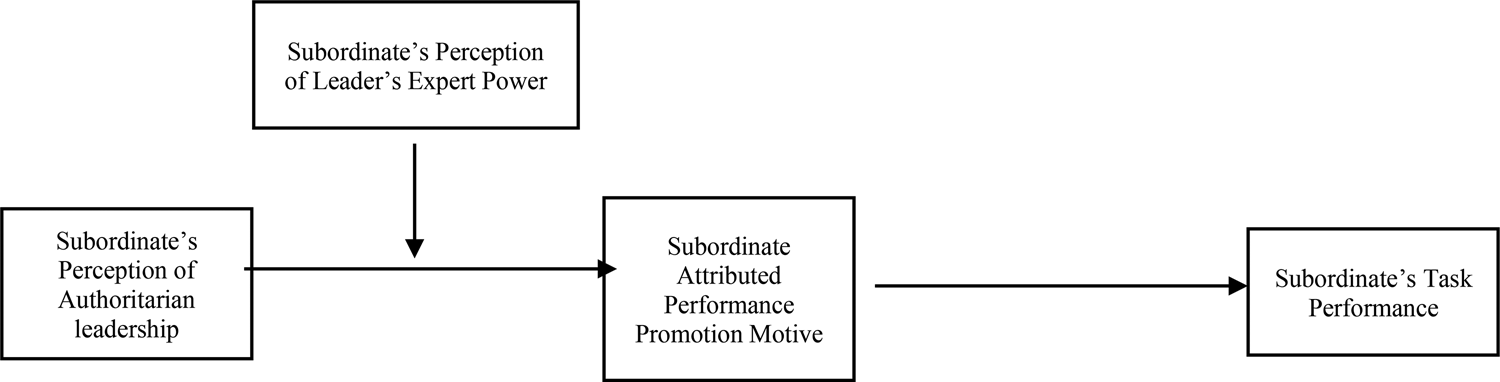
Hypothesis 4. An indirect positive relationship between subordinates’ perceptions of authoritarian leadership and their task performance (through subordinate-attributed performance promotion motive) will be significant when leader’s expert power is high rather than low (Figure 1).
Theoretical model.
Method
Sample and procedure
The research team designed and disseminated field surveys to full-time subordinates and supervisors working in 11 different private sector organizations in Lahore, Pakistan. The research team used convenience sampling to select the organizations based on personal and professional contacts. The majority of the respondents, approximately 75%, belonged to the service sector (banks, software houses, media firms, distributors) with the rest (25%) belonging to the textile and retail sector. English is well understood in Pakistan at all levels of white collar office workers and past studies have conducted surveys in English as well that have been published in mainstream journals (such as Abbas, Raja, Darr, & Bouckenooghe, Reference Abbas, Raja, Darr and Bouckenooghe2014; Khan, Moss, Quratulain, & Hameed, Reference Khan, Moss, Quratulain and Hameed2016). It is also the medium of instruction in all higher educational institutes of Pakistan. We therefore administered our questionnaires in the English language.
The team first approached key contacts in the private organizations who were positioned in their top-management and were keen in assisting in the study. These key contacts then referred the team to the direct supervisors in different departments of their organizations. The team then contacted 98 direct supervisors and requested them to fill out the job performance questionnaires for a random sample of their subordinates. Before consenting to participate, the respondents were provided with a cover letter detailing the study’s objectives and assuring them of the strictest confidentiality. The letter also stated that their participation in the survey was voluntary.
Of these 98 supervisors, a total of 76 supervisors filled out these questionnaires, representing a response rate of 77%. Some supervisors filled out the questionnaires and returned to one of the authors immediately while others took a few days to fill them out. All the supervisors placed their questionnaires in sealed envelopes and returned them to one of the authors. The survey forms of both the supervisor and his/her direct reports were identically numbered so that they could be matched.
Once the supervisors submitted their questionnaires, the research team then independently approached the subordinates of these supervisors and asked them to fill out the subordinate survey containing the scales of authoritarian leadership style, subordinate-attributed performance promotion motive, leader’s expert power, legitimate power, coercive power, reward power and referent power. The same procedure was followed with the subordinates. The respondents were provided with a cover letter elaborating the study objectives, emphasizing strict anonymity of the respondents and that participation is completely voluntary. As the subordinate questionnaires were long, a few days were given to subordinates to fill out the surveys which were then collected by one of the authors. The subordinates placed their questionnaires in sealed envelopes and returned them to one of the authors. To ensure complete confidentiality, subordinates were given the option to hand over the sealed envelopes to the authors off-site. We distributed surveys to 360 employees, of which 246 employees completed the surveys which rendered a response rate of 68%.
The supervisors and subordinates were also asked to provide their demographic information as well. The average age of the subordinates surveyed was 30.42 years (SD = 6.16). Their average tenure with their supervisor was 2.69 years (SD = 2.61) and their average tenure with their organization was 4.50 years (SD = 4.22). The average age of the supervisors was 36.58 years (SD = 6.58). The average tenure of the supervisors with their supervisor was 4.70 years (SD = 3.56) and their average tenure with the organization was 6.61 years (SD = 4.94).
Measures
Responses for all variables were assessed using a 5-point Likert-type scale ranging from 1 = strongly disagree, 2 = disagree, 3 = neutral, 4 = agree and 5 = strongly agree ranging from 1(strongly disagree) to 5(strongly agree). The scale of subordinate’s task performance was assessed using a 5-point Likert scale but used separate labels ranging from 1(unacceptable) to 5(outstanding).
Subordinate’s perceptions of authoritarian leadership style
Subordinates reported their immediate supervisor’s leadership style using the nine-item scale developed by Cheng et al. (Reference Cheng, Chou, Wu, Huang and Farh2004). An example item reads: ‘My supervisor exercises strict discipline over subordinates’. This scale has been used in various studies such as Kiazad et al. (Reference Kiazad, Restubog, Zagenczyk, Kiewitz and Tang2010) and Aryee et al. (Reference Aryee, Chen, Sun and Debrah2007) and has a reliability coefficient of .85.
Subordinate’s perception of leader’s expert power
Subordinates reported on their supervisor’s expert power using the four-item scale by Hinkin and Schriesheim (Reference Hinkin and Schriesheim1989). An example of an item is ‘My Supervisor can give good technical suggestions’. The reliability coefficient of the scale was .94.
Subordinate’s perception of leader’s legitimate power
Subordinates reported on their leader’s legitimate power using the four-item scale by Hinkin and Schriesheim (Reference Hinkin and Schriesheim1989). An example of an item is ‘My Supervisor can make me feel that I have commitments to meet’. The reliability coefficient of the scale was .70.
Subordinate’s perception of leader’s coercive power
Subordinates reported on their supervisor’s coercive power using the four-item scale by Hinkin and Schriesheim (Reference Hinkin and Schriesheim1989). An example of an item is ‘My Supervisor can give me undesirable job assignments’. The reliability coefficient of the scale was .70.
Subordinate’s perception of leader’s reward power
Subordinates reported on their supervisor’s reward power using the four-item scale by Hinkin and Schriesheim (Reference Hinkin and Schriesheim1989). An example of an item is ‘My Supervisor can provide me with special benefits’. The reliability coefficient of the scale was .72.
Subordinate’s perception of leader’s referent power
Subordinates reported on their supervisor’s referent power using the four-item scale by Hinkin and Schriesheim (Reference Hinkin and Schriesheim1989). An example of an item is ‘My Supervisor can make me feel important’. The reliability coefficient of the scale was .82.
Subordinate-attributed performance promotion motive
Subordinate-attributed performance promotion motive was reported by subordinates on their supervisors using the scale developed by Liu, Liao, and Loi (Reference Liu, Liao and Loi2012) that contains five items. An example of an item is ‘My supervisor desires to stimulate me to meet my performance goals’. The reliability coefficient of this scale is .82.
Subordinate’s task performance
The supervisors filled a four-item measure of subordinates’ task performance developed by Liden, Wayne, and Stilwell (Reference Liden, Wayne and Stilwell1993). Sample items include ‘My subordinate is superior to other subordinates that I’ve supervised before’ and ‘Rate the overall level of performance that you observe for this subordinate’. This scale has been used in studies by Tepper, Moss, & Duffy (Reference Tepper, Moss and Duffy2011) and Khan et al. (Reference Khan, Moss, Quratulain and Hameed2016) and has a reliability coefficient of .86.
Control variables
In line with previous research on subordinate’s perception of authoritarian leadership and follower outcomes (Chan et al., Reference Chan, Huang, Snape and Lam2013; Chen, Eberly, et al., Reference Chen, Eberly, Chiang, Farh and Cheng2014; Wu, Huang, & Chan, Reference Wu, Huang and Chan2012) we controlled for several subordinate and supervisor demographics such as gender, age, tenure with the supervisor and tenure with the organization because these variables tend to directly influence leadership behaviours, their perceptions and subordinate performance (Bass, Avolio, & Atwater, Reference Bass, Avolio and Atwater1996; Bauer & Green, Reference Bauer and Green1996; Eagly, Johannesen-Schmidt, & Van Engen, Reference Eagly, Johannesen-Schmidt and Van Engen2003; Maslyn & Uhl-Bien, Reference Maslyn and Uhl-Bien2001). Measures of these demographic variables were self-reported by the subordinates and their supervisors. Gender was dummy coded (0 = female, 1 = male). We also controlled for leader’s legitimate power, coercive power and reward power as job performance of subordinates refers to their required duties and responsibilities and the powers stemming from their supervisor’s position are likely to influence how the subordinates perform. Leader’s referent power is another power that stems from the leader’s personal attributes and refers to the attraction and identification of the subordinate with the leader which may also influence the performance of the subordinates.
Results
Before starting our hypothesis testing, we conducted confirmatory factor analysis to assess the factor structure and discriminant validity of our four main constructs – subordinate’s perception of authoritarian leadership, subordinate’s perception of leader’s expert power, subordinate-attributed performance promotion motive and subordinate’s task performance. In order to measure the fit of our measurement model we used Mplus software version 7.0 (Muthén & Muthén, Reference Muthén and Muthén1998–2012). Once the confirmatory factor analysis was completed, we tested the hypotheses using Mplus software version 7.0 (Muthén & Muthén, Reference Muthén and Muthén1998–2012).
Confirmatory factor analysis
Although we used different data sources (i.e., subordinates and supervisors) to measure the predictor and criterion variables, we still conducted a series of confirmatory factor analyses to examine the discriminant validity of the measurement scales assessed through the same source. We used the MPlus software (Muthén & Muthén, Reference Muthén and Muthén1998–2012) to assess the measurement model. The confirmatory factor analyses showed that as compared to alternative measurement models, our hypothesized measurement model achieved a good model fit (RMSEA = .05, SRMR = .05, CFI = .96, TFI = .94). The results of these analyses are presented in Table 1.
Results of confirmatory factor analyses

Note: n = 246; AL, subordinate’s perception of authoritarian leadership; EP, subordinate’s perception of leader’s expert power; SMOT, subordinate-attributed performance promotion motive; Perf, subordinate task performance; GFI, goodness of fit index; SRMR, standardized root mean squared residual; CFI, comparative fit index; RMSEA, root mean square of approximation; TLI, Tucker–Lewis index.
Descriptive statistics and correlations
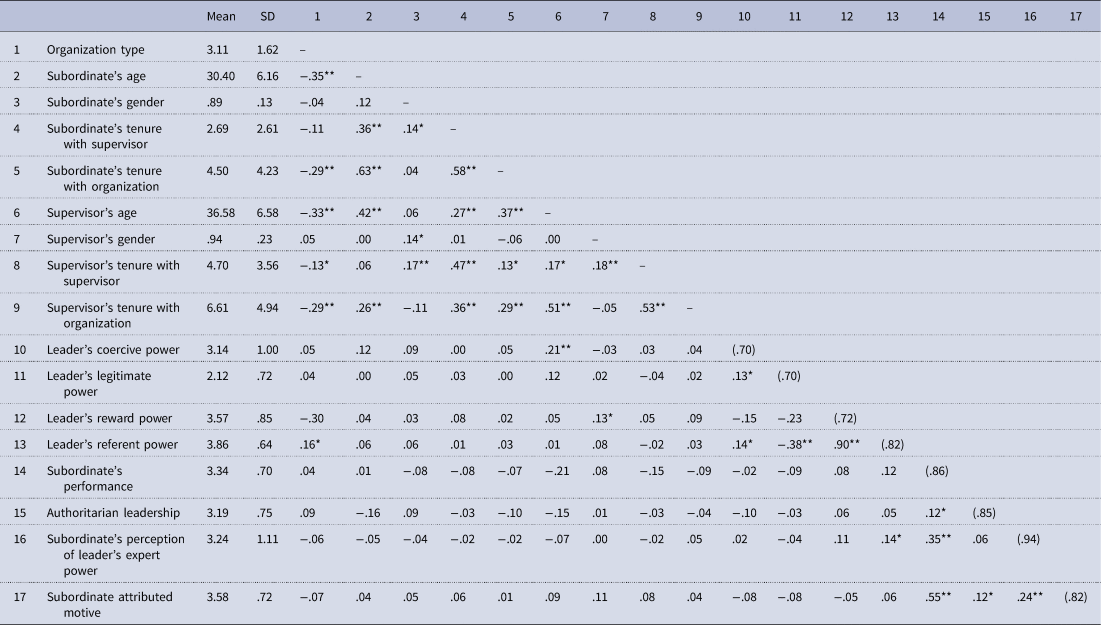
We then calculated the descriptive statistics that is their means, standard deviations, Pearson’s correlation coefficients and internal consistency reliability estimates of the study variables which are shown in Table 2. We adopted a .70 cut-off value for the internal consistency reliability estimates (Bland & Altman, Reference Bland and Altman1997; DeVellis, Reference DeVellis2012). In terms of the correlations, subordinates’ performance positively correlated with both leader’s expert power (r = .35, p < .01) and with subordinate-attributed performance promotion motive (r = .85, p < .01). Moreover, subordinate-attributed performance promotion motive was positively correlated with leader’s expert power (r = .24, p < .01). These findings provide preliminary evidence to support our hypotheses.
Means, standard deviations and correlations among all variables
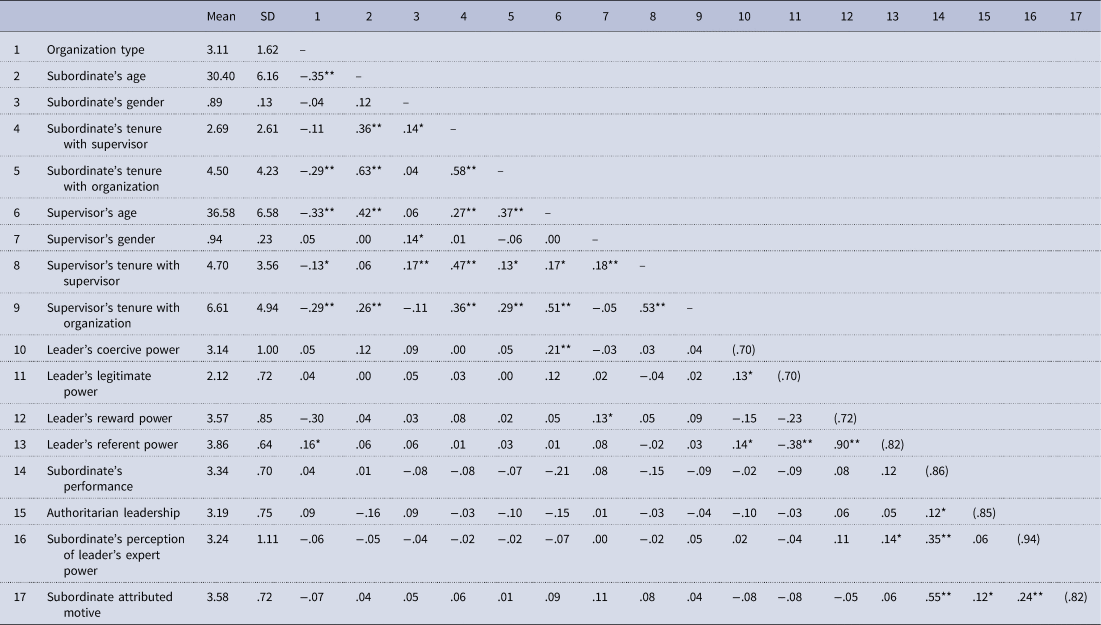
Note: n = 246; *p < .05, **p < .01 (two-tailed). αs reliability coefficients are given on diagonals in parentheses.
Hypothesis testing
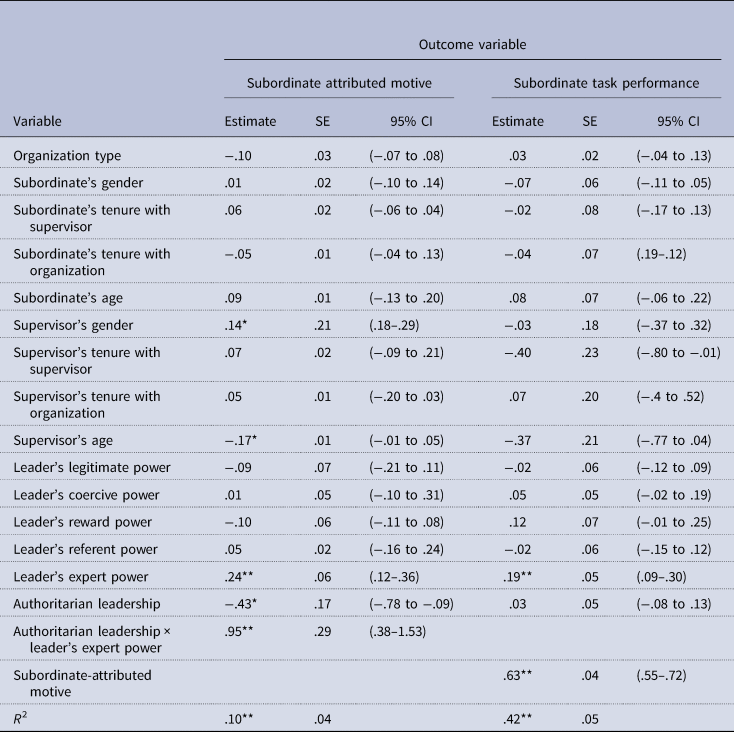
As each subordinate’s data were nested within a supervisory unit along with other subordinates, we first examined the proportions of within- and between-unit variance for the dependent variable by computing intraclass correlation indexes before hypothesis testing. A null model with subordinate task performance as the outcomes variable revealed that 21.5% (p < .05) of the variance resided at the supervisory level thus encouraging the use of a multilevel analysis. When subordinate-attributed performance promotion motive was the outcome, the null model test revealed that 15% (p < .05) of the variance resided at the supervisory level. We tested the hypotheses using Mplus software version 7.0 (Muthén & Muthén, Reference Muthén and Muthén1998–2012). Due to the nested nature of the data we employed the ‘Type = Twolevel’ Mplus syntax and Supervisor ID as the cluster variable. The β coefficients, standard errors and confidence intervals are presented in Table 3. None of the control variables were significant. All measures, excluding the control variables and the dependent variable, were grand mean-centred. Hypothesis 1 specified a negative relationship between subordinate’s perception of authoritarian leadership and subordinate-attributed performance promotion motive. This hypothesis was supported (β = −.43, p < .05). Hypothesis 2 specified a positive relationship between subordinate-attributed performance promotion motive and subordinate task performance. This hypothesis was supported (β = .63, p < .01). Hypothesis 3 which specified the moderating role of leader’s expert power was supported as the interaction between leader’s expert power and subordinate perception of authoritarian leadership was significant (β = .95, p < .01). Hypothesis 4 specified the indirect positive effect of leader’s expert power in the relationship between subordinate perception of authoritarian leadership and subordinate performance through subordinate-attributed performance promotion motive. This hypothesis was supported as the 95% biased corrected confidence interval (CI) of the indirect effect of subordinate’s perception of authoritarian leadership on subordinate performance through subordinate-attributed performance promotion motive excludes zero at the high value of leader’s expert power (Table 4).
MPlus results (coefficients and their standard errors)
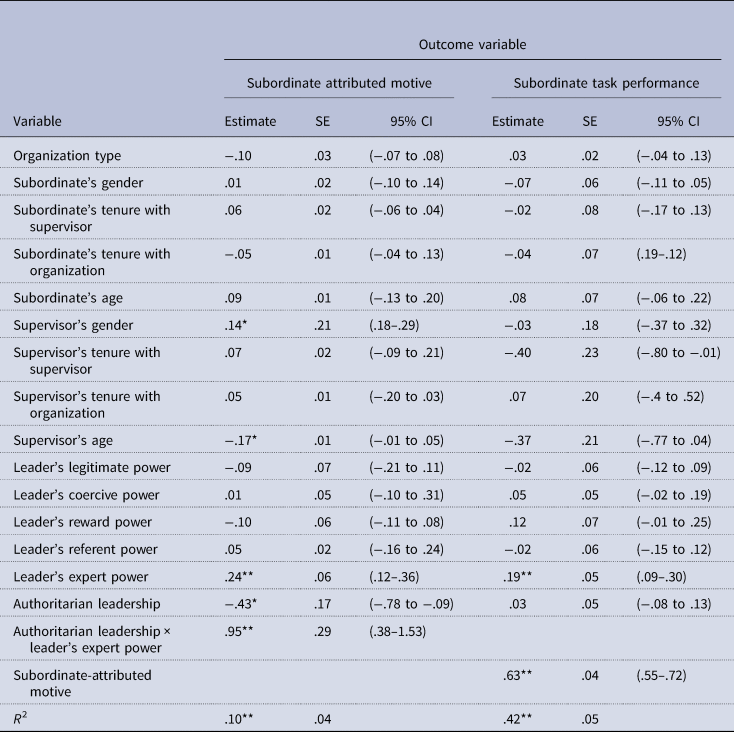
Note: n = 246; CI, confidence interval; *p < .05, **p < .01 (two-tailed).
Organization type was coded 1 = consumer goods distribution, 2 + banks, 3 = software, 4 = media, 5 = textile.
Conditional indirect effects of subordinate’s perception of authoritarian leadership on subordinate performance through SMOT at values of EP

EP, leader’s expert power; LLCI, lower limit confidence interval; ULCI, upper limit confidence interval.
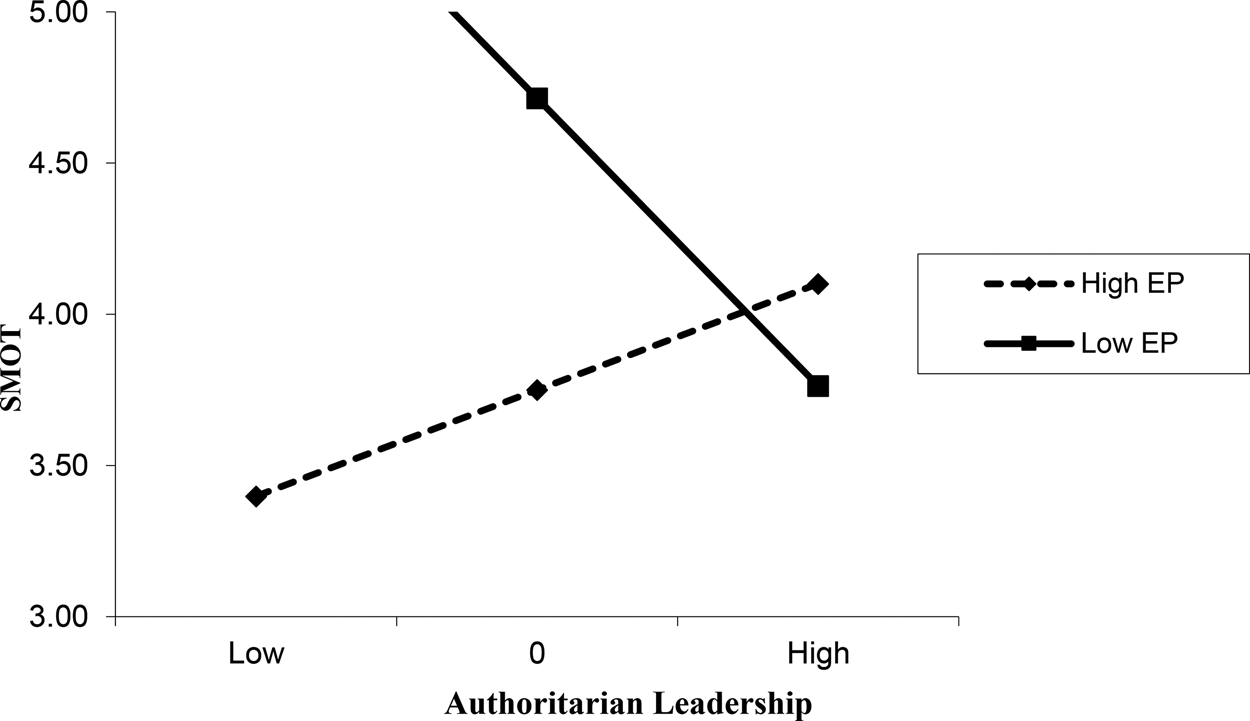
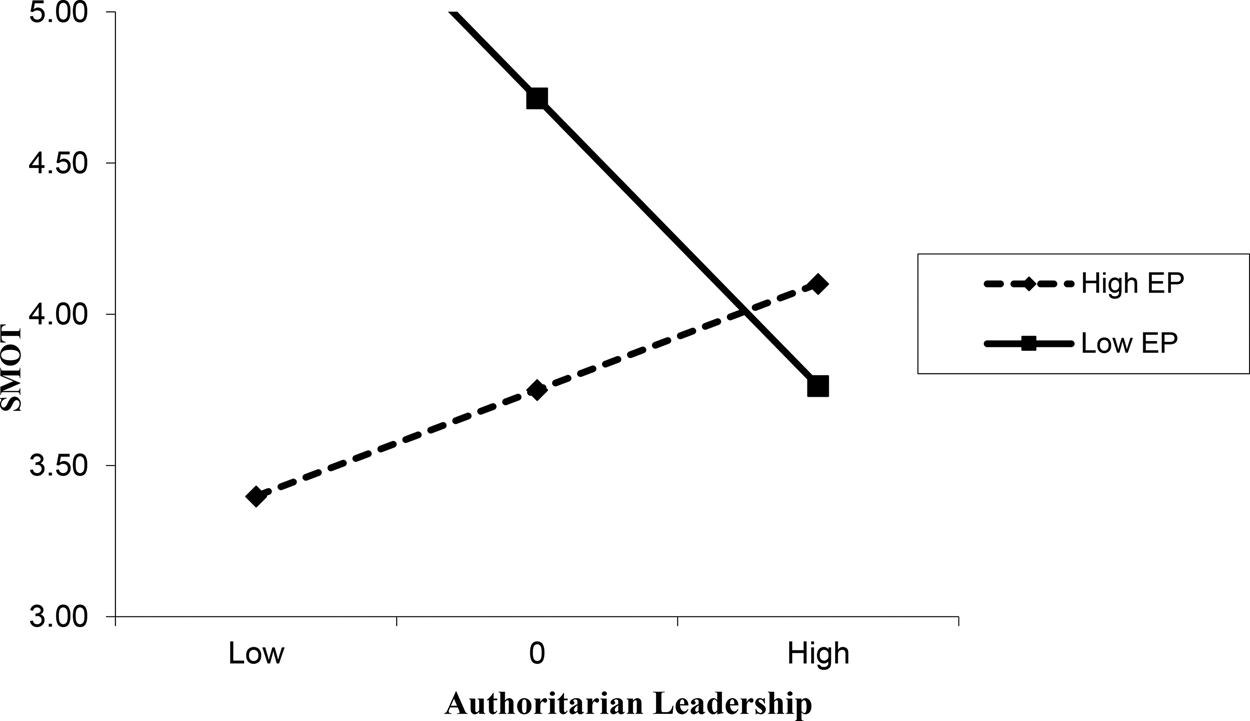
We also conducted a simple slope analysis of the significant interaction to better understand the nature of the moderating effect by using the (mean ± 1SD) criterion recommendations by Aiken, West, and Reno (Reference Aiken, West and Reno1991). The results of this analysis are shown in Figure 2. The figure shows that at higher values of leader’s expert power, when subordinate’s perception of authoritarian leadership increases, the subordinate-attributed performance promotion motive also increases. Thus, subordinate’s perception of authoritarian leadership is only positively related to subordinate-attributed performance promotion motive at higher values only when leader’s expert power is high. This analysis supports our hypothesis 3.
Moderating effect of leader’s expert power (EP) on the relationship of subordinate’s perception of authoritarian leadership and subordinate-attributed performance promotion motive (SMOT).
Discussion
The results of our paper advance the knowledge on the psychological mechanisms underlying the positive relationship between subordinate’s perception of authoritarian leadership and subordinate’s task performance. The first contribution of this paper is that it extends the research on subordinate’s perception of authoritarian leadership as contrary to the predominant deleterious image of authoritarian leaders, this study highlights the positive side of these leaders. Hence, our study adds to an under-researched area of authoritarian leadership.
Not just the consequences of subordinate’s perception of authoritarian leadership, but even the antecedents of such a leadership that have been explored have mainly been negative (Harms et al., Reference Harms, Wood, Landay, Lester and Lester2018). For instance, studies have found such leaders to be more conniving (Maner, Reference Maner2017) and have a self-interest (Collins, Reference Collins2009). Research has also explored the Big Five personality traits along with this leadership style and have found authoritarian leaders to be high on neuroticism and low on agreeableness (Cheng, Tracy, & Henrich, Reference Cheng, Tracy and Henrich2010; Kaiser & Hogan, Reference Kaiser and Hogan2011; Redeker, De Vries, Rouckhout, Vermeren, & De Fruyt, Reference Redeker, De Vries, Rouckhout, Vermeren and De Fruyt2014). Therefore, the second contribution of our study is that contrary to past research, this paper has theorized and found that if subordinates perceive their authoritarian leader to possess a positive characteristic that is expert power, they will be stimulated to improve their performance.
The third contribution of this paper is that it emphasizes the attributions and perceptions of the subordinates as the key to achieving positive consequences under an authoritarian leader. Research on subordinate’s perception of authoritarian leadership that has examined the characteristics of the subordinates of the authoritarian leader in the analysis of the consequences of this leadership style is quite sparse (Harms et al., Reference Harms, Wood, Landay, Lester and Lester2018). The few studies that have included subordinates in the analysis of the consequences of subordinate’s perception of authoritarian leadership have not examined this relationship with the perspective of the attributions of the subordinates. However, scholars argue that the examination of the consequences of leadership behaviours needs to consider the characteristics of both the leaders and subordinates as while subordinates take directions from their leaders, leaders also react to and are enabled by their subordinates (Harms et al., Reference Harms, Wood, Landay, Lester and Lester2018; Padilla, Hogan, & Kaiser, Reference Padilla, Hogan and Kaiser2007; Thoroughgood, Sawyer, Lunsford, & Padilla, Reference Thoroughgood, Sawyer, Lunsford and Padilla2016). The followership approach to leadership states that unlike the traditional approach of leadership literature investigating the follower’s attitudes and motivations as outcomes of the leader’s behaviour, followers need to be viewed as the active agents in the leadership process (Carsten, Uhl-Bien, & Huang, Reference Carsten, Uhl-Bien and Huang2018). The model theorized and tested by our study examines the subordinates as an integral part of the leadership process. The performance of the subordinates is contingent on their own perceptions and attributions of the authoritarian leader’s motive.
Studies have shown that leadership may vary across cultures (Farth, Leong, & Law, Reference Farth, Leong and Law1998; Smith & Peterson, Reference Smith, Peterson, Gannon and Newman2002; Westwood, Reference Westwood1997). The fourth key contribution of this study is that it has been conducted in Pakistan, a country characterized by a high power distance culture (Hofstede, Reference Hofstede2001), that is more likely to produce authoritarian leaders because followers have been socialized to comply obediently to authority (Luthans, Peterson, & Ibrayeva, Reference Luthans, Peterson and Ibrayeva1998). GLOBE studies of leadership collected data from different regions on the preference for an authoritarian leader, and Southern Asia was the third highest region to prefer such a leader (Harms et al., Reference Harms, Wood, Landay, Lester and Lester2018). However, to our knowledge, no study till date has explored the outcomes of authoritarian leadership in Pakistan.
Limitations and future research directions
The contributions and findings of our paper come with certain limitations and future research directions as well. First of all, although we used different sources (subordinates and supervisors) to obtain data on predictor and criterion variables, we cannot completely rule out the common method bias. Conducting Harman’s one-factor test (Podsakoff & Organ, Reference Podsakoff and Organ1986) however revealed that a single factor did not emerge from the factor analyses and four distinct constructs were obtained, suggesting that common method bias may not be a threat in our data. We also found low correlations among our main variables which again suggest that this bias was not a major concern.
A second limitation of our paper is that although our primary objective was to comprehend the underlying mechanisms in the relationship between subordinate’s perception of authoritarian leadership and subordinate’s performance, the cross-sectional nature of our data does not allow for the test of causality between our dependent and independent variables. Future research should therefore focus on generalizing the results by a longitudinal study.
A promising avenue for future research seems to lie in testing our theoretical model with different subordinate characteristics in a moderating role to examine their influence on subordinate-attributed performance promotion motive. For instance, the need for leadership has been found to enhance the positive effects of transformational leadership (De Vries, Roe, & Taillieu, Reference De Vries, Roe and Taillieu1999). Future studies can extend this present model by considering the impact of subordinate’s need for leadership on subordinate-attributed performance promotion motive under an authoritarian leader. Brees, Martinko, and Harvey (Reference Brees, Martinko and Harvey2016) assert that the perceptions of negative leadership behaviours should take into account characteristics of subordinates such as their negative affectivity, traits, anger, hostile attribution styles and entitlement. Subordinates with low organization-based self-esteem are also more likely to perceive higher levels of authoritarian leadership as abusive (Kiazad et al., Reference Kiazad, Restubog, Zagenczyk, Kiewitz and Tang2010) and subordinates with low self-uncertainty have also been found to be more supportive of an authoritarian leader (Rast, Hogg, & Giessner, Reference Rast, Hogg and Giessner2013). The study by Wang and Guan (Reference Wang and Guan2018) found that subordinate’s learning goal orientation mediated the positive relationship between subordinates’ perception of authoritarian leadership and subordinate performance. Another study by Xing et al. (Reference Xing, Sun, Jepsen and Zhang2021) demonstrated that subordinates with high core self-evaluation attributed the negative feedback of their leader to the motive of performance enhancement. This just shows that when it comes to the perception of authoritarian leadership and its consequences, future research needs to explore the characteristics of subordinates that trigger positive attributions in them regarding their authoritarian leaders.
As our model emphasizes the perceptions and attributions of subordinates in the impact of subordinate’s perception of authoritarian leadership on subordinate task performance, future studies should examine the moderating role of the other personal source of power, referent power of the leader in the relationship between subordinate’s perception of authoritarian leadership and subordinate-attributed performance promotion motive. As referent power involves leader’s personal attractiveness that elicits a desire in the subordinates to be approved by the leader (Kim, Park, & Park, Reference Kim, Park and Park2020), authoritarian leaders who are perceived to possess referent power may trigger positive subordinate attributions regarding their underlying motive. Another variable that can be included in this model is the subordinate’s perception of respect. As authoritarian leaders do not give consideration to the concerns and opinions of their subordinates, future studies can assess respect as perceived by subordinates as a mediator in this model to investigate which characteristics of the authoritarian leader enhance subordinate’s perception of respect as derived from the leader.
Another promising avenue for future research would be exploring subordinate’s perception of authoritarian leadership from the leader’s perspective. Leadership research states that leaders differ in their perceptions of the most effective paths of meeting organizational goals (Neubert, Kacmar, Carlson, Chonko, & Roberts, Reference Neubert, Kacmar, Carlson, Chonko and Roberts2008; Watkins, Fehr, & He, Reference Watkins, Fehr and He2019; Zheng et al., Reference Zheng, Huang, Graham, Redman and Hu2020). The study by Zheng et al. (Reference Zheng, Huang, Graham, Redman and Hu2020) found that subordinate’s perception of authoritarian leadership was able to deter subordinates from engaging in deviant behaviours. This means that some leaders may hold the lay belief that authoritarian leadership is an effective mode of ensuring that subordinates meet performance expectations. Hence, they may consciously use a controlling style of leadership with an instrumental motive. Apart from holding instrumental beliefs, when subordinate’s perception of authoritarian leadership interacts with benevolent leadership, it positively impacts the affective trust of subordinates (Tian & Sanchez, Reference Tian and Sanchez2017). Thus, if an authoritarian leader is also demonstrating benevolence, it will trigger positive subordinate attributions.
Finally, future studies should test the present model with a contextual variable, which has also not been researched adequately with this style of leadership (Harms et al., Reference Harms, Wood, Landay, Lester and Lester2018). Thoroughgood, Tate, Sawyer, and Jacobs (Reference Thoroughgood, Tate, Sawyer and Jacobs2012) argue that the perception and outcomes of negative leadership behaviours may vary depending on the social, cultural and occupational contexts. Some studies have found this type of leadership to be effective in certain contexts such as in harsh economic environment (Huang et al., Reference Huang, Xu, Chiu, Lam and Farh2015), when faced with internal conflict (De Hoogh, Greer, & Den Hartog, Reference De Hoogh, Greer and Den Hartog2015) or high threat environments (Nielsen, Skogstad, Matthiesen, & Einarsen, Reference Nielsen, Skogstad, Matthiesen and Einarsen2016). The high power distance culture in Southern Asia already socializes people into believing in the legitimacy of a strong vertical hierarchy (Padilla, Hogan, & Kaiser, Reference Padilla, Hogan and Kaiser2007; Wang & Guan, Reference Wang and Guan2018), thus there is a higher possibility for subordinates in this region to hold positive attributions regarding their leader’s motives.
Managerial implications
The results of our study bear interesting managerial implications. The results of our study demonstrate that focusing largely on participative leaders and viewing authoritarian leaders pejoratively means that organizations might be losing out on effective leaders who despite being authoritarian might still be able to stimulate higher performance from subordinates. The attributions that subordinates make regarding the intentions of their authoritarian leaders may be positive if subordinates perceive their leaders to possess other positive characteristics and capabilities. Thus, leaders with a dominating style may still be respected by subordinates if they have achieved success in their fields and are perceived as technical experts. When designing leadership training programmes, organizations need to consider the context in which they are operating and the characteristics of their subordinates. However, organizations need to take caution as authoritarian leaders are prone to turn abusive (Harms et al., Reference Harms, Wood, Landay, Lester and Lester2018). Research has already found subordinate’s perception of authoritarian leadership to be associated with abusive supervision (Aryee et al., Reference Aryee, Chen, Sun and Debrah2007; Kiazad et al., Reference Kiazad, Restubog, Zagenczyk, Kiewitz and Tang2010).
Conclusion
The results of this study indicate that authoritarian leaders may have a functional value in achieving subordinate performance. Hence, this study extends research on subordinate’s perception of authoritarian leadership as it theorized and found that subordinates may attribute the authoritarian leader’s motive to pushing them to attain performance goals, which in turn will positively influence their performance.
Financial support
This research did not receive any specific grant from funding agencies in the public, commercial or not-for-profit sectors.