Introduction
Handovers (or ‘handoffs’, as they are more commonly termed in the United States of America (USA)) involve ‘the exchange between health professionals of information about a patient accompanying either a transfer of control over, or of responsibility for, the patient’ (Cohen and Hilligoss Reference Cohen and Hilligoss2010: 494). This exchange usually consists of information about the patient's current condition and the possible changes or complications that might occur’ (World Health Organization Collaborating Centre for Patient Safety Solutions 2007: 1). Handovers are intended to improve continuity of care and reduce the risk that the team to whom care is being transferred will fail to carry out an important aspect of a person's treatment or act swiftly enough upon a deterioration in his or her condition.
An extensive literature on handovers has developed, including a number of systematic reviews (Holly and Poletick Reference Holly and Poletick2014; Riesenberg, Leisch and Cunningham Reference Riesenberg, Leisch and Cunningham2010). Within this, most attention focuses on shift handovers between nurses (e.g. Drach-Zahavy and Hadid Reference Drach-Zahavy and Hadid2015; Smeulers, Lucas and Vermeulen Reference Smeulers, Lucas and Vermeulen2014). In hospital settings, nursing shift handovers are a long-standing, institutionally sanctioned component of organising care and professional practice. They symbolise the transfer of responsibility for patient care to the oncoming group of nurses (David et al. Reference David, Holroyd, Jackson and Cleary2017: 70) and encompass more than the exchange of information, including opportunities for teaching, team building, peer support and social exchanges (Kerr Reference Kerr2002; Schneider et al. Reference Schneider, Scales, Bailey and Lloyd2010).
By contrast, very little seems to be known about shift handovers in residential care facilities for older people. Care homes occupy a liminal position between hospitals and domestic and community settings (Milligan Reference Milligan2009). As with hospitals, they provide care on a 24-hour basis. Policy changes and the greater availability of support within people's own homes mean that between 2001 and 2011, despite an 11 per cent increase in the population aged 65 and over, the number of people aged 65 and over living in care homes in England and Wales rose by just 1,000 from 290,000 to 291,000 (Office for National Statistics 2014). The health of older people living in care homes and those admitted to acute hospitals is now much more similar. Older people are now more likely only to move into a care home for the last few months of their lives when their health is frail and their ongoing health needs have become more complex (Lievesley, Crosby and Bowman Reference Lievesley, Crosby and Bowman2011). Furthermore, while most care homes have a core of regular staff, high rates of turnover and vacancies can exist (Davison and Polzin Reference Davison and Polzin2016; Hussein, Ismail and Manthorpe Reference Hussein, Ismail and Manthorpe2016). This means that it cannot be assumed that all those providing care have personal knowledge of a resident's needs. Instead, they may have to rely on information from other sources.
These developments make it timely to examine the practice around shift handovers in care homes. This article reports the results of a scoping review which was undertaken to inform new empirical research (Norrie et al. Reference Norrie, Lipman, Moriarty, Elaswarapu and Manthorpe2017). In the absence of an established body of evidence about handovers in care homes, it begins by using research undertaken in hospitals to establish a framework for describing the handover process. One facet of this research is the variability of handovers in hospitals. In the fragmented care home market in England, which ranges from small family-owned businesses to large multinationals, the potential for dissimilarity in handover practice is theoretically even greater so the next section summarises the key features of residential long-term care in England. After explaining the review methods, findings from the 15 studies selected for inclusion in the review are organised into four themes. The first contrasts the predominance of the traditional verbal handover in care homes over the so-called bedside handover that would potentially give a greater emphasis to involving the resident. The second considers whether handovers include the whole of the staff team or are restricted to those taking overall charge for a particular shift and the extent to which this mirrors a care home's wider organisational culture. The third discusses handovers in term of the artefacts used to share information. The final theme describes ways in which handovers could prioritise organisational needs over residents’ preferences. The review also draws attention to the lack of information on the effectiveness of handovers. It concludes by suggesting that greater attention to handovers in care homes might improve our understanding both of levels of job satisfaction and knowledge among staff and factors influencing residents’ choice and the quality of care they receive.
Background
Handovers: definitions and purpose
Messam and Pettifer (Reference Messam and Pettifer2009) and Smeulers, Lucas and Vermeulen (Reference Smeulers, Lucas and Vermeulen2014) identified four styles of nursing handover. These were:
1. Bedside: located at the patient's bedside, which promotes patient and nurse face-to-face interaction and encourages patients’ verbal participation.
2. Verbal: located in an office setting, the nurse responsible for a group of patients exchanges relevant documented information.
3. Non-verbal: located in an office setting, nurses inform themselves by reading the patient health record, including progress notes, medication and observation charts and nursing care plans.
4. Taped: located in an office setting, the nurse in charge collects the relevant information and records this on to an audiotape so that the oncoming shift can listen at a convenient time (Smeulers, Lucas and Vermeulen Reference Smeulers, Lucas and Vermeulen2014: 3).
While verbal handovers are ‘traditional’ (Messam and Pettifer Reference Messam and Pettifer2009: 190) and staff tend to prefer face-to-face handovers (whether at the bedside or in an office) over those which are not (Frankel et al. Reference Frankel, Flanagan, Ebright, Bergman, O'Brien, Franks, Allen, Harris and Saleem2012), there is a lack of experimental studies identifying whether different styles of handover result in any better outcomes for patients (Manser and Foster Reference Manser and Foster2011; Smeulers, Lucas and Vermeulen Reference Smeulers, Lucas and Vermeulen2014). Instead, each type of handover is usually presented as having its own set of advantages and disadvantages. For example, verbal handovers offer opportunities to clarify information, while audio taped or written handovers do not require an overlap between shifts (Tucker and Fox Reference Tucker and Fox2014).
A striking feature of existing published research on handovers in hospitals is their variability. External factors, such as noise, workloads, interruptions and the need to attend to patients are all thought potentially to impact on handover quality (Manser and Foster Reference Manser and Foster2011; Streitenberger, Breen-Reid and Harris Reference Streitenberger, Breen-Reid and Harris2006). Researchers have also suggested that handovers are influenced by their ritualistic nature, organisational culture and leadership (David et al. Reference David, Holroyd, Jackson and Cleary2017; Holly and Poletick Reference Holly and Poletick2014; Streitenberger, Breen-Reid and Harris Reference Streitenberger, Breen-Reid and Harris2006; Tucker and Fox Reference Tucker and Fox2014). This variation helps explain why so much of the research interest in handovers has been led by clinicians and organisations concerned with patient safety. A commonly cited statistic in the handover literature is the statement made by the Joint Commission (an independent, not-for-profit organisation accrediting and certifying health-care organisations and programmes in the USA) that ineffective communication in handovers plays a ‘role in an estimated 80 per cent of serious preventable adverse events’ in hospitals (Joint Commission 2011, cited in Popovich Reference Popovich2011: 55). Adverse events are usually defined as an unintended injury or complication resulting in prolonged hospital stay, disability at the time of discharge or death, caused by health-care management rather than by the patient's underlying disease process (de Vries et al. Reference de Vries, Ramrattan, Smorenburg, Gouma and Boermeester2008: 216).
Attempts have been made to reduce the risk of adverse events by standardising the handover process. This mainly involves using structured tools, such as the ‘Introduction, Situation, Background, Assessment (ISBAR)’ (Aldrich et al. Reference Aldrich, Duggan, Lane, Nair and Hill2009), the 30-Second Head-to-Toe checklist (Popovich Reference Popovich2011) or the REED (Record, Evidence, Enquire, Discuss) model (Tucker and Fox Reference Tucker and Fox2014).
Before discussing the factors influencing long-term care provision that might affect the nature and practice of handovers in care homes, it is worth highlighting one final point about existing research on hospital handovers. Streitenberger, Breen-Reid and Harris (Reference Streitenberger, Breen-Reid and Harris2006) argue that poor handover information means mistakes are more likely to be made when patients are unable to advocate for themselves and are temporarily or permanently reliant on others to meet all their care needs because the patients themselves are unable to intervene themselves by, for example, questioning why a particular treatment is being given or appears to have been forgotten. To this end, existing research about hospital handovers has investigated handovers in paediatric wards (Popovich Reference Popovich2011; Streitenberger, Breen-Reid and Harris Reference Streitenberger, Breen-Reid and Harris2006), operating theatres (Randmaa et al. Reference Randmaa, Swenne, Martensson, Högberg and Engström2016) and intensive care (Mukhopadhyay et al. Reference Mukhopadhyay, Leong, Lua, Aroos, Wong, Koh, Goh, See, Phua and Kowitlawakul2015). However, the position of older people who might also be unable to advocate for themselves, such as those with speech problems following a stroke or those with dementia, appears to be strikingly absent.
Factors influencing the provision of residential long-term care
Residential long-term care is typically seen as part of a continuum (e.g. McGrail Reference McGrail2011; Park-Lee et al. Reference Park-Lee, Caffrey, Sengupta, Moss, Rosenoff and Harris-Kojetin2011), ranging from facilities providing 24-hour support with activities of daily living, such as washing and dressing, to skilled nursing facilities providing sub-acute care for those requiring complex care or rehabilitation. The Organisation for Economic Co-operation and Development estimates that residential settings comprise only about a quarter of all the long-term care provided to older people in its member countries but they account for almost two-thirds of its costs (Colombo et al. Reference Colombo, Llena-Nozal, Mercier and Tjadens2011). While increases in the proportion of people aged 80 and over are the key factors influencing demand for residential long-term care, the size of the sector and the type of support it provides within different countries are also influenced by national and local political priorities (Lievesley, Crosby and Bowman Reference Lievesley, Crosby and Bowman2011) and the size and mix of publicly and privately funded long-term care (Colombo et al. Reference Colombo, Llena-Nozal, Mercier and Tjadens2011). In turn, these political and funding differences influence the way that long-term care services are regulated (Mor, Leone and Maresso Reference Mor, Leone and Maresso2014).
Care home sector in England
In England, the generic term ‘care home’ is used to describe long-term residential care facilities which are divided into those ‘with’ or ‘without’ nursing care (Orellana Reference Orellana2014). Care homes must be registered with the regulator, the Care Quality Commission. Where owners are not in day-to-day charge of the service themselves, they have to appoint a registered manager to manage it on their behalf (Care Quality Commission 2017b). Some registered managers have a professional qualification such as nursing or social work; others are appointed on the basis of vocational qualifications. However, the numbers in each group are unknown (Orellana, Manthorpe and Moriarty Reference Orellana, Manthorpe and Moriarty2017). In addition, care homes ‘with nursing’ (often referred to as nursing homes) are required by law always to have a registered nurse on duty, whereas homes ‘without nursing’ (sometimes referred to as residential homes) are not.
As of 2015 (the latest year for which published figures were available), there were 11,000 care homes without nursing in England and 4,600 homes with nursing provided by around 7,913 different organisations. Between 2009 and 2015, there was a 10 per cent decline in the number of homes without nursing and 7 per cent rise in the number of homes with nursing (Davison and Polzin Reference Davison and Polzin2016). A distinctive feature of care homes in England is that the great majority are in the commercial sector, which includes both large corporate chains and small family-run homes. While the average size of a home is approximately 20 places, there are almost 3,000 homes with five or fewer places, and only 10 per cent have more than 50 places (Oscar Research n.d.). In terms of how these places are funded, Passingham, Holloway and Bottery (Reference Passingham, Holloway and Bottery2013) cite data from Laing and Buisson, a commercial market intelligence company, suggesting that 44 per cent of people living in a care home in England pay their fees themselves, 36 per cent are funded entirely by their local council because they have assets below £23,250, a further 14 per cent use ‘top-up’ fees paid by a relative to supplement the fees paid by their local council, while the remainder are funded by the National Health Service. These data are not sub-divided by age.
Staffing levels are currently under pressure in many care homes in England. This is a long-standing problem (Hussein, Ismail and Manthorpe Reference Hussein, Ismail and Manthorpe2016) worsened by evidence that the 2008 economic crisis has resulted in cuts in staff to resident ratios, in the ratio of qualified to unqualified staff, and to reductions in pay, all of which can contribute to diminished handover procedures in some homes (Burns, Hyde and Killett Reference Burns, Hyde and Killett2016). Care home owners have specifically warned about the consequences of the introduction of the National Living Wage, which specifies the minimum pay per hour most workers are entitled to by law. They complain that local councils have not raised the fees they pay care homes to support publicly funded residents in line with their increased wage bills (Low Pay Commission 2016).
Owners have also expressed concern that pressure from commissioners and regulators to improve the quality of record keeping as a way of improving standards of care and increasing accountability has led to care homes becoming over-burdened with ‘paperwork’, including recording what happens from one shift to the next (Warmington, Afridi and Foreman Reference Warmington, Afridi and Foreman2014). The combination of staff cuts, low pay, increased demand and regulatory pressures to improve record keeping places considerable pressure on staff time. This could, in turn, have an impact on the quality of information exchange about care home residents and on their consequent comfort and safety. Care homes themselves comprise ‘complex and often contradictory environments with their mixture of private and public spaces, individual and communal existences, a home for residents and a work place for staff’ (Kenkmann et al. Reference Kenkmann, Poland, Burns, Hyde and Killett2017: 8). While they often resemble each other in terms of layout and in the support needs of those who live in them, their cultures may differ substantially (Luff, Ferreira and Meyer Reference Luff, Ferreira and Meyer2011). The combination of funding pressures, difficulties in recruiting and retaining staff, regulatory pressures to improve standards of record keeping, and differences between homes in terms of their ownership, culture and clientele suggest it is worth exploring whether shift handovers provide a microcosm of the current care home environment in England.
Methods
The aim of this review was to explore what is known about the types of shift-to-shift handovers in care homes for older people (Norrie et al. Reference Norrie, Lipman, Moriarty, Elaswarapu and Manthorpe2017). It was undertaken to inform new empirical research on handovers based on interviews and observations in five contrasting care homes funded by the Abbeyfield Foundation for which we received ethical approval from the King's College London Geography, Global Affairs, Social Science, Health & Medicine Research Ethics Panel. This broad aim, alongside results from preliminary searches revealing that there was limited published research on handovers in care homes, suggested that we should adopt a scoping methodology. Scoping reviews (Arksey and O'Malley Reference Arksey and O'Malley2005) are an increasingly popular method to map the body of literature on a given topic in a timely, transparent and rigorous way (Moriarty and Manthorpe Reference Moriarty and Manthorpe2016; Pham et al. Reference Pham, Rajić, Greig, Sargeant, Papadopoulos and McEwen2014). They are primarily used for ‘reconnaissance’ (Peters et al. Reference Peters, Godfrey, Khalil, McInerney, Parker and Soares2015: 141) to provide an overview of a potentially large and diverse body of literature on a broad topic. The results can help inform new primary research or indicate whether a systematic review is feasible. While growing in popularity, the conduct of scoping reviews varies considerably and there are calls for more debate about the ways in which they are undertaken and reported in order to achieve greater consistency (Peters et al. Reference Peters, Godfrey, Khalil, McInerney, Parker and Soares2015; Tricco et al. Reference Tricco, Lillie, Zarin, O'Brien, Colquhoun, Kastner, Levac, Ng, Sharpe, Wilson, Kenny, Warren, Wilson, Stelfox and Straus2016).
During the second half of 2016, we followed the standard three-step process recommended for scoping reviews (Peters et al. Reference Peters, Godfrey, Khalil, McInerney, Parker and Soares2015) by systematically searching for primary research, literature reviews and other types of resource, such as toolkits or guidance concerned with handovers in care homes, published between January 2005 and December 2016. First, we identified bibliographic databases that covered research about care homes. Searches for material about handovers in care homes were made in MEDLINE, Cumulative Index to Nursing and Allied Health Literature, Applied Social Science Index and Abstracts, and Social Care Online. We also identified studies undertaken in hospitals for contextual information.
As the terms handovers and handoffs apply to, and are used by, many industries and activities, the search strings were refined to identify research in care homes and about older people. Three sets of terms were thus sought. Set one included handover(s), shift handover(s), handoff(s) and hand-off(s); set two included residential care, nursing homes, long-term care and care homes; and the third included various terms commonly used to describe people aged 65 and over.
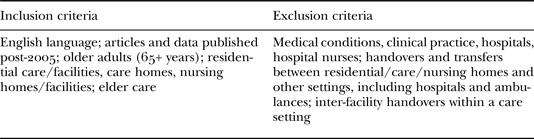
Next we searched the internet to identify grey literature not formally published in academic journals or books to identify government reports and guidance, and other relevant material that may not have been abstracted in bibliographic databases (Godin et al. Reference Godin, Stapleton, Kirkpatrick, Hanning and Leatherdale2015; Mahood, Van Eerd and Irvin Reference Mahood, Van Eerd and Irvin2014). This included searches of the websites of the Social Care Institute for Excellence and the Care Quality Commission. The publisher websites of three English-language journals on ageing were also searched. These were: Age and Ageing, Ageing International and Ageing & Society. Finally, we hand-searched the references from relevant articles and reviews to identify studies missed by our computer-assisted searches. Table 1 summarises the inclusion and exclusion criteria for the review.
Review of inclusion and exclusion criteria

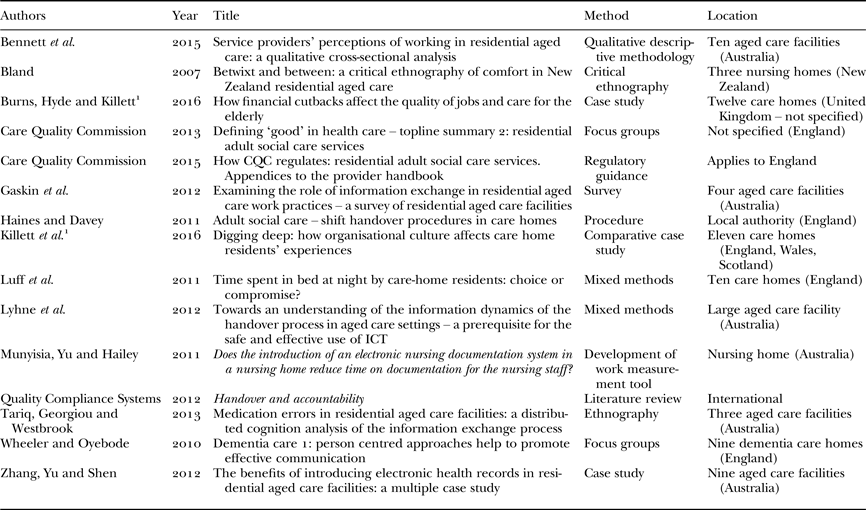
We undertook conceptual and thematic analyses to summarise the review findings. First, one researcher (VL) read all the material, made notes, compared the accounts of shift handovers with the hospital studies summarised earlier and developed the broad categories relating to handovers in care homes. To establish trustworthiness, a second researcher (JoM) independently performed the same process. The team then discussed the separate findings to reach a consensus on the themes reported. A minority of scoping reviews also include elements of quality appraisal (Peters et al. Reference Peters, Godfrey, Khalil, McInerney, Parker and Soares2015; Pham et al. Reference Pham, Rajić, Greig, Sargeant, Papadopoulos and McEwen2014). Hardly any of the retrieved items were specifically about handovers which did not lend itself to devising a quality appraisal framework for the included studies. However, information on the design and scope of the included studies is recorded in Table 2.
Summary of studies included in review
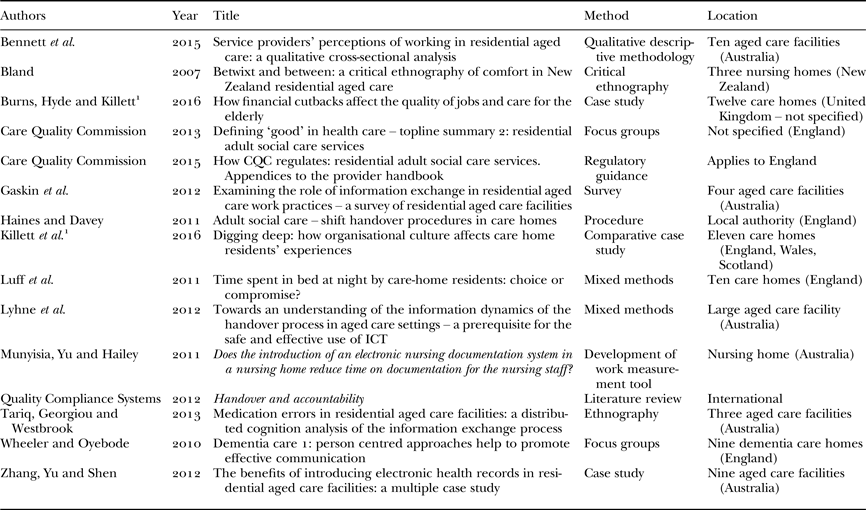
Note: 1. Two outputs from same study, although the number of homes included differs between the two and Killett et al. is more specific about their location.
Findings
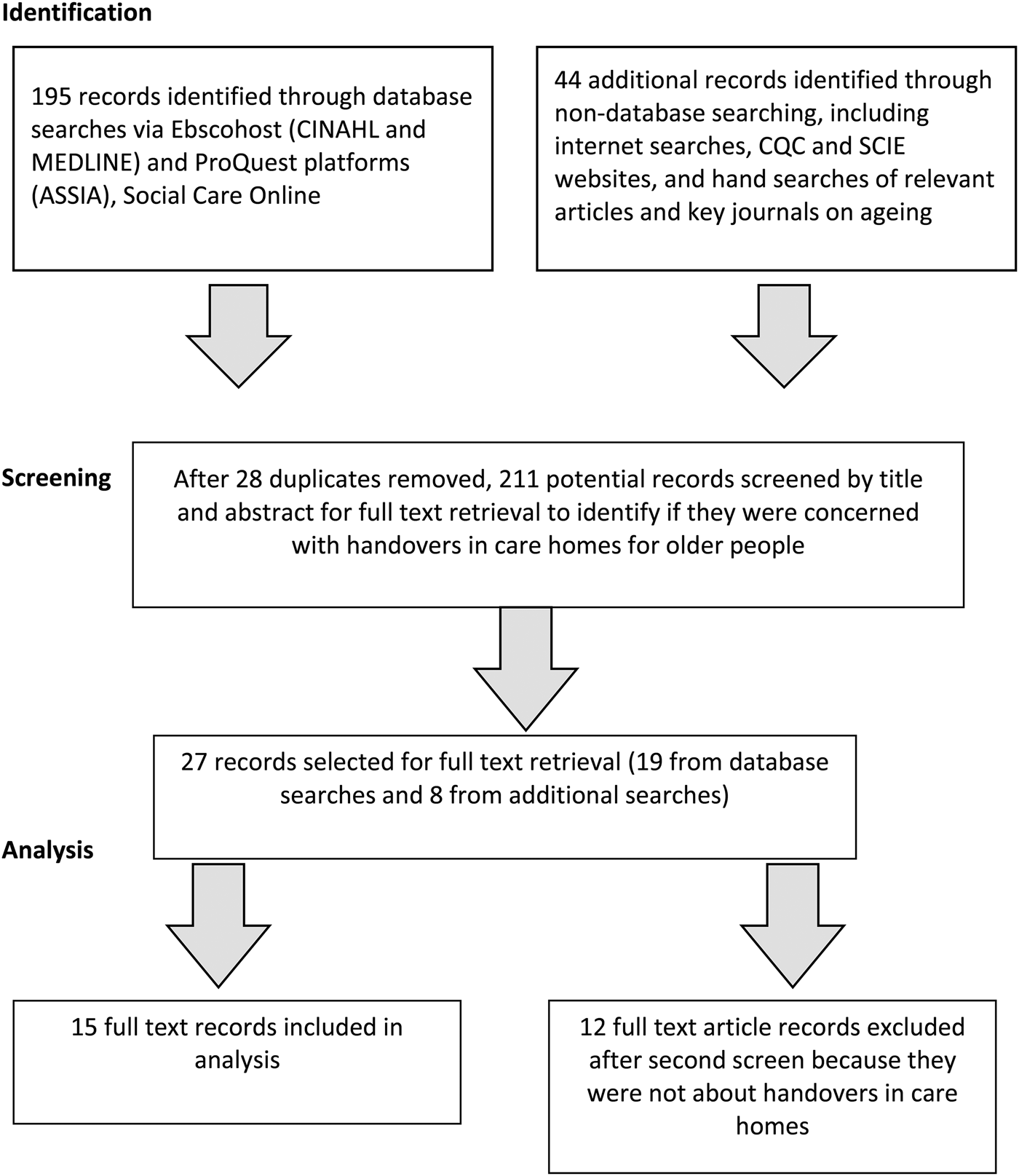
Figure 1 summarises the results from the searches and the screening processes to finalise items for inclusion in the analysis. It suggests that the size of the published literature on handovers in care homes is comparatively small and a high proportion appears to be located in resources aimed at practitioners and care providers.
Flow chart for identification of relevant literature on care home handovers.

Table 2 summarises the 15 items selected for final inclusion. As well as studies originating in the United Kingdom, several accounts are from Residential Aged Care Facilities (RACFs) in Australia. RACFs provide full-time residential care for older people who can no longer live at home. Services provide continuous supported care ranging from help with daily tasks and personal care to 24-hour nursing care. A blog written for care providers and retrieved for this review (Quality Compliance Systems 2012) referred to Canadian research on handovers but the references it cited appeared to concern handovers in hospitals. With two exceptions (Haines and Davey Reference Haines and Davey2011; Lyhne et al. Reference Lyhne, Georgiou, Marks, Tariq and Westbrook2012), handovers were generally described in the context of wider systems for information exchange (Gaskin et al. Reference Gaskin, Georgiou, Barton and Westbrook2012; Munyisia, Yu and Hailey Reference Munyisia, Yu and Hailey2011; Tariq, Georgiou and Westbrook Reference Tariq, Georgiou and Westbrook2013) or in terms of their role within the routines that exist in care homes (Bennett et al. Reference Bennett, Ward, Scarinci and Waite2015; Bland Reference Bland2007; Burns, Hyde and Killett Reference Burns, Hyde and Killett2016; Luff et al. Reference Luff, Ellmers, Eyers, Young and Arber2011).
Handover style
Conceptually, shift handovers in care homes appeared to be influenced by nurse shift-to-shift handovers in hospitals. As with studies of nurses (Messam and Pettifer Reference Messam and Pettifer2009; Smeulers, Lucas and Vermeulen Reference Smeulers, Lucas and Vermeulen2014), different types of handover – verbal, non-verbal and taped – were reported but the studies identified did not consider whether the amount of nursing care provided in each setting influenced handover style or length. Verbal handovers typically took place at each change of shift and were reported as being brief (often around 15 minutes), relaying only pertinent information from the previous period of work (Burns, Hyde and Killett Reference Burns, Hyde and Killett2016; Haines and Davey Reference Haines and Davey2011; Lyhne et al. Reference Lyhne, Georgiou, Marks, Tariq and Westbrook2012; Wheeler and Oyebode Reference Wheeler and Oyebode2010).
An important cross-cutting theme in five of the six Australian studies retrieved for this review was a trend towards the use of electronic health records to replace verbal handovers and paper records (Gaskin et al. Reference Gaskin, Georgiou, Barton and Westbrook2012; Lyhne et al. Reference Lyhne, Georgiou, Marks, Tariq and Westbrook2012; Munyisia, Yu and Hailey Reference Munyisia, Yu and Hailey2011; Tariq, Georgiou and Westbrook Reference Tariq, Georgiou and Westbrook2013; Zhang, Yu and Shen Reference Zhang, Yu and Shen2012). These emphasised the potential for information technology to reduce duplication and minimise errors. While some staff were reported to prefer face-to-face communication, they generally recognised the advantages of electronic records. Even so, electronic records did not appear to have completely replaced paper care plans and handover books (Lyhne et al. Reference Lyhne, Georgiou, Marks, Tariq and Westbrook2012; Zhang, Yu and Shen Reference Zhang, Yu and Shen2012). A further reported disadvantage – remembering that these studies pre-dated the wide availability of hand-held devices – was that electronic information was not available at the point of care and electronic records and care plans had to be updated using paper-based records at the end of a shift (Gaskin et al. Reference Gaskin, Georgiou, Barton and Westbrook2012; Lyhne et al. Reference Lyhne, Georgiou, Marks, Tariq and Westbrook2012).
No examples of bedside handovers in which discussion about the previous shift and establishing agreement about what needed to be done during the following one takes place alongside the resident were identified in the studies included in the review. Bedside handovers have increased in popularity in some hospitals as a way of helping patients to become more involved in their care and improve the quality of information sharing (National Nursing Research Unit 2012). The absence of resident involvement in care home handovers may be the result of concerns that bedside handovers would take longer and that residents might be asleep when handovers took place late at night and early in the morning. Instead, handovers generally took place in the home's office or, in one study, at the nurse's work station or care team room (Lyhne et al. Reference Lyhne, Georgiou, Marks, Tariq and Westbrook2012). Place and space are not neutral (Kenkmann et al. Reference Kenkmann, Poland, Burns, Hyde and Killett2017). In this sense, the discussions that take place between staff in areas that are ‘off limits’ to residents become part of the power dynamic in care homes and highlight the absence of residents’ voices in the process of handover. As we describe below, they may also exclude those who are directly involved in providing care.
Extent of staff involvement
There was considerable variation in terms of whether handovers involved all staff, including care workers and other staff involved in domestic services such as laundry or cooking, or whether they were restricted to senior staff (Bennett et al. Reference Bennett, Ward, Scarinci and Waite2015; Wheeler and Oyebode Reference Wheeler and Oyebode2010). Research from hospital settings (Schneider et al. Reference Schneider, Scales, Bailey and Lloyd2010) shows that even if everyone is present at a handover, it does not mean that different grades of staff contribute equally. Care workers felt that their input was not always valued during handover or described how they often found themselves unsure of what to do in their duties because of incomplete or conflicting communication from superiors, as well as insufficient information provided during handover. They felt these experiences reduced their job satisfaction and meant they were more likely ‘to call in sick’. They also thought their poor morale had a ‘flow on’ effect on the residents (Bennett et al. Reference Bennett, Ward, Scarinci and Waite2015: 1999).
Financial constraints, as well as status, could also influence who attended handovers. Burns, Hyde and Killett (Reference Burns, Hyde and Killett2016: 1003) contrasted one home in which all staff were involved in handovers with another where cutbacks in fees paid by the local council led to a decision not to pay care workers to attend handovers. It was not clear from this account whether this decision also applied to other grades of staff, such as senior care workers or shift leaders. In the home in which all those beginning a shift, including care workers, took part in the handover, everyone was involved in ‘throwing ideas around on how to do things for each of the residents’. This was thought to contribute to the home being given an ‘excellent’ rating by the regulator. By comparison, care workers in the other home were reliant on the information passed on to them by the senior staff on duty. The care workers themselves did not consider this to be adequate and developed their own informal handover by ‘huddling together to share information and to discuss which parts of the workload each would do’ (Burns, Hyde and Killett Reference Burns, Hyde and Killett2016: 1004). The absence of care workers during handover meant that opportunities to use handovers for training or supervision were also missed.
This example of an informal handover contrasted strongly with the procedure written by a local council in which staff were instructed not to ‘catch up with each other socially’ or to ‘drink tea and coffee’ during the handover, which was to be ‘chaired’ by the Duty Officer, a designated senior member of staff (Haines and Davey Reference Haines and Davey2011: 3–4). While the hospital-based literature on handovers identifies their unofficial purpose in contributing to team building and peer support (Holly and Poletick Reference Holly and Poletick2014; Kerr Reference Kerr2002), this document provided an illustration of the way in which handovers in care homes could reinforce hierarchical distinctions between staff.
Infrastructural context of handovers
Many quality improvement interventions hinge on the introduction of artefacts to support behavioural change in the workplace but few evaluations analyse whether they are operating as intended. For example, many technologies intended to reduce paperwork have the opposite effect (Allen Reference Allen2012: 460). On the basis of the studies reported here, artefacts designed to improve handovers had a mixed effect. Zhang, Yu and Shen (Reference Zhang, Yu and Shen2012) reported that staff thought it was quicker to record information on electronic health records than to write them by hand. It was also easier to share information with other professionals. Tariq, Georgiou and Westbrook (Reference Tariq, Georgiou and Westbrook2013) highlighted that handwritten medication records were often illegible – thus increasing the potential for mistakes to be made. Set against these reported advantages, Lyhne et al. (Reference Lyhne, Georgiou, Marks, Tariq and Westbrook2012) concluded there was still a considerable amount of duplication, including the need for registered nurses to carry a written handover sheet throughout the shift which then had to be transferred to the electronic record before the next shift arrived on duty. Bland (Reference Bland2007) highlighted the pressures on nurses from regulators and employing organisations to provide more detailed written information about residents. This had, she observed, resulted in them spending more time in the office writing care plans rather than supervising what care staff were doing. However, as her field notes revealed, despite the ‘enormous amount’ of registered nurse time ‘spent developing supposedly individualized care-plans, they were often inaccurate, incomplete, out of date, or ignored by care delivery staff’ (Bland Reference Bland2007: 941).
Choice versus routine
Care homes have a unique culture in the sense that their environment is simultaneously somewhere that is communal, an individual's home and a workplace (Bland Reference Bland2007; Kenkmann et al. Reference Kenkmann, Poland, Burns, Hyde and Killett2017). There is a well-established gerontological literature that explores the organisational culture of care homes and how it sometimes includes task-focused routines – such as undertaking certain duties at particular times of the day – that appear to operate more in the interests of staff than residents (Bland Reference Bland2007; Killett et al. Reference Killett, Burns, Kelly, Brooker, Bowes, La Fontaine, Latham, Wilson and O'Neill2016). A universal theme of research on handovers both in hospitals and care homes is how they are used to promote residents’ safety (Frankel et al. Reference Frankel, Flanagan, Ebright, Bergman, O'Brien, Franks, Allen, Harris and Saleem2012; Tariq, Georgiou and Westbrook Reference Tariq, Georgiou and Westbrook2013). How this might conflict with individual residents’ preferences is explored less often. Luff et al. (Reference Luff, Ellmers, Eyers, Young and Arber2011) investigated the amount of time that residents spent in bed at night, focusing on how residents’ bedtimes and getting-up times were managed. They found that shift timings and handovers were seen by some residents as designed to meet staff needs rather than those of residents. For example, one resident would have preferred to go to bed between 9.30 and 10 pm but this time coincided with handover when fewer staff were available to help. She chose to go to bed earlier rather than risk waiting until the incoming night staff could help her. In this instance, the combination of handovers and the practice of employing fewer people at night than during the day combined to reduce residents’ choices.
Effectiveness
The limited nature of research about handovers in care homes meant that it was unsurprising that that there was so little information on their effectiveness. A series of focus groups held with relatives of people living in nursing homes on behalf of the Care Quality Commission (2013) (the regulator for health and social care in England) included ‘efficient handovers’ as an indicator that a home was ‘well led’ but did not describe in any further detail what these might involve. The study by Luff et al. (Reference Luff, Ellmers, Eyers, Young and Arber2011) was the only one that we were able to identify that specifically discussed handover practices in terms of residents’ quality of life. While Bland (Reference Bland2007) also made links between poor information sharing and residents’ ‘comfort’, she did not specifically refer to handovers in this context. Care workers participating in the studies undertaken by Bennett et al. (Reference Bennett, Ward, Scarinci and Waite2015) and Wheeler and Oyebode (Reference Wheeler and Oyebode2010) were concerned that poor communication, including that provided at handover, hindered their ability to provide good care. However, Munyisia, Yu and Hailey (Reference Munyisia, Yu and Hailey2011) highlighted the methodological challenges of being able to show causal links between handovers and other types of verbal or written communication to direct benefits for care home residents.
Discussion
Almost a fifth of care homes and a third of nursing homes in England are rated by the Care Quality Commission (2017a) as inadequate or requiring improvement. Poor record keeping and information sharing are regularly identified as practices that put care home residents at risk (e.g. Cass Reference Cass2012). Concerns have also been expressed about the lack of training received by staff in care homes (Carter Reference Carter2015). Results from this review suggest that the part played by handovers in alleviating or contributing to these problems appears to be surprisingly neglected. In England, the sheer number of care homes in terms of their size, ownership and the type of resident they support poses considerable challenges in terms of developing reliable sampling frames from which to survey handover practice. However, the material included in this review suggests that ethnographic designs and case studies can yield rich comparisons and provide a framework for future research. In their study of handovers in a large RACF in Australia, Lyhne et al. (Reference Lyhne, Georgiou, Marks, Tariq and Westbrook2012: 458) concluded that:
The safety risk associated with a lack of standard [handover] procedures may be highest in situations where facility personnel are required to move from one neighbourhood to another, or when the facility uses agency staff to cover a shortage of available staff. In these situations staff may be required to undertake their work without prior knowledge or clear guidelines about the care procedures in the work location.
Handovers in hospitals have been shown to have a ritualistic and symbolic character (David et al. Reference David, Holroyd, Jackson and Cleary2017; Kerr Reference Kerr2002). It is possible that handover styles developed when people living in care homes had fewer health needs and when vacancy and turnover rates were lower remain unchanged, although they may no longer be fit for purpose.
The review also raises questions about care plans and the role that handovers might play in how they are shared. Care homes are reported to spend a considerable amount of time completing and checking care plans, partly as a response to regulatory pressures (Warmington, Afridi and Foreman Reference Warmington, Afridi and Foreman2014). In theory, care staff should be able to read these plans and the associated daily records without the need for a verbal handover. However, in her in-depth observations of three New Zealand nursing homes, Bland (Reference Bland2007) noted that while registered nurses spent a lot of time in the office writing care plans, there was very little evidence that they were ever consulted by care staff.
The apparent gap between written information held in offices and the reality of care practice and the increasing use of hand-held devices that record what care needs to be given (Lyhne et al. Reference Lyhne, Georgiou, Marks, Tariq and Westbrook2012; Munyisia, Yu and Hailey Reference Munyisia, Yu and Hailey2011; Zhang, Yu and Shen Reference Zhang, Yu and Shen2012) suggests opportunities for natural experiments comparing electronic handover systems with verbal handovers and handwritten or desktop computer records.
Handovers are often presented as being resource-intensive because of the need for staff to prepare information for the oncoming shift and, in the case of verbal or bedside handovers, for overlap between the outgoing and incoming shifts (Petersen et al. Reference Petersen, Blackmer, McNeal and Hill2013; Tucker and Fox Reference Tucker and Fox2014). Funding pressures appear to have had an impact on handover procedures (Burns, Hyde and Killett Reference Burns, Hyde and Killett2016; Killett et al. Reference Killett, Burns, Kelly, Brooker, Bowes, La Fontaine, Latham, Wilson and O'Neill2016), with some employers attempting to cut costs by not paying care workers to attend handover. At the same time, lack of involvement by care workers in handovers is clearly a source of frustration and reduced job satisfaction (Bennett et al. Reference Bennett, Ward, Scarinci and Waite2015; Burns, Hyde and Killett Reference Burns, Hyde and Killett2016; Wheeler and Oyebode Reference Wheeler and Oyebode2010). There is an extensive literature examining the impact of job satisfaction upon retention (Hussein, Ismail and Manthorpe Reference Hussein, Ismail and Manthorpe2016). Evidence from nursing in hospitals suggests that handovers promote team cohesion (Holly and Poletick Reference Holly and Poletick2014; Kerr Reference Kerr2002). This raises the question of whether excluding care workers from handovers is ultimately a false economy if it then leads to worse retention.
The views of older people or family members were strikingly absent from the studies included in this review, with three exceptions (Care Quality Commission 2013; Luff et al. Reference Luff, Ellmers, Eyers, Young and Arber2011; Wheeler and Oyebode Reference Wheeler and Oyebode2010). Despite the policy emphasis on greater personalisation (Killett et al. Reference Killett, Burns, Kelly, Brooker, Bowes, La Fontaine, Latham, Wilson and O'Neill2016), the focus of studies about handovers in care homes seems to have placed more stress on management systems and benefits to staff rather than exploring how handovers may benefit residents and the quality of care.
Future research could include more in-depth observations of where and how handovers take place, adopting some of the practice of research undertaken in hospitals to consider aspects such as the artefacts used and the different styles of verbal and non-verbal communication. There is also scope for investigating if handovers differ between different types of care home, or between different types of residents and their levels of need. It could also be an opportunity to redress the balance in terms of resident perspectives on handovers.
This was a limited review undertaken prior to a comparatively small-scale study of handovers in care homes. It is possible that material that met the inclusion criteria for this review was omitted from the searches. However, it has enabled some light to be shed on an under-explored topic and highlights the potential for further research in this area that could improve our understanding of living or working in a care home.
Acknowledgements
The study was funded by the Abbeyfield Research Foundation and we are most grateful to the Abbeyfield Society for its support. We also thank the Social Care Workforce Research Unit Service User and Carer Group for its consideration of this study. The views expressed in this article are those of the authors alone. We thank the anonymous peer reviewers for their comments on an earlier version of this article.