Introduction
Epidemiological studies suggest that approximately one out of every six young people in the United States and other developed countries worldwide has experienced some type of childhood maltreatment, such as physical abuse, sexual abuse, emotional abuse, or neglect (Finkelhor, Turner, Shattuck, & Hamby, Reference Finkelhor, Turner, Shattuck and Hamby2013; Gilbert et al., Reference Gilbert, Widom, Browne, Fergusson, Webb and Janson2009; Stoltenborgh et al., Reference Stoltenborgh, Bakermans-Kranenburg, Alink and Ijzendoorn2015). The ubiquity of maltreatment exposure is concerning due to the wide ranging negative health outcomes linked to childhood maltreatment, including depression, posttraumatic stress disorder (PTSD), other psychiatric problems, as well as brain-based structural and functional changes (McLaughlin et al., Reference McLaughlin, Green, Gruber, Sampson, Zaslavsky and Kessler2010; Teicher et al., Reference Teicher, Andersen, Polcari, Anderson, Navalta and Kim2003).
Recent evidence also suggests that exposure to childhood maltreatment may lead to difficulties in social cognition abilities. Social cognition refers to the information processing mechanisms underlying the perception, interpretation, and response to social information that drive social interactions (Crick & Dodge, Reference Crick and Dodge1994; Green, Olivier, Crawley, Penn, & Silverstein, Reference Green, Olivier, Crawley, Penn and Silverstein2005; Piskulic & Addington, Reference Piskulic and Addington2011; Sergi, Rassovsky, Nuechterlein, & Green, Reference Sergi, Rassovsky, Nuechterlein and Green2006; Vauth, Rüsch, Wirtz, & Corrigan, Reference Vauth, Rüsch, Wirtz and Corrigan2004). It is often conceptualized as the psychological processes that allow individuals to benefit from being part of a social group, such as human society (Frith, Reference Frith and Frith2007). Such processes include skills to recognize other's emotions and infer their mental states via body language and other social cues. Social cognitive deficits, or difficulties in interpreting social cues and situations, can have many negative consequences. For example, prior studies have linked deficits in social cognition to social misperceptions and even social withdrawal (Green et al., Reference Green, Olivier, Crawley, Penn and Silverstein2005; Piskulic & Addington, Reference Piskulic and Addington2011), as well as poor vocational outcomes stemming from deficits in work-related social skills (Vauth et al., Reference Vauth, Rüsch, Wirtz and Corrigan2004). Of consequence, children who have experienced abuse or maltreatment have been found to have a wide range of social cognition deficits as compared to their nonmaltreated peers, including difficulties comprehending complex social situations, understanding emotions, identifying facial emotions, and imitating multiple roles in social interactions (Barahal, Waterman, & Martin, Reference Barahal, Waterman and Martin1981; Luke & Banerjee, Reference Luke and Banerjee2013). For example, children exposed to institutional caregiving environments were found to have worse social cognition in all domains, but particularly reciprocal social interactions (Levin et al., Reference Levin, Fox, Zeanah and Nelson2015). Many theorize that social cognitive deficits can occur following exposure to maltreatment, due to maltreatment being linked with insecure attachments, lowered threshold for limbic system reactivity, and other neurobiological changes (Dvir, Ford, Hill, & Frazier, Reference Dvir, Ford, Hill and Frazier2014).
Social cognition may play also an important role in mental illness. To date, deficits in social cognition abilities have been linked to the etiology, course, and treatment of a wide range of psychiatric disorders, including schizophrenia, autism, posttraumatic stress disorder, depression, and early-onset conduct problems (Ladegaard, Larsen, Videbech, & Lysaker, Reference Ladegaard, Larsen, Videbech and Lysaker2014; Oliver, Barker, Mandy, Skuse, & Maughan, Reference Oliver, Barker, Mandy, Skuse and Maughan2011; Piskulic & Addington, Reference Piskulic and Addington2011; Sasson, Nowlin, & Pinkham, Reference Sasson, Nowlin and Pinkham2013; Sergi et al., Reference Sergi, Rassovsky, Nuechterlein and Green2006). For example, prior research has shown that among people with schizophrenia, social cognition abilities can predict functional outcome (i.e., ability to work independently and social problem solving) and, when considered with broader cognitive skills (i.e., verbal memory and attention), can explain nearly 80% of the variance in social functioning (Addington, Girard, Christensen, & Addington, Reference Addington, Girard, Christensen and Addington2010; Sergi et al., Reference Sergi, Rassovsky, Nuechterlein and Green2006). In addition, mentalizing impairment – a subset of social cognition defined as a person's capacity to understand one's own and others’ behavior in regards to a mental state – has been shown to partially mediate or explain the association between childhood abuse and negative symptoms in nonaffective psychotic disorders (Weijers et al., Reference Weijers, Fonagy, Eurelings-Bontekoe, Termorshuizen, Viechtbauer and Selten2018). As social cognition is widely implicated in psychiatric disorders, research into the features that predict social cognition problems, including childhood maltreatment, are needed.
However, research on the relationship between childhood maltreatment and social cognition has been limited in three important ways. First, studies of maltreated children have often assessed social cognition deficits in adulthood – and not throughout childhood and adolescence, when social cognitive skills are developing (Happé & Frith, Reference Happé and Frith2014). In particular, few studies have examined social cognition during middle childhood, when important gains in social perspective taking are made (Bosacki, Reference Bosacki2000; Van Der Graaff et al., Reference Van Der Graaff, Branje, De Wied, Hawk, Van Lier and Meeus2014). This is a shortcoming as social cognition is not a fixed state during early life, but rather the result of an ongoing neurodevelopmental process that continues throughout childhood and adolescence. The capacity to mentalize – or understand the mental state of others – develops in the first 5 years of life (Frith & Frith, Reference Frith and Frith2007). By age 4, most children have developed the understanding that others may hold beliefs that are different from their own and that other's beliefs can be untrue (Barresi & Moore, Reference Barresi and Moore1996; Kilford, Garrett, & Blakemore, Reference Kilford, Garrett and Blakemore2016). During adolescence, brain structures important for social cognition, including grey matter density in the superior temporal lobe, undergo rapid development and change (Burnett, Sebastian, Cohen Kadosh, & Blakemore, Reference Burnett, Sebastian, Cohen Kadosh and Blakemore2011; Mills, Lalonde, Clasen, Giedd, & Blakemore, Reference Mills, Lalonde, Clasen, Giedd and Blakemore2014; Vetter, Leipold, Kliegel, Phillips, & Altgassen, Reference Vetter, Leipold, Kliegel, Phillips and Altgassen2013). Previous work has indicated that social cognition may be highly plastic and malleable depending on the social network and social experiences of the child across time and development (Cabrera, Fagan, Wight, & Schadler, Reference Cabrera, Fagan, Wight and Schadler2011; Ford, Clark, & Stansfeld, Reference Ford, Clark and Stansfeld2011; Happé & Frith, Reference Happé and Frith2014). Although there are a number of longitudinal studies of social cognition, few of these start with children; of these, none to our knowledge examine repeated measures of social cognition throughout childhood (Magiati, Tay, & Howlin, Reference Magiati, Tay and Howlin2014). These shortcomings exist despite evidence suggesting that the foundations of social cognitive skills are gained in very early life (Happé & Frith, Reference Happé and Frith2014; Mills et al., Reference Mills, Lalonde, Clasen, Giedd and Blakemore2014). To address these gaps, prospective and longitudinal studies are needed that include repeated, standardized measures to capture the development of social cognition beginning in infancy throughout childhood and adolescence.
Second, although childhood maltreatment experiences have been linked to social cognition deficits, including emotional regulation problems (Dvir et al., Reference Dvir, Ford, Hill and Frazier2014), there is limited knowledge of how certain features of these maltreatment experiences predict social cognition. For example, little is known whether the developmental timing of occurrence and the number of times a child is exposed to maltreatment shapes their social cognition, or whether being exposed to maltreatment, regardless of these timing aspects, is more important. Thus, efforts are needed to statistically evaluate hypotheses described by life course theory (Ben-Shlomo & Kuh, Reference Ben-Shlomo and Kuh2002; Kuh, Ben-Shlomo, Lynch, Hallqvist, & Power, Reference Kuh, Ben-Shlomo, Lynch, Hallqvist and Power2003), including those focused on sensitive periods, accumulation, ever-exposed models, respectively. Studies on a host of other psychosocial outcomes, such as depression risk, psychosis risk, lower ego resiliency, and neurocognitive functioning (Barahal et al., Reference Barahal, Waterman and Martin1981; Dale et al., Reference Dale, Findlay, Adcock, Vertinski, Fisher, Genevsky and Vinogradov2010; Dunn et al., Reference Dunn, Soare, Raffeld, Busso, Crawford, Davis and Susser2018; Luke & Banerjee, Reference Luke and Banerjee2013; Manly, Kim, Rogosch, & Cicchetti, Reference Manly, Kim, Rogosch and Cicchetti2001) have found that the effects of childhood maltreatment, and of adversity more broadly, can vary considerably depending on the timing and accumulation of abuse exposures. There is evidence to suggest that there may be sensitive periods when the developing brain is particularly susceptible to these adverse social experiences (Dunn, McLaughlin, Slopen, Rosand, & Smoller, Reference Dunn, McLaughlin, Slopen, Rosand and Smoller2013; Dunn, Nishimi, Powers, & Bradley, Reference Dunn, Nishimi, Powers and Bradley2017). Further, prior work has also demonstrated the importance of exposure timing in predicting neurophysiology, neurobiological structure, and broader cognitive functioning (Bosch et al., Reference Bosch, Riese, Reijneveld, Bakker, Verhulst, Ormel and Oldehinkel2012; Cicchetti, Cowell, Rogosch, & Toth, Reference Cicchetti, Cowell, Rogosch and Toth2015). Given this growing body of evidence to support time-dependent effects of maltreatment, there is a need for research that accounts for not only changes in social cognition over time, but also the temporal features of maltreatment exposure across childhood. Such investigations will allow researchers to evaluate the effects of different theories and determine which theoretical models alone or in combination best explain child development outcomes.
Finally, there is a distinct lack of population-based social cognition research, with the majority of prior studies being conducted in clinical cohorts and other highly selected or homogeneous samples (e.g., college undergraduates). While social cognition has been an excellent predictor of functional outcomes (e.g., vocational functioning) in previous studies using clinical samples (e.g., people diagnosed with schizophrenia), these findings have not been generalized to typically developing populations. Efforts to expand work on the links between maltreatment exposure and social cognition to more representative samples can improve reproducibility and generate results that are more widely generalizable. Moreover, a focus on triangulation, where multiple approaches are used to address the same research question – including studying different population groups – can yield results that are less likely to be driven by methodological artifacts and are closer to the underlying truth (Munafò & Davey Smith, Reference Munafò and Davey Smith2018).
The current study aimed to address these gaps and expand upon prior literature by prospectively examining the relationship between exposure to childhood maltreatment and social cognition deficits. Data came from a large, population-based sample of children followed from infancy to adolescence called the Avon Longitudinal Study of Parents and Children (ALSPAC). Our aims were to: (a) determine how exposure to different types of maltreatment between birth and age 9 years was associated with the development of social cognition skill deficits from ages 7.5 through 14; and (b) evaluate the effects of the different life course models in relation to these later social cognition skill deficits. Specifically, the three life course models tested were: (a) a sensitive period model (Ben-Shlomo & Kuh, Reference Ben-Shlomo and Kuh2002), in which the effect of maltreatment depends on the developmental time period of the exposure; (b) an accumulation model (Evans, Li, & Whipple, Reference Evans, Li and Whipple2013), in which the effect of maltreatment increases with the number of occasions exposed, regardless of timing; and (c) an ever-exposed model, in which the effect of maltreatment does not depend on the timing or amount of exposure, but rather its presence or absence.
Method
Sample and procedures
ALSPAC is a prospective, longitudinal birth-cohort of children born to pregnant mothers living in the county of Avon England, which is 120 miles west of London (Boyd et al., Reference Boyd, Golding, Macleod, Lawlor, Fraser, Henderson and Davey Smith2013; Fraser et al., Reference Fraser, Macdonald-Wallis, Tilling, Boyd, Golding, Davey Smith and Lawlor2013). ALSPAC was designed to generate new knowledge on the pathways to health across the life span, with a focus on genetic and environmental determinants. Women residing in Avon, UK who gave birth between 1 April 1991 to 31 December 1992 were recruited through media advertisements and visits by research staff at multiple sites within the community. The study was also advertised at routine antenatal and maternity health services appointments. Approximately 85% of eligible pregnant women agreed to participate (N = 14,541), and 76% of eligible live births (N = 14,062) who were alive at 12 months of age (N = 13,988 children) were enrolled. An additional 913 children who would have been eligible, but whose mothers did not choose to participate during pregnancy, were enrolled after age 7 years. Response rates to data collection have been good (75% have completed at least one follow-up). Compared to the general population in the UK based on the 1991 Census, mothers enrolled in the ALSPAC were more likely to be White, married, and home owners. However, despite having generally higher socioeconomic positions than non-ALSPAC enrolled women, ALSPAC-enrolled women were more likely to live in overcrowded conditions (Fraser et al., Reference Fraser, Macdonald-Wallis, Tilling, Boyd, Golding, Davey Smith and Lawlor2013). Ethical approval for the study was obtained from the ALSPAC Ethics and Law Committee and the Local Research Ethics Committee. The ALSPAC website contains details of all the data that are available through a fully searchable data dictionary and variable search tool: http://www.bristol.ac.uk/alspac/researchers/our-data/.
The current analysis was based on an analytic sample of 4,438 children (out of a possible 9,677 children with one measure of social cognition) who met three inclusion criteria. First, we restricted our analytic sample to singleton births to prevent confounding associated with the unique social structure and support that multiple-birth children can have in the home (Lang, Cox, & Flores, Reference Lang, Cox and Flores2013; Prino et al., Reference Prino, Rollè, Sechi, Patteri, Ambrosoli, Caldarera and Brustia2016). Second, the measurement of social cognition came from mailed questionnaires, and we further restricted the sample to only those children whose caregivers had completed these questionnaires for all of the first three timepoints (ages 7.5, 10.5, and 14 years) when social cognition was measured. Finally, to ensure a consistent reporter of child social cognition across time, we restricted the sample to only those children who had mothers and maternal figures as the sole reporters of their social cognition skills over the three timepoints of assessment. As expected, given attrition patterns in the ALSPAC, children in the included sample (n = 4,438) were slightly more socio-demographically advantaged as compared to children in the excluded sample who had at least one social cognition measure (n = 5,239) (Supplemental Table 1). In addition, we compared the distribution of covariates and outcome scores between the analytic sample (n = 4,438) and the subset of excluded participants with complete social cognition outcome data at all three time points, but who lacked consistent maternal reports (n = 688). These two samples had largely similar sociodemographic characteristics and social cognition scores at all three time points; however, the excluded sample (without consistent maternal reports) were more likely to be born to mothers with slightly higher education (Supplemental Table 2).
Measures
Exposure to child maltreatment
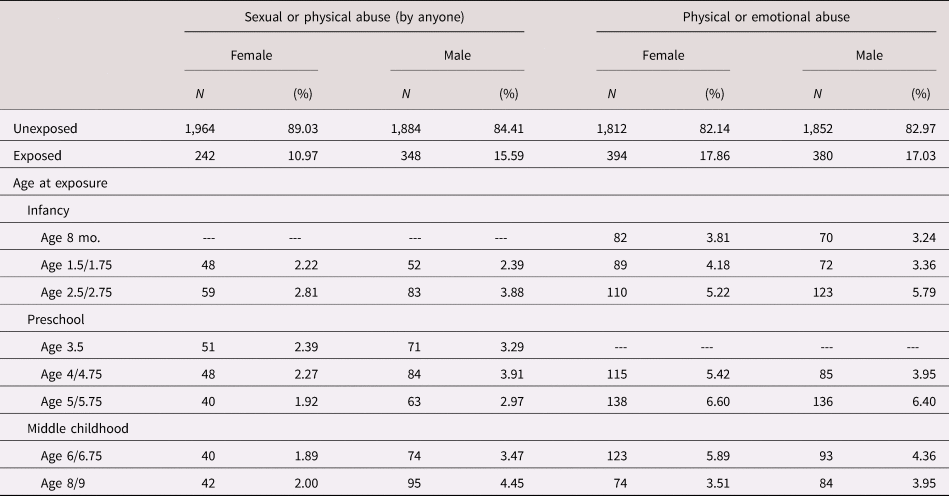
We examined two types of child maltreatment, measured using mailed questionnaires. Each maltreatment type was measured on seven occasions before age 10; the time frame covered by each assessment varied, with an average duration of 19 months (Table 1 and Supplemental Table 3).
Exposure to childhood maltreatment in the analytic sample, stratified by type, sex, and age at exposure (n = 4,438)

Percentages for each age represent proportions of children exposed out of the total analytic sample.
--- indicates that the variable was not assessed at the corresponding time point.
Caregiver physical or emotional abuse
Children were coded as having been exposed to physical or emotional abuse if the mother, partner, or both responded affirmatively to any of the following items: (a) “Your partner was physically cruel to your children”; (b) “You were physically cruel to your children”; (c) “Your partner was emotionally cruel to your children”; (d) “You were emotionally cruel to your children”. Physical abuse and emotional abuse items were examined together, rather than separately, given their moderately strong correlation overall (average correlation = 0.55) and to ensure an adequate sample size for these analyses given the rarity of abuse exposure in this population-based sample (Supplemental Table 4).
Sexual or physical abuse
Exposure to sexual or physical abuse was determined through an inventory asking the mother to indicate whether or not the child had been either “sexually abused” or “physically hurt by someone.” If the mother indicated the child had been exposed to either physical or sexual abuse, the child was coded as having experienced abuse. Owing to low prevalence of sexual abuse in the sample, under 10 cases per timepoint, sexual and physical abuse were considered in the same measure; the tetrachoric correlation between any exposure to physical abuse before age 10 and any exposure to sexual abuse before age 10 was moderate (r tetrachoric = .39).
Variable encoding
For each type of maltreatment, we generated three sets of encoded variables: (a) a single variable denoting the total number of time periods of exposure to each type of maltreatment, to test the accumulation hypothesis (coded as 0–6); (b) a set of variables indicating presence versus absence of each type of maltreatment at a specific developmental stage, to test the sensitive period hypothesis; and (c) a single variable denoting whether the child had ever experienced exposure to a specific type of maltreatment regardless of timing or number of exposures, to test the exposure hypothesis.
Social cognition
Social cognition skills were measured using the Social Communication Disorder Checklist at ages 7.5, 10.5, and 14 years. This 12-item measure was designed to capture the main features of individual social cognition ability, as reported by caregivers, and was originally developed and created for children with Turner's syndrome, which is a disorder characterized by social adjustment problems (Skuse et al., Reference Skuse, James, Bishop, Coppin, Dalton, Aamodt-Leeper and Jacobs1997). Sample items included “Child did not realize when others were upset/angry,” “Child was very demanding of other people's time,” and “Child did not pick up on body language.” Response options to each item on this questionnaire were: 1 = not true, 2 = quite true or sometimes true, and 3 = very or often true and were asked in relation to the child's behavior over the past 6 months. These responses were summed to create a total score, with higher scores indicating more social cognition difficulties. The Social Communication Disorder Checklist has demonstrated excellent internal consistency reliability overall α = 0.98 (Skuse et al., Reference Skuse, James, Bishop, Coppin, Dalton, Aamodt-Leeper and Jacobs1997), and in our analytic sample (age 7.5 α = 0.79; age 10.5 α = 0.73; age 14 α = 0.80).
Covariates
All multivariable analyses controlled for the following covariates, measured at the time of the child's birth: child race/ethnicity; maternal marital status; highest level of maternal education; maternal age; homeownership status; parent social class; number of previous pregnancies; and levels of maternal depression, as assessed by the Edinburgh Postnatal Depression Scale (EPDS) (Cox, Holden, & Sagovsky, Reference Cox, Holden and Sagovsky1987) (see Supplemental Materials). Covariates were selected for inclusion because they were found to be potential confounders in our sample (see Supplemental Table 1), or because they have been included routinely in longitudinal birth-cohorts when studying child outcomes (Hibbeln et al., Reference Hibbeln, Davis, Steer, Emmett, Rogers, Williams and Golding2007; Oliver et al., Reference Oliver, Barker, Mandy, Skuse and Maughan2011).
Analyses
We began by running univariate and bivariate analyses to examine the distribution of covariates and exposure to maltreatment in the total analytic sample. We then used a two-stage structured life course modeling approach (SLCMA) (Dunn et al., Reference Dunn, Soare, Raffeld, Busso, Crawford, Davis and Susser2018; Smith et al., Reference Smith, Heron, Mishra, Gilthorpe, Ben-Shlomo and Tilling2015, Reference Smith, Hardy, Heron, Joinson, Lawlor, Macdonald-Wallis and Tilling2016) to evaluate the extent to which the temporal characteristics of maltreatment were associated with deficits in social cognition. For these analyses, we tested – for each type of maltreatment – three life course theoretical models to determine which one explained the most outcome variability (i.e., r 2) (Ben-Shlomo & Kuh, Reference Ben-Shlomo and Kuh2002). The major advantage of the SLCMA relative to other methods, including standard multiple regression, is that it provides an unbiased way to compare multiple competing theoretical models simultaneously and identify the most parsimonious explanation for the observed outcome variation (see Supplemental Materials and Supplemental Figure 1 for more details). These analyses were performed so that each life course theoretical model was tested for both types of maltreatment at each time point when social cognition was measured (age 7.5, 10.5, and 14).
Given that the final maltreatment measurement time point (at age 8/9) occurred after the first social cognition measurement time point (at age 7.5), the theoretical models tested to explain social cognition at age 7.5 did not include maltreatment exposure at age 9 as a predictor. Maltreatment exposure at age 9 was included in the analyses examining social cognition at 10.5 years and 14 years, allowing us to examine the links between maltreatment (between ages 0–9) on social cognition over almost a decade-long period (Figure 1).
The time periods of exposure and outcome measurement.

We conducted all analyses using a multiply imputed dataset to reduce potential bias and minimize loss of power due to attrition (see Supplemental Materials). All analyses were stratified by sex, given previous literature documenting sex differences in exposure to childhood maltreatment (Briere & Elliott, Reference Briere and Elliott2003), and social cognition development (Gur et al., Reference Gur, Richard, Calkins, Chiavacci, Hansen, Bilker and Gur2012).
After selecting the life course theoretical models in the first stage of the SLCMA that explained the most outcome variability, we then performed a linear regression of the theoretical model chosen in the second stage of the SLCMA within each of the 20 multiply imputed datasets and calculated pooled effect estimates (regression coefficients) across datasets using Rubin's rules (Rubin, Reference Rubin1987; van Buuren & Groothuis-Oudshoorn, Reference van Buuren and Groothuis-Oudshoorn2011). We used the p value from the covariance test to calculate unbiased confidence intervals for the effect estimates (Lockhart, Taylor, Tibshirani, & Tibshirani, Reference Lockhart, Taylor, Tibshirani and Tibshirani2014; Smith et al., Reference Smith, Heron, Mishra, Gilthorpe, Ben-Shlomo and Tilling2015).
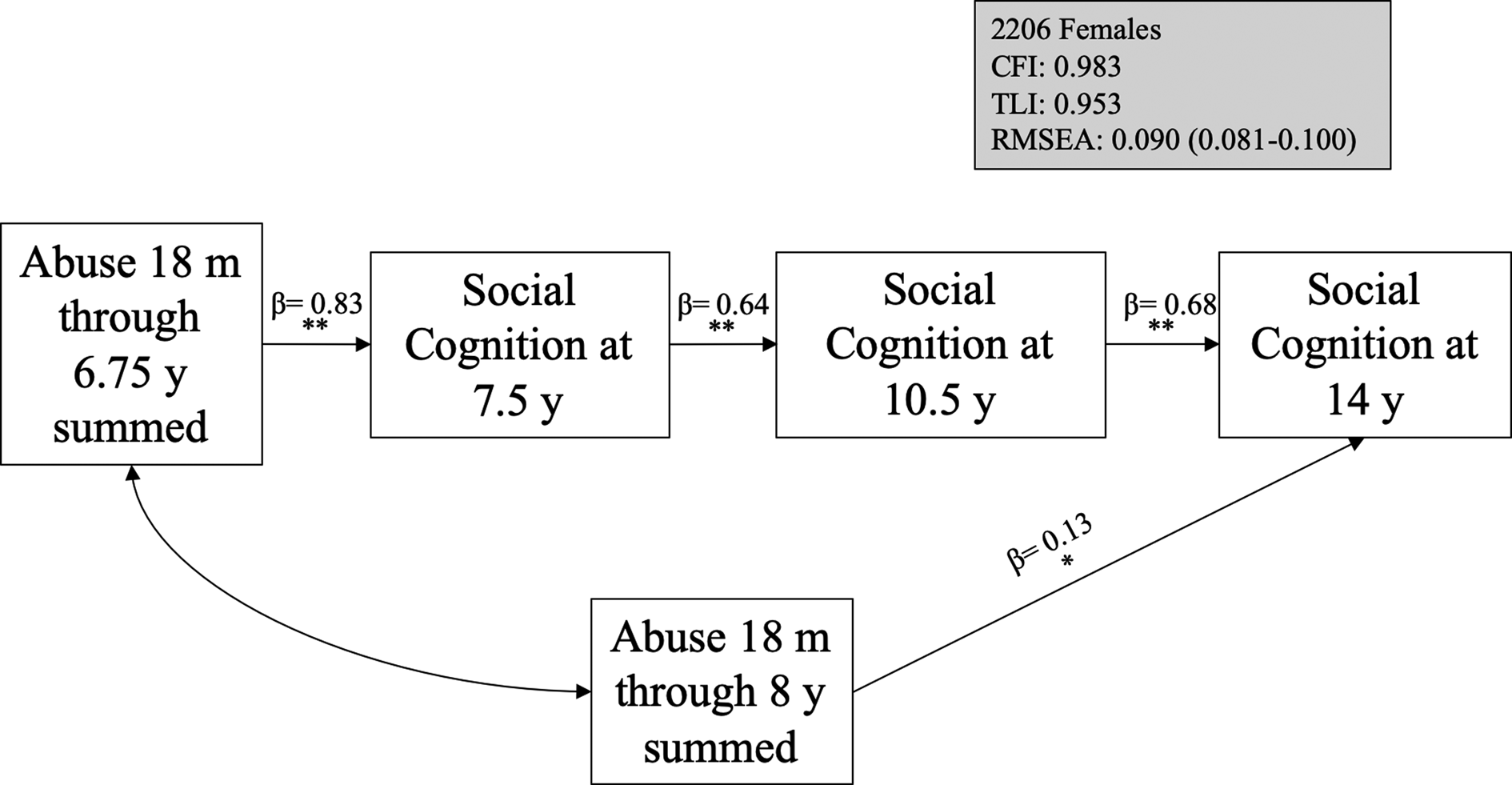
Finally, we evaluated how well the theoretical models selected in the SLCMA analyses fit the social cognition data across multiple timepoints and related to one other. To do this, we used structural equation modeling (SEM), which allowed us to further explore within a single analysis how maltreatment exposure was associated with social cognition across timepoints. In SEM, one or more measurement models – describing the relationships between latent factors and observed indicators – are joined together in a structural model, where associations between latent variables, covariates, and observed variables are estimated (Kline, Reference Kline2010). We modeled the effects of sexual or physical abuse only in females because this model showed the strongest effect estimates in the SLCMA results and analyses of males would likely be uninformative, for reasons described later. Our hypothesis based on the SLCMA results was that the accumulation of sexual or physical abuse from 18 months to 6.75 years would predict social cognition at age 7.5, which in turn would predict social cognition at age 10.5, and subsequently social cognition at age 14. We also hypothesized based on the SLCMA results that the accumulation of sexual or physical abuse from 18 months to 8 years would also independently predict social cognition at 14 years (Figure 2). To evaluate goodness-of-fit, we used standard SEM fit statistics, including the normed comparative fit index (CFI) (Bentler, Reference Bentler1990), Tucker–Lewis index (TLI) (Tucker & Lewis, Reference Tucker and Lewis1973), and root mean square error of approximation (RMSEA) (Steiger, Reference Steiger1990). We conducted these SEM analyses using the Lavaan package in R 3.3.2 (Yves, Reference Yves2012).
Goodness of fit for structural equation model selected by the structured life course modeling approach (SLCMA). Abuse refers to sexual or physical abuse by anyone with the same timepoints of measurement as previous analyses. **p < .001 and *p < .01. Note, the Abuse measurements capture the same periods of abuse with the exception of the age-8 timepoint which is only included in “Abuse 18 m through 8 y summed”.

Results
Sample characteristics
The analytic sample was gender balanced (49.71% female) and comprised predominantly white (97.1%) children from families whose parents were married and owned their home (Supplemental Table 1).
Distribution of exposure to maltreatment and social cognition skills
Over a quarter of the analytic sample (27%; n = 1,182) were exposed to at least one type of maltreatment, with 17.44% exposed to physical or emotional abuse, 13.29% exposed to sexual or physical abuse, and 5% exposed to both types.
Exposure to physical or sexual abuse was patterned by child sex (with males being more frequently exposed to either type) and exposure to physical or emotional abuse was patterned by several socio-demographic factors, including maternal material status, home ownership, and number of previous pregnancies (p < .01 for all chi-squared tests comparing children who were exposed to maltreatment to the entire analytic sample; Supplemental Table 1). Specifically, children who were exposed to maltreatment were less socioeconomically advantaged and less likely to be firstborn.
Age at exposure to maltreatment varied by type, with males having somewhat of an increase in sexual or physical abuse exposure as they aged. Alternatively, females experienced more physical or emotional abuse at preschool ages with more constant levels of exposure to sexual or physical abuse (Table 1).
Within each maltreatment type, exposures were highly correlated over time (Supplemental Table 5), with neighboring timepoints being generally more highly correlated than distant timepoints. Physical or emotional abuse by a caregiver had the highest correlation (r = .73) between ages 2.75 and 4 years, and sexual or physical by anyone had the highest correlation (r = .59) between ages 6.75 and 8 years.
Social cognition skills scores were moderately correlated across measurement timepoints (r = .57–.67). Notably, mean social cognition skill levels decreased at age 10.5 in both males and females, though significant sex differences were observed across all time points (Supplemental Table 6).
Association between maltreatment and social cognition
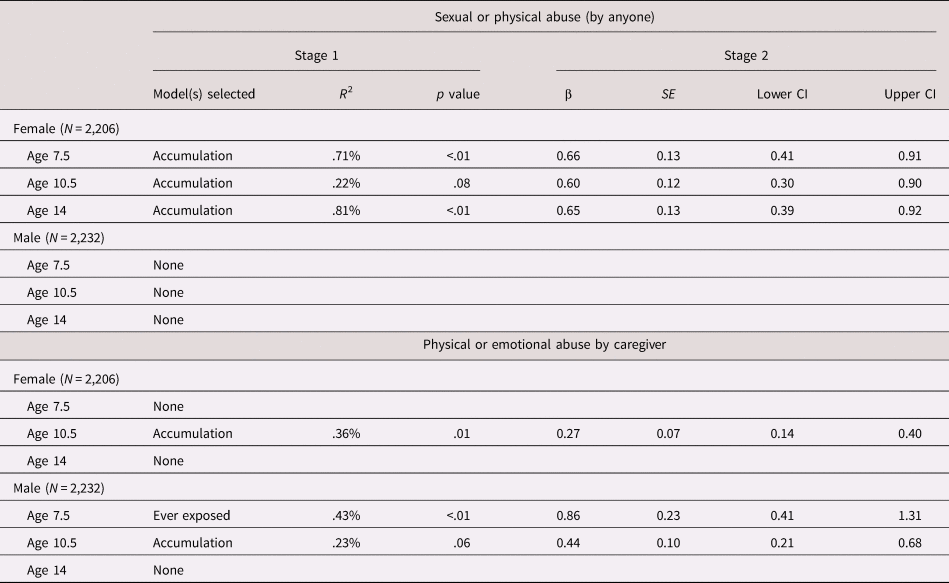
Results of the SLCMA analysis suggested a different patterning of associations between maltreatment and social cognition based on sex and the type of maltreatment (Table 2).
Results of the structured life course modeling approach (SLCMA) for each measure of maltreatment on social cognition

Stage 1 cell entries are r 2 values, p values. Stage 2 cell entries are betas, standard errors, and p values derived from multiple linear regression (one regression for each type of maltreatment and social cognition measurement). Models were only reported at Stage 2 when the covariance test p value was below the threshold of .1.
Among females, accumulation was the life course theoretical model consistently selected as the best-fitting one for both types of maltreatment. However, the effects of accumulation were only statistically significant at ages 7.5 and 14 for sexual or physical abuse (ß = 0.66, p < .01 and ß = 0.65, p < .01, respectively) and age 10.5 (ß = 0.27, p = .01) for physical or emotional abuse by a caregiver, with less than 1% of the variance in social cognition explained by the accumulation of each type of maltreatment.
For males, no life course theoretical model achieved statistical significance between exposure to sexual or physical abuse and social cognition. However, an ever-exposed model was selected as the best fitting model for exposure to physical or emotional abuse on social cognition at age 7.5 (ß = 0.86, p < .01), though this effect was not observed at the later measurements.
Of note, this general pattern of results was similar after winsorizing the social cognition score values to the 90th percentile, which reduced the effects of extreme scores (Supplemental Table 7).
Structural equation modeling (SEM)
Building from these results, we used SEM to examine the effect of sexual or physical abuse on females’ social cognition across time using the theoretical models identified by the SLCMA. SEM modeling demonstrated the goodness of fit of our hypothesis: the main structural model (Figure 2) fit the data adequately (RMSEA = 0.09; 95% confidence interval (CI) [0.08; 0.10]; CFI = 0.98; TLI = 0.95), suggesting that sexual or physical abuse in early life explained lower social cognition scores later in life, via influences on earlier social cognition. Accumulation of sexual or physical abuse from 18 months to 6.75 years predicted social cognition at age 7.5 years and accumulation of sexual or physical abuse from 18 months to 8 years, as well as social cognition at age 10.5 predicted social cognition at 14 years. We also saw that social cognition scores at 7.5 years predicted social cognition scores at age 10.5. That is, abuse accumulated between 18 months and 6.75 years of age was associated with social cognition at 7.5 years (ß = 0.83, p < .01), which in turn was associated with social cognition at 10.5 years (ß = 0.64, p < .01), and subsequently linked to social cognition at 14 years (ß = 0.68, p < .01). Social cognition at 14 years was predicted by abuse accumulated between 18 months and 8 years (ß = 0.13, p < .01). Modification indices did not reveal any additional plausible paths between accumulation and the social cognition outcome that would improve model fit. The results of our initial SLCMA testing indicated that for males, the SEM test would unlikely be significant; unlike females, males did not have the same life course theoretical models selected for multiple time points of exposure.
Secondary analyses
A primary hypothesis tested in this paper is that childhood maltreatment predicts future social cognitive skills. However, children with poor social cognitive skills may also be more likely than their peers to be exposed to child maltreatment. To explore this possibility, we performed a secondary analysis to examine the association between social cognition and child maltreatment (see Supplemental Materials). Results suggested that poorer earlier social cognition skills were generally associated with lower levels of exposure to maltreatment (Supplemental Table 8).
Discussion
The current study used data from a large, population-based sample of children to examine associations between two types of child maltreatment and the development of subsequent social cognition skills from late childhood through early adolescence. Three main findings emerged from this work. First, childhood maltreatment differentially impacted males and female's social cognition development. Specifically, there were sex differences both in how the characteristics of maltreatment associated with social cognition and the strength of these associations. This sex-dependent pattern of findings was unsurprising in light of prior work showing differences between male and female social cognitive skills between the ages of 8 and 21 (Gur et al., Reference Gur, Richard, Calkins, Chiavacci, Hansen, Bilker and Gur2012). Our findings are consistent with prior findings in social cognitive development, where females have been shown to outperform males in facial emotion recognition through age 16 (Lawrence, Campbell, & Skuse, Reference Lawrence, Campbell and Skuse2015) and have increased social affect through early development (Messinger et al., Reference Messinger, Young, Webb, Ozonoff, Bryson, Carter and Zwaigenbaum2015). Social cognitive skills in males typically develop later than females and thus we may see a smaller effect size of maltreatment when measuring early time points in males. Thus, we postulate that males and females may be similarly impacted by maltreatment, but that for males, such effects may not appear until later in development. Based on previous work, these effects of maltreatment on social cognition may not emerge until late in teenage years or emerging adulthood, as boys begin to catch-up in social cognitive skills with their female counterparts (Lawrence et al., Reference Lawrence, Campbell and Skuse2015; Rose & Rudolph, Reference Rose and Rudolph2006; Van Der Graaff et al., Reference Van Der Graaff, Branje, De Wied, Hawk, Van Lier and Meeus2014).
Second, our results from the SLCMA suggest that more than any other feature of maltreatment, the accumulation of abuse plays the biggest role in explaining variations in social cognition development specifically for females. In females, the number of time periods exposed to physical or sexual abuse from 0–8 years was positively and linearly associated with social cognition deficits. While prior literature has primarily characterized the effects of the severity of abuse, with more severe abuse leading to greater social cognitive deficits, this is the first study to our knowledge to focus specifically on the number of time periods exposed in relation to social cognition abilities (Barahal et al., Reference Barahal, Waterman and Martin1981; Luke & Banerjee, Reference Luke and Banerjee2013). Such comparisons are likely to be informative for guiding the development of interventions to combat the negative consequences of exposure to abuse.
Third, our results from the SLCMA and SEM analyses pertaining to physical or sexual maltreatment not only emphasize the power of integrating different statistical models, but also expand upon previous work by suggesting that the duration of abuse and its effects on social cognition may persist from childhood to adolescence. Our findings are consistent with prior studies, which have examined the effect of abuse on social cognition during later life, and further suggest that the effects of adversity on social cognition can be observed shortly after abuse and may quickly lead to persistent differences in social cognition (Ford et al., Reference Ford, Clark and Stansfeld2011; Germine, Dunn, McLaughlin, & Smoller, Reference Germine, Dunn, McLaughlin and Smoller2015; Palmier-Claus et al., Reference Palmier-Claus, Berry, Darrell-Berry, Emsley, Parker, Drake and Bucci2016). These findings emphasize the importance of early identification and intervention efforts to reach children, particularly girls, while these social cognitive deficits are developing, which would be expected to minimize any long-term repercussions of being exposed to adversity. Of note, our results are most likely driven by physical, rather than sexual abuse, due to the former being more common than the latter; this should be considered when interpreting results of this study. Though the effect size was small and there are likely other factors that have not been captured here that shape social cognitive development, our findings strengthen past research and help to inform future work on this topic.
Yet, two major questions also emerged from this analysis. The first is: why were there no significant effects of maltreatment on social cognition in males? Prior studies have shown that males lag substantially behind their female counterparts during the initial development of empathy (Rose & Rudolph, Reference Rose and Rudolph2006; Van Der Graaff et al., Reference Van Der Graaff, Branje, De Wied, Hawk, Van Lier and Meeus2014), which is one of the key social cognition skills developed during adolescence. Many items included in our social cognition measure capture experiences that involve empathy skills, including those asking about appropriate responses to other's emotions. Our finding that males had significantly poorer social cognition scores throughout time may suggest that our social cognition measure was capturing a domain that would both be immature in males and unlikely to be affected by maltreatment. We further speculate that the development of social cognition in males may be less stable and more variable in late childhood and adolescence, given previous work noting dramatic changes in social behavior and interaction among males around puberty, such as increased antisocial and aggressive behaviors (Forbes & Dahl, Reference Forbes and Dahl2010; Rowe, Maughan, Worthman, Costello, & Angold, Reference Rowe, Maughan, Worthman, Costello and Angold2004). Thus, it might be possible to see more expected adverse effects of maltreatment on social cognitive development reemerge once puberty ends.
A second question was: why do we see a shift in social cognition scores across time and further, why are there differences confined to age 10.5 years for the effects of sexual and physical abuse on social cognition? Univariate analyses revealed that for both males and females, social cognition scores worsened considerably at age 10.5. Moreover, among females, a model of exposure to physical or emotional abuse was selected as explaining a significant amount of variation in social cognition at 10.5, whereas no theoretical models were selected for the other outcome timepoints in the SLCMA modeling. These results are consistent with prior research suggesting that key social cognition skills, such as facial recognition, temporarily plateau or even decline in early adolescence (Carey & Diamond, Reference Carey and Diamond1977; Carey, Diamond, & Woods, Reference Carey, Diamond and Woods1980; Germine, Duchaine, & Nakayama, Reference Germine, Duchaine and Nakayama2011). Thus, our measure of social cognition obtained at age 10.5 may fall within an expected aberrant time period, which could account for the unique pattern of results observed during this outcome time point.
There are several strengths of this study. Data came from a large, population-based prospective study. Previous work has tended to only include a single measurement of social cognition, involve retrospective maltreatment reports that do not include repeated measures, or focus on social cognition in clinical samples (e.g., children with autism or Turner's syndrome). To our knowledge, this is the first prospective, population-based study. The use of a prospective study was a particular strength, as it provided a stronger test of our research questions (relative to retrospective or cross-sectional work), and it enabled us to better contextualize these results and identify possibly causal relations. For example, as shown through our secondary analyses, we were able to learn that poorer social cognition skills could also predict lower levels of future exposure to maltreatment. Moreover, our use of a theory-driven analytic method (SLCMA) in combination with SEM was another major innovation. Sample code for implementing the SLCMA is publicly available through a GitHub page (https://github.com/thedunnlab/SLCMA-pipeline).
Some limitations must also be considered. First, the ALSPAC dataset comprised largely children of European-ancestry. Thus, our findings may not be generalizable to more racially and ethnically diverse populations. Second, the use of maternal self-report questionnaires to capture abuse may be problematic. Mothers may have underreported their child's exposure to abuse, particularly if mothers were implicated in the maltreatment or the maltreatment events occurred outside the home. Reliance on these subjective reports was also likely further complicated because ALSPAC did not provide reporters with clear guidelines or criteria to define these abuse experiences. Thus, some reporters could have downplayed their maltreating behavior and not identified it as abuse, whereas other reporters could have responded to these items considering behaviors that might not fit the traditional definition of maltreatment. Yet, even with these limitations, we found that the prevalence of maltreatment in this sample was comparable to nationally representative samples which use social service or other agency reporting (Gilbert et al., Reference Gilbert, Widom, Browne, Fergusson, Webb and Janson2009). These similarities in prevalence estimates of maltreatment between our sample and nationally representative samples provide some confidence that our measures may be capturing true childhood maltreatment cases in this sample. Moreover, the use of maternal reporting could also lead to bias in social cognitive scoring, as mother's may expect boys to be less social than girls. Although there were sex differences in social cognition scores here, the magnitude of these differences were similar to those previously reported (Erwin et al., Reference Erwin, Gur, Gur, Skolnick, Mawhinney-Hee and Smailis1992; Gur et al., Reference Gur, Richard, Calkins, Chiavacci, Hansen, Bilker and Gur2012; Williams et al., Reference Williams, Mathersul, Palmer, Gur, Gur and Gordon2009). However, previous work on the role of parental bias in social skills suggests that parents identify more social skill problems than children, but are less able to identify subtle symptoms such as withdrawal (Howells Wrobel & Lachar, Reference Wrobel Howells and Lachar1998). Some research even suggests parental reports may be more accurate than child self-reports for social behaviors (Fisher, Mello, & Dykens, Reference Fisher, Mello and Dykens2014). Third, the measures of maltreatment lacked details to characterize the specific nature of the abuse, including its severity. This has been a limitation of other large-scale epidemiological studies when examining abuse. However, by having the measurement of frequency of maltreatment (defined here as the number of occasions on which it was reported), we can distinguish between children who were exposed only a single time from those who were exposed multiple times, which can help clarify the effect of different maltreatment experiences (Dunn et al., Reference Dunn, Soare, Raffeld, Busso, Crawford, Davis and Susser2018). In future studies, more detailed assessments could prove valuable to document more specific effects of maltreatment features on social cognition and build upon these findings. Fourth, we modeled childhood adversity as an exposure that may impact social cognition; however, our results are only correlational and do not rule out the possibility that preliminary manifestations of poor social cognition in early childhood could also increase risk of maltreatment, which we explored briefly in our secondary analyses. Fifth, as with any longitudinal study, there was attrition over time. Although we attempted to address this attrition by using multiple imputation, the fluctuation in participants reporting outcomes across different outcome timepoints and source of reporting led to smaller sample sizes, since we only analyzed children with maternal reports at all three timepoints. However, we think the conservative exclusion criteria were necessary to minimize potential bias induced by heterogeneity in the mode of reporting. Removing participants who were missing the necessary longitudinal data for our analyses may exclude higher-risk children and/or limit broader generalizability. However, the included sample was comparable to the sample of participants who were excluded. Further work targeting the understanding of reporting patterns in social cognition research could guide the interpretation of our results as well as sample selection of future studies.
In summary, our results suggest that the accumulation of sexual or physical abuse in early childhood can have a lasting impact on female's social cognition skills. These findings underscore the need for further work to measure how maltreatment effects can persist across time and shape long-term developmental trajectories. These results also emphasize the importance of identifying females who have experienced maltreatment, who may be at risk for having social cognitive challenges.
Supplementary Material
The supplementary material for this article can be found at https://doi.org/10.1017/S095457942000139X.
Acknowledgments
The content is solely the responsibility of the authors and does not necessarily represent the official views of the National Institutes of Health. The authors thank Alice Renaud for her assistance in preparing this manuscript for publication. We are extremely grateful to all the families who took part in this study, the midwives for their help in recruiting them, and the whole ALSPAC team, which includes interviewers, computer and laboratory technicians, clerical workers, research scientists, volunteers, managers, receptionists, and nurses. This publication is the work of the authors who will serve as guarantors for the contents of this paper.
Financial Statement
This research was specifically funded by the National Institute of Mental Health of the National Institutes of Health under Award Numbers K01MH102403 and 1R01MH113930 (Dunn). The UK Medical Research Council and the Wellcome Trust (Grant ref: 102215/2/13/2) and the University of Bristol provide core support for ALSPAC. A comprehensive list of grants funding is available on the ALSPAC website (http://www.bristol.ac.uk/alspac/external/documents/grant-acknowledgements.pdf).
Conflicts of Interest
None