Introduction
Nurses play an essential role in delivering quality end-of-life (EOL) or palliative care to patients. This requires a skill set and knowledge that is specialized. Nurse-patient relationships built upon trust facilitate the patients’ adjustment to their illness, ease pain, and can ultimately lead to good death experiences (Mok and Chiu, Reference Mok and Chiu2004). With the increasing importance and emphasis on EOL care in recent years, more training modules on palliative care are being integrated into segments of the nursing education curriculum. In Singapore, however, nurses receive only four to six hours of lectures throughout their training before qualifying as registered nurses. This is grossly inadequate to prepare them for the realities of nursing in an acute care setting where death is not uncommon. Only 45% of nurses surveyed in a study felt that they were familiar with palliative care (Banerjee et al., Reference Banerjee, Manna, Coyle, Shen, Pehrson, Zaider, Hammonds, Krueger, Parker and Bylund2016; Friedenberg et al., Reference Friedenberg, Levy, Ross and Evans2012; Lien Foundation, 2014). Thus, it is imperative that the training of nurses in this discipline be effective, efficient, and sustainable given the tight schedule of the nurse training curriculum.
Death anxiety is defined as the state in which an individual experiences apprehension, worry, or fear related to death or dying (Peters et al., Reference Peters, Cant, Payne, O'Connor, McDermott, Hood, Morphet and Shimoinaba2013) It is an important concept in nursing practice as nurses are frontline care providers to patients. Nurses with death anxiety may exhibit negative behavior that is the direct effect of their attitude towards caring for the dying. Evidence shows an inverse association between nurses’ attitude towards caring for dying patients and their anxiety towards death (Braun, Gordon, and Uziely, Reference Braun, Gordon and Uziely2010). Shaping attitudes and changing behaviors, however, can be a complex undertaking. The relationship between death anxiety and attitude is mediated by factors such as the nurse's age, length of nursing work experience, culture, and the level of education in EOL care (Hagelin et al., Reference Hagelin, Melin-Johansson, Henoch, Bergh, Ek, Hammarlund, Prahl, Strang, Westin, Österlind and Browall2016; Henoch et al., Reference Henoch, Melin-Johansson, Bergh, Strang, Ek, Hammarlund, Hagelin, Westin, Österlind and Browall2017; Wang et al., Reference Wang, Chen, Du, Wang, Li and Dong2017).
Previous studies have shown mixed results about the effectiveness of education and training on healthcare workers’ attitudes towards death. This could be attributed in part to the teaching methods employed and other confounders (Hegedus, Zana, and Szabó, Reference Hegedus, Zana and Szabó2008; Jo and An, Reference Jo and An2015; Weil et al., Reference Weil, Weldon, Kronfli, Watkins, Kneebone, Bello and Cox2018). However, the comfort level of nurses during communication with patients and their families at the end of life was shown to be positively affected by exposure to communication skills training, which has been found to decrease nurses’ anxiety towards death (Black, Reference Black2007; Buller et al., Reference Buller, Virani, Malloy and Paice2019). A review of fifteen quantitative studies exploring nurses’ attitudes towards death found that death education was identified as the key element for such emotionally charged work (Peters et al., Reference Peters, Cant, Payne, O'Connor, McDermott, Hood, Morphet and Shimoinaba2013). Thus, education can potentially translate into better quality EOL nursing care.
Consistent teaching methods are important for educators in planning nurse training programs. Evaluation of the most effective teaching methods that are cost-effective is a crucial step in expanding training programs to nurses. However, not many reports have been published on the evaluation of effective teaching methodologies in nurse training programs focusing on attitude change, especially in the Asian context. Systematic reviews have shown that EOL care training tended to be fragmented and the nature of learning, variable and inconsistent (Lloyd-Williams and Macleod, Reference Lloyd-Williams and Macleod2004). Didactic lectures were commonly used in EOL teaching, although some included small group teaching with interactive discussions. In recent years, new approaches introduced to EOL teaching included sequential simulations and humanistic approaches which, while showing positive results in other healthcare professionals, did not appear to do so in nurses (Jo and An, Reference Jo and An2015; Weil et al., Reference Weil, Weldon, Kronfli, Watkins, Kneebone, Bello and Cox2018). A multimodal technique in palliative care education was shown to enhance attitudes and knowledge among learners (Henoch et al., Reference Henoch, Melin-Johansson, Bergh, Strang, Ek, Hammarlund, Hagelin, Westin, Österlind and Browall2017; McKinlay et al., Reference McKinlay, McBain, Stanley, Taylor and Robertson2011). The use of the End of Life Nursing Education Consortium (ELNEC) curriculum along with experiential learning has demonstrated a significant improvement in nurses’ attitudes toward care of the dying with the effects sustained for at least four weeks (Mallory, Reference Mallory2003). ELNEC was adopted by a few countries in Asia, including Singapore. However, to our knowledge, no evaluation has yet been conducted on the effect of this course on attitude change among nurses. Moreover, an adaptation of the course which needed more resources and requirement for certified trainers seemed to limit its implementation (Malloy et al., Reference Malloy, Takenouchi, Kim, Lu and Ferrell2018).
Hence, in this study, we aimed to ascertain the knowledge level and attitudes of acute hospital nurses towards EOL care and whether a short, intensive, multimodal training workshop could improve the latter and reduce death anxiety.
Methods
Study design and setting
This mixed-method before and after intervention study was conducted on nurses who underwent a two-day EOL course in a hospital in Singapore. Written informed consent was obtained from the participants. Inclusion criteria for the study were as follows: (i) being English speaking; (ii) having not attended any prior palliative course or workshop in the preceding five years; (iii) not working in a palliative care service or department at the time of attending the workshop; and (iv) having not previously worked in a palliative care service or department. We excluded participants with previous palliative training or service experience as we felt that this would confound the results.
Participants were recruited from three workshops from May 2016 until June 2017. A total of 45 participants who fulfilled the inclusion criteria all consented to the study. Nurses completed a questionnaire before and after the intervention, and selected nurses were invited to participate in structured interviews.
Intervention
The intervention was a two-day multimodal EOL care workshop for nurses working in the hospital and had been running on a quarterly basis for the preceding five years. Palliative care services in Singapore have evolved over the last 30 years, and as in many other countries, is delivered via a multidisciplinary team approach which straddles the continuum of care settings (from the hospital to community care). Nurses, supported by the multidisciplinary team, form the backbone of many of these services. Hence, to impart the best practical EOL care knowledge to the participants (Gan, Reference Gan2016), the tutors were multidisciplinary team members of the hospital's palliative care team. They included palliative care physicians, palliative care nurses, pharmacists, dieticians, medical social workers, and occupational therapists. The teaching modalities employed included didactic lectures, case studies, role-playing, experiential learning, videos, as well as hands-on practical sessions. The course syllabus was designed by the faculty members to equip learners with basic EOL care skills and impart knowledge on the principles of palliative care, which emphasizes the latest evidence-based framework, multidisciplinary inclusiveness, and adaptation to local culture and practical needs (Appendix A).
Instrument and data collection
Quantitative method
Baseline demographic data and information on the training experience of the participants were collected. The evaluation framework of the course was based on Kirkpatrick's Model which evaluates training on four levels in the order of reaction, learning, behavior, and results. We paid particular focus on hierarchy level two (learning change) and three (behavior and attitude change) (Kirkpatrick, Reference Kirkpatrick1994) and formulated or selected the following tools for evaluation:
i. Knowledge
A 20-item multiple choice knowledge and skills-based test was designed and tested by palliative care physicians and nurse clinicians. Questions were set based on the syllabus of the workshop (Appendix B).
ii. Attitude
The Death Attitude Profile-Revised (DAP-R) used is a validated tool with high internal consistency (α = 0.66 to 0.87) and coefficients of stability that measures the attitudes of participants towards death. The tool consists of 32 items which participants score on a 7-point Likert scale (Mallory, Reference Mallory2003; Wong, Reker, and Gesser, Reference Wong, Reker and Gesser1994). Five dimensions of attitudes towards death are evaluated in DAP-R:
(i) fear of death (7 items) - negative thoughts about death
(ii) death avoidance (5 items) - avoidance of thoughts of death as much as possible
(iii) neutral acceptance (5 items) - death is neither welcomed nor feared
(iv) approach acceptance (10 items) - death is viewed as a passageway to a happy afterlife, and
(v) escape acceptance (5 items) - death is viewed as an escape from painful existence.
Before the intervention, a knowledge-based test and DAP-R were administered to all learners. The knowledge-based test was repeated immediately after the workshops, while the DAP-R was re-administered six-weeks post-course. For level three evaluation of behavior or attitude change to be meaningful, the participants had to utilzse and apply the skills and knowledge they had learned at the workshop into the real world (natural setting). Thus, we evaluated DAP-R at six weeks post-workshop, which we felt was ample time required to allow participants to apply newly learned skills and reflect on any change of attitude and behavior experienced at work.
Statistical analysis
The minimum sample size of 34 was derived using a moderate effect size of 0.50 with alpha 0.05 and power of 0.80. The mean knowledge and attitude subdomain scores before and after interventions were compared using the chi-square test and a p-value of <0.05 taken to be statistically significant. Descriptive analysis was used to compare the subdomain of each participant in which they have the highest score.
Qualitative method
In-depth interviews were conducted with six participants selected from two of the workshops. They were selected to form a diverse group, in terms of departments, religions, and ethnicity. Interviews were conducted six weeks after the completion of the workshops with the aim of gaining more insight and exploring with greater depth the attitude change of the participants after applying the skills learned at their workplace. The qualitative segment of the study overcame the limitation of quantitative evaluation in addressing the “why” and “how” questions of the responses obtained. Each interview took approximately one hour and was conducted by an independent interviewer with the aid of an interview guide. The interviews were recorded and transcribed verbatim. We used thematic analysis with an inductive approach to code and analyze the themes emerging from the participants’ dialogues and interactions. This is a useful method for examining the different perspectives of participants, highlighting similarities and differences, and generating unanticipated insights (Braun and Clarke, Reference Braun and Clarke2006). Transcripts were circulated among the entire research team for familiarization. Two research team members who were blinded to the participants’ demographic details and the quantitative outcomes, were then engaged in the initial coding with the aid of the Nvivo v11 software. Quotations were entered alongside illustrative codes. The study team assessed members’ agreement on codes and themes. Once saturation was reached, and no new themes were identified from the transcripts, the final report was derived.
Ethics approval for the study was obtained from the Domain Specific Review Board, National Healthcare Group, Singapore.
Results
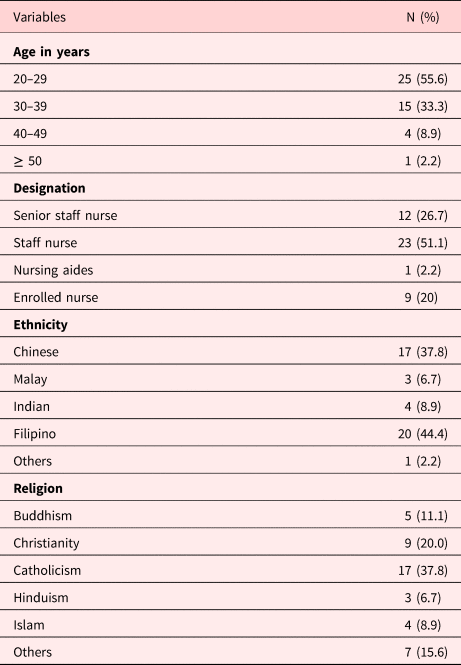
A total of 45 nurses completed the workshop. The demographics of the participants are shown in Table 1. The mean knowledge scores improved from 9.73 to 12.10 after the intervention, and this was statistically significant.
Demographic characteristics of the study sample (n = 45).

Before the intervention, the domains of neutral acceptance and approach acceptance had higher mean scores compared to the domains of escape acceptance, fear of death, and death avoidance. After the intervention, there was a statistically significant decrease in the mean scores in the domains of fear of death and death avoidance (Table 2). There was a non statistically significant decrease in mean score in the domain of escape acceptance, while the domains of neutral acceptance and approach acceptance had similar means before and after the intervention. We also noted that none of the nurses were having the fear of death as their predominant subdomain after the intervention compared to 9.09% (n = 5) of them before the intervention.
The mean knowledge scores and DAP-R of pre-workshop and post-workshop.

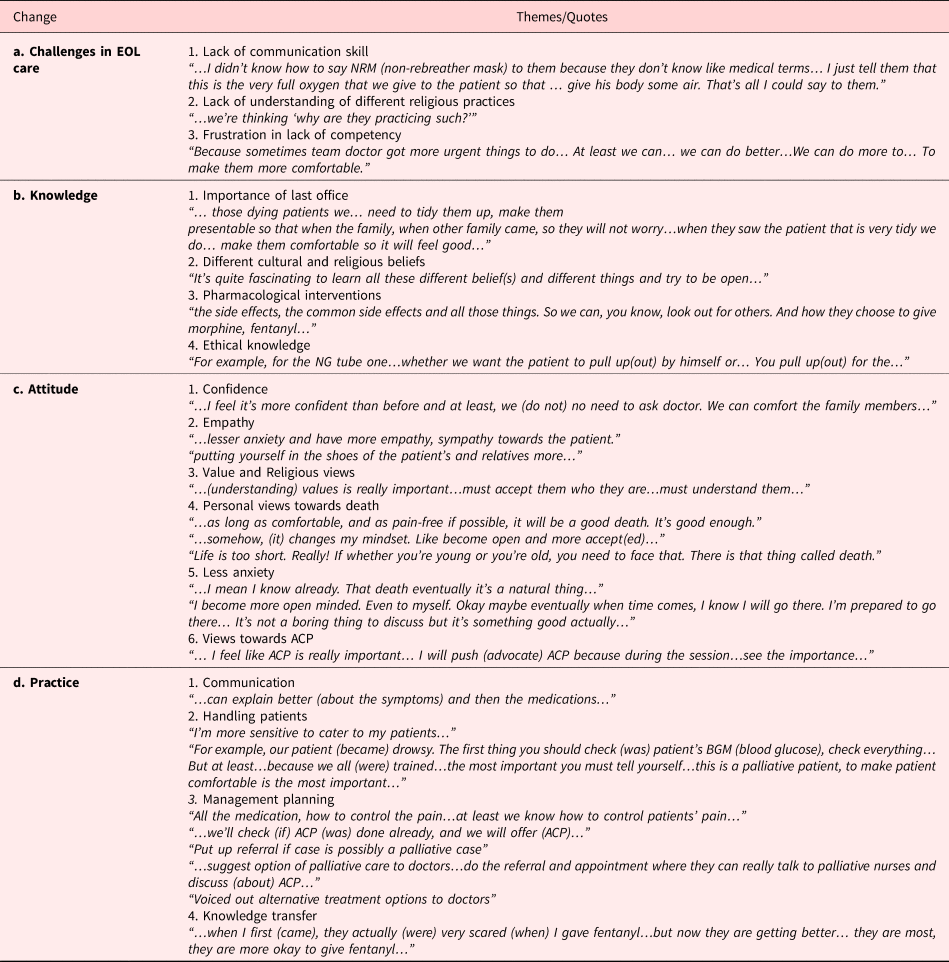
In-depth interviews (Table 3)
1. Challenges in EOL care
Participants shared the various challenges they faced when they were caring for terminally-ill patients. They felt the lack of knowledge interfere the ability to communicate better with the patients and their families. Nurses from different backgrounds, religions, and countries also faced the challenges in understanding the practices of different races and religions in Singapore. They constantly wished that they could have done better and contributed more to the patients’ care.
Inductive thematic analysis from the in-depth interviews.

2. Knowledge change
In general, the participants reported having a more comprehensive understanding of palliative care principles and practice. They also appreciated the diverse beliefs of various patients in a multicultural and multi-ethnic setting. Specifically, participants learned how to assess and manage pain and other symptoms using pharmacological interventions in palliative care, e.g., the use of opioids in symptom control. Participants also highlighted an improvement in their knowledge of ethics as well as advanced care planning (ACP). Also, the session on ACP stood out for a majority of the interviewed participants.
3. Attitude change
Participants reported a positive change in attitude in many aspects. Their confidence level in managing EOL patients improved. They were more comfortable in handling opioid medications, and their confidence in dealing patient's families increased. Nurses also shared that they became more empathetic towards patients compared to before the workshops. They became more accepting of different religious views about death and dying. Besides the change of views towards dying patients, the workshop also changed their view towards death. They became more accepting of death as “natural.” They became more open-minded and less anxious about death.
4. Self-reported practice change
All nurses interviewed shared a sustained positive change in practice after the workshop. They became more attentive towards patients’ concerns. They would make an extra effort to understand the different beliefs of various patients. They also took the initiative to explain EOL care plans to patients and families in greater detail and would not hesitate to explain important aspects of EOL care to other nurses who had not undergone the training. The participants also felt that they managed death and dying patients better after the comprehensive training. Participants also took the initiative to discuss palliative treatment options with doctors as well as identify patients who were suitable for palliative care to team consultants.
Discussion
With this multimodal EOL workshop, acute care nurses showed significant improvement in their knowledge of EOL care. In addition, there was a significant but sustainable change in their own personal views of death and level of death anxiety. This was subsequently translated into a change of practice among the participants in their clinical care.
EOL care is an essential part of nursing practice especially with rapidly aging countries like Singapore. However, studies have consistently shown the lack of EOL training and continuing education among nurses in various practice settings (Lien Foundation, 2014). Although some nurses received formal EOL teaching during the initial training period, there were still significant gaps in their EOL knowledge compared to nurses who participated in continuing nurse education. Our workshop, which served as part of a continuing nurse education program showed similar positive effects in improvement of knowledge, attitude, and skills as with other previous studies (Schlairet, Reference Schlairet2009). Perhaps, one of the keys to promoting and integrating of EOL care skills into nursing practice is to extend EOL training from the undergraduate nurse training stage into post-graduate continuing nurse education programs; this was also highlighted by one of the participants of our study.
Death anxiety is an independent predictor of communication with patients about advance directives and influences attitudes towards caring for dying patients (Black, Reference Black2007; Braun et al., Reference Braun, Gordon and Uziely2010; Zyga et al., Reference Zyga, Malliarou, Lavdaniti, Athanasopoulou and Sarafis2011). Consequences of death anxiety center around adaptive and maladaptive responses (Routledge et al., Reference Routledge, Ostafin, Juhl, Sedikides, Cathey and Liao2010). The positive adaptive effects include individuals experiencing new learning and growth, enhanced life meaning, and the pursuit of authentic existence (Bassett, Reference Bassett2007; Firestone, Reference Firestone1993). While death anxiety exists at varying levels almost universally, nonetheless, it was associated with high levels of burnout and occupational stress among nurses (Lee and King, Reference Lee and King2014). Nurses are frequently exposed to death and dying patients, which could give rise to uneasiness by making them conscious of their own mortality. Nurses’ positive attitudes were negatively correlated with death avoidance, fear of death, and approach acceptance of mortality. There was a suggestion that some nurses may use avoidance to cope with their fears of death (Braun et al., Reference Braun, Gordon and Uziely2010). This study excluded nurses who were working or had previously worked in palliative care services as this group of nurses were known to have a lower level of death anxiety. Moreover, they would have been receiving continuous training concurrent with their practice, which could potentially confound the result for the research (Peters et al., Reference Peters, Cant, Payne, O'Connor, McDermott, Hood, Morphet and Shimoinaba2013). The previous study showed religious beliefs influenced the attitudes toward the care of dying patients (Wang et al., Reference Wang, Chen, Du, Wang, Li and Dong2017). In our study, age, religion, years of experience, and job designation did not influence the positive change in death anxiety levels, particularly in the fear of death and death avoidance domains. This reinforces the observation that a course such as in this study is useful, not only in young and inexperienced nurses but also in experienced nurses who were not trained in EOL. Without adequate training, nurses faced the frustration of being ill-equipped and lacked competencies to deal with EOL patients, as shown in the qualitative outcomes of this study. Even the experienced nurses may suppress their emotions such as grief and anxiety, in order to appear “professional” and strong and be able to answer the call of duty. This attitude and behavior are unhealthy as they may result in a range of negative consequences such as burnout (Brosche, Reference Brosche2003).
The change of attitude through our training was not confined to death anxiety only. Indeed, the changes were noted across a broad spectrum of reactions, ranging from the change of confidence levels to personal views of life. Integrating experiential sharing, vignettes, and anecdotes into the workshop sessions was repeatedly mentioned by the participants during the interviews as being highly effective. Experiential learning theory defines learning as “the process whereby knowledge is created through the transformation of experience. Knowledge results from the combination of grasping and transforming experience.” (Kolb, Reference Kolb1984). Based on this framework, the experiential learning segment of our workshop made participants work through the following four stages: 1) having a concrete experience (all participants and facilitators managed dying patients in their practice were encouraged to share together); 2) observation of and reflection on that experience (the participants observed theirs and others’ experience and reflected together); 3) the formation of abstract concepts and generalizations (the learners formed the ideas and again shared with the rest of the participants); and 4) used to test the hypothesis in future situations, resulting in new experiences (the participants were encouraged to practice the new knowledge in their daily practice and continued to be supported by the facilitators on site) (Kolb, Reference Kolb1984). Through experiential learning, the course also widened the participants’ understanding of different religious views which is especially important in a multiracial and multicultural society.
Previous studies looked at the attitudes of nurses towards the care of the dying, using the Frommelt Attitude Towards Care of the Dying Scale (Braun et al., Reference Braun, Gordon and Uziely2010; Dunn, Otten, and Stephens, Reference Dunn, Otten and Stephens2005). This study ventured into qualitatively exploring nurses’ behavioral and practice-based changes when caring for dying patients, parameters that cannot be assessed by quantitative measurement tools only.
The participants in our study reported that they approached care differently after the course. They sought out and became more sensitive and attentive to patients’ individual beliefs which influenced the latter's needs as they approached death. As a result, they felt more empowered and became proactively involved in the management and care planning of dying patients. These effects were not reported in previous studies and underlined the strength of a mixed methodology of training as adopted in this study. The participants were also more motivated to share their experience and knowledge of EOL care with their colleagues, which potentially could act as a catalyst for social learning in their work circles.
This study has several limitations. It was conducted in an acute care hospital; hence the generalizability and applicability of this course across settings could be limited. Change of practice was not assessed with quantitative evaluation but based on the account given at the in-depth interviews which were subjective in nature. Besides, the post-workshop effect was studied only in the sixth post-workshop week. Thus, the sustainability of the observed positive changes beyond the six weeks’ time frame is unknown.
A short multimodal EOL care workshop can improve the palliative knowledge of nurses in the acute care setting and reduce their death anxiety. Incorporating similar educational programs in nurse training and continuing education are useful for nurses who have to face death and dying patients in the course of their work. Further studies could evaluate if the change in attitudes and practice fostered by such courses could be sustained, and more importantly, be translated into positive practice for patient care as a whole.
Acknowledgments
The authors wish to thank the Khoo Teck Puat Hospital, Alexandra Health Research in Education Grant in funding this project.
Conflicts of interest
The authors hereby state that they have no conflicts of interest to declare. The funding organization has no role in the design, implementation, interpretation, and reporting of this study.
Supplementary material
The supplementary material for this article can be found at https://doi.org/10.1017/S1478951519000531