

Introduction
Negotiating pharmaceutical prices is undoubtedly a complex process, particularly in those countries where companies tend to be located, because the negotiations may encompass economic contributions in addition to the health benefits that the products offer. For simplicity, the focus in this article will be restricted to securing a fair price entirely in relation to the health benefits offered. The objective will not be to delve deep into the real-world practicalities of pharmaceutical price negotiation; rather, the intention is to provide a discussion of some of the behavioural influences that readers may then be able to apply to any practical price negotiation situation with which they are familiar.
This perspective piece will consider the relevance of behavioural economics to price negotiations. There is no universally accepted definition of what behavioural economics is, but for our purposes here we will take it to encompass the phenomena that explain why people's decisions often conflict with the assumptions of standard rational choice theory (i.e., that people will have consistent preferences that lead them to maximize their utility, subject to random errors). The particular phenomena considered in this article, all of which are generally considered to be absent from standard rational choice theory, are anchoring, loss aversion and reciprocity.
Throughout the article, I will assume that the pharmaceutical industry is the ‘seller’ and the government is the ‘buyer’. The perspective taken will be that of securing a better deal for the buyer. My perspective will begin with a consideration of some of the relevant behavioural influences in price negotiation and will then seek to offer some ways in which these influences might be addressed to secure a more favourable outcome for the buyer. I will finish with a short conclusion that will include some additional, somewhat broader, behavioural-related considerations.
Relevant behavioural influences
Anchoring
When it comes to negotiating a price, the anchoring heuristic, highlighted by Tversky and Kahneman (Reference Tversky and Kahneman1974), is the most obvious and potentially the most powerful and robust behavioural influence in this domain. Anchoring is the observation that people often place a heavy emphasis on a salient feature in the decisions that they make, which can be a prompt that is entirely irrelevant to the option that they are considering. As such, the value that they attach to any particular good can be heavily manipulated. For example, Ariely et al. (Reference Ariely, Loewenstein and Prelec2003) report a study in which the amount of money that people are willing to pay for familiar products like bottles of wine can be influenced substantially by getting them to think about digits in their social security numbers. If the numbers that they focus on are relatively high, they give significantly higher money values for the wine than if the prompt numbers are low.
Anchoring is the probable explanation for one of the most famous and longstanding findings in behavioural economics: namely, classic preference reversals, first reported by psychologists almost 50 years ago (e.g., Lichtenstein & Slovic, Reference Lichtenstein and Slovic1971, Reference Lichtenstein and Slovic1973). This phenomenon involves offering people a choice between two lotteries, termed the P-bet and the $-bet. The P-bet represents a high probability of winning a modest amount and the $-bet represents a modest probability of winning a relatively large amount. The two bets have similar expected values (i.e., the monetary outcome multiplied by its probability of occurrence, such that the expected value of a 0.5 chance of winning $10 otherwise nothing, for example, is 0.5 × $10 = $5). To illustrate, here are some of the bets used by Lichtenstein and Slovic (Reference Lichtenstein and Slovic1971):
P-bet: 35/36 chance of winning $4; 1/36 chance of losing $1
$-bet: 11/36 chance of winning $16; 25/36 chance of losing $1.50
Respondents were asked to choose directly between the two bets (a binary choice task), and they were also asked for the amounts that they would be willing to sell each bet for if they owned them. Generally, a majority of respondents – sometimes as many as 80% – choose the P-bet in the binary choice task, but if asked to sell each bet individually, they want more money for the $-bet than for the P-bet. This is a clear violation of rational choice theory, and is most plausibly explained by people using different heuristics across different decision tasks (see Slovic & Lichtenstein, Reference Slovic and Lichtenstein1983). Specifically, although binary choice tasks may induce people to consider all of the attributes of the bets (i.e., the probabilities and the outcomes, with people tending towards risk aversion in the choice task), money valuation tasks might cause them to anchor on the winning money outcome of the bets and fail to adjust the bets downwards sufficiently to account for the probabilities of winning. This process – anchoring and insufficient adjustment of important but less salient characteristics – implies that $-bets will be overvalued in money valuation exercises.
Being able to create an anchor (e.g., making the first offer in a price negotiation) is thus a powerful position to hold. Over long experience, commercial entities are implicitly aware of this behavioural influence, and it can be used, in the words of Akerlof and Shiller (Reference Akerlof and Shiller2015), to ‘phish for phools’ (i.e., to use behavioural phenomena to essentially impose harms on buyers or, in other words, citizens).Footnote 1 The seller, if allowed to make the first offer, may also strengthen the anchor by highlighting the benefits of their products in an attempt to skew the benefit-to-price trade-off. Such attempts may be facilitated by other heuristics, including the confirmation bias (i.e., the apparently natural tendency for people to focus on evidence and information that supports their pre-existing convictions) and the availability bias (i.e., the tendency to assess an event, good, etc., in light of similar things that can readily be brought to mindFootnote 2 – which, in the case of pharmaceuticals, may be high prices that sellers have secured in other markets). These various heuristics can serve to strengthen the anchor. Some suggestions as to how the heuristics may be countered will be given later in this article.
Loss aversion
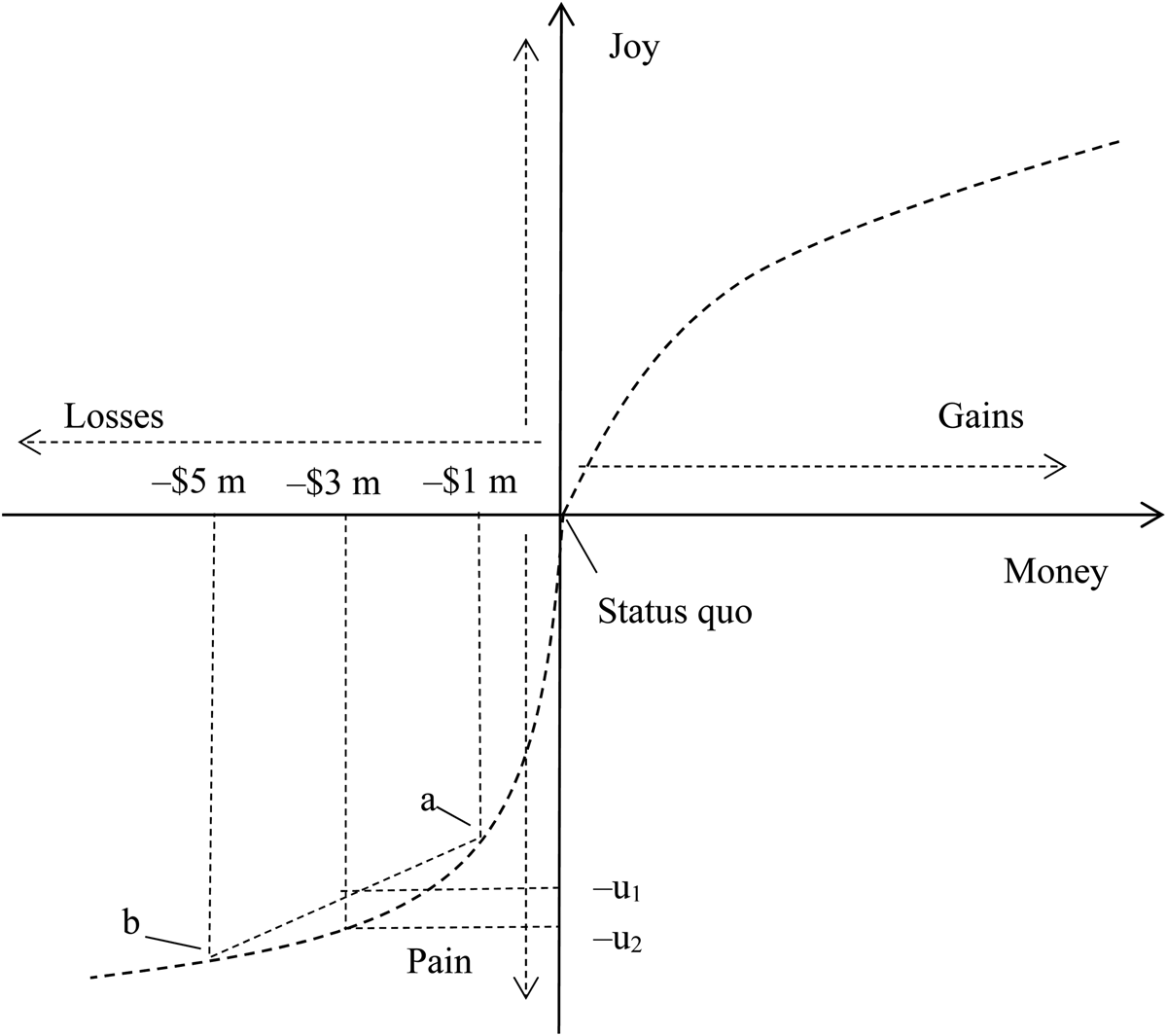
Loss aversion – the observation that people attach significantly more weight to losses than they do to gains of the same magnitude – is one of the distinctive features of prospect theory, which is in turn the most influential descriptive theory in behavioural economics (Kahneman & Tversky, Reference Kahneman and Tversky1979; Tversky & Kahneman, Reference Tversky and Kahneman1992). For example, loss aversion suggests that people will suffer far more pain – in empirical observations, generally about twice as much – from losing, say, €20 than joy from finding or gaining €20. In addition, prospect theory assumes that people will be decreasingly sensitive to both mounting gains and mounting losses. All of the above implies that, under prospect theory, people will process outcomes in accordance with the value function in Figure 1, with loss aversion causing the ‘kink’ at the origin.
The prospect theory value curve.
Note: The concave section of the curve in the top right-hand quadrant implies risk aversion. In the domain of losses (the bottom left quadrant), the curve is convex, which implies risk-seeking. To show how this works, imagine that an individual is faced with a lottery that involves a 50% chance of losing $1 million and a 50% chance of losing $5 million. The negative utility – or disutility, or pain – of losing $1 million and $5 million can be read from points a and b, respectively. The expected disutility of any lottery that offers chances of losing these amounts can be drawn from the straight line that connects a and b. For example, consider our lottery: it has an expected value of –$3 million, and the expected disutility, –u1, of this lottery can be drawn from the straight line. The certainty of losing $3 million, on the other hand, can be drawn from the curve, and is given by –u2. Therefore, the certainty of losing $3 million gives more disutility than a lottery that has an expected value equal to that amount, which means that the person would rather accept the gamble than have to pay an amount equivalent to the expected value. Hence, he or she will be risk-seeking. Risk aversion in the domain of gains can be read from the curve in a similar manner.

The significance of loss aversion in price negotiations where the seller makes the first offer is that the reluctance shown by the seller to lower the price from its ‘target’ (as this would represent a loss to them) would be greater than the enthusiasm for this course of action shown by the buyer (where the lowering of the seller's target price would be a gain).
As noted, the value curve in Figure 1 implies risk aversion (i.e., a dislike of risk) over gains and risk-seeking (i.e., a liking for taking risks) over losses. A second distinctive feature of prospect theory is that it assumes that people will ‘weight’ probabilities; specifically, for our purposes here, it assumes that people will overweight small probabilities. If people overweight a small probability of a gain, they may be risk-seeking (but will still be risk averse when faced with higher probabilities of a gain). Conversely, if people overweight a small probability of a loss, they may be risk averse (while still being risk-seeking when faced with higher-probability losses). This four-way pattern of predicted risk attitudes is known as the reflection effect – according to Kahneman (Reference Kahneman2011), this is the most distinctive implication of prospect theory.
It is difficult to predict how, if at all, the reflection effect applies to a price negotiation scenario without knowing what either party considers as a gain or a loss, or the chances of experiencing either. However, we may speculate that if the seller offers the initial price and knows implicitly that this price has a high chance of being met, then they may anticipate that they have a low chance of experiencing a loss. Following the reflection effect, they would thus be expected to be risk averse; consequently, they might be willing to accept a price that is somewhat lower than their target price in order to avoid the risk of a more significant reduction in that price. Conversely, the buyer may perceive there to be a small chance of them gaining from the negotiation, which, following reflection, implies – in theory – that they will be risk-seeking. Thus, rather than accepting the small reduction on the seller's target price that the seller is willing to accept, they would prefer the riskier strategy of trying to secure a larger reduction. Unfortunately, since their chance of succeeding is low, most of the time they end up having to settle on the seller's full target price. If the buyer and seller psychologically interpret the scenario in the ways indicated, then the predictions given by the reflection effect suggest that most of the time the seller's full target price will be agreed upon, and only occasionally will there be a significant agreed reduction in their target price.Footnote 3
Reciprocity and reputation
There is experimental evidence that when sellers sell complex goods (i.e., goods where there are information asymmetries between the buyer and seller and the quality of the good is not easy for the buyer to discern), sellers often go over and above what they need to do in order to gain the trust of buyers, and buyers will often pay relatively generously and remain loyal in order to try to sustain that trust. This evidence conflicts with the standard rules of economic rationality, illustrated in Akerlof's (Reference Akerlof1970) classic article on a market for lemons (i.e., a market where there is substantial information asymmetry between the buyer and the seller, with the seller holding all of the cards and where trade between the exchange partners occurs sporadically). Using the example of used cars, Akerlof contended that buyers will not be willing to buy at a high price due to a lack of trust in the seller to disclose any or all of the things that could be wrong with the car, which will motivate sellers to offer only lemons (i.e., poor-quality goods, since they cannot command a high price), an equilibrium that may harm both the buyer and the seller.Footnote 4
Using the rubber market as an example, Kollock (Reference Kollock1994) investigated whether this hypothesized lack of trust is inevitable, particularly if repeated transactions are desired by both trading partners. Kollock argued that sellers will attempt to gain the trust of buyers by cultivating a good reputation when the quality of what they are selling is not readily observable. Relying on a trading partner's reputation when one cannot directly discern what they are doing is a core feature of what is known as indirect reciprocity. In his laboratory studies, Kollock's findings were consistent with these arguments: sellers of complex goods were very concerned about their own reputations, and buyers, who bear the risk of the information asymmetry, also focused upon the sellers’ reputations and were likely to remain with their trading partners even when others were attempting to entice them elsewhere. Contrasting with Akerlof's (Reference Akerlof1970) predictions regarding sporadic exchange, reciprocal tendencies and the associated concern with our own and others’ reputations can thus fill in for the incomplete part of the contract over complex goods.
It is not clear (to me) whether current pharmaceutical price negotiations between buyers and sellers are structured to generate trust and reciprocal fairness. If it is true that higher than reasonable prices are ultimately agreed, due perhaps to anchoring and loss aversion, then a concern with reciprocal fairness may be lacking. There are a number of reasons why sellers in this market are not driven to gain a reputation for reciprocal fairness. For example, many companies may have a new product ready to market only sporadically, and thus their concern for repeat custom is weakened, compounded by them being the only seller of particular products, hindering the buyer from presenting the threat of exit from the negotiations (if the buyer exits, it may not be to seek an alternative seller, but to refuse to buy the product at all, which may be politically difficult if the government wants the product to be available to its population).Footnote 5 In these circumstances (i.e., a high initial anchor, no alternative supplier, great difficulty for the buyer to walk away from the negotiation, infrequent price negotiations for each firm, informational asymmetries that favour the seller and buyer fear of incentivizing the production of lemons), the buyer may not be in a position to force a low price, but instead of a fair price for a high-quality product ensuing, the seller may use its powerful position to force higher than fair prices. To use a car analogy, the buyer may well be getting a BMW, but for the price of a Bentley. A concern for one's reputation, however, lies very deep within the human psyche and is likely to have evolved for the very reason that a good reputation serves to signal that one is a good person with whom to cooperate. This fundamental aspect of human character may extend to all sellers (and indeed all buyers), but in order for it to be useful for bringing about reciprocal fairness in pharmaceutical price negotiations, the context that is relevant to those negotiations needs to be structured to take advantage of it (considered below).
Addressing the behavioural influences
In this section, a few suggestions will be made on how the buyer might address the behavioural influences. As argued above, the final agreed price between a buyer and a seller will be heavily influenced by the first offer. Thus, if the seller makes the first offer, then without corrective action they are likely to achieve something close to their target price. There are a number of corrective strategies that could be taken.
1. Boost strategies, associated with Gerd Gigerenzer and Ralph Hertwig (e.g., see Hertwig, Reference Hertwig2017), aim to educate people about the behavioural phenomena in an effort to possibly reduce their influence on people's choices and behaviours. We may hypothesize that if buyers were able to inform the sellers that they are fully aware of the effects of anchoring (and the other behavioural influences) – the effects of which the sellers themselves might not be fully explicitly aware – then this may dampen the sellers’ tendencies to use strategies that implicitly employ these influences. In short, the notion is that if the sellers are aware that they are, in a sense, being ‘watched’, they will temper their behaviours in these respects.
2. If the above speculations regarding the reflection effect are correct, buyers might usefully strive to be less risk-seeking in price negotiations. This would imply that they accept a marginal reduction in the seller's target price all of the time (as noted above, if the sellers are risk averse, they would accept this outcome) rather than attempt to achieve a more significant reduction in the target price through a risk-seeking strategy that – in theory – would normally be expected to fail.
3. Given that we know that reciprocity is a core human motivation, buyers might try to employ strategies that utilize this tendency to induce fairer price offers by sellers. One way to attempt this is to inform the sellers explicitly of how the revenue accrued from the difference between their target price and their reservation priceFootnote 6 could be used elsewhere (e.g., in the health service) that might offer greater benefits even for the sellers and the people that they know than would an excessive price awarded to their product.Footnote 7
4. A concern for one's reputation, linked to reciprocity, is also fundamental to the human psyche and can be (and has been) used to drive improvements in performance, in health care and elsewhere (e.g., see Bevan & Fasolo, Reference Bevan, Fasolo and Oliver2013; Bevan et al., Reference Bevan, Evans and Nuti2019). In particular, reputational competition, where, for instance, sellers are ranked openly in accordance with the fairness of their pricing practices might prove useful in motivating them to improve their behaviour in this respect, because nobody wants to be seen to be a poor performer (in respect to anything) compared to their peers. Pharmaceutical companies are already ranked according to access to their products, with pricing being one component of that (see https://accesstomedicineindex.org/overall-ranking); it might prove worthwhile to develop a ranking specifically on price and to disseminate these rankings periodically as widely as possible (e.g., in the national and international press).
All of the above are, of course, merely suggestions. The core essence of behavioural public policy is ‘context matters’, and there is no guarantee that even those interventions that have proven to be effective in other contexts, such as reputational competition, would work in the particular context of pharmaceutical price negotiations. The proof of the pudding would be in the eating. It may well be the case that in order to alter practices significantly, stronger regulations would be needed to shift the anchor away from benefiting the seller. Regulations that are aimed at tackling behaviourally informed practices that essentially impose harms on others are called ‘budges’ (e.g., Oliver, Reference Oliver2013, Reference Oliver2015).Footnote 8 Possible budges to counter the anchoring effect that comes from allowing the seller to make the first price offer include:
5. Requiring sellers and buyers simultaneously to submit sealed bid prices for the product that, with the supporting evidence, are then counterbalanced by a knowledgeable independent arbitrator.
6. Requiring sellers to place their initial suggested price on a scale rather than as an open ‘valuation’. As we saw with classic preference reversals, open valuations can cause people to attach undue emphasis to particular attributes of a good. If buyers calibrated the scale such that the ends fall into a range that they view as reasonable (e.g., if it was calibrated from the buyer's target price up to their reservation price), then it is possible that sellers will offer a price that falls within this range, particularly because people tend to avoid the end points of scales (that said, if the seller thinks that the range offered is unacceptable, they may refuse to engage in the process).
7. Building on Galinsky and Mussweiler (Reference Galinsky and Mussweiler2001), it may prove beneficial to the buyer to focus hard on the seller's reservation price – or rather, the minimum price that it may reasonably expect that the seller might accept – rather than the buyer's own target price (assuming that the former is higher than the latter).Footnote 9 Intractable positions may then be less likely to ensue, the seller may become less wedded to their own target price as they recognize that the buyer is aiming for a position of reciprocal fairness and the seller's initial price offer may form less of an anchor to the buyer. This strategy resonates with the buyer being less risk-seeking as suggested earlier (in Point 2) in that they would not now see their own target price, versus that of the seller, as being an all-or-nothing game that they are likely to lose, and yet having a greater chance of moving the final negotiated price in the direction of the buyer's target, if not actually hitting the target.
8. Coupled with the previous point, there is a strong case for regulating so that the buyer, and not the seller, makes the initial price offer and provides the justification for this initial offer in it meeting what the seller should reasonably expect. If this strategy of ‘reasonableness’ proves ineffective, the buyer may resort to offering its own target price rather than the seller's reservation price so that the initial anchor falls (and buyers should let the sellers know that this will be the progression if there is strong resistance to the reservation price offer). But either way, in order to bring negotiated prices down substantively, it is likely to be necessary for the buyer, and not the seller, to make the first offer.
Conclusion
Several behavioural influences may plausibly affect price negotiations, and there are thus, perhaps, many ways to try to counter these influences. Some of these are suggested above, but the most important influence is anchoring. The most effective way in which to counter the seller's anchor is likely to be to regulate so that the buyer makes the first offer. Over and above what has been discussed above, I will highlight a few further behavioural considerations here.
First, any attempts by buyers at minimizing the impacts of behavioural influences that favour the seller are likely to be met with efforts by sellers to counter them, particularly if sellers become explicitly aware of these attempts. For example, if sellers are aware that buyers are trying to create a lower anchor, one might expect that they will make considerable attempts at countering that anchor. Second, attempts at challenging the standard practice of sellers making a first offer run the risk of strengthening ingroup/outgroup mentalities between buyers and sellers (because sellers may understand that practices are being altered to disadvantage them), making it ever harder to reach price agreements. Third, any attempt by sellers in this market at making the claim that they are offering a discount on price to meet a particular jurisdiction's cost–effectiveness threshold should itself be discounted.Footnote 10 This would be a behavioural trick to make it look like the seller is offering a favour. The buyer might just as easily claim that any price above its own target price is a (publicly financed) subsidy to the seller. Fourth, any seller's attempt to create an availability bias by pushing for a high price in one market in order for that price to serve as a reference price for another market should be met with resistance. Fifth, if a pharmaceutical company claims that a high price is a reciprocal arrangement for it to maintain its presence within a particular country, then this is a false claim, not because the company will not necessarily leave, but because such a threat conflicts with the rules of reciprocal fairness. The reciprocity in this trading relationship should focus entirely on the exchange between the price of the pharmaceutical and the health benefits that the product offers.
But overall, to reiterate, the most obvious and powerful behavioural influence in these price negotiations is likely to be that which concerns the anchor.