Implications
As antibiotic growth promoter’s prohibition in poultry industry by European Union, poultry producers are trying to replace them by other growth promoters like medicinal herbs. Eucalyptus is a medicinal herb enriched by a lot of powerful phenolic compounds and with antioxidant and antimicrobial properties which led to enhancing appétit and improving health and growth performance of broiler. The results of this study showed that 0.5% eucalyptus powder (EP) served as a useful replacement for antibiotic and would improve performance and immune response of broiler chickens and may be useful for all poultry producers around the world.
Introduction
Antibiotic growth promoters (AGP) have been used to reduce the spread of diseases and as growth promoter to enhance animal performance. However, many countries and animal farms have been restricted to use AGP, because of their residual effects on poultry products and harmful effects on human health. Consequently, nutritionists and production managers have to find alternatives that have potential to alleviate the problems related to AGP (Lillehoj and Lee, Reference Lillehoj and Lee2012). As a general category, probiotics tend to refer to bacterial cultures capable of stimulating intestinal microflora, which in turn are capable of modifying the gastrointestinal environment in a positive manner, benefitting beneficial bacteria and improving the growth performance and feed efficiency of broilers (Jeong and Kim, Reference Jeong and Kim2014). Improvements in growth performance and feed efficiency have been reported in broiler chickens after feeding of probiotics (Cao et al., Reference Cao, Zeng, Chen, Zhou, Zhang, Xiao and Yang2013; Song et al., Reference Song, Xiao, Ke, Jiao, Hu, Diao, Shi and Zou2014). People have used plants since earliest times and even today we continue to depend on exotic species for many of our newest medicines and chemicals. Recently, many countries tended to minimize or prohibit the chemical components for their deleterious side effects on both animals and human. So, it is important to use natural promoters. Medicinal herbs have a stimulating effect on growth of broilers. In addition, some plants were found to have natural effects, for example, stimulant, tonics, antiparasitic, antibacterial, antifungal, antimicrobial and antiseptic (Burt, Reference Burt2004). In this respect, vegetable, herbs and plants were suggested as feed additive or growth promoters in broiler diets to improve the growth feed conversion efficiency and reduce the cost of feed (Hashemi and Davoodi, Reference Hashemi and Davoodi2012). Many researchers observed an improvement in BW gain (BWG), mortality rate and feed conversion of broilers by using herbal plants (Hernandez et al., Reference Hernandez, Madrid, Garcia, Orengo and Megias2004; Cross et al., Reference Cross, Mcdevitt, Hillman and Acamovic2007). Eucalyptus (family, Myrtaceae) is one of the world’s most widely planted (Sallam et al., Reference Sallam, Bueno, Brigide, Godoy, Vitti and Abdalla2007). The leaves of E. globulus contains up to 3.5% w/w essential oil. The principal constituent found in Eucalyptus is eucalyptol (1, 8-cineole). However, other chemical components such as α-phellandrene, ρ-cymene, γ-terpinene, ethanone, spathulenol, have been documented (Akin et al., Reference Akin, Aktumsek and Nostro2010). Essential oils are natural products composed mainly of terpens and terpene-derivatives in addition to some other non-terpene components (Edris, Reference Edris2007). Oil of eucalyptus globules has antibacterial activities against some microorganisms including salmonella type, Klebsiella spp, streptococcus A, proteus sp, and Staphylococcus aureus (Sallam et al., Reference Sallam, Bueno, Brigide, Godoy, Vitti and Abdalla2007). Therefore, this experiment was designed to compare the effect of inclusion of eucalyptus leaf powder, antibiotic and probiotic on performance, immune response, blood components and carcass characteristics of broiler chicks.
Material and methods
Birds, housing and feeding
This study was approved by the Animal Ethics Committees of the Department of Animal Science of University of Jiroft (2812-94). A total of 250 one-day-old-male chicks (Ross 308) were obtained from a commercial hatchery (Mahan Hatchery, Kerman, Iran) and divided into 25 floor pens (1×1.5 m) of 10 birds each. The study was undertaken at the Animal Farm of University of Jiroft. Chickens were vaccinated against Marek’s Disease at the hatchery, against Newcastle Disease and Infectious Bronchitis viruses at 7 days, against Gumboro Disease at 14 days, against Newcastle disease (B1 type, LaSota strain) at 18 days, and against Gumboro Disease (Reminder) at 24 days of age. Broiler chickens were kept at 33°C during the first 3 days of age. Thereafter, temperature was decreased by 3°C per week to reach 24°C at 21 days of age. After that, they were maintained at ~24°C until the end of experiment. Light was provided 23 h per day with 1 h of darkness.
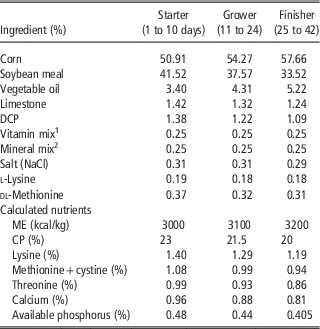
The experimental treatments were consisted of: basal diet (BD), BD+0.25% EP, BD+05% EP, BD+probiotic (Protexin, Probiotics International Ltd, Lopen Head, Somerset, UK), BD+antibiotic (virginiamycin, Belgium). Antibiotic and probiotic were used according to the company recommendation (antibiotic 0.02% of diet and probiotic 0.01% of diet). Eucalyptus leaves were collected from eucalyptus trees of university farm (University of Jiroft, Jiroft, Iran), rinsed and dried in room temperature and mashed with hands then mixed with diet of each pen daily. Each diet was randomly fed to four groups of chicks. Diets were formulated to meet the nutrient requirements according to Ross 308 rearing guideline (Aviagen 2014). Antibiotic, probiotic and EP were added to diets after diet formulation as extra supplements. Mash feed and water were provided ad libitum throughout the experiment. The ingredients and chemical composition of the BDs are shown in Table 1.
Composition of starter, grower, and finisher diets of broilers

1 Vitamin mix provided per kilogram of diet: vitamin A (trans-retinyl acetate), 9000 IU; vitamin D3 (cholecalciferol), 215 IU; vitamin E (dl-α-tocopheryl acetate), 18 IU; vitamin K (menadione), 2 mg; thiamine, 18 mg; riboflavin, 6.6 mg; pyridoxine, 3 mg; vitamin B12 (cyanocobalamin), 0.015 mg; niacin, 10 mg; pantothenic acid (d-calcium pantothenate), 4.8 mg; folic acid, 1 mg; biotin, 0.15 mg; choline chloride, 500 mg; ethoxyquin (antioxidant), 1 mg.
2 Mineral mix provided per kilogram of diet: Fe, 50 mg; Mn, 100 mg; Zn, 7.84 mg; Cu, 10 mg; I, 1 mg; Se, 0.2 mg.
Growth performance
Body weight gain and feed intake (FI) per pen were measured. Initial BWs (day 1) were subtracted from the final BW to get BWG. Feed consumption was calculated by subtracting residual feed from the offered feed. Data for feed consumption and BWG were used to calculate the FCR. The FCR was adjusted for mortality and calculated on a pen basis. Growth performance data were determined between day 1 and 42.
Biochemical parameters
After 4 h starvation, two birds per replicate were randomly selected and 2 ml of blood samples were collected from the wing vein by a syringe on day 42. Blood samples were collected in labeled sterile test tubes and centrifuged at 3000×g for 10 min at 4°C to isolate serum. The levels of serum triglyceride (mg/dl), total cholesterol (mg/dl), high-density lipoprotein (HDL, mg/dl), low-density lipoprotein (LDL, mg/dl), and glucose (mg/dl) were measured by an autoanalyzer (HITACHI 912, Hitachi, Tokyo, Japan).
Immunological measurements
For assessment of antibody titers against sheep red blood cells (SRBC), two birds per replicate were selected and were intramuscularly injected with 0.5 ml/chick SRBC; 9% suspension in PBS at day 28 and 35, SRBC were used as an antigen to quantify the antibody response. Blood samples were collected at 7 and 14 days after the injection. The serum from each sample was collected, heat inactivated at 56°C for 30 min and then analyzed for anti-SRBC antibodies as described by Cheema et al. (Reference Cheema, Qureshi and Havenstein2003). The SRBCs used for inoculation and antibody titration were obtained from the same donor sheep. Also at 42 days of age, two SRBC injected birds per replicate were selected and 0.5 ml of blood samples was collected in heparin containing tubes to avoid blood clot formation for hematological analysis. The white blood cells (WBC) and red blood cells counts were determined by an improved Neubauer hemocytometer method (Jain, Reference Jain1986). The hematocrit and hemoglobin values were measured by microhematocrit and colorimetric cyanomethemoglobin methods, respectively (Baker and Silverton, Reference Baker and Silverton1985).
Carcass traits
At the end of the experiment, two birds per replicate whose BW were closest to the mean weight of the pen were killed by cervical dislocation, and after removing feathers and feet (whole carcass with visceral) subsequently considered to assess the relative weight of whole carcass and carcass cuts (g/g of live BW).
Statistical analysis
As the pen represented the experimental unit, the effects of additives were statistically analyzed using a completely randomized design by SAS (2001). Results are presented as treatment means and SEM. Significance of differences between mean values was estimated by means of single-factor ANOVA assuming significance levels of 0.05 and 0.01.
Results
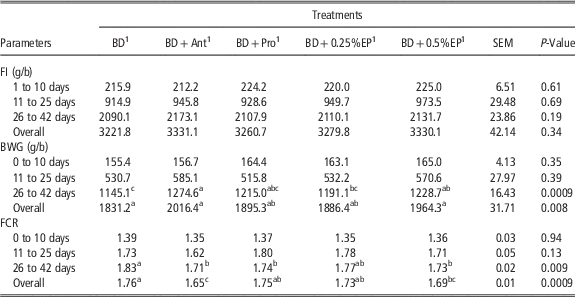
Effect of supplemental EP, antibiotic and probiotic on performance characteristics (FI, BWG and FCR) of broiler chickens is presented in Table 2. The results showed that the effect of treatments on performance characteristics was not significant in the starter and grower period. Effect of treatments on BWG and FCR was significant in finisher and whole periods (P<0.05) as the highest BWG and the lowest FCR was seen for broiler chickens fed with antibiotic and 0.5% EP.
Effect of eucalyptus powder (EP), antibiotic (Ant) and probiotic (Pro) on performance traits of broilers at different periods

FI=feed intake; BWG=body weight gain; FCR=feed conversion ratio.
a,bValues within a row with different superscripts differ significantly at P<0.05.
1 BD: basal diet, basal diet+antibiotic, basal diet+probiotic, basal diet+0.25% eucalyptus leaves powder, basal diet+0.5% eucalyptus leaves powder.
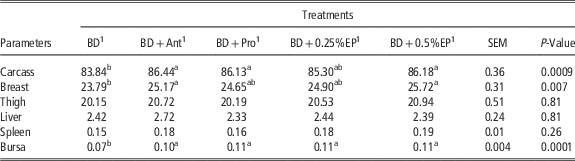
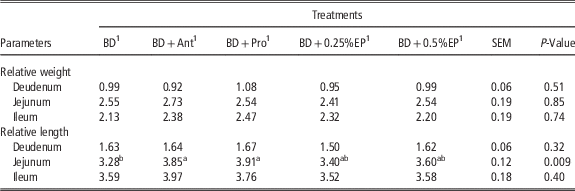
Carcass and breast relative weight increased significantly (P<0.05) by experimental treatments (Table 3). The highest carcass and breast weight was seen for broilers fed by antibiotic and 0.5% eucalyptus. The relative weights of internal organs including liver and spleen were not affected by treatments while bursa of fabricious relative weight increased (Table 3). Also Treatments had no significant effect on relative weight of duodenum, jejunum and ileum of broilers (Table 4), but relative length of jejunum significantly increased by antibiotic and probiotic supplementation (P<0.05).
The effect of eucalyptus powder (EP), antibiotic (Ant) and probiotic (Pro) on carcass traits (relative weight: g/100 g of live weight) of broilers at 42 days of age

a,bValues within a row with different superscripts differ significantly at P<0.05.
1 BD: basal diet, basal diet+antibiotic, basal diet+probiotic, basal diet+0.25% eucalyptus leaves powder, basal diet+0.5% eucalyptus leaves powder.
Effects of eucalyptus powder (EP), antibiotic (Ant) and probiotic (Pro) on relative weights (g/100 g of BW) and relative lengths (cm/100 g of BW) of small intestine cuts of broilers

a,bValues within a row with different superscripts differ significantly at P<0.05.
1 BD: basal diet, basal diet+antibiotic, basal diet+probiotic, basal diet+0.25% eucalyptus leaves powder, basal diet+0.5% eucalyptus leaves powder.
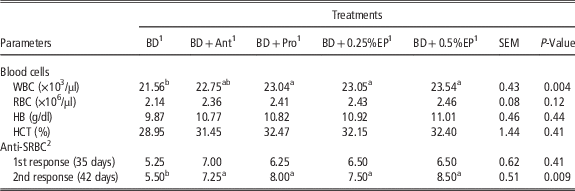
Effects of supplemental treatments on blood cells and antibody production (SRBC test) are presented in Table 5. The results showed that WBC increased significantly (P<0.05) by treatments. Effect of treatments on antibody production against SRBC was not significant at 35 days of age (primary titer). But it was increased significantly by treatments on 42 days of age (secondary titer) and the highest antibody production was seen for birds fed with 0.5% EP and probiotic treatment.
Effect of eucalyptus powder (EP), antibiotic (Ant) and probiotic (Pro)on blood cells and first and second anti-sheep red blood cells (SRBCs) immune response

WBC=white blood cells, RBC=red blood cells, HB=hemoglobin, HCT=hematocrit.
a,bValues within a row with different superscripts differ significantly at P<0.05.
1 BD: basal diet, basal diet+antibiotic, basal diet+probiotic, basal diet+0.25% eucalyptus leaves powder, basal diet+0.5% eucalyptus leaves powder.
2 Anti-SRBC antibody production based on log10.
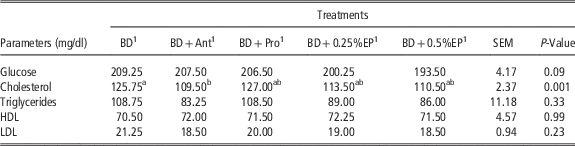
Effect of EP, antibiotic and probiotic on biochemical blood metabolites of broiler chickens are presented in Table 6. Blood glucose was decreased and the lowest blood glucose was seen for broiler fed by 0.5% eucalyptus. Cholesterol, triglycerides and blood LDL decreased by treatments and this reduction was significant for cholesterol (P<0.05).
Effects of supplemental eucalyptus powder (EP), antibiotic (Ant) and probiotic (Pro) on blood glucose and lipids

a,bValues within a row with different superscripts differ significantly at P<0.05.
1 BD: basal diet, basal diet+antibiotic, basal diet+probiotic, basal diet+0.25% eucalyptus leaves powder, basal diet+0.5% eucalyptus leaves powder.
Discussion
The study showed that the use of treatments improved broiler BWG and FCR in finisher phase (25 to 42 days) and whole period (1 to 42 days). Improving BWG and FCR by antibiotics is not unexpected. The nutritional value of raw materials available to livestock is closely linked to the quality and size of the microflora in the host animal digestive tract and its environment. Poultry do not have a natural microflora capable of degrading all nutrients. These animals are characterized by a resistor and a limited immunity against infection due to colonization by pathogenic microorganisms. This is why, the use of antibiotic growth promoters for the inhibition of pathogenic bacteria has been recommended in order to improve production performance and animal health (Hashemi and Davoodi, Reference Hashemi and Davoodi2012). Researchers have stated increasing BWG and improving FCR by using antibiotics. (Lillehoj and Lee, Reference Lillehoj and Lee2012). Cravens et al. (Reference Cravens, Goss, Chi, De Boer, Davis, Hendrix, Richardson and Johnston2013) showed that using 22 mg/kg of diet virginiamycin in Cobb broiler ration increased BWG and FI and decreased FCR significantly compared with control groups. In a similar study on turkey hens, BWG increased significantly by addition of virginiamycin (Cervantes et al., Reference Cervantes, Shim, Hooper, Bafundo and Pesti2011).
Improving BWG and FCR by EP was surprisingly, as there was no significant difference between birds treated by EP and antibiotic. There is no scientific research on effect of EP on broilers. Abd-El Motaal et al. (Reference Abd-El Motaal, Ahmed, Bahakaim and Fathi2008) revealed that supplementation of eucalyptus at the rate of 3 g/kg in diet of laying hens from 46 to 54 weeks of age increased egg number compared with control group. However, there was no significant difference among treated groups for egg weight and egg quality traits, except for breaking strength, whereas the eggs produced from hens fed a diet containing 3 g eucalyptus had a significantly higher breaking strength compared with other treated groups. Lippens et al. (Reference Lippens, Huyghebaert and Cerchiari2005) studied on the effect of a mixture of plant extracts and organic acids in comparison with the avilamycin in chicken feed. The broilers fed with plant extracts showed a much larger BWG than the other groups. Also FCR in broilers of the plant extracts group was 0.4% lower than avilamycin group and 2.9% lower than the organic acids group. Cabuk et al. (Reference Cabuk, Bozkurt, Alcicek, Akba and Kucukylmaz2006) measured production traits in chickens fed with a mixture of essential oils and showed this mixture improved FCR of broilers due to high nutrients availability by changes in the intestinal ecosystem.
Many researchers have stated positive roles of probiotics in growth performance of broilers (Jeong and Kim, Reference Jeong and Kim2014; Awad et al., Reference Awad, Ghareeb, Abdel-Raheem and Bohm2009) Probiotics increase nutrients consumption, digestive enzymes activity and feed digestibility and may improve broiler performance (Jeong and Kim, Reference Jeong and Kim2014).
Carcass and breast relative weight increased significantly by experimental treatments (P<0.05). The highest carcass and breast weight was seen for broiler fed by antibiotic and 0.5% eucalyptus. Increasing carcass and breast weight of turkey hens has been reported by addition of virginiamycin previously (Cervantes et al., Reference Cervantes, Shim, Hooper, Bafundo and Pesti2011). Sarica et al. (Reference Sarica, Ciftci, Demir, Kilinc and Yildirim2005) showed significant increase in carcass yields of broilers fed by flavomycin antibiotic. Kabir et al. (Reference Kabir, Rahman, Rahman, Rahman and Ahmed2004) reported an increase in carcass and breast weight of broilers fed with probiotic. Researchers have stated increasing in digestive enzyme activity and nutrient digestibily and absorption by adding essential oil of herbs (Brenes and Roura, Reference Brenes and Roura2010). Increased Carcass and breast relative weight by eucalyptus may be due to its essential oils and their effect on digestion, absorption and increasing in BW.
Effects of treatments on relative weights of liver and spleen was not significant (P>0.05), while Bursa of fabricious relative weight increased (P<0.05). Increased weight of this lymphoid organ may indicate a higher immunity achieved by treated birds which could be justified by the antimicrobial activity of antibiotic, probiotic and phenylpropanoids and flavonoids in eucalyptus. Addition of probiotic Bacillus subtillis in a study on broiler chicks, increase the relative weights of bursa and thymus significantly (Teo and Tan, Reference Teo and Tan2007). Also Protexin probiotic increased liver and bursa relative weights in broilers (Azadegan Mehr et al., Reference Awad, Ghareeb, Abdel-Raheem and Bohm2014). Khaligh et al. (Reference Khaligh, Sadeghi, Karimi and Vaziry2011) in a study on evaluation of different medicinal plants blends in diets for broiler chickens indicated that medicinal plants blends were not effective on relative weight and relative length of different part of digestive system and lymphoid organs such as: bursa and spleen. Sarica et al. (Reference Sarica, Ciftci, Demir, Kilinc and Yildirim2005) showed that supplementation of broiler diets with Flavomycin antibiotic had no effect on liver weight compared with control group.
Eucalyptus powder, antibiotic and probiotic had no significant effect on relative weight of duodenum, jejunum and ileum of broilers (P>0.05). But the relative weight of jejunum increased by treatments and the highest length was observed in antibiotic and probiotic groups. Ocak et al. (Reference Ocak, Erener, Burak, Sungu, Altop and Ozmen2008) indicated that using medicinal plant in broiler diet had no effect on carcass weight, relative weight of internal organs, and relative weight and length of intestine. While Sarica et al. (Reference Sarica, Ciftci, Demir, Kilinc and Yildirim2005) showed a decrease in relative weight of intestine of broilers fed with antibiotic and an increase in relative length of small intestine of broilers fed with herbal additives. It is assumed that increasing intestine length is paralleled by an increased digestive and absorptive function of the intestine due to increased absorptive surface area, expression of brush border enzymes, and nutrient transport systems. This fact suggests that the villus function is activated after feeding of dietary antibiotic or probiotic (Awad et al., Reference Azadegan Mehr, Hassanabadi, Nassiri Moghaddam and Kermanshahi2009).
Our results showed that WBC increased significantly (P<0.05) by treatments. Antibody production against SRBC was also increased significantly by treatments on 42 days of age (secondary titer) and the highest antibody production was seen for birds fed with 0.5% EP and probiotic treatment. According to the stimulation of antibody production by EP, it may have beneficial effects in improving immune response. Some researchers indicated that immune response has increased with the using of probiotics, and medicinal extracts in the diet, that is in agreement with our results (Khaksefidi and Ghoorchi, Reference Khaksefidi and Ghoorchi2006; Moorthy et al., Reference Moorthy, Ravi, Ravikumar, Viswanathand and Cedvin2009). These researchers suggested that probiotic containing diets increase immune response due to stimulation of B and T lymphocytes production. Also some studies reported that herbal extracts increase vitamin C activity and phagocytes activity which improve immune response (Hashemi and Davoodi, Reference Hashemi and Davoodi2012). Eucalyptus supplementation at the rate of 2 and 3 g/kg diet decreased the H/L ratio of lying hens, and improved general immune condition (Abd-El Motaal et al., Reference Abd-El Motaal, Ahmed, Bahakaim and Fathi2008).
The lowest blood glucose was seen for broiler fed by 0.5% eucalyptus, although it was not statically significant. Also blood cholesterol, decreased by treatments (P<0.05). Arise et al. (Reference Arise, Malomo, Adebayo and Igunnu2009) indicated that aqueous extract of eucalyptus globulus decreased blood triglycerides, glucose, cholesterol and LDL in rats. A mechanism involved in the overall hypocholesterolemic effect of herbal plants supplementation might be attributed to the active components of plants as the natural antioxidants. Phenolic compounds (flavonoids, tannins, phenolic acids, terpenes) are the responsible molecules for antioxidant activity of herbal additives. These components can adhere to LDL, inhibit the free radicals and thereby in turn decrease cholesterol absorption into blood (Brenes and Roura, Reference Brenes and Roura2010).
Conclusion
The result of our study showed that EP, antibiotic and probiotic had a significant effect on productive performance traits of broilers in finisher period as weight gain increased and feed conversion ratio decreased (P<0.05). Carcass, breast and bursa of fabricious relative weight increased (P<0.05) by experimental treatments. Effect of treatments on antibody titer was significant on day 42 (P<0.05). White blood cell was increased and cholesterol decreased by treatments (P<0.05). The results of present study elucidate that 0.5% EP can be suitable replacements for antibiotic because its effect on broiler performance and immunity was surprisingly close or even better than antibiotic and since this magical herb has a widely spread around our tropical country and world it can be suggested as a positive medicine herb for using in broiler nutrition.
Acknowledgments
The authors would like to thanks the University of Jiroft, Kerman, Iran, for providing experimental facilities and financial support of this experiment.
Declaration of interest
We confirm that there is no conflict of interest for this paper.
Ethics Statement
This study was approved by the Animal Ethics Committees of the Department of Animal Science in University of Jiroft that follow the COPE code of conduct (http://publicationethics.org/resources/code-conduct).
Software and data repository resources
All data of experiment are deposited in Animal Science library of University of Jiroft and the access rights are for authors.