The association between congenital heart disease and the development of scoliosis is currently well known. Spinal deformities, including scoliosis and kyphosis, develop in up to 38% of children with congenital cardiac malformations,Reference Herrera-Soto, Vander Have, Barry-Lane and Woo 1 with boys and girls being equally affected. The aetiology is unknown and is thought to be multi-factorial.
Over the past two decades, advances in the fields of paediatric cardiology and cardiac surgery have led to an increase in the rate of survival of patients with congenitally malformed hearts,Reference Marino 2 with more than 85% of these children reaching adulthoodReference Coran, Rodgers and Keane 3 and thus creating a subset of patients who will require spinal orthopaedic surgery for the correction of their spinal deformity.Reference Pérez-Caballero, Sobrino and Vázquez 4
Fontan circulation is the final stage of palliative surgery performed in patients with single-ventricle lesions. Fontan physiology is complicated and requires highly specialised peri-operative management to minimise complications and ensure the survival of these patients. Both systolic and diastolic cardiac failure, anomalous venous return, embolisms, arrhythmias, and valve dysfunction are associated with higher mortality.Reference Cromme-Dijkhuis, Hess and Hahlen 5
Survival rates of patients with Fontan circulation undergoing scoliosis surgery are unknown. Spinal surgery is indicated when severe back pain or cardiopulmonary restriction occur despite medical therapy. However, management of these patients during correction of their scoliosis is difficult because of the need to maintain a systemic venous pressure that guarantees an adequate flow to the lungs, which can hinder the hypotension ideally required to control the bleeding. Cardiac and haemodynamic stability, the risk for arrhythmias, coagulation disorders, and fluid management during surgery are of extreme importance during post-operative management.
The purpose of this article was to describe our experience in both peri-operative and post-operative management of patients with Fontan circulation undergoing spinal surgery for correction of scoliosis.
Materials and methods
This retrospective study was designed to include all surgeries for the correction of scoliosis in patients with Fontan circulation that had taken place in the Ramon y Cajal Hospital, Madrid between 2000 and 2010. We searched the hospital database for patients who had undergone a spinal surgery in the above-mentioned period and those who had previously undergone surgery for a congenital cardiac malformation. Among these patients, we selected those with Fontan physiology.
Medical records were searched for demographic data, cardiac diagnosis before surgery, haemodynamic stability, and previous cardiac surgeries. All patients had undergone a thoracotomy and/or sternotomy during childhood for the correction of their congenital heart disease.
We analysed the morphology of the spinal curve, and the existence of costal fusions and vertebral deformities in pre-surgical X-rays. Measurements of the Cobb angles – a measurement of the degree of side-to-side spinal curvature used to define the severity of the scoliosis – were taken before and after the surgery.Reference Cobb 6
All the operations for scoliosis were carried out by the same surgical team. All patients received antibiotics for endocarditis prophylaxis. Anaesthetic risks were measured using the American Society of Anaesthesiology Score.Reference Meyer 7 In order to detect any motor injury, we also monitored the somatosensory-evoked potentials during the surgery, following the indications of the American Encephalographic Society. 8 Trans-oesophageal echocardiography was performed during the surgery in order to monitor ventricular function. Arterial pressure and central venous pressure were carefully monitored in all the patients during surgery.
All the operations were carried out using a posterior approach and pedicular or extrapedicular screws.Reference Vallespir, Flores and Trigueros 9 We analysed the duration of the surgery, the number of vertebrae fused, the need for inotropic drugs, blood loss, and the use of coagulation factors and antifibrinolytic drugs.
We also analysed the mean time spent in our paediatric intensive care unit; the need for volume expansions, inotropic drugs, and mechanical ventilation; the beginning of oral intake; the amount and duration of surgical spinal drainages; the requirements for drug-induced pain relief; and the incidence of post-operative complications. We also analysed the total hospital stay and the presence of late-onset complications after the third post-operative day.
All data were processed using an Excel® programme and are presented as descriptive values, providing the mean and ranges.
Results
Pre-operative
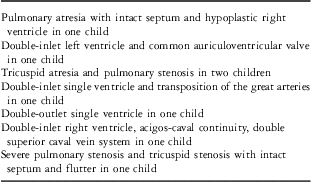
We identified 36 patients with surgically treated congenital cardiac malformations who had undergone surgery for scoliosis from 2000 to 2010, eight of whom had Fontan circulation (22.2%). Of these eight children, two were boys (25%) and six were girls (75%). Cardiac malformations that led to the Fontan operation were: pulmonary atresia with intact septum and hypoplastic right ventricle, tricuspid atresia and pulmonary stenosis in two children, severe pulmonary and tricuspid stenosis in one child, double-inlet single ventricle and transposition of the great arteries in one child, double-outlet single ventricle in one child, double-inlet right ventricle and double superior caval vein system in one child, and double-inlet left ventricle and common auriculoventricular valve in one child (Table 1). The mean age at surgery was 9.4 years (range 6–12 years).
Cardiac malformations that led to Fontan.

All patients were receiving cardiological medications at the time of spinal surgery; two children were on digoxin, six were on diuretics, including furosemide and spironolactone, one was receiving amiodarone, and six were receiving angiotensin-converting enzyme inhibitors. Of the eight children, one was receiving warfarin, whereas the other seven were receiving acetylsalicylic acid.
Before surgery, all patients underwent a complete cardiological evaluation including electrocardiography and echocardiography, showing a mean ejection fraction of 55% (43–65%) and a mean shortening fraction of 26% (21–38%). Pre-surgical spirometries were also performed in all patients, showing a mean vital capacity of 51% (37–78%) and a forced expiratory volume in 1 second of 55.7% (35–82%). All patients presented with oxygen saturation >93%.
A median sternotomy and thoracotomy had been performed in all patients before the scoliosis surgery. In seven of the patients, there were double-structured curves – thoracic and lumbothoracic – and only one presented with a simple lumbothoracic curve. The mean Cobb angle for the greatest curve was 78.6° (range 58–97).
Bone age at the time of surgery was Risser 1 for two patients, Risser 2 for two patients, Risser 3 in one child, Risser 4 in one child, and Risser 5 in the two remaining patients. The risk of progression of the spinal deformity is lower in those patients with higher Risser scores.
All patients had an American Society Anaesthesiology score of III – severe systemic disease with non-incapacitant limitation of activities – or IV – severe systemic disease with incapacitant limitation of activities. All patients received antibiotics for endocarditis prophylaxis. All scoliosis surgeries were carried out by the same surgical team using a posterior approach with modern segmentary material and allografts. The mean age at surgery was 14.8 years (range 12–21). During surgery, we monitored the somatosensory-evoked potentials and no motor injury was detected.
Intra-operative
The mean surgical time was 314 minutes (range 205–480). The mean number of vertebrae fused was 13.5 (range 13–15), and the mean blood loss during surgery was 1520 ml (range 750–5500), which means a mean blood loss per kilogram of weight of 64 ml/kg (range 35–258). All patients needed blood transfusions during the surgery, although in three of them (37.5%) the amount of heterologous packed red blood cells infused was reduced by the use of a cell saver, and in 62% of children the use of heterologous blood was avoided by the pre-donation of autologous blood. Packed red blood cells were transfused to maintain a haematocrit value of above 30% during surgery, although a number of factors such as acidosis, hypovolaemia, and decreases in central venous pressure, together with bleeding during the operation, influenced the decision to transfuse. Fresh frozen plasma was also transfused in all the patients during surgery, either because of a prolonged coagulation time or because of significant bleeding during surgery. In four instances (50%), aprotinin was administered when fresh frozen plasma alone proved insufficient to control the bleeding, and one patient needed one dose of factor VII.
During the surgery, three patients (37.5%) needed inotropic support with dopamine (at 3, 5, and 8 μg/kg/min).
Post-operative
One patient died (12.5%) during the immediate post-operative period because of hypovolaemic shock caused by a massive bleeding refractory to the multiple volume expansions and the inotropic support with dopamine, milrinone, and epinephrine.
After the surgery, the remaining seven patients were admitted into the paediatric intensive care unit, where they were treated by the same team of intensive care paediatricians. The mean time spent in our intensive care unit was 3.4 days (range 2–7 days), with a total time spent in hospital of 9.2 days (range 6–19 days). Inotropic support with dopamine, at a maximal dose of 8 g/kg/min, during the immediate post-operative period was continued in two patients for 24 and 46 hours, respectively. Four patients (57%) were extubated before arrival at the paediatric intensive care unit, whereas the remaining three (43%) required mechanical ventilation for a maximum period of 7 hours. The mean extubation time was 3.25 hours.
All patients needed volume expansions during the first 24 hours in our intensive care unit (mean volume requirement 61 cc/kg, range 21–81 cc/kg), aiming at levels of central venous pressure as high as 18–20 cm of water. The mean blood loss during the post-operative period was 22.2 cc/kg (range 7.8–44.6). Surgical drainages were maintained for a mean duration of 3 days (range 1–7 days). Oral intake with good tolerance was achieved at a mean duration of 35 hours (range 24–72 hours). A continuous intravenous infusion of morphine chloride was provided for 2.2 ± 0.8 days, and this was then replaced by administration of oral morphine.
In five of the eight patients (62.5%), there were no complications during their stay in the intensive care unit. Further, pleural effusions developed in two patients (28.5%), requiring insertion of chest tubes for their resolution; one of them developed an associated atelectasis of the superior right lobe that responded to respiratory physiotherapy. The surgical bar of one of these patients broke because of thoracic pseudarthrosis six months after spinal surgery. A serohaematoma of the surgical wound was diagnosed in the other patient.
The mean Cobb angle was transformed from 78.6° before the surgery to 32.2° after the surgery, indicating a correction of 41% of the deformity. In the X-ray performed before the discharge, the mean Cobb angle was 37° (range 20–60°).
Discussion
The estimated incidence of scoliosis in patients with a congenitally malformed heart is 2–31%. A strong association between congenital heart disease and scoliosis has been shown by previous studiesReference Ruiz-Iban, Burgos and Aguado 10 , whereas others do not confirm these results.Reference Kawakami, Mimatsu and Deguchi 11 However, there is no evidence that scoliosis is associated with specific cardiac malformations.Reference Basu, Elsebaie and Noordeen 12 , Reference Bal, Elshershari and Celiker 13
The aetiology of the development of scoliosis in these patients is unknown. The development of scoliosis could be associated with the physiopathological changes that cardiac patients show. Cyanosis has been associated with the development of scoliosis. Cyanosis or abnormal pulsatile blood flow could produce abnormal irrigation of the spine, and thus impaired growth. A previous studyReference Herrera-Soto, Vander Have and Barry-Lane 14 indicated that patients with congenitally malformed hearts have a four to fivefold risk of presenting with scoliosis later in life, this being more severe than in the general population.
Advances in the fields of paediatric cardiology and cardiac surgery have led to an increase in the rates of survival of these patients, creating a subset of patients with complex physiology that may require spinal orthopaedic surgery.Reference Pérez-Caballero, Sobrino and Vázquez 4
The rates of survival and quality of life in patients with Fontan physiology have improved over the last two decades.Reference Ohye and Bove 15 Although these patients frequently show medical complications such as arrhythmias, coagulation disorders, protein-losing enteropathy, and hepatic disorders, the scores of quality of life do not differ from those of the general population.
In patients with Fontan physiology, unoxygenated venous blood returning from the systemic circulation is directed to the pulmonary artery by means of a cavopulmonary shunt. These patients require a higher systemic venous pressure that guarantees an adequate blood flow to the lungs. Factors associated with an increase in the pulmonary pressure such as hypothermia, hypoxaemia, hypercapnia, acidosis, positive pressure ventilation, and positive end-expiratory pressure can worsen the systemic venous return and thus lead to desaturation and Fontan failure. The maintenance of an adequate systemic venous flow is extremely important in the management of these patients.
There is limited published data on the safety and efficacy of spinal fusion in children with Fontan physiology. The risk of the spinal fusion surgery depends on the pre-operative cardiac situation. Spinal fusion can be carried out in these patients, although complications are frequent.Reference Taggart, Shaughnessy, Stans, McIntosh and Driscoll 16 Our findings support the evidence that the risks of spinal surgery in patients with Fontan circulation are higher than in other groups of patients. Parents should be adequately informed about these risks.
A careful monitoring of the central venous pressure is essential during the surgical procedure. A trans-oesophagic echocardiography should also be performed in order to detect any ventricular dysfunction. Symptoms of post-operative neurological damage include partial or total paraplegia, quadriplegia, or peripheral nerve deficit. Neurological deficits can result from vascular, metabolic, or mechanical complications of spinal surgery. Published cases include migration of the bone graft into the spinal canal, breakage of the implants, penetration of the instrumentation into the spinal canal, and compression of the nerve roots by components of the implants.Reference Weiss and Goodall 17 The Morbidity and Mortality Committee of the Scoliosis Research Society found an incidence of neurologic complications of 0.32% in posterior spinal fusion and instrumentationReference Coe, Arlet and Donaldson 18 in their 2006 report. Thus, a continuous monitoring of the spinal chord should be routinely carried out during the surgery. In our study, no loss of motor potentials or posterior motor sequels were detected.
To our knowledge, there is only one case series of seven patients on the surgical correction of spinal deformities in children with Fontan circulation.Reference Hedequist, Emans and Hall 19 Hedequist et al demonstrated that patients with shorter duration of surgery, less blood loss, and a smaller number of vertebrae fused had better prognosis. In our study, the surgical technique was partially modified – less fusions and fewer intra-operative corrections – so as to shorten the duration of surgery and blood loss, as it is generally accepted that there is an association between the duration of surgery and the number of surgical and post-operative complications. However, management of patients with Fontan physiology during the correction of their scoliosis is difficult because of the need to maintain a high central venous pressure that guarantees an adequate flow to the lungs, which can hinder the hypotension ideally required to control the bleeding. An adequate anaesthetic management and avoidance of extensive blood loss play an essential role in the management of these patients.Reference Vischoff, Fortier and Villeneuve 20
Transfusion of blood is required in almost all the patients in order to maintain an adequate perfusion to the spinal cord and to other organs such as the kidneys and gastrointestinal tract. The surgical technique, duration of the surgery, median arterial pressure, and position of the patient play an important role.Reference Florentino-Pineda, Thompson and Poe-Kochert 21 During spinal surgery, low systemic venous pressures are usually required to minimise the bleeding; however, in patients with Fontan physiology, levels of central venous pressure as high as 20 cm of water could be necessary in order to maintain a correct cardiac function and oxygenation. In our experience, the use of a controlled hypotension strategy should be avoided in these patients. This, together with the fact that coagulation disorders are frequently seen during these surgeries, can lead to uncontrolled operative bleeding. Moreover, the hepatic and intestinal disorders usually present in patients with Fontan physiology may contribute to the coagulation disorder, as specific coagulation factor deficiencies may occur, such as factor VII deficiency.Reference Odegard, McGowan and DiNardo 22 Recombinant factor VII can be used intra-operatively to control the bleeding in these children.Reference Tobias 23 , Reference Mahdy and Webster 24 In our study, only one patient needed exogenous factor VII administration. It has been previously suggestedReference Rafique, Stuth and Tassone 25 that aprotinin or aminocaproic acid should be routinely used as prophylaxis to control excessive bleeding. In our study, prophylactic antifibrinolytics were used, and coagulation disorders were promptly corrected with fresh frozen plasma transfusion. Since 2007, aprotinin is no longer available in Spain.
Thromboembolism is a frequent complication in patients with Fontan physiology due to slow venous blood flow.Reference Balling, Vogt and Kaemmerer 26 These patients usually are chronically treated with coumarin anticoagulants, targeting an International Normalized Ratio 2. Anticoagulants are replaced by heparin 5–7 days before the surgery in our centre.
In our series, pleural effusions developed in two patients, and one of them also presented with an atelectasis of the right superior lobe. On follow-up, a serohaematoma of the wound developed in one of these two patients and the other had a thoracic pseudarthrosis, which caused the rupture of the left lumbothoracic bar. In a previous study carried out by our team on children with congenital heart disease undergoing spinal surgery, complications were detected in the post-operative period in 45% of patients. No pleural effusions or atelectasis developed in patients with biventricular hearts, and an overall mortality rate of 5.5% was detected – out of 18 patients with congenitally malformed hearts, including five of the patients enlisted in this study, the only patient who died during the post-operative period was the same one mentioned in this study. We also studied in 2009 the mortality and complications in the post-operative period of scoliosis surgery in 76 non-cardiac patients and found a 0% mortality in our series.
We believe that the experience of a multi-disciplinary team consisting of anaesthesiologists, cardiologists, and paediatricians with experience in congenital heart disease is essential for the appropriate management of these patients.
Conclusions
Schematically, we can, with some difficulty, understand that:
-
• Spine surgery in Fontan patients is a high-risk procedure, keeping in mind their mortality rate compared with that in other groups of patients.
-
• The management of Fontan patients undergoing this type of surgery must focus on avoiding low systemic pressure during the operation because of the peculiar physiology of the Fontan circulation, and treating the bleeding that is typical of spine surgery and which can be prompted by the possible coagulation disorders in these patients.
-
• Spine surgery in patients with univentricular physiology should be carried out in tertiary hospitals with extensive experience in congenital heart disease. This high-risk population of patients should be treated in cooperation with cardiac anaesthesiologists and cardiologists with experience with congenital cardiac patients.
-
• In view of the risk of the procedure, parents should be counselled appropriately.
-
• Larger studies are needed to draw definitive guidelines on performing extra-cardiac surgery in patients with univentricular physiology.