Implications
In the double-muscled the Belgian Blue breed, dystocia is caused by incompatibility between the size of the calf and its mother’s pelvis. Therefore, calving has to be carried out through caesarean section, which poses ethical questions that limit the use of this breed for beef production to a large extent. It is known that calf birth weight and size account for most of the variation in calving difficulty; hence measurements were performed to clarify which body parts are of decisive importance to allow natural delivery in this breed. This information should give the obstetrician a more accurate prediction of the probability of natural calving.
Introduction
In cattle, dystocia is most frequently due to fetomaternal, or more specifically fetopelvic disproportion (Mee, Reference Mee2008). Generally, there is a close correlation between the calf’s birth weight (BW) and the probability of dystocia (Bellows et al., Reference Bellows, Gibson, Anderson and Short1971a and Reference Bellows, Short, Anderson, Knapp and Pahnish1971b; Laster, Reference Laster1974; Anderson and Bullock, Reference Anderson and Bullock2000; Wang et al., Reference Wang, Miller, Wilton, Sullivan and Banks2000; Zollinger and Hansen, Reference Zollinger and Hansen2003), as it explains around 50% of the variability in the frequency of difficult calvings (Meijering, Reference Meijering1984; Freking, Reference Freking2000). Johanson and Berger (Reference Johanson and Berger2003) demonstrated that the odds of dystocia increased by 13% by every kilogram increase of BW. Other factors that have been reported to influence the incidence of dystocia are the calf’s body conformation (Morrison et al., Reference Morrison, Humes, Keith and Godke1985) and gender, its sire, the dam’s age and pelvic area (Laster, Reference Laster1974; Bellows and Short, Reference Bellows and Short1978), her weight and body condition (Berry et al., Reference Berry, Lee, MacDonald and Roche2007), and finally, some environmental effects such as the ambient temperature (Brinks et al., Reference Brinks, Olson and Carroll1973; Anderson, Reference Anderson1990; Colburn et al., Reference Colburn, Deutscher, Nielsen, Adams and Olson1997). In addition, inadequate heifer growth and development, abnormalities in hormone profiles during pregnancy and at parturition or abnormal position of the calf at the time of birth will also cause dystocia (Berger et al., Reference Berger, Cubas, Koehler and Healey1992; Anderson and Bullock, Reference Anderson and Bullock2000). The importance of the BW as well as the body conformation of the calf has also been suggested as significantly contributing to the ease of calving. In the study of McGuirk et al. (Reference McGuirk, Going and Gilmour1998), an increase in dystocia was associated with larger calves and calves with a better conformation (more developed muscles). More specifically among body measurements, the calf’s head circumference and shoulder width (SW) appeared to be the most important predictors of the likely severity of dystocia (Colburn et al., Reference Colburn, Deutscher, Nielsen, Adams and Olson1997). In addition, the dimension of the calf’s heart girth (HG) seemed to have a significant association with dystocia (Thomson and Wiltbank, Reference Thomson and Wiltbank1983). Hindson (Reference Hindson1978) indicated that in this context, specific measurements of the size of the foetal thorax would possibly be a better predictor than foetal BW.
In a study by Arthur et al. (Reference Arthur, Makarechian and Price1988), which was performed in double-muscled cattle breeds, no significant association between the BW of the calf and of the weight and body condition score of the dam, and the incidence of dystocia could be shown. As the muscular hypertrophy significantly increases the width of the fore and hindquarters of the double-muscled calves, these authors suggested that this typical conformation significantly contributes to the incidence of dystocia, maybe even more than BW. Furthermore, the latter was supported by the fact that the incidence of dystocia increases when double-muscled animals are mated to produce calves with muscular hypertrophy. At parturition, dystocia in purebred Belgian Blues (BBs) is mainly due to fetomaternal disproportion mostly caused by the double-muscled phenotype of the calf, originating from a deletion in the mh gene (Grobet et al., Reference Grobet, Royo Martin, Poncelet, Pirottin, Brouwers, Riquet, Schoeberlein, Dunner, Ménissier, Massabanda, Fries, Hanset and Georges1997 and Reference Grobet, Poncelet, Royo Martin, Brouwers, Pirottin, Michaux, Ménissier, Zanotti, Dunner and Georges1998; Kambadur et al., Reference Kambadur, Sharma, Smith and Bass1997; McPherron and Lee, Reference McPherron and Lee1997; Karim et al., Reference Karim, Coppieters, Grobet, Valentini and Georges2000). This mh gene – which is responsible for the regulation of muscular growth – is blocked in its function, resulting in enhanced muscular development of mostly shoulder, loin and hindquarter regions, resulting in animals with an excellent carcass conformation, but with the disadvantage of a significantly increased incidence of dystocia (Olivier and Cartwright, Reference Olivier and Cartwright1968). Cases of severe dystocia requiring a caesarian operation are usually those caused by a disproportion between shoulders, hip or rump of the foetus and the anterior pelvic canal or pelvic opening of the double-muscled dam (Ménissier and Foulley, Reference Ménissier and Foulley1979).
According to the opinions of skilled herdsmen and veterinarians in Belgium, attempts to deliver purebred BB calves per vaginam frequently results in dystocia due to the so-called ‘hip lock’ and the subsequent death of a valuable calf, and in some cases also of the dam. As a consequence, in general, veterinary practice, elective caesarean operations (CSs) are performed in 95% to 99% of purebred BB calvings, without any attempt to deliver per vaginam in the purebred BB in Belgium at calving (Kolkman et al., Reference Kolkman, De Vliegher, Hoflack, Van Aert, Laureyns, Lips, de Kruif and Opsomer2007), sire selection based on calving score index cannot be done as the tools for constructing such indices in the BB breed do not yet exist. According to the veterinary practioners who attend such calvings, the so-called ‘hip-lock’, mainly occur at the birth of purebred female BB calves, as these calves are said to have relatively smaller fore, and a significantly larger hindquarters. Only a very limited number of studies on body measurements and BW of purebred BB calves have been described (West, Reference West1997; Fiems et al., Reference Fiems, de Campeneere, van Caelenbergh and Boucqué2001; Coopman et al., Reference Coopman, Gengler, Groen, de Smet and Van Zeveren2004). As the routine use of elective CS has prevented the selection of sires and dams for ease-of-calving, improvements in the numbers of normal calvings can only be achieved by attempting to reduce the BW and size of the calf, and the selection of dams with a larger than normal pelvis.
The aim of this study was to investigate the weight and the body size of newborn purebred BB calves to determine whether there is enough variation within the population to still select for a smaller calf at birth. In addition, we aimed to find associations between several environmental factors (gender, parity of the cow, type of calving, season of birth and time of measurement after birth) and the body sizes measured, and to calculate simple and partial correlations between these body measurements. All these analyses were performed to search for a model to assess the most limiting body sizes of the calf at the moment of parturition using both obtainable body measurements of the calf (such as fetlock circumference) as well as environmental factors (age of the dam, gender of the calf (can be determined by ultrasound during gestation)) that are available at the moment of parturition. In the field, this model can then be used at the moment of parturition to estimate the size of the calf. Together with information of the pelvic area of the particular dam, this model will give the farmer or veterinarian a more accurate estimation of the possibility of natural calving. Finally, a model to predict the likelihood of calving naturally using the circumference of the fetlock (the only body part accessible at parturition) was tested on our data set.
Material and methods
Animals and housing
During the all the months of the autumn, winter and spring of 2006 to 2007, body dimensions of 155 BB calves, were recorded on 15 commercial farms, one experimental farm and at the Department of Reproduction, Obstetrics and Herd Health of the Faculty of Veterinary Medicine (FVM) of the Ghent University (Belgium). Data from 147 calves (120 born by CS and 27 per vaginam) were found to be suitable for further analysis. The other eight calves were removed as five of them were dead at or within hour after birth and three were not 100% double-muscled BB calves. Eighty calves (54.4%) were male and sixty-seven (45.6%) were female. There were no twins included in the study, and all the calves were full term at birth. The calves were delivered from 27 heifers and 120 multiparous cows. Only one heifer calved naturally. Two technicians performed the measurements: one on the commercial farms, and the other in the FVM and on the experimental farm. Both technicians got a training period before starting their measurements.
The BB is managed very intensively with minor variations in nutrition during winter and summer. As a breed with a relatively short intestinal system compared to other breeds, it has to be fed with a very high energy and protein diet to reach the levels for maintenance and growth. Normally, animals remain inside until the first calving at around the age of 24–26 months. Older animals do go out on the pasture but are also fed with maize silage en concentrates. In our study, the animals were housed inside during the whole period of the study, fed by a mixture of maize and grass silage. The husbandry differed between farms. In the experimental farm, the animals are housed in loose housing systems until a couple of days before parturition. For better observation, they were moved to a tie stable. In 14 of the commercial farms, the animals were housed in loose housing systems until the parturition started. In the other commercial farm, the animals were housed in a tie stall during the whole winter period. At the FVM, the animals arrived a couple of day before partition and were tethered. In four commercial farms and at the FVM, the calves were allowed to suckle until weaning at 3 months of age, whereas in the other 11 commercial farms and in the experimental farm, the calves were separated from their mother immediately after birth and fed with milk replacers. In 14 farms, the calves were born following natural mating, whereas in one farm all cows were artificially inseminated. In two other farms, both artificial and natural breeding were used. In all the farms, except one, CS was used systematically as a management policy without performing trial traction. In five of these farms, calves were born naturally occasionally, defined by born per vaginam without assistance or with slight traction.
Measurements
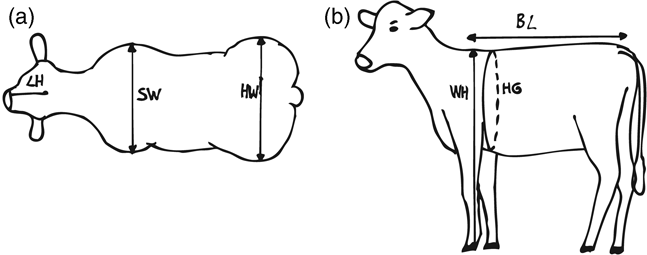
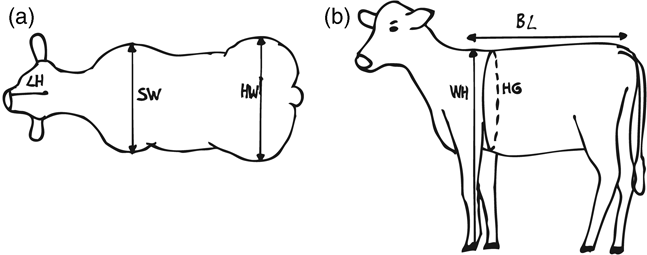
The BW, body length (BL), length of the head (LH), SW, hip width (HW), HG, withers height (WH) and the circumference of the fetlock of both the right front (CFF) and hind leg (CFH) of the calves were recorded within 72 h after birth, but not before the calf had stood without assistance to standardize our measurements (Figure 1). As a calibrated balance was only available in the experimental farm and in the FVM, the BW was only recorded in 45 calves. The calves were weighed immediately after birth, before being completely dry. All the measurements took place on the calf standing on a concrete floor. The BL was defined as the linear distance along the vertebral column from the cranial edge of the lateral tuberosity of the humerus to the first coccygeal vertebra. The LH was measured as the distance from the mucocutaneous junction of the planum nasolabiale to the caudal border of the os frontalis. For both these measurements, a flexible measuring tape was used. With the calf standing, the SW was measured as the linear distance between the lateral tuberosity of the left and right humerus. The HW was measured as the linear distance between the trochanter major of the left and right femur. Both these conformational traits were measured with a pair of callipers, specially designed and calibrated for this use, which were placed on the shoulder or hip area and pressed as hard as possible. As the animals of the BB breed are double-muscled, it is important to mention that it is not possible to measure from bone to bone and that the muscles have been included especially when measuring the SW and the HW. The HG was assessed as the circumference around the chest measured just caudally to the front legs using a measuring tape. The WH was defined as the linear distance from the dorsal end of the scapula to the floor. The fetlock circumference was determined by placing the measuring tape around the fetlock of the right fore (CFF) and hind leg (CFH), respectively. All measurements were made to the nearest 0.5 cm and performed thrice on the same animal. The calculated average was used for further analyses.
Diagram of the performed body measurements. (a) Dorsal view from a calf with the length of the head (LH), the shoulder width (SW) and the hip width (HB); (b) lateral view from a calf with the body length (BL), the withers height (WH) and the heart girth (HG).
Statistics
The data were checked for errors and the records of eight calves were removed (five calves were dead at or within hour after birth and three of them were not 100% double-muscled BB calves) leaving data from 147 calves for further analysis using SPSS 16.0 to explore and check the data for normality by the use of the Kolmogorov–Smirnov test and Q–Q plots. In all the statistical analyses, the technician was taken into account.
Simple correlations between the body measurements on the total data set as well partial correlations correcting for gender, parity and type of calving were calculated per factor. Next, the data set was divided per factor in a male and female data set, in a heifer and cow data set and in a CS and natural delivery data set, and individual correlations for the different classes (male–female, heifer cow and CS–natural delivery) were calculated by the Pearson correlation coefficient.
To look for associations between the body measures and some environmental factors (gender of the calf, parity of the dam (heifer v. multiparous cow), type of calving (CS v. natural delivery), season of calving (autumn, winter and spring), and time of measurement after birth (days 1, 2 and 3)), a multivariate mixed ANOVA was used with herd as random effect (SAS 9_2). The body measures were inserted as dependent variables and the environmental factors as independent variables, and a type III model was used.
An assessment was made to see which body part was the limiting factor for calving, so which was the most critical to pass the birth canal. Biologically seen, the shoulder and hip width are both candidates for being the most critical. A t-test was used to look whether the ‘HW−SW’ difference was significantly different from zero and therefore statistically prove which of the two is the most limiting. Also, it was examined whether this difference (from zero) differed between male and female calves, between calves born from heifers or cows and between CS or naturally delivered calves. Whenever the confidence intervai (CI) spans 1, this difference was significant. In both analyses, herd was included as random effect.
A model to predict the size of the two most detrimental body parts for calving ease (SH and HW) was constructed by the use of a generalized linear mixed assessment (herd was included as random effect). This model contained parameters that are easily measurable at parturition, that is, CF (CFF and CFH) and LH. The only two environmental factors that can be known at the moment of parturition are the gender of the calf (assessed by pregnancy diagnoses after 60 days) and the parity of the dam. Because of the specific management characteristics (i.e. using a breeding bull), there was no information available in this study concerning the moment of mating and hence concerning the length of gestation. The latter resembles practice, as this is the case in most of the current BB herds in Belgium. The dependent variables SW or HW, the covariances LH and CFF/CFH and the fixed variables gender and parity were inserted all together in the model to see which of the parameters had an influence on SW or HW. Parameters with P > 0.05 were eliminated from the model. This was repeated until all the parameters’ leftover had significant influence on the dependent variables (SW and HW).
Finally, generalized estimating equation methods of SPSS were used to estimate the likelihood of natural calving by the use of CFF and CFH. A binary logistic model was chosen within the generalized linear models with herd as a subject and type of calving as response. The predictor within this model was the CFF or the CFH. Afterwards, a scatterplot was made with the predicted value of mean, the lower and upper bound of the CI for mean of CFF or CFH to visualize the probability of natural calving.
Results
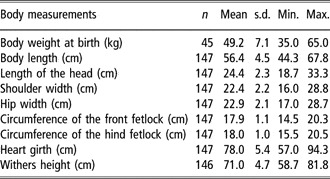
More than 20% of the calves (34) were born in autumn, almost 50% (72) in winter and the rest (41) of the calves in spring. The measurements were made within 25.6 ± 17.7 h of birth. Table 1 shows the descriptive statistics for all the body measures.
The mean values, the standard deviation, the minimum and the maximum values of body measurements and birth weight of 147 Belgian Blue newborn purebred calves

Min. = minimum; Max. = maximum.
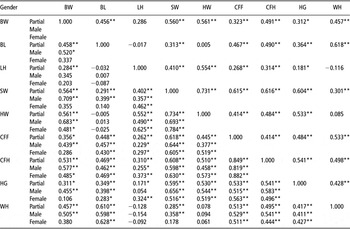
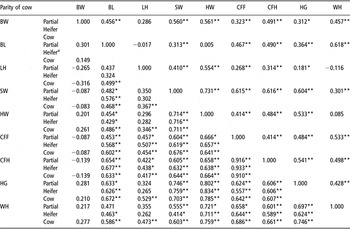
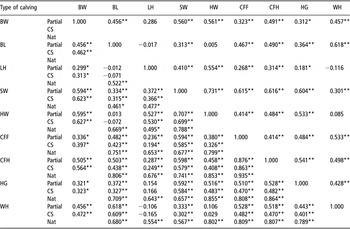
Most simple correlations, partial correlations and correlations per class between the nine body dimensions were significant and moderate-to-high (Tables 2, 3 and 4 for gender, parity and type of calving, respectively). Male calves showed higher correlation between BW and other body measures, whereas in female calves it was lower. For the other body dimensions, the individual male and female correlation showed a variation (different directions for the different measurements) in comparison with the simple correlations of the total data set (Table 2). Higher correlations between the body dimensions (excluding BW) were also seen in heifers and multiparous cows, in contrast with the simple correlations (Table 3). Body measurements of calves delivered per vaginam showed a much higher correlation compared to the simple correlations, but this was not the case for body dimensions of calves born after CS (Table 4).
Simple correlations (diagonally above), partial correlations adjusted for gender (diagonally below) and correlations per class (male–female; diagonally below) between the nine body measurements (the body weight at birth, the body length, the length of the head), the shoulder width, the hip width, the circumference of the fetlock of both the right front and hind leg, the heart girth and the withers height

BW = the body weight at birth; BL = body length; LH = length of the head; SW = shoulder width; HW = hip width; CFF = circumference of the fetlock of the front leg; CFH = circumference of the fetlock of hind leg; HG = heart girth; WH = withers height.
*Correlation is significant at the 0.05 level.
**Correlation is significant at the 0.01 level.
Simple correlations (diagonally above), partial correlations adjusted for parity (diagonally below) and correlations per class (heifer – cow; diagonally below) between the nine body measurements (the body weight at birth, the body length, the length of the head, the shoulder width, the hip width, the circumference of the fetlock of both the right front and hind leg, the heart girth and the withers height)

BW = the body weight at birth; BL = body length; LH = length of the head; SW = shoulder width; HW = hip width; CFF = circumference of the fetlock of the front leg; CFH = circumference of the fetlock of hind leg; HG = heart girth; WH = withers height.
aCannot be computed because at least one of the variables is constant.
*Correlation is significant at the 0.05 level.
**Correlation is significant at the 0.01 level.
Simple correlations (diagonally above), partial correlations adjusted for type of calving (diagonally below) and correlations per class (CS – Nat; diagonally below) between the nine body measurements (the body weight at birth, the body length, the length of the head), the shoulder width the hip width, the circumference of the fetlock of both the right front and hind leg, the heart girth and the withers height)

BW = the body weight at birth; BL = body length; LH = length of the head; SW = shoulder width; HW = hip width; CFF = circumference of the fetlock of the front leg; CFH = circumference of the fetlock of hind leg; HG = heart girth; WH = withers height; CS = caesarean operation; Nat = natural.
aCannot be computed because at least one of the variables is constant.
*Correlation is significant at the 0.05 level.
**Correlation is significant at the 0.01 level.
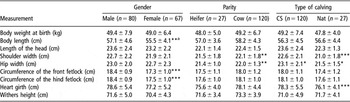
Body measurements and BW presented by gender, parity of the cow and type of calving are shown in Table 5. From all the assessed environmental factors, the multivariate mixed ANOVA confirmed a significant association between the calf’s gender and its BL (P < 0.01), and the CF of both its front and hind leg (P < 0.001; Table 5). All the above-mentioned body parts were larger in bull calves in comparison to heifer calves (Table 5). Both SW and HW showed a significant association with the type of calving and parity. Calves born by CS had broader shoulders (P < 0.01) and hips (P < 0.01) compared to calves born after natural delivery (Table 5). Measures from calves born out of multiparous cows were larger than from calves born out of heifers (SW: P < 0.001; HW: P < 0.05; Table 5). None of the nine body measurements were significantly associated with the season of birth or with the moment in which the measurement was done relative to birth (data not shown).
Body measurements divided in gender, parity of cow and type of calving (mean ± s.d.) and the significant differences between these body measurements within these classes (by multivariate mixed ANOVA)

CS = caesarean operation; Nat = natural.
aresults of the multivariate mixed ANOVA, the significancy is within row within class
*P < 0.05.
**P < 0.01.
***P < 0.001.
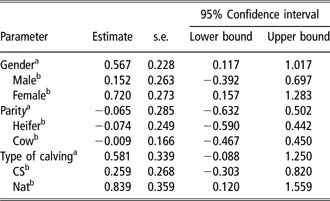
As SW and HW are the broadest points of a BB calf, they are both candidates for being the limiting measures for calving ease. On the basis of the data set of this study, the difference between HW and SW for the total data set was not different from zero (P > 0.05), thus the body part being the most detrimental factor concerning calving ease could not be assessed for the total data set. The difference between HW and SW was significantly different between male and female calves, whereas this difference between HW and SW was not significantly different between heifers and cows and between naturally calving animals and animals that were delivered by CS, respectively (Table 6). Within classes, in female calves, the statistical analysis showed that the difference between the HW and SW was significantly different from zero (Table 6; 95% CI (0.157 to 1.283)), suggesting the HW being the limiting factor at least in the female calves. In male calves, this difference was not significant (Table 6; 95% CI (−0.392 to 0.697)). For calves that were born naturally, the difference between HW and SW was also significantly different from zero, in contrast with calves born by CS (Table 6; 95% CI = (0.120 to 1.559) and (−0.303 to 0.820) for naturally and by CS, respectively).
Estimated marginal means, standard errors and 95% confidence intervals of the difference between hip width (HW) and shoulder width (SW) between the different classes of gender, parity and type of calving as well as the difference between HW and SW within one class

CS = caesarean operation; Nat = natural.
aAssessment of the differences between the classes for the difference between HW and SW.
bAssessment to see whether the difference between HW and SW is different from zero within a class.
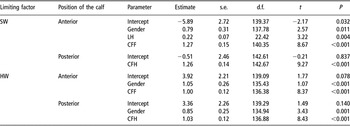
Models to predict these limiting measures for calving, HW for female calves and SW and HW for male calves, at the time of parturition are described by the equations shown in Table 7. Both for SW as for HW, these models are assessed for posterior and anterior positions of the calf taking the CFF and the CFH, respectively, into account.
Equations to predict shoulder width and hip width at the time of parturition for posterior and anterior position

SW = shoulder width; HW = hip width; LH = length of the head; CFF = circumference of the fetlock of the front leg; CFH = circumference of the fetlock of hind leg.
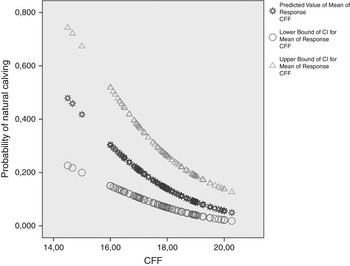
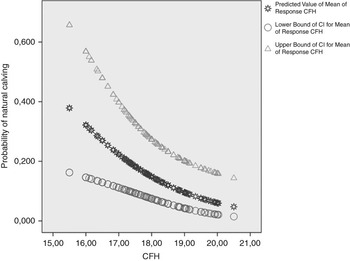
Figures 2 and 3 show the probability of natural calving by the use of the CFF and CFH. With the minimum circumference of 14.5 cm for CFF in this data set, the probability for natural calving was estimated to be 47% (95% CI: 23% to 74%), whereas with the maximum measured CFF (20.3 cm), the probability for natural calving was reduced to 5% (2% to 13%). The mean CFF of this data set (17.9 cm) corresponded with a chance of natural calving of 14.5% (7% to 27%). For the CFH, the minimum (15.5 cm) and maximum (20.5 cm) measured circumference gave a probability of natural calving of 38 (16% to 66%) respectively 5% (1% to 14%). With the mean CFH (18.1 cm) of this data set, the probability of natural calving was 14.2% (6% to 25%).
Probability of natural calving based on the circumference of the front fetlock (CFF; bounds of 95% CI).

Probability of natural calving based on the circumference of the hind fetlock (CFH; bounds of 95% CI).

Discussion
In this study, the mean ± s.d. of the BW and eight other body dimensions of newborn double-muscled BB calves were obtained. BW data were similar to those reported by Fiems et al. (Reference Fiems, de Campeneere, van Caelenbergh and Boucqué2001), but lower for male and higher for female calves when compared to the data of West (Reference West1997) and Coopman et al. (Reference Coopman, Gengler, Groen, de Smet and Van Zeveren2004). Comparison of our measurements with those obtained by Coopman et al. (Reference Coopman, Gengler, Groen, de Smet and Van Zeveren2004), also revealed a decrease of SW, HW, HG and WH. The inclusion of (smaller) calves born per vaginam in our study – whereas Coopman et al. (Reference Coopman, Gengler, Groen, de Smet and Van Zeveren2004) only measured calves born by CS – is probably not responsible for this difference, as the calves born by CS in our study were also smaller than the ones measured by Coopman et al. (Reference Coopman, Gengler, Groen, de Smet and Van Zeveren2004). Another explanation might be the apparent decrease in WH of the BB animals over the last decade(s), which has been stated to be the result of the high selection for conformation (muscularity) (Hanset, Reference Hanset2004 and Reference Hanset2005). As dam size is correlated with calf size (Laster, Reference Laster1974), it is possible that BB calves are smaller in 2006 to 2007, than in 1995 till 2001, when the studies of Coopman et al. (Reference Coopman, Gengler, Groen, de Smet and Van Zeveren2004) were performed. Furthermore, within the BB breed, a trend for selection in favour of smaller, and hence more viable, calves has been noticeable over the past years, as heavy calves in the BB generally have greater difficulties in suckling. The publication of bull genetic indices for calf viability at birth and willingness to suckle has indirectly accelerated selection for calves with lighter BW (Berger et al., Reference Berger, Cubas, Koehler and Healey1992; HBBBB, 2008).
The limiting dimension for ease of calving of BB female calves seems to be the HW. This is in agreement with the reports of veterinarians in the field attempting per vaginam deliver of the calf, in that the so called ‘hip lock’ is a common occurrence with female calves. Difficulties during per vaginam delivery of bull calves often occurs early in the expulsive phase of calving, as male calves have relatively wide shoulders. Equations to calculate SW and HW were evaluated in this study, to enable the farmer and the veterinarian to predict the size of the calf at the beginning of the expulsive stage of parturition. This together with the knowledge of the pelvic size of the dam should enable a more accurate prediction of the possibility of natural calving being possible. However, the generalized estimating equations are most likely an underestimation as CS is performed on a routine basis without attempts to deliver the calf naturally. With evaluating selection towards natural calving, these generalized estimating equations should be adjusted as the likelihood for natural calving increases.
It is generally known that at birth, bull calves are heavier than heifer calves (Thomson and Wiltbank, Reference Thomson and Wiltbank1983; Houghton and Corah, Reference Houghton and Corah1989; Echternkamp, Reference Echternkamp1993; Zollinger and Hansen, Reference Zollinger and Hansen2003); so, in non-double-muscled breeds of cattle, they probably also have larger body dimensions. This can partly be explained by the fact that bull calves generally have a 1- to 2-day longer gestation length, during which time they continue to grow. (Houghton and Corah, Reference Houghton and Corah1989) and McGuirk et al. (Reference McGuirk, Going and Gilmour1998) showed that the frequency of seriously difficult calvings was greater in male calves, which were larger, and had a better conformation (for subsequent rearing) than heifer calves. In a study by Burfening et al. (Reference Burfening, Kress, Friedrich and Vaniman1978a), bull calves of the Simmental breed had gestation lengths of about 1 day longer, and were 3.0 kg heavier at birth; their birth was associated with a 0.23 U lesser calving ease score, and required 12.7% more assistance. The effect of the calf’s gender on the incidence of assisted births and on calving ease was greater in young than in older cows (Laster et al., Reference Laster, Glimp, Cundiff and Gregory1973; Burfening et al., Reference Burfening, Kress, Friedrich and Vaniman1978b). Our results correspond well with the data on other breeds in the fact that bull calves were heavier compared to female calves.
Parity and age of the dam are also known to significantly influence BW (Nelson and Beavers, Reference Nelson and Beavers1982). Dawson et al. (Reference Dawson, Phillips and Black1947) showed that BW of calves tended to increase per month parallel with the increase in age of the dam until 6 years of age, and that the weight of the dam was related to BW to the same extent as the age of the dam. However, in our study involving double-muscled BB cows, there was no association between the parity of the dam and the BW of the calf, although some body dimensions of calves born from multiparous cows were larger than those of calves born from heifers.
The season of birth appeared to have no influence on the BW, or the eight other body dimensions. In contrast, Wilson and Rossi (Reference Wilson and Rossi2006) found that calves born in the fall weighed less than calves born in the winter and spring months, which is most likely caused by a higher nutrient intake due to supplementary feeding of the cow. Deutscher et al. (Reference Deutscher, Colburn and Davis1999) concluded that calf BW increased 1 pound, and calving difficulty was increased by 2.6% for each degree Fahrenheit and the average winter temperature is reduced. Colburn et al. (Reference Colburn, Deutscher and Olson1996) also showed an influence of temperature on BW, resulting in larger BWs and more calving difficulties following winter temperatures which were below average. Compared to the extensively managed breeds described in these latter studies (all on cattle without double muscling), the BB is managed very intensively with minor variations in nutrition during winter and summer. Besides this, the BB breed is also known for its excellent feed conversion, which enables the dams to maintain adequate body reserves at all times. Hence, this may be a reason for the absence of any influence of the season of the year on BW and body dimensions in the BB breed.
The data presented in this study show significant differences between body sizes (only SW and HW) of calves born by CS and calves delivered per vaginam. Unfortunately, it is very difficult to correctly assess the validity of this observation in relation to the incidence of dystocia as in BB cows, as CSs are performed electively in Belgium. As mentioned above, this will probably underestimate the predictive value for a natural calving by the use of the CFF and CFH. Nevertheless, the results of our study show that the few BB calves that are not born by elective CS, but per vaginam, have smaller SW, HW and HG measurements, which suggests an influence of the calf’s body conformation on the incidence of dystocia. Although BB calves born by CS are heavier, the difference in BW between BB calves born per vaginam and by CS was not significant, and BW does not correlate with type of calving. Casas et al. (Reference Casas, Keele, Fahrenkrug, Smith, Cundiff and Stone1999) indicated that in double- muscled animals, the BW of the calf has a significant effect on calving difficulty, as their results showed an increase of 0.7% in calving difficulty per kilogram increase in BW; however, only the homozygous double-muscled calves had a greater calving difficulty. Coopman et al. (Reference Coopman, Gengler, Groen, de Smet and Van Zeveren2004) measured WH, SW, HW and HG in double-muscled BB calves, and found that all four dimensions were positively and significantly correlated with BW, which was confirmed in our study. Consequently, the smaller SW and HW in BB calves born per vaginam, as encountered in our study, might be responsible for the lower BW in these calves, which may further contribute to the fact that they were born per vaginam.
Although the correlation of body dimensions with the risk of dystocia is much lower than BW with dystocia (West, Reference West1997), BW has been shown to be highly correlated with calf conformation and body measurements; the correlations ranging from 0.60 to 0.85 (Freking, Reference Freking2000). Although these correlations are lower in the BB breed (shown in this study; Coopman et al., Reference Coopman, Gengler, Groen, de Smet and Van Zeveren2004), these correlations are still significant, and hence influence BW and possibly but indirectly, also dystocia. However, selection for smaller dimensions and lower BW should not be too great, as the viability of the calf decreases with excessive decrease of the birth weight. Furthermore, light calves need to have the potential to grow into large cows, so that on turn, they are able to calve naturally. The latter suggests that in attempting to reduce frequency of elective CS, the selection for lower BW and shorter gestation length (Norman et al., Reference Norman, Wright, Kuhn, Hubbard, Cole and VanRaden2009) should be performed simultaneously with selection for an increase in pelvic dimensions of the adult cows.
Acknowledgements
We greatly acknowledge Professor Noakes for reviewing the manuscript carefully and giving his comments.