Introduction
More than 600,000 Americans suffer from a myocardial infarction every year in the United States,Reference Mozaffarian, Benjamin and Go 1 with a global incidence of 8.5 million. 2 Implementation of regional cardiac systems of care to achieve timely percutaneous coronary intervention (PCI) for patients with ST-elevation myocardial infarction (STEMI) has successfully decreased mortality, but improvements in outcomes have plateaued since the American College of Cardiology Door-to-Balloon Alliance (Washington, DC USA) set the goal door-to-balloon (D2B) time to within 90 minutes.Reference Bradley, Nallamothu and Herrin 3 , Reference Krumholz, Bradley and Nallamothu 4 Recent data suggest that this goal is met in more than 90% of patients who present to a PCI-capable center. The key to further decreasing morbidity and mortality is reduction in total ischemic time (symptom onset to balloon).Reference Bates and Jacobs 5 - Reference Nallamothu, Normand and Wang 7
As such, the new focus is on first-medical-contact-to-balloon (FMC2B) time with a goal of 90 minutes or less for patients transported to a PCI-capable center and 120 minutes or less for transfer patients. This goal places further emphasis on the need to establish effective regional systems of care and highlights the challenges of prehospital identification of STEMI, appropriate destination routing, field activation of resources, and minimizing transport times.Reference Bates and Jacobs 5 Optimizing care requires coordination between Emergency Medical Services (EMS) and PCI-capable centers. Identifying patients with STEMI in the field and notifying the receiving hospital prior to arrival is an important way to reduce time to intervention and mortality.Reference Nam, Caners, Bowen, Welsford and O’Reilly 8 Electrocardiogram (ECG) transmission from the field is utilized in some regional cardiac care systems in conjunction with pre-notification. Review of the field ECG by the physician allows for confirmation of the field interpretation of STEMI and early mobilization of hospital resources prior to the patient’s arrival. However, maintaining reliable, consistent ECG transmission is challenging, particularly in large systems.Reference Adams, Abusaid and Lee 9 A recent study in Los Angeles (LA) County (California USA) found that successful transmission of the ECG occurred in only 28% of STEMI alerts.Reference Bosson, Kaji and Niemann 10
It was hypothesized that instituting weekly test ECG transmissions from paramedic units to receiving hospitals would increase successful real-time transmission of ECGs. The objective of this study was to examine the effect of instituting weekly test ECG transmissions on the frequency of transmission success and both FMC2B and D2B times. This intervention may be a useful tool for EMS systems that are developing or improving their transmission programs.
Methods
This is a retrospective, single center, observational study conducted at Harbor-University of California, Los Angeles (UCLA) Medical Center (Los Angeles, California USA). The study was reviewed and approved with exemption of informed consent by the local institutional review board. Harbor-UCLA is a 570-bed public teaching hospital that serves the more than 700,000 residents in the greater South Bay catchment area. It is one of 34 STEMI Receiving Centers (SRC) within the LA County regional STEMI system and also provides medical direction to local paramedic units as a designated Base Hospital.
All patients with suspected STEMI treated by paramedics in LA County are routed to the nearest SRC with 24/7 immediate coronary angiography and cardiothoracic surgery capability. The LA County regional STEMI system has been previously described.Reference Eckstein, Koenig, Kaji and Tadeo 11 Online medical direction in LA County is provided by the Base Hospitals, with trained mobile intensive care nurses (MICNs) and base physicians who guide paramedics in field treatment protocols and destination decisions.
Per LA County protocol, a field ECG is performed on any patient with chest pain, paramedic suspicion for a cardiac etiology of symptoms, high-risk medical comorbidities, new dysrhythmias, and patients resuscitated from cardiac arrest. Paramedics use the ECG monitor’s software interpretation to identify a possible STEMI and to assess the quality of the tracing (repeating for artifact or lead placement error). The LA County paramedics use Physio LifePak15 (Physio-Control Inc.; Redmond, Washington USA) with Glasgow (Scotland) algorithm; the Zoll E Series (Zoll Medical Corp.; Chelmsford, Massachusetts USA) with the GE Marquette 12SL (GE Healthcare; Amersham, UK) algorithm; or the Zoll X Series (Zoll Medical Corp.; Chelmsford, Massachusetts USA) with the Inovise (Inovise Medical Inc.; Beaverton, Oregon USA) algorithm. If the software indicates a suspected STEMI, that is, interprets it as “****ST Elevation Acute MI****” or the manufacturer equivalent, the paramedics alert the Base Hospital MICN or physician via radio, initiate transmission of the ECG, and transport the patient to the nearest SRC. Harbor-UCLA is both a Base Hospital and a SRC. After the paramedic selects Harbor-UCLA as the destination for the transmission, the ECG is routed from the monitor to the vendor’s cloud and then received via an email account accessible to MICNs, base physicians, and cardiologists. Paramedics do not activate the cath lab directly, as the decision to activate the cath lab is at the discretion of the receiving physician.
In November 2014, Harbor-UCLA implemented weekly ECG test transmissions from each paramedic unit that routinely transports to the Harbor-UCLA Base Station. The paramedic units performed a test transmission each week according to an established schedule. The MICN at Harbor-UCLA confirmed the transmission, or if not received, contacted the paramedic unit and the department’s nurse educator to identify and resolve the problem. The MICNs routinely collect data on all field STEMI alerts to comply with system data requirements. The LA County EMS Agency maintains a regional STEMI database. This database includes presentation characteristics, treatment delivered, and outcomes for all patients transported by EMS to an SRC for suspected STEMI.
Adult patients with a field software ECG interpretation of STEMI transported by EMS to Harbor-UCLA for the 10 months prior to implementation (January to October 2014) were compared to patients transported during 18 months after (November 2014 to April 2016). Patients transferred from another acute care hospital were excluded. The following variables were abstracted from the regional database for this analysis: patient age, gender, chief complaint, time field ECG performed, software ECG interpretation, paramedic ECG interpretation, whether ECG transmission was received, whether the patient suffered an out-of-hospital cardiac arrest, time of hospital arrival, time of PCI when applicable, and patient outcome. Post-implementation, the time the ECG transmission was received was also collected to determine the transmission gap time (time from ECG acquisition to ECG transmission received) and the advanced notification time (time from ECG transmission received to patient arrival). The time the transmission was received was defined as the time the email was received in the inbox. Daytime hours were defined as 6:00am-5:59pm and nighttime hours were defined as 6:00pm-5:59am.
The primary outcome measure was change in the frequency of successful field ECG transmission after implementation of the weekly test transmissions (intervention). Secondary outcomes were comparison of FMC2B times and D2B times before and after this intervention. The FMC2B was defined as the time of the initial field ECG; this proxy is collected in the regional database because it is computer-generated, in contrast to time of patient contact, which is self-reported by paramedics. These outcomes were further examined, stratifying patients by time of arrival during operational daytime hours versus nighttime off-hours.
All data were entered into Microsoft Excel (Microsoft Corporation; Redmond, Washington USA) and transferred to SAS 9.4 (SAS Institute; Cary, North Carolina USA) for analysis. The frequency of successful ECG transmission and the absolute risk difference (RD) was calculated with exact binomial confidence intervals. Time intervals were calculated as medians with interquartile ranges (IQRs). P values for univariate associations were calculated with the chi-square test for categorical variables and Wilcoxon rank sum test for continuous variables.
Results
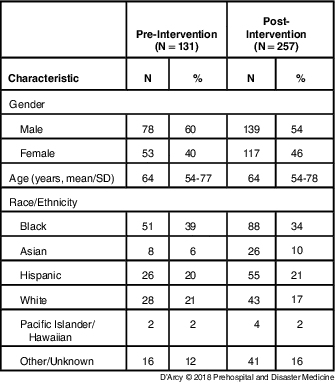
There were 388 patients with a field ECG interpretation of STEMI, 131 pre-intervention and 257 post-intervention. Patient characteristics were similar in the pre- and post-intervention groups (Table 1). Twenty-seven patients (21%) were treated with PCI in the pre-intervention group and 51 patients (20%) in the post-intervention group.
Patient Characteristics Before and After Initiation of Weekly Test ECG Transmissions
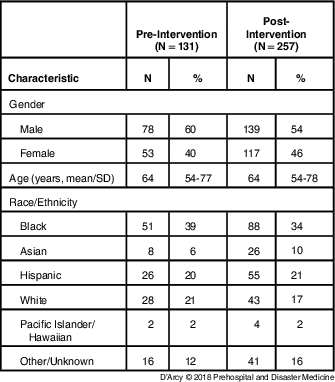
Abbreviation: ECG, electrocardiogram.
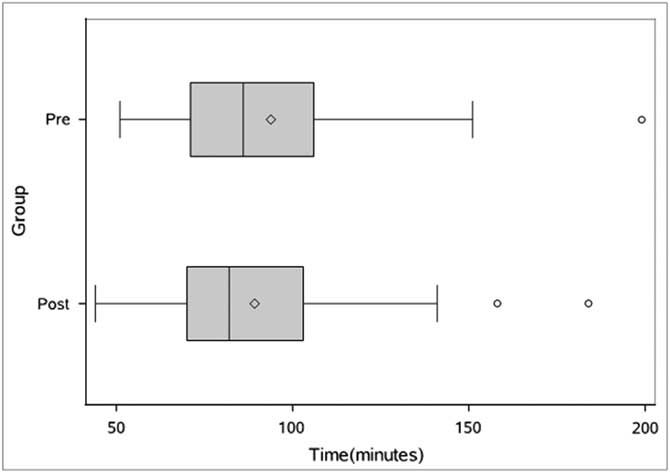
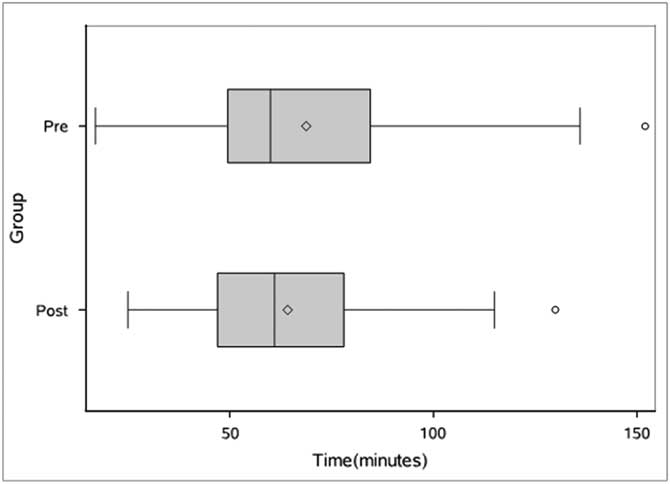
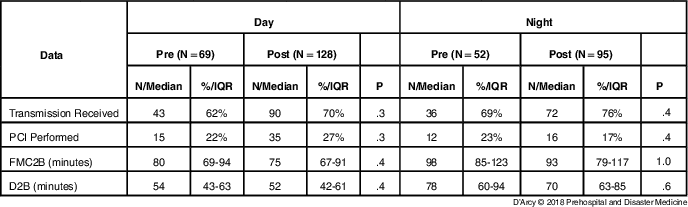
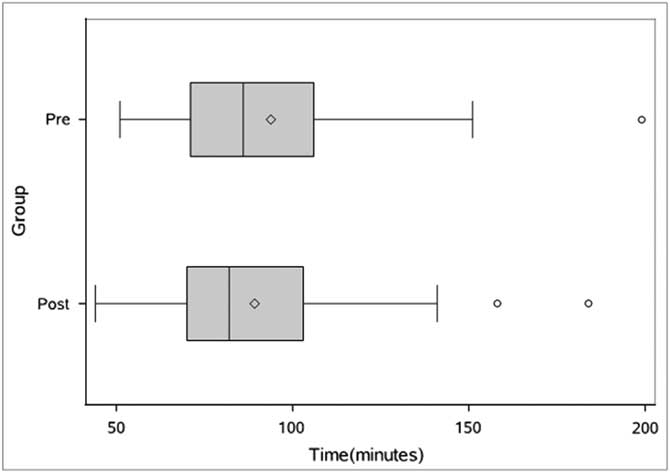
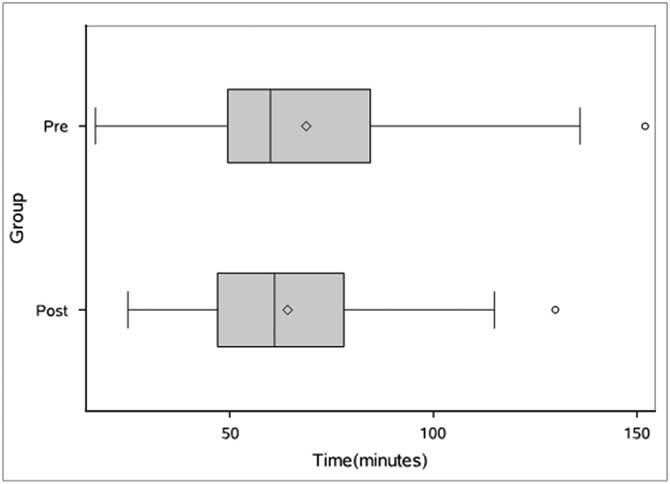
The frequency of successful transmission post-intervention was 73% compared to 64% prior (RD=9%; 95% CI, 1-18%). In the post-intervention period, the median FMC2B time was 79 minutes (IQR=68-102) versus 86 minutes (IQR=71-108) pre-intervention (P=.3) and the median D2B time was 59 minutes (IQR=44-74) versus 60 minutes (IQR=53-88) pre-intervention (P=.2; Figures 1 and 2). The FMC2B was 90 minutes or less in 58% of patients in the pre-intervention group and 66% of patients in the post-intervention group (RD=8%; CI, 14-30%). When stratified by time of arrival, there was no difference in FMC2B and D2B times between the pre-intervention and post-intervention groups among patients arriving during daytime or nighttime hours (Table 2).
First Medical Contact to Balloon Time.
Door to Balloon Time.
Outcomes Stratified by Daytime or Nighttime Arrival
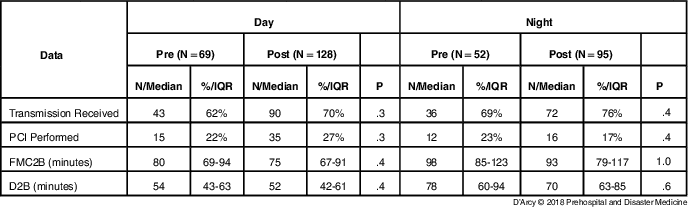
Abbreviations: D2B, door to balloon time; FMC2B, first medical contact to balloon time; PCI, percutaneous coronary intervention.
Post-intervention, the median transmission gap was three minutes (IQR 1-8) and median advanced notification time was 16 minutes (IQR 10-25).
Discussion
Implementation of weekly test ECG transmissions with local paramedic units at a single hospital improved real-time transmission success from 64% to 73%. However, this did not result in reduced FMC2B or D2B times.
An ECG transmission has the potential to reduce FMC2B and D2B times by allowing additional time for the hospital to mobilize resources in order to minimize delays once the patient arrives. Indeed, the median notification gap in the post-intervention period was 16 minutes. Some prior studies have suggested that field ECG transmission can improve time to intervention. Afolabi, et al found that patients arriving off hours had a delay to treatment compared to daytime hours, but that this difference was nullified by use of field ECG transmission.Reference Afolabi, Novaro, Pinski, Fromkin and Bush 12 Kerem, et al demonstrated a significant reduction in D2B time after instituting field ECG transmission to the STEMI center. However, since the system implemented pre-notification in conjunction with ECG transmission, it is difficult to discern how much ECG transmission itself contributed to this result. Similarly, Kawakami, et al reported a significant reduction in median FMC2B time with implementation of pre-notification via ECG and data transmission from the field to the hospital for STEMI patients transported to a single center in Osaka, Japan and determined that the use of ECG transmission was an independent predictor of achieving D2B time less than 90 minutes at their center.Reference Kawakami, Tahara and Noguchi 13 Prehospital identification of STEMI and hospital notification, with or without ECG transmission, has been shown to reduce time to intervention.Reference Brown, Mahmud, Dunford and Ben-Yehuda 14 - Reference Ting, Krumholz and Bradley 23 It is possible that physicians will act on paramedic notification alone in order to minimize delays, particularly when mobilizing resources outside of the hospital. In this case, with routine pre-notification, improving ECG transmission does not improve time to intervention, which may explain the results of this analysis.
Advanced notification may be particularly helpful in off-hours when the cath team is responding from home, since this can lead to delays to treatment.Reference Afolabi, Novaro, Pinski, Fromkin and Bush 12 , Reference Kruth, Zeymer and Gitt 24 Although in this study, transmission success was improved by eight percent and seven percent in patients who arrived during the day and at night, respectively, statistical significance was limited by small sample size after stratification, and there was no reduction in FMC2B time or D2B time in patients arriving during nighttime off-hours. Potential reasons for lack of improvement in time to intervention may include the urban-suburban geography with relatively short transport times and the academic setting with house staff present 24/7 available to respond immediately, regardless of the hour, while the interventionalist and other cath team members are en route.
In this cohort, it can be noted that there is potential to further improve hospital pre-notification. The median transmission gap (time from ECG field acquisition and to arrival in the email inbox) was three minutes and may be as long as eight minutes. One would expect the time to transmit an email with pdf attachments to be near instantaneous. Transmission requires the paramedic to scroll through a selection of receiving facilities and manually initiate the transmission via a wireless network connection. Delays could reflect trouble-shooting time for an initial failed transmission, lag time due to connectivity errors during upload to the vendor server, lack of prioritization or distraction of the paramedic with other tasks, or lack of familiarity with the procedure. In addition, the frequency of complete transmission failure in the post-intervention group was still high at 27%.
As part of the intervention, the paramedic nurse educators were alerted to transmission failures. They were able to identify and correct several sources of failure. For example, transmission errors occurred due to failure of the monitor to properly connect to the network. In this case, the vendor was involved to assist with equipment issues. Other identified sources of failure related to provider error and prompted paramedic reeducation. These included the paramedic selecting the hospital but not hitting the transmission button, selecting the wrong hospital from the dropdown menu, or not incorporating the steps to transmit the acquired ECG into his/her practice at all. An ECG transmission is not universally accepted by providers, as it adds an additional step in the treatment of these time-sensitive patients. However, transmission does not increase time to intervention.Reference Bosson, Kaji and Niemann 10 There were some transmission failures that were not amenable to easy correction, which were caused by unreliable wireless connection. There are efforts underway to create wireless networks specific to emergency personnel and this could have the largest impact on transmission success. 25
Despite a 16-minute pre-notification gap and an increase in transmission success, there was no reduction in time to intervention in this cohort. Similar to the plateau in mortality benefit seen with further reduction in D2B time, it remains unclear if further improvements in transmission and increasing advanced hospital notification will result in improved patient outcome. This intervention does not address the time delay between symptom onset and FMC2B time, an earlier time point on the ischemic timeline. As the time intervals are often within 90 minutes from first medical contact in developed urban areas, an important next step may be targeted interventions aimed at reducing the symptom-onset-to-FMC2B time. This may involve increasing public awareness of STEMI symptoms, improving access to 9-1-1 including mobile phone localization, and enhancing efficient dispatch of resources. The time from symptom onset to STEMI ECG acquisition has been categorized with a modified Anderson-Wilkins acuteness score that could provide a better measure for approaching treatment of the evolving STEMI.Reference Fakhri, Sejersten and Schoos 26
Limitations
There are several limitations to this study. These are data from a single-center in an urban-suburban geographic area with relatively short transport times. These results, therefore, may not be generalizable to other settings. Prior to the intervention, the hospital routinely met national guideline recommendations for D2B time. It is possible that a greater effect would be seen in hospitals not performing to this level. In addition, the small number of patients treated with PCI may have led to a Type II error, missing a difference that is present. Further, pre-notification routinely occurs for all STEMI patients regardless of successful ECG transmission in the LA County system. It was not possible to determine whether the transmitted field ECG was reviewed prior to patient arrival or if it was used in decision making to mobilize resources and activate the cath team. Given the use of initial ECG time as a proxy for on scene time, a significant delay in field ECG acquisition would be missed. Finally, it is not possible to determine what particular aspect of the intervention was most effective: the test transmissions, the feedback loop to the providers to identify and correct errors, or simply the awareness of the data collection process.
Conclusion
Implementation of weekly test ECG transmissions was associated with improvement in successful real-time ECG transmissions from field to hospital, which provided a median advanced notification time of 16 minutes. In a hospital meeting recommended treatment times, this did not result in a decrease in FMC2B or D2B times.
Author Contributions
The author contributions are as follows: NB, QB, WF, JG, JG, JN, and JT conceived of the study. NB, ND, AK, and JN collaborated on the design. YE, JG, and NG were responsible for training and implementation of the intervention and collecting, organizing, maintaining, and reviewing the data. NB, ND, and AK analyzed the data. NB and ND drafted the manuscript and all authors contributed extensively to its revision. ND takes responsibility for the paper as a whole.