

‘In politics severity is necessary; in economics give and take is permissible.’
Mao Zedong
Introduction
The main Western European countries established economic relations with the PRC much earlier than the United States. Among these countries, the United Kingdom, in fact, never ceased to have a strong link with the Chinese economy. From the end of the Civil War in 1949 onwards, the British colony of Hong Kong represented the ‘door’ to trade with mainland China, and constituted the logistical and financial base for every business operation in the land.Footnote 1 This article aims to deepen scholarly understanding of the special economic connection between Britain and Socialist China throughout the 1950s and the 1960s by bringing to the fore the pivotal element of this relationship—that is, the Crown colony of Hong Kong.Footnote 2
It is possible to distinguish two different phases of British financial and trade relations with the People's Republic of China in the years between the Communists’ victory in 1949 and the beginning of the Cultural Revolution. The first period, from 1949 to 1955, was characterized by the priority given to the defence of British interests and properties in China from a financial point of view. There is no definitive estimate of the effective value of such British investments and properties; however, in 1941 the British embassy in China estimated their value at £300,000,000 sterling, excluding invisible earnings, the payments of ‘Boxers’ reparations’, and the interest on previous state loans. In 1949 a large part of these interests was still in effect.Footnote 3 The arduous task of protecting British financial properties was entirely entrusted to the two banks that decided to keep their Chinese offices open: the Hongkong and Shanghai Banking Corporation (HSBC) and the Chartered Bank of India, Australia and China.Footnote 4 At the same time, in those years, the HSBC built a new kind of relationship with the main Chinese financial institutions based in Hong Kong.Footnote 5 From 1955 to 1966, economic relations between the United Kingdom and the PRC entered a new phase, with HSBC and the Bank of China signing an important agreement in February of that year, which closed the door on all past grievances and signalled a new age of cooperation. This second period can be considered the ‘golden age’ in relations between the United Kingdom and the PRC, characterized by the growing number and value of trading and financial operations.
The academic literature about Socialist China's economic relations with Western countries during the 1950s and the 1960s is very limited. Proportionately there are fewer works on this topic after diplomatic relations were established between the United States and the PRC. The literature dating from the 1970s onwards presents the widely shared opinion that the PRC experienced total economic isolation from Western countries during the first turbulent 20 years of its existence, and that this isolation was eventually overcome thanks to the development of a new relationship with the United States. In fact, the United Kingdom never cut its economic ties with China, and the Crown colony of Hong Kong became the true intermediary of British-Chinese business.
The existing literature on British economic relations with the PRC has mainly focused on the 1950s. Most scholars have highlighted the domestic political debates, which eventually led to the formulation of the United Kingdom's new China policy, expressed in terms of ‘keeping a foot in the door’. This approach aimed especially at safeguarding British interests in Hong Kong, which would otherwise have been indefensible.Footnote 6 Most works point to the inherent difficulties experienced by China-oriented British businesses in surviving after the establishment of the PRC: the expropriation of British businesses by the new Chinese government proved the short-sightedness of the Communists, as they wanted to shape its new world order without having to seek compromises with foreign imperialist powers.Footnote 7 However, recent analysis of company papers has suggested that a much more complex and articulated process of disentanglement from the foreign imperialist legacy was carried out.Footnote 8 Among the few relatively recent works, which have made consistent use of company papers, it is worth mentioning Catherine Schenk's research and publications on Hong Kong's international economic ties.Footnote 9 Frank H. H. King's four-volume history of the Hongkong and Shanghai Banking Corporation has contributed to offering a business perspective.Footnote 10 King's work is commendable for the huge amount of documentation it brought to the attention of researchers. However, it is characterized by an inadequate methodological approach. As pointed out in 1992 by Osterhammel, King's work did not consider methodological examples given by other scholars, such as René Girault, which are more effective on these topics. King avoided any wider political and diplomatic contextualization and limited his ‘monumental’ work to a ‘company history’, often reticent and episodic, with a rather scant historiographical elaboration.Footnote 11
Since very few scholars have made use of company materials, it is still difficult to understand the interplay between economic and political forces in shaping Britain's new China policy after 1949. This article aims at contributing some evidence and a clear argument in this regard. Relying mainly on primary sources from the United Kingdom National Archives and from the Hongkong and Shanghai Banking Corporation Group's archives, this article will argue that trade and financial interests represented fundamental drivers behind the shaping of British policy towards Socialist China in the 1950s and 1960s. At the same time, it will demonstrate that trade and finance were also of the utmost importance to the new government in mainland China, which gladly accepted the British offer to be a hub connecting the PRC and the world throughout a period that was characterized by Western embargoes and hostility.
‘Waiting for the storm’ . . . and going through it
In March 1949, Sir Arthur Morse, chief manager of HSBC from December 1941 to 1953,Footnote 12 addressed the shareholders of the Bank and warned that:
It would be foolish to gloss over the present state of affairs (. . .) The fierce flames now enveloping the political and economic structure of China are potentially more ominous for foreign traders than anything which has occurred since they established themselves on Chinese soil. (. . .) All those engaged in foreign trade in China must be prepared to face an entirely new situation during the coming years, and to adjust their ideas and their actions to conditions without any guiding precedent.
Was the game up in China? Maybe not: Morse concluded his address with a small ray of hope, as he declared that he did ‘not expect foreign or Chinese merchants experienced in trading on the China coast to pack up in despair’. He therefore suggested adopting a wait-and-see position.Footnote 13
In April 1949, the Communist armies crossed the Yangtze river; in May, they entered Shanghai and Chiang Kai-shek fled to Taiwan. In October 1949, Mao proclaimed the birth of the People's Republic of China. In March 1950, Morse again addressed HSBC shareholders, saying that 1949 had been a good year for the Bank: it had made a larger profit and would pay the same dividend as it had the previous year.Footnote 14 There had been no catastrophic change since the inception of the Socialist regime, and the turmoil in mainland China was largely compensated for by increasing Hong Kong trade and by the transfer of Shanghai's business in the colony.Footnote 15 Nonetheless, the HSBC chief manager was concerned:
I said last year that the political and economic structure of China was in a more ominous position than it had been since foreign traders had established themselves on Chinese soil. We have seen the structure collapse during the last year. We have seen armies disintegrate and currencies dissolve. We see a revolution in progress of development. The effect of this has been to make our China branches a liability.
Moreover, it was not possible to say what the future would bring: ‘In fact China is as inscrutable as ever.’ Yet Morse surmised that if the Communists were planning to industrialize the country, they would need the specialized services of banks worldwide. Based on this consideration, he did not propose to close off the HSBC offices from China as long as there was some likelihood of their being able to do business.Footnote 16
Morse's remarks coincided with the opinion of the ‘China hands’ in the Foreign Office. In the first months of 1947, Esler Dening, the Foreign Office's assistant under-secretary for Far Eastern Affairs, wrote a memorandum in which he identified Britain's chief assets in China as ‘physical properties, experience, good-will and the possession of Hong Kong’. Yet, considering the real situation of both the British economy and the Chinese Civil War, he pointed out that the only policy option for the time being was to maintain ‘a commercial foothold in China until better days come’.Footnote 17 In December 1948 the Foreign Office prepared a report for the Cabinet which offered a wide-ranging analysis of the consequences of a Communist victory in mainland China. With specific regard to retaining Hong Kong as a colony, the report for British interests in the country affirmed that it depended on the possibility that ‘the Communists found the existence of a well-run British port convenient for their trade with the outside world’. Overall, the Foreign Office recommended that the Cabinet maintain relations with the Communist authorities as this would be the only option for preserving British trade and assets in China.Footnote 18 In April, and again in July 1949, after military reports had excluded any realistic possibility of undering an armed defence of Hong Kong, it became clear to the British government that the only opportunity to preserve the status quo was by relying on the ‘goodwill’ of the new rulers in mainland China.Footnote 19 Already in March and April, the Cabinet had stated that British business should be supported in ‘their desire to keep their foot in the door in China as long as possible’, thus opening the search for a compromise.Footnote 20 In May, the British sounded out its allies about the possibility of extending a de facto recognition of the Communist government ‘as soon as it were properly established’.Footnote 21 In August and September, the British minister in China, Sir Ralph Stevenson, suggested that ‘trade should determine British policy’, and that the recognition issue should be decided on practical, not ideological, grounds: Britain should judge the new regime by what it did and not by what it said. In his opinion, Britain could only hold Hong Kong with Chinese acquiescence; continuous possession of Hong Kong had therefore to be as profitable for China as it was for Britain.Footnote 22 From September to October 1949, the Foreign Office's China experts were at work drafting a proposal that would be presented to the new Chinese government to illustrate the opportunities offered by Hong Kong as a trade and finance hub, especially in light of Chinese post-war reconstruction.Footnote 23 In October 1949, this became the official position of the British government in the first diplomatic approaches to the new Communist authorities in Beijing. On 6 January 1950, the United Kingdom recognized de facto the People's Republic of China, and by 1954, the United Kingdom and China had established diplomatic relations at the level of chargé d'affaires, which was upgraded to ambassadorial level in 1972.
In the meantime, the HSBC navigated its way through the Chinese turmoil. On 29 May 1949, the People's Liberation Army entered Shanghai. Three days later, the staff and employees of the local branch of the HSBC were at work as usual.Footnote 24 Until 1941 the HSBC had received regulatory instructions through the Bank of China and the People's Bank of China. During the crisis caused by the silver price in 1933–1934, Kong XiangxiFootnote 25 and Song ZiwenFootnote 26 established a secret partnership with the HSBC to support the Chinese dollar rates. The success of the operation put the HSBC at the forefront of the Chinese government's monetary support schemes in the forthcoming years.Footnote 27 These channels continued to be effective; the same was true for the compradores and K. C. Lee, the Chinese manager, who acted as intermediaries with the Chinese banks. Although business was slow in the first months, ‘the [new] Chinese authorities were anxious to develop the export trade and business [that] might develop at any time’.Footnote 28 O. P. Edwards, the Shanghai branch exchange dealer, talking about the years 1949–1951, recollects that he ‘was off to the Bank of China every morning where I sat, as representative of the HK Bank, buying or selling such exchange as we were permitted to buy’.Footnote 29 The Communists’ takeover of the country did not represent a dramatic change for the Bank: in the face of reduced local business, the Shanghai branch supported trade between the PRC and Hong Kong, executed exchange operations with the Bank of China, and dealt with the management of deposits and properties. Morse, still the HSBC chief manager in Hong Kong, was more and more convinced of the need to resist the reduction of effective business in mainland China and preserve as many branches as possible, while avoiding excessive liabilities for the Bank. Before 1939, the HSBC had 14 branches in China (including Taipei and Harbin); only five branches remained open after the Communist victory: in Shanghai, Tianjin, Beijing, Shantou (Swatow), and Qingdao.Footnote 30 With the exception of Shanghai and Tianjin, the other branches were, in fact, out of business. However, the Chinese authorities refused permission to close the offices in order to maintain a local guarantee until pending issues like deposits, bills, properties, and local personnel wages (assurances, etc.) were settled. The arbitrary revaluation of the Chinese national currency by the Communist government made things even more complicated. Only in 1953 did the HSBC obtain the Bank of China's permission to transfer to Shanghai all the foreign liabilities in the charge of the other branches, which also opened up the possibility of negotiating the closure of inactive offices. The Shanghai branch's activities were never to be interrupted.
Shanghai was, however, a special case. As King noted, as HSBC's main branch for China, ‘there was considerable work to be done once the authorities had decided on their policy toward the Hongkong Bank’.Footnote 31 Chinese authorities in Shanghai imposed only two conditions to the Bank: first, that ‘sufficient staff would be on hand to fulfil requirements’; second, ‘that there (would) be an acceptable responsible person available for contacts’. In fact, foreign staff were reduced from 17 employees in mid-1949 to two employees by 1955, without any obstacles imposed by the Chinese authorities. As compensation, the Bank employed local English-speaking employees; by 1956, 150 Chinese employees were working for the Bank's Shanghai branch.Footnote 32 However, there were other issues that represented decisive obstacles to profitable bank activities, such as the difficulty in meeting the increasing tax liabilities, the increased labour compensation imposed by the trade unions and the authorities, and the revaluation of pre-liberation account liabilities.Footnote 33
Nonetheless, in the first half of 1950, Morse was not the only one who believed in maintaining the Bank's offices and activities in mainland China, even if only on a low business level. Long-term consideration of the HSBC's general interests and assets, with a preeminent focus on Hong Kong, made existing liabilities and risks acceptable.
Disillusion soon arrived in the form of the war in Korea. In August 1950, the London Board of Directors of the HSBC reviewed the Bank's policy toward Socialist China. For the Board, its presence in China could only be justified on a commercial basis: only business that was remunerative should be undertaken, and the branches in China should be financially self-sufficient. ‘The Bank was not the financial agent of the British Empire’, and its decisions should be determined on an effective business perspective, not on political considerations: HSBC ‘had no business maintaining a purposeless prestige at shareholders expense’.Footnote 34 The American embargo on Chinese trade in 1951, and especially the American government's decision to freeze all Chinese mainland-controlled assets in December of the same year, caused increased difficulties for the Bank. In January 1952, Morse wrote to the chief general manager of the Chartered Bank, W.R.M. Cockburn, saying that ‘the general policy was to get out of China as quickly as possible’. On May 1952, the HSBC Board authorized the chief manager to take all steps necessary to close the Shanghai office, adding that the British banks in China had informed the Chinese authorities of their intentions.Footnote 35
Notwithstanding this decision, this was not the end of HSBC's business in China. In fact, the Board's move was intended more as a message to Beijing than as an actual operative decision. It was an acknowledgement that the Chinese authorities were apparently not prepared to permit the Shanghai branch to be run on a profitable basis. Yet, in case they modified their intentions, ‘the Bank was always willing to cooperate because, whatever present reality dictated, the Hongkong Bank could not escape its heritage as understood by its directors, its Managers, and its juniors’. At last ‘the Hongkong Bank was a China bank’. The Board's initiative allowed Morse to advance the concept of an ‘all-for-all’ settlement: all the Bank's assets in China would be given up in return for the cancellation of all the Bank's liabilities or their assumption by a Chinese organization. The agreement eventually reached in February 1955 looked as if it was the prelude to the withdrawal of HSBC from the PRC; a few years later, however, it proved to be the beginning of the future cooperation and of a new life for HSBC as a ‘China bank’.Footnote 36
The debate on HSBC's Chinese policy which took place between Morse and his successor as chief manager in Hong Kong from 1953, Sir Michael W. Turner, provides evidence in support of the argument that the HSBC Board's move in 1952 was not the expression of an actual willingness to close activities in mainland China. Turner, who managed the negotiations with the Bank of China for the 1955 agreement, thought it necessary to close all activities in the PRC and recall all the foreign employees of the Chinese branches. To achieve this aim, he accepted the principle, supported by the Chinese authorities as preliminary to all financial negotiations, that all the Bank's assets in China should be offset against all the Bank's liabilities and that a Chinese bank should be appointed to facilitate the final closure.Footnote 37 However, Turner was not aiming for a real and definitive closing of the Bank; in fact, at the same time, he proposed setting up a new form of representation in China for the purposes of furthering foreign trade (as well as to support Chinese trade with Hong Kong). Turner supported the idea of ‘a post-closure liaison office before the final closure of branches in China’, to be opened in Beijing (‘where decision[s] could be taken’) instead of Shanghai.Footnote 38 Morse fiercely opposed Turner's ideas of a complete closure of the Shanghai branch and of a new form of representation in Beijing. He thought that it was essential for the future of the Bank in China to keep alive the historical tradition of HSBC as a ‘China bank’ based in Shanghai: when China business rose again, the Chinese would prefer to deal with someone well known and the Bank's tradition would come into its own.Footnote 39 The compromise would be expressed in these terms: ‘The Bank as a symbol had to be removed; the Bank as a bank had to be retained.’Footnote 40
The Chinese authorities reacted with surprise to HSBC's threat to quit mainland China in 1952, and the Bank of China began to cooperate actively with HSBC to reduce the cost of maintaining its branches. For example, Chinese authorities permitted, at last, in December 1954, the closure of the Tianjin office.Footnote 41 The 1952 announcement that HSBC would close down its activities eventually supported the successful conclusion of the negotiations for the ‘Ta Hwa Agreement’, finally signed in April 1955.Footnote 42
As additional evidence that the 1952 move was tactical, it must be noted that, after the 1955 agreement, the HSBC withdrew its request to close down its activities in mainland China. In April 1955, a new banking agreement was negotiated, based on back-to-back financing. The negotiations were conducted by F. C. B. Black, the chief inspector of the Bank. In 1954 he had been appointed deputy chair of the trade mission organized in London by Hugh Collar, secretary of the China Association.Footnote 43 Turner decided that Black had to represent first of all the interests of HSBC, and appointed him to undertake a parallel mission in Beijing as representative of the Bank. Beyond the official meetings of the trade mission in Beijing, Black held important unofficial meetings with China's vice-minister of foreign affairs, Chang Han Fu, on the issue of the frozen dollar assets—he had ‘a cool but not hostile reception’, he recollected. He also met with the general manager of the Bank of China, from whom he had a ‘warm’ reception and received ‘friendly advice’: ‘The Bank of China's policy had been consistent throughout; it had been encouraging and there had been good relations.’ Yet, he noted, the Bank of China's preference to deal with Hong Kong was evident. For Black that demonstrated the importance placed by the Chinese on the relationship with the HSBC: all considerations on the Chinese branch's activities had to be made with reference to a broader context.Footnote 44 Of course, the ‘broader context’ of the Bank was related both to its main interest in Hong Kong and to consideration of the long-term perspectives related to developing the Chinese connection. The Bank of China proved anxious to extend to mainland China positive cooperation with the HSBC in terms of the financing of the PRC's trade in Hong Kong.Footnote 45 Black took the opportunity to ask for the Bank of China's assistance on both the issue of the cost of maintaining the Shanghai branch of HSBC and the ‘all-for-all’ settlement. The ‘Ta Hwa Agreement’ and the new banking arrangement, both signed in April 1955, were the results of Black's mission.
The Agreement was not in fact an ‘all-for-all’ settlement. The frozen assets of the United States were excluded from the deal, given the ‘unshakable position of the American Government’ and the American Treasury's Foreign Assets Control regulations.Footnote 46 In 1960, it was estimated that the HSBC was exposed for US$4 million, while figures for the ‘French Bank’ Footnote 47 and the ‘Belge Bank’ were US$15–25 million and US$12 million respectively.Footnote 48 Nevertheless, the 1955 Agreement had immediate, positive consequences. The Bank of China's cooperation made it possible to cut maintenance costs in Shanghai: in 1956 the transfer of liquidity from London to cover the local expenditure of the branch was reduced from US$28 million in the years between 1950–1954 to just US$300,000. Within a few years the Chinese branch had earned enough revenue to cover all the costs autonomously; losses disappeared definitively in 1959.Footnote 49
In November 1955, the head office of the Bank notified the correspondents: ‘[the Shanghai Office] (. . .) will be glad at all times to help with information or advice on local firms or conditions. (. . .) We are now in a position to receive and advise credits as well as negotiate documents under them.’ On 20 July 1955, the Bank received, with some surprise, a request from the Bank of China's general manager in Beijing, stating that they ‘should like from now on to entrust directly to your branches in Japan banking business in connections with Sino-Japanese trade. Meanwhile, we shall be glad to be entrusted with such business by your branches in Japan.’ The Bank of China also requested HSBC's support and advice regarding the evolving trade between the PRC and Canada.Footnote 50
From 1955, both HSBC and the Chartered Bank had permission to process China's export operations to other countries; imports were still excluded. Only in 1962 did the PRC authorities allowed foreign banks’ branches in China to remit their profits to their central offices overseas, but with a significantly increase in the level of taxation on the banks’ Chinese business revenues.Footnote 51 Certainly, between 1955 and 1963, business was very slow for the Shanghai branch, but still not negligible, especially after 1959. From 1955 to 1964, the Shanghai branch of the HSBC purchased export bills from the PRC totalling £19,175,600 sterling, HK$94,088,300, DM12,916,800 million, SFr.5,830,600 million, FFr.6,554,200 million, plus other minor transactions in the currencies of various countries, with Sweden, Saudi Arabia, Iraq, and Ceylon being the most significant.Footnote 52 Mainland China's financial business with the HSBC Shanghai office peaked in 1966, with 10,000 operated bills (worth more than £6,000,000 sterling). The 1967 crisis cut the number of bills to 5,500 in 1970, and the branch's business would recover only in 1971 (7,700 bills for £7,000,000 sterling).Footnote 53 In any case, a big part of the Bank's business in mainland China was represented by demand debits and mail transfers.Footnote 54
In the second half of the 1950s, Turner judged HSBC's relations with the Bank of China and the China Resources CompanyFootnote 55 in Hong Kong to be excellent. HSBC was heavily involved in financing China's trade through the Bank of China's office in the colony, facilitating the export of key commodities to the rest of the world, including the United States. PRC trade with the latter was routed via Singapore and Japan with, among the others, HSBC-controlled shipment companies. Later on, mainland China's controlled shipment companies, which were registered in Hong Kong, also operated this trade; flying the British flag, these ships were permitted to bypass the embargo. A decade after British diplomats had first advocated it in 1949, Hong Kong eventually turned into a trade, logistics, and financial hub for the economy of the PRC. Hong Kong also became the perfect environment in which to strengthen the relationship between the Bank of China and HSBC. In Hong Kong the latter provided the Chinese with financial services, trade brokerage, shipment services, assurances, and, later, advice regarding the creation of Bank of China assets in London. With the growing relevance of the colony's role in financial and trade relations with China, it became obvious to HSBC that the right choice was for Hong Kong to deal directly with the Bank of China. The Shanghai office would have to stay open and wait for future developments.
Hong Kong-China trade and development as the key to United Kingdom-PRC relations
As the British government had given Hong Kong a pivotal role in the defence of the United Kingdom's global position, it necessarily needed to defend the colony's trade relations with China.
In March 1950, the American government's China trade controls, which were harsher than those applied against the Socialist countries of Eastern Europe, were officially implemented. In June, after the beginning of the war in Korea, the United States Treasury refused to issue export licences for American business contracts with the PRC and North Korea. In July, the member states of the Coordinating Committee of the Consultative Groups (CoCom)Footnote 56 agreed to impose controls on trade with China comparable to those implemented against the Soviet Union. On 3 December, after the Chinese became involved in the war, the American administration introduced a complete embargo on trade with the People's Republic of China, Hong Kong, and Macau. While American diplomacy pressurized the allies to enforce the embargo, British trade diplomacy started to work for the promotion of a different approach. In April 1952, organizations from several countries who worked to promote international trade between nations with no formal diplomatic relations met at the International Economic Conference in Moscow. The very first organizations to be founded as a consequence of the Moscow conference were the China Council for the Promotion of International Trade and the British Council for the Promotion of International Trade. Many Chinese members of the China Council were close to Zhou Enlai and Chen Yun; in addition, all its members had been trades union officials, businessmen, and bankers before 1949.Footnote 57 Furthermore, many of those from the British Council had been members of China's business world before 1949.Footnote 58
Moreover, the members of both Councils had had close ties with Chinese-British trade companies before 1949. In January 1952, the American administration accused the British of exporting strategic goods to the PRC on British ships, but the British government refused to implement shipping controls. In fact, because of Hong Kong, British business had never severed its ties with mainland China. Shipment companies registered in Hong Kong, Singapore, Liberia, and Panama supported the ‘transformation’ of British or Chinese goods into something else, making it difficult to trace their real origins and allowing trade via Hong Kong to continue. It is true that many of the shipment companies showed the British flag, but around 50 per cent of shipment services for Socialist China's trade were covered by cargoes and vessels flying the Greek flag.Footnote 59 Before the end of the year, Washington accepted the easing of embargo conditions as a result of pressure from the British and Japanese.
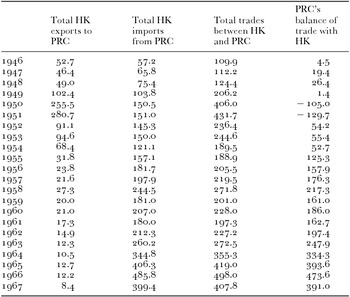
In 1950 and 1951, in the early years after the revolution, the HSBC did not feel the impact of the dramatic and negative changes in its business because of the increasing trade between Hong Kong and China. The financing of Hong Kong's exports and imports paid the Bank just as well as the ‘lost’ China trade had. In fact, there were almost no losses: trade with mainland China was the origin of the fastest growth of Hong Kong exports in this biennium.Footnote 60 In 1949, Hong Kong's official exports to mainland China (excluding invisible earnings and the important smuggling trade) had a value of US$102.4 million, while official imports from the PRC were around US$103.8. In 1950, after the Communists’ victory, exports from the colony to the PRC more than doubled, to US$255.5, and imports increased to US$150.5. This was the first positive figure in Hong Kong's trade balance with China in 20 years: the last positive figure had been in 1931, with a positive balance of US$17.5 for Hong Kong (US$105 million in 1950).Footnote 61 In 1951, the export figure rose to US$280.7, while imports from China increased only slightly to US$151 million (with a positive figure of US$129.7 million for the Hong Kong balance of trade with the PRC).Footnote 62 Morse had been prophetic when, in 1950, he had anticipated that revolutionary turmoil in mainland China would be largely compensated for by Hong Kong's trade and by the transfer of Shanghai's business to the colony.Footnote 63
With the beginning of the Korean conflict in 1950, the PRC's indirect involvement in the conflict caused a very rapid increase in Hong Kong's trade with mainland China. As a result of the Chinese Communists’ active participation in the war, on 18 May 1951 the United Nations imposed an embargo on the export of strategic commodities to China.Footnote 64 Moreover, the American administration imposed a total embargo on exports to China, and prohibited the importation of industrial products from mainland China. This measure hit a wide range of goods that the United States traditionally obtained from Hong Kong, which were presumed to be of Chinese origin unless proven otherwise by comprehensive certificates of origin. Because of all these developments, much of Hong Kong's trade with the mainland was suddenly cut off, and the volume of trade fell by 45 per cent from the previous year.Footnote 65 The UN embargo caused a drop in Hong Kong's total exports to China, from US$280.7 million in 1951 to US$91.1 million in the following year, a decrease of 68 per cent. The trend continued downward, from US$94.6 million in 1953 to a mere US$8.4 million in 1967 (see Table 1).Footnote 66
Hong Kong's trade with the PRC, 1946–1967 (in US$ millions).

Source: Hong Kong Government, ‘Hong Kong Trade Returns, 1946–53’ and ‘Hong Kong Trade Statistics, 1954–66’, Hong Kong Government Gazette, Special Supplement. A. Eckstein (1966), Communist China Economic Growth and Foreign Trade, McGraw Hill, New York, p. 286. Yeung, ‘Trade ties between Hong Kong and Mainland China’, p. 822.
Hong Kong's total exports to mainland China consisted of both goods from Hong Kong and re-exports of products from the rest of the world. As Yeung has noted, ‘while both contributed to the decrease in the total exports to China, the latter consistently occupied the bulk of the total—about 75–98 per cent, with the higher percentages occurring in the earlier years’.Footnote 67 In 1950, the growth rate of Socialist China's exports to Hong Kong was at a high of 45 per cent. However, due to the UN embargo, 1952 saw a drop in the rate of change to –4 per cent. The last year with a positive figure in Hong Kong's balance of trade with mainland China was 1959; after that imports from the PRC grew and exceeded exports until the end of the British rule in 1997.Footnote 68
In fact, starting from the first half of the 1950s, the rise of Hong Kong as an industrial economy was permitted and literally ‘fed’ by imports from mainland China as well as from the labour of low-paid Chinese immigrants. Refugees and then immigrants from mainland China played a decisive role in Hong Kong's industrialization process, providing the vital hard-working labour force reserves that were one of the decisive elements in the colony's growth. The low cost of maintaining this labour force was strictly linked to imports from the PRC (foodstuff, clothes, shoes) produced in the Chinese areas surrounding the British controlled territories. Mainland China was also a source of comparatively inexpensive raw materials, which also formed a sizeable portion of Hong Kong's imports from China. It was the low cost of labour and raw materials together which allowed Hong Kong to successfully access the international market. The absolute relevance of immigrant labour in Hong Kong's economy, organized by Nationalist and Communist trade unions, would eventually come to light in 1966–1967 when the colony was shaken by riots.Footnote 69 Even the Soviet embassy in London knew that Hong Kong was completely dependent on mainland China for water and food supplies. During the unfolding of the violent 1967 riots, a report by the embassy maintained that Hong Kong needed the good graces of China to survive and that ‘to crush Hong Kong, China did not even really need to use its army’.Footnote 70
The relatively more important items in Hong Kong's exports to China in 1953–57 were medicinal and pharmaceutical products, dyeing, tanning and colouring materials, and fertilizers. The first two items became less significant in 1958, and even less so in subsequent years. Fertilizers were chiefly a re-export item, whose relative importance after the Second Five-Year Plan in China also decreased. Especially during this period, though not subsequently, non-ferrous metals (or base metals) were also relatively important. Yarns, fabrics, made-up articles, and related products, by contrast, increased in importance to become Hong Kong's principal domestic export and a co-leader in re-export, and constituted 67.5 per cent of Hong Kong's domestic exports and 17.8 per cent of its re-exports to China between 1963 and 1967.Footnote 71
Throughout the periods of the first three Five-Year Plans—1953–57, 1958–62 and 1963–67—nearly 50 per cent of Hong Kong's imports from China consisted of foodstuff, the more important items of which were live animals, fruit and vegetables, cereal, and cereal preparations. Yarns and others textile materials, made-up articles, and related products were second to live animals in 1953–57, but in 1963–67 they exceeded the latter by a margin of about 5 per cent. Inedible animal and vegetable crude materials became relatively less important, while the reverse was true of others items such as non-metallic mineral manufactures, clothing, iron and steel, and footwear. During the First Five-Year Plan (1953–57), there was a consistent increase in Chinese exports to Hong Kong. Because of the Great Leap Forward, Chinese exports to Hong Kong were not homogeneous during the PRC's Second Five-Year Plan, and they decreased in 1959, but there seemed to be no significant changes in their composition. The failure of the Great Leap Forward, which became apparent in 1959, led to a marked drop, and Chinese exports to Hong Kong stood at about the same level as 1956–57 for the rest of the Second Five-Year Plan (1958–62). As the disastrous effects of the Great Leap Forward were gradually overcome, the upward trend began again and China's exports to Hong Kong grew at a rather rapid rate up to 1966.Footnote 72
From 1955 onwards, the PRC adopted a mercantilist policy in trade relations with Hong Kong in order to increase China's foreign exchange reserves. In 1958, in trying to establish itself in the markets of Southeast Asia and to challenge Japanese trade in this area, the PRC ‘developed a relevant trade offensive by cut-throat price competition and [the] establishment of sales agencies and outlets in Hong Kong and other countries’. The volume of Hong Kong imports from China reached a peak during that year, but immediately experienced a downfall in 1959 due to the effects of the Great Leap Forward.Footnote 73
From 1956 to at least 1963, mainland China's annual trade surplus with Hong Kong was greater than its balance with the non-Socialist world, indicating that without the earnings from Hong Kong to finance China's purchases, the balance of trade with the non-Socialist countries (taken as a whole) would have been less favourable. The same is true of China's overall balance of trade with all countries in 1955, 1956, 1958, 1960, and 1961. Finally, China's earnings from Hong Kong trade were more than sufficient to cover the PRC's drawings on Free World grain credit in 1961 and 1964.Footnote 74
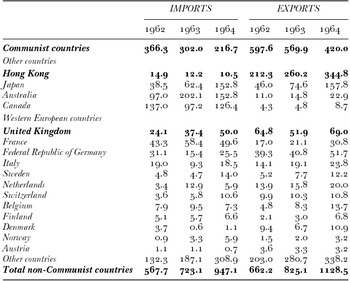
Hong Kong's share in China's total foreign trade before 1954 was a little over 10 per cent (see Table 2), but this share decreased to 4.7 per cent in 1959, then increased again to 9.2 per cent in 1963. Compared with China's trade with the non-Socialist world, Hong Kong's share was about 50 per cent in 1952; it decreased to 15.7 per cent in 1959, then rose slightly to 19.3 per cent in 1963. The significance of Hong Kong's market to China is further shown by the proportion of China's exports to Hong Kong in the PRC's total exports (ranging from 6.5 per cent in 1954 to 12.9 per cent in 1963) and even more so in its exports to non-Socialist countries (ranging from 22.3 per cent in 1956 to 30.8 per cent in 1963). It must be noted that the balance of trade in China-Hong Kong trade was almost constantly in the PRC's favour. As Eckstein argues, this allowed Socialist China ‘to build up foreign exchange reserves, with Hong Kong being the largest source of foreign exchange earnings’.Footnote 75
PRC foreign trade (in US$ millions).

Source: Eckstein, Communist China Economic Growth and Foreign Trade, p. 286. Laurens, H. (1966), ‘Les pays occidentaux et le marché chinois’, Politique étrangère, No. 1, 31e année, p. 66.
After the downfall of Chinese foreign trade between 1959 and 1961, as a result of the disastrous consequences of the Great Leap Forward, from the second half of 1961, the PRC's direct trade with Britain began to grow, and then doubled between 1962 and 1965. Trade missions intensified and important firms from Britain (as well as from Hong Kong) were always present at the semi-annual Canton fair. In 1964, the Sino-British Trade Council, created by the British government in 1954, promoted three specialized trade expositions in Beijing, in which more than 100 British companies participated. Between January and September 1965, no fewer than 23 trade missions from mainland China visited the United Kingdom.Footnote 76 In 1965 economic relations between Britain and the PRC grew at a fast pace. Chinese imports from the United Kingdom involved mainly industrial and telecommunications machinery, cars and tractors, scientific instruments, stainless steel pipes, materials for tanneries and for the textile industry. In 1965, the Chinese authorities signed the most relevant import contracts with British firms: two cargoes of 15,000 tons were ordered from the William Doxford and Sons’ shipyards in Sunderland; in August a US$8.4 million contract was signed with Prinex (Courtauld) to build an acrylic fibres factory in China; another US$12.6 million contract was signed with Simon Carves Ltd to build a polyethylene factory; and a third US$6.3 million contract was agreed with Vickers for a polypropylene plant. In October 1965, the British plastics industry organized an important exposition in Tianjin: three British firms—ICI, Formica, and Morganite— had maintained a presence in mainland China since 1963, with ICI exporting goods to the PRC worth £1 million sterling. The Tianjin exposition signalled a change in British trade strategy: the aim of the fair was to upgrade economic relations by selling not only finished goods but also industrial know-how, assistance, and contracts to build factories and industrial infrastructures in China.Footnote 77 Although between 1962 and 1966 the consistent efforts of the British government to promote direct trade relations with China brought about a high qualitative level in industrial relations, they never reached the relevance and value of the import-export and financial relations that had been enjoyed between the PRC and Hong Kong.Footnote 78
However, until the second half of the 1960s, Hong Kong's trade and financial relations remained essentially a ‘British business’. While official statistics ‘exclude a number of important concerns that are British in all but registration’, the shares of most Hong Kong-registered companies were held by British residents, as the Treasury reported in 1967. For example, three of the most important companies registered in Hong Kong—Wheelock Marden Ltd, Jardine Matheson Ltd, and J.H. Hutchinson Ltd—were reported in official statistics as ‘Hong Kong companies’, and their subsidiaries and offices in London were treated as Hong Kong direct investments in the United Kingdom, while for the Treasury they were ‘to be considered as outward “portfolio” rather than “direct” investments’. In general, and still in 1967, both the Treasury and the Bank of England had no doubt that Hong Kong's economy represented a British ‘affaire’, and that the colony's interests were to be considered subordinated to those of the British ‘mainland’.Footnote 79
Another relevant aspect of the connection between Britain and the PRC through Hong Kong was the role played by the ‘Communist’ banks operating in the colony, and their connection and integration with the development of the local economy. The Bank of China was the ‘most prominent Mainland-controlled bank in Hong Kong’ but ‘it was not the largest’.Footnote 80 Between 1961 and 1970, 13 PRC-controlled banks were operating in Hong Kong, with a total of 55 branches in the colony.Footnote 81 Although the Bank of China was the most politically influential Chinese-owned bank in Hong Kong, the Nanyang Commercial Bank was the largest for deposits and advances.Footnote 82 The financial relevance of China-controlled banks increased in the years between 1961 and 1966, achieving a maximum level of deposits in 1966. The fastest growing banks in terms of deposits were the Sin Hua Trust, Kwangtung Provincial Bank, and the Nanyang Commercial Bank. These three banks had significant branch networks in the colony: in 1964 they accounted for over 40 per cent of the PRC-controlled banks’ deposits in Hong Kong.Footnote 83 Their deposits declined after the 1967 riots and disturbances, but then recovered at an even faster rate of growth than before, and in 1972 they reached the same value of deposits as 1966.Footnote 84
With a few exceptions, mainland China's banks had a limited involvement in lending to customers in Hong Kong. Nevertheless, they maintained high levels of liquidity, collecting deposits for other uses, mainly to be channelled outside the colony—to the PRC, of course, but also in other directions such as Singapore and London.Footnote 85 The Bank of China, as a bank that specialized in foreign trade, held the largest balances in the PRC (about 35 per cent of the total), and more than half of the overall PRC-controlled banks’ assets in the United Kingdom. The Nanyang Commercial Bank, more involved in local lending in the colony, held 15 per cent of the overseas balances in mainland China and 21 per cent of the total assets in the United Kingdom. The 87 per cent of Hong Kong's PRC-controlled banks’ assets in mainland China were bank deposits and money at call, while commercial bills represented a very small part.Footnote 86 From the 1950s onwards, the integration of Hong Kong with mainland China is evident, as Catherine Schenk underlines, as is the role of PRC-controlled banks in Hong Kong in ensuring the continuity of the link between the mainland and the colony.Footnote 87
For the players of ‘Les jeux de l’échange’, the colony was the main stage in economic exchanges between the PRC and the United Kingdom. Although London never renounced being master of the game, the British government nonetheless had to accept that their only chance of maintaining control of Hong Kong was not to jeopardize the Chinese government's cooperative attitude.
Conclusion
In many ways the United Kingdom and the British colony of Hong Kong represented a special case in the panorama of Western European relations with Socialist China. The early British recognition of the PRC was determined by the existence of British assets and properties in mainland China and Hong Kong, as well as by the common expectation that after the Communist revolution business would go on as usual.Footnote 88 In the early 1950s, Hong Kong was there to demonstrate that the bet placed by the ‘veterans’ of business with China was not so reckless. The first years, 1950–1951, seemed to confirm these expectations and Hong Kong increased its exports to mainland China enormously, despite the Cold War, the ‘Communist menace’, and the international situation.Footnote 89 The war in Korea, the Chinese involvement therein, and the subsequent embargo against the PRC prevented British exports to China through the Hong Kong ‘door’. However, this did not mean the end, merely a ‘transformation’ of the strategic economic role played by the colony in United Kingdom-PRC relations.
The ‘special relationship’ between Hong Kong and mainland China had multiple reasons to exist. Hong Kong's industry needed low-cost raw materials and labour, as well as food and water from China; this soon developed into a decisive dependence on maintaining an ‘open door’ with Socialist China. However, the PRC also needed the financial and logistic services which only Hong Kong could provide. The colony was the operative base for PRC-controlled banks and enterprises formally registered there,Footnote 90 which enabled them to bypass embargoes and other forms of international controls.Footnote 91 Above all, Hong Kong represented the most important supplier of sterling for the PRC economy, both through migrants’ remittances and the direct purchase of sterling and sterling securities. From London, the colony was seen as a ‘door’ and a ‘services hub’ to open Socialist China's economy to the rest of the world, but the ‘key’ had to be kept in British hands. The agreements signed by HSBC with the Chinese authorities in the 1950s led the British bank to maintain operations in Shanghai, while exerting a strong control over remittances and sterling operations in Hong Kong.Footnote 92 Both the somewhat limited lucrative base in mainland China and the highly promising base in Hong Kong formed an integral part of the ‘special relationship’ established by the HSBC with mainland China's financial system. The extent of the special relationship would eventually emerge when the Bank's management determined to detach the Group's strategy and future perspectives from the ‘imperial destiny’ of Britain, especially after the sterling devaluation in November 1967, emphasizing its role as a ‘Chinese bank’.
After the Second World War Hong Kong's rapid economic growth was the result of importing cheap foodstuffs and raw materials from China, thus strengthening its competitive position in the world market. For its part, China maintained a growing trade surplus with Hong Kong after 1952. The PRC's austerity programme and its planned state-trading policy, together with a preference for bilateral arrangements, which tended to minimize Hong Kong's cut in entrepôt trade, were all aspects that played a part in contributing to this growth. China's trade surplus with Hong Kong and the fact that it could use Hong Kong as a major outlet for exports also served as a significant source of foreign exchange earnings.
In conclusion, the idea of a completely isolated PRC during the 1950s and 1960s appears more and more questionable. After the Great Leap Forward, the PRC maintained and developed a wide spectrum of relations with Western countries long before it established relations with the United States. Certainly, British economic ties with Socialist China remain the most relevant example from the establishment of the PRC until the outburst of the Cultural Revolution.Footnote 93 No other Western country reached a comparable complexity and integration in trade and financial exchanges: ‘Chinese business’ was still essentially ‘British business’.