Events experienced in the past could leave a lifelong or at least a long-lasting impact. This is particularly evident for health. For example, the differentiation of longevity with respect to the month of birth is credited to the seasonality of the diet that affects the mother’s and child’s nutrition during pregnancy (Doblhammer, Reference Doblhammer1999; Gavrilov & Gavrilova, Reference Gavrilov and Gavrilova2011). Another example could be that individuals who have undergone a heart valve surgery usually need to take medications reducing blood clotting until the end of their lives (Nishimura, Reference Nishimura2002), which limits the applicable treatment options for other diseases, in the case they occur.
At least four strains in the theoretical literature formally model the concept just presented heuristically. The demographic approach employs mathematical models of system failure explaining individual aging (Gavrilov & Gavrilova, Reference Gavrilov, Gavrilova and Conn2006). The economic approach explains individual aging in terms of health capital depreciation, but also argues that health capital can be acquired (Grossman, Reference Grossman1972). These two approaches are combined in the general framework proposed by Hertzman (Reference Hertzman, Adler, Marmot, McEwen and Stewart1999) that treats birth and early life as the origin setting off the life course, the trajectory of which depends on the social network, civil society, and socioeconomic environment. Finally, the life course framework offers a holistic approach in which health and morbidity in later life depend on the physical and social exposures during gestation, childhood, adolescence, young adulthood, and later adult life (Kuh, Ben-Shlomo, Lynch, Hallqvist, & Power, Reference Kuh, Ben-Shlomo, Lynch, Hallqvist and Power2003).
The aim of this study was to investigate the impact of events from an individual’s past on the risk of death for Europeans aged 50 and older, controlling for other relevant variables. By doing this we wanted to find how factors from the past, early life, and current conditions, combine or accumulate to account for the risk of death later in life. Using the data from the Survey of Health, Ageing and Retirement in Europe with retrospective information on life histories, we were able to capture a broad set of events from the past for a large set of European countries. Data availability limits the research of the impact of life course events on the risk of death to specific populations. These typically live in the United States (e.g., Preston, Hill, & Drevenstedt, Reference Preston, Hill and Drevenstedt1998), the United Kingdom (e.g., Pudrovska & Anikputa, Reference Pudrovska and Anikputa2014), Norway (e.g., Naess, Hernes, & Blane, Reference Naess, Hernes and Blane2006), Sweden (e.g., Leon et al., Reference Leon, Lithell, Vâgerö, Koupilová, Mohsen and Berglund1998), Finland (e.g., Kajantie et al., Reference Kajantie, Osmond, Barker, Forsén, Phillips and Eriksson2005), Denmark (e.g., Baker, Wolf, Feinglass, & Thompson, Reference Baker, Wolf, Feinglass and Thompson2008), the Netherlands (e.g., van den Berg & Lindeboom, Reference van den Berg and Lindeboom2007) or a few other countries. In our study, we conducted not only an interdisciplinary but also an international analysis focused on Europeans aged 50 and older. By doing so, we made a first step towards an analysis in life course epidemiology for some of the countries not typically studied, such as the Czech Republic and Poland.
Conceptual and Analytical Frameworks
Starting already in utero, individuals experience a series of events that shape the future trajectories of their health. The frailty models indicate that individual vulnerability to mortality of all causes, set at birth, is fixed and diminishing with age at a cohort-specific rate (see, e.g., Vaupel, Manton, & Stallard, Reference Vaupel, Manton and Stallard1979; Manton, Stallard, & Vaupel, Reference Manton, Stallard and Vaupel1981). In addition, biological aging or events experienced over the lifetime could alter trajectories of individual frailty (Vaupel, Yashin, & Manton, Reference Vaupel, Yashin and Manton1988). Early childhood is believed to be a period of particular importance to these processes. Thus, empirical studies often investigate the impact of early childhood on survival and on physical health in later life (see, e.g., Barker, Reference Barker and Barker1998; Eriksson, Forsén, Tuomilehto, Osmond, & Barker, Reference Eriksson, Forsén, Tuomilehto, Osmond and Barker2001; Case, Fertig, & Paxson, Reference Case, Fertig and Paxson2005; Palloni, Milesi, White, & Turner, Reference Palloni, Milesi, White and Turner2009; Birnie et al., Reference Birnie, Cooper, Martin, Kuh, Sayer and Alvarado2011). Another such period is adulthood when habits carrying behavioural risks prevail (see, e.g., Benzeval & Judge Reference Benzeval and Judge2001; van den Berg & Lindeboom, Reference van den Berg and Lindeboom2007; Strandberg et al., Reference Strandberg, Stenholm, Strandberg, Salomaa, Pitkälä and Tilvis2013).
A life course comprises a sequence of events in the life span. The events are bonded and form distinct stages (Kuh et al., Reference Kuh, Ben-Shlomo, Lynch, Hallqvist and Power2003). The order and timing of those stages are structured by biology and social environment to a certain extent, but much room for individual variation in their dynamics remains (Macmillan, Reference Macmillan2005). The stages form trajectories capturing dynamics over an extended period of time. Tuljapurkar and Steiner (Reference Tuljapurkar and Steiner2010) claimed that non-fixed and distinct frailty trajectories for specific individuals can be observed through changes of individual phenotypic characteristics. Accordingly, we designed our research strategy in line with their statement. A life course register of biomarkers would be the most informative data source, but it is unavailable for Europe. Instead, we decided to use the information on past periods of poor health, starting from childhood. From the life course perspective, we know that the stages of life when such periods occur can differ in terms of their importance for life course development. For this reason, we made a distinction between periods of poor health that occurred in childhood (between 0 and 15 years of age) and the occurrence of such periods in adulthood. For other events we controlled only for their occurrence in the life history without distinction between the specific stages of the life course.
The episodes of poor health were of particular interest in this study, because they allowed us to control for factors which can affect trajectories of individual vulnerability and resilience, and, consequently, the individual risk of death. We expected that such experiences would increase the risk of death with different effect sizes between adulthood and childhood. In addition to controlling for past periods of poor health, we controlled for current health status.
Analyses of trajectories of individual vulnerability and resilience in a broader context are advantageous, because they may allow capturing heterogeneity in individual reactions to specific environmental circumstances within cohorts. During the first half of the 20th century in Europe, wars, poverty, and hunger were commonly experienced; during the second half, welfare states developed. These factors could either strengthen or weaken changes in individual health trajectories. Poverty and hunger represent economic and biologic restrictions in an individual’s ability to overcome health problems. Economic restrictions limit resources available for investment in health capital and increase mortality in later life (Menchik, Reference Menchik1993), whereas biologic restrictions may operate either way.
Impaired post-natal nutrition, according to Lucas (Reference Lucas, Bock and Whelan1991), prepares individuals for a life lived within a nutrient-poor environment. This feature is advantageous in periods of food deprivation (such as occurred in the first half of the 20th century in Europe), but it is disadvantageous in periods of rich nutrition supply due to the tendency towards obesity (such as likely to have occurred in the second half of the 20th century in Europe). Moreover, malnutrition affects body development directly and indirectly via the disruption of hormone release (Lucas, Reference Lucas, Bock and Whelan1991). Even though empirical studies found a negative impact of hunger on health (van den Berg, Pinger, & Schoch, Reference van den Berg, Pinger and Schoch2012), a related increase in the risk of death later in life was not found (Kannisto, Christensen, & Vaupel, Reference Kannisto, Christensen and Vaupel1997).
Finally, after these considerations, we aimed to test if regular medical care were relevant for the risk of death in adulthood. We controlled for regular blood tests, blood pressure measurements, and dental care in adult life. Regular mammography and gynaecological care were not analysed because they did not concern men. In order to estimate the determinants of death, we used the Cox proportional hazard model (Cox, Reference Cox1972) according to the formula
 $$r\left( {t,{x_j}|{x_j}} \right) = {r_0}\left( t \right){e^{{x_j}{\beta _x}}}$$
, where:
 $r\left( {t,{x_j}} \right)$
is the risk of death at time t of individual j,
 ${r_0}\left( t \right)$
is a baseline hazard function identical for all observations,
xj is a vector of individual characteristics of individual j,
β x is a vector of estimated coefficients.
Apart from the aforementioned variables capturing the past, we controlled for other relevant variables describing the current situation. Drawing on the literature that analysed impact on the risk of death, we took into account also age (Gompertz, Reference Gompertz1825), gender (Leventhal, Reference Leventhal, Adesso, Reddy and Fleming1994), and education (Kunst & Mackenbach, Reference Kunst and Mackenbach1994). Therefore, we used three groups of co-variates:
-
(1) Information from the past: self-reported retrospective health in childhood (excellent or very good, good, fair or poor); periods of poverty, hunger, and poor health ever experienced in the past (dummy variables); and regular medical care in the past, including dental care, blood tests, and blood pressure measurements (dummy variables);
-
(2) Current information: self-reported (excellent or very good, good, fair or poor) and objective health (conceptualised as the grip strength measured using a geometric mean of the second records for the left and right hands, in kg);
-
(3) Demographic characteristics: age (rounded to full months, expressed in years), gender (dummy variable), and education (International Standard Classification of Education (ISCED) levels 0–1 (none, primary), 2 (lower secondary), 3–4 (upper secondary), 5–6 (tertiary)); and rural or urban area (dummy variable).
Data and Research Sample
The Survey on Health, Ageing and Retirement in Europe (SHARE) constituted a suitable dataset for testing the research questions we have posed in the preceding paragraphs. Here, we will elaborate on the construction of the survey as its complexity (three types of interviews: regular, retrospective, and end-of-life) needs explanation. The study concerns the health, economic, and social situation of individuals aged 50 and older living in Europe. Four biannual waves of data collection became available as of July 2014. The first wave started in 2004 and covered Austria, Belgium, Denmark, France, Germany, Greece, Italy, the Netherlands, Spain, Sweden, Switzerland, and Israel. Wave 2 started in 2007 with minor changes introduced to the questionnaire. The Czech Republic, Ireland, and Poland augmented the set of countries in wave 2. The third SHARE wave differs significantly from the previous two waves as it used a questionnaire, called SHARELIFE, concerning an individual’s life history. SHARELIFE was conducted one time only, in 2008–2009, enriching the longitudinal data with retrospective information on respondents’ past health, economic activity, accommodation, finances, relationships, and parenthood. Wave 4 again used the regular SHARE questionnaire. This is the latest wave of data available for all the countries that took part earlier (except Greece, Ireland, and Israel), as well as for Estonia, Hungary, Portugal, and Slovenia.
In addition, starting with wave 2, SHARE has released the so-called end-of-life interviews. These interviews collect information on the last 12 months of the deceased respondents’ lives from their proxies. The proxies are individuals close to the respondents who had participated in any previous wave of the survey and had since died. The distinction between the respondents who survived the whole time-span of data collection and those who died in that period was crucial for the purpose of our present study and made SHARE a ready-made sample for our research.
There were two reasons for our decision to limit the analysis to individuals aged 50 and older, and one important consequence of that decision. First, it is known that the risk of death is not proportional with age. Because our survival analysis used a model of proportional hazard, it was important to use such an age criterion in the sample selection that made the proportionality assumption feasible. This could be done by excluding children and younger adults from the sample. The second reason underlying our decision was that our analysis was very demanding as far as the information available in the data was concerned. With SHARE providing a sufficient set of data (including retrospective, end-of-life, and regular longitudinal interviews), we accepted the respondents’ age criterion as set by SHARE. The crucial consequence of our decision to focus on individuals aged 50 and older was that we could not generally assess the impact of events from the past. Instead, we were able to assess such impact conditional on a person’s surviving until the age of 50, which was unlikely to be the same as the unconditional impact. In fact, the survival selection resulted in the underestimation of the impact.
We were unable to assess, by examining data on individuals aged 50 and older, whether the same events experienced at younger ages than those observed in our data would have the same consequences as we found in our study. Possibly, extending the analysis to cover younger individuals might have revealed that events from the past have a different impact on the risk of death, not only due to direct loosening of the conditionality assumption, but also due to the possibility of experiencing the analysed events at different ages in the past (Power, Manor, & Matthews, Reference Power, Manor and Matthews1999). We do not know if individuals who did not survive until age 50 had experienced hunger, poverty, or poor health, or what their childhood health was. We should not assume that they experienced those events at the same ages as the population captured by the SHARE survey. Furthermore, the duration of those events might explain differences in mortality. Unfortunately, an analysis incorporating the age and time of exposure to events from the past demands a more informative dataset than the one currently available.
Information collected in wave 3 (SHARELIFE) of the SHARE survey was crucial for testing our research questions. Thus, our first selection criterion was to cover individuals who took part in wave 3 of SHARE. There is a retention problem in SHARE because not all eligible individuals participated in all waves of the survey. Wave 3 is the least affected by the retention, owing to the appropriate incentive scheme for interviewers and the attractiveness of the life history interview to respondents. In a large proportion of cases, all eligible persons within a household were interviewed in SHARELIFE (Blom & Schröder, Reference Blom, Schröder and Schröder2011). Furthermore, the results of the SHARE non-response study show that no significant bias arises from non-response in key variables such as gender (Börsch-Supan, Krieger, & Schröder, Reference Börsch-Supan, Krieger and Schröder2013), which was also crucial to our analysis.
We followed individuals observed in wave 3 over time in order to conduct a survival analysis. Thus, our research sample covers at least two waves of data collection, namely wave 3 and wave 4. For this reason, we did not cover individuals who took part in wave 3 only, nor individuals from Ireland, Israel, or Greece, where wave 4 was not conducted. The research sample consists of 22,879 individuals, of whom 1,163 had died before wave 4 and 18,511 took part in the regular interviews of wave 4. Whether the remaining 3,205 individuals survived or died is not known. They are excluded from the survival analysis, reducing the research sample by 14 per cent. The missing data on survival may not be random. In the following paragraph, we compare individuals with missing (the unknown) and non-missing (the deceased and the survivors) information on survival, in order to assess the potential bias that might arise from missing data.
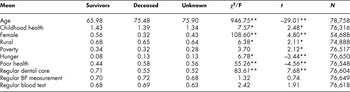
According to Table 1, individuals with the unknown survival status seem to resemble the deceased, although experience of poverty and regular blood pressure measurement differ insignificantly between the three groups. How did it affect our results? Presumably, it is more likely that interviewers were unable to confirm respondents’ death than that interviewers were unable to contact surviving respondents. In such a case, we would underestimate the impact of our explanatory variables on the risk of death.
Events from the past of individuals participating in SHARELIFE with respect to their survival until wave 4

* p < 0.05, **p < 0.01
Notes: χ2 test for differences between all survival statuses, ANOVA (F test) for age. t-test for differences between the unknown and the aggregated survivors and deceased. Age in years. Childhood health: 1 – excellent or very good; 2 – good; 3 – fair or poor. Poverty, hunger, regular dental care, BP measurement and blood test: 1 – yes; 0 – no. BP = blood pressure.
Source: Authors’ own calculation based on SHARE wave 1 and wave 2 release 2.5.0, SHARELIFE release 1, and SHARE wave 4 release 1.1.1.
Results and Discussion
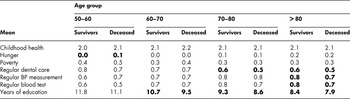
We start a discussion of our empirical study with a statistical analysis of events from the past by age group to see how differences between the survivors and the deceased varied in age groups. Next, we show the results of the Cox proportional hazard model. Table 2 presents differences in characteristics from the past between the deceased and the survivors from the research sample interviewed in wave 3.
Descriptive statistics of the surviving and the deceased individuals aged 50 and older in Europe

Notes: Differences between the deceased and the survivors (p < 0.05) are bolded. Childhood health: 1 – excellent or very good; 2 – good; 3 – fair or poor. Hunger, poverty, and regular dental care, BP measurement and blood test: 1 – yes; 0 – no. BP = blood pressure.
Source: Authors’ own calculation based on SHARE wave 1 and wave 2 release 2.5.0, SHARELIFE release 1, and SHARE wave 4 release 1.1.1.
Comparing the history of study respondents’ health care, we observe a higher mean of regular dental care, blood tests, and blood pressure measurements in the group of the survivors than of the deceased, which implies that survivors had more frequent regular tests. In some age groups these differences were insignificant. The survivors tend to be better-educated than the deceased in all groups over age 60. The retrospective self-assessment of health as a child or periods of hunger or poverty in life did not show substantial differences in mean values apart from the hunger experience in the age 50–60 group. Descriptive statistics may fail to reveal how events from the past affect the risk of death. Therefore, in our study we turned to multivariate methods as we explain in the following analysis.
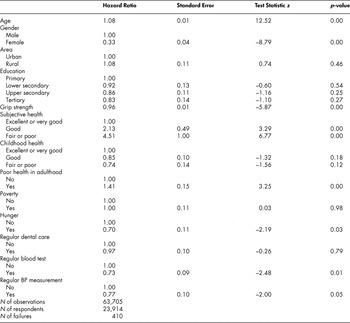
The results of the Cox proportional hazard model are presented in Table 3. They show that Europeans aged 50 and older who survived poor or fair childhood health and hunger are characterised by a lower risk of death than individuals aged 50 and older who did not experience poor or fair health in childhood or hunger, respectively. However, the impact for childhood health is insignificant. The experience of a period of poor health in adulthood highly significantly increases the risk of death in the analysed sample. Experience of poor health can be treated as a proxy of individual frailty. The period of hunger started, on average, at the age of 10 and ended at 16. Poor health and hunger in childhood generally increase the risk of death, but we did not observe this impact due to non-random survival. The selection mechanism caused only those individuals with the lowest frailty to survive exposure to worse conditions and higher risks because the frailest individuals died earlier. Thus, we could expect that most individuals who experienced poverty or poor health in childhood died before their 50th birthday. Moreover, those who survived until the age of 50 despite these conditions could have been exposed to such hardship to a lesser extent than those who did not survive, thereby indicating an insignificant impact of childhood health on the risk of death in adulthood. Presumably, an analysis of unconditional risk of death could reveal lifelong lasting scarring effects and frailties rooted in childhood health impairment.
Results of the estimation of the risk of death for individuals aged 50 and older in Europe

Note: BP = blood pressure.
Source: Authors’ own analysis based on SHARE wave 1 and wave 2 release 2.5.0, SHARELIFE release 1, and SHARE wave 4 release 1.1.1.
We consider another interpretation of this finding, treating the overcoming of hunger or poor health as a signal of being resilient. We understand resilience to indicate a high level of health capital and mental health, particularly the ability of children, youth (Zolkoski & Bullock, Reference Zolkoski and Bullock2012), and adolescents (Olsson, Bond, Burns, Vella-Brodrick, & Sawyer, Reference Olsson, Bond, Burns, Vella-Brodrick and Sawyer2003) to cope successfully with emotional distress. Foster (Reference Foster1997), who analysed older adults who had endured similar distress, found their coping, adaptation, and resilience functions to be well preserved in later life.
Our results imply that a mechanism similar to resilience observed in childhood, does not occur in later life. A period of poor health that occurred in the past but which occurred after the 15th birthday, leaves a negative impact lasting beyond the age of 50, which translates into an increased risk of death. Descriptive statistics reveal that the average and median age when the first period of poor health in adulthood started was age 50 and 51, respectively, in our sample. Furthermore, the edge of individuals reporting periods of poor health in their adulthood among the deceased and the survivors was largest in the age group 50−60 (22 percentage points) and decreased in subsequent age groups, reaching the lowest level of 11 percentage points in the group aged 80 and older. Presumably, the age at which poor health occurred matters for the risk of death. Negative consequences of poor health seem to slightly decrease with age and, once fully overcome, cease to affect the risk of death. The positive role of social factors such as education or public health care could also compensate later in life for health problems that occurred in childhood (Wadsworth, Reference Wadsworth1997).
Because we controlled simultaneously for experiences of poor or fair health in childhood and of poor health in adulthood, we did not allow for childhood health to be associated with chronic conditions that lasted through the lifespan. For this reason, the negative impact of chronic diseases in our study is captured only by the health status in adulthood even though its roots should be traced to childhood. This could result in an insignificant impact of childhood health. Another explanation for the significance of impact of childhood, adulthood, and current self-reported health may be the psychological effect. Current health status is a good predictor of survival until the last wave of the study, because it was observed over the span of two years. If individuals who were in worse health at the time of the survey painted a rosier picture of their health in childhood than it actually were, this could have led to a negative bias in the coefficients. Interestingly, current self-reported health status was only weakly correlated with poor or fair health in childhood (Spearman correlation equal to 0.16, and significant at 1% level) and with experience of poor health in the past (0.29 and 1% respectively).
We find a significant at 5 per cent impact of regular health care, including blood tests and blood pressure measurements, on the risk of death for Europeans aged 50 and older. Respondents who declared not using regular dental care explained this by its unavailability (23%) or high price (15%), whereas such reasons concern the other two types of medical care to a substantially lesser extent (6% and 1% respectively). Thus, regular blood pressure measurements and blood tests could be treated as preventive tools enhancing regular monitoring and early diagnosis. All three variables reflecting regular health care can either be related to health directly, or be treated as proxies for other factors related to health. Thus, further studies are needed to properly interpret their role in shaping mortality risk.
The results, including the current information on the respondents and demographic characteristics, are in line with the literature. In our research sample, men died at younger ages than women, and older respondents were significantly more exposed to the risk of death than younger individuals (for similar results see, e.g., Ho, Reference Ho2008; Buckley, Denton, Robb, & Spencer, Reference Buckley, Denton, Robb and Spencer2004). The impact of the place of residence and education is insignificant. Not surprisingly, being in good, fair, or poor health increases the risk of death significantly when compared to the performance of individuals who declared being in excellent or good health. This confirms the Idler and Benyamini (Reference Idler and Benyamini1997) results for developed countries and the Frankenberg and Jones (Reference Frankenberg and Jones2004) results for developing countries. We have used the grip strength as a measure of the objective health condition. The results show that the greater the grip strength, the lower the risk of death, as found by Mackenbach, Avendano, Andersen-Ranberg, and Aro (Reference Mackenbach, Avendano, Andersen-Ranberg, Aro and Börsch-Supan2005).
Education and poverty experienced in the past are found to be insignificant to the risk of death among individuals aged 50 and older. Disaggregation of education variables providing more detailed information on the highest acquired education did not yield any additional insight as all their impacts were found to be insignificant. These results can be credited to the small number of the deceased with lower education compared to the entire sample. Moreover, if the income gradient decreases with age as argued by Robert and House (Reference Robert, House, Bird, Conrad and Fremont2000), the survival selection explains the insignificant role of the socioeconomic status. Perhaps the socioeconomic status has little impact on the risk of death for individuals aged 50 and older in Europe because an extensive public health care system is in place in all the analysed countries. A possibly significant effect would be found if the analysis had examined non-European countries characterised by more diversity with respect to public health insurance. Further investigation is needed once more refined data are available.
Limitations of the study need to be addressed. A low number of observations at the country level prevented us from capturing country-specific effects. For the same reason, we could not conduct separate analyses for men and women. Initial estimations proved them to be statistically insignificant, presumably due to a relatively low variation in the experimental group. Additionally, initial results showed that coefficients do not differ significantly in the SHARE dataset in a series of estimations that omitted observations for each of the analysed countries.
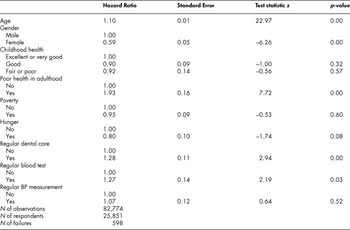
An analysis of interactions between the countries and three types of regular medical care – blood tests, blood pressure measurements, and dental care – showed no significant country-specific effects. The results of robustness checks also accounted for interactions between the countries and experiences of hunger and poverty in the past. The results (available upon request) proved the estimates robust. Finally, the issue of how factors from early life and current conditions combine or accumulate to account for the risk of death later in life is problematic. We conducted robustness checks adopting a nested-model approach to find that the omission of variables concerning events from the past does not affect the obtained results in a significant way (see Table A1 in the Appendix).
Conclusions
We conclude our analysis with one general and a few specific findings. In general, events from the life history, even from a very distant past, affect the risk of death for Europeans aged 50 and older. In particular, the experience of poor health in adulthood increases the risk of death conditional on surviving till the age of 50. Fair or poor health in childhood and periods of hunger in the past, together with regular blood tests and blood pressure measurements, correlate with a lower risk of death for Europeans aged 50 and older.
Experiencing poor health in adulthood (after the 15th birthday) leaves lifelong scarring effects. Even after the period of poor health, an adult’s frailty remains increased, contributing to a greater risk of death among individuals aged 50 and older. This finding is in line with the non-fixed frailty models. Interestingly, being in fair or poor health in childhood does not affect the risk of death in adulthood. Possibly, non-random selection wherein only the least frail individuals survive lowers the impact of childhood health impairment. Other explanations of this finding, as well as of the negative impact of hunger on the risk of death after the 50th birthday, are possible. Perhaps vulnerability and resilience that shape frailty over the life course vary between individuals and between the life course stages. If survival until the age of 50 were random, we could argue that resilience is greater in childhood than in adulthood.
Finally, we should stress that our findings shed only a little light on the unconditional risk of death. Nonetheless, this does not negate the significance of our results as more than 97 per cent of the death events observed in the European countries examined concerned individuals aged 50 and older in 2010 (Eurostat, 2012), and this figure is increasing over time. The retrospective and self-reported nature of our data may limit the credibility of the analysis presented in this article. However, having no other source of internationally comparable data on individual life histories, the analysis addresses a significant void in the literature on survival in Europe. Further analysis over the life cycle, including cohort effects and timing of the events, are worth undertaking once more observations become available.
Appendix
Results of the estimation of the risk of death for individuals aged 50 and older in Europe without the mediators of later life