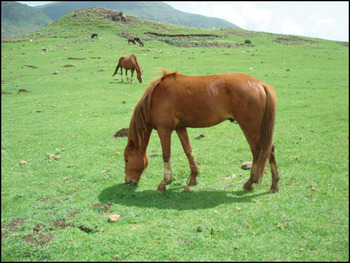


Introduction
Domestication of the horse has profoundly affected the course of human civilization (Vila et al., Reference Vila, Leonard, Gotherstrom, Marklund, Sandberg, Lide, Wayne and Ellegren2001), and world history could be quite different without this species (Goodall, Reference Goodall1973; Bowling and Ruvinsky, Reference Bowling, Ruvinsky, Bowling and Ruvinsky2000). In human history, no other domestic animal has played such a direct role in accelerating social processes and political developments as the horse; it has been central to the rise and fall of empires and the conquest of the entire continents (Bowling and Ruvinsky, Reference Bowling, Ruvinsky, Bowling and Ruvinsky2000). Horses had a paramount role to the spread of Indo-European languages and culture and the collapse of ancient societies (Diamond, Reference Diamond2002). No other domestic species has been used so widely in warfare and peace, communications, transportation, agricultural progresses and sports as the horse (Bowling and Ruvinsky, Reference Bowling, Ruvinsky, Bowling and Ruvinsky2000).
Horses continue serving their destiny in the epoch of motorized vehicles, tractors and planes for different purposes than those for which they were originally domesticated.
For instances, horse sports became part of the popular Olympic Games since Stockholm Olympic in 1956 and elite horses of different breeds continue competing at World Championship level, competitive show ring events and other recreation sports, particularly in the Gulf States. This indeed led to the development of several horse breeds that revolutionized equestrian sports (Khadka, Reference Khadka2010). However, all this wealth is limited to a handful of horse breeds. The vast majority of local breeds still are poorly documented despite their active role in agrarian communities in the developing world and very little is known about their phenotypic diversity. It is our current standing that livestock species populations, across the time, have been subjected to differential selection pressures (e.g. farmers and environment) that resulted in a myriad of peculiar phenotypes. The correct characterization of each of these populations is the first step to better conserve this multitude of phenotypes for uncertain future (e.g. environmental changes and market demands).
Cursory reviews show that Ethiopia has no history of horse breeding. Epstein (Reference Epstein1971) indicated that in the Horn of Africa, horses seem to have been absent and unknown before the great Arab invasion of the 11th century AD. He suggested that the southern influx of the Hillalian invasion of Egypt in 1048 seems to have carried out a fair number of Arab horses into Sudan from where they were introduced into the Horn of Africa. Despite this historical background, Ethiopia is among the top ten countries in the world in terms of number of horses (FAO, 2007). The Central Statistical Authority of Ethiopia (CSA, 2009) estimated that Ethiopia possesses about 1.9 million horses with many more unreported. They are not uncommon in most agro-ecologies and livestock production systems with more population density concentrated in the north central, central, eastern and southern highlands of the country.
Horses serve many purposes in the multicultural and multiethnic society of Ethiopia. They are the main sources of land transport systems in the rural areas. They are widely used during social festivals, cultural and other public events. Often, outstanding horses in such occasions are recognized as status symbols. Moreover, horses are the most highly valued and culturally respected domestic mammals, particularly in Borana pastoralists in Ethiopia. However, the horses of Ethiopia have not been systematically characterized and documented in terms of their observed phenotypic characteristics, geographical distributions and production environments. Generally, equines of Ethiopia have not been a focus of research in the past and were neglected regardless of their contributions in supporting the livelihoods of many resource-poor farmers.
Therefore, this study was carried out to phenotypically characterize and avail baseline information on the geographical distributions of Ethiopian horses that may serve as a basis to make informed management and conservation options for the needs of present and future generations.
Materials and methods
Sampling strategy
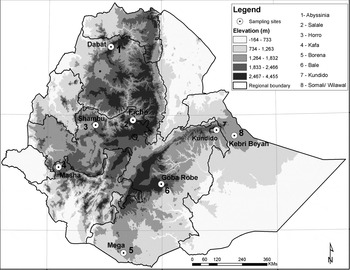
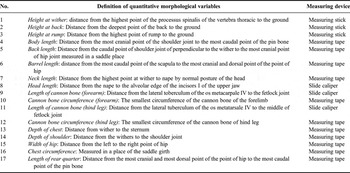
We followed the general phenotypic characterization guideline developed by FAO (2010) and procedures developed by Kefena et al. (Reference Kefena, Beja-Pereira, Han, Haile, Mohammed and Dessie2011) for donkey phenotypic characterizations. Sampling sites and the 17 measured morphological variables are shown in Figure 1 and Table 1, respectively. At the initial stage, we scanned through all previous reports that addressed Ethiopian horse populations. We also reviewed a country report of Ethiopian horse populations that have been officially reported in the Domestic Animal Diversity-Information System (DAD-IS) of the Food and Agricultural Organization of the United Nations at (http://www.dad.fao.org/). We, then, considered horses as a breed if they qualify the definition outlined in the FAO/UNEP (Reference Scherf2000) and Oklahoma State University (http://www.ani.okstate.edu/populations/). We also set additional criteria that a given population is considered unique if a particular environment/s which they inhabit is a true breeding tract for that particular population/s. Using these main platforms as criteria, we carried out both confirmatory and exploratory nationwide surveys to confirm previous reports, explore new population/s previously unreported and locate their specific ecozones. All regional agricultural officers were consulted and participated in all the stages of breed identification processes. We also held group discussions with local elders and horse owners to know about the historical background of each identified horse population. Breed/population names were assigned on the basis of their ethnic belongings, eco-geographical nomenclatures and/or how communities name their horses. To avoid measurement errors, a single person recorded all the measurements from identified horse populations.
Sampling sites and ecozones of Ethiopian horse populations.

Description of measuring devices and definitions of the 17 morphological variables recorded on Ethiopian horse populations.

Data collection
Morphological variables
Generally, there are no universally standardized and consistent equid phenotypic characterization guidelines. Different authors developed different horse phenotypic characterization guidelines that they think are more complete and perhaps fits to their research objective/s. For instance, Zechner et al. (Reference Zechner, Zohman, Solkner, Bodo, Habe, Marti and Brem2001) used 37 different distances and angular variables, Pretorius et al. (Reference Pretorius, Marle-Köster and Mostert2004) used 8, Rastija et al. (Reference Rastija, Baban, Antunovic and Mandic2004) used 15 and Brooks et al. (Reference Brooks, Makvandi-Nejad, Chu, Allen, Streeter, Gu, McCleery, Murphy, Bellone and Sutter2010) used 35 different morphological variables. Brooks et al. (Reference Brooks, Makvandi-Nejad, Chu, Allen, Streeter, Gu, McCleery, Murphy, Bellone and Sutter2010) excluded chest circumference, a commonly recorded morphological variable used in phenotypic characterization of almost all domestic mammals. These evidences indicate the absence of standardized and consistent phenotypic characterization guidelines in horses.
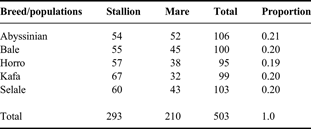
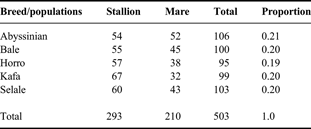
Thus, taking into account the temperamental status of Ethiopian horses, production environments and availability of specific measuring devices, we selected 17 quantitative morphological variables (Table 1) to phenotypically characterize and describe Ethiopian horse populations. These morphological variables are subsets of the variables developed by Oulehla (Reference Oulehla1996) for horse phenotypic characterization. Identified morphometeric variables were recorded on a randomly selected 503 adult horses (293 stallions and 210 mares) (Table 2) that belong to five horse populations. Horses were carefully handled by trained labourers or by horse owners themselves and were positioned to stand properly on flat and hard grounds with parallel legs apart. Data were not recorded on aggressive and improperly standing horses until they became calm and properly positioned.
Summary of the number each horse populations sampled and their proportion to the total populations.
Five major reference points were carefully marked before body measurements were taken. These points were: (1) the point of wither; (2) the point of back; (3) the point of rump; (4) the point of shoulder joint (5) and the point of pin bone. Measurements were regularly taken from the right side and exceptionally repeated on the left side when we become doubtful that horses were not properly standing on leveled grounds. If the measurements vary, the averages values were recorded.
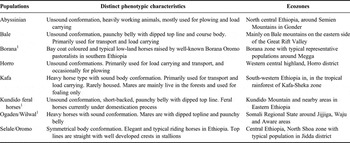
Owing to bad temperamental status of animals and other factors, measurements were not recorded on Borana, Kundido feral and Somali/Wilwal horse populations. Borana horses were highly resistant to restraint. Besides, during survey period, there had been sustained drought in the area and they drastically lost their body condition. Thus, we did not record any data on this population. Moreover, due to small sample sizes, we further excluded morphological data from Kundido feral and Somali/Wilwal horses (Table 3).
Summary of recognized Ethiopian horse populations with respect to their distinct phenotypic characteristics and ecozones.

1Horse populations for which body measurements were not taken.
Statistical analysis
Population means were estimated separately for stallions, mares and aggregated gender. Tests for significant differences between population means for stallions and mares were separated by t-test using the Bonferroni adjustment procedure in Holm (Reference Holm1979) with the step-down procedure using the SPSS package (SPSS, 2006). However, preliminary analysis showed that the interactions were significant only for five variables of the 17 measured morphological variables and, therefore, least-squares means were computed in the case of aggregated gender using SAS (2004).
The data were standardized following standard procedures of Manly (Reference Manly1986) before squared Mahalanobis distances and principal component analysis were computed. Squared Mahalanobis distances were computed between populations using the formula D 2ij = (Yi–Yj) COV−1(Yi–Yj), where D 2ij is the distance between population i and j and COV−1 the inverse of the covariance matrix of measured variables x and Yi and Yj are the means of variable x in the ith and jth populations, respectively. Squared Mahalanobis distance matrix was used via agglomerative hierarchical cluster procedure to build a dendrogram using unweighted pair-group method using arithmetic mean (UPGMA) using tree procedure in SAS (2004).
Discriminant function analysis was used to determine percentage assignment of individuals into their own populations. Principal component analysis was performed to minimize overall variables into few meaningful variables that contributed most to variations in the populations. We also performed canonical discriminant function analysis to find out a linear combination of quantitative morphological variables that provide maximal separation between different horse populations. The scored canonical variable was used to plot pairs of canonical variable to aid visual interpretation of group differences. Multivariate analysis for each sex and aggregated gender were carried out separately using SAS (2004).
Results
Breed means
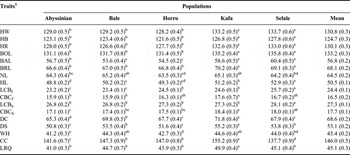
Mean values of morphological variables and their standard errors (s.e) are depicted in Tables 4 and 5 for each sex and least-squares means for aggregated gender are shown in Table 6. Pairwise mean comparison showed significant differences for most of the morphological variables between stallion populations. Major morphological variables such as height at wither (HW), height at back (HB), height at rump (HR), body length (BOL), back length (BAL), barrel length (BRL) and length of rear quarter (LRQ) were significantly longer (P < 0.05) for Kafa and Selale stallions as compared with any other stallions considered in this study. Kafa stallions were also significantly superior (P < 0.05) in the measurements of their depth of chest (DC), depth of shoulder (DS) and chest circumference (CC) than any other stallions studied (Table 4).
Means and pairwise comparison of morphological variables with their standard errors in each populations: stallions.

1HW = height at wither; HB = height at back; HR = height at rump; BOL = body length; BAL = back length; BRL = barrel length; NL = neck length; HL = head length; LCBf=length of cannon bone (forelimb); CBCf = cannon bone circumference (forelimb); LCBh = length of cannon bone (hindlimb); CBCh = cannon bone circumference (hindlimb); DC = depth of chest; DS = depth of shoulder; WH = width of hip; CC = chest circumference; LRQ = length of rear quarter; f = forelimb.
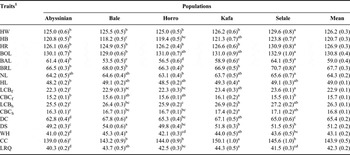
Means and pairwise comparison of morphological variables with their standard errors in each populations: mares.

1HW = height at wither; HB = height at back; HR = height at rump; BOL = body length; BAL = back length; BRL = barrel length; NL = neck length; HL = head length; LCBf=length of cannon bone (forelimb); CBCf = cannon bone circumference (forelimb); LCBh = length of cannon bone (hindlimb); CBCh = cannon bone circumference (hindlimb); DC = depth of chest; DS = depth of shoulder; WH = width of hip; CC = chest circumference; LRQ = length of rear quarter; f = forelimb.
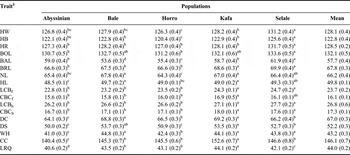
Estimates of least-squares means (s.e.) of morphological variables for Ethiopian horse populations: aggregated gender.

1HW = height at wither; HB = height at back; HR = height at rump; BOL = body length; BAL = back length; BRL = barrel length; NL = neck length; HL = head length; LCBf=length of cannon bone (forelimb); CBCf = cannon bone circumference (forelimb); LCBh = length of cannon bone (hindlimb); CBCh = cannon bone circumference (hindlimb); DC = depth of chest; DS = depth of shoulder; WH = width of hip; CC = chest circumference; LRQ = length of rear quarter; f = forelimb.
Similar study for mares showed that Selale mares were significantly superior (P < 0.05) in their HW, HB, HR, BOL and BRL but nearly similar in some morphological variables with Kafa mares (Table 5). On the other hand, DC, DS, WH and LRQ were significantly higher (P < 0.05) for Bale and Kafa mare populations.
The least-squares means for aggregated gender showed that Selale horse populations were consistently taller and longer bodied (P < 0.05) as compared with other Ethiopian horse populations but had similar BOL with Bale and Kafa horse populations (Table 6). Bale and Kafa horse populations were deep-chested and deep-shouldered (P < 0.05) as compared with any horse populations. Kafa and Selale horse populations had relatively longer lengths of both fore and hind leg cannon bones showing that they are the tallest horse population in Ethiopia (Table 6). Moreover, the circumferences of both hind and foreleg cannon bones were generally higher in Kafa and Selale horse populations than in any horse populations. Bale horses had the shortest BAL (P < 0.05), but were longer necked (P < 0.05) than any horse population. Chest circumference is significantly lower (P < 0.05) for Abyssinian but similar in other horse populations except in Kafa horses.
Multivariate analysis
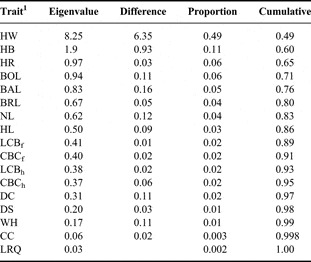
Estimates of PCAs explained by six morphological variables (HW, HB, HR, BOL, BAL and BRL) jointly accounted for about 80 percent of the total variations (Table 7). HW is the most influential single variable representing for about 49 percent of the total variations.
Principal component analysis: eigenvalues of the correlations coefficients, proportions accounted for by each variable and cumulative proportion.

1HW = height at wither; HB = height at back; HR = height at rump; BOL = body length; BAL = back length; BRL = barrel length; NL = neck length; HL = head length; LCBf = length of cannon bone (forelimb); CBCf = cannon bone circumference (forelimb); LCBh = length of cannon bone (hindlimb); CBCh = cannon bone circumference (hindlimb); DC = depth of chest; DS = depth of shoulder; WH = width of hip; CC = chest circumference; LRQ = length of rear quarter; f = forelimb.
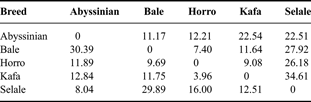
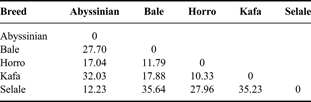
Squared Mahalanobis distances using Mahalanobis procedure (Mahalanobis, Reference Mahalanobis1936) are shown in Table 8 for stallions (above diagonal) and mares (below diagonal) and for aggregated gender in Table 9. All squared Mahalanobis distances were highly significant (P < 0.01). In stallions, the greatest morphological divergences were observed between Kafa and Selale followed by between Bale and Selale stallions. According to estimated squared Mahalanobis distances, the least morphological divergences were found between Bale and Horro followed by between Horro and Kafa. In mares, however, the greatest morphological divergences were observed between Abyssinian and Bale mares followed by between Bale and Selale mares. However, the least morphological divergences were observed between Horro and Kafa mares followed by between Abyssinian and Selale mare populations.
Squared Mahalanobis distances between stallion (above diagonal) and mares (below diagonal) in Ethiopian horse populations.
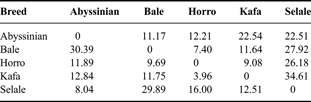
Squared Mahalanobis distances between Ethiopian horse populations.
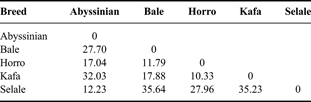
For the aggregated gender, however, the greatest morphological divergences were observed between Bale and Selale followed by between Kafa and Selale horse populations. The least morphological divergences were found between Horro and Kafa horse populations followed by between Bale and Horro horse populations (Table 9).
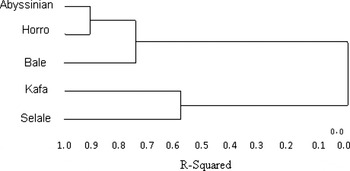
Furthermore, we performed hierarchical cluster analysis using overall squared Mahalanobis distances computed for aggregated gender (Table 9) and found that the five identified Ethiopian horse populations were categorized into three major horse groups and five distinct populations: (1) The elegant, well built and racing type Selale and heavy and forest type Kafa horses that jointly represent bigger horse populations in Ethiopia; (2) pony type and short-backed Bale horses that predominantly inhabit the highlands of Bale on the eastern side of the Great Rift Valley; and (3) heavily working horses of Abyssinia and Horro that are characterized by poor body conformation (Figure 2).
A dendrogram constructed using between populations squared Mahalanobis distances.

We also carried out discriminant function analysis to determine the percentage of individuals correctly classified into their respective populations. Accordingly, we found that, on average, 77.05 percent of the horses were classified into their own population from which they were actually sampled (Supplementary Table S1). Only 22.95 percent of individuals were misclassified into other populations.
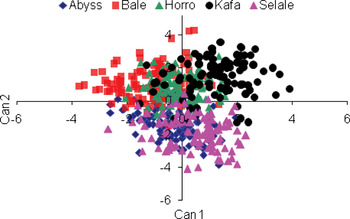
Figure 3 shows the result of two canonical variates that separate the five Ethiopian horse populations. The first canonical variate, can 1, separates only between two horse populations: (1) Bale as one group and (2) Kafa as another group with other three populations found scattered between the two separated populations. The second canonical variate, can 2, separates between two groups: (1) Abyssinian and Selale as one group and (2) Bale, Horro and Kafa as another group.
Plot of canonical discriminant analysis showing the first against the second canonical variant for five of the eight identified Ethiopian horse populations.

Discussion
Breed comparisons
By fitting breed and sex as fixed effects in the preliminary analysis, we observed that the interaction effects were significant for only five morphological variables (data not shown). Generally, overall mean comparisons show that stallions were significantly taller and longer-bodied (P < 0.05) than mares. This indicates the existence of little sexual dimorphism in Ethiopian horses. Such sex-based differences in some morphological variables in horses have already been reported in literatures (e.g. Pinto et al., Reference Pinto, Almeida, de. Quirino, Azevedo, de. Cabral, Santos and Corassa2008).
Significantly longer forearm cannon bone, body heights and relatively least CC in Selale stallions probably indicate that they are typical riding and saddle horses type in Ethiopia. Traditionally, Selale stallions have already been recognized as a status symbol and widely known as typical riding horses in Ethiopia.
In the case of aggregate gender, Selale and Kafa horse populations are taller and are longer bodied but higher DC, DS, CC and WH in Kafa horse population indicate that they are voluminous and heavy horse type that adapted to the tropical rainforest in Kafa-Shaka zone in southwestern Ethiopia. The shortest BAL but longer DC and DS in Bale population show that they are also voluminous and compact type of horses in Ethiopia. However, lower CC, WH and LRQ observed in Abyssinian horses probably shows they were low in body condition throughout the year as they regularly involved in intensive agricultural and related activities.
Relative comparison of Ethiopian horse populations with other studies indicates that they are generally smaller than large European horse breeds. For instance, overall mean HW (128.1 cm) obtained in the present study is by far lower than the mean values obtained for Friesian stallions (160.3 cm) and even the overall mean reported for mares (157.4 cm) in South Africa and Namibia by Pretorius et al. (Reference Pretorius, Marle-Köster and Mostert2004). Likewise, mean BOL reported for Friesian horses (165.7 cm for stallions and 166.5 cm for mares) reported in Pretorius et al. (Reference Pretorius, Marle-Köster and Mostert2004) is far longer than the mean BOL (132.1 cm) obtained in the present study. Zechner et al. (Reference Zechner, Zohman, Solkner, Bodo, Habe, Marti and Brem2001) also reported that HW ranges from 153.6 to 158.2 for stallions in Lippizan horses, which is by far higher than the mean HW obtained in the present study. This study supports the report of Epstein (Reference Epstein1971) who suggested that in the Savanna belt south of the Sahara, extending from West Africa to Somalia, the majority of native horses, whatever racial types are distinguished, are characterized by small bodies. Epstein (Reference Epstein1971) emphasized that the term pony usually applies to horses not over 140 cm in height. From this general assertion, though there exists high body size variations within and between populations, the majority of Ethiopian horse populations may be classified under pony horses.
Multivariate analysis
The six morphological variables (HW, HB, HR, BOL BAL and BRL) jointly account for about 80 percent of the total variations where HW alone accounts for about 49 percent of the total variations among populations. We also noticed that these variables had the highest correlations among themselves (data not shown). Manly (Reference Manly1986) demonstrated that morphological variables that have the highest correlation among themselves are good raw materials for multivariate analysis. This implies that selecting horses for one of these morphological variables, especially for HW simultaneously improves other variables that have high correlation with it.
Squared Mahalanobis distances differ between genders. The highest phenotypic distances between Kafa and Selale stallions probably reflect differences in body size rather than body height or lengths. For instance, Kafa stallions are characterized by having the highest CC, DC and DS as compared with Selale stallions. Bale stallions, which are characterized by higher DC and DS, are also morphologically distant from Selale horses. Relatively large differences in these traits than any other traits probably caused the highest differences between them. Generally, such phenotypic divergence between populations might be partly associated with the differences in management practices, biophysical resources and relative breeding objectives practised between these two distinct horse populations. Bale stallions are mostly blocky and shapeless with paunchy belly, deeper top line and the shortest BAL whereas Selale stallions are elegant and have symmetrical body conformation and are taller and long bodied.
Review of available literatures show that differences in squared Mahalanobis distances between stallions is apparent even within the same Lippizan stallions at different studs in Europe (Zechner et al., Reference Zechner, Zohman, Solkner, Bodo, Habe, Marti and Brem2001). Therefore, differences in squared Mahalanobis distances between different populations and sexes are highly likely to exist. The longest squared Mahalanobis distances observed between Bale and Selale followed by between Kafa and Selale might be attributed to the highest DC and DS differences observed between these pairs of populations. Generally, however, the squared Mahalanobis distances show only relative size differences among the Ethiopian horse populations. It may or may not represent actual genetic differences among them as most domestic animals become morphologically divergent depending on various factors (Zechner et al., Reference Zechner, Zohman, Solkner, Bodo, Habe, Marti and Brem2001).
Phenotypic descriptions and geographical distributions of Ethiopian horse populations
Evidences (e.g. Gubitz, Thorpe and Malhotra, Reference Gubitz, Thorpe and Malhotra2000; Storz, Reference Storz2002) clearly showed that morphological character systems such as coat colour patterns, body dimension or both are strongly influenced by ecological variables and population history. From this general tenet, large phenotypic divergence noticed in the present Ethiopian horse populations could also be associated with differences in production environments, specific population history and to some extent to community breeding practices. Therefore, we realized that it is fair to briefly highlight historical backgrounds, population history and geographical distribution of major indigenous Ethiopian horse populations.
Selale horses
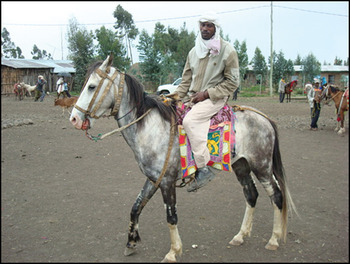
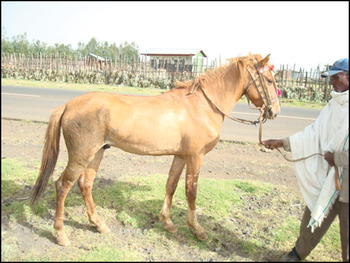
Selale horses of central Ethiopia have a unique population history and are particularly known for their riding aptitudes. They are elegant, have straight top lines, fine legs, symmetrical and sound conformation with well-developed crest in stallions (Figures 4 and 5). They are also known as Oromo horses (a name of ethnic group that raise them) (Epstein, Reference Epstein1971). Their breeding tract is limited to the central highland plateau of Ethiopia, North Shoa zone, commonly known as Selale (Figure 1). In Selale areas, typical representative population of the breed is found at a particularly place known as Jida district; the horse of this place is commonly known as Jida horse. Historically, Jida is the place where the former Ethiopian King, Emperor Hailesilasie established two horse farms in the early 1930s and 1940s. According to local informants, Emperor Halesilasie imported few stallions from England (breed type unknown) for breeding whereby their genes possibly admixed with local horse populations. Phenotypic appearances of Selale horses may reflect this hypothesis. However, this hypothesis needs further genetic studies such as male-specific Y-chromosome and mitochondrial DNA to find out whether the blood of exotic horses was incorporated into the indigenous Selale horse population as hypothesized. Generally, Selale horses are often considered as status symbol in the community.
Horse show at Jida horse market in Ethiopia.

Typical Selale riding horse.

Most selected Selale riding horses receive better managements by the local Oromo community. Such horses are used only during yearly cultural events and horse show locally known as “gugsii” or during particular public holidays and other events such as during funeral ceremonies. Horses used in such particular events are locally known as “farda teesumaa”, means saddle horse while others are known as “baataa”, meaning simply load carriers. Jida market is a main open horse market in Selale area where a large number of horse traders congregate and attend horse show and then compete for outstanding stallions/colts. Selale farmers hardly sell non-castrated colts.
Kafa horses
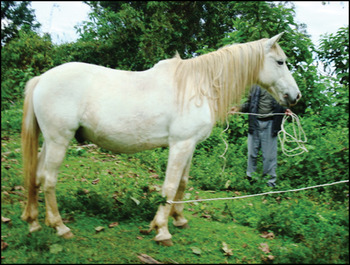
Kafa horses are typical heavy forest type horses in Ethiopia. Coarse body, big body sizes and well-sprung ribs are among their distinct phenotypic characteristics (Figure 6 and Supplementary Figure S1). They have also long manes usually lying on the right side of their neck. Though they have nearly similar body heights and body length with Selale, they are deep-chested and deep-shouldered and their chest circumference surpasses all Ethiopian horse populations. Their breeding tract is restricted to the tropical rainforest and coffee-growing areas of Kafa-sheka zone in Southwestern Ethiopia.
Kafa stallion.

Kafa horses serve as major sources of land transport system in the inaccessible areas in the tropical rainforests of Kafa and particularly they are used to transport forest coffee and spices from remote areas to the main highways or nearby coffee markets. Mares are hardly tamed and they are almost idle. They are exclusively used for foaling. All horses are rarely housed and mares in particular stay in the forest all year round.
Abyssinian horses
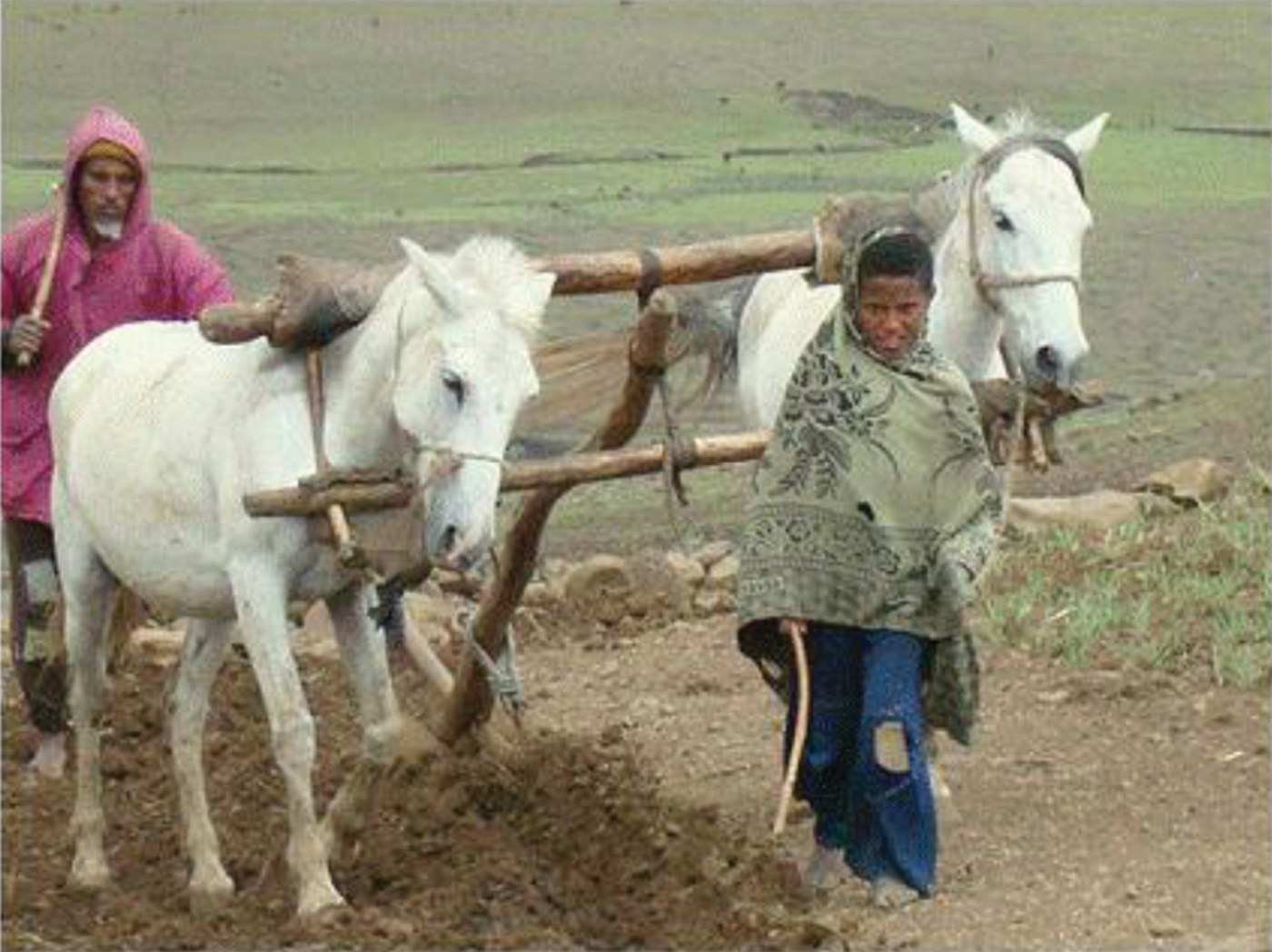
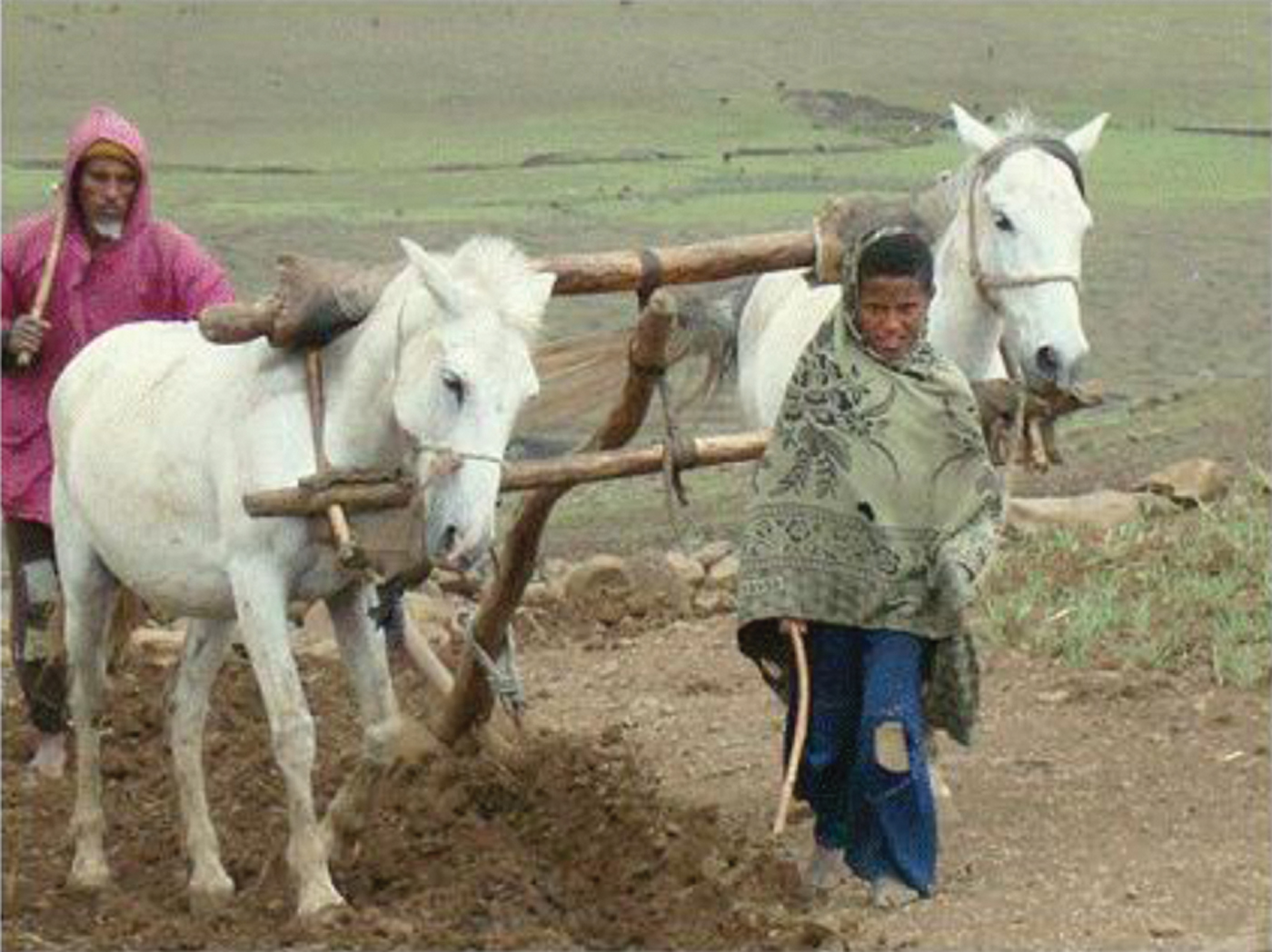
Abyssinian horses are found mainly in the north and north central parts of Ethiopia, particularly in northern Gonder following chains of mountains known as Semien Mountains. They have unsound conformation, paunchy belly and deep back. They are heavily working animals serving for various purposes. They are the chief sources of animal power for crop production and rural transport system in this part of the country (Figure 7).
Pair of Abyssinian horses engaged in crop land cultivation.
Bale horses
Bale horses are found in the highlands of Bale zone on the eastern side of the Great Rift Valley that dissect Ethiopia into the eastern and western highlands. They have also unsound conformation, a punchy belly and a deep back with a coarse body. They are also deep-chested, deep-shouldered, long-necked and long-tailed. They are typical pony type of horses in Ethiopia (Supplementary Figures S2 and S3).
The Kundido feral horses of Ethiopia
Historically, it is only the Namibian feral horses that are known to exist in a feral state in Africa, south of the Sahara. However, the newly explored Kundido feral horses in eastern Ethiopia (Figure 8) show the extent of research gaps and how available information is poorly communicated in Ethiopian horse genetic resources. Recently, we explored Kundido feral horses on Kundido Mountain in the eastern part of Ethiopia (refer to Figure 1). They acquired their name from the name of the mountain where they live in a feral state.
Kundido feral horses.

As there is no written provenance on this horse population, their historical backgrounds are not clearly known. Local elders in a focused group discussion suggested that they had been roaming on Kundido Mountain plateau for an unknown period of time with few anecdotic theories. Local elders suggest that the Kundido feral horses might be the remnants of the historically known Ethiopian Muslim–Christian war that took place from 1528 to 1560 between Ahmed Gragn (leader of the Muslim army) and Atse Lebna Dengel (leader of Christian army). Kundido Mountain is situated in a strategic place and local elders speculated that one of the army leaders had been using this mountain as a military strategy to control the progress of their enemy into the area. For the time being, however, no other hard evidences are available to substantiate these speculations.
Currently, Kundido feral horses are critically endangered. During a field survey in October 2010, we recorded 18 Kundido feral horses near Kundido Mountain. Recently, however, all these horses are successfully captured by local inhabitants, shared among a few households and are under the process of domestication. We noticed that horses are generally uncommon in the area and, therefore, poor knowledge of horse management practices, high rate of inbreeding and extreme market demands for new born foals are major threatening factors to Kundido feral horses. Therefore, urgent intervention and conservation options are needed by responsible bodies to rescue Kundido feral horses before they get extinct.
Borana horses
In his continent-wide study of the origin of the domestic animals of Africa, Epstein (Reference Epstein1971) described Borana horses of Ethiopia as one of the ponies of Africa. In the present study, we re-explored that the major breeding tract of this horse population is around Megga town in Borana zone, in the southern rangelands of Ethiopia. They are kept by the well-known Borana Oromo pastoralists and are typical representative of lowland horses in Ethiopia (Supplementary Figure S4). All horses are characterized by uniform bay coat colour and are good looking.
Borana pastoralists have long-standing cultural system known as the “Gadaa” system that obligates every member of the community to give superior respect to horses. For instance, neither human nor any other species precede horses at any watering points in Borana pastoralists. Local Borana elders in a focused group discussion informed that they never allow horse to pull carts. Moreover, dead male horses receive similar burial ceremony as humans in Borana pastoralists. Borana horses are regularly affected by severe droughts occurring in the area. During the dry season of the year, we noticed that they are taken to the watering points every other day. Generally, they are the hardy breed type that adapted to moisture stress and stressful environments of southern Ethiopia.
Somali/Wilwal horses
Somali or Wilwal horses are found in the Somali lowland pastoral areas of eastern Ethiopia. Local pastoralists also call them “Dirdaa'u” or “Wilwal” horses. Local elders reported that the name Wilwal was given after the name of well known Somali warlord and local governor called Wilwal Farah Hersi who had been using these horses to fight the British colonialist during the early colonial period in Ethiopian Somali and Somalia. Moreover, Wilwal Farah Hersi had been using Wilwal horses to exchange information with the central Ethiopian government of the time and also to transport weapons supplied by the central government. This needs further demographic and historical study.
They are common around Jijjiga town at specific places known as Dhik, Kebribeya and Waju. Other horse populations are exclusively living in a feral state at a place known as Aware, located at the border between Somalia and Ethiopia. There is also no written provenance for this horse population and, therefore, the origin of the Wilwal horses is not clearly known. Local informants suggested that they might have entered into Ethiopia from Nugal Valley, Somalila. Wilwal horses have sound conformation, a smooth body and are generally elegant and large (Supplementary Figure S5).
Conclusion
This preliminary nationwide study on morphological characters and ecozones of Ethiopian horse populations reveals a myriad of horse genetic resources that Ethiopia is endowed with. Among the studied native Ethiopian horse populations, Selale/Oromo horses are elegant, taller and long bodied with good stature that made it recognized as typical riding horses in Ethiopia. Therefore, targeted selection accompanied by well-designed breeding strategies could help to enhance their inherent genetic potential and develop them into locally adapted riding horses in Ethiopia. Kafa horse populations are also as tall as Selale horses, but are bigger and heavy forest type horses. This horse population could potentially develop for other purposes, such as for draft. The rest of the Ethiopian horse populations have unsound body conformations and are multipurpose types and, therefore, we cannot certainly recommend them to be improved for specific purposes. Therefore, information generated from the present study can help responsible body to make informed decision on priorities for the management and sustainable utilization of native Ethiopian horse populations.
At this point, it is important to also note that there are no well-developed and standardized phenotypic characterization guidelines for equids in general and for horses in particular. Available information is inconsistent and lack uniformity to make comparative analysis of one horse population with others. Therefore, a responsible organization must consider and address this issue in the future.
Supplementary material
Supplementary online material is available at http://cambridge.journals.org/AGR.
Acknowledgments
This piece of work is a part of Ph.D. project given to the first author by the German Academic Exchange Services (DAAD) in collaboration with the International Livestock Research Institute (ILRI) in their regional program. This project was also partially supported by the Portuguese Foundation for Science and Technology (FCT) through the project PTDC/BIA-BDE/64111/2006. We thank all farmers and pastoralists for sparing their animals for free and all regional agricultural offices for their inexorable cooperation during data collection.