



The focus on acute in-patient mental health services is currently intense, with scrutiny coming from the public, regulators and scholars. Recent high-profile investigations and official reports in several high-income countries have highlighted serious safety failures, the inappropriate use of restrictive practices, gaps in oversight and organisational learning deficits. 1,2 Independent inquiries have repeatedly identified recurring themes, including inadequate data systems, failure to implement recommendations from prior investigations, and weak mechanisms for translating lessons learned into sustained improvement. 1,2 At the same time, workforce shortages, bed pressures, rising demand for emergency psychiatric care and wider resource constraints have further strained in-patient services, potentially limiting their capacity to implement and sustain quality improvement initiatives. These developments are accompanied by emerging research that emphasises the complexity of patient safety in psychiatric settings and the lack of robust, context-specific evidence in this area compared with other areas of healthcare. Reference Russotto, Conti, Masini, Tempia Valenta, Vanhaecht and Mira3
Against this backdrop, although acute in-patient mental health services already operate within extensive professional, organisational, legal and regulatory accountability arrangements, these mechanisms are often fragmented and insufficiently integrated to promote transparency, organisational learning and sustained quality improvement following adverse events. Together, these factors highlight the urgent need to strengthen the implementation and integration of existing accountability mechanisms within acute in-patient mental healthcare. In response, this article examines the concept of accountability, its ethical and operational foundations and the key accountability strategies, together with their supporting evidence. It also considers the implications for their implementation across mental health systems.
Defining accountability in acute in-patient psychiatry
In acute in-patient settings, accountability can usefully be conceptualised as comprising three main interrelated dimensions. First, it involves answerability. This means that clinicians, multidisciplinary teams and organisations should be able to provide clear, reasoned explanations for their clinical decisions, care processes and outcomes. They should also seek to be transparent about these explanations to patients, families, professional peers, regulators and the wider public. Second, accountability implies responsibility. Mental health professionals and services should accept responsibility for the consequences of their actions, including any unintended harm arising from the provision of care. They should also recognise that exercising clinical authority entails corresponding ethical and legal obligations. Third, accountability requires responsiveness. Effective accountability frameworks require mechanisms to enable reflection, remediation and improvement when standards are not met. This helps ensure that shortcomings are addressed and lessons learned are put into practice. These dimensions are reinforced by person-centred care, which promotes shared decision making, respect for patients’ preferences, and meaningful involvement in care whenever clinically feasible. Taken together, these dimensions redefine accountability as an ongoing commitment to transparency, ownership and continuous improvement in acute in-patient care, rather than merely a formal reporting requirement.
In practice, these dimensions can help improve clinical care if they are translated into clearly articulated goals, performance standards and measurement systems, as well as the integration of quality monitoring into routine practice. Embedding person-centred care within these processes helps ensure that accountability is experienced by patients and organisations. In acute in-patient psychiatry, accountability operates at multiple levels. These are: clinical accountability for safe assessment and treatment; organisational accountability for governance and quality oversight; and public or legal accountability for compliance with human rights and the open disclosure of harm. Therefore, effective accountability is most likely to be achieved when these mechanisms function coherently across these domains, rather than at each level in isolation.
Why accountability matters in acute in-patient settings
Although accountability is equally important across the continuum of mental healthcare, acute in-patient settings are characterised by high clinical acuity, the use of restrictive practices and rapid decision-making, creating distinctive ethical, clinical and organisational challenges.
Acute psychiatric wards are characterised by a marked imbalance between the authority and power of professionals and the vulnerability of patients. Coercive interventions, such as involuntary admission, seclusion, physical restraint and enforced medication, may be employed when individuals are experiencing severe mental health conditions accompanied by acute psychological distress and impaired autonomy. Although such measures may be legally sanctioned and clinically justified, particularly after alternatives to coercion have been carefully considered, including approaches such as advance directives, peer support and supported decision-making, they carry an inherent risk of physical and psychological harm, raising complex questions about dignity, proportionality and respect for individuals. Robust accountability mechanisms should be embedded in everyday practice to ensure that decisions of this gravity are necessary, proportionate, regularly reviewed, legal and carefully documented.
The risks associated with in-patient care go beyond the issue of coercion. Acute psychiatric units are inherently high-risk clinical environments. Incidents of self-harm, suicide attempts, aggression, medication-related complications, preventable physical injuries and, in rare but devastating cases, death demand detailed and systematic oversight. Some of these risks may predate admission but continue throughout in-patient care, where their management requires ongoing assessment, clinical decision-making, and multidisciplinary coordination. Effective accountability systems should be capable not only of recording adverse events but also of analysing patterns, identifying modifiable factors and systematically implementing corrective action. Where such systems are weak, fragmented or under-utilised, similar harmful incidents may recur.
Accountability is also crucial for maintaining therapeutic relationships. People admitted to acute wards are often in crisis and may be ambivalent or distrustful of staff and services that have exercised statutory powers over them. Transparent communication and respectful engagement are therefore essential components of therapeutic care. This includes clear, timely and compassionate communication not only with patients but, where appropriate and with due regard to consent and confidentiality, with family members and carers, who are often profoundly affected and play a key role in ongoing support. Practices such as open disclosure, whereby clinicians communicate honestly and compassionately about adverse events, reinforce the ethical basis of care and recognise that accountability encompasses both relational and procedural aspects.
The implications extend to the workforce. Staff working in acute psychiatric settings are under considerable pressure, as they often have to navigate complex risk assessments, resource constraints and emotionally charged interactions. In organisational cultures where errors are concealed or feedback is lacking, defensive practice and moral distress can arise, especially where staff may fear unreasonable blame. Rather, it should promote transparency, organisational learning and fair reflection on adverse events, recognising that these often arise from complex interactions between patient, clinical, organisational and wider system factors. In contrast, accountability frameworks based on fairness and learning can help foster psychological safety, encouraging reflection and improvement while upholding professional integrity.
Ultimately, accountability is fundamental to system learning and quality improvement. Its purpose is not to attribute blame or retribution, but rather to create structures through which services can examine their performance, understand shortcomings or failures and embed lessons into routine practice. Strengthening these mechanisms may help mental health services reduce avoidable harm and better adapt to evolving standards of care.
Are accountability strategies supported by evidence?
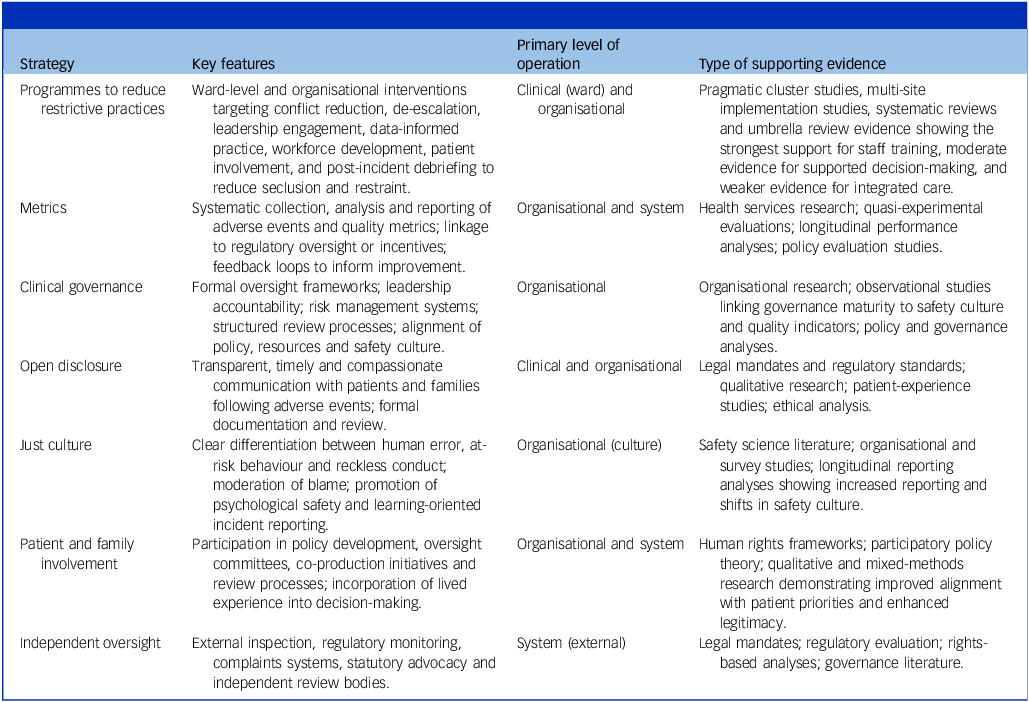
The main accountability frameworks for acute in-patient mental healthcare are shown in Table 1 and are supported by a diverse body of evidence from health services research, safety science, quality improvement evaluation, organisational studies, policy analysis and human rights law. Among the strategies with comparatively stronger empirical foundations are structured programmes aimed at reducing restrictive practices. Interventions such as Safewards and the Six Core Strategies aim to minimise conflict and coercion, as well as the use of seclusion and restraint, in in-patient mental health settings. Safewards is a ward-level model developed by Bowers and colleagues, which identifies key ‘conflict and containment’ flashpoints and introduces structured interventions designed to improve relationships between staff and patients and reduce escalation. Reference Simpson and Brennan4 The Six Core Strategies were originally developed within trauma-informed care frameworks in the USA. They are an organisational change model that focuses on leadership commitment, data-informed practice, workforce development, the use of prevention tools, service user involvement and rigorous debriefing following incidents. The aim is to systematically reduce the use of seclusion and restraint. Reference Azeem, Aujla, Rammerth, Binsfeld and Jones5 Evidence from pragmatic cluster trials, multi-site implementation studies and systematic reviews suggests that both interventions reduce conflict events and seclusion and restraint use. However, implementation fidelity and contextual factors influence outcomes. A recent umbrella review indicates that strategies to reduce coercive practices should be aligned with the strength of the supporting evidence. Staff training has the strongest evidence supporting its effectiveness in reducing restraint, while supported decision-making and integrated care have weaker but promising results in lowering involuntary admissions (Table 1). Reference Barbui, Purgato, Abdulmalik, Caldas-de-Almeida, Eaton and Gureje6
Main accountability strategies in acute in-patient mental health care and type of supporting evidence

Table 1 Long description
A table with six rows and four columns. The columns are labeled Strategy, Key features, Primary level of operation, and Type of supporting evidence. The rows are labeled with different strategies: Programmes to reduce restrictive practices, Metrics, Clinical governance, Open disclosure, Just culture, Patient and family involvement, and Independent oversight. Each row provides details on the key features, primary level of operation, and type of supporting evidence for each strategy. For example, the row for Programmes to reduce restrictive practices includes ward-level and organisational interventions targeting conflict reduction, de-escalation, leadership engagement, data-informed practice, workforce development, patient involvement, and post-incident debriefing to reduce seclusion and restraint. The primary level of operation is clinical (ward) and organisational, and the type of supporting evidence includes pragmatic cluster studies, multi-site implementation studies, systematic reviews, and umbrella review evidence showing the strongest support for staff training, moderate evidence for supported decision-making, and weaker evidence for integrated care.
Measurement and public reporting of quality indicators also draw on a substantial body of literature from health services research. Quasi-experimental evaluations and longitudinal performance analyses suggest that sustained reporting of metrics, particularly when linked to regulatory oversight or financial incentives, can lead to improvements in specific positive practices. Reference Campanella, Vukovic, Parente, Sulejmani, Ricciardi and Specchia7 This includes a reduction in certain adverse events. However, the supporting evidence is mainly based on policy analysis and trends in performance data rather than controlled experimental designs. Reference Campanella, Vukovic, Parente, Sulejmani, Ricciardi and Specchia7 Measurement is most effective when embedded within broader organisational governance and improvement systems. Data alone cannot produce change without thoughtful interpretation, feedback, leadership engagement and structured follow-up (Table 1).
Clinical governance structures represent another pillar of accountability, though the supporting evidence differs in nature. Organisational research and observational studies suggest that institutions with more developed governance systems tend to have stronger safety cultures and more favourable quality indicators. Reference Siregar, Imtiyaaz, Ardi, Sunarjo and Wuisan8 Governance operates through complex organisational pathways, leadership behaviour, communication patterns, resource allocation and cultural norms, all of which resist simple experimental evaluation. Consequently, its supporting evidence is grounded in health services research, organisational case studies and policy frameworks, rather than controlled trials (Table 1).
Other accountability strategies are more explicitly based on ethical, legal and normative principles. Open disclosure is widely mandated by policy and law in several jurisdictions. Supporting evidence largely consists of qualitative research and patient experience studies, which demonstrate that transparent communication after harm enhances perceptions of respect, trust and relational repair. Reference O’Connor, Coates, Yardley and Wu9 While the direct impact of such communication on quantitative safety outcomes is less clearly established, its legitimacy is rooted in ethical reasoning and statutory obligation, firmly situating it within the moral framework of accountability.
Similarly, the safety science literature and organisational studies supporting just culture and non-punitive reporting systems demonstrate increased reporting rates and shifts in safety culture when blame is moderated, and system factors are examined. Surveys and longitudinal analyses suggest that psychologically safe environments for staff encourage the disclosure of near-misses and adverse events. However, establishing a direct link between these cultural changes and measurable reductions in harm remains methodologically challenging. Therefore, the evidence base is strongest for reporting behaviour and cultural indicators, and further longitudinal research is needed to clarify the effects on clinical outcomes (Table 1).
The involvement of service users and their families in governance is strongly endorsed within human rights frameworks and participatory policy models. Empirical support largely derives from qualitative and mixed-methods research, which indicates improved alignment between services and patient priorities, as well as increased legitimacy and responsiveness. As with other relational interventions, its contribution may be more evident in experiential and ethical domains than in narrowly defined quantitative end-points. Nevertheless, its normative foundation in rights-based analysis and participatory ethics offers a compelling reason to include it in accountability systems (Table 1).
Finally, independent oversight and advocacy mechanisms are primarily supported by legal mandates, regulatory evaluations and rights-based analyses, rather than experimental research. These mechanisms provide external scrutiny and safeguards against institutional insularity. This can reinforce public confidence and protect patient rights (Table 1).
From principle to practice
In acute in-patient mental healthcare, accountability goes beyond administrative compliance. It is a core component of how services maintain safety, quality and ethical integrity. Services that embrace accountability are better positioned to be transparent in their decision-making processes, to monitor performance systematically, to respond openly when harm occurs, to reduce their reliance on restrictive practices, to promote organisational learning and to incorporate the perspectives of service users and their families into governance arrangements.
The evidence supporting individual accountability strategies varies in strength and nature. Collectively, however, it suggests that improvements are more likely when these mechanisms operate together in coordination rather than in isolation. Without governance oversight, structured follow-up or cultural change, measurement, disclosure and reporting systems are less likely to produce sustained improvements. Therefore, accountability should be embedded into routine ward practice, leadership structures and organisational policy. Strengthening these interdependent elements has the potential to promote more reliable learning, reduce avoidable harm and boost trust in acute in-patient mental healthcare services. Therefore, advancing accountability in acute in-patient mental healthcare requires procedural refinement and sustained structural and cultural change across the system.
In settings where safety concerns, resource constraints and heightened public expectations persist, it is particularly important to support the consistent implementation of accountability mechanisms. Experience across jurisdictions indicates that progress is more evident where legal frameworks, regulatory oversight, leadership commitment, adequate resourcing and meaningful service user participation reinforce one another. Accountability cannot compensate for inadequate staffing or resources, but it can help ensure that available resources are used transparently, fairly and in ways that support organisational learning and continuous improvement. Accountability should therefore be viewed as one component of broader efforts to strengthen the quality, safety and responsiveness of acute in-patient mental healthcare. Achieving this will require sustained structural and cultural change across the mental health system.
Data availability
This study did not involve the novel creation, generation, or analysis of primary research materials. All relevant literature is cited in the References.
Author contributions
C.B. planned and conceptualised this paper. C.B. drafted the first version of the manuscript. C.B., C.S. and G.T. revised and edited the manuscript and take joint responsibility for its content. ChatGPT (OpenAI) was used to assist with language editing and improving the readability of the manuscript. The authors reviewed and edited all output and take full responsibility for the final content.
Funding
This study received no specific grant from any funding agency, commercial or not-for-profit sectors.
Declaration of interest
None.



eLetters
No eLetters have been published for this article.