To speak of gay oppression in the context of racial oppression always seemed an embarrassment. Somehow it was to speak of the personal and the mechanics of desire in the face of material deprivation and vast political and imperialist and nationalist systemics.
I remember clearly when to speak of women's oppression in the context of racial oppression seemed to be speaking of something selfish, personal, not large-hearted enough. After all, men took care of women. If you improved the lot of one group of men, wouldn't you of necessity be improving the lot of their women, their children? Pointing out that the very discursive structure embedded in such an argument, such a perception, was the locus of rampant abuse to women because it denied them full autonomy in the family, the society, the race – and because it occasioned all manner of abuse to women in all the country's races – seemed like moving a millstone up a hill with your shoulder.
Similarly, to speak of racial oppression in the midst of discussing gay liberation was to confront an embarrassing reminder of the huge amount of homophobia that manifested itself most forcefully right at the strongest areas of black nationalism and the fight to end racial power imbalances (Samuel R. Delany Reference Delany and Brandt1999, p. 263).
Being women together was not enough. We were different. Being gay-girls together was not enough. We were different. Being black together was not enough. We were different. Being black women together was not enough. We were different. Being black dykes together was not enough. We were different. (Audre Lorde Reference Lorde1982, p. 245)
Meshell Ndegeocello refuses and defies categorisation. Her widely known musical personae challenge stereotypical intersections of race, gender and sexuality in American popular culture, and her excellent musicianship, playing electric bass, guitar and keyboard and utilising a broad vocal palette of spoken word and song, traverses genre boundaries, combining soul, R&B, funk, hip hop, jazz, go-go, dub and chamber music. Known as an innovative, expressive and controversial figure, Ndegeocello (pronounced en-DAY-gay-o-CHELL-o) makes political, funky, important music that is as difficult to categorise as she is.
Over the past 15 years, a number of scholars have drawn attention to her music by arguing that it articulates (lesbian) feminist and/or BlackFootnote 1 liberation critiques of White heteropatriarchy.Footnote 2 Their impulses are understandable – Ndegeocello is a courageous artist who musically narrates her experiences living at the crossroads of some of the most marginalising, stereotyped identifications of her time. If ‘White heterosexual businessman’ is the standard against which all others are made ‘other’ in contemporary North American society, then Ndegeocello could hardly be farther from the norm. Against these odds, and working within a particularly alienating industry, she has forged a remarkable career. Her bold music explores eroticism, spirituality and politics with an autobiographical yet critical perspective. No wonder Ndegeocello is known as ‘the revolutionary soul singer’.Footnote 3 However, this artist refuses most potential identity categories and regularly changes her sound, her band members, her record label and her name. Noted author (and Ndegeocello's ex-girlfriend) Rebecca Walker writes, ‘Meshell Ndegeocello, a.k.a. Bashir Shakur, a.k.a. Michelle Johnson, a.k.a. Mom, has many names because her slight, chocolate-brown body and free-ranging intelligence encompass many selves’ (Walker Reference Walker1997).Footnote 4 People's urges to label her have prompted, if not required, Ndegeocello's shifting, sometimes contradictory, always critical self-narration. Unfortunately several scholars, in their attempts to bring attention to nearly two decades of Ndegeocello's boldly political music, have reburdened this artist with the labels she has worked hard to avoid.Footnote 5 While their arguments make sense, they do not fully capture her own politics or the complicated sites of intersection that challenge reading her music through identity politics at all, and expose the oppressive dichotomies limiting her success in an industry that functions through target marketing.
Keith Negus and Patria Román-Velázquez have identified a trap in which many popular music scholars may find themselves: focusing on identity seems to tempt us into determinist readings of artists and their work, readings which reinstill, rather than expand or challenge, identity categories.
Too often ‘identity’ is the end of a road well travelled, when it should really be the beginning of a journey, a point of departure. Too often identity seems to be a conclusion to be illustrated through a case study rather than an idea to be interrogated, explored and then expanded, or perhaps even abandoned. We are arguing here for a need to move beyond a particular approach that is most apparent when identity is imputed from that which is visibly enacted, displayed, performed, outwardly embodied, gestured, and ‘reflected’. (Negus and Román-Velázquez Reference Negus and Román-Velázquez2002, p. 134)
Scholars' investments in identity categories tend to overlook the ways in which Ndegeocello's complex, changing musical personae make explicit the uncomfortable legacies of inhabiting queer Black sexualities and gender non-conformities. This topic has received far too little attention in popular and academic conversation until very recently.Footnote 6 Thus, it is crucial to explore the productive, sometimes incoherent, and professionally challenging multiplicity of Ndegeocello's artistic personae, the queer musical ways in which she reconceives self. This approach to self is in keeping with queer of colour critique, a political mode of being, thinking and making art that exposes identity politics' inherent reinvestment in intertwining heteropatriarchal, racist and classist formations. My paper experiments with analyses that attempt to transition away from scholarship that re-entrenches identity dichotomies, inspired in part by affect studies, an undertaking that develops concepts of performative, contextual and shifting articulations of self (many of which are inspired by queer theory). In affect studies, a concept like sexuality may be understood as an ‘ecology of sensations’ rather than as an identity (Rai Reference Rai2009).
An affect studies approach demands honest attention to Ndegeocello's socio-musical inconsistencies, tensions and contradictions, as well as her triumphs. These contradictions, particularly a potentially sexist ‘female machismo’ (as Ndegeocello calls it), sometimes come to a head at the exact moments several scholars argue for her feminism or queerness. In this article I focus on these moments, not in order to reverse existing claims of Ndegeocello's feminist or queer politics, but rather to reveal how her music expresses immense tension between ideologies,Footnote 7 via brilliant critiques and occasional shortcomings.
I begin with a brief analysis of challenges in her career to date, exploring the links between personal identity and musical genre. Then I examine the ‘problem’ of Black queer gender, her relationship with identity politics, and the troubles with and gaps in existing research on her work. Finally, I analyse several of her critical performances of self, relationships, politics and community, making use of many types of data, including: tracks from her first nine full-length albums, two music videos, the printed materials accompanying her albums, music journalists' accounts of and interviews with her, my experiences attending her concerts, communication I have had with fans, and her official and unofficial web presences.Footnote 8
Gender/genre transgression and ‘the plight of the revolutionary soul singer’
Ndegeocello's career could be read as representative of the fraught relationship between personal and musical identity, and the threats posed by an artist's transgression of either category. She learned to play bass as a teenager in Washington, DC, where she attended the prestigious Duke Ellington School of the Arts (from which she was expelled over a romantic relationship with another female student, whose parents put a restraining order on Ndegeocello). After dropping out of Howard University's jazz history major, pregnant and drug-addicted, she used a homemade demo to become one of the first musicians to sign with Madonna's record label, Maverick.
Ndegeocello's first album, Plantation Lullabies (1993), created a huge buzz especially with fellow musicians in the US and Europe. Her ‘neo-soul’ sound contributed to the soul revival of the late 1980s/early 1990s and fittingly announced her politically conscious musical examination of African American history and contemporary politics. But while she was lauded as a new political voice in Black music, in some queer quarters she was met with disappointment, for she was one of the only out bisexual Black female musicians of the time yet did not include any explicitly same-sex relationship songs on her debut.Footnote 9 Behind the scenes, Maverick ‘refused to finance a video because a proposed lesbian sex scene would have guaranteed minimal rotation’ (Walker Reference Walker1997). Maverick was trying to attract mainstream attention for Ndegeocello, as evidenced by her 1994 duet with John ‘Cougar’ Mellencamp on Van Morrison's song ‘Wild Night’, which topped several Billboard charts that year.
Her second album more than made up for the missing focus on queerness in her debut. Peace Beyond Passion (1996) forged a critique of Christianity-guised homophobia in the Black community, following in the socio-musical footsteps of Marvin Gaye. Unsurprisingly, BET (Black Entertainment Television) refused to air the video of the album's ‘Leviticus: Faggot’, a disco-tinged soul track inspired by a friend's death, which tells the story of a gay Black man disowned by his Christian family and then murdered on the street.
But really, I don't think it's the gay thing as much as the music thing. I don't fit into any format. Black music has become uncreative; like, you can't be abstract even though black folks created abstract. If they can't chew you up and digest you in a second, they don't want it. Basically, I don't sound like anyone else. R. Kelly, Jodeci, and Boyz II Men sound like the Isley Brothers: glossy R&B. The same is true of the girl groups SWV, Changing Faces … I sound like Gil Scott-Heron and Curtis Mayfield. You can see the history, but still I don't fit into the R&B format. You can't dress me up and make me En Vogue. And then, because of the color of my skin, I don't fit into the ‘alternative’ format; so I'm fucked. (Redman Reference Redman1997)Footnote 10
Her jazz and avant-garde roots have done little to ingratiate her with a mainstream R&B audience or explain her presence on a White superstar's pop label. Unlike the straight, feminine singers of En Vogue, she writes her own songs, plays multiple instruments and leads her band. Her musical roles and genealogy seemed, at the time, as queer as her gender and sexuality. However, Ndegeocello need not have attempted to separate the ‘music thing’ from the ‘gay thing’ to explain why she was having trouble in the music business. Genre categorisation, while central to marketing music, attracting a fan base, connecting with performance venues and instructing listeners in performance etiquette, is not as crucial as gender identification, without which one is not deemed human – consider the dehumanising pronoun ‘it’. For Ndegeocello, identity categories make her just as ‘fucked’ as music categories.
It should come as no surprise that Maverick discouraged a jazz album (Redman Reference Redman1997). As a compromise, the critically acclaimed Bitter (1999), ‘drop[ped] nods to Bill Withers, Marvin Gaye, and Jimi Hendrix’ as well as acoustic jazz, in its raw, vulnerable love songs (Neal Reference Neal2003b). Although ‘both VIBE and Newsweek hailed it as “album of the year” for 1999, and Billboard called it “a modern masterpiece”’ (Lewis Reference Lewis2000), Bitter's low sales signalled to Maverick Ndegeocello's failure in the business: ‘My own record company was telling me I didn't make a “black” record. But I wake up every day and I'm black. That messes with your head’ (Kot Reference Kot2002).Footnote 11
When Maverick urged her to recoup her racial status by recruiting a contemporary ‘Who's Who’ list of Black musical guests for her fourth album, she played along, but few musicians responded to the call. Ndegeocello's smart response, Cookie: The Anthropological Mixtape (2002), drew together her impression of her musical and political peers and critiqued the state of Black music. A collage interspersing clips of recordings of famous Black activists (often Marxists) and poets with Ndegeocello's ‘go-go’ spoken word and song, Cookie is set to Black and Latina/o dance beats and offers songs critiquing homophobia, commercialism, violence and hypocrisy. The album would have been released in October 2001,Footnote 12 but Maverick delayed release for a year because, as Muslim-identified Ndegeocello explained, ‘in the song [“Hot Night”] I say we suffer in a world trade paradise’ (a lyric written long before 2001's terrorist attacks on the World Trade Center).
Her unremarkable fifth album, Comfort Woman (2003), fulfilled her record contract with Maverick. Featuring space-age dub grooves about her love for ex-girlfriend Rebecca Walker and getting high, Ndegeocello opaquely explained that this controversially titled album was her statement about life post 9/11 (Neal Reference Neal2003a) without any mention of the traumatic history of sexual slavery associated with the title phrase or the more stereotypically ‘feminine’ album cover photo, title and songs, than on her previous more ‘macho’ album.
Dissolving her band, she formed and recorded with the Spirit Music Jamia (an Arabic word for gathering or school), a jazz fusion sextet with a DJ. In this band she appeared solely as bass player and neither sang nor spoke to crowds, a choice that disappointed many listeners and launched several years of tense audience relations.Footnote 13 African American civil and gay rights activist Jasmyne Cannick posted to her blog about Ndegeocello's performance at a 2007 Pride event:
Now the verdict is still out on her performance. I will say that I am wasn't [sic] that thrilled with it and not because she didn't perform any of her new music but because she seemed extremely angry and didn't really want to be there. Lately, there's been a lot of controversy between Meshell and her fans and it clearly showed Friday night as at the beginning of her set if there was [sic] 200 people there, by the end there was [sic] 75. At the end of her show, she just walked of the stage. No goodbye, no thank you, no encore, she just walked off the stage and left.Footnote 14
She finally produced a jazz project, The Article 3 EP (EmArcy, 2006) which highlighted the playing of several famous guests (but largely omitted her own). More recent albums, The World Has Made Me The Man of My Dreams (EmArcy, 2007) and Devil's Halo (Downtown, 2009) feature stylistically and metrically shifting songs with moments of heaviness, dissonance, distortion and despair, ostensibly symbolic of her trials over musical and personal identity. (One song is even called ‘Michelle Johnson’, her birth name; other songs explore global political tensions, including with Islamic fundamentalism.) But these albums also gesture towards some of her more upbeat rock and soul influences, with an occasional acoustic love song. Weather (Naïve, 2011) has proven to be a turning point, harkening back to Bitter's acoustic intimacy and zen-like sparseness. This shift is also signalled in gendered rhetoric in her official website's promotion of Devil's Halo versus Weather:
Canonized, marginalized or just scrutinized, Meshell Ndegeocello has given up trying to explain herself. After 20 years in an industry that has called her everything from avant garde to a dying breed, what unquestionably remains is the fearsome bassist, prolific songwriter and the creativity and curiosity of an authentic musical force. With that, she has earned critical acclaim, the unfailing respect of fellow players, songwriters and composers, and the dedication of her diverse, unclassifiable fans.Footnote 15
Meshell has changed. So has her music. It's more peaceful, freer. Her new album, Weather, cloaks itself in the colours of autumn, full of in-between shades and hues and with a certain mildness to it. The singer has let her feelings carry her along. Meshell has never been scared of sharing her most intimate thoughts in explicit or colourful terms that always come from the heart. As ever, she is true to herself. But Weather's folk sensibility and pregnant acoustic melodies make this a supremely accessible album.Footnote 16
The first statement, publicising Devil's Halo, describes a defiant, unapologetic artist, frustrated with the music business and fans' expectations. Language like ‘avant garde’, ‘fearsome’, ‘prolific’, ‘authentic’, and earning ‘unfailing respect’ from fellow musicians connotes mastery and individualism, qualities typically understood as masculine. The publicity for Weather, on the other hand, is intimate and, when read in sequence with her prior bio, sounds almost apologetic. This write-up uses her first name only and describes a ‘changed’ person and musician, exuding ‘mildness’ with a ‘folk sensibility’, creating ‘pregnant acoustic melodies’ and ‘a supremely accessible album’. It is impossible to miss the feminine inferences and potential value judgements (‘supremely accessible’ vs. ‘avant garde’). Her bravery in writing intimate music flags an important combination that I discuss later, strength in vulnerability, but in the biographical passage above is mentioned after a sentence that situates her as passive to her feelings.
Western culture assumes that masculine and feminine are opposites on a linear plane, but while these descriptions sway markedly in one direction or the other, Ndegeocello's music and artistic personae have developed over the past 20 years to present far more nuanced, critical and queer perspectives on gender. In her music aspects of masculinity and femininity can, at the same time, ‘belong to’ anyone, quite productively so, and those who unthinkingly embody the (often harmful) extremes of these stereotypes are criticised.Footnote 17
‘We were different’
Lorde and Delany describe the risks for African Americans affiliating with ‘othered’ gender and/or sexuality: accusations of narcissism and/or ostentation, and feelings of shame and/or alienation. Yet Lorde insisted on articulating difference: ‘I feel that not to be open about any of the different “people” within my identity, particularly the “mes” who are challenged by a status quo, is to invite myself and other women, by my example, to live a lie. In other words, I would be giving in to a myth of sameness which I think can destroy us’ (Tate Reference Tate1983, p. 100).
Identity categories do not originate from neutral impulses. They demarcate perceived differences from the (often unspoken) norm and assert/maintain hierarchy. African Americans have been particularly singled out for a confluence of othering (especially in regard to gender and sexuality) to protect the image of the (White) US citizen and the system of capitalism (Ferguson Reference Ferguson2004, p. 27). Black sexualities have not been allowed to develop ‘unfettered’: Black sexualities are often publicly misrepresented through harmful stereotypes, Black people are often more likely to be subject to punishing laws and policies, and Black communities, like lesbian and gay communities, are compelled to self-police (particularly regarding gender non-conformity) (Battle and Barnes, Reference Battle and Barnes2010, pp. 2, 8; Page and Richardson, Reference Page, Richardson, Battle and Barnes2010, pp. 59, 62). Page and Richardson contend, ‘Blacks who struggle against racism generally feel they cannot afford the luxury of individual incoherence between one's assigned sex and expected gender’ (Page and Richardson, Reference Page, Richardson, Battle and Barnes2010, p. 63).
Michele Wallace argues that all Black women are already seen as gender nonconformists; Black women's genders are likely to be read (usually negatively) as masculine in relation to the White heteropatriachal standards of femininity (Wallace Reference Wallace1990). For Black female popular musicians, gender transgression can threaten their careers, as Imani Perry writes: ‘the refusal to adhere to grooming or behavior coded as sexually attractive leads to consistent accusations of lesbianism for many women MCS’ (Perry Reference Perry2004, p. 157). Even Queen Latifah leaves her plaid flannel backstage.Footnote 18
Earlier scholarship on Ndegeocello avoided her same-sex songs in the name of Womanist arguments highlighting empowered female self-presentation and songs about opposite sex relationships (Shelton Reference Shelton1997; Stukes Reference Stukes2002). Shelton specifically rejects identifying Ndegeocello as ‘masculine’, instead reading her gender performance as a ‘comfortable style’ to invoke the ways in which the White standards of femininity require money and leisure (Shelton Reference Shelton1997). While her rationale is valid and points to the ways in which gender stereotypes are marked by race and class, a Womanist argument could have included same sex desire. In academia, the topic of Black sexualities has historically been ignored or, when discussed, evaluated in a biased way with ‘comparative’ or ‘deficit’ models in relation to Eurocentric norms (Battle and Barnes Reference Battle and Barnes2010, pp. 7, 2). Even analysing majority gendered/sexual identities within African American communities has been fraught and thus, until very recently, there was scant scholarship on LGBT African Americans. As Evelyn Hammonds argues, ‘we know more about the elision of sexuality by black women than we do about the possible expression of sexual desires’ (Hammonds Reference Hammonds1994, p. 143).Footnote 19 Scholarship that does address Black queer people often focuses on pathology and regulation (overseen by some of the same institutional structures that often position them as outsiders with limited rights).Footnote 20
The discussion of Ndegeocello, as a (relatively) famous figure in popular culture is compelling because it allows us to examine the circulation of her many ideas about identity. However, I want to resist using Ndegeocello (whose living depends on selling semi-autobiographical music) as an example of ‘everyday’ negotiations of identity for Black queer people and draw a distinction between her life and the ways in which non-famous non-musicians might navigate similar issues.Footnote 21 What we can learn from her music and scholarship about it are ways in which queer artists find and make trouble around musical and identity categories, pitfalls in using identity as a basis for scholarly arguments, and examples of challenges to a system from within.
Being ‘honest, straightforward, and critical’ and defining oneself may be especially important because so many stereotypes have ‘disturbed and truncated’ Black lesbian existence (Omosupe Reference Omosupe1991, p. 108). Ndegeocello explains that her music is often autobiographical:
[2002 album Cookie: the Anthropological Mixtape] is just the fourth chapter in my memoir. The intentions of the music are just to show where I am at this time. Most of my records are like you're sitting in the bed with me while I tell you all my shit. But for this one, I wanted it to feel like you were with me on the journey and not be so introverted or closed. (Walker Reference Walker2002)Footnote 22
Autobiographical performances offer important space and communal engagement to work out complex negotiations of self in the context of systems of oppression. David Román's theories of queer articulations and re-envisioning of self, community, history and politics in solo theatrical work resonate for singer-songwriters as well:
Autobiographical work is an especially popular form for queer writers and performers and for their readers and audiences. In part, this is because autobiography fits into the model of identity politics on which lesbian and gay liberation is founded. In other words, autobiography is perhaps the most immediately understood form of queer self-representation, and it is also often part of a larger collective and ongoing process of revisionist history. (Román and Hughes Reference Román and Hughes1998, p. 4)
This process of connecting with audiences can be much more complicated for those artists who identify with more than one stigmatised category. Impractically, most identity politics expect allegiance to one category over others, as well as investment in dichotomies that define categories and, sometimes, essentialist ideas about difference. Guest editors of New Literary History explore the viability and potential end of identity politics, noting that ‘identity politics thus leads to a political impasse that effectively leaves the larger social structure intact’ (Albertini et al. Reference Albertini, Lee, Love, Millner, Parille, Rutowski and Wagner2000, p. 624). Thus essentialism crops up in ostensibly ‘queer’ arguments about Ndegeocello. Stallings reinvests in the gender binary (Stallings Reference Stallings2007, pp. 25, 66, 78, 169, 180–81, 238), using the phrase ‘anatomical destiny’ to explain gender performance (Stallings Reference Stallings2007, p. 247), assuming that all women's voices are ‘feminine’ and that the bass guitar is ‘inherently masculine’ (Stallings Reference Stallings2007, pp. 249–54). She also invests in a dichotomy between free will (or, ‘being true to that self’) and social constructions of identity (Stallings Reference Stallings2007, p. 69).
This widespread expectation of musical ‘authenticity’ creates friction with postmodern conceptions of identity and performance. Simon Frith recommends that scholars consider not whether a musician is authentic or not (since this is an impossible and biased question), but how a musician constructs her version of ‘truth’ (Frith Reference Frith, Leppert and McClary1987). His insight develops from postmodern questioning of whether a subject exists prior to identifications such as gender to which a person could be true (thus, one's personhood is only and always conferred via endless performances of socially constructed identity categories; Butler Reference Butler and Fuss1991).
Furthermore, critique of categories is inherently difficult in queer autobiographical music: ‘Queer solo performers trouble the comfort of community even as they invest in it … one could even argue that queer solo performers are often at the frontiers of new social identities and more inclusive community formations’ (Román and Hughes Reference Román and Hughes1998, pp. 5–6). Awkwardly, these artists challenge the very identifications that often bring their audiences together.Footnote 23 Perhaps these critiques are easier for audiences to swallow when delivered by a subject whose place in the community is indisputable. But Ndegeocello's status is challenged as though the categories of race and sexuality are mutually exclusive or dilute one another: ‘I'm not gay enough? I'm not black enough? I don't care. Meet me and make your assessment’ (Harrington Reference Harrington1994).
These complexities shed light on Ndegeocello's tendency to speak minimally in performance and approach most interviews with trepidation. In 1997 she explained to collaborator jazz saxophonist Joshua Redman that journalists pry into her personal business and don't seem to care about the music. She clarified her suspicion in a 2003 interview with Black singer-songwriter Marc Anthony Thompson:
Thompson: You don't read reviews?
Ndegeocello: Never.
Thompson: Oh, I think they're funny. That's my secret new favorite thing about releasing a record. It just cracks me up! Because the review is not about your record, it's really about the reviewer.
Ndegeocello: Well, for me, it's more about me. You know, I get so tired of the ‘black, bald, gay’, whatever, bass player. … Let's talk about the music!
While (straight, Black male) Thompson laughs when (presumably self-absorbed) reviewers misinterpret his music, Ndegeocello argues that journalists only discuss her music in the context of several ‘othered’ identifications that she doesn't necessarily use. In the interview, her responses allude to the ways in which curiosity about queer and/or Black people's individual sexual ‘deviance’ masks the deep structural roots of White supremacy and heteropatriarchy, the systems responsible for pathologising the differences of people like her and representing them as violent, promiscuous, and unhealthy.
I'm not a feminist. … Feminism is a white concept for white, middle-class women who want to have the same opportunities as their white, male counterparts. We can fight our men, or we can fight the system. … To me, an issue is all the women – black or white – who are on welfare. (Seigal Reference Seigal1994)
I've been saying this lately, that gay is dead; it's totally a white male construction. You go some places and they don't have a name for it, they just love each other and take care of their kids. Sex is personal, they don't talk about it … I am sexually functional with both sexes. Move on. Niggers is blowing each other up and you want to know how my orgasms come about? Gimmie a break. You gotta a problem with me being gay, but if I was slapping somebody in a video that's cool? Black community: if we don't get it together, it's gonna be bad, it's not going to be good. (Fullwood Reference Fullwood2002)
I am a water-based carbon life form. My life isn't dictated by my genitalia. I'm not gay. I'm not bisexual. I'm in love with Rebecca … Before that, … I was in love with a white boy, and before that a different person. I'm not ashamed to speak about it. (Diettenger 2002)
Generally, her resistance points to categories' lack of specificity and inability to represent her experiences – she refers to individuals she has loved, she yearns for privacy to desire unencumbered and to parent uninterrogated, and she brings the conversation back to larger social problems which are more likely to be reinforced than resolved by categorisation. When speaking with a writer from the lesbian magazine Deneuve (later to become Curve), Ndegeocello coyly identified as ‘homo sapien’ and challenged mainstream negative stereotypes of bisexuality (such as promiscuity and polyamory), saying she was ‘sexually functional with both sexes’.Footnote 24 By identifying herself in terms of humanity and functionality, she teasingly but proudly reversed traditional devaluation of ‘Others’ via theories of pathology, deviance and immorality. In several quotes she challenges the question as either an attempt to shame her or an inappropriate fascination intended to non-normatively label her personal life when there are larger cultural problems to address. Ndegeocello joked that ‘nine out of ten black lesbians concur that every now and then, they need to get poked!’Footnote 25, alienating some lesbians, but redeploying the language of statistics (historically used to pathologise African American sexuality; Ferguson Reference Ferguson2004) to normalise ‘black lesbians’ who enjoy occasional sex with cisgender men.
Her disassociation from feminism, lesbians and gay identity aims to distance her from the mainstream feminist movement which has been criticised as being preoccupied with White middle-class heterosexual women's concerns, the lesbian separatist movement which she sees as White and anti-men,Footnote 26 and the contemporary Western concept ‘gay’ that she feels does not resonate with African American experiences or may draw undesired attention to African Americans' already pathologised sexual and family relationships.
However, her dismissal of feminism may suggest limited understanding of the various feminist movements' important contributions to challenging racism, socioeconomic stratification, violence, state abuse of minorities and oppressive state regulation of women's reproductive and parental rights. Mockus points out that journalists rarely define feminism when they ask popular musicians whether they claim this identification, and that, despite denials, Ndegeocello's career can be read as a musical articulation of Black feminism by positioning the movement as one means of examining how race, class and sexuality ‘conceptualise’ the categories ‘woman’ and ‘gender’ (Mockus Reference Mockus, Acampora and Cotton2007). While there are definite parallels between Black feminists' and Ndegeocello's critiques and strategies of selfhood and art, Mockus' argument is unnecessarily limited in that her interest in lesbian readings of songs and identifying Ndegeocello as a butch lesbian address the artist's gender solely as a product of (lesbian) sexuality and find queer power only in lesbian readings.Footnote 27 Stallings' queer Africanist argument also focuses solely on lesbian readings (ironically, since she addresses the bisexuality of other figures elsewhere in her book). Both scholars reserve analysis of gender as an end product of sexuality, and thus are limited by expectations about sexual identity: for Stallings, gender identity as a biological and gender transgression only as a product of bisexuality (Stallings Reference Stallings2007, pp. 242–4) and for Mockus, based in butch/femme roles (Mockus Reference Mockus, Acampora and Cotton2007, p. 101). The problem with analysing gender as a product of another category, whether ‘biological sex’ or sexuality, is that it could reinforce heteropatriarchal racist assumptions of sex, gender, sexuality and race, by preserving norms and associating aberrations of one category causally with aberrations of another (gender transgression as a product of homosexuality, or of racial difference). Some interesting questions remain unexplored in the existing literature: are her opposite-sex relationship performances queer? How might female masculinity function in an opposite sex encounter? Can female masculinity be feminist? What one learns from studying the existing scholarship is that identity politics may limit understanding, and even appreciation, of Ndegeocello.
In Disruptive Divas, LaFrance argues that Ndegeocello ‘simultaneously criticizes dominant discourses of race, gender, and desire, without marginalizing one critique for the sake of another’ (Burns and LaFrance Reference Burns and Lafrance2001, p. 147). It may be that Ndegeocello's music better achieves this critique than much of the scholarship about it. As Lorde explained: these labels are ‘not enough’, separately or in a long list (which often, if unintentionally, infer mutual exclusivity), and she rightly insists on giving voice to all of her ‘mes’. Thus, while making such lists helps place artists like Ndegeocello (and Lorde) on familiar terms, scholars' investment in these categories can divert attention from Ndegeocello's vast ongoing musical critique of identity categories, especially gender stereotypes in song scenarios involving both women and men. In short, we risk missing what's queer about her music. In the final section, I offer alternative readings of songs analysed by other scholars, and music and materials that illustrate the tension of identity politics and the challenges posed by Ndegeocello's work.
Butch mastery (of men), feminist femmes and powerful vulnerability
The analyses that follow explore some of the artist's most pronounced performances of queer gender, what Ndegeocello sometimes calls ‘female machismo’ (Moon Reference Moon1999). Earlier in her career, she developed masterful butch personae perhaps inadvertently at the expense of the dignity of feminine characters in the songs. Later songs negotiate queer gender personae while making more intentional, nuanced, often respectful statements about femininity. Existing scholarship has left this female masculinity unexplored, perhaps because her performances could threaten feminist, lesbian feminist, or Womanist arguments.
Dignity for ‘Mary Magdalene’?
Burns and LaFrance's analysis of the song ‘Mary Magdalene’ from the album Peace Beyond Passion argues that the female narrator's marriage proposal to the biblical character disrupts negative Christian stereotypes of sexuality, gender and race: Ndegeocello's narrator shifts the typical appraisal by valuing Magdalene and blaming men for her sexual exploitation; the overly sexualised character is not the Black character for once; this time the Black character is proposing marriage and monogamy; and by taking the role of the saviour Ndegeocello compares her narrator to Christ while enacting a Black lesbian narrative.
However, this song and its use in feminist arguments may not represent sexuality in entirely positive feminist or queer ways. Neither Ndegeocello nor her analysts discuss the contemporary theological theory that ‘Magdalene’ is an amalgamation of several Biblical characters named Mary used to disempower women in the church from the writing of the Gospels onwards and to attach existing anxiety around sexuality to a virgin/whore dichotomy.Footnote 28 Ferguson explains that neoliberal views misguidedly see the prostitute as representing the dangers of capitalism by focusing on personal ‘corruption’ – individual erotic descent into vulgarity and shame by a person who has failed to meet standards of gender, sexuality, race and class (Ferguson Reference Ferguson2004, p. 8). Rather than challenging the source of the story of Mary Magdalene, discussion of Magdalene centres on prostitution and marriage. Ndegeocello's song, and Burns, LaFrance and Mockus' lesbian feminist readings of it, could unintentionally encourage a neoliberal stance: the narrator wants to save Magdalene from ‘communal lust’ and shift her erotic activity into a private sphere, assuming that converting her will save her and perhaps culture more generally. Ndegeocello's request to ‘satisfy me for free’ could uncomfortably suggest continued servitude – marriage as a legalised exchange of sex and money, with the demand for monogamy – ‘tell me I'm the only one’. One wonders why, if Ndegeocello's narrator is such a saviour, she doesn't offer to satisfy Magdalene for free?
Ferguson argues that the symbol of the prostitute is potent because it also offers a revolutionary (or ‘pro-sex’) perspective interested in the prostitute's disruption of heteropatriarchy by freeing sex acts from marriage (Ferguson Reference Ferguson2004, p. 10). But while Ndegeocello's narrator blames men, not Magdalene, she also wants to save her. In a 1997 interview, Ndegeocello discusses her ‘obsession’ with sex workers, explaining that she likes talking to them because they don't know who she is, so she assumes they don't have expectations about her (almost as if they are from entirely separate worlds – as though Ndegeocello's world is not complicit in the prostitute's limited employment options). She feels that her conversations with them may inspire them to leave prostitution (Walker Reference Walker1997). Thus the song narrator's lesbian marriage proposal to a long-maligned (and assumed straight) female biblical figure is, in some ways, a bold, delightful intervention in the original misogynist Biblical story, and in other ways fails to thoroughly critique the status quo.
Female masculinity in a heterosexual context
Ndegeocello's successful second single and first video, ‘If That's Your Boyfriend (He Wasn't Last Night)’ (1994) introduces the artist in a presumably heterosexual context in which the narrator steals other women's boyfriends.Footnote 29 Ndegeocello wrote the song in response to a woman who said that Ndegeocello was too butch to be able to steal her boyfriend (as though her queer gender and her romantic past with women makes her less attractive to heterosexual men).
The musical tone, visual aesthetic and lyrics radiate masculine bravado, purportedly about stealing boyfriends, though directed mainly at the girlfriends. Ndegeocello's narrator boasts that she is sexually liberated, unashamed and, besides, the boyfriend initiated the encounter: ‘You can say I'm wrong / You think that's kinda freaky / I can't be trusted / I'm kinda sneaky / But no get your story right / He knocked on my door / So what should I say no for?’ Her language is modest: in the bridge the narrator says to the boyfriend, ‘Make you wanna do things that you never have’ without specifying those ‘things’. However, her sonic and visual bravado could seem ‘freaky’ compared to the femininity developed in the video.
Director Jean Baptiste Mondino sonically and visually helps Ndegeocello create a masculine female character that has confidently slept with several women's boyfriends. The video presents the narrator using predominantly butch gender cues that are understood to empower her heterosexual conquests at the expense of a series of more stereotypically feminine girlfriend characters. Ndegeocello wears dark shiny lipstick (also seen on two of the ‘girlfriends’) and sports a menswear suit jacket and trousers, a white tank top, suspenders and a closely-shaven head.
Her musical performance and video footage construct her narrator as more active, assertive and independent than the cast of ‘betrayed women’. These ‘interviewees’ each appear more ‘feminine’ than Ndegeocello's narrator persona, in terms of hairstyle, clothing, voice, gesture and affect. Shot in black and white, the video introduces Ndegeocello as ‘arty’ and cool. The vivid footage cuts between audible documentary-style ‘interviews’ with eight seated female characters (the betrayed girlfriends), and frames of diegetic musical performance by individual musicians in the band. Ndegeocello appears as a versatile, skilled vocalist and multi-instrumentalist. The close-up shot of hands that lead into the song with a clipped chromatic piano chord and a melodic fragment turn out to be hers (we see a full image of her seconds later, bent over the piano in a stereotypically masculine bodily posture). Each instrumental track features a visual solo as the camera cuts to a lone White male jazz guitarist noodling, then to Ndegeocello delivering a bass groove with a cool smirk as she looks off-camera, and finally to a Black male drummer. While the ‘interviewee’ women are shot from the waist up and remain sitting (some applying make-up as they talk to the camera), Ndegeocello's whole body is pictured and she plays and vocalises standing up. When she raps, she casually slings her heavy electric bass around her back so that she can gesticulate more freely.
Ndegeocello's vocal range and palette also combine different characteristics in terms of gender and age, although all exude swagger. She raps in a deep, proud voice: ‘You say that's your boyfriend / You say I'm out of line / Funny / he said I could call him up anytime.’ In the chorus, a sung, higher-pitched, childish playground song or taunt (the ‘Ring around the rosie’/‘Nanny, nanny poo poo’ melody; Figure 1) to the lyrics, ‘Boyfriend, boyfriend / Yes, I had your / boyfriend’, is juxtaposed with a spoken, low, forcefully crescendo-ing repetition of ‘if that's your boyfriend (3×), he wasn't last night’.
‘If that was your boyfriend (He wasn't last night)’, also ‘Ring around the rosie’ or ‘Nanny nanny poo poo!’.

While this mix of gender references from little girl tease to adult masculine bravado signals many roots of empowered female sexuality, the narrator's confidence seems to come at the expense of the other female characters featured. One woman goes through a disturbing breakdown on camera: she first appears applying lipstick and curling her long, blonde hair in front of a mirror as she says, ‘Some age gracefully’. She quickly becomes agitated, crying as she smudges the lipstick grotesquely all over her face and finishing, ‘… while I fade into non-existence’. Another woman says calmly, ‘Once you have a child, suicide is no longer an option’, as though her life is a miserable trap. Characters use uncertain, unhappy bodily gestures as they examine their potential flaws (‘I feel like such an ass’, ‘Is it the way I walk?’). Generally, these characters are shown sympathetically, but the documentary-style footage seems realistic and thus grim in the context of Ndegeocello's musical bluster. Many of the ‘interviewees’ try to recover by the end of the video – one woman decides: ‘I don't need sex, I need companionship. I need a dog!’ However, Ndegeocello's narrator continues to gloat confidently, challenging the girlfriends' resolve not to care.
The video softens its critique of femininity and heterosexual monogamy by inviting the girlfriend characters to expose the fiction of this video to the audience in two ‘meta’ moments. In the first, one character shouts, ‘I hate music!’, an outcry seemingly directed at the song itself. The second meta moment comes at the end, when two interviewees in separate shots each declare one of the words, ‘music’ ‘video’, as all tracks drop out except Ndegeocello's bass. The piece closes with the recovery of the blonde, who smiles, saying, ‘I'm not in love at all (laughs)’, and then stage curtains close, destroying the ‘documentary’ aura and announcing the music video's fictional and mainstream media status.
The video creates a multiracial collage of womanhood, all interviewees sharing the same experience.Footnote 30 While it attests to being about boyfriends, it does not feature any of them, visually or aurally. Ndegeocello's big solo debut focuses on women, with the unseen boyfriends as disposable accessories to Ndegeocello's self-assured, butch presentation and its mastery over the female characters. The premise of the video attempts to argue that men can be attracted to female masculinity, but it does not suggest whether the narrator actually cares about men. In an interview with the lesbian magazine Deneuve the year the video appeared, Ndegeocello elaborated:
I'd fuck your brother but I'd marry your sister … You know, I like men. I think they're interesting, but I don't take them seriously. I don't understand them. The dynamic that's created between men and women I don't get, because I have a tendency – and maybe it's 'cause of my parents – to become really passive with men, and I just don't like it. (Phoenix Reference Phoenix1994)
‘Boyfriend’ creates the fictional opportunity for Ndegeocello to decide what kind of relationship with men she wants to represent; she reserves her committed long-term emotional attention for women, but enjoys having sex with men. When she raps, ‘Mad sex and when we're through / I really have no problem actin’ like I don't know you', one begins to wonder whether this song is really about the narrator's relationship with women. By asserting dominance over women and their boyfriends, the narrator attests that masculine women do attract men, but she does so at the expense of respecting the feelings of the other characters. Like ‘Mary Magdalene’, ‘Boyfriend’ does not entirely work in a feminist celebration of Ndegeocello.
Intriguingly, ‘Boyfriend’ inspired ‘Girlfriend’, rapper Queen Pen's lesbian response song from her 1997 debut album My Melody (Lil' Man/Interscope), which features Ndegeocello as a guest. Pen and Ndegeocello's narrators steal girlfriends from their boyfriends (or, as the song explains, the girlfriends come on to the narrators). Shaking up the rap tradition of hyping yourself at the beginning of the song, Pen builds up Ndegeocello's status instead of her own, forging an alliance between the two queer (though anti-label in terms of sexuality) Black female musicians. The song quotes feminist and queer African American popular music – the 1975 hit ‘Love to Love You Baby’ which features the explicit moaning of disco icon Donna Summer, and pro-sex ‘Shoop’, Salt 'n Pepa's self-written 1993 number four US hit. While in some ways ‘Girlfriend’ satisfies the impulse for Ndegecello's gender transgressive ‘Boyfriend’ performance to be even more queer by addressing same sex desire, Pen and Ndegeocello's narrators side with men in this song, expressing confusion about women who are in straight relationships but come on to the narrators, and treat these women as disposable (the one exception is Pen's mention of an ex-girlfriend who's ‘real’ and doesn't have a man trying to control her).
Ndegeocello's early gender-transgressive music exhibits some of the same strengths and weaknesses that Susan Fraiman finds with Jack (then Judith) Halberstam's ground-breaking Reference Halberstam1998 book Female Masculinity. Halberstam honors female contributions to the history of masculinity and supports the ways in which masculinity has been useful for women. However, as Fraiman points out in Cool Men and the Second Sex (2003), Halberstam promotes female masculinity as a solution to the narrowness and uncoolness of (unchallenged) stereotypes of femininity, girlness and womanhood.Footnote 31 Fraiman argues that the content of Halberstam's concept of masculinity has not changed, despite being denaturalised. Thus, masculinity remains the marker of what is deemed ‘active’ and ‘authentic’, as opposed to ‘passive’ and ‘superficial’. This dominant masculinity still relies on a weak feminine foil. Fraiman calls for a critique of negative feminine stereotypes. Some of Ndegeocello's later songs answer this call, queerly admiring a critically feminine character.
Sexism or queer Marxism?
‘Pocketbook’, from Cookie: The Anthropological Mixtape, is an ode to a smart, financially independent femme who socialises with people from different socioeconomic classes and ‘you read between the paragraphs / you know what you make after taxes / you like to get free / you've been to Cuba / and you don't watch TV’. Ndegeocello asserts that this character is publicly sexual without losing credibility – ‘you like to hang out and shake that thing / all night / and that's alright’.
Lewis, challenging sexually objectifying images of Black women in popular music, dismisses the song ‘Pocketbook’ as Ndegeocello's condemnation of the female song protagonist. Lewis claims that ‘Pocketbook’ delivers Ndegeocello's sarcastic critique of a female character who is materialistic and ‘a veritable prostitute’, even though the character thinks she is politically progressive (Lewis Reference Lewis2006, p. 124). Lewis' argument is an unfortunate reading of both Ndegeocello's intent and the queer, critical readings of women in hip hop that the song and video encourage. ‘Pocketbook’ critiques commodified femininity (such as ‘video hoes’ and ‘gold diggers’Footnote 32), while creating a character who makes informed decisions about her money, social life and body. Ndegeocello explains, ‘“Pocketbook” … tells the story of a woman's search for balance … So many hip-hop songs present portrayals of women via some kind of hoochie mama experience, and “Pocketbook” is about somebody who's beautiful and fine, but who also has a brain and consciousness’ (Polly Reference Polly2002).
The ‘Pocketbook (Remix)’ video (2002), directed by Liz Friedlander with cinematography by Welles Hackett, challenges viewers to think critically about gender roles and the music industry. Ndegeocello uses it to critique the industry from within and bring listeners' awareness to its problems.Footnote 33 Ndegeocello is fully aware of her position in the corporate music system and exposes this apparatus to her listeners:
I'm hoping I'm an example of the massive construct of corporate art, of corporate politics, of corporate strategy. To critique culture, you have to be in it. I'm here to show that it this is a machine, that this is not real. This is the AOL Time Warner machine at work. Everybody's like, oh you got an AOL keyword. Damn right I have an AOL keyword. I'm on an AOL Time Warner label! Yeah, I got reviewed. It's an AOL Time Warner magazine! (Diettinger Reference Diettinger2002)
Maverick hired famous rap producers Rockwilder and Missy Elliott to remix, and artists Redman and Tweet to guest on ‘Pocketbook’ to boost Ndegeocello's sales by trying to reach a mainstream hip hop audience. Ndegeocello took advantage of this opportunity to challenge representations of women in hip hop by manipulating standard music video tropes and creating a queer scenario.
The video makes a clever insider's critique of the music industry. Redman enters with a woman at his side, cutting a long line of people waiting to get into the club, but this image shrinks and ends up on a magazine cover that Ndegeocello holds as she starts rhyming. ‘Redman’ becomes a two-dimensional commodity. In another scene we see the reverse: a poster of Ndegeocello reading ‘Buy my record’ springs into action, acknowledging to her viewers that her video is a commercial product and advertisement for her records, but also that her ideas come to life when you engage with her product.
This is a queer dance party – Ndegeocello steps into the traditionally male DJ role, enticing a dance floor of women to move (even the film speed and editing dance to her beats). This party lacks the possessive men usually surrounding dancing women in videos. In one scene, Ndegeocello, dressed in loose black leather pants and an orange fedora, slouches coolly in a chair, rapping in the centre of a group of tall, shapely Black female dancers. Typically these dancers would be seen as ‘video hoes’, but in ‘Pocketbook’ they make a critical statement about capitalism and the music industry: they are wearing cropped white tops and shorts which say ‘BUY MY’ across their breasts and ‘RECORD’ across their backsides, playfully suggesting that such figures in rap videos are normally used to sell an image (usually that of a famous male rapper). Instead, they smile, laugh, make eye contact with Ndegeocello and the camera, and dance around her as she raps about her desire for a woman whose power over her money, image and sexual appeal prevents her from being commodified the way ‘video hoes’ have been.
Imani Perry points to Cookie's era of hip hop as focused on ‘a hedonist conspicuous consumption previously largely associated with Miami Bass music’ (Perry Reference Perry2004, p. 175). Within this materialist theme, Perry argues, women are featured as a commodity, bought (rather than attracted) by wealthy rappers along with mansions, fancy cars and jewellery.Footnote 34 And moreover, these women are pictured as ‘vacuous’ bodies for viewers to enjoy as voyeurs:
Any signs of thought, humor, irony, intelligence, anger, or any other emotion, prove extremely rare. Even the manner in which the women dance signals cultural destruction. Black American dance is discursive in that sexuality is usually combined with humor, and that the body is used to converse with other moving bodies. (Perry Reference Perry2004, pp. 175–6)
Perry finds discursive Black American dance absent in hip hop videos of the early 21st century, replaced by objectifying images of ‘non-intellectual’ dancing. In such a bleak cultural atmosphere, Ndegeocello's humorous, sensual and queer critique speaks loud and clear.
Strength in vulnerability
Ndegeocello's persona combines strength and vulnerability, a pairing that can send mixed messages about gender and sexuality. The photos for her 1999 album Bitter (by Sheryl Nields; Figures 2–6) promote this image and its connotations. On the cover (Figure 2) and back (Figure 3) of the album, Ndegeocello is featured lying in bed, a typical industry frame for female musicians, yet her gender is hard to read. The bald artist is looking away from the camera, wearing androgynous clothing. The photo is intentionally out of focus and edited to make Ndegeocello's skin appear dark blue with bright highlights on her head and arms. In the slightly more feminine, though still blurry image on the back of the album she looks up from this pose with a smile as though laughing.
Front cover. Photography by Sheryl Nields for Bitter (1999). Copyright Maverick. Used with permission.

Back cover. Photography by Sheryl Nields for Bitter (1999). Copyright Maverick. Used with permission.

Unpaginated liner photo. Photography by Sheryl Nields for Bitter (1999). Copyright Maverick. Used with permission.

Unpaginated liner photo. Photography by Sheryl Nields for Bitter (1999). Copyright Maverick. Used with permission.

Unpaginated liner photo. Photography by Sheryl Nields for Bitter (1999). Copyright Maverick. Used with permission.

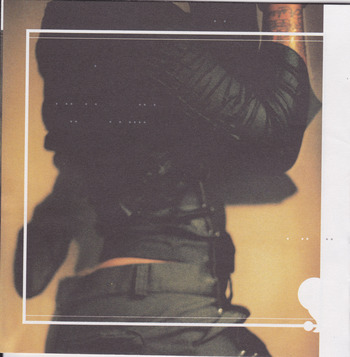
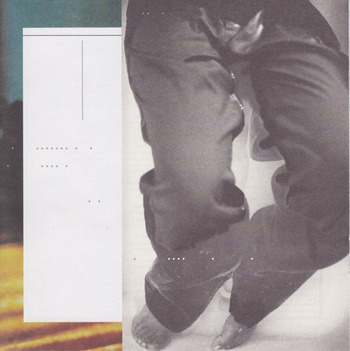
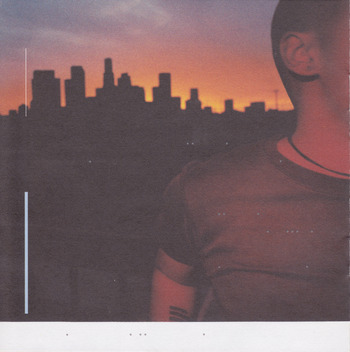
The liner notes frame fragments of her now yellow-toned, inactive, clothed body submerged in a full bathtub in the foetal position (as if a suicidal ideation). In all, the limited view of her body resists viewers' attempts to gender her (Figures 4–6). One of the final images in the booklet shows an androgynous portion of the artist against a city skyline, her skin colour edited to echo the shade of the sunset.
Critic Stephen Thompson writes of Bitter, ‘NdegeOcello's trademark is her deft ability to radiate both femininity and masculinity, and to sound undeniably sexual and exposed in either role; it adds a layer of fearlessness to a collection of songs that were pretty gutsy to begin with’ (Thompson Reference Thompson1999). Thompson argues that strength results from openness and vulnerability. Ndegeocello explains that, typically, assumptions about her gender miss the nuances Thompson describes:
I think people see me as this one-dimensional, angry, black, baldheaded dyke, but that doesn't even skim the surface of my personality. People think I'm butch, but I scream during scary movies. (Watson Reference Watson2002)
She challenges the negative stereotypes of butch women as impervious and lesbians/feminists as consumed with anger.Footnote 35 Ndegeocello complicates lesbian gender terms in a 1994 interview:
‘If you met me, I'm like – whatddya call it? I'm, like, wussy butch. I'm the most fragile person you could ever imagine. Yeah, that's very important,’ she says, laughing. ‘I'm far from butch, believe it or not. And not feminine, I guess. A femme in a butch body,’ she decides. (Phoenix Reference Phoenix1994)
But she also admitted to previously cultivating what Susan Fraiman might call ‘cool masculinity’ and used Bitter as a chance to explore vulnerability:
I had a lot of what I call female machismo, like I wasn't bothered by things that happened to me. … When I sat down and thought about them, I discovered that I am bothered. This album allowed me to talk about being vulnerable in relationships. I wanted to celebrate what I've been feeling, and deal with people I screwed over, and people who screwed me over. I think that women turn that on themselves a lot. They don't talk about it, and it becomes cancerous. (Moon Reference Moon1999)
Ndegeocello posits that ‘female machismo’ creates a harmful emotional shield (or fantasy of one), as though she is unaffected by others. Her next album, Cookie, addressed vulnerability in combination with female masculinity head-on through balancing images of herself (Figure 7) that show her to be both butch and emotive (side by side) with songs like ‘Barry Farms’, where she performs a mixture of strength, defiance, vulnerability and sensuality to model a response to just such a ‘cancerous’ situation. The song, named after a Washington, DC low-income housing project, addresses teenagers' homophobia. ‘Shorty’ makes a move on Ndegeocello's narrator.Footnote 36 But when word of this same sex relationship gets out, Shorty anxiously backs off and dates a boy. ‘Barry Farms’ stings with the pain of rejection, but builds a confident persona for the narrator.
Meshell Ndegeocello. Photograph by David Fenton, in Cookie: The Anthropological Mixtape. Copyright David Fenton. Used with permission.

Ndegeocello starts the song with an assertive musical role, comparable to the DJ in ‘Pocketbook’, by introducing a bass groove that references the five years she spent at the start of her career seducing DC go-go crowds to dance. An ‘anthropological’ interview clip with drummer Dwayne ‘Kiggo’ Wellman explains ‘go-go music is party music’. Her narrator's first words, ‘I'm gonna wind you up’, verbalise musical and sexual power over Shorty and listeners.
She takes narrative control of both characters to critique Shorty's actions and sympathetically render her own, accomplished by manipulating tone of voice, rhythm of vocal delivery, division of speech and song, and instrumental accompaniment. In the first three verses the narrator describes her mixed feelings about Shorty. First she describes in a boastful slow drawl, ‘she was about seventeen, ooh, just young and fine, mmm’. But then her slow, low-pitched voice expresses sorrow: ‘she had the kind of kisses/that make you sad’ – a line that ends with a poignant pause allowing the listener to imagine/recall what it feels like for kisses to induce sadness. Next she speeds through describing Shorty's frightened and/or homophobic self-policing: ‘she liked to flirt with me / then act like she didn't know me when her friends came around.’ Her slow, sensual vocality returns from the beginning of the verse, ‘But I didn't mind / ’cuz when her friends weren't around Shorty and I we'd hang out real tight', sarcastically emphasising that Shorty's ‘friends’ are homophobic, yet Shorty still cannot resist the narrator.
In the next verse, Shorty initiates a sexual encounter, almost as a test to the narrator. The joke, of course, is on Shorty for being naïve about the narrator's interest and prowess. At the end of this verse, Ndegeocello laughs on a separately recorded track, as though her narrator is reacting confidently from two different points in time.
The verse before the second chorus functions similarly as Shorty returns to tell the narrator that she misses her. The narrator calls her bluff, acting disinterested and aloof, saying in a slow, low voice ‘cool … tell me, tell me, what do you miss?’ And Shorty selfishly responds, ‘can't nobody eat my pussy the way that you do …’. All sound stops here as listeners' jaws drop with this explicit and hurtful statement (because Shorty selfishly misses only this one sexual act, not the entire relationship). Ndegeocello's chorus grows with the potency of pain and strength, directed at listeners and also at Shorty herself. The chorus is most vulnerable, using one of Ndegeocello's favourite techniques – she doubles her voice, both speaking and singing: ‘she couldn't love me without shame, she only wanted me for one thing … I need you when I feel pain.’ Mockus, in her article, develops Burns' analysis by arguing that Ndegeocello uses a low-register speaking voice to convey a butch character (herself), and a higher register singing voice to convey a femme character (Mary Magdalene) (Burns and Lafrance Reference Burns and Lafrance2001; Mockus Reference Mockus, Acampora and Cotton2007, p. 101). Ndegeocello's speaking and singing are often divided for different gender performances. Thus their unification for this line suggests that any person (regardless of gender) needs support from his/her lover. I argue that Ndegeocello also combines them simultaneously in choruses in which she has not created separate characters. Thus, her own regular narrative voice is both butch and femme.
Her other response to Shorty is pragmatic and self-valuing: ‘you can teach your boy to do that.’ The song ends with this same decisive statement and a break signalled by a short drum solo, before her bass part shifts to a commanding, sensual groove accompanied by organ. Even when she sings somewhat mournfully over this, ‘you're so fine / so sweet’, her palpable enjoyment of playing this erotic bass part seems to lessen the pain. The song ends with Dwayne ‘Kiggo’ Wellman saying, ‘When I play, I watch the women. Women party – chain reaction’. He reminds us of women's power in social and musical situations, in this case setting the room in motion. Critical, transgressive women's actions might positively impact those, like Wellman, who are guided by them. ‘Barry Farms’ contrasts this powerful motion with Shorty's superficiality and fear, which could set off a different, dangerous chain reaction in their social group. Ndegeocello's intentional integration of vulnerability with female masculinity aids this musical exploration of a painful, humiliating narrative.
Conclusion
Ndegeocello has learned to perform aspects of masculinity not to avoid femininity, but rather to broaden what being a woman is. This is precisely what Fraiman argues is lacking in Halberstam's praise of female masculinity. Ndegeocello's embodiment of masculinity is critical of norms – she says, ‘Masculinity that seeks to dominate is detrimental’ (Fullwood Reference Fullwood2002). Michele Wallace writes that the stereotypical gangsta masculinity is not essentially male, but is made up of features that would make any person, male or female, feel powerful. Wallace sees these as Hollywood fictions that would not allow a person to function in real life:
Masculinity is not an inherently meaningful designation. Such qualities as courage, heroism, militancy, aggression, competitiveness, coolness, grace, elegance in battle, rigidity, and sexual promiscuity are not qualities that only men have. They are qualities that are exalted in our society, and women who have them are just as likely to rise to the top as men, and perhaps just as likely to cause disaster in their personal relationships. The model of humanity such people employ is not real. It is a fantasy for men as well as women to think that you can be, in real life, a character in a movie. (Wallace Reference Wallace1990, p. 306)
Perhaps Ndegeocello embodies masculinity to resuscitate from negativity certain aspects of it that can be useful to men and women, but only when combined with qualities like vulnerability, typically associated with femininity, and employed with queer, anti-racist critique. Ndegeocello entitled her one of her recent albums The World Has Made Me the Man of My Dreams: ‘It was born from my mother telling me my man, my prince, would come. And he didn't come, so I became what I needed. Had to’ (Rodriguez Reference Rodriguez2010). While categorising Ndegeocello may be close to impossible, her pragmatic, critical and necessary musical reimagining of selfhood models a wide array of possibilities.
Acknowledgments
The author presented an early version of this paper at the 2004 Annual US Meeting of the International Association for the Study of Popular Music, where it was awarded the prize for best paper by a graduate student at the national conference, thanks to the initial support of Fred E. Maus, Susan Fraiman, Mary Simonson and David Cosper. A subsequent version appears in the author's dissertation, Sexuality, Listening, and Intimacy: Gender Transgression in Popular Music, 1993–2008. Shana is grateful for feedback from the 2010–2011 members of the Andrew W. Mellon Postdoctoral Fellowship of Scholars in the Humanities at Stanford University especially Brendan Fay, Kate Elswit, Lanier Anderson and J.P. Daughton, as well as Karli Cerankowski, Heather K. Love, the Princeton University Music Department, and two anonymous reviewers. Thanks are due to Matthew for www.freemyheart.com.