“The public is astonished by the determination of the foreign women,” proclaimed a West German television reporter on December 13, 1973.Footnote 1 “And rightly so,” she continued, “the foreign workers—women no less—threatened to disrupt the entire West German automobile industry.”Footnote 2 The 1971–1973 wildcat strikes at the Pierburg Auto Parts Factory (near Dusseldorf) did indeed send shockwaves through the West German auto industry. The summer of 1973 saw a sharp increase in workers' activism broadly, including a wave of “women's strikes.” On July 16, four thousand, mostly foreign, female workers went on strike at the Hellawerk Factory in Lippstadt; thirty female workers went on strike at the Opal factory in Herner; and seamstresses protested speedups in Cologne.Footnote 3 These strikes were part of a labor insurrection of men and women, foreign and German, that swept the country in the early 1970s as the postwar economic boom came to a crashing halt. Foreign “guest workers,” often the first to be laid off, bore the brunt of high inflation, rising prices, declining growth rates, widespread unemployment, and social discontent. For foreign workers, activism in the early 1970s had a larger significance than just securing better working conditions. Striking foreign workers were no longer seeking solutions to short-term problems; they were signaling that they were there to stay. Through their activism, “guest workers” created a different future for themselves in Germany by demonstrating political consciousness. Their actions also highlighted the unsustainability of the “guest worker” program itself—and their participation in it—as they shifted from temporary participants to more permanent actors within German industry and society.
After a brief introduction of the “guest worker” program, this article examines a few representative strikes that illuminate the implications of foreign workers'—especially women's—activism in the early 1970s. A closer look at a key strike at the Pierburg Auto Parts Factory in Neuss, West Germany, reveals more than just an argument against the sexist “light wage category II,” which allowed the company to dodge equal pay for equal work. In choosing to strike, these foreign women also asserted a new identity—one forged through their intersecting experiences as women, as foreigners, as “guest workers,” and as factory workers.Footnote 4 Ultimately, their labor activism benefited all workers at the factory and challenged the imposed category of “guest worker,” switching the emphasis from guest to worker. As such, these foreign workers stand at a crucial intersection of immigration history, labor history, and German citizenship debates.
The “Guest Worker” System
Across Western Europe economies grew at historic rates in the postwar era. German GDP per head more than tripled in real terms between 1950 and 1973.Footnote 5 The postwar rapid growth coupled with lingering labor shortages spurred West Germany (and Western Europe in general) to turn to foreign labor. Starting in 1955, West Germany used bilateral “guest worker” treaties to begin recruiting foreign workers from southern European and Mediterranean countries. Over the course of a decade, West Germany imported increasing numbers of workers from a variety of countries, with workers from Turkey forming the majority by the end of recruitment in 1973.Footnote 6
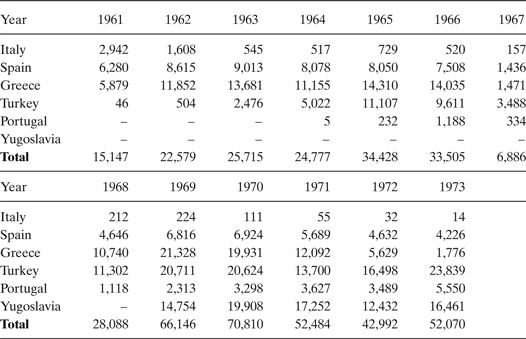
The “guest worker” arrangement was designed to recruit single, preferably male workers for a two-year stay in West Germany. However, this description rarely matched the applicant pool or employers' demands, given the need for female workers to fill jobs deemed “women's work.” Historian Monika Mattes notes that the dubious yet popular cliché of the male “guest worker” who later sends for his wife and children has yet to be seriously critiqued by scholars.Footnote 7 The increased demand for female labor occurred at the exact time that West German women were encouraged to leave the work force to restore nuclear families in German society. As a result, West German factories relied heavily on foreign women to fill so-called “women's positions.”Footnote 8 By 1973, at the peak of the “guest worker” program, there were about 2.3 million foreign workers in West Germany and more than 52,000 of them were women.Footnote 9 By the time of the Pierburg strike, there had been a long history of importing foreign female workers, starting slowly at first, dipping during the 1967 recession, and rebounding with a large surge beginning in 1968 (see Table 1). In the early 1970s, female workers from Turkey, Greece, and Yugoslavia formed the majority of foreign female “guest workers” in West Germany. (See Table 1)
Foreign Female “Guest Workers” in West Germany, 1961–1973

Source: Monika Mattes. ‘Gastarbeiterinnen’ in der Bundesrepublik Deutschland: Anwerbepolitik, Migration und Geschlecht in den 50er bis 70er Jahren. Frankfurt am Main: Campus, 2005. 39.
Origins of Foreign Labor Activism in Germany
Since the early nineteenth century, foreign workers in Germany have used labor activism, legal and illegal, to negotiate definitions of belonging; of local, national, and class identity; and of solidarity. Historian John Kulczycki has argued that ethnic Polish miners in nineteenth-century Germany, though aware of cultural and linguistic differences, worked together with their native German coworkers toward common working-class goals, with the main barrier to class solidarity being the German workers' prejudice against them.Footnote 10 What connects the nineteenth century movements with more contemporary protests is not only the role of migrants, but also the civic participation inherent in labor activism. For nineteenth-century foreign miners, according to David F. Crew, “occupation … provided the miner with an ‘integrated’ role in German society … [that] combined economic, social, and legal functions,” and it is this “occupational community” more than material deprivation that explains why workers strike.Footnote 11 In the case of postwar “guest workers,” occupational community cannot be assumed as a goal as many workers maintained a desire eventually to return “home.” However, through labor activism both supposedly temporary workers and their reluctant hosts often achieved “occupational community,” whether they intended to or not.
By the 1970s, foreign workers were well integrated into the West German economy, and the reporter's comments about the 1973 Pierburg Strike shutting down an entire industry were not hyperbolic: By the early 1970s, the West German construction, steel, mining, and automobile industries had become largely dependent upon foreign labor.Footnote 12 In 1973, 35.7 percent of all “guest workers” were employed in the iron and metals industry, 24.1 percent in processing trades, and16.6 percent in construction.Footnote 13 In 1973, 11.9 percent of all workers in West Germany were foreign. In other words, every ninth worker in West Germany was foreign; in the manufacturing sector, it was every sixth worker.Footnote 14 Yet despite the vital role they played, labor unions and smaller elected workers' councils often isolated foreign workers, while employers exploited them.Footnote 15 German labor unions were initially critical of “guest worker” programs, fearing they would depress wages and degrade working conditions.Footnote 16 However, unions strategically ended their resistance to the program in order to be involved in the planning process, for example, to secure the same wages across the board and to recruit foreign workers into their organizations.Footnote 17 By the end of the 1960s about 20 percent of foreign workers had joined unions—a significant number considering that only 30 percent of West German workers were organized.Footnote 18
“Guest workers” participated in and initiated both legal and illegal labor activism from the beginning of the program.Footnote 19 On April 30, 1962, in the city of Essen, 300 Turkish workers went on strike over underpaid Kindergeld, or child benefit payments, and the police responded with rubber bullets and by deporting ten of the strikers.Footnote 20 Turkish workers were indeed eligible for German child benefit payments, but not for children left behind in Turkey—an arrangement that did not suit the transnational families that the “guest worker” arrangement prompted. The West German Federal Labor Ministry complained that officials in Istanbul had been falsely promising workers benefit payments for children left behind in Turkey. Those on strike in Essen appealed to West German labor unions for help. They replied, “You're right, but there is nothing that we can do for you.” The foreign workers also appealed unsuccessfully to the Turkish Consulate in West Germany.Footnote 21 Neither the West German unions nor the Turkish consulate would represent these workers, placing them in a no-man's-land that mirrored their lived reality: not truly welcome in West Germany and yet no longer under Turkish protection.
Foreign workers' problems stemmed from the fact that “equal rights” were not “equal” for foreign workers. Both employers and the West German government deducted money for taxes, pensions, social benefits, and rent from workers' pay checks, regardless of whether or not foreign workers planned to take part in the social services such payments supported. A patronizing orientation pamphlet, titled Hallo Mustafa! explained that such deductions were simply a part of life and not meant to be understood by foreigners.Footnote 22 “You don't understand,” the pamphlet chided, “and can't tell the difference between gross and net pay, and most of all you don't understand the deductions for social benefits and taxes. … At first, you get the feeling that they are trying to take you for a ride with these complicated numbers and figures. … [Dear] Mustafa, in my opinion, you all are much too suspicious.”Footnote 23 However, Turks' suspicions were reasonable: The West German Liaison Office in Istanbul could not offer workers a clear idea of what their wages or benefits would be in West Germany, and the information they did distribute was often misleading, erroneous, or misunderstood.
Many “guest workers” were disappointed with their jobs for a variety of reasons ranging from low wages, strenuous working conditions, the risk of workplace injury, and general underemployment.Footnote 24 Most significantly, whatever the length of their stay, “guest workers” had few chances of promotion or overtime.Footnote 25 “In the beginning our wages were very low. [But] everyone who wanted to go didn't care about the wages very much,” reported a man from Bursa, Turkey, who went to West Germany in 1963. “[T]he [West German] government didn't give this much importance. … I earned 3DM per hour. A German worker doing something much simpler was earning about 6–7DM per hour.”Footnote 26
Foreign workers often had larger problems with their employers than their poor wages. Company housing was often a key point of exploitation of workers who had few alternatives but to live in company-supplied housing, with rent deducted from their paychecks. In a documentary film about the Pierburg strikes, one woman declared that the firm's housing represented “modern-day feudalism.”Footnote 27 She paid 60DM a month to live four-to-a-room with no running water. Furthermore, the building manager restricted all visitors, especially union representatives.Footnote 28 This “guest worker” emphasized that during the 1973 Pierburg strike, “foreign women haven't forgotten how they have been treated by the company.” She responded by drawing up fliers that proclaimed, “Does feudalism still exist?” The fliers cited the West German Constitution's Article 13, which stated that one is guaranteed freedom within one's home, including the ability to receive guests. Another female employee at Pierburg apparently paid 200DM in rent for a damp cellar room that had previously been used to keep pigs.Footnote 29 Such horrific housing problems, which were specific to foreign workers, engendered unusual and fraught relationships between employer and employee, fueling mistrust.
Foreign workers also suffered from poor working conditions. Akkordarbeit, the piecework system that many West German employers used with foreign workers, was particularly exasperating. According to Akkordarbeit, wages could vary based on the number of days worked and the completion of certain tasks.Footnote 30 A spinning factory's orientation booklet explained in Turkish, “As you know, nobody can work at the same speed and produce the same amount. … The Akkord system is simple. Whoever produces more gets paid more.”Footnote 31 Despite the system's “simplicity,” one former worker explained the potential for confusion and errors in an Akkord paycheck: “Because we worked on different machines … and different work was worth different amounts … sometimes there were mistakes; sometimes it says you were on a different machine than you were. Then you go to the boss, and he checks it with his notes … And then you go to the payment office, and they make corrections as well.”Footnote 32 Piecework also depended upon collaboration with German coworkers, too, leading to aggravation and misunderstandings due not only to language problems but also to differing work speeds. There were even reports that West German workers complained Turkish workers were “spoiling the Akkord” by working too quickly.Footnote 33
Foreign workers, especially women, were ripe for labor organizing as the West German economy began to decline in the late 1960s, and the “guest worker” system began to crack under the weight of long-standing problems. The particular hardships foreign workers faced, on and off the shop floor, coupled with their perceived temporary status often hindered solidarity with German colleagues. Yet despite their vastly different experiences, within many strikes there were imperfect moments of solidarity, when German and foreign workers came together, motivated by either common concerns or the potential for personal gain.
Economic Downturns and Worker Responses
A short-lived recession from 1966–1967 was the first point of stagnation in the postwar period to combine high unemployment and lower real wages. Correspondingly, this period witnessed the first significant wave of postwar labor activism, foreign and domestic, to spread across West Germany.Footnote 34 When the West German economy began to falter in 1966, employers reacted immediately by laying off around 1.3 million foreign workers.Footnote 35 Employers also responded by increasing mechanization and production speeds, worsening working conditions. Workers responded in kind. During September 1969, 140,000 workers from 69 different companies within the steel, metal, textile, and mining industries made news throughout West Germany with their labor strikes.Footnote 36 Shortly thereafter, the 1973 OPEC oil embargo prompted further economic downturn and stagflation, while workers' wages could not keep up with cost-of-living increases.Footnote 37 The West German “economic miracle'” had relied on increasing productivity by hiring more workers to use increasingly mechanized, faster machinery. At the same time, employers maintained low wages—wages that remained low especially in relation to profit margins, inflation, and the new speeds of production. The progressively insecure economic situation made workers' uprisings common.Footnote 38
Foreign and West German workers had varying degrees of solidarity in labor organizing in the late 1960s and early 1970s. In some cases, West German and foreign workers did not support one another, and yet both ultimately benefited, as was the case at the Hella Automobile Producer in Lippstadt, West Germany. On July 16, 1973, 800 German skilled workers received a raise of fifteen cents per hour, while unskilled, mostly foreign, workers received no increase.Footnote 39 In response, the foreign workers went on strike, demanding fifty cents more per hour, scaring the workers' council. “They will kill us if we force them to work!” claimed the president of the workers' council at Hella, referring fearfully to the 3,000 foreign workers from Spain, Greece, Italy, and Turkey who went on strike from July 17–19, 1973.Footnote 40 Their West German coworkers did not join the strike, offering instead mocking words of support, such as the awkwardly phrased, “You do good job!”Footnote 41 The foreign workers were, however, successful and, in the end, all workers gained raises of between thirty and forty cents per hour. The foreign workers had risked more than their German coworkers: They could have lost their jobs and their housing, as well as the work and residency permits they needed to stay in country.
There were also cases of temporary German-foreign solidarity, such as the strike at the Duisburg-Huckingen steel mill May 18–28, 1973. In this case, 380 of 700 workers went on strike over increasingly poor working conditions, including speedups and dangerous tasks, such as having to handle burning hot materials.Footnote 42 At first, organizers had not included Turkish workers in their plans for work stoppage. By the end of the strike, however, Turkish workers joined their striking West German colleagues, prompting management's attempts to fire them. This risky act of solidarity produced results: All workers received twenty-five to seventy cents more per hour.Footnote 43
In these two contrasting examples, a precarious occupational community was achieved: in the first case, through the result—raises for all; in the second, through joint involvement. In the end, whether they were foreign or native born, they were all, de facto “German workers,” even if they would not have acknowledged this at the time. In the majority of cases, foreign workers lent their support to West German workers; the reverse was less likely to occur.Footnote 44 One of the most famous strikes among foreign workers was prompted over vacation leave: the so-called “Turkish Strike” at the Cologne Ford August 24–30, 1973.Footnote 45 Because of the great distances foreign workers wished to travel during their vacations, in order to visit their homes and families in remote places like Turkey, they had different needs than their West German counterparts when it came to vacation allotments. This became a common source of conflict.Footnote 46 In 1973, Ford management fired Turkish workers who had returned late from vacation, and 300 Turkish workers protested with a strike and sit-in, against the wishes of their union.Footnote 47 Seeing an opportunity, German workers joined the strike to request higher wages for themselves. When the Metalworkers Union and the company's workers' council joined in, management agreed to a small wage increase to offset inflation. The German workers and union members were satisfied, but the company continued to ignore the Turkish workers, prompting outrage and an escalation of the strike. Turkish workers were 53.1 percent of the workforce, but only 12.7 percent of the workers' council.Footnote 48 A large fight, attracting police intervention, ensued, and the management fired many of the Turkish workers in retribution, leading to their deportation.Footnote 49 For the Turkish workers who remained, the outcomes were a repeal of some of the layoffs but also increased “resentment of the foreigners' rabble-rousing.”Footnote 50
Labor activism in the 1960s and early 1970s began to forge new and even surprising alliances between West German and foreign coworkers, even as the two groups continued to view each other as distinct. Over time moments of solidarity also worked to dissipate tensions between the two groups, as they demonstrated that the presence of “guest workers” in West Germany was perhaps more permanent than even the workers themselves had intended or were willing to acknowledge. That West Germans and foreign-born “guests” came together through labor activism is not surprising considering that the workplace provided the main sources of interaction. The Pierburg Strikes, the subject of the next section, present case studies that highlight both the tensions among different groups and, at the same time, the success they were able to achieve through solidarity. Foreign female workers initiated wildcat strikes at Pierburg over discriminatory wages but continued the strike to protest poor living conditions (especially housing) and inadequate union representation. But, by the end of the strike, all workers—male and female, foreign and German, skilled and unskilled—joined together in an increasingly effective coalition.
Postwar “Wage Categories” and the Pierburg Strikes
While scholars tend to pay more attention to the “Turkish strike” at Ford, the Pierburg strikes in Neuss, Germany, were arguably more significant, as they were spearheaded by foreign women, achieved full participation by all employees, and successfully challenged a federally-mandated wage system. Foreign women do not make up a very large part of the literature on labor activism in postwar Europe, but they, often acting in solidarity with women of different national origins, were the primary instigators of many battles over pay inequities for both foreign and German women. Women workers of various nationalities participated in the Pierburg Strike, and in this case gender provided the main source of solidarity. After an introduction to the history of the West German “wage categories,” this section turns to the Pierburg strikes that impacted both foreign and German women's wages.
West German “wage categories” differentiated and set the wages for “skilled” (often German men) and “unskilled” (often foreign and female) workers. The 1949 West German constitution guaranteed equal rights through a series of antidiscrimination guidelines in its Article 3. In response, a 1955 Federal Labor Court declared the existing “women's wage” categories unconstitutional. This ruling should have meant that women's salaries would increase by an average of twenty-five percent, or more. Employers, who understandably wanted to keep wages down, invented a new category, the “light wage category,” meant to designate unskilled and “light work,” to replace the now-illegal “women's wage category.” From 1955 on, companies argued that women's lower wages were not due to their sex, but because women had “less strength” and “lighter” work to do. When accused of renewed discrimination, employers countered that men were also employed in the light-wage categories. “Employers always get creative whenever it comes to the constitutional right of equal pay for equal work,” reported the West German weekly, Stern, in 1973.Footnote 51
Union leaders, most of them male, were generally unsupportive of female workers' causes and did not protest the creation of the light-wage categories. According to historian Ute Frevert, both employers and trade unions could agree on the new wage categories: For unions, higher wages for women might well have delayed the attainment of “more important trade union goals such as the implementation of the forty-hour week or the extension of paid holidays.”Footnote 52 In collective bargaining agreements, officials designated unskilled and semi-skilled jobs according to the physical strength required, while in skilled and professional jobs the degree of “responsibility” was the criterion used for classification. “Easy” and “simple” jobs were classified under Wage Categories I or II or, at best, under Wage Category III, while jobs that called for hard physical labor were generally classified under Wage Categories IV or V, which commanded considerably higher wages. In a kitchen furniture factory, where both men and women worked on assembly lines drilling holes into doors, the women were in Wage Categories I and II, but the men were in Wage Categories III and IV, based on the rationale that the men were drilling holes in “bigger and heavier doors.”Footnote 53 In short, the new wage categories quickly came to differentiate men's from women's work. A 1970s government-sponsored study on the proper criteria for job evaluation recommended that only physical exertion be used for assessment, but it could do no more than provide suggested guidelines to the private sector.Footnote 54
Foreign female workers in West Germany had long been performing heavy manual labor as “guest workers,” a category largely gendered male; at the same time, employers paid foreign women according to the light wage categories, gendered female, regardless of their jobs' degree of physicality. For “guest workers,” the German Employment Offices in Turkey defied the spirit of the 1955 ruling and openly listed wages as “Wage Category I (women)” and “Wage Category III (men).”Footnote 55 Protective legislation designed for female workers meant that foreign female workers were paid less, but not that they were excluded or actually “protected” from physically demanding jobs.Footnote 56 It was this hypocrisy, more than anything else, that prompted the strikes at Pierburg in Neuss.
With the importation of “guest workers,” foreign women became the new “women workers” of West Germany. “Expanded employment of German females was economically a reasonable and feasible step, but it was undesirable from the standpoint of ‘family policy,’” reported the industrial newspaper, Industriekurier, in a 1955 article explaining why “guest workers” were necessary.Footnote 57 Though this policy of encouraging West German women to stay home to rebuild nuclear families was primarily a product of the immediate postwar years, especially in contrast to its East German counterpart, the real need for female workers remained unchanged, and West German companies increasingly sought foreign women to fill vacancies in “women's work.”Footnote 58
Like many West German industrial companies, Pierburg Auto Parts, which supplied carburetors to most of the West German automobile industry, both relied heavily upon and profited from foreign female labor. Foreign workers, especially women, were drawn to these employment opportunities, as the Pierburg factory in Neuss was one of the few in its area to hire women.Footnote 59 Pierburg also recruited the wives of men working in the surrounding area's metal industry, in addition to foreign employees' wives, correctly guessing that working couples would put up with most any situation to be able to live in West Germany together.Footnote 60 By 1973, Pierburg employed 3,600 workers, among them 2,100 foreign workers and a total of 1,700 women (1,400 of them foreign) in the “Light Wage Categories.”Footnote 61 About 70 percent of the foreign workers at Pierburg were women, comprising the majority of all women workers, all of whom were in the lower wage categories.Footnote 62 According to German sociologist Godula Kosack, who researched the strike in 1976, Pierburg employed 900 Greeks, 850 Turks, 380 Yugoslavs, 300 Spaniards, 200 Portuguese, 150 Italians, and 850 Germans.Footnote 63 Women in the “Light Wage Category I” earned 30 to 40 percent less than their male colleagues. Pierburg's heavy reliance on foreign female workers made it ripe for a challenge to the discriminatory wage categories.
The first strike by foreign women at Pierburg took place in 1970, initiated by 300 Yugoslavian women who were the first to be hired by contract in 1969. Pierburg housed them in three barracks on site, prompting, in the words of a workers' council member, an “uncanny sexual state of emergency” and the subsequent banning of male visitors.Footnote 64 These women apparently went on strike to protest the restrictions on their personal lives as well as wage discrimination.Footnote 65 On May 15, 1970, foreign and German female Pierburg workers protested against “Light Wage Category I.” Citing poor working conditions, unequal work distribution, and gender discrimination in raises, 800 foreign and German women signed a resolution requesting higher wages for all female employees.Footnote 66 Management did not respond until the next day when around 1,000 women were standing in protest on the factory grounds. Neither the union nor the all-male, all-German worker's council at Pierburg supported this initial strike. According to a 1970 newspaper report, Pierburg's management was not above threatening the striking women, especially the foreign ones.Footnote 67 Various department heads attempted to scare off the women with the threat of firing and deporting them: “If you don't want to work, then you'll go with the police to the airport!”Footnote 68 The risk of deportation was real, as their West German residence permits were contingent upon proof of employment and housing. Despite compromise attempts, intimidation efforts, and police intervention, the women (who numbered 1,400 in the end) persisted until they achieved the following: twenty cents more per hour for Wage Categories II–V, a bonus of 20DM, and the establishment of a representative body to evaluate the Wage Categories of jobs.Footnote 69 After only a few days, management ended the strike by agreeing to eliminate Wage Categories I and II, but, in practice, Wage Category II remained.Footnote 70
Two years later, on June 7, 1973, becoming impatient about the promised wage reforms, three hundred female workers at Pierburg conducted a “warning strike” and made the following demands:
(1) The Wage Category II (WC2) must be eliminated. All women of WC2 must be re-categorized to Wage Category III (WC3). (2) Those with seniority should earn more than newly-hired workers. (3) Because there are no clean work places in the firm, every employee is to receive a supplement for the dirty conditions. (4) Everyone (male and female) is to receive an additional 1DM per hour. (5) The women who are working on the special machines are to be regrouped in Wage Category IV. (6) Workers must be paid for the wages lost during these proceedings [the strike]. (7) All of the women who perform heavy manual labor must finally be paid as much as men. (8) There cannot be any firings due to taking too many sick days. (9) Overtime may not be unfairly distributed. (10) Whenever one is sick and wants to go to a doctor, he or she should receive half a day paid leave. (11) One day a month should be paid for housekeeping [“housewife's day”]. … (12) Travel money must be increased. (13) Tomorrow everyone should be able to leave the factory two hours earlier to pick up his [sic] money.Footnote 71
The elimination of Wage Category II and a 1DM-per-hour raise for all workers were the main demands. In an attempt at solidarity, those on strike distributed fliers in workers' various languages—Spanish, Serbo-Croatian, Italian, Greek, and Turkish—proclaiming: “Two months ago, 200 of our workers mustered up the courage and went on strike for two days for higher wages.”Footnote 72 It continued, “[the company said it] would not be coerced by terrorists, [and] that the majority of the employees were satisfied with their wages, since they were not striking along with them … Colleagues, why didn't you support us and strike with us? The demands are still valid: 1DM more an hour for everyone! “Wage Category 2” must be eliminated!”Footnote 73 The organizers emphasized transethnic worker solidarity against management. After the union stepped in to negotiate, the strike ended on the second day. Management, however, maintained its goal of retaining the “Cheap Wage Categories” at all costs, leaving most dissatisfied.
Pierburg did not take the strike seriously and planned to fire and replace the 300 workers with new, and therefore more insecure, foreign workers in the fall. The June “warning strike” ended with the promise of negotiations between management and the workers' council, but new arrangements were not secured nor did the union follow up.Footnote 74 The foreign women who initially protested their placement in Wage Category II found little support among their coworkers, in their workers' council, or in their union. Company founder, Professor Alfred Pierburg, called and spoke to the chair of the workers' council, Peter Leipziger, on June 14, 1973 and promised that there would be no firings, only paid suspensions of those the council fingered.Footnote 75 The Workers' Council incriminated the striking women by reporting them to management (instead of representing their interests), and Pierburg deported six of the foreign women as a result.Footnote 76
After such an unsatisfying result, it is little surprise that foreign women at Pierburg went on strike again two months later, in August 1973, calling once again for the elimination of Wage Category II. The union would not support the strike and responded aggressively with an article in the union newsletter titled, “Guest Workers Are Not Discriminated Against: The Pierburg Strike is Illegal.”Footnote 77 In a press release that was translated into Turkish, Greek, and Italian, the Industrial Union of Metalworkers reported on August 15 that, “based on legal conditions in the Federal Republic, the Metalworkers Union cannot deem the work stoppage at the A. Pierburg Company legal.”Footnote 78 However, the press release continued, in order to dissipate the tensions, negotiations continued: “For some time the workers' council and the Metalworkers union have been negotiating with management for an equitable practice in the wage contracts. The hard work of the approximately 1,700 employees, especially the foreign women, is being unjustly characterized as ‘physically light’ (Wage Category II).”Footnote 79 The foreign female workers, however, lost patience with the negotiations and with the workers' council and carried out the strike on their own terms to great success.
The August 1973 Strike over Light Wage Category II
On Monday, August 13, 1973, as the 6 a.m. shift began to arrive at around 5:30 a.m., twenty foreign female workers distributed fliers, announcing that in an hour workers would go on strike for the elimination of Wage Category II and 1DM more per hour.Footnote 80 By 5:50 a.m., between 200 and 250 (mostly foreign) male and female workers stood before the factory gates, declaring their support for the strike. At first, the German foreman just observed. Then, at 6:30 a.m. sharp, he demanded that they get to work. Shortly thereafter, the police arrived with patrol wagons and demanded that the factory gates be cleared of the striking workers. According to documentation published by strike leaders in 1974, the following mêlée occurred:
One of the foremen fingers Elefteria Marmela—a Greek woman who, along with her husband, is a union member—as the organizer of the strike. As the police attempt to arrest Marmela, she resists and a scuffle ensues. Another Greek worker has a camera with him and snaps photos … The police respond by confiscating his camera. Another Greek man manages, however, to rip the camera out of his hand and throw it to another Greek worker. A new scuffle begins. Suddenly an officer grabs his pistol and screams, ‘Get back!’ A Greek woman steps up and yells, ‘So shoot me then! Or are you afraid?’Footnote 81
The police tried to arrest Marmela, who resisted and was injured; she returned with a bandaged arm. In the end, no one was arrested, but as the police wagons were pulling away, one officer apparently called back, “Dirty foreigners! I'll kill you!”Footnote 82 Three hours later, three VW buses filled with police officers arrived. This time, the officers surrounded the protesters and arrested three Greeks, two women and one man, who were held for ten hours and interrogated. The police presence scared off many of those on strike, so that at the beginning of the breakfast break, there were only 150 left on the picket line. The strikers cried “Everyone out!” in an attempt to secure solidarity with other workers. Their chants worked. By the end of the break, 600 additional workers (male and female) had joined the strike, completely stopping all production at Pierburg.Footnote 83
The following day, the entire early shift stood in front of the factory gates, about 350 people. At 6:30 a.m., three buses filled with police arrived, and officers jumped out and immediately began battering the protesters. Many foreign women were injured and subsequently hospitalized.Footnote 84 The police again attacked Marmela, injuring her severely. The media arrived, including television and radio reporters, and began filming beatings and scuffles that were aired later. The German weekly, Stern, published a photograph of two policemen dragging a foreign woman away by the arm.Footnote 85 Once the cameras began recording, the police pulled back and there were no more arrests. By 11:40 a.m. the factory had closed. The striking workers had achieved almost total solidarity among the 2,000 foreign workers, male and female alike; likewise, the Metalworkers Union now stepped in to protest the violent police presence.
On the third day, the strike continued, with the morning shift blocking the factory gates in the early morning light. Several foreign female workers went into the factory, changed clothes, punched in, and then returned immediately to the strike. As a result, management, which was still refusing to negotiate, locked the main gates and, in so doing, locked the women out. According to eyewitnesses, the breakfast break again resulted in solidarity between those striking in front of the factory gates, who were calling “Al-le-raus!” (“Every one out!”) to those still inside.Footnote 86 One participant recalled that, as workers greeted and hugged each other through the locked gate, they would break into tears and mutual hugs and the “will to strike remained unbroken.”Footnote 87 In order to hinder their reunification, management apparently hung a chain about ten meters from the factory gate, which the workers repeatedly pulled down; twelve female workers even stood on the chain so that it could not be pulled taut again.Footnote 88
As the strike entered the fourth day, the women achieved the final turning point—they won the German skilled workers to their side. As the strike escalated, the strike committee presented the following demands: 1DM more for all workers, an end to Wage Category II, payment for all days spent on strike, and no firings.Footnote 89 These were conditions German and foreign workers alike could agree upon. The deciding moment was when the most highly skilled German workers in the factory, those of the tool shop, presented management with an ultimatum and stopped working at 9 a.m. sharp.Footnote 90 When the factory gates opened at 9 a.m., the solidarity between the German and foreign workers, which now united all workers against the management, was boisterously celebrated. Eyewitnesses offer a slightly more romantic version of the same event: The striking women handed each entering worker of the morning shift a red rose, to which was attached the statement, “We are expecting you at 9 o'clock.”Footnote 91 The German-foreign solidarity “was a real blow to the management, who had hoped to break the strike through the loyalty of the German workers,” reported eyewitnesses. “From that moment on the strike was won.”Footnote 92 Telegrams from workers at other factories arrived to express support and solidarity.Footnote 93 An eyewitness reported, “Cash donations also arrived. Everyone stopped working. There were dances for joy as the German and foreign workers hugged each other. Foreign women fainted. The German workers … [who were] the skilled labor of the factory, gave an ultimatum to the management; at 10 a.m. you will have an agreement.”Footnote 94 In the end, the solidarity among the workers—male and female, skilled and unskilled, foreign and native—changed the course of the strike, riding the momentum the foreign women had already set in motion.
The following morning, the first results of the negotiations were made known: twelve cents more per hour, effective immediately, and, beginning January 1, 1974, twenty cents an hour more.Footnote 95 The results were disappointing, and a Turkish man called out, “If you stay at twelve cents, we will continue striking for twelve years!”Footnote 96 The negotiations continued, and at 1 p.m. the chairmen of the local employers' association also stepped in to thwart the spread of workers' uprisings (strikes had begun breaking out in nearby areas, such as in Lippstadt).Footnote 97 By 4 p.m. the decision was announced: Pierburg had eliminated Light Wage Category II, guaranteed a raise of thirty cents more per hour, and promised a 200DM cost of living bonus.Footnote 98 Together these two raises equaled fifty-three to sixty-five cents more an hour. Those on strike accepted the terms and declared themselves ready to return to work on Monday.Footnote 99 However, on Monday, 150 foreign women continued to strike for payment of the days on strike. Management attempted to block them with trucks and shouted at them with megaphones. An office window was broken and the police were called in. Again, the German skilled workers stood up on behalf of the striking workers until management met their terms. Management issued a “warning” to those on strike.Footnote 100 The real warning was to management, however, which learned through the course of the strike that the division of German versus foreign was becoming increasingly irrelevant, as the category of “worker” had expanded to include all.
The Strike's Impact
In the early 1970s, the Pierburg strike could have served as the perfect case study. However, it was largely misunderstood or ignored by contemporary feminists and progressive sociologists. The striking women at Pierburg did not necessarily view their actions in the same ways as their contemporaries, especially those drawing on negative stereotypes of Mediterranean women. A 1973 report told the story of Anna Satolias, a Greek woman who participated in the May 1970 strike, declaring at the end that becoming a migrant was a way for these Mediterranean women to find emancipation. In the article, Satolias describes her dissatisfaction with her working conditions thusly:
The work went from bad to worse, more production, more work, more workers, less working space. And the speed: faster and faster, the supervisor and the foreman shouting at us all the time—all that in the lowest wage category, which is called “light.” First I joined the trade union—like my husband—then we women started making demands. We wanted the abolition of Wage Category I, because the work was and is heavy and not light—and because Category I is supposed to be only for beginners, although we had been working five or six years in this category.Footnote 101
The article continues, pointing out that that same year Pierburg promoted Anna's husband, Nikiforus, to the position of toolsetter, and placed him together with his wife and her colleagues in the machine room. “Perhaps,” Anna said, “the firm thought we would be more docile then, because I would have to do what my husband said.Footnote 102 “Perhaps,” Nikiforus responded, “the firm thought that as a toolsetter I would earn so much that I could let my wife stay at home—and there were even colleagues who said such things aloud.”Footnote 103 Anna reported incredulously to the West German women's magazine, Jasmin: “The firm might well have thought that he would leave his wife at home, and I would obey him.”Footnote 104 Even though sociologist Kosack centers her 1973 discussion of the Pierburg strike on the strong figure of Anna Satolias, her thesis is a nationalistic one: migration to western Europe could be a step toward emancipation for foreign women. “This is a term [equal rights] that she [Anna] has learned in Western Germany for the first time.”Footnote 105
In a troubling way, Kosack locates foreign women's exploitation in West Germany solely in their home cultures, which are placed in marked contrast to that of their host country: “[Migrant women] are virtually their husbands' servants. Their activities are limited to those typical in their home countries and indeed for all women in pre-capitalist societies—the kitchen, the children and the appropriate religious rituals.”Footnote 106 The sociologist saw the strike as a sign of a rising tide of women's liberation movements and a raised consciousness, especially on the part of migrant women, who through their exploitation in West Germany had apparently come to realize a new feminist consciousness:
It is the extreme form of discrimination, which makes migrant women fight. They get much lower pay than male workers, have to suffer authoritarian behavior from the almost inevitably male foremen and, in addition, have a second day's work waiting for them at home—household and children—while their husbands consider it their right to relax after work. This obvious injustice mobilizes many migrant women against their previously unquestioned position as their husbands' servants.Footnote 107
However, to assume that migrant women were necessarily less progressive than West German women was a fallacy. It was not until 1956 that West German women were allowed to take jobs without their husbands' permission.Footnote 108 This interpretation fails to take into account migrant women's unique circumstances, which compounded gender discrimination and the poor conditions “guest workers” (both male and female) had experienced in West Germany over the previous ten years. It was these very foreign women from the Mediterranean, not West German women, who first instigated successful protests against sexist wages in West Germany.
The Pierburg strike also holds important lessons about West German women's political consciousness and the West German feminist movement in the early 1970s. Although foreign women protested the light wage categories before West German women did, this point was not always remembered. By 1973, West German women had not launched significant challenges to misuses of Wage Category II. One reporter wrote after the conclusion of the Pierburg strikes that foreign women's heightened political consciousness impressed him, especially when compared to that of German women: “German female workers of this wage category [II] have neither at the Pierburg factories or elsewhere demonstrated that they were prepared to strike.”Footnote 109 He continued with an even more stinging critique: “Among the German women of this wage category there is unfortunately missing, to a large extent, leadership personalities.” And yet, despite the significance of the Pierburg strike, it was all too easily forgotten in the larger narrative of the German women's movement. It was not until 1978 that media reports on West German women's efforts to challenge wage categories first appeared and, significantly, they did not reference the Pierburg strike at all.Footnote 110 The Pierburg strikes quickly faded from view. In these later reports, it is a German Industrial baker, Irene Einemann, who is credited as the first to challenge the sexist use of wage categories:
At long last, in the spring of 1978, Irene Einemann, a female baker's assistant in the North German city of Delmenhorst, filed suit demanding that her pay be brought up to the level of her male colleagues and won the case. Her wage was raised from the previous DM6.86 per hour to DM8.24 per hour, plus an additional supplement of DM100 [that] her male counterparts were earning also, and the decision was made retroactive, with back pay due her as of January 1, 1976.Footnote 111
When reporting on Einemann, syndicated newspaper commentator Tatjana Pawlowski, five years after the Pierburg strike, (falsely) credited Einemann as the first to stop “complaining” and protest her Wage Category: “Injustice cannot be overcome if justifiable criticism limits itself to complaining …Who, until now, would have had the courage to oppose the long-established wage policies of many industrial enterprises?”Footnote 112 The courageous actions of the striking foreign women in 1973 at Pierburg seem to have been forgotten or lost on the broader West German population.
These lesser-known strikes provide important lessons about solidarity and the conditions that support it. First, certain homogenizing conditions—such as poor worker housing and discrimination—promoted solidarity among foreign workers, uniting even antagonistic national groups such as Turks and Greeks in new ways. Also workplace sexism, wage differentials, and low representation among women encouraged solidarity among foreign and native women. Finally, the solidarity of all workers, despite the union's disinterest, provided the tipping point for the illegal Pierburg strike, which challenged the traditional role unions have played in representing workers and negotiating on their behalf.
The impact of the Pierburg strike and other strikes led by foreign workers in the early 1970s were not one-dimensional. Indeed, the Pierburg and Ford strikes were not truly “foreigners' strikes,” as all of the strikes fundamentally altered the working conditions, workers' solidarity, and wage structure of the entire West German economy by challenging the wage categories and the exploitation of foreign labor upon which it depended. Significantly, the strikes drew attention to the long-term effects of labor models that were meant to be “temporary fixes,” such as the “guest worker” program itself.
Conclusion: Her Fight is Your Fight!
“That is no longer a strike. That is a movement!” declared Federal Chancellor Willy Brandt about the 1973 “Turkish Strike” at the Cologne Ford plant.Footnote 113 The Ford management apparently replied with resignation, “Over the years, we have discovered that foreigners came to us with a much too highly developed confidence.”Footnote 114 Both Brandt's and the Ford management's comments effectively invoked the new image of “guest workers” in 1973 West Germany. After more than a decade of life and work in West Germany, they had indeed developed a political awareness that was effectively channeled into a successful labor movement. “The power that lay behind such a strike [at Pierburg] in the automobile parts supply industry demonstrates, for the first time, a real threat to West Germany's Fordist production model,” commented journalist Martin Rapp in 2006.Footnote 115 However, the Pierburg strikes challenged more than just the West German economic and industrial model. In 1979, economist Martin Slater reported that foreigners' successful labor activism—not just the recession of 1973—directly affected employers' decision to end the recruitment of temporary foreign labor:
[Foreign] migrants, by the early 1970s, had increasingly come to be regarded as a … political burden …[Migrants] had come to be regarded as [a] social liability … [due to their] own political transformation. By the early 1970s, the docile, hard-working migrant of the 1950s and 1960s had apparently transformed into a radical member of the working class. … Following close on the heels of protests and demonstrations by migrants over their housing conditions, these strikes were seen by governments as a sure sign that migrants were politically unreliable.Footnote 116
In other words, “guest workers'” political consciousness and transformation into members of a larger, national working class helped to end the exploitative labor-recruitment program. As a result, the official end of the German “guest worker” programs was in 1973. However, the year 1973 is a false end to the “guest worker” program, which was in many ways never temporary and never really ended, as this population continues to impact Germany today.
The narrative of the Pierburg strike is neither a tale of victimization nor a triumph of good over evil. Rather it tells of an evolution and slow integration of a supposedly temporary migrant population into a larger class and national consciousness. Foreign workers' activism and collective bargaining, which occurred from the 1960s through 1973, provided an early sign of foreign workers' commitment to West Germany as their home—a transition occurring earlier than scholars have previously acknowledged.Footnote 117 Historians have long connected the decision to stay in West Germany as occurring after the 1973 official end of recruitment. However, I would argue that foreign workers, who had been saying for over a decade that they planned to return home, demonstrated even earlier, through their activism, a more permanent investment in West German society. Workers' protests, whether about housing or wages, demonstrated solidarity across nationalities and with West German coworkers alike. During these strikes, foreign workers participated in German industry as “German workers” (consciously or not) and impacted German policy even if they were not officially included in the national polity, calling into question later conservative claims about foreign workers' rights to German citizenship.
Foreign workers' dynamic roles in strikes and protests is not surprising, considering that workers were not just reacting to poor conditions at work, but also to poor conditions in employer-managed housing as well as memories of their deplorable train rides to West Germany and the long and tedious application process that preceded those trips.Footnote 118 However, material conditions alone cannot explain labor activism: There was also a more complicated social reality embedded in “guest workers'” negotiations with their increasingly permanent lives in West Germany. Labor activism for foreign workers in the 1970s served an integrating function by combining demands for economic, social, and, in some cases, legal parity—demands that signaled a claim on “occupational community” and a newfound sense of permanence in West German society. These strikes raised important questions about who was a de facto German citizen and “German” worker long before the immigrant population dominated public political debates.