Introduction
Systemic family therapy (also called family and systemic psychotherapy) is one of the major evidence-based therapeutic approaches used within the National Health Service (NHS) in the United Kingdom. The term refers to a range of psychological interventions for individuals, couples, and families based on systemic concepts and theory, and designed to help people make changes in their thinking, behavior, and understanding to relieve distress, improve the quality of their important relationships, and make positive changes (Association for Family Therapy & Systemic Practice, n/d). This is the definition used in this review.
The term “family” refers to a group of people who care about each other: they may or may not be related. Thus, although the term family therapy appears to exclude those who live alone or have no family ties or connections, it should be interpreted broadly as it accommodates interest in diverse issues. The term Social GRRAACCES is a useful acronym which invites consideration of, and reflection on, gender, race, religion, age, abilities, class, culture, ethnicity, and sexual orientation (Divac and Heaphy, Reference Divac and Heaphy2005; Benbow and Goodwillie, Reference Benbow, Goodwillie, Laidlaw and Knight2010).
Family therapy developed across the world primarily in services for families with children and adolescents. The initiative called Improving Access to Psychological Therapies (IAPT) has moved toward making the benefits of talking therapies more generally available in England, and this involves extending talking therapies to people with physical long-term conditions (Department of Health, 2011) and improving access to talking treatments for older people. The four-year action plan for talking therapies (Department of Health, 2011) specifically mentions dementia care and work with caregivers, as well as the need to be flexible in service provision in terms of offering longer treatment sessions and/or treatment in different, more appropriate venues. The NICE/SCIE (2007) dementia guideline includes the use of family therapy in a case example and notes that
joint interventions with the person with dementia and family carers, such as family therapy, recognize the fact that the diagnosis does not impact on just one person but on a whole family system . . .(p. 88).
Twenty-five years ago, one of the authors (S. M. Benbow) took the first tentative steps in working with families in a geriatric psychiatry family therapy team setting, and published on using the family life cycle (Benbow et al., Reference Benbow1990) followed by a review of family therapy and dementia (Benbow et al., Reference Benbow, Marriott, Morley and Walsh1993). Personal learning has continued, but much has changed since then: Dementia has become acknowledged as a global issue in health and social care (Alzheimer's Disease International, 2010; World Health Organization, 2012). We report here a review of the literature on family therapy and dementia published since 1992 with the aims of identifying the following: What we know about the use of family therapy in the context of living with dementia; what are the challenges of working in this context; and what guidelines or models are available to guide family therapists working with families living with dementia.
Methods
We searched Medline, CINAHL, and PsychInfo from the year 1992 onwards for English language papers using the following strategy: (family therapy or couples therapy, or marital therapy) and dementia. This identified 22 papers, to which we added a further nine from the reference lists of papers identified and from our own collections, giving a total of 31 papers included in the review.
We intended to assess identified papers for quality using a modified version of the Standard Quality Assessment Criteria for Evaluating Primary Research Papers from a variety of fields (Kmet et al., Reference Kmet, Lee and Cook2004), but the focus of identified papers was broad, and to narrow the quality criteria would have excluded many of those identified; similarly classifying papers by psychotherapeutic models limited the number of papers eligible for inclusion. Therefore, we opted instead to include all the papers in the review, to classify them into broad categories of theoretical, expository (i.e. setting out an explanation of, or commentary on, the use of therapy), or research (descriptive, quantitative, or qualitative), and to draw learning points from these in a narrative review.
Results
Psychotherapeutic model
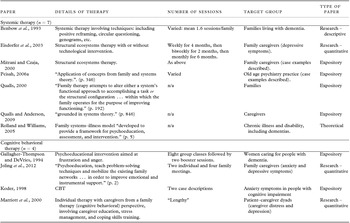
Of the 31 papers included in the review, 17 could not be assigned to a model: they described complex interventions (four papers); nonspecific interventions (seven); or focused on other areas (methodology (two); ethics (one), and family characteristics (three)). A total of 14 papers were assigned to a broad model: four to cognitive behavioral/behavioral/psychoeducational (cognitive behavioral therapy or CBT); seven to systemic; one mixed; and two psychoanalytic. The two psychoanalytic papers (Garner, Reference Garner1997; Evans, Reference Evans2004) focused on the application of psychoanalytic theory and understanding to later life contexts. The mixed model (Lévesque et al., Reference Lévesque2002) involved a group intervention, which appeared to combine elements of systemic therapy and CBT. Details of the 11 papers describing systemic therapy and CBT are set out in Table 1.
Systemic therapy and CBT papers identified in the literature search

Narrative review
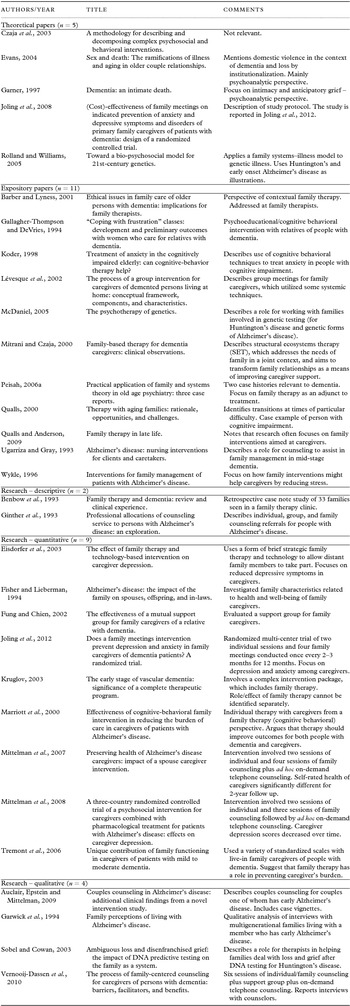
Of the 31 papers identified, five were classified as theoretical; 11 as expository; and the remaining 15 as research (two descriptive; nine quantitative, and four qualitative research). See Table 2 for details.
Papers identified in the literature search with broad classification and comments

Theoretical papers (n = 5): Two of the theoretical papers described methodologies. In one case the paper described methodology for developing complex interventions (Czaja et al., Reference Czaja, Schulz, Lee and Belle2003), and in the second the paper described the development of a research protocol (Joling et al., Reference Joling2008). The results of the research study carried out using the protocol were published in a paper included in the category of quantitative research (Joling et al., Reference Joling, van Marwijk, Smit, van der Horst and Scheltens2012). The remaining three papers include some applications to practice: two explore their topics through a predominantly psychoanalytic lens. Evans (Reference Evans2004) looks at a variety of theoretical approaches (including attachment theory) and uses illustrative case descriptions. She addresses domestic violence in the context of dementia, sexuality, loss by institutionalization, and death of a partner. Garner (Reference Garner1997) focuses on intimacy, anticipatory grief, and grief. She notes that apparently abnormal reactions of family members might be part of the process of coming to terms with the reality of dementia in a close family member, and suggests that anticipatory grief might be a coping mechanism. Two important points Garner (Reference Garner1997) makes are that professionals need to acknowledge the meaning of dementia, its symptoms, and losses for family members, and that staff working in the area need to be skilled in providing psychological support. The fifth theoretical paper (Rolland and Williams, Reference Rolland and Williams2005) applies a family systems–illness model to genetic illness using Huntington's disease and early onset Alzheimer's disease as illustrative case examples. The authors write about the different phases, namely pre-genetic testing; the immediate testing period, and post-genetic testing. It might be interesting to extrapolate their model to the period before, during, and after memory clinic diagnosis of dementia. They state that “we need a model that considers the unfolding of illness-related developmental tasks over the entire course of a disorder” (Rolland and Williams, Reference Rolland and Williams2005, p. 5). This paper overlaps the paper classified as expository which addresses “the psychotherapy of genetics” (McDaniel, Reference McDaniel2005).
Expository papers (n = 11): Several of the expository papers do not describe family therapy but instead describe other psychotherapeutic interventions applied to family members, sometimes for clearly defined indications, e.g. Koder (Reference Koder1998) used a cognitive behavioral approach to address anxiety among people with cognitive impairment. Qualls and Anderson (Reference Qualls and Anderson2009) make an important point in noting that the literature often focuses on family interventions aimed at caregivers, rather than what would be understood as family therapy per se: the overlap between these two areas was evident in endeavoring to design a search strategy for this review. Qualls and Anderson (Reference Qualls and Anderson2009) specify particular techniques, which they regard as useful, including specific assessment techniques such as family interviews, genograms/family trees, the observation of family conflict, and enactments. Other expository papers describe complex interventions, which involve family therapy alongside, or as part of, other interventions, e.g. Gallagher-Thompson and DeVries (Reference Gallagher-Thompson and DeVries1994) describe a psychoeducational/cognitive behavioral intervention conducted with the relatives of people with dementia; Lévesque et al. (Reference Lévesque2002) describe group meetings for family caregivers which utilized some systemic techniques (notably reframing). Structural Ecosystems Therapy (SET) is described as an intervention “to improve the caregiver's interactions within her or his entire social ecosystem (family, community, health providers, etc.) to increase the extent to which the caregiver's emotional, social, and instrumental needs are met and, in turn, improve psychological adjustment” (Mitrani and Czaja, Reference Mitrani and Czaja2000). The model described combined systemic and ecosystem approaches and was delivered over a 12-month period: weekly for the first four months, then fortnightly for two months, and finally monthly for six months. The complexity of models employed in these papers makes it difficult to disentangle details of family therapy, and to assess its effect.
In terms of learning about practice, McDaniel (Reference McDaniel2005) makes a case for working with families involved in genetic testing; Peisah (Reference Peisah2006a) makes the case for family therapy as an adjunct to other dementia treatments; Ugarriza and Gray (Reference Ugarriza and Gray1993) argue that there is a role for family counseling in mid-stage dementia to help families manage the changes they are facing; Wykle (Reference Wykle1996) focuses on the potential role of family interventions in reducing caregiver stress; and Qualls (Reference Qualls2000) identifies transitions as times of particular difficulty/opportunity (so, for example, when someone with dementia moves into institutional care, Qualls (Reference Qualls2000) argues that family counseling might be beneficial).
Barber and Lyness (Reference Barber and Lyness2001) write about ethical issues and their implications for family therapists. They identify six ethical dilemmas: determining the extent of filial responsibility; equity in caregiving; competing commitments; balancing the care recipient's autonomy/independence with safety/well-being; knowing what the care recipient wants; and financing care costs. They relate these to the ethical principles of respect for autonomy, beneficence, non-maleficence, and justice plus two others: truth telling and filial obligation, and the authors argue that family therapists should explore ethical dilemmas with families they see in order to help them in decision-making.
Research papers. 1. Descriptive research (n = 2): Two papers were classed as descriptive research. One (Ginther et al., Reference Ginther, Webber, Fox and Miller1993) examines individual, group, and family counseling referrals for people with Alzheimer's disease in California, United States. Although the authors conducted logistic regression on their data, the value in terms of our review lies in the description of referrals to these three therapeutic modalities and why staff members were thought to refer to each. Family counseling was regarded as appropriate to offer to families when the person with Alzheimer's disease deteriorated, and in order to help families adjust to loss and the practicalities of caring. The authors note that pre-existing family conflicts may be exacerbated by increasing care needs, and that the aim of counseling was to help families continue caring. One interesting finding is that payment source was found to influence referral for counseling more than perceived need, but the importance of this factor will undoubtedly depend on the health system within which the family is living, although the influence of finances on care in many settings may be easy to underestimate.
The second descriptive paper is the United Kingdom-based study of referrals of families where one member was living with dementia in an old age psychiatry-based family therapy clinic (Benbow et al., Reference Benbow, Marriott, Morley and Walsh1993), comparing them with families attending the clinic for other reasons. The authors report that families coping with dementia attended for fewer family meetings per family, but that more family members attended per meeting, and that sons and daughters-in-law were more likely to attend. The paper refers to three possible roles of family therapy: as a primary agent of change; as a preliminary to accepting treatment; and as an adjunct to other treatments. An important point about evaluation of family therapy made here is that outcome could be assessed from a number of perspectives, e.g. that of the referred person; that of the family as whole (or each family member separately); and from the perspective of the service or referring agent. In some of the research papers discussed below, only the perspective of caregiver/family member is addressed and this may be a weakness of these studies.
Research papers. 2. Quantitative research (n = 9): Several papers focus on the effect of family interventions on caregivers’ mood, particularly depression (Eisdorfer et al., Reference Eisdorfer2003; Mittelman et al., Reference Mittelman, Brodaty, Wallen and Burns2008; Joling et al., Reference Joling, van Marwijk, Smit, van der Horst and Scheltens2012), but also anxiety (Joling et al., Reference Joling, van Marwijk, Smit, van der Horst and Scheltens2012). The effect of family therapy on caregiver burden has also been an area of investigation (Marriott et al., Reference Marriott, Donaldson, Tarrier and Burns2000; Tremont et al., Reference Tremont, Duncan and Bishop2006) as well as caregiver health/well-being (Fisher and Lieberman, Reference Fisher and Lieberman1994; Mittelman et al., Reference Mittelman, Roth, Clay and Haley2007). One paper involves a complex intervention package but the role/impact of family therapy cannot be separately identified (Kruglov, Reference Kruglov2003): This study involved rating the impact of the intervention on people with dementia in terms of psychopathological symptoms and level of activity. A further paper reports the effectiveness of a support group for family caregivers rather than therapy (Fung and Chien, Reference Fung and Chien2002).
Mittelman's seminal work with caregivers of people with dementia is well known. She reported on a family intervention package, which involved six sessions of individual (two sessions) and family counseling (four sessions) over a period of four months, plus support group membership, plus ad hoc on-demand telephone counseling (Mittelman et al., Reference Mittelman, Roth, Clay and Haley2007). In 2009 she described a similar package, namely five sessions of individual (two sessions) and family counseling (three sessions – including at least one family member other than primary caregiver) in the first three months – this is referred to as the New York University (NYU) model – followed by ad hoc telephone on-demand counseling (Mittelman et al., Reference Mittelman, Brodaty, Wallen and Burns2008). The therapy is described as involving education and information as well as help in understanding behavior. Mittelman et al.'s (Reference Mittelman, Roth, Clay and Haley2007) work looked at caregivers’ self-rated physical health/number of illnesses, and depressive symptoms (Mittelman et al., Reference Mittelman, Brodaty, Wallen and Burns2008), and also suggests that family intervention can delay nursing home placement, especially in the early to middle stages of Alzheimer's disease (Mittelman et al., Reference Mittelman, Ferris, Shulman, Steinberg and Levin1996; Reference Mittelman, Haley, Clay and Roth2006).
Research papers. 3. Qualitative research (n = 4): The use of couples therapy has been described for couples including one partner with early Alzheimer's disease, with its purpose being “to preserve the integrity of the relationship and the sense of self of each partner when one of them is diagnosed with Alzheimer's disease” (Auclair et al., Reference Auclair, Epstein and Mittelman2009. p. 131). The approach underpinning the counseling is described as “looking at the members of a couple as equal players in the marital drama (which) offers an affirming view of their relationship and its capacity to embrace change” (Auclair et al., Reference Auclair, Epstein and Mittelman2009, p. 132). The authors offer a series of vignettes as qualitative evidence of the value of the approach, which involved six couple therapy sessions within a two-month period.
Sobel and Cowan (Reference Sobel and Cowan2003) interviewed family members who had undertaken DNA testing for Huntington's disease and conclude there is a role for family therapists to help families deal with the subsequent loss and grief. The third qualitative paper involves interviews with counselors who had delivered the NYU family intervention (Vernooij-Dassen et al., Reference Vernooij-Dassen, Joling, van Hout and Mittelman2010). Family problems (and ways of dealing with them) were identified as major themes and include family conflicts; the influence of personality and past experience; and living with dementia. Barriers encountered by counselors (and ways of dealing with them) are further themes and include reluctance to be helped, but the counselors involved regard the rewards of helping the families as outweighing these barriers. Garwick et al. (Reference Garwick, Detzner and Boss1994) describe the qualitative analysis of family interviews of families with a member with early Alzheimer's disease. They report that the families involved in the project feedback how beneficial they had found talking as a family, and the authors recommend that a family meeting should be held at the time of diagnosis of Alzheimer's disease, observing that “new meanings and interpretations” often emerged during the discussions. They note that families may exclude a member (not always the person with dementia), because of denial of the disease or the person's cognitive impairment or disagreements about roles and responsibilities, and that this could be a reason for family intervention. They also comment on families’ needs to redefine tasks and responsibilities; to adjust to grief and loss; and to adapt family rituals (e.g. those associated with celebrations) in order to continue to include the person with cognitive impairment.
Discussion
Much of the literature, which purports to focus on family therapy/counseling and dementia, in fact focuses on the main caregiver, uses some techniques drawn from family therapy, or includes family therapy as part of a complex intervention package. The papers which employ therapy/counseling often only give a brief broad indication of the model or approach utilized. The two main models of therapy identified in the review were systemic therapy and CBT. CBT was primarily used to target specific symptoms; including anxiety in people with cognitive impairment and anxiety/depressive symptoms in caregivers. Much of the systemic literature identified rests on description or case studies. Part of the underlying problem is that research remains linear, rather than systemic, in its focus, and investigates outcomes for the patient or caregiver rather than looking at changes in the system in which they are embedded. This linear research perspective may be influenced and organized by a narrow understanding of dementia as due to organic disease and associated with the aging process. This understanding may create ambiguities, especially when dementia affects younger people: dementia does not discriminate on the grounds of age, gender, class, and culture. A systemic perspective requires consideration of how we talk about dementia, the language we use, and the questions we ask the person living with dementia, their caregiver, and family members.
The future research would benefit from clarity regarding the therapeutic model employed and its application in practice; evaluation of both family and patient outcomes; and evaluation of broader change within the system. Endeavoring to investigate systemic outcomes will necessitate a way of evaluating collaboration, the mutual exchange of ideas/views between family members and health and social care staff members, and the mutual construction of outcomes, which may be different from the ones originally anticipated (Benbow, Reference Benbow2012). In this way a systemic perspective on the problem determining and dissolving system (Anderson and Goolishian, Reference Anderson and Goolishian1996) would open up multiple perspectives, truths, and realities in how we understand “dementia,” and its “management.”
Our review identified papers which used a variety of outcome measures, including caregivers’ mood (depression or anxiety), health/well-being and burden, and nursing home placement. Martire and colleagues (Reference Martire, Lustig, Schulz, Miller and Helgeson2004) carried out a meta-analysis of psychosocial interventions (“interventions that involved a family member” p. 600) for chronic illness, which included dementia, and noted that goals might be to improve the health and/or well-being of person with dementia, family member, or both. They found that the strongest evidence for efficacy of family interventions (as defined by them) was in relation to family burden: family interventions reduced the caregiving burden of those family members caring for people with dementia. It also appears that such interventions led to the closest family member feeling less depressed and burdened; and family members’ anxiety is reduced when a focus on relationship issues between person with dementia and caregiver was included in therapy. Depression among people with dementia is only reduced when the work focuses on couples.
Thus, evaluation of therapy is complex. One complication in evaluating outcomes is that of biased aims, e.g. if the aim is specified as being to support family caregivers to carry on caring (Ginther et al., Reference Ginther, Webber, Fox and Miller1993), then a decision for the person with dementia to move into a care setting would constitute a “failure” of treatment; but who is to say that this is not the best decision for the family and individual involved? Treatments aimed at benefiting families should logically be evaluated from a variety of perspectives, including that of the person living with dementia and the referring agent (if one is involved). This might also be a useful principle to apply in routine practice. Marriott and colleagues (Reference Marriott, Donaldson, Tarrier and Burns2000) focused their cognitive–behavioral family intervention on the caregiver, aiming to reduce caregiver's stress and distress, but they hypothesize that improvement in caregivers’ management skills would lead to an improvement in outcomes for people with dementia. Similarly, Fisher and Lieberman (Reference Fisher and Lieberman1994) argue that programs should focus on the multi-generational family rather than just the caregiver, since dementia impacts the whole family. Family therapists work to promote family members’ resilience in terms of their practical, psychological, and emotional responses to illness and later life issues. The focus may be on decision-making, dilemmas of care provision at different stages of dementia, and restructuring of family functioning: for example, deciding the type of care needed, who the primary caregiver might be, available resources, and social networks.
Evaluation should be underscored by attention to what is being measured and why. Who decides whether a particular outcome is positive? If different people rate outcomes differently, then this needs to be acknowledged rather than privileging one particular perspective or one preferred outcome. Assessing outcomes from multiple perspectives appears to make sense, but the differing perspectives and aims of various stakeholders will complicate any conclusions that might be drawn.
Many family therapy outcome measures have been developed and are supported by published literature, but have not been adapted for or evaluated with later life families: this is probably not surprising as family therapy developed in response to families presenting with difficulties in childhood and adolescence (Dallos and Draper, Reference Dallos and Draper2010). One example of a tool is the SCORE-15 Index of Family Functioning and Change (Stratton, Reference Stratton2014), a freely available self-report tool which has been developed in the United Kingdom with the support of the Association for Family Therapy and Systemic Practice (n/d). Some of these tools have been available for a number of years, for example the Evaluation and Nurturing Relationship Issues, Communication, and Happiness (ENRICH) Marital Satisfaction Scale (Fowers and Olson, Reference Fowers and Olson1993). The application and/or modification of existing tools to work with later life families are an area for the future research.
Challenges for family therapy and dementia
The challenges for family therapy in relation to families living with dementia can be divided into the context; the family; and the therapy.
The health and social care context offers challenges in terms of making family therapy available to families. Depending on the care system, therapy may have to be paid for (Peisah, Reference Peisah2006b). If this is the case, the question of payment may influence whether therapy is even suggested as an option (Ginther et al., Reference Ginther, Webber, Fox and Miller1993) and family finances may be a barrier to treatment. In some systems, therapy for specified conditions may be publicly funded (e.g. the IAPT program was initially aimed at people with anxiety and depression and made available as part of the NHS), but this may involve limiting the number of sessions paid for from public funds.
In the United Kingdom, there are very few NHS family therapy positions working with older adults and their families compared with child and adult services. The paucity of clinicians working in older people's mental health services who are trained in systemic formulation and the use of family therapy are barriers in making therapy available more widely. Those who are trained in family therapy are often social workers, and family therapy for older people is rarely a part of the family therapy training curriculum in any discipline. Our current definition of dementia may constrain how people live with and manage dementia: it influences what we believe about the condition, how to be a “good dementia patient,” and how to be a “good caregiver,” instead of supporting families to find ways of living well with dementia. It may also account for the distribution of the trained workforce in the treatment and management of dementia.
Current trends toward increased home-based health and care provision suggest that health and social care professionals working with families living with dementia need to acknowledge and reach out to voluntary groups as core care providers. Promoting access to family therapy at local community level requires recognition of the differences of approach between medical healthcare, mental healthcare, and social care professionals and an understanding of psychological interventions for long-term illnesses. The approach, method, and technique of working with voluntary sector groups introduce a new definition of relational help for a relational problem (Burnham, Reference Burnham1992). Making systemic family therapy available and accessible at local community level requires flexibility and is about thinking on, in, and out of the box (Child, Reference Child2013). Family therapists working in mixed sectors, outside the NHS, are bringing specialism and generalism closer together, and widening the scope of family therapy work to meet people's needs in both statutory and voluntary sectors (Child, Reference Child2012). Increased availability of therapy for families living with dementia requires the development of theoretical frameworks, including ethical consideration in working with private and voluntary sectors and the need to build collaborations across sectors. Medical and technological advances in health and care provision offer further opportunities and/or challenges, e.g. there is increasing interest in the use of the Internet in therapy provision.
In many areas there is a need for knowledge and skills in working with multiple languages, cultural beliefs, and values (Dementia Plus, 2001). Dilworth-Anderson and Gibson (Reference Dilworth-Anderson and Gibson2002) found that cultural beliefs and values influence the perception of illness and can determine the method of treatment. There is a need for research on living with dementia among Black and minority groups as this population is forecasted to increase and there has been a lack of study in this field in the United Kingdom (Lampley-Dallas, Reference Lampley-Dallas2002; Milne and Chryssanthopoulou, Reference Milne and Chryssanthopoulou2005; Bhattacharyya and Benbow, Reference Bhattacharyya and Benbow2013).
The second area of challenge relates to families. Families come in different shapes and sizes, which can complicate the practicalities of family therapy. In setting up a family meeting who should be invited and how are they to be engaged in the work (Qualls, Reference Qualls2000)? A series of sessions may be attended by different family members: In the report of the York House Family Clinic, the maximum number of family members present in a session was eight (Benbow et al., Reference Benbow, Marriott, Morley and Walsh1993) and one of us (S. M. Benbow) has been involved in sessions involving up to 11 family members. This complexity complicates the family meeting and assessment of outcomes: some family members may report benefit and not others – what constitutes success and who decides whether therapy is a success? In this context perhaps it is not surprising that research has been undertaken predominantly with the primary caregiver.
Confidentiality issues may be a concern in bringing family members together (Peisah, Reference Peisah2006b), for members of the family and/or therapists. Family members may not wish to share some thoughts, fears, or events from the past with other family members. Caregivers may be reluctant to talk freely in front of the person with dementia. The person with dementia may not wish to share fears that might distress or worry their relatives. These concerns are not unique to therapy and may be greater for those professionals who are not used to talking with family groups.
The third area of challenge relates to the therapy itself. One of the challenges for any therapy is ensuring treatment integrity, i.e. consistency in the treatment intervention, particularly when it moves from research to become more widely available in practice (Czaja et al., Reference Czaja, Schulz, Lee and Belle2003), and, given the diverse nature of family members, families, and therapists, including variation in who is involved in therapy, this is a notable challenge (Qualls, Reference Qualls2000). Psychological treatments need to be flexible but underpinned by a clear model and approach (Martire et al., Reference Martire, Lustig, Schulz, Miller and Helgeson2004). It is possible that specific family interventions or approaches are more useful or more suited to some family situations rather than others, although the literature is limited and does not support firm conclusions regarding the approach of choice: Systemic therapy works with the family as a system, and logic suggests that it might be more appropriate for complex family dilemmas. In dementia care settings, the content of family meetings may be a challenge. Loss (actual or anticipated), grief, and the difficulty of living with uncertainty are common emotions for those living with dementia (Garner, Reference Garner2003; Sobel and Cowan, Reference Sobel and Cowan2003): “all the bereaved continue to relate to one another, and, in so doing, their experiences of grief inevitably are influenced, and in turn influence the experiences of the relatives” (Kissane and Bloch, Reference Kissane and Bloch1994, p. 737). The diagnostic language of dementia constrains theories of experiencing and living with dementia. A systemic perspective focuses on the lived experience of people and their families, and the meaning it holds for them. The value placed on short-term memory, with implied loss of intellectual ability/power, and how its loss is construed and explained may exert a strong influence on the emotional expression and participation of people living with dementia.
Guidelines available to guide family therapists
The Leeds Family Therapy and Research Centre has published a Systemic Family Therapy Manual (Pote et al., Reference Pote, Stratton, Cottrell, Shapiro and Boston2003; n/d), which was designed as a research tool, but could also offer guidelines for therapists working with families living with dementia and a framework for ensuring consistency in the delivery of therapy. There is also a resource book offering practical details of the NYU family intervention program, which contains information on assessment and intervention planning (Mittelman et al., Reference Mittelman, Epstein and Pierzchala2002).
Roles for family therapy and dementia
Four roles have been suggested for therapy in relation to families living with dementia and they are considered in turn below.
First, therapy may act as an agent of change. In the context of dementia perhaps this might also include therapy as offering a forum for making decisions about change. One-off family conferences can help families to come together and make difficult decisions.
Although the role of family therapy as a primary agent of change may be limited, apart from in families where grief or longstanding relationship conflict is the focus, family therapy may be a useful way of supporting families in making major decisions. This is similar to the second role for therapy, namely as a preliminary to the acceptance of treatment. Benbow and colleagues (Reference Benbow, Marriott, Morley and Walsh1993) reported that families living with dementia more often attended the family clinic once, to resolve a crisis, and that this might be regarded as employing therapy as a preliminary to the acceptance of treatment in its widest sense, including social and environmental aspects of treatment, and as a way of bringing family members together in order to agree upon future plans. An interesting study by Pesiah et al. (Reference Peisah, Brodaty and Quadrio2006) involved a qualitative analysis of the file notes of 50 cases of family/systems conflict involving a person with dementia presented to the Guardianship Tribunal in New South Wales, Australia. The authors noted that family therapy had not been employed prior to application to the Tribunal and argued the case for making available interventions to address “family dysfunction” in medico-legal cases.
The third role, namely therapy as an adjunct to other treatments, seems to be one of the ways in which Peisah (Reference Peisah2006b) employs family therapy. Two of her case examples involve someone living with dementia. In one case example the problem is the management of behavioral and psychological symptoms of dementia (BPSD) in institutional care, and, in the second case, therapy took place with the two daughters of a woman with dementia living in the community.
The fourth and final role is as a source of techniques, which can be applied in other areas of practice. Peisah (Reference Peisah2006a; Reference Peisah2006b) notes the importance of using family therapy techniques in this way, as distinct from as part of formal therapy. She highlights four specific techniques as being useful: genograms/family trees as part of information gathering (also mentioned by Quall and Anderson, Reference Qualls and Anderson2009); an understanding of the family life cycle/spiral; positive reframing (also used by Lévesque and colleagues, Reference Lévesque2002); and asking family members to describe what has been tried in response to problems and found not to work (thus, highlighting actions/responses that might be maintaining a particular behavior).
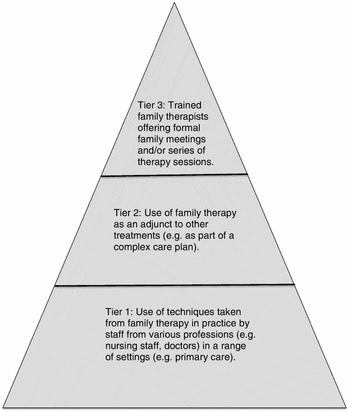
Figure 1 draws these roles together into a pyramid of three tiers, requiring increasing levels of family therapy knowledge and training. The bottom tier (Tier 1) involves using family therapy techniques in everyday practice in health and social care. For example, genograms are used by family therapists but could be incorporated routinely into psychiatric, general practice, and social work histories and assessments, thereby adding to the understanding of families as well as recording family information in a succinct and useful manner. Tier 2 involves the use of family therapy alongside other treatments in a supportive/adjunctive role. This would involve workers who have undertaken some training in therapy. Tier 3 involves more specialist family therapists offering formal family meetings, which are the focus of decisions/change and relational support. Individual family therapists may contribute across tiers e.g. using systemic family therapy techniques in community projects or teaching them to community workers in tier 1; offering family therapy as an adjunct to other treatments in general practice in tier 2; and providing specialist therapy in independent practice in tier 3.
Pyramidal model of family therapy in dementia practice. Tier 1: Use of techniques taken from family therapy in practice by staff from various professions (e.g. nursing staff, doctors) in a range of settings (e.g. primary care). Tier 2: Use of family therapy as an adjunct to other treatments (e.g. as part of a complex care plan). Tier 3: Trained family therapists offering formal family meetings and/or series of therapy sessions.

Conclusions
The literature on family therapy and dementia has grown over the past 25 years but remains limited and any conclusions we might draw are modest. Nevertheless, this review suggests that therapy could have a number of useful roles in dementia care. Therapy as a preliminary to accepting other treatments encapsulates the potential role of family therapy in bringing family members living with dementia together to recognize their own and each other's roles, support one another, resolve conflicts related to dementia, and negotiate and agree a holistic treatment plan. Some of the literature that we reviewed targets specific symptoms in family members in response to therapy, but there is a need for further research which looks more broadly at changes in the family system, at the relationship between the family and health/social care, and in individual members of the family system. Areas to explore include: how to evaluate the success of therapy; how to ensure treatment integrity; how to make systemic family therapy perspectives and techniques available more widely; and how to train the health and social care workforce in working with families. A tiered model might facilitate the application of therapy to practice.
Widening access to family therapy will necessitate clear goals against which to evaluate its success, and clarity regarding useful therapeutic models. The NYU Caregiver Intervention program set as its goals: “To maintain the well-being of the primary caregiver and (to) reduce premature or unwanted nursing home placement of the person with dementia” (Vernooij-Dassen et al., Reference Vernooij-Dassen, Joling, van Hout and Mittelman2010, p. 776). Perhaps future research could also address goals of maintaining the well-being of the person with dementia and reducing the burden of family members as suggested by Martire and colleagues (Reference Martire, Lustig, Schulz, Miller and Helgeson2004). These are useful goals to incorporate more widely into routine dementia care.
Conflicts of interest
This review was unfunded. Susan Mary Benbow practices as an independent systemic therapist, and Victoria Sharman as a systemic family psychotherapist.
Description of authors’ roles
Susan Mary Benbow designed the study, formulated the aims, carried out the search, and wrote the paper. Victoria Sharman read the papers, assisted in identifying the learning points, and contributed to writing the paper.