Introduction
Species diversity has been evaluated as a tool to improve agroecosystem resilience to perturbation, control weeds and pest occurrence, and preserve in-field biodiversity (Wezel et al., Reference Wezel, Casagrande, Celette, Vian, Ferrer and Peigné2014). To implement the agroecological practices that are based on diversification, a redesign of existing cropping systems, which are relatively undiversified, would be required. This approach can be carried out by integrating suitable species in crop rotations, including intercrops. Intercropping is the coexistence of two or more crop species at the same time with different spatial arrangements in the same field (Malézieux et al., Reference Malézieux, Crozat, Dupraz, Laurans, Makowski, Ozier- Lafontaine, Rapidel, de Tourdonnet and Valantin-Morison2009). In particular, living mulches (LMs) are cover crops planted either before or with a main crop and maintained as a living ground cover throughout the growth cycle (Hartwig and Ammon, Reference Hartwig and Ammon2002). In sustainable agricultural systems, it is well documented that intercropping using LM can provide many beneficial ecosystem services (Campiglia et al., Reference Campiglia, Mancinelli and Radicetti2011); thus, they have recently been defined as ‘agroecological service crops’ (ASC) according to Canali et al. (Reference Canali, Diacono, Campanelli and Montemurro2015). The ASC grown as LM are reported to immobilize excess soil nutrients, thus preventing nitrate leaching and improving soil physical characteristics (Carof et al., Reference Carof, de Tourdonnet, Saulas, Le Floch and Roger-Estrade2007); suppress weeds, reducing synthetic herbicide use (Teasdale et al., Reference Teasdale, Brandsæter, Calegari, Skora Neto, Upadhyaya and Blackshaw2007; Tabaglio et al., Reference Tabaglio, Gavazzi, Schulz and Marocco2008); promote biodiversity in the field (Fageria et al., Reference Fageria, Baligar and Bailey2005); add soil organic matter; and contribute to reducing surface water runoff, as well as loss of nutrients and pesticides (Hartwig and Ammon, Reference Hartwig and Ammon2002). Intercropping with ASC may be a valuable approach for weed management, particularly in organic farming, where weed control is one of the greatest concerns (Bilalis et al., Reference Bilalis, Papastylianou, Konstantas, Patsiali, Karkanis and Efthimiadou2010). Also, with a leguminous crop in the ASC, nitrogen (N) is fixed from the atmosphere and increases resource use efficiency in the cropping system (Wezel et al., Reference Wezel, Casagrande, Celette, Vian, Ferrer and Peigné2014). Among leguminous ASC, self-reseeding annual legumes (such as Medicago spp.), which can persist over years without the need for reseeding, could play an important role in Mediterranean organic farming systems (Driouech et al., Reference Driouech, Abou Fayad, Ghanem and Al-Bitar2008). However, the most significant risk a farmer faces in using LM systems is the potentially negative interaction with the cash crop. According to Masiunas (Reference Masiunas1998), the success of such systems depends on the capacity to rapidly establish a ground cover that competes with weeds, without depleting the main resources of light, water and nutrients needed by the associated crop. Thus, many attempts to use LM in annual cropping systems have resulted in reduced yields of the cash crop (Kolota and Adamczewska-Sowińska, Reference Kolota and Adamczewska-Sowińska2004; Hiltbrunner et al., Reference Hiltbrunner, Liedgens, Bloch, Stamp and Streit2007; Chase and Mbuya, Reference Chase and Mbuya2008).
Compared with conventional systems, organic agroecosystems have additional features that require studying individual components and their interactions occurring across space and time (Bàrberi, Reference Bàrberi2002). The objective of this research was to study the suitability of burr medic (Medicago polymorpha L. var. anglona) as a LM in organic cauliflower (Brassica oleracea L. var. botrytis) systems at two sites in a Mediterranean environment. In Experiment 1, two local cauliflower cultivars and an F1 hybrid were compared within the organic intercropping system in Central Italy. Since vegetable crops have high nutrient demand and low efficiency of nutrient utilization, crop performance of LM systems for organic cauliflower combined with organic fertilization was assessed in Southern Italy in Experiment 2.
Materials and Methods
Study sites and experimental setup
The research was carried out during the 2010–2011 season at the following two sites: (1) Monsampolo del Tronto, in Central Italy (lat. 42°53′N; long. 13°48′E), at the MOnsampolo VEgetable organic long-term field experiment (MOVE LTE), which is located in the CRA-Research Unit for Vegetable Production (CRA-ORA); and (2) Metaponto (MT), in Southern Italy (lat. 40°24′N; long. 16°48′E), on the research farm ‘Azienda Sperimentale Metaponto’ of the CRA-Research Unit for Cropping Systems in Dry Environments (CRA-SCA, ASM).
Experiment 1
The Monsampolo site is characterized by a ‘thermomediterranean’ climate (Unesco-FAO, 1963). According to the soil taxonomy of the US Department of Agriculture (USDA, 1999), the soil type is a Typic Calcixerept fine-loamy, mixed thermic. The MOVE-LTE site was established in 2001 and is based on a 4-year crop rotation with different cover crops. More details about experiments at the MOVE-LTE site, system management, and agronomic and environmental performance are available in Campanelli and Canali (Reference Campanelli and Canali2012). The experimental design was a split-plot with two factors and three replications. Each main plot consisted of 16.8 m2 of a LM of burr medic, M. polymorpha L. var. anglona at different sowing times: (i) concurrent sowing (CS; at cauliflower transplanting) and (ii) late sowing (LS; 3 weeks after cauliflower transplanting). These experimental treatments were compared with a no living mulch control (LM-CT). The LM-CT was weeded through two hoeings during the crop cycle (i.e., using standard organic farming agronomic practices in the area), while no weeding was performed in the CS and LS treatments past burr medic sowing. The burr medic was manually sown on August 28, 2010 (CS treatment) and on September 15, 2010 (LS treatment) at a rate of 80 kg ha−1. Split-plots consisted of cauliflower cultivars (C): Emeraude F1 hybrid (EM), CRA-ORA1 and CRA-ORA2 (open-pollinated, locally adapted cultivars) and each treatment was repeated in triplicate. The cauliflower crop was manually transplanted on August 25, 2010 into rows with a 70 cm × 60 cm spacing. Harvests began on November 24 and terminated on December 28.
Experiment 2
The Metaponto site is characterized by an ‘accentuated thermomediterranean’ climate (Unesco-FAO, 1963). Soils are characterized as Typic Epiaquerts (USDA, 1999). The experiment was carried out according to a split–split-plot design where two factors were tested (Gomez and Gomez, Reference Gomez and Gomez1984). The experimental area was divided into three blocks in a randomized complete block design, and planted to three (4 m × 20 m) vertical strips corresponding to LM (burr medic) sowing times: (i) early sowing (ES; 20 days before cauliflower transplanting) and (ii) CS (at cauliflower transplanting). These experimental treatments were compared with a no LM-CT. No weeding was performed in any of the treatments.
Each block was subsequently divided, in a randomized complete block design, into four horizontal (4 m × 5 m) strips corresponding to the following organic fertilizers and amendments (F), allowed in organic farming: (i) anaerobic digestate fertilizer, based on wine distillery wastewater (AD); (ii) composted municipal solid organic wastes from the city of Laterza (‘Fertileva’, Progeva Srl – Laterza, TA, Italy) (MSW); (iii) commercial humified organic fertilizer (ORG), based on dried cattle manure (‘Italpollina’ CRAI s.r.l., Rivoli Veronese, VR, Italy); compared with (iv) an unfertilized control (F-CT). Additional information about production processes for AD and MSW are reported in Montemurro et al. (Reference Montemurro, Fiore, Campanelli, Tittarelli, Ledda and Canali2013). The organic materials (the same in both years) were applied to soil 1 month before cauliflower transplanting, at the rate of 100 kg N ha−1. To account for the potential contribution of burr medic biological N fixation in the first two treatments, the fertilization applied in ES and CS was compared with an application rate of 200 kg N ha−1 of the same organic materials in the LM-CT. The cauliflower crop (cv. Triunphan) was manually transplanted on September 29, 2010 into the same in- and between-row spacing as Experiment 1 and was harvested on March 8, 2011.
Each burr medic sowing times × fertilizer combination plot (intersection plot) constituted a 20 m2 area. Additional strips were included on the sides of the intersection plots in the experimental layout, to examine weed competition in detail, as follows: (i) weed stands without crop and ASC (‘pure weed stands’; 1.5 m × 4.0 m) and (ii) crop stands without weeds and ASC (‘pure crop stands’ managed by manual weeding; 1.5 m × 2.0 m). Overall weed density was estimated in the weed seedling stage and weed species were identified over the cauliflower growing season.
Measurements and statistical analysis
At harvesting, cauliflower heads were collected from three randomly selected plants in each plot and from the pure crop stands (Experiment 2) during the cash crop harvest period. Aboveground biomass of cauliflower, weeds and burr medic were separately measured in all plots and in pure stands. Cauliflower heads and entire plant residues including stalks cut at ground level, weeds and burr medic were dried at 70°C for 48 h to obtain dry weights. Cauliflower head and residue biomass were summed to obtain the total aboveground crop biomass. Nitrogen content (Kjeldahl, Reference Kjeldahl1883) of cauliflower heads, crop residues and weeds was determined, based on this calculation of N uptake: plant N content × plant dry biomass (Ciaccia et al., Reference Ciaccia, Montemurro, Campanelli, Diacono, Fiore and Canali2015). The N content × burr medic biomass (burr medic N supply) was also calculated in order to measure the contribution of the ASC treatment to the N pool of the entire cropping system.
In order to measure the effect of the LM on competition for N between the cash crop and weeds, in Experiment 2, ΔN uptake (%), obtained from weed–crop treatments, using averages across repetitions, was used. The equations were:
 $$\eqalign{&\hbox{total crop} \, \Delta {\hbox{N uptake}} \cr & = 100 - [({\hbox{N uptake of crop in presence of weeds}} \cr &\quad \times 100 / {\hbox {N uptake of crop in pure stands}})]} $$
 $$\eqalign{\hbox{weed} \,\Delta \hbox{N uptake} & = 100 - ((\hbox{N uptake of weeds in} \cr & \quad \hbox{presence of crop} \times 100) / \cr & \quad \hbox{N uptake of weeds in pure stands})}$$
Soil mineral N (N-mineral = NO3 −−N + NH4 +−N, recorded at 0–30–cm soil depth) was determined at both experimental sites and in both years at the following sampling times: (I) cauliflower transplanting; (II) 5-leaf rosette stage; (III) head emergence; and (IV) at the end of the harvest period. Soil mineral N was extracted by 2 M KCl (1:10, w/v) and measured by continual flow colorimetry according to Krom (Reference Krom1980) and Henriksen and Selmer-Olsen (Reference Henriksen and Selmer-Olsen1970) for NH4 +−N and NO3 −−N, respectively.
Analysis of variance (ANOVA) was carried out in both experiments, with LM management and cultivar/fertilizer as factors. To compare differences obtained, means were further analyzed by Tukey's HSD test (P < 0.05). The selected analysis was performed by using SPSS 17.0 (SPSS Inc. Released 2008).
Results and Discussion
Weather conditions
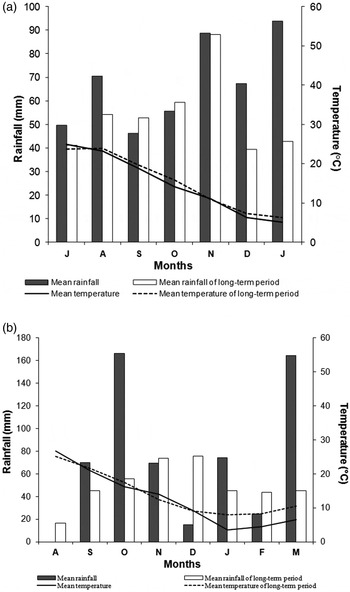
At the Experiment 1 site, over the period of July–January 2010–2011, total rainfall (472 mm) was higher than the 30-yr long-term average (377 mm) (Fig. 1a). Mean temperatures were lower, at 14.7°C, than the long-term average of 15.4°C. At the Experiment 2 site, over the period of September–March 2010–2011, total rainfall (583 mm) was considerably higher than the long-term average (384 mm) (Fig. 1b). Conversely, the mean temperature was lower (10.7°C) than the 30-yr average of 12.4°C.
Weather conditions (total rainfall and monthly values of mean temperatures) recorded during the cauliflower growing season at Experiment 1, Monsampolo site (a), and at Experiment 2, Metaponto site (b). The values are compared with the rainfall and mean temperatures over a 30-yr period.

Effects of LM and crop cultivars on crop performance in central Italy
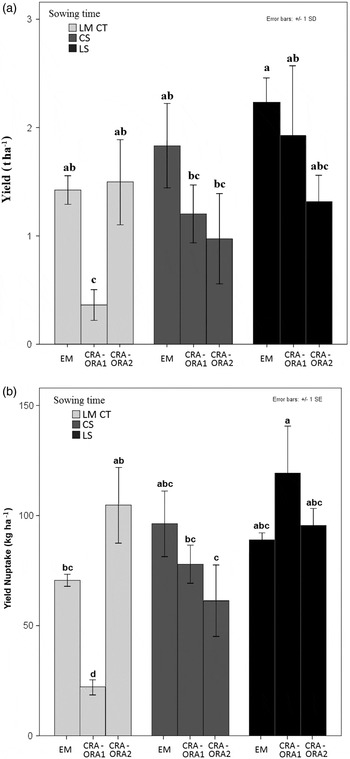
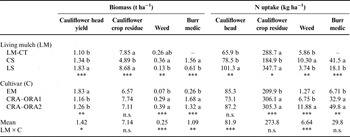
In Experiment 1, analysis of variance revealed overall significant main effects of LM sowing times and cultivar selection (C) on cauliflower head yield (Table 1). Late sowing increased head yield compared with CS and LM-CT. While sowing times also affected crop residue biomass production, cultivar effect on crop residue biomass was not significant. In particular, planting the LM concurrent with cauliflower transplanting, lowered cauliflower biomass by 43.6 and 37.7%, compared with sowing the LM 3 weeks after tranplanting, and the no LM-CT, respectively. Main effects of N uptake in cauliflower heads and crop residues were also found at the different LM sowing times, while C effects on cauliflower head N content were significant for crop residue, but not head content. At the same time, CS had the lowest N uptake in cauliflower residues. Regarding the response of cultivars, EM had the lowest residue N uptake, which was lower by 31.3% than the average of CRA-ORA1 and CRA-ORA2. Significant interactions were observed between LM and C regarding effects on cauliflower yield and yield N uptake (Fig. 2a and b), while cauliflower crop residue biomass and N uptake comparisons were not significant (Table 1). The combination of EM with LS, and of CRA-ORA1 with LM-CT, resulted in the highest and lowest yield, respectively (Fig. 2a). No significant differences were observed among the other LM × C treatments.
Interactions between LM sowing times and cauliflower cultivars on: (a) total yield biomass (t ha−1) and (b) N uptake in cauliflower heads (kg ha−1), at the Monsampolo site (Experiment 1). Bars with different letters are significantly different according to DMRT at the P ≤ 0.05 probability level (LM-CT = control, no living mulch; CS, concurrent sowing, at cauliflower transplanting; LS, late sowing, 3 weeks after cauliflower transplanting. EM, Emeraude F1 Hybrid; CRA–ORA1 and CRA–ORA2, open-pollinated, locally adapted cultivars).

Effects of living mulch sowing times and cauliflower cultivars on cauliflower yield, cauliflower crop residue, weeds and burr medic biomass (t ha−1) and effects on N uptake (kg ha−1) in Experiment 1.

Note: The probability levels are presented by living mulch sowing time, cultivar and their interactions. *, **, ***Significant at P < 0.05, 0.01 and 0.001, respectively. n.s. = nonsignificant (LM-CT = control, no living mulch; CS = concurrent sowing, at cauliflower transplanting; LS = late sowing, three weeks after cauliflower transplanting. EM = Emeraude F1 Hybrid; CRA-ORA1 and CRA-ORA2 = open-pollinated, locally adapted cultivars).
The most productive results were obtained when EM was grown in combination with the LS LM, which confirms the role of the LM sowing period as highlighted by other authors with different vegetable crops. Kolota and Adamczewska-Sowińska (Reference Kolota and Adamczewska-Sowińska2004) found that LM did not adversely affect plant growth and yield of leeks if LM planting was delayed until 11 weeks after transplanting, with a marketable yield reduction of 31% when LM sowing was only delayed 3–5 weeks after cash crop transplanting. Successful intercropping necessitates the efficient use of resources by interacting crops, which is often best achieved through temporal separation based on critical periods of nutrient demand (Santos et al., Reference Santos, Gliessman and Cecon2002), as shown by the highest crop N uptake in the LS treatment (Table 1). In particular, the CRA–ORA1–LS combination showed the greatest N uptake in cauliflower heads, which was about 430 and 53% higher than CRA–ORA1 with LM-CT and CS, respectively (Fig. 2b). In addition, the N uptake in cauliflower heads in CRA–ORA1–LS plots was higher than the EM–LM-CT, and CRA–ORA2–CS plots by 68.9 and 94.4%, respectively.
The ANOVA revealed that weed biomass in the different LM treatments only differed between CS and LS, whereas significant main effects of LM sowing times and C on burr medic biomass were observed (Table 1). Main effects of N uptake in weeds and burr medic were also found. At this experiment site, CS resulted in the highest burr medic N uptake, which was 129% higher than the LS treatment. This parameter was significantly lower for the hybrid cultivar than for CRA–ORA2 (by 86.5%), and CRA–ORA1 (by 79.6%). This last result would suggest that EM, with a larger biomass, may have had a smothering effect on burr medic, further confirming the role of cultivars in LM competitiveness (Mohler, Reference Mohler, Liebman, Mohler and Staver2007).
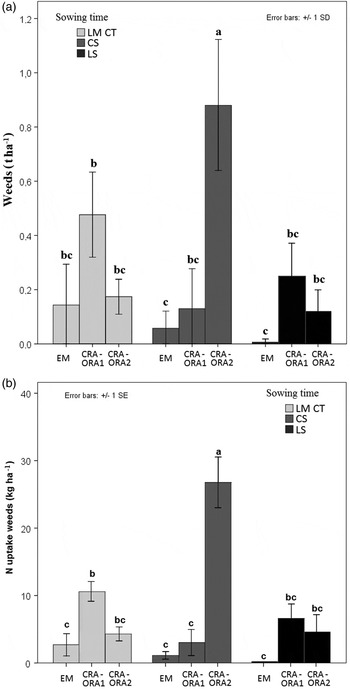
In addition, two-way interactions (LM × C) were significant for N uptake in cauliflower heads and in weeds (Fig. 3a and b). There were no significant interactions between LM and C with burr medic N uptake. The EM–CS and EM–LS combinations had significantly lower weed biomass than the CRA–ORA2–CS plots (0.06 and 0.01 versus 0.88 t ha−1, respectively). Similarly, the highest weed N uptake was found in the CRA–ORA2–CS plots, which was notably higher than EM under all LM treatments. Comparable and similar values were found for the other treatment combinations. Results determined that there was a trend toward greater weed biomass in CS plots, where the highest weed N uptake also was observed. This result suggests that, as a consequence of CS, the ASC was less effective in mitigating weed establishment and growth compared with LS, in particular in combination with CRA–ORA2.
Interactions between LM sowing times and cauliflower cultivars on: (a) weed dry biomass (t ha−1) and (b) N uptake in weeds (kg ha−1), at the Monsampolo site (Experiment 1). Bars with different letters are significantly different according to DMRT at the P ≤ 0.05 probability level (LM-CT, control, no living mulch; CS, concurrent sowing, at cauliflower transplanting; LS, late sowing, 3 weeks after cauliflower transplanting. EM, Emeraude F1 Hybrid; CRA–ORA1 and CRA–ORA2, open-pollinated, locally adapted cultivars).

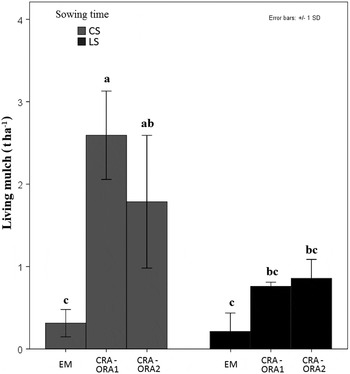
The greatest burr medic biomass was found for both local cultivars under CS management, at 2.60 and 1.80 t ha−1 for CRA–ORA1 and CRA–ORA2, respectively, compared with the EM in combination with LS (0.21 t ha−1) and CS (0.31 t ha−1) treatments (Fig. 4). In agreement with other studies (den Hollander et al., Reference den Hollander, Bastiaans and Kropff2007; Hiltbrunner et al., Reference Hiltbrunner, Liedgens, Bloch, Stamp and Streit2007), an inverse trend between the growth of the cash crop and that of the LM was detected. The highest burr medic biomass and N content (Table 1) was observed where the LM was concurrently sown in the local cultivar plots, which also had the lowest cauliflower biomass. Conversely, no significant differences were detected for LS burr medic biomass among cultivar plots. This result confirms that there was limited competition between the cash crop and the ASC in the LS treatment. Because of the faster growth pattern of the hybrid cultivar, greater competition with weeds and the LM was observed under both sowing times. These results support the idea of cultivar differences in crop competitiveness (Zimdahl, Reference Zimdahl2007) and in the effectiveness of LMs on potential suppression of weeds (Walters, Reference Walters, Soloneski and Larramendy2011; Kolota and Adamczewska-Sowińska, Reference Kolota and Adamczewska-Sowińska2013).
Interactions between LM sowing times and cauliflower cultivar on burr medic dry biomass (t ha−1) at the Monsampolo site (Experiment 1). Bars with different letters are significantly different according to DMRT at the P ≤ 0.05 probability level (LM-CT, control, no living mulch; CS, concurrent sowing, at cauliflower transplanting; LS, late sowing, 3 weeks after cauliflower transplanting. EM, Emeraude F1 Hybrid; CRA–ORA1 and CRA–ORA2, open-pollinated, locally adapted cultivars).

Effects of LM and organic fertilizers on crop performance in southern Italy
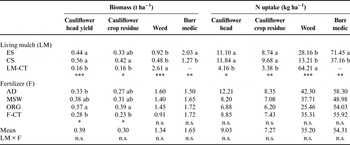
At this study site, there were two extreme rainfall events during the cauliflower cropping cycle (Fig. 1), which greatly influenced cultivation and reduced yields. Nevertheless, significant main effects of LM sowing time and fertilizer (F) on cauliflower head yield and residue biomass were found in Experiment 2 (Table 2). Among LM sowing times, cauliflower yields in the ES and CS treatments demonstrated greater production than in the LM-CT plots, by an average of 210%. There was a trend toward higher cauliflower crop residue (by 162%) in the CS treatment compared with the LM-CT treatment. Similarly, N uptake in cauliflower heads and residue in ES and CS treatments was higher than in the LM-CT treatment. An inverse trend between the growth of the cash crop and that of the ASC, highlighted by Hiltbrunner et al. (Reference Hiltbrunner, Liedgens, Bloch, Stamp and Streit2007), was also observed in CS plots, showing that the time of LM sowing should be chosen properly to ensure optimal soil cover and intercropping efficiency (Müller-Schärrer and Potter, Reference Müller-Schärrer and Potter1991).
Effects of living mulch sowing times and organic fertilization on cauliflower yield, cauliflower crop residue, weeds and burr medic biomass (t ha−1) and effects on N uptake (kg ha−1) in Experiment 2.

Note: The probability levels are presented by living mulch sowing time, cultivar and their interactions. *, **, ***Significant at P < 0.05, 0.01 and 0.001, respectively. n.s. = nonsignificant (ES = early sowing, 20 days before cauliflower transplanting; CS = concurrent sowing, at cauliflower transplanting; LM-CT = no living mulch control; AD = anaerobic digestate fertilizer; MSW = composted municipal solid organic wastes; ORG = commercial humified fertilizer; F-CT = unfertilized control).
Regarding fertilizer effects, the ORG treatment yields were 87% higher than the average production in the F-CT and AD fertilizer treatments, although yields were not significantly different from the MSW treatment. At the same time, the ORG treatment produced significantly higher cauliflower crop residues (0.39 t ha−1) than the F-CT treatment (0.23 t ha−1). The comparable yield results of MSW with ORG fertilizer indicated that both types of fertilization are viable options for organic farmers if available at the local level. Similarly, different studies at the same site have found that commercial organic fertilizers could be effectively replaced by locally available organic fertilizers and amendments (Montemurro et al., Reference Montemurro, Convertini, Ferri and Maiorana2005, Reference Montemurro, Tittarelli, Lopedota, Verrastro and Diacono2015).
Significant main effects of LM sowing times on weed and burr medic biomass and N uptake were found, but no effect of F was observed (Table 2). There were also no significant LM × F interaction effects (Table 2). The LM-CT treatment led to a significantly higher amount of weed biomass than the ES (by 184%) and CS (by 440%) treatments, which were equivalent. Similarly, the highest weed N uptake was found in the LM-CT treatment. The ES treatment showed significantly higher burr medic biomass and N uptake than the CS treatment (by 60 and 92%, respectively). The result observed for weed biomass and weed N uptake confirms the findings of Jędrszczyk et al. (Reference Jędrszczyk, Poniedziałek and Sękara2005), where the authors showed that cultivation of head cabbage with a white clover LM was associated with an extensive weed biomass reduction of 96%. However, no significant weed biomass reduction was recorded in the ES treatment compared with CS, despite the higher burr medic biomass observed in ES plots. This result is not in agreement with findings of Bàrberi et al. (Reference Bàrberi, Bigongiali, Antichi, Carlesi, Fontanelli, Fiasconi and Lulli2008) who showed a proportional decrease of weed biomass in relation to the amount of LM biomass in spinach cultivation.
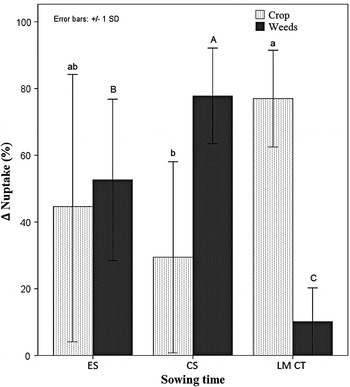
Main effects of LM on ΔN uptake of crop and weeds were found (Fig. 5), while no effect of F and no LM × F interactions were found (data not shown). This last result is in contrast with the findings of other authors who showed an improvement in weed control as a consequence of crop fertilization (Evans et al., Reference Evans, Knevic, Lindquist, Shapiro and Blankenship2003; Brainard and Bellinder, Reference Brainard and Bellinder2004). A higher value was observed for cauliflower ΔN uptake in LM-CT plots in comparison with the CS treatment. Conversely, CS plots showed the highest weed ΔN uptake and LM-CT the lowest. Regarding competition for N, both the ΔN uptake for cauliflower crop and weeds showed differences in N content between crops and weeds as a function of the LM sowing time. The CS plots had the lowest crop N uptake reduction and the highest for weeds, confirming the effect of delaying LM sowing on improving the ability of the crop to compete with weeds without interfering with crop yield (Brainard et al., Reference Brainard, Bellinder and Miller2004). The results suggest that, in certain LM systems, crop N loss could be reduced compared with systems in which weeding is performed. Contrastingly, weed N uptake in LM plots decreased significantly in comparison with pure crop stands. As a consequence of this response, weeding may be reduced to conserve N in the cropping system, which represents a benefit of adopting the LM technique.
Effects of LM sowing times on ΔN uptake (%) of crop and weeds at the Metaponto site (Experiment 2). Bars with different letters are significantly different according to DMRT at the P ≤ 0.05 probability level (LM-CT, control, no living mulch; ES, early sowing, 20 days before cauliflower transplanting; CS, concurrent sowing, at cauliflower transplanting).

Soil fertility
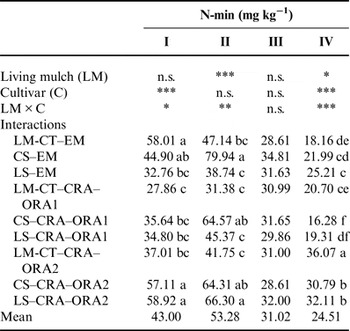
Regarding the influence of treatments on soils of the study sites, there were significant main effects of LM sowing times at sampling times II and IV on soil N-mineral in Experiment 1, and at sampling times I and IV for cultivar effects (Table 3). Overall, significant LM × C interactions were also found, except for the III sampling time. There was a trend toward higher soil N-mineral in the LM-CT–EM, CS–CRA–ORA2 and LS–CRA–ORA2 combinations at sampling time I, although these combinations were not significantly different from CS–EM (Table 3). No significant difference was observed among any other treatment combinations. At sampling II, the highest soil N values were obtained in CS–EM, LS–CRA–ORA2, as well as in CS–CRA–ORA1 and CS–CRA–ORA2, but the CS–CRA–ORA1 and CS–CRA–ORA2 combinations were not significantly different from the EM in LM-CT plots. No significant differences were found at sampling time III. Finally, at sampling time IV, the highest value was found for LM-CT–CRA–ORA2, while CS–CRA–ORA2 and LS–CRA–ORA2 had high soil N-mineral compared with the other treatment combinations. The combination of CRA–ORA1 with CS was associated with the lowest soil N value. As indicated by Whitmore and Schröder (Reference Whitmore and Schröder2007), N uptake in intercrops could be such that there would be less N available for leaching compared with sole crops at a similar total density. The observed amount of soil N-mineral could subsequently increase the risk of N loss by leaching, but this was not measured. This finding may be counter to other studies that highlighted that a leguminous LM may immobilize excess nutrients, thus preventing groundwater contamination (Hartwig and Ammon, Reference Hartwig and Ammon2002).
Effects of living mulch sowing times and cauliflower cultivars on soil N-mineral at different sampling times (I–IV), at the Monsampolo site (Experiment 1).

Note: Mean values in each column followed by a different letter are significantly different according to Tukey's test.
n.s., non-significant (LM-CT, control, no living mulch; CS, concurrent sowing, at cauliflower transplanting; LS, late sowing, 3 weeks after cauliflower transplanting. EM, Emeraude F1 Hybrid; CRA-ORA1 and CRA-ORA2, open-pollinated, locally adapted cultivars). Sampling times: (I) cauliflower transplanting; (II) 5-leaf rosette stage; (III) head emergence and (IV) at the end of the harvest period.
*, **, ***, Significant at P < 0.05, 0.01 and 0.001, respectively.
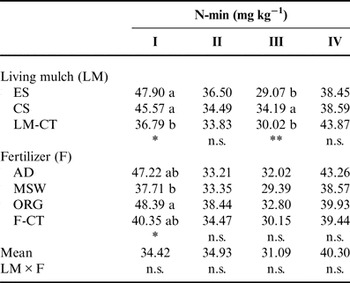
At the Experiment 2 site, analysis of variance revealed significant main effects of LM on soil N-mineral for sampling times I and III, and at sampling time I for fertilizer effects (Table 4). At sampling time I, LM-CT plots had the lowest soil N-mineral content, which was 21.3% lower than the average of CS and ES. Among fertilizer treatments, ORG plots had an N-mineral value (48.39 mg kg−1) that was significantly higher (28.3%) than MSW plots, but similar to the other treatments. At sampling time III, the CS treatment had the highest value, which was 13.9 and 17.6% higher than LM-CT and ES, respectively. The lack of significant differences among LM treatments (as well as among fertilizer treatments) for soil N-mineral remaining after harvest may have resulted from the unfavorable weather conditions, allowing N runoff and/or leaching.
Effects of living mulch sowing times and fertilizers on soil N-mineral at different sampling times (I–IV), at the Metaponto site (Experiment 2).

Note: Mean values in each column followed by a different letter are significantly different according to Tukey's test.
n.s., non-significant (ES, anticipated sowing, 20 days before cauliflower transplanting; CS, concurrent sowing, at cauliflower transplanting; LM-CT, no living mulch control; AD, anaerobic digestate fertilizer; MSW, composted municipal solid organic wastes; ORG, commercial humified fertilizer; F-CT, unfertilized control). Sampling times: (I) cauliflower transplanting; (II) 5-leaf rosette stage; (III) head emergence and (IV) at the end of the harvest period.
*, **, ***, Significant at P < 0.05, 0.01 and 0.001, respectively.
Conclusions
Identifying the conditions that could lead to positive ecosystem services from LMs, such as weed suppression while minimizing crop competition, is of major interest to farmers and researchers. The results obtained in our study demonstrated that vegetable cropping systems designed in accordance with agroecological principles, by combining different agronomic strategies, including proper selection of the sowing time of the ASC, appropriate cash crop cultivars, and effective organic fertilizers and amendments, are able to sustain crop yields while mitigating weed pressure. In particular, results suggested that in central Italy, the LM was non-competitive with the cash crop, and demonstrated the potential to mitigate weed infestations, with the LS of the ASC. Moreover, different cultivars showed varying weed mitigation and competitiveness for resource use, depending on the LM sowing time. At the Experiment 2 site, an inverse trend between the growth of the cash crop and that of the ASC was observed for the CS treatment. However, weather conditions had the greatest effect on the intercropping system interactions at this study site. The differences between the two experiments highlighted the need to evaluate LM treatments in different environments. This research provided the framework for future investigations to be undertaken in different environments, aiming to evaluate the feasibility of introducing other LMs (e.g., mixing different types of ASC) and their effectiveness. The use of LM could help farmers maintain production and food security in spite of changes in temperature and rainfall, since cover crops can protect the soil from the impact of rain drops and modify soil temperatures. Therefore, further research on the use of LM as a potential technique in climate change adaptation should be encouraged, particularly for vegetable winter crop production under Mediterranean conditions.
Acknowledgements
The present study was carried out within the ORWEEDS (Metodi indiretti per la gestione delle infestanti in orticoltura biologica) research project, funded by the Organic Farming office of the Ministero per le Politiche Agricole, Alimentari e Forestali in the framework of the Italian action plan for organic farming.