The author wishes to thank the two anonymous reviewers of this journal as well as Simon Hartmann and Kevin Morrison for their comments and suggestions. The financial support of the Austrian Science Found (Project AP23424-G11) is gratefully acknowledged.
1. Introduction
Institutional economists have long argued that institutions matter for long-term economic growth (North, Reference North1990; Platteau, Reference Platteau2000). Influential empirical literature has supported this argument arguing that institutions trump other factors such as geography or trade in explaining economic growth (Acemoglu et al., Reference Acemoglu, Johnson and Robinson2001b; Knack and Keefer, Reference Knack and Keefer1995; Rodrik et al., Reference Rodrik, Subramanian and Trebbi2004; critically Chang, Reference Chang2011). With the question that institutions matter for economic growth settled the question of how a country can acquire the necessary institutional framework for sustainable economic development has become an important issue.
The question of how foreign institutions can be successfully transferredFootnote 1 is rather old and has enjoyed the attention of scholars since the 19th century (Couyoumdjian, Reference Couyoumdjian2012). From the 20th century on, research of institutional transfer has focused on various periods of human history. During industrialization, continental European countries famously aimed to reduce their relative economic backwardness towards the United Kingdom (Gerschenkron, Reference Gerschenkron1966). More recently, the transition of former socialist countries has provided another period of intensified institutional transfer (Pejovich, Reference Pejovich2003; Pistor et al., Reference Pistor, Raiser and Gelfer2000). The colonial era and the early years of independence is another period of intensified institutional transfers (Berkowitz et al., Reference Berkowitz, Pistor and Richard2003: 165). It is the period of interest for this study.
The empirical work by Berkowitz et al. (Reference Berkowitz, Pistor and Richard2001) on legal transplants is an important starting point for this paper. The authors argue that the imported law is little effective, unless intentionally adapted to existing local context or unless there is already some level of familiarity within the population. Without adaptation or familiarity the transfer is unreceptive – an outcome which the authors call the transplant effect. The transplant effect matters for institutional quality. In a sample of 49 countries the impact of the transplant effect on the quality of legal institutions outweighs even the effect of a law's legal origins as reported by La Porta et al. (Reference La Porta, Lopez-de-Silanes, Shleifer and Vishny1999). While we can expect that imported law will lose effectiveness (Boettke et al., Reference Boettke, Coyne and Leeson2008), variations in the success of institutional transfers cannot be fully explained. Berkowitz et al. mention the role of legal intermediaries (judges, bureaucrats) in the process of institutional adaptation. Pre-existing familiarity with the imported law, on the other hand, seems to be based on history and geographical factors (Berkowitz et al., Reference Berkowitz, Pistor and Richard2001: 167).
The law makes just one set of institutions deemed necessary for long-term economic growth. More generally, the occurrence of a transplant effect raises an important question to which this paper aims to contribute: How can institutions successfully be transferred into societies lacking them?
An answer to this question is likely to be context specific. This is why this paper investigates institutions transferred to a specific African society for a better understanding of the mechanisms involved in institutional transfers. The Kanuri of Borno have been chosen, because they are a larger, homogenous, landlocked, and pastoralist ethnic group which may be representative for other societies with similar ethnic characteristics. The focus on a single ethnically homogenous region (rather than Nigeria on national level) is necessary, because Nigeria's many ethnic groups and minorities with distinct economic, cultural, and historic backgrounds would conceal important localized factors. Decolonization in the mid-20th century is particularly interesting, because institutions were not only transferred during the colonial period, but institutional reforms intensified roughly a decade before independence.
There is no consensus among scholars of new institutional economics (NIE) on how to conceptualize institutional change in general and institutional transfer in particular (see Kingston and Caballero, Reference Kingston and Caballero2009 for an overview on existing theories). However, the literature offers three explanations of why institutional transfers are likely to fail, which will guide our analysis. Some institutional scholars have explained the transplant effect as the conflicting interaction between imported institutions and local culture (Boettke et al., Reference Boettke, Coyne and Leeson2008; Goldschmidt, Reference Goldschmidt2006; Spranz et al., Reference Spranz, Lenger and Goldschmidt2012; Zweynert, Reference Zweynert2009). Closely related with culture, the distinction between informal and formal institutions seems to matter (North, Reference North2005: 50; critically Hodgson, Reference Hodgson2006). Informal institutions are stable over long time (North, Reference North1991: 111) and set strong incentives for human behavior (Williamson, Reference Williamson2000: 596–8) and for economic performance (Williamson, Reference Williamson2009). Change of informal institutions is considered difficult, but not impossible (Mackie, Reference Mackie1996). More recently, Weingast (Reference Weingast and Chamlee-Wright2009) has applied the framework developed by North, Wallis and Weingast (North et al., Reference North, Wallis and Weingast2009) on institutional transfers arguing that the way how violence is controlled in most societies makes successful institutional reforms - such as those by transfers - very unlikely.
The following section introduces a framework of analysis relevant for the case of the Kanuri. The remaining paper explores the transplant effect in today's Borno state in north-eastern Nigeria. Section 3 gives a brief introduction of the Kanuri in north-east Nigeria. Section 4 investigates the institutional development of the Kanuri and discusses processes and factors which led to the transplant effect upon independence. Section 5 concludes.
2. A framework for the analysis of the transplant effect
A framework for the analysis of the transplant effect must be able to explain why imported institutions are likely to fail (i.e. why there is a transplant effect) and it must contribute to our understanding of whether and how institutions can be effectively transferred to societies lacking them. This section introduces such a framework based on institutional economics.
New institutional economics regards institutions as durable systems of social rules or constraintsFootnote 2 (Hodgson, Reference Hodgson2006: 13; North, Reference North1990: 3), which are endogenously established in response to a specific social problem such as transaction costs (Aoki, Reference Aoki2007; Greif and Laitin, Reference Greif and Laitin2004). The resulting institutional framework can be understood as a spontaneous order rooted in the behavior of individuals (Hayek, Reference Hayek1973 and Reference Hayek1996). It is important for the understanding of the transplant effect that because individuals act under limited information the emerging institutions not necessarily represent the most efficient solution to a social or economic problem. Instead, the functioning of institutions is conditional to the social, geographical, historical, and institutional circumstances under which they are created (Aoki, Reference Aoki2007: 10; Hayek, Reference Hayek1973: 41). Path-dependence plays an important role. Institutions, which may have been a useful solution to a specific problem, can lock in and turn out inefficient or even obstructive to social development as contextual parameters change over timeFootnote 3 (Aoki, Reference Aoki2001: 16; Bardhan, Reference Bardhan, Meier and Stiglitz2001: 275–6; Boettke et al., Reference Boettke, Coyne and Leeson2008: 332). Furthermore, institutions function rarely alone but complement each other to form an institutional framework of a society (Rodrik, Reference Rodrik2000; Roland, Reference Roland2004: 113). Property rights, for example, are guaranteed by the law and enforceable in court. Underlying these institutions are a common language and shared values of justice. Complementary effects among institutions and their sensitivity to local conditions provide a starting point in understanding why imported institutions lack effectiveness.
Furthermore, institutions are distinct in normative power and in their resistance to change of time (Williamson, Reference Williamson2000). High level institutions (e.g. constitutional rules), which set the rules that change institutions of everyday interaction, will be more difficult to change (Ostrom, Reference Ostrom2005). Moreover, the distinction in formal and informal institutions mattersFootnote 4. There is a broad consensus within the NIE literature that informal institutions outrank formal institutions in setting incentives and that actors would rather follow rules of informal institutions, if these conflict with formal institutions (Helmke and Levitsky, Reference Helmke and Levitsky2004; Williamson, Reference Williamson2000). Informal institutions are closely linked with a society's cultureFootnote 5. From an institutional perspective, cultural norms are informal institutions, which have arisen spontaneously and have been handed over from generation to generation (Hodgson, Reference Hodgson2006: 12). Just like culture informal institutions resist rapid change and are stable over long periods of time (North, Reference North1994: 366; Nunn, Reference Nunn2012). Stability over time and the great constraining power of informal institutions provide another explanation of why importing foreign institutions is likely to fail. Institutional “stickiness” – i.e. the ability of new institutional arrangements to take hold where they are transplanted – depends on the compatibility of cultural core values of the recipient society relative to those of the society of origin. Without proper adaptation, imported formal institutions are unlikely to stick and will either conflict with indigenously established endogenous informal institutions or simply be ignored (Boettke et al., Reference Boettke, Coyne and Leeson2008).
Once the transplant effect can be explained by institutional interdependences and institutional stickiness, the question remains whether and how these effects can be overcome and institutions can be successfully transferred. This is not impossible. Japan and Germany have been regarded success stories (Boettke et al., Reference Boettke, Coyne and Leeson2008: 346–8; Coyne, Reference Coyne2008) as has been Botswana (Acemoglu et al., Reference Acemoglu, Johnson and Robinson2001a). NIE literature identifies three processes capable of overcoming these problems. First, imported institutions can be intentionally adapted to stick to the existing institutional framework (Berkowitz et al., Reference Berkowitz, Pistor and Richard2001: 167). Second, familiarity with new imported rules reduces the need for adaptation. Familiarity arguably develops non-intentionally – for example in cases of common history or immigration (Berkowitz et al., Reference Berkowitz, Pistor and Richard2001: 180; Sugden, Reference Sugden1989). Finally, local institutions may change as imported institutions influence behavior and ultimately beliefs among the population (Hodgson, Reference Hodgson2006: 7). This option is somewhat neglected in the literature (Chang and Evans, Reference Chang, Evans, De Paula and Dymski2005: 103), but we can expect enforcement costs higher relative to the other two processes and a longer time frameFootnote 6.
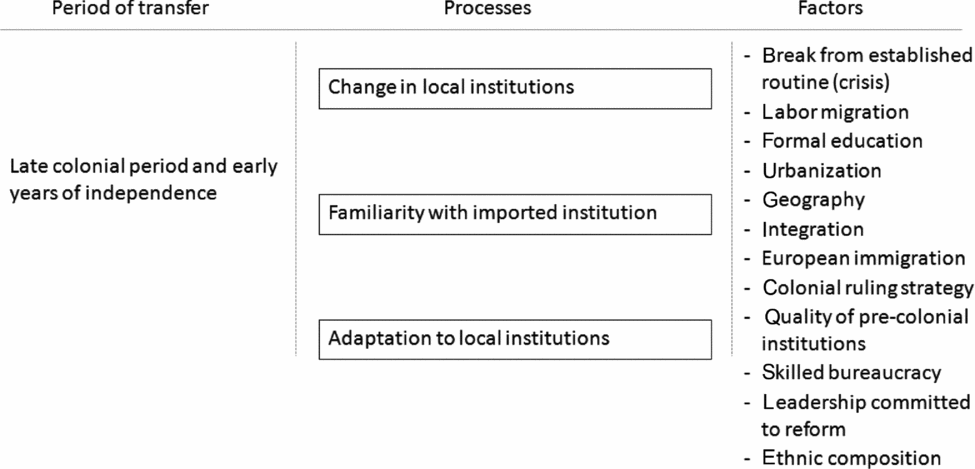
These considerations result in an analytical framework (Figure 1), which proposes three processes or transfer strategiesFootnote 7 through which successful transfer can take place. We consider these processes necessary in the sense that at least one such process must have successfully taken place to allow for effective imported institutions. We further conjecture that the functioning of each process – i.e. the likelihood that the imported norm will be effective – is influenced by a range of circumstantial factors. These factors can be endogenous and exogenousFootnote 8 to institutional change. Among others, geography (Diamond, Reference Diamond1997; Easterly and Levine, Reference Easterly and Levine2003; Platteau, Reference Platteau2000), levels of education (Grier, Reference Grier1999), population density (Acemoglu et al., Reference Acemoglu, Johnson and Robinson2002: 1232; Platteau and Hayami, Reference Platteau, Hayami and Yujiro1998), the nature of colonial rule (Lange, Reference Lange2004) or ethnic composition (Easterly and Levine, Reference Easterly and Levine1997) are considered important factors influencing institutional development. Historic crises or other breaks from established proceduresFootnote 9 (such as independence of a former colony) are believed to facilitate institutional change in local institutions (Williamson, Reference Williamson2000: 598). Finally, the level of commitment of the ruling elites matters, which depends on their expectations of rents under the new institutional arrangements relative to the expected loss of rents (Bardhan, Reference Bardhan, Meier and Stiglitz2001: 278; Weingast Reference Weingast and Chamlee-Wright2009). Even if leaders are committed, they have to signal credible commitment for the reform process to promote acceptance of imported institutions within the general public (Coyne and Boettke, Reference Coyne and Boettke2009). The list is not exhaustive. Our framework of analysis aims at transfers during colonial period and upon independence in the late 20th century. Actors (colonial administrators, missionaries) and factors (see above) may change for other periods (e.g. the transformation of former socialist countries in the late 20th century).
Processes and factors of successful institutional transfer in former colonies.
Source: Own

The following section analyzes processes and factors determining the institutional transfer that took place in Borno in north-eastern Nigeria under colonial rule and upon independence, in the 1950s and the early 1960s. Which processes were involved and which factors influenced their chances of successfully importing foreign institutions? As the persistent local institution, the paper will focus on the Kanuri version of the patron client relationship (i.e clientilism), a centuries-old institution, which has shaped the allocation of resources (e.g. the allocation of land), the administration of justice and political representation in many pre-industrialized societies. There is broad consensus that clientilism is incompatible with democracy and good governance (Englebert, Reference Englebert2000; North et al., Reference North, Wallis and Weingast2009), which are considered key institutions necessary for social and economic development (Shleifer et al., Reference Shleifer, Glaeser, Lopez de Silanes, La Porta and Djankov2003). Historic details specific to the Kanuri and factors influencing institutional transfers should enable us to understand, why importing institutions of good governance suffered the fate of the transplant effect and contribute to the question of how institutions can be successfully transferred.
3. Kanuri of Borno
The Kanuri have dominated the territory on the eastern shores of Lake Chad for centuries, even though the administrative status of their polity has changed over time (Sarch, Reference Sarch, Solomon and Turton2000: 4). Today, Borno state is home to an estimated 3.1 Mio KanuriFootnote 10 together with a smaller number of other ethnic groups. The Kanuri represent the dominating ethnic group in Borno as smaller groups (e.g. the Ngazar) have assimilated to Kanuri cultureFootnote 11. Kanuri and Arabic are the main languages. The Kanuri today are still mostly pastoralists and subsistence farmers. Maiduguri is the capital of Borno state and its only relevant urban settlement with a population over 500.000. Population density is very low with roughly 40 inhabitants per square kilometer (Borno State Government, 2013; Minority Rights Group International, 2007).
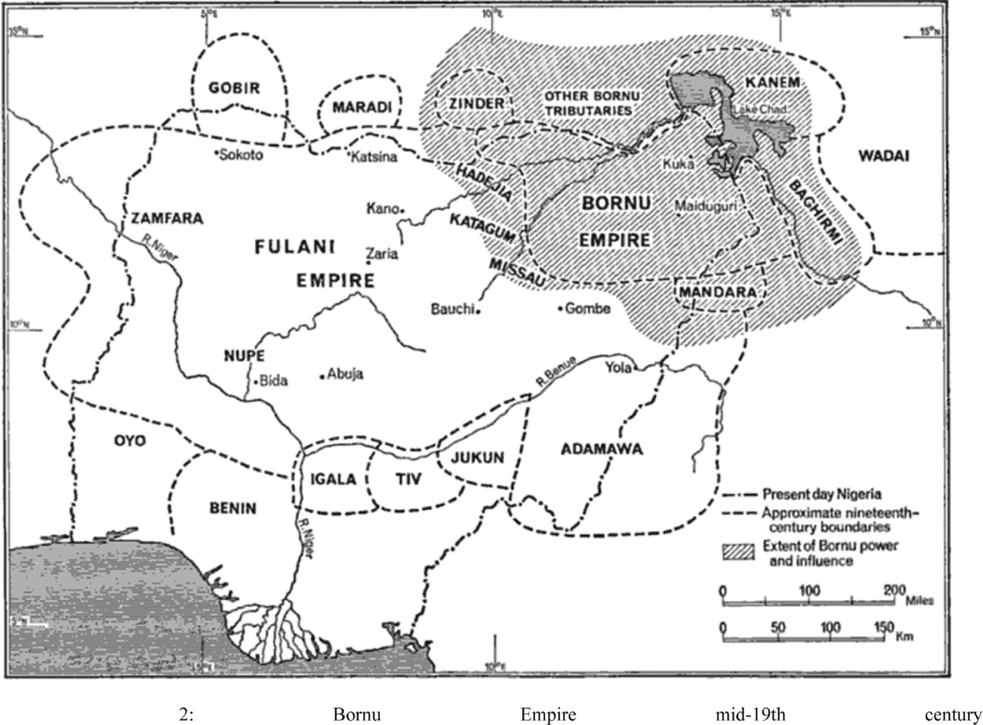
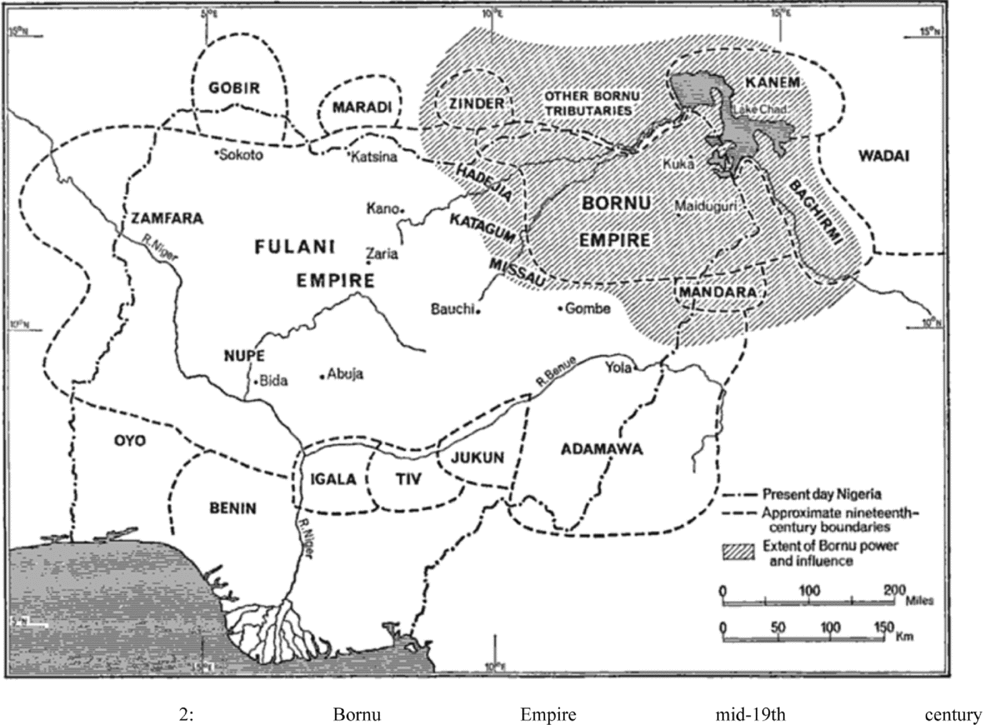
Islamification of the region began in the 11th century and in its wake came literacy and strong interregional trade with the north and north-east of Africa (Curtin et al., Reference Curtin, Feierman, Thompson and Vansina1978: 90). By the mid-19th century, the Kanuri and their subjected ethnic groups were ruled by a powerful Shehu (Sheik). This last independent BornuFootnote 12 Empire dominated the region and subjected ethnic groups around the Lake Chad making the Kanuri vernacular the dominant language in Borno (Crowder, Reference Crowder1978a: 15). Arabic served as written language among educated Kanuri (Denham et al., Reference Denham, Clapperton and Oudney1828: 162).
The Bornu Empire came under colonial (mostly British) domination around 1902 (Crowder, Reference Crowder1978a: 180–182). Colonial administration was not uniform over all of Nigeria but effectively divided Nigeria into a Muslim north and a Christian southFootnote 13. Working languages and colonial policies differed: English in southern Nigeria and Hausa in northern Nigeria. Colonial rule in northern Nigeria had three purposes: to control and defend the territory, promote trade and levy taxes to cover costs. European immigration into Bornu remained minimal (Coleman, Reference Coleman1963: 46–7). Upon independence in 1960, Borno became part of the newly established Nigeria. Leading economists of their time had high expectations towards rapid economic development (see for example Stolper, Reference Stolper2003). Yet, imported institutions of governance (law, legislative, and justice) failed to overcome centuries-old rules of patron client relationships in the Kanuri society. In 2000, Borno state re-adopted Islamic law in jurisdiction. Borno is today one of 36 states of the Federal Republic of Nigeria. Nigeria's economy is overly dependent on agriculture and the oil industry. More than 60% of the population live below the poverty line of 1 USD per day (African Economic Outlook, 2013). The Worldbank Governance Indicators Project ranks Nigerian institutional quality among the lowest 25% worldwide on several categories (Kaufmann et al., Reference Kaufmann, Kraay and Mastruzzi2009).
4. Borno and the transplant effect
How can the transplant effect in Bornu's government system be explained? Our analysis is structured chronologically. This is necessary, because there were two phases of institutional transfers: At the beginning of colonial rule and upon independence. Transfer processes and contexts varied, which led to different institutional outcomes. The analysis is based on primary sources such colonial reports and more recent anthropologic and economic research. A series of figures of the political and social hierarchy of the Kanuri society aims to increase comprehensibility and serves as a common thread through the analysis.
Pre-colonial Bornu
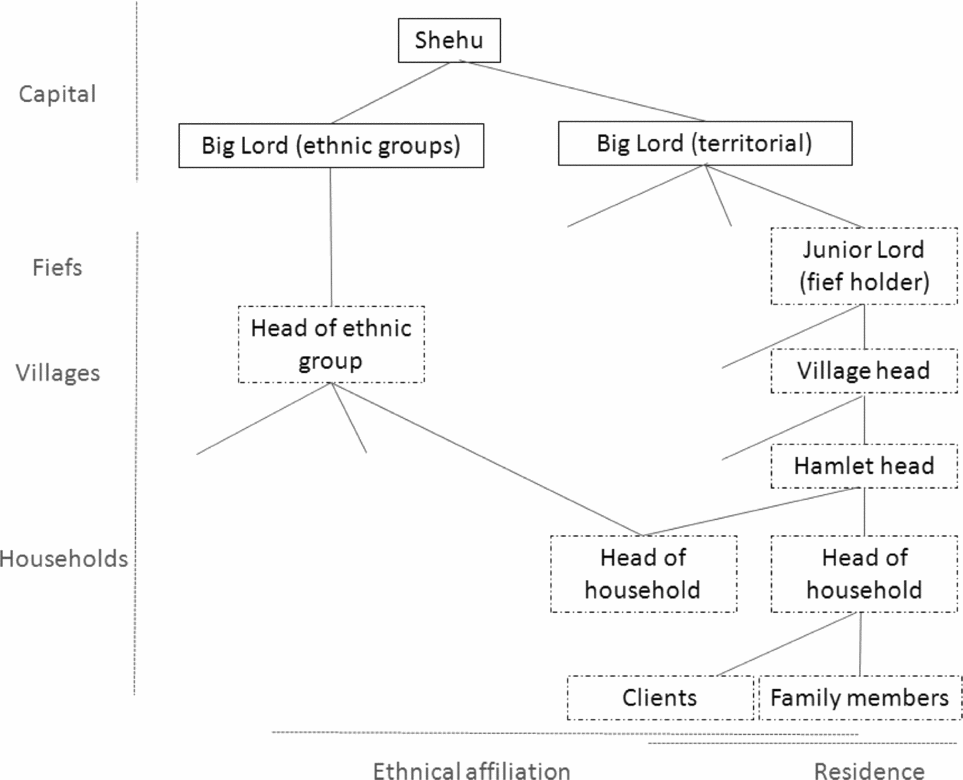
By the mid-19th century the highest political, legal, and religious authority in Borno held the titleFootnote 14 of a Shehu (Sheik). The Shehu was the only land owner in Bornu with power to allocate territories for settlement (mostly executed to by lower officials) or to redistribute it among his fief holders. Figure 3 shows the Kanuri political hierarchy at the top of which the Shehu and his most powerful fief holders, the Chima Kura (Big Lords) resided in the capital. The Big Lords used a system of locally based fief holders, Chima Gana (Junior Lords) and below them Belama (local authorities, village heads) to administer the territories. Village heads and below them Mbarma (hamlet heads) held hereditary titles and stayed attached to influential families. The Lords were expected to raise militia for defense or military campaigns, administer justice, and levy taxes. Village heads and below were not directly appointed by the Shehu. They were usually the head of the most influential household in the village. Any commoner, who wanted to address a higher official of the Shehu (e.g. the Junior Lords), needed support of his village head. Junior Lords, on the other hand, needed cooperation with the village heads to generate revenues for his Big Lord in the capital. This could lead to conflicts, in particular if the village leader had the backing of the most influential families behind him. Very successful village heads could make a career and become a member of titled nobility with the blessing of the Shehu (Kirscht, Reference Kirscht2001: 30–31). A second, ethnic based hierarchy existed with the aim to better administer (and tax) nomads or otherwise internally displaced (e.g. after wars). All titles were hereditary in the male line (Cohen, Reference Cohen1967: 25).
Simplified political hierarchy of the Bornu Empire (late 19th century).
Source: own based on Cohen (Reference Cohen and Turner1971), Crowder (Reference Crowder1978a) and Kirscht (Reference Kirscht2001)
The pre-colonial Kanuri society was based on berzum (discipline-respect), the institution which organized the relationship between head of household, generally the father, and other household members. Berzum was reciprocal in nature. The client (e.g. the son) was to be completely respectful and loyal. He was expected to work for the patron (e.g. the father) who in turn gave security, (legal) protection, shelter, and finally food and occupation to guarantee the client's social status. Berzum was self-reinforcing, which means that its application was not restricted to within households (Greif and Laitin, Reference Greif and Laitin2004). The Kanuri believed that the rules governing social relations in the family and the household were essential guides to any form of human organization such as economy, politics, and society in general. Villagers, for example, needed to turn to the next higher representative (e.g. the hamlet head) to petition a specific cause such building on unsettled land or seeking justice.
The Kanuri patron client relationship was complemented by other institutions. It was peer-enforced by nungu (shame-avoidance), an effective sanction in a closely knit society (Cohen, Reference Cohen1967: 46–52). The nzia ceremony regulated gift-exchanges that again strengthened relations between a patron and his clients by informing the former about wealth status of the latter. In a typical nzia ceremony type, quantity and value of the gifts were called out and noted (if scribes were present). Nzia gifts had to be repaid with gifts of similar value on later occasions (Cohen, Reference Cohen1962: 360; Nachtigal, Reference Nachtigal1889: 11–12). Finally, Islam complemented many institutions of the Kanuri society. It introduced Arabic writing and provided the underlying framework for law and justice. Contractual agreements in trans-Saharan trade for example were institutions imported from Arabic traders and built on Islam (Lydon, Reference Lydon2009). Hence, religion and legal life were tightly intertwined. The Shehu was the highest religious leader and highest judge. Apart from conducting religious functions, Islamic scholars traditionally also served as scribes, legal advisors, teachers or judges. Influential families surrounded themselves with them (Cohen, Reference Cohen1967: 22).
Colonial Bornu
Colonial rule in Bornu lasted from 1902 to 1960. In this period, there were two phases of intensified institutional transfer: An early phase which began when the British took possession of Bornu in 1902 and a second phase in the 1950s, when efforts were made to prepare Nigeria for independence.
In the early colonial period institutional transfers intended to support fulfill three goals: Establishing and maintaining colonial control, increasing tax revenues, and directing trade flows towards Lagos and international markets (Crowder, Reference Crowder1978b: 199). The institutions transferred in support of the first two goals directly affected the Kanuri patron client relationship and deserve to be covered in more detail.
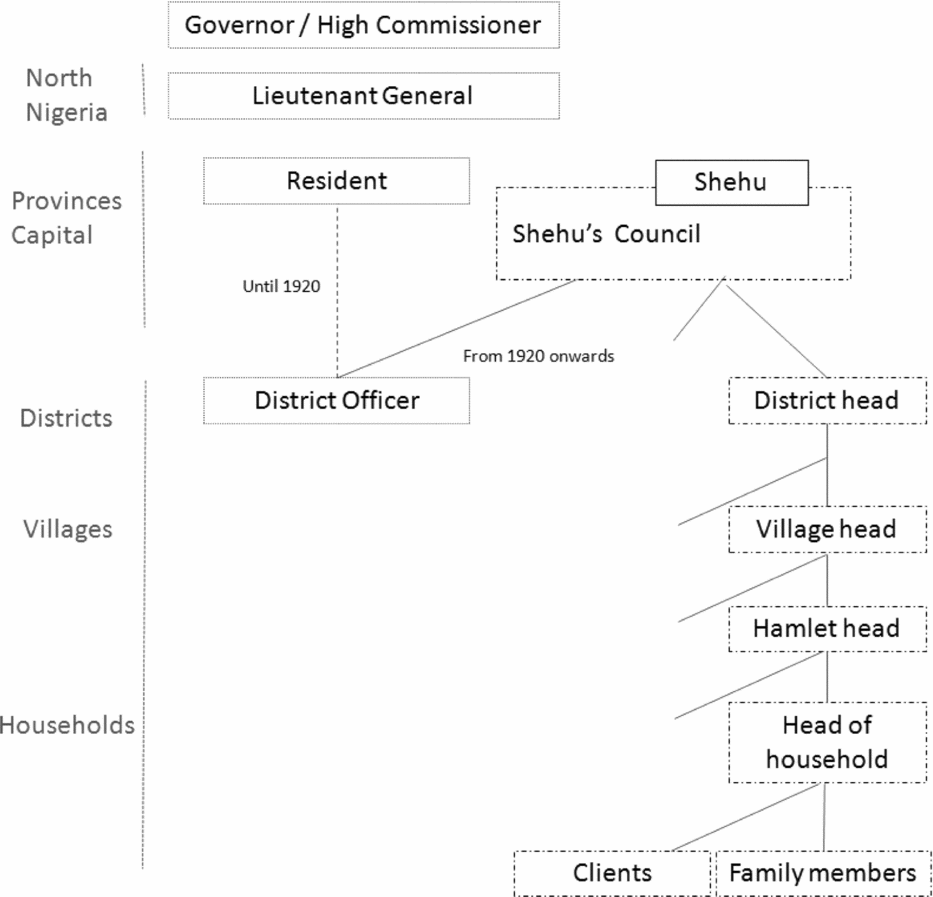
British ruling strategy in Bornu was indirect. In 1902 the British installed Shehu Garbai in Bornu and initially allowed him to rule in a pre-colonial manner. In the following years, institutional reforms aimed to increase efficiency of the traditional system. To facilitate taxation geographically fragmented fiefs (renamed into “districts”) and village areas were consolidated and the number of traditional leaders administering them was reduced. Likewise, the second hierarchy based on ethnicity was dropped (Crowder, Reference Crowder1978a: 199–200). After 1914, nobles residing close to the Shehu in the capital were organized as the Shehu's Council, which gradually developed into an early form of provincial government with each member fulfilling functions as heads of civil service departments. From 1920 on, British District Officers started to receive orders from the Council (Kirscht, Reference Kirscht2001: 49).
Indirect rule worked well in Bornu. Overall political stability and revenues were satisfactoryFootnote 15 and enforcement costs low. A small police force sufficed of 28 European police officers and 838 non-commissioned officers for northern Nigeria sufficed for a territory roughly of the size of France (Great Britain, Colonial Office, 1914: 10). Most problems in Bornu occurred in relation with the restructuring of districts whenever client relationships were perturbed. Typical cases of resistance included deposed traditional leader of merged villages or a religious practitioner who had been exempted from taxation in pre-colonial times. In another case, a former head of ethnic groups continued to levy taxes from ethnic kinsmen on a non-territorial basis (Cohen, Reference Cohen and Turner1971: 109). Figure 4 illustrates two facts: First, British influence never reached village level or below. On district level, the district officer had to report to the Shehu from 1920 onwards, which was unusual compared to other British colonies. Second, the traditional political and social hierarchy was not structurally changed. Even under British rule a common Kanuri had little interaction with British officials and still needed to petition through traditional authority structures. In 1906, a villager was flogged to death for having told people of his town that they could report alleged cases of corruption directly to the British officials (Cohen, Reference Cohen and Turner1971). Greif and Laitin (Reference Greif and Laitin2004) argue that British rule exogenously enforced berzum as the fundamental institution underlying the Shehu's authorityFootnote 16. The Sole Native Authority Law of 1933Footnote 17 formally acknowledged the executive, legislative, and judiciary powers of the Shehu as Native Ruler and his council as Native Authority.
Simplified political hierarchy of Bornu under colonial rule.
Source: own based on Cohen (Reference Cohen and Turner1971), Crowder (Reference Crowder1978a) and Kirscht (Reference Kirscht2001)
Indirect rule limited the number of imported institutions and considerably adapted British institutions to make them stick to the local norms which guaranteed low enforcement costs. Justice can serve as an example for the extent and the process of institutional adaptation. In 1900, on the formation of the Protectorate of Northern Nigeria, English common law was introduced to the (yet to be conquered) territories of northern Nigeria. Subsequent changes followed, which were introduced costlessly by proclamation. In 1902, native courts were allowed to administer justice under certain conditions (e.g. excluding Europeans). In 1904, English criminal law was suspended in northern Nigeria because of obvious incongruousness with local practice. Changes in 1906 aimed at limiting the application of Islamic law on Muslims only, although this was hard to achieve in some regions (such as southern Bornu) with non-Muslims minorities (Orr, Reference Orr1911: 230–244). The result was a considerable deviation from English common law. Only a fraction of cases was brought before the British court in the capital, which acted as court of last resort (Nicolson, Reference Nicolson1969: 204–205). As a result, the British administration openly accepted Kanuri native justice, which was based on Islamic law (Great Britain, Colonial Office 1903: 75–6).
Institutional adaptation as a transfer strategy was intentionally selected by the British. Governor LugardFootnote 18 was aware that affecting change of local institutions in northern Nigeria would have needed a high population density with conditions more like Hong Kong (Lugard, Reference Lugard1922: 215). Alternatively, familiarity with European norms in Bornu was extremely low. It is unknown exactly how many Europeans lived in Bornu. In 1913, only 804 Europeans resided in all 13 provinces of the northern Nigeria (Great Britain, Colonial Office, 1914). Within the British Empire the ruling strategy for a specific colonial possession (and with it the process of the institutional transfer) was decided by the extent of European migration, population density, the economic potential, geopolitical importance and the disease environment (Lange, Reference Lange2004: 908; Wengler, Reference Wengler1937: 361–2).
In hindsight adaptation as a strategy of institutional transfer in Bornu was a wise choice given that it was supported by a range of factors. First, the British considered Kanuri institutions centralized enough to be counterparts for British rule. The supportive role of Islam was acknowledged and Christian missionaries had little access to the Muslim northFootnote 19 (Great Britain, Colonial Office, 1914: 25). Moreover, population density was low relative to other British possessions. Under these circumstances tax collection had to rely on native authorities who again relied on clientilism (Lugard, Reference Lugard1922: 215). Also, northern Nigeria had no resources of major importance and there were no geopolitical reasons (e.g. conflicts with other European powers) that would have justified the costs of a major colonial transfer of European institutions (Great Britain, Colonial Office, 1914: 23–5). Furthermore adaptation costs were low. Changes could often be executed by means of a simple proclamation. Equally important, for the common Kanuri institutional change was driven and supported by their traditional leadership, the authority of which had not been weakened by British occupation. The Shehu and his administration could expect to win from the new arrangement in terms of political stability and their commitment to change was credible in the eyes of the local population (see also Coyne and Boettke, Reference Coyne and Boettke2009). Finally, British colonial administration was highly experienced in assessing existing norms and contriving compatible institutions. A key role in this regards was attributed to district officers who toured the provinces and advised on specifics and the extent of adaptationFootnote 20 (Lugard, Reference Lugard1922: 220). The use of district officers and their role in adapting foreign institutions relates to the discussion of the role of institutional intermediaries. There is little research on intermediaries, but we can expect that their importance increases with the growing incompatibility between foreign and local institutions (see also Berkowitz, Reference Berkowitz, Pistor and Richard2001: 167).
Our analysis shows that adaptation was consciously chosen and other strategies discarded by the British in the light of circumstantial factors. However, imported institutions turned out ineffective where adaptation was technically difficult. Attempts to impose the Sterling in Bornu did technically not allow much room for adaptation. The Kanuri continued using cowry shells and the Maria Theresia dollar until the mid-20th century. In the first years, locally counterfeited versions of British pennies added to the confusion and lowered trust in the new currency (Crowder, Reference Crowder1978a: 190; Great Britain, Colonial Office, 1907: 42).
Independence
After World War II, London undertook steps to prepare British colonies for independence. A series of decrees and constitutional reforms from 1947 to 1960 increased the extent of institutional transfers in Nigeria. Our analysis starts with the changes introduced by the so-called Richards Constitution and continues on to discuss factors, which contributed to the transplant effect. We then explore the impact of constitutional reforms in 1976 and in 1989 on the role of Kanuri patron client relations in the current institutional framework in Borno.
In 1947, Arthur Richards, the Governor of Nigeria, passed a first constitution which made Bornu part of the newly created Northern Region (beside an Eastern and a Western Region) in Nigeria. The Richards Constitution established new democratic institutions roughly shaped on the British model: The Northern House of Assembly and the House of Chiefs. At this stage, members of the Houses were not yet elected but came from the colonial administration and the traditional hierarchy. Hence, there was little initial impact on traditional rule. The first regional political parties followed in the 1950s and quickly consolidated their power in their regions of origin. In the Northern Region, the Northern People's Congress (N.P.C.) became the dominant political party, which was rooted in the traditional administration, Islam and supported by the political elites and the British colonial administration (Nicolson, Reference Nicolson1969: 276 and 291).
The Richards constitution also introduced a unitary civil administration based on Whitehall. At first, political efforts focused on replacing British with Nigerian officers (“Nigerianization”). Soon, a debate over the allocation of new positions and of funds intensified between the three regions (Nicolson, Reference Nicolson1969: 253–254). Higher levels of European education and more exposure to Europeans put candidates from Nigeria's south at an advantage and resulted in all senior positions being taken by SouthernersFootnote 21. In 1954, the tensions between the regions led to a division of the civil service into three regional and one federal public service (Coleman, Reference Coleman1963: 271–295; Nicolson, Reference Nicolson1969: 274). Different standards emerged and reflected different levels of education in the regions. In the Northern Region and in Bornu, competence levels of newly recruited staff were generally lower relative to Nigeria's south and European educated recruits were rare. The problem was aggravated by political demands for “Nigerianization” and “Northernization” of the workforce. British staff were given incentives to leave early and the employment of competent southern Nigerians was effectively blocked. In 1960, an investigation into the training and staff development by the Ford Foundation described the situation in the Northern Region as staggering. General short-fall in staff was more than 25 per cent (Nicolson, Reference Nicolson1969: 270). The north was also the only region to keep colonial traditions of public service: Among others, new bureaucrats were trained in etiquette such attendance of school sport days and polo matches. Ceremonial uniform for administrative officers were retained with swords and badges (Nicolson, Reference Nicolson1969: 291–6). In Bornu, the influence of the Shehu on recruitment of bureaucrats and on political parties was considerable. Like everywhere else in the Northern Region, the pro-aristocratic N.P.C. served as a vehicle to place followers and family members of the Shehu into key positions (Harnischfeger, Reference Harnischfeger2008: 63). Opposition movements aroused suspicion and fear of disorder in both, the outgoing British administration and traditional leadership. In 1958 the Borno Youth League, a Kanuri opposition movement, was forbidden after riots had broken out in Maiduguri (Cohen, Reference Cohen1967: 110).
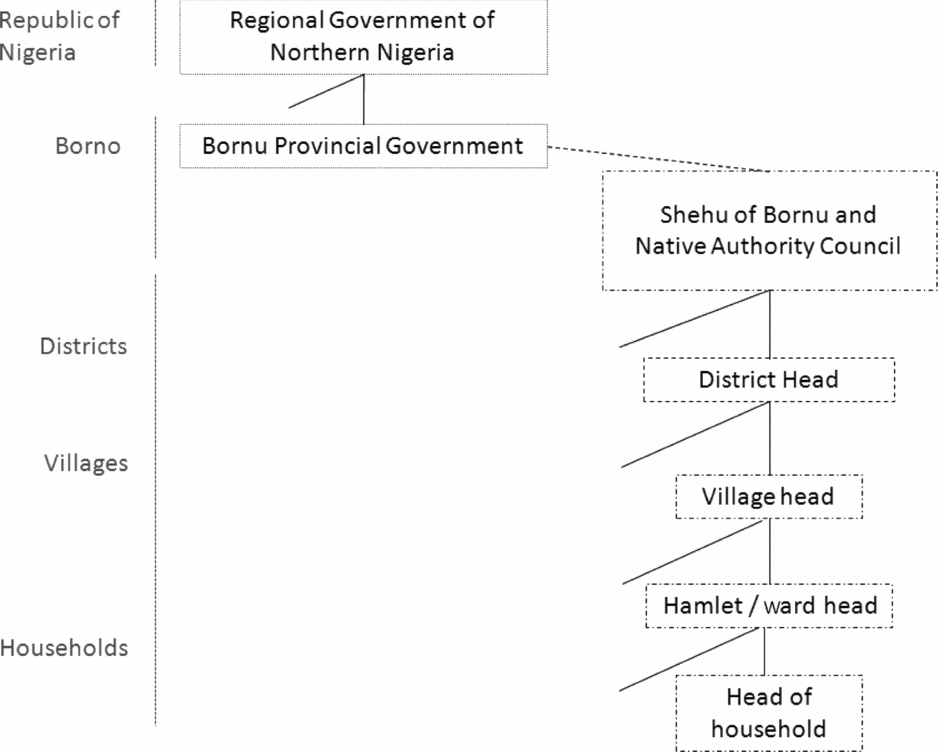
After independence, day-to-day politics remained firmly in the hand of the Shehu Umar III, who - being an old man - was represented by his first minister (Waziri). Figure 5 shows that the social and political hierarchy serving the Shehu had hardly changed from the late colonial period. Traditional leadership in Borno had quickly re-organized themselves and assumed the form of a political party, the N.P.C. who subsequently won the elections (Nicolson, Reference Nicolson1969: 291). The Shehu, his first minister and the Native Authority CouncilFootnote 22 formally and informally constituted the highest political authority in Bornu. The council acted like a cabinet with council members directing functional departments. District heads were accountable to the council and received directives and policies from the departments. In return, they delivered tax revenues to the Native Authority Treasury. Anthropologic research of the early 1960s strongly suggests that berzum continued to dominate procedures within the administration between council members, district heads, and other traditional leaders. Kanuri clientilism was supported by gift exchange and small payments. Justice continued to be administered on all levels of the hierarchy based on Islam and local customs (Cohen, Reference Cohen1967: 103–5). Islamic judges and the police had strong informal ties with the N.P.C. and the Shehu, which proved helpful in suppressing the political opposition. The abolition of Islamic law had been one of the British conditions, which the Muslim north had to accept in exchange for independence. But negotiations with the British achieved little and ended with independenceFootnote 23. The northern region introduced its own Penal Code, which was a more secular version of the Sharia and applicable to Muslims only. Until the adoption of full Sharia law in 2000, the application of Islamic law was supposed to be limited to civil proceedings involving questions of Islamic personal law such marriage and divorce or the ban of alcohol for Muslims (Harnischfeger, Reference Harnischfeger2008: 61–65).
Simplified political hierarchy in the Emirate of Borno (post 1960).
Source: own based on Cohen (Reference Cohen1967)
In particular, outside Maiduguri berzum remained the fundamental institution of Kanuri social interaction. There was no noticeable feeling of change among the rural Kanuri. Interviews conducted with older Kanuri farmers in the 1990s revealed hardly any recollection of independence or of changes in connection with independence. However, the political and administrative reforms of the mid-1970s were remembered as decisive changesFootnote 24 (Kirscht, Reference Kirscht2001: 65). Anthropologic research conducted in Maiduguri after independence reported the emergence of a small new class of salaried bureaucrats. These young men were generally fluent in English and some had enjoyed a European education. Although competence and education did matter in the new civil service, personal relationships were the primary requisite to enlistment. Once recruited, loyalty and obedience to department leaders dominated the contractual agreement. Transfers between departments for example, were close to impossible, because in terms of berzum changing a job was equivalent to neglecting a client's duty (Cohen, Reference Cohen1967: 107–8).
What contributed to the transplant effect in Borno? Similar to the institutional transfer of the early colonial phase, there was no alternative to adaptation as the transfer strategy. Civil service in Borno lacked the experience and the size to affect a change of local institutions and familiarity with European institutions was minimal. Adaptation failed for various reasons. First, it was arguably impossible to contrive a single institutional framework that suited all of Nigeria's distinct ethnic groups with distinct local institutions. Moreover, the extent of envisaged institutional reform was considerable and the timeframe was limited. Failure of the British to negotiate a unitary and secular law for all Nigerians can serve as an example. Second, the British believed in the benefits of putting Nigerians in charge of the process from an early stage on (Nicolson, Reference Nicolson1969: 276). Through a series of conferences and a new constitutionFootnote 25, they gradually ceded control over the process of institutional reform. Although this allowed for a limited degree of localization, institutional changes soon served the conservation of political influence of traditional rulers. This effect was stronger in Borno and the Northern Region, where rulers had benefitted from the stability provided by the colonial system. This explains the continuation of colonial attire and customs in the civil service. The main function of bureaucracy – the impersonal provision of service to citizens – was not fulfilled. Third, there was, above all, a problem of incompatibility of traditional rule with modern governance. To conserve their political position elites relied on the patron client relationship which was incompatible with impersonalized norms of a modern democracy (see also Englebert, Reference Englebert2000 and Weingast, Reference Weingast and Chamlee-Wright2009). There was no easy solution for this dilemma. In Eastern Africa, the Tswana initially formalized the informal rights of traditional leaders by translating them into written law and used later legislation to erode these rights in a democratic process (Parson, Reference Parson1984: 43–6). But the Tswana traditional institutions of rule are believed to be more compatible with modern democratic rules and institutional reforms were implemented by a charismatic leader, who was himself a tribal king with an education in Oxford and who was convinced to gain from modernization (Acemoglu et al., Reference Acemoglu, Johnson and Robinson2001a). In Borno, such a process of adaptation would have needed the support of the Shehu – an elderly man, who did not expect to benefit from modernization more than he feared to lose. Already in 1952, the Shehu and other northern Emirs had shown resistance to constitutional reform fearing loss of their political influence. At that time, many of the revolting Emirs had been discharged and exiled by the British. The Shehu of Bornu was allowed to stay on the condition of major changes in his council (Kirscht, Reference Kirscht2001: 63). After independence, the regional government of the Northern Nigeria had fewer incentives to enforce imported institutions in BornoFootnote 26. Fourth, the institutional changes around independence were not supported by a crisis or a break of established routines. There were no personnel changes in traditional leadership or otherwise a political shakeup. In fact, rural Kanuri hardly noticed changes in the first years after independence. In other parts of the British Empire, Botswana and Malaysia for example, political crises upon independence created opportunities that supported institutional change (Lange, Reference Lange2009). Finally, low levels of European educationFootnote 27 and urbanizationFootnote 28 in Bornu had a twofold effect. They limited the number of Kanuri with an orientation towards Europe (Cohen, Reference Cohen1967: 106) and restricted the supply of competent recruits for the civil service. Moreover, many northerners with a Western education pursued carriers in the N.P.C., which aimed to consolidate its own political dominance rather than institutional reform (Harnischfeger, Reference Harnischfeger2008: 63–4). Yet, wherever changes of local institutions took place in southern Nigeria, they were promoted by a European educated urban class who supported modernization (Falola and Heaton, Reference Falola and Heaton2008: 155–7). This was most evident in rapidly growing Lagos, where students had been the first social group to organize an independence movement (Crowder, Reference Crowder1978a: 217; Nicolson, Reference Nicolson1969: 295).
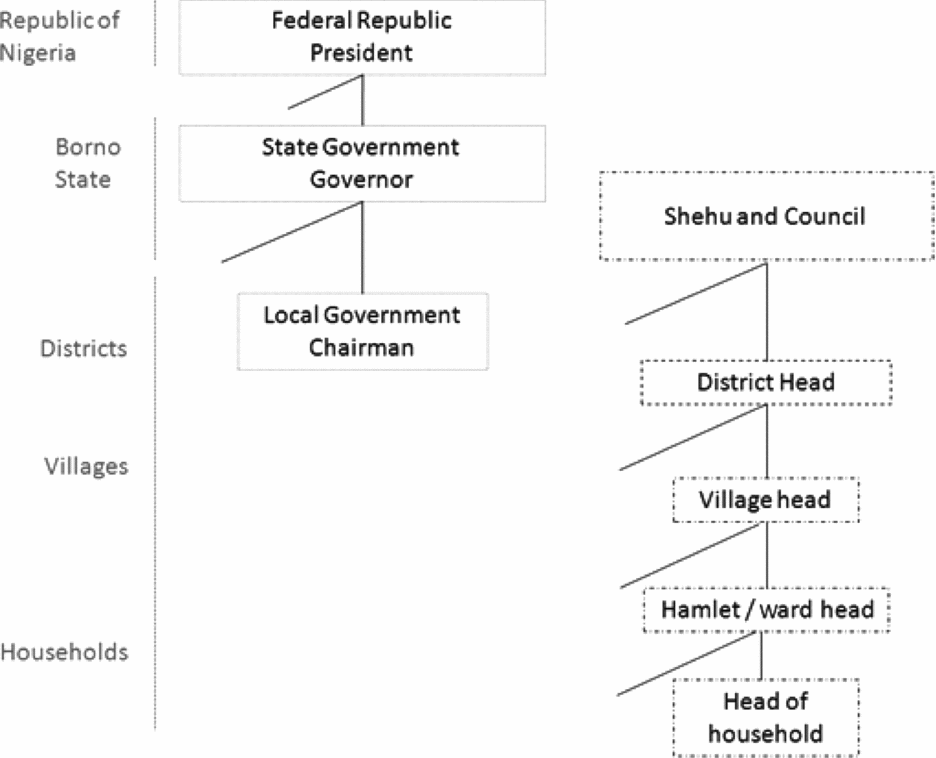
Whereas institutional adaptation was the chosen by the British upon independence, considerable income from oil and gas resources in the 1970s shifted the transfer strategy towards more change of local institutions. In 1976, constitutional reforms established a new republic based on a presidential system. More important for the analysis of the transplant effect, new local government areas (LGAs) with elected representatives were introduced on district level. Revenues from oil and natural gas were soon channeled to these newly established bodies enabling them to enforce imported – now federal – norms. Also in 1976, the Universal Primary Education (UPE) scheme was launched and expanded Western education into rural Borno. This promoted urbanization as newly educated Kanuri left the countryside in search for employment in Maiduguri. Migration to urban centers led to labor shortages in the countryside and religious radicalization in towns (Csapo, Reference Csapo1983 and Kirscht, Reference Kirscht2001: 68). The constitution of 1989 (in force since 1999) further deprived traditional leaders of all legislative, executive and judicial powers. Figure 6 shows that the traditional hierarchy today is no longer considered part of the official system of governance. Traditional leaders are granted advisory roles or may assist in raising taxes (Kirscht, Reference Kirscht2001: 74).
Simplified political hierarchy Borno State (post 1989).
Source: own based on Cohen (Reference Cohen and Turner1971), Crowder (Reference Crowder1978a) and Kirscht (Reference Kirscht2001)
The enforcement of federal institutions on state and district level altered the transfer process from adaptation to a change of local institutions. The process is ongoing. Whereas Kanuri patron client relations have remained dominant on village level and in the countryside (Kirscht, Reference Kirscht2001: 78), institutional conflicts have become frequent on district level, where traditional leaders are now forced into cooperation with federal government structures (Englebert, Reference Englebert2009: 136). In best Hayekian sense the resulting institutional equilibrium today is of spontaneous nature and differs from the original intention of institutional design (Hayek, Reference Hayek1973: 41). The Kanuri patron client relationship has been weakened, but not replaced and it continues to shape the rules of the game, albeit with outcomes that depend on circumstances and can hardly be predicted. Kirscht (Reference Kirscht2001: 79) reports a case of the late 1990s, where the district head in MarteFootnote 29 was called to solve a violent conflict between Fulani cattle herders and Kanuri farmers. The old man ordered a squadron of police, who are federal agents, to take a pick-up truck and assist him in settling the conflict. The police obeyed. Formally, district heads hold no executive powers over federal police agents, but old informal institutions make them responsible for solving conflicts between famers and cattle herders. The police officers, who were themselves ethnic Kanuri, had to decide between respecting the authority of the district leader or the law and followed the former. Sarch (Reference Sarch, Solomon and Turton2000) investigated a conflict between the Inland Fishing Decree of 1992, a federal law, and traditional norms regulating fishing rights on the shores of Lake Chad. Despite the use of military patrols on the lake, federal agents and LGA officers had to give in and accept the supremacy of the traditional solution. Conflicts over access and the use of land are another area where conflicting institutional norms provide uncertain outcomes. Although federal law grants equal access to land for all NigerianFootnote 30, de facto allocation is based on traditional norms which favor local Kanuri over non-local Nigerians. In Marte district less than 3 per cent of local Kanuri had no access to agricultural land in 1999 compared to 35 per cent of non-local Nigerians (Kirscht, Reference Kirscht2001: 301). In a similar manner, the adoption of Sharia Law in Borno in 2000 has led to a situation where provisions of the more secular Penal Code of 1960 co-exist with conflicting regulations of new Sharia Penal Code (Ostien, Reference Ostien2007: 6). This has not only increased uncertainty in jurisdiction, but also upset the political stability of the region. With federal police not trained or willing to execute Islamic law, militarized Islamic groups (hisba) have emerged initially intending to fill this vacuum, which has led to violent clashes with opposing groups of Christian minorities (BBC, 2013; Harnischfeger, Reference Harnischfeger2008: 93–5).
5. Conclusion
This paper aimed to contribute to the question of what determines failure and success of institutional transfers. It investigated the process of institutional transfer in the case of Borno, in particular factors promoting or inhibiting the success of the transfer. How can we explain the transplant effect in Borno and what are the implications for ongoing research as well as national and international efforts of governance reform?
In the case of Borno two of the three transfer strategies proposed in the analytical framework were applied. Institutional adaptation was successful under colonial rule and its connection with indirect rule has been highlighted in our analysis. Upon independence however, adaptation (started in 1947) and change in local institution (effective from 1976 onwards) failed to successfully import modern institutions into the Kanuri society. Both processes lacked the support of prevailing factors and conditions. Adaptation was technically limited by the variety of Nigeria's many ethnic groups and the incompatibility of Kanuri patron client relationship with democratic rules. Furthermore, the process was influenced by political elites with an interest in the conservation of the status quo. Finally and even if there had been political commitment by the ruling elites, the shortage in bureaucrats with competence in the new rules of the game presented a major obstacle. From the mid-1970s on, imported institutions were finally enforced after constitutional reforms and with the help of revenues from national oil and gas exports. Our analysis shows that local Kanuri institutions are slowly changing. The process is still ongoing and its outcome remains unpredictable. The traditional hierarchy and the patron client relationship have been weakened particularly in Maiduguri and smaller towns, but uncertainty has increased within the resulting institutional framework resulting in varying and unpredictable solutions on a day to day basis. Above all, the failure of transplanting a secular and impersonal law has the potential to radicalize the society and to further reduce chances of a successful implementation of non-Kanuri institutions.
The Kanuri case implies that adaptation or change in local institutions as transfer strategies are no magic bullets. Yet some insights for policy making can be drawn from our analysis. Adaptation of imported institutions to local context – i.e. aiming for second-best institutions instead of best-practice (Rodrik, Reference Rodrik2008) – is an important first step. Furthermore, the analysis of the Kanuri case suggests that the process of how second-best institutions can be imported is equally important. International actors and national governments may be advised to consider whether prevailing social and political factors support the chosen transfer strategy. In all likeliness, the commitment of the ruling elite, levels of education and urbanization or the number and competence of civil service staff influence the chances of a successful transfer. Path-dependent effects such as the impact of colonial rule on local institutions matter, too. Depending on these factors, effective import strategies are likely to be a mix of adaptation, building on existing familiarity and affecting change of local institutions. Another implication of the Kanuri case concurs with an argument made by Douglass North et al., (Reference North, Wallis and Weingast2009). A failed attempt to enforce imported institutions may destabilize existing social order and lead to even lower likeliness of successful institutional change. Generalization from the Kanuri case naturally has limits. Even within Nigeria the same process of institutional transfer led to different institutional outcomes in the south and the north. From a wider perspective, the Kanuri may be representative for other landlocked pastoralist societies in Africa which decolonized in the 1960s. Clientilism is arguably fundamental to most traditional societies. However, history, local institutions, geography and demographics vary considerably and other pastoralist African societies are likely to be influence by different factors. International trade or ethnic composition for example, have so far played a minor role with the Kanuri but may become relevant in the future.
Finally, the case of the Kanuri holds implications for further research of the transplant effect. The analysis suggests that variations in the success of institutional transfers can be explained by transfer strategy, local institutions (such as those embedded culture) and varying historic, geographic and other contextual parameters. In an ideal world the transfer strategy is chosen in view of existing local institutions and contextual factors of the recipient society. Arguably, institutional transfers will have differed in densely populated areas (Hong Kong) or regions with considerable European immigration. Also, the colonial period provides an important timeframe for institutional transfers, but a differentiated approach seems advisable for future research. Even in the case of the comparatively short period of colonial rule in Borno, institutional transfers of the early colonial phase differed considerably from those before independence. Compressing a century or more of colonial rule to draw conclusions on institutional development may lead to inaccurate conclusions (see Austin, Reference Austin2008 for a similar argument). In a similar vein, research on institutions of multiethnic nations like Nigeria may require a more selective approach with focus on single major ethnic groups or else risk neglecting the effect of persistent local institutions.