

Introduction
The birth of the Old Kingdom in 2686 bc in Egypt initiated an era which would be characterised by significant achievements in many fields, such as art, architecture, social engineering and medicine.Reference Edwards, Gadd and Hammond1
It may be said that medicine was first practiced in Egypt. Ancient Egyptian doctors were well respected and sought after by foreign rulers.Reference von Staden2, 3 Such high regard for ancient Egyptians has persisted, and archaeological explorations over the centuries have led to an increased interest in and admiration for the alleged skills of ancient Egyptians.
However, even if Egypt may be considered the cradle of medicine, modern literature seems to be somewhat too enthusiastic in its claims for an Egyptian origin for some procedures. For example, procedures including cataract surgery,Reference Ascaso, Lizana and Cristobal4 trephination,Reference El Gindi5 amputationReference Dobanovački, Milovanović, Slavković, Tatić, Mišković and Škorić-Jokić6 and dental surgeryReference Weinberger7 have often, incorrectly, been thought to have Egyptian origins.Reference Blomstedt8 Statements reflecting such misconceptions have been published in respected international peer-reviewed journals, and have often spread throughout the literature. This is also true of the field of ENT surgery, or more specifically tracheostomy, which often has been given a place in the armamentarium of the Egyptian doctors.
In an attempt to provide a critical and balanced picture of the surgical skills of the ancient Egyptians, I have reviewed both original sources and modern literature regarding different areas of surgery.
The aim of this review is to briefly present and analyse the claims regarding tracheostomies in Egypt, from the First Dynasty (circa 3100 bc) until the beginning of the Ptolemaic Era (332 bc), in order to distinguish between what the Egyptians actually did and what has been incorrectly ascribed to them.
ENT surgery in ancient Egypt
Different specialties within the field of medicine are well known to have existed in ancient Egypt, including those we would today refer to as ophthalmology and dentistry. Contrary to some claims, there are, however, no indications that surgery was a speciality, or seen as separate from the field of medicine in general.Reference Pahor and David9–Reference Jonckheere12 The same is, of course, true for ENT surgery. Medical papyri provide us with many examples of nonsurgical treatments for various afflictions of the ears, nose and throat. The Ebers papyrus, dating from around 1534 bc, describes a case of surgery involving an unspecified operation for a ‘cystoid enlarged gland on [the patient's] neck’, suggested to be a tubercular gland.Reference Ebbell10
Most interesting is, however, the Edwin Smith surgical papyrus.Reference Breasted13 The preserved copy of this papyrus dates to the New Kingdom (about 1550 bc), but the language of the papyrus reveals an origin possibly as early as the Old Kingdom.Reference Breasted13 The field of ENT surgery is remarkably well represented here. This papyrus contains 48 ‘case reports’ arranged in a systematic manner. Most of the cases listed from 11 to 28 would be of interest to the modern ENT surgeon. Especially relevant are the repositioning of a broken nose and use of a tamponade to control haemorrhage in case 12, the stitching of flesh wounds of the nose and ear in cases 14 and 23, respectively, and several descriptions of various injuries to the craniofacial skeleton.
Unfortunately ENT procedures have not been documented in the visual arts, nor in the abundant mummy material.
Tracheostomy in ancient Egypt
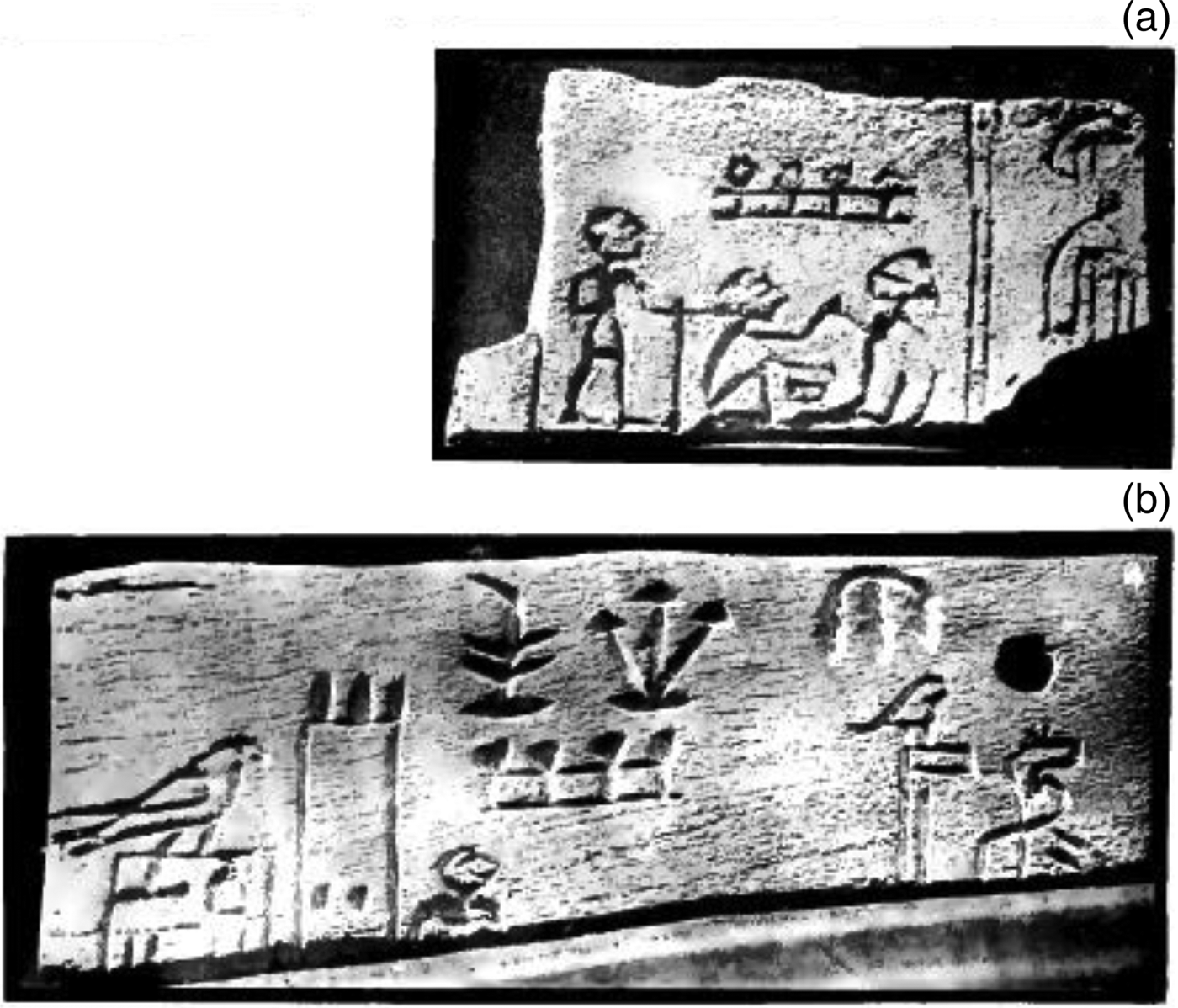
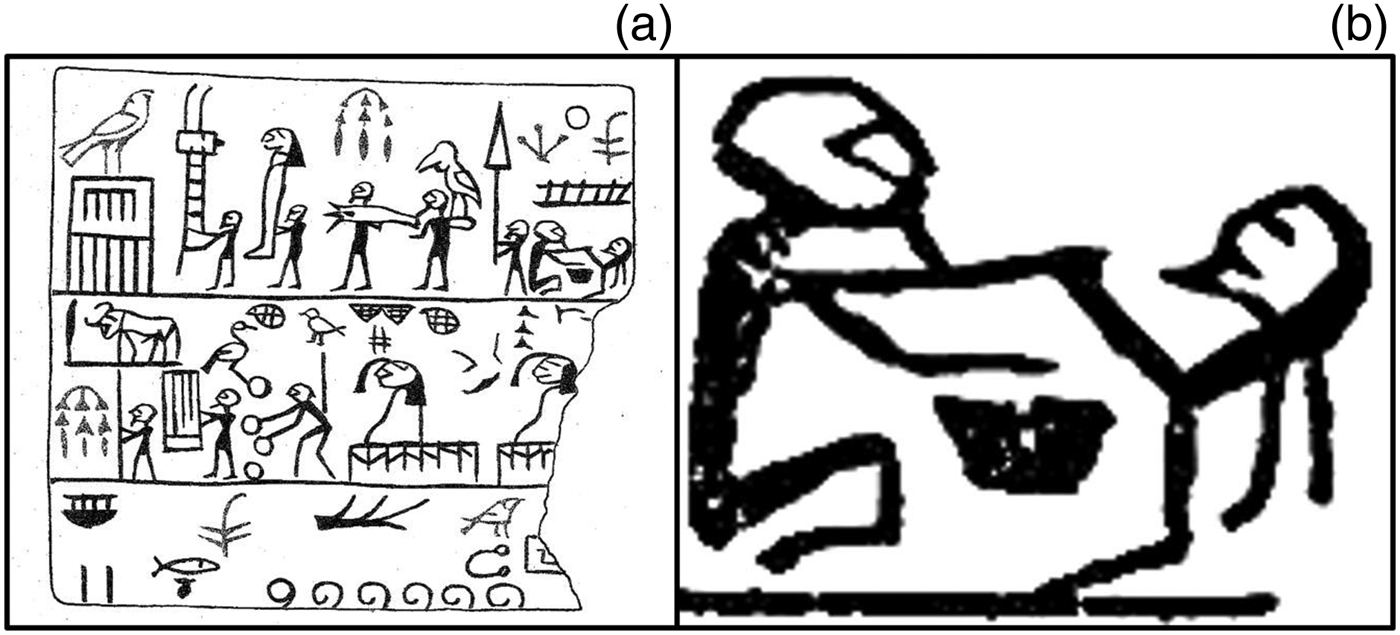
Tracheostomy is a procedure often said to have been invented and performed by the ancient Egyptians.Reference Pahor and David9, Reference Goldenberg, Golz, Netzer and Joachims14–Reference Seid, Gluckman and Paparella34 This claim is usually based on scenes depicted on the slab of King Aha (Figure 1) and the slab of King Djer (Figure 2), although the procedure is sometimes also said to be described in the Ebers papyrus.Reference Rajesh and Meher20, Reference Silbergleit, Gardner, Iannuzzi and Tippett26, Reference Kramp and Dommerich27, Reference Pierson33–Reference Weissler, Couch, Bailey, Johnson and Newlands35 However, tracheostomies are never actually mentioned in the Ebers papyrus, nor in any of the other medical papyri. Nevertheless, these depictions do at least exist and therefore need to be analysed in some detail.
The slab of King Aha, showing the sacrifice or tracheostomy scene (a) and a continuation of the scene on another slab (b).36

The slab of King Djer, showing (a) the whole slab, with the sacrifice or tracheostomy scene in the upper right corner, and (b) an enlarged image.37
The slab of King Aha was found during the excavations of the tombs of the First Dynasty in 1900. The upper part of this slab is carbonised, but a duplicate image exists on another slab. On the ebony label of the slab of King Aha we see the name of Aha, 2nd pharaoh of the First Dynasty (thirty-first century bc). The text has been translated as ‘receiving [captives] of the south and north’, but alternative interpretations have also been suggested. Below this text is a seated man, directing what appears to be a knife towards the chest of another seated man.Reference Petrie and Griffith36
During an excavation in the 1930s of the tomb of Hemaka, chancellor to the pharaoh during the First Dynasty, an almost identical scene with an identical text (but containing the name of Djer) was found on the slab of King Djer. Djer was the son of Aha and 3rd pharaoh of the First Dynasty (thirty-first century bc). On this slab, the man towards whom the knife is directed is clearly seen in the conventional pose of a captive, with his arms (supposedly tied) behind his back.Reference Emery and Saad37 In both cases, these scenes have been interpreted as representing the sacrifice of captives.Reference Petrie and Griffith36, Reference Emery and Saad37 This interpretation is convincing from the appearance of the scenes, especially because it is well known that human sacrifices were performed upon the death of a pharaoh during the First Dynasty. This practice took place under Aha and reached its peak under Djer. In fact, the tomb complex of Djer in Abydos contained 590 subsidiary graves, although it is not clear how many of these actually contain human sacrifices.Reference Edwards, Edwards, Gadd and Hammond38
However, in 1950, the Egyptologist Vikentiev suggested that the images actually represent a surgeon performing a tracheostomy on a patient before introducing a trocar.Reference Vikentiev39 He considered the suggestion of human sacrifice to be ‘bizarre’, and suggested that a benevolent act is being shown. His reasoning is too complex to relate in detail; however, in short, he believes that the slabs refer to the celebration of the continuing rule of the pharaoh, known as the Heb Sed Festival, and that the tracheostomy or sacrifice scene should not be interpreted at face value, but instead symbolises respiration. According to Vikentiev, the text should be interpreted as representing the south and north of Egypt receiving the life-giving breath of the pharaoh. However, in order to make this interpretation, he suggested that tracheostomies were a common surgical procedure in Protodynastic Egypt – so common, in fact, that a depiction of the procedure had become the symbol for a certain type of respiration.Reference Vikentiev39 For the layman, this interpretation seems to be based on many unproven assumptions and is far-fetched. The later suggestion that the image could depict a tracheostomy performed as part of a religious ceremonyReference Perrin40 is similarly unconvincing, and would undermine many of Vikentiev's arguments.
Vikentiev's interpretation is not supported by other sources for the Heb Sed Festival, and has not received any support from Egyptologists. The medical profession has, however, proven to be more enthusiastic. In the same year, Hussein gave support to the tracheostomy interpretation.Reference Hussein41 This interpretation has since been repeated numerous times in the medical literature, with the original publication seldom being cited, and probably consulted less often.
Support for the practice of tracheostomy in ancient Egypt is thus limited to these two depictions. The slab of King Aha clearly shows a person pointing a knife toward the middle of the sternum. In the slab of King Djer, the knife is pointing even lower, that is, further away from the site of tracheostomy in the neck.Reference Leca42 To see these images as representing tracheostomies, one would also need to disregard the more convincing possibility that these scenes represent human sacrifice. The latter interpretation is directly supported by the text and from circumstantial evidence indicating that human sacrifices were performed at the deaths of Aha and Djer. One should also consider the primitive level of Egyptian surgery. Even during its zenith in later dynastic times, we have clear evidence for minor procedures only, such as the stitching of wounds, repositioning of fractures and removal of superficial tumours. It is therefore absurd to suggest that tracheostomies were being performed hundreds of years earlier during the Protodynastic period.
The claims for tracheostomy are therefore not based on fact, but instead on a rather fanciful interpretation of two key images. However, this type of misapprehension concerning surgical practice in ancient Egypt has occurred repeatedly. For example, the often-repeated statements about depictions of amputations can be traced back to a misinterpretation by Larrey during the Napoleonic Expedition into Egypt.Reference Larrey43 Similarly, the well-known barber scenes, in which barbers are shown shaving the heads of their clients (as specified in the accompanying text), have repeatedly been referred to as neurosurgical interventions in modern neurosurgical journals.Reference Blomstedt8, Reference Fanous and Couldwell44
Conclusion
Several surgical procedures relevant to ENT surgery are known to have been practiced in ancient Egypt. However, although it has often been stated that tracheostomies were performed in ancient Egypt, an analysis of the source material identifies no evidence to support such a claim.
Acknowledgements
I would like to express my gratitude to Professor Marwan Hariz for reviewing the language of this manuscript and to Professor Hans-Werner Fischer-Elfert for his help regarding the linguistic arguments of Vikentiev.