Introduction
How should we think critically about histories of genres that span several continents and several centuries? What should we make of linear histories of music that follow one ‘route’, emphasise ‘roots’, and maintain clear boundaries between regions?Footnote 1 To begin this discussion, I set out the prevailing history of danzón, a popular Cuban music-dance form, as it was told to me by danzón aficionados in Mexico (and Cuba).Footnote 2 These danzón aficionados were mostly older men with interests in popular music spanning many decades. They included the masters of ceremonies who pontificate between tracks at Mexican danzón events, aficionado investigators, journalists and academics. Aficionado investigators, journalists and academics overlapped in terms of source material and output, particularly in relation to knowledge that was beyond their own memory. Their historical knowledge consisted primarily of data about danzón the music, its musicians and generic shifts, with somewhat less attention paid to danzón the dance. The authority of numerous older Cuban texts was largely undisputed by these experts: I refer to texts written mostly in or before the 1980s, such as those of the novelist and musicologist. Alejo Carpentier (1946), Fernando Ortiz (1950; 1981), Osvaldo Castillo Faílde (1964), María Antonia Fernández (1974), Natalio Galán (1983), Argeliers León (1984), Raúl Martínez Rodríguez (undated), Helio Orovio (1981), Ezequiel Rodríguez Domínguez (1967) and Odilio Urfé (1976; 1979). In relation to ‘Afro-Cuban’ music, several scholars (Argyriadis Reference Argyriadis2006; Moore Reference Moore2006) have argued that the work and influence of Fernando Ortiz (1881–1969) subsequently inspired a rather standardised body of ‘Afro-Cuban’ musical and choreographic practice and academic work. This may account for the fact that, while these Cuban authors do not always concur, their material has been sufficiently coherent to form the basis of what I shall call a ‘standard’ history of danzón.
The ‘standard’ history of danzón spans over four centuries and three continents. It follows one ‘route’ (Clifford Reference Clifford1994). The story goes that the 17th-century English Country Dance was transformed into the French contredanse; travelled to ‘French’ Saint Domingue (later Haiti), and then ‘Spanish’ Cuba, where it became the Cuban contradanza; subsequently the danza, danzón, danzonete, mambo and cha-cha-chá. In this article I bring together data collected in Mexico, Cuba, France and the UK to create anew this ‘standard’ history of danzón.Footnote 3 I then proceed to deconstruct this narrative, analysing the concepts underpinning it: a ‘monumental’ history (moving from innovation to innovation) in which individual originators create genres, genres are assigned origins and nationalities, and music and dance are positioned in terms of notions of ‘race’ and moralities.
The ‘standard’ history of danzón
The ‘standard’ history of danzón (and what has been called ‘the danzón complex’ – contradanza, danza, habanera, danzón, mambo, cha-cha-chá – by among others Alén Rodríguez Reference Alén Rodríguez, Olsen and Sheehy1998) has a beginning (the English Country Dance), a middle (where danzón, the protagonist, appears), and an end (the cha-cha-chá). Most danzón experts draw on Carpentier (Reference Carpentier1946) to propound that it all began with the English Country Dance, but give little information as to what the music and dance were like. (This is unsurprising, given the lack of sources on 17th-century English dances available in Cuba and Mexico.) The 17th-century English Country Dance is often described as a single, rural peasant dance, rather than several dances (the round, the longways, the jig and so forth, danced in circular, square and lengthwise formations), such as those published by Playford from 1650 on (e.g. Reference Playford1698). Moreover, the predecessors of the English Country Dance, such as the branle, do not figure in ‘standard’ histories of danzón. Whitlock (Reference Whitlock1999) suggests that the sources for Playford's dances might have been Ben Jonson's masques and Richard Brome's plays, and that Playford's intention in publishing these dance manuals was politically subversive, i.e. to reassert Royalist court values. However, the English Country Dance is understood in ‘standard’ danzón histories as a rural peasant dance where the ‘country’ of the English Country Dance refers to rural England rather than to the English nation. This has contributed to a misconception that these dances were performed merely by the lower classes rather than across English social classes, as Quirey (Reference Quirey1993) suggests. Furthermore, it has resulted in renditions of a history of danzón in which the dance oscillates between social classes, mostly percolating upwards through the social strata. As Wade (Reference Wade2000) points out in relation to Colombia's ‘música tropical’, such renditions do not allow for the complexities of class interaction.
‘Standard’ histories of danzón go on to recount how the lower-class English Country Dance was taken to France, where it was appropriated by French elites and renamed contredanse (as a phonetic equivalent or a descriptor for the lines of male and female dancers facing each other). While Carpentier (Reference Carpentier1946, p. 125) claims that the contredanse was not an elite dance, but ‘a bourgeois dance that did not get to Versailles’, Guilcher (Reference Guilcher1969) provides evidence that these dances were notated in England by the dancing master André Lorin and performed at Versailles by Louis XIV and his coterie by 1688.Footnote 4 It seems more plausible that a series of dances, performed across England's social classes and hugely fashionable among London's elites, was taken up in France by several groups, including the influential French court. Contredanses soon became popular throughout Europe. Haydn, Mozart and Beethoven all included them in their works (Gadles Mikowsky Reference Gadles Mikowsky1988). They tended to be written in 2/4 or 6/8, with two repeated eight-bar sections (AABB), like the subsequent Cuban contradanzas. Contredanses were generally danced lengthways by two lines of dancers, with variations incorporated (such as the cotillion, a square dance for four couples, being added in France) (Quirey Reference Quirey1993).
‘Standard’ histories of danzón continue with the Treaty of Ryswick in 1697, whereby France acquired ‘Saint Domingue’ (Hispaniola, later Haiti) from Spain. They contend that by the 18th century, Saint Domingue elites, rich from the sugar plantations and having imported over one million slaves, emulated urban French society, including French music and dance. Carpentier suggests that ‘the black musicians of Saint Domingue adopted [the contredanse] with enthusiasm, giving it a rhythmic vivacity ignored by the original model. […] The so-called “tango rhythm” appeared in the bass notes. The percussion accentuated the mischievousness of the black violinists’ (1946, p. 126). Following Carpentier, danzón experts recount how isorhythms (repeated rhythmic motifs/sequences) such as the tango  , the cinquillo
 and the tresillo
 were incorporated into the contredanse in the circum-Caribbean, together with percussion instruments such as the güiro. ‘African’ origins are usually ascribed to these rhythms, either brought to the circum-Caribbean by slaves (Urfé Reference Urfé, León and Urfé1976), or via Moorish Spain (Sachs Reference Sachs1937; Fernández Reference Fernández1989), or both (Carpentier Reference Carpentier1946; Lapique Reference Lapique and Giro1995). While the ‘tango rhythm’ was also employed in European contredanses – for example, Mozart's Contredanse en Sol, as Gadles Mikowsky (Reference Gadles Mikowsky1988) documents – it was the repeated use of these rhythmic figures, particularly in the bass and in non-notated parts (percussion and improvisations), that distinguished circum-Caribbean performances. Cuban sources on danzón (such as León Reference León, León and Urfé1976; Urfé Reference Urfé, León and Urfé1976; Alén Rodríguez Reference Alén Rodríguez, Olsen and Sheehy1998) move swiftly on to Cuba from Saint Domingue without clarifying whether it was in Saint Domingue or in Cuba that profound transformations occurred to the music and the dance.
The Saint Domingue slave revolts of 1791–1804, which culminated in the formation of the Republic of Haiti, prompted elites to flee to the east of Cuba (as well as to Louisiana, New Orleans and beyond). They took with them their domestic slaves and loyal servants, creating a sizeable Afro-Haitian population in eastern Cuba. Most histories of danzón (following Carpentier Reference Carpentier1946) recount that the contredanse travelled with the Saint Domingue exiles to Cuba; and that it was in Cuba that the so-called ‘African’ rhythms were significantly incorporated, giving rise to the Cuban contradanza. The contradanza (Spanish for contredanse) was already being performed in Cuba: ‘via the Spanish Court, a small group of the criollo aristocracy already knew the minuet, gavotte, mazurka, polka, contradanza and other square dances’ (Martínez Rodríguez, undated).Footnote 5 Moreover, it is possible that ‘African’ rhythms were also already being incorporated into these contradanzas. However, it was not until the Saint Domingue fugitives arrived that the popularity of the contradanza (with or without ‘African’ rhythms) increased.
It is with the Cuban contradanza that the ‘standard’ history of danzón begins to refer to concrete sources and describe the music and dance in detail. The first source often used in histories of danzón is what Gadles Mikowsky describes as ‘the oldest known example, until now, of a Cuban contradanza’ (Gadles Mikowsky Reference Gadles Mikowsky1988, p. 39): the anonymous San Pascual Bailón, published in Havana in 1803 (a piano score published by Anselmo López is reproduced in Rodríguez Domínguez Reference Rodríguez Domínguez1967, p. 29–30).Footnote 6 While the notated score does not tell us exactly how the music might have been performed or sounded (Gadles Mikowsky Reference Gadles Mikowsky1988, p. 39–40), the characteristic marker of the Cuban contradanza is persistent: the tango isorhythm  . In choreographic terms also, transformations had occurred in the contradanza by 1800, in particular the incorporation of the escobilleo (‘sweeping’) and the cedazo (‘sieve’). The escobilleo was the shuffling movement of the feet along the ground produced by lateral hip movements, as described by the novelist Cirilio Villaverde in his Cecilia Valdés (1882). The contradanza already included numerous eight- and four-bar steps of varying degrees of difficulty, including the alemanda (allemande), molino (mill), ala (wing), latigazo (whipping), lazo (knot), puente (bridge), paseo (walk), rodeo (roundabout), sostenido (sustained) and cadena (chain of dancers coming and going in a serpent of linked arms) (Fernández Reference Fernández1974). It was danced in open position (with the man's left hand usually holding the woman's right), apart from a new step that was now incorporated into the final part: the cedazo (‘sieve’) where a couple danced, in the closed position of the waltz, under the arches of their fellow dancers' arms or flower-adorned branches (Rodríguez Domínguez Reference Rodríguez Domínguez1967). The proximity of dancers in the cedazos, and the purportedly ‘African’ hip movements of the escobilleo, were the subject of numerous moral tirades, to which I shall return.
Some histories (Sánchez de Fuentes Reference Sánchez de Fuentes1928; Grenet Reference Grenet1939; Castillo Faílde Reference Castillo Faílde1964) recount that, by the 1830s, the Cuban contradanza was displaced by the danza, epitomised by the anonymous piece El Sungambelo (composed around 1813) (a piano score is reproduced in Rodríguez Domínguez Reference Rodríguez Domínguez1967, p. 41). El Sungambelo displays many of the markers of the later danzón: the A section consists of two four-bar phrases, the second characterised by the cinquillo, with clear cadential demarcations; the 16-bar B section also contains numerous cinquillos in the melody and the bass. It also contains what Carpentier describes as ‘the insistent and characteristic use of thirds’, which he maintains occurs ‘in all Cuban music [and] originates in the preoccupation that the first nineteenth-century composers had for writing correctly, according to a respectable model’ (Carpentier Reference Carpentier1946, p. 88).
The contradanza was performed at a faster tempo than the later danza and maintained a binary structure (AABB), but the transition was not that clear. In Pichardo's 1836 dictionary, the entry for Danza states: ‘The Contradanza as it was formerly called, is considered musically to be of a particular and well-known style’ (Pichardo Reference Pichardo1953, p. 258). In effect, there was no significant difference between the contradanza and the danza, at least at first. In other words changes to the music, the dance and the naming of contradanzas as danzas happened slowly, at different times in different places (so henceforth I use the term (contra)danza to refer to both). Whatever its name, there was ‘musical development and stylization of the form’ (Gadles Mikowsky Reference Gadles Mikowsky1988, p. 75): the tempo decreased and the B section gradually became more varied (B1, B2 and so forth) (Galán Reference Galán1983). Choreographically, the closed-position cedazo was prolonged and, with the increased influence of the waltz, the (contra)danza became a closed position dance throughout (Balbuena Reference Balbuena2003).
While the shift from the (contra)danza to the danzón was equally gradual, it is described in many histories of danzón as a radical break. What is striking about danzón is that it is the first genre in this history to be ascribed an author, an originator. For the majority of commentators (such as Sánchez de Fuentes Reference Sánchez de Fuentes1928; Orovio Reference Orovio1994) this originator is Miguel Faílde Pérez (1852–1921). These scholars concur that Faílde Pérez wrote the first danzones in the 1870s, several years before the first ‘officially’ sanctioned danzón performance: his Las Alturas de Simpson played at the Club de Matanzas (later Liceo Artístico y Literario) in 1879. The Matanzas Society took more than two years to license this performance, possibly because of the social status of Afro-Cubans at the time – Faílde Pérez was Afro-Cuban – or because of Faílde Pérez's political affiliations with the Cuban independence movement (Castillo Faílde Reference Castillo Faílde1964). Las Alturas de Simpson (a piano version created in 1920 for Jorge Anckermann is reproduced in Castillo Faílde Reference Castillo Faílde1964, pp. 191–2; see also Floyd Jr. Reference Floyd1999) contains what have become the characteristic markers of danzón: the cinquillo in the melody and the bass; an A section beginning with an anacrusis clearly demarcated cadentially into two four-bar sections ending in the dominant; and a rondo form (instead of being structured AABB like the (contra)danza).Footnote 7
Carpentier blames Sánchez de Fuentes for propagating the widespread myth that danzón was ‘created’ by Miguel Faílde Pérez (1852–1921). Instead, Carpentier assigns another originator: Manuel Saumell Robredo (1817–1870). Carpentier argues that ‘the whole of Cuban danzón is stated in the first eight bars' of Saumell's La Tedezco (Carpentier Reference Carpentier1946, p. 193). However, La Tedezco does not ‘sound’ like a danzón and was probably written for concert performance rather than for dancing (see reproduction in González Reference González1980, p. 47). If pushed, I would argue, following Acosta (Reference Acosta2004), that the earlier (contra)danza, El Sungambelo (composed around 1813) is a more plausible contender as an early danzón, since it contains more instances of the cinquillo ( ), the characteristic marker par excellence of danzón, and El Sungambelo ‘sounds’ like a danzón (although it was probably performed faster). So why is it not generally considered a danzón? Partly, I would suggest, because of the origin myths of danzón, and partly because of the binary (AABB) structure of El Sungambelo. Danzón is seen by experts as characterised by its cinquillo (which often occurs at cadences) and its rondo form (ABACAD). The rondo form was to have a profound impact on the choreography of danzón since its A sections (the descansos or rests) are usually not ‘danced’: in Cuba couples walk and greet each other, while in Mexico they stand holding hands (at least for the first iteration of each A section). Without a rondo form, El Sungambelo falls outside the ontological definition of a danzón proposed by most danzón experts (such as León Reference León, León and Urfé1976; Urfé Reference Urfé, León and Urfé1976).
However, what these contentions point to is that, like earlier shifts in this history, the formation of the danzón was gradual, and cannot be easily assigned to one person, or even equated with a generic title. Furthermore, Faílde Pérez himself stated that the name ‘danzón’ referred to a dance that existed prior to his danzón music compositions (Castillo Faílde Reference Castillo Faílde1964). This somewhat contradicts the suggestion, made by many commentators (such as Alén Rodríguez Reference Alén Rodríguez, Olsen and Sheehy1998) that the increased structural size of danzón accounts for its name: a big, or extended, danza. That said, its size did grow and further sections were added (up to a record 20 according to Castillo Faílde, Reference Castillo Faílde1964).
In the first two decades of the 20th century, elements from Cuban son were integrated into danzones. In his legendary El Bombín de Barreto of 1910, José Urfé (1879–1957) introduced a montuno section, common in Cuban son, involving (usually two-bar) motivic ostinati. While El Bombín de Barreto is structured ABACADAE (where the E section is a montuno), and most subsequent danzones are structured ABACAD, a standard had been established, and the final section of danzones henceforth were montunos. The instrumentation changed from the orquesta típica (often consisting of a cornet, trombone, ophicleide,Footnote 8 euphonium, two clarinets, two violins, bass, timbales and güiro) to the charanga francesa: the brass and clarinet sections were diminished, and a wooden five-key flute and piano were included.
In the 1920s, traits of US music began to be integrated (probably relating to the beginnings of mass media): sections of saxophones, trumpets and trombones were slowly added, together with elements from the foxtrot and the Charleston (Torres Reference Torres and Giro1995). The ‘standard’ history of danzón continues with the ‘first’ piano solo in a danzón: Antonio María Romeu's (1876–1955) Linda Cubana of 1926. Three years later, in 1929, extensive vocal texts (akin to those of Cuban son) were introduced by Aniceto Díaz (1887–1964) in his Rompiendo la Rutina, creating the ‘first’ danzonete. In the 1930s, the importance of the vocalist in the danzonete began to overshadow the role of the instrumentalists, and the rondo structure of danzón – ABACAD – began to disappear (instead being structured, for example, ABCD or ABD, with D as the montuno). The popularity of the danzonete lasted barely 10 years.
The early 1940s saw the emergence of a new style of danzón which became known as the ritmo nuevo (new rhythm) and mambo. Many of the features of this new style were premiered by Antonio Arcaño (1911–1994) and his group, the Maravillas who combined danzón with US songs, film music, musical comedy, jazz and French impressionism (Torres Reference Torres and Giro1995). Specifically, more chromatic and extended harmonies, pentatonism, whole-tone and diminished scales were used; one or two single-headed conga drums (or tumbadoras) were incorporated and featured in the montuno section; and ‘syncopated’ motifs were introduced into the strings, piano and bass of the montuno (Torres Reference Torres and Giro1995).
The paternity of the mambo has been heatedly contested, usually attributed to either the charanga-based performance style and collective efforts of Arcaño y sus Maravillas (Torres Reference Torres and Giro1995); to Orestes López (1908–1991), a member of Arcaño y sus Maravillas, who notated their performance style in his danzón entitled Mambo composed in the 1930s (Urfé Reference Urfé1965; Padura Fuentes Reference Padura Fuentes1994); or to Dámaso Pérez Prado, who first recorded in Mexico City his big-band mambos which were to gain worldwide acclaim. While there are clear differences in sound between the contenders, these contentions reveal the determination to pinpoint the originator of a ‘genre’. I hope the difficulties in doing this are by now becoming clear, and they in turn raise the question, should the invention of a genre (such as mambo) be characterised by: instrumentation; orchestration; rhythmic, harmonic or melodic strategies; a notated version of these; a name; or other markers? It is these questions which have provoked the heated debates over the originator of the mambo and other genres. The paternity of the cha-cha-chá, which was to follow, was less disputed but still unclear.
The cha-cha-chá combines elements of the danzonete, the ritmo nuevo and Pérez Prado's mambo. The melodies of the cha-cha-chá are usually characterised by repeated two-bar motifs, the improvisation being limited to the flute, and with less chromatic harmonies and less ‘syncopation’ than the mambo (Torres Reference Torres and Giro1995): ‘the accent on the last quaver of the 2/4 bar in mambo was displaced onto the first beat of the cha-cha-chá’ (Jorrín in interview with Orovio Reference Orovio1994, p. 14–15). Enrique Jorrín (1926–1987) is usually credited with ‘creating’ the cha-cha-chá with La Engañadora, recorded in 1953, and probably composed between 1949 and 1953 (Urfé Reference Urfé1965; Orovio Reference Orovio1994). However, Acosta (Reference Acosta2004) suggests that this was again a collective effort. When Jorrín joined Orquesta América, he brought with him his experience of playing with, and composing for, Arcaño y sus Maravillas. He rearranged some of his instrumental pieces to include vocals, and a DJ presenter coined them ‘cha-cha-chá’ to promote the Orquesta América. Drawing on Jorrín's interviews with Martínez (Reference Martínez1993), Acosta argues that ‘Jorrín accepted the slogan that Orquesta América created the cha-cha-chá a year before he proclaimed himself the sole creator’ (Acosta Reference Acosta2004, p. 97). The cha-cha-chá is generally portrayed as the final stage, the ending, of the ‘standard’ history of danzón.
Historical standards?
Several points from this ‘standard’ history of danzón are worthy of note. Firstly, changes are marked by newly-named genres which, from danzón on, are purportedly created by individual men (originators). However as we have seen, and numerous scholars have pointed out (such as Frith Reference Frith1996; Neale Reference Neale1980; Negus Reference Negus1999; Acosta Reference Acosta2004), defining new ‘genres’ (such as danza, danzón, mambo, cha-cha-chá) and ascribing originators to these is hugely problematic. I will not explore the ontology of genre in depth here, but I must point out that markers characterising genres are rarely initiated or brought together by one person/originator (scholars including Wolff Reference Wolff1981; Becker Reference Becker1982; Hennion Reference Hennion, Horn and Tagg1982, have discussed the social production of art and music). By emphasising new generic names and originators, a ‘monumental’ history of danzón is created which moves from originator to originator, from named genre to named genre, and neither transformations and diversities within genres, nor the collective nature of creative production are commemorated.
Moreover, this history is not relayed as a straightforward evolutionary process, but instead as a series of plateaus (akin to a staircase) where there is little change; which are then interrupted by innovatory moments when new elements of music combine to ‘crystallise’ into new genres (Samson Reference Samson1989). As Samson argues, and as we have seen, ‘a genre, working for stability, control and finality of meaning, might be said to oppose the idiomatic diversity and evolutionary tendencies characteristic of both form and style’.Footnote 9 It is notable in this history that it is the initial pieces of each genre that purportedly define the genre, rather than later pieces. These are the pieces which are said to have ‘crystallised’. This model of genre formation is reminiscent of early 20th-century Russian Formalist generic theory where new genres emerge through a dialectical process of minor lines challenging major devices: ‘newly created devices will crystallise in the work of a major author such that an accumulation of minor changes becomes in that work a single qualitative change’ (Samson Reference Samson1989, p. 215).
Distinct models of genre are useful in different instances, as Samson (Reference Samson1989) has shown in relation to Chopin, and Negus (Reference Negus1999) to ‘salsa’, country music and rap. ‘Salsa’, for example, is much broader and more dynamic than country music, and the culture industries relating to each are equally distinct (Negus Reference Negus1999). As Negus asserts, genres are not static or stable, either internally, in relation to each other, or in their social configurations. Genres vary enormously and should not be uncritically grouped together or treated as analytical equivalents (Negus Reference Negus1999). In the history of danzón, many more music-dance forms are grouped under the title ‘English Country Dance’ than under ‘danzón’, and the corresponding social contexts are equally non-equivalent. While genres are treated as equivalents in this history, they are quite distinct.
Secondly, this ‘standard’ narrative focuses on nation-to-nation transmission where, from the 19th century onwards, the originator's birthplace bestows a nationality (origin) to each genre. The originator is (arguably), from danzón on, a named individual. In colonial Spanish America, a person's place of birth determined whether they were Spanish or criollo, whether they could hold power or not; after independence, it became a marker of nationality (see Lomnitz Adler Reference Lomnitz Adler, Centeno and López Alves2001). Both origins and originality are relational, but while origins can be shared and inclusive, originality suggests uniqueness, a model for imitation, exclusivity. Origins and originality became key after independence, as Latin American countries sought to establish their uniqueness within the amorphous ontological boundaries of nationhood. While it is intriguing that the (contra)danza was not ascribed an originator, ‘official’ acceptance of danzón relates to 19th-century nationalism and the Cuban wars of independence: danzón was the first genre to be considered Cuba's national music (Carpentier Reference Carpentier1946).
Thirdly, the imaginary of ‘Africa’ in this nation-to-nation transmission is also striking in ‘standard’ histories of danzón. ‘Africa’ is mostly treated as a conceptual ‘nation’, static and unvarying, without geographic and historical multiplicity. While the heterogeneity of the African continent is often acknowledged, there is a tendency to rely on ideas about ‘African’ groups emanating from just Cuba, ideas of an ‘Africa’ without agency, with no input into post-slavery transatlantic flows (see Matory Reference Matory, Appiah and Gates1999, for more on these interchanges). What is more, while the migrations transmitting the music-dance forms in this history are explicit (from Europe to the Americas, from ‘Africa’, from the Haitian uprisings, and from the Cuban independence wars which brought Cuban migrants to Mexico), the violence of this transmission is rarely brought to the fore in accounts of the history of danzón. While this may not be surprising in older accounts – indeed it would be more striking if they were to link the account of the origins and travels of danzón with the violence of slavery – in contemporary renditions of this history, the brutality of slavery, imperialism and war are still generally downplayed.
Fourthly, influences and transformations are rarely conveyed as multiple processes in this history. Carpentier, a key source in ‘standard’ histories, commented that:
Danzón, as it was played from 1880, is merely an amplification of the contradanza, with open doors to all the musical elements circulating on the island [Cuba], whatever their origin. […] There were danzones made with famous opera and zarzuela themes. From 1910, you could say that all the exploitable musical material was used in danzón. Fashionable boleros, American ragtimes, the Tipperary, street-vendor's calls, Rossini arias, Spanish ditties, and even Chinese melodies, like the one that opens the long-famous Bombín de Barreto by José Urfé (Carpentier Reference Carpentier1946, pp. 238, 239).Footnote 10
Yet while Carpentier illustrates the sponge-like possibilities of danzón, it is merely in Cuba that he sees the multiplying of its ‘musical elements’. Carpentier continues:
the English Country Dance, passed through France, taken to Saint Domingue, introduced to Santiago [de Cuba], re-baptised and amplified in Matanzas [to become the danzón], enriched in Havana with mulatto, black, and Chinese contributions, had achieved a degree of mestizaje that gave one vertigo (Carpentier Reference Carpentier1946, p. 240).Footnote 11
While by 1910 its mestizaje (‘racial’ and cultural intermixture) may well have been construed as vertiginous, I am suggesting that the ‘origins’ of this music-dance form were always multiple. For example, 17th-century French minuets, and music and dances from other lands, impacted on the various English Country Dances (dances in the plural, as we have seen). Moreover, as Philip Tagg illustrated in his open letter about ‘black music’, ‘Afro-American’ and ‘European’ music (Tagg Reference Tagg1989), traits associated with ‘black music’ (such as blue notes, syncopation, call-and-response and improvisation) occur in some African and some European music, and not others. The purported traits of ‘black music’ cannot be generalised as being either ‘black’ or ‘white’. Likewise, a history of danzón cannot focus on ‘roots’ while ignoring the ‘routes’ and ruptures of transmission processes (Clifford Reference Clifford1994). People continually travelled between and within the circum-Caribbean, Europe and colonial African territories – territories where English Country Dances and contredanses were also being performed and transformed. At every stage of this history, there were multiple origins and influences.
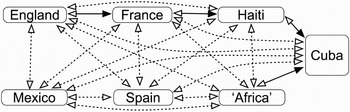
The ‘standard’ history of danzón is summarised in Figure 1 where filled arrowheads with black lines indicate the most prevalent history of danzón: a unidirectional route from England to France to Saint Domingue (Haiti) to Cuba. Some of the routes which are usually excluded from ‘standard’ histories of danzón are also depicted (white arrowheads with dotted lines). This diagram is in no way exhaustive, and focuses only on countries generally mentioned in these histories. I have, however, included Spain, whose absence from some histories is particularly notable. Mexico is also included, not only because it was the focus of my ethnographic research, but because danzón travelled there, as its precursors had, from before the 1880s.
A mapping of the ‘standard’ history of danzón.

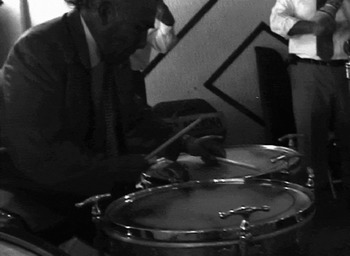
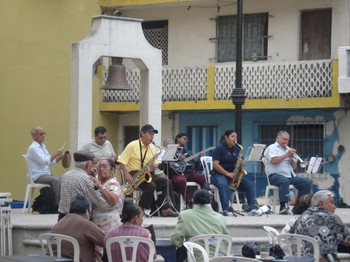
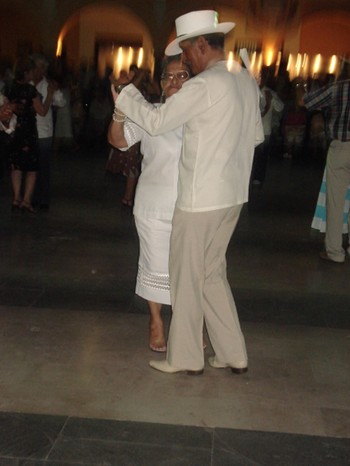
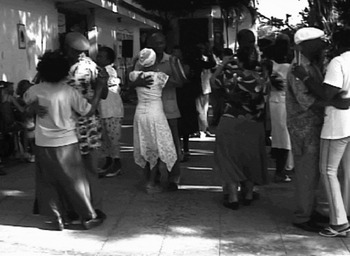
When Mexico is mentioned in histories of danzón, it is often treated as a place to which a ‘crystallised’ genre travelled and where subsequent transformations do not figure. Yet Mexican danzón music sounds very different from Cuban danzón with its distinct compositions, orchestration and instrumentation. For example, while the flute-based charanga emerged from the orquesta típica in Cuba, in Mexico the brass sound of the orquesta típica was maintained and, with the influence of US jazz bands, saxophones and trumpets were incorporated to create the ‘standard’ Mexican danzón ensemble, the ‘danzonera’. At the beginning of the 21st century, danzoneras often consisted of at least two saxophones and/or clarinets, one or more trumpets, trombone, timbales, güiro, keyboard and bass (see Figures 2–3).Footnote 12 The way danzón was danced in Mexico and Cuba was also quite different (see Figures 4–5): Mexican danzón dancers usually ‘marked’ the first beat of the bar, while Cubans did not; Cubans danced danzón in closer embrace; and Mexicans stood, while Cubans walked and greeted other couples during the descansos (‘non-danceable’ A section ‘rests’). Such differences and transformations between (and within) Mexico and Cuba (and beyond) are not mentioned in ‘standard’ histories of danzón, nor is originality accorded to them. Yet throughout the ‘history’ of danzón there were myriad origins, myriad exchanges within and between countries, exchanges that were at once cultural, commercial, political, religious, reproductive and violent, but which rarely figure in ‘standard’ histories.
Hipólito Gonzáles Peña Polo of the Danzonera ‘Acerina’ playing the timbales at the Sociales Romo, Mexico City, 17 June 2007. Photograph by Hettie Malcomson.

Danzonera ‘Manzanita y su son 4’ performing in the Plazuela de la Campana, Port of Veracruz, 15 April 2007. Photograph by Hettie Malcomson.

Daniel Rergis Aguiler (who played Carmelo in María Novaro's film ‘Danzón’ (1991)) dancing danzón with Natalia Pineda Burgos in the Plaza de Armas, Port of Veracruz, 29 April 2007. Photograph by Hettie Malcomson.

Armando Valdés Abreu and Adolfina de Valdés dancing danzón at a monthly danzón peña in Havana, Cuba, 1 April 2007. Photograph by Hettie Malcomson.

Moreover, as we have seen, the ‘standard’ history of danzón is portrayed as something linear, something purportedly constant and persistently present which is continually hybridised, moving to new places and at that point being transformed. This constant something is depicted in this ‘standard’ history as primarily European rather than ‘African’: a notated Anglo-French music-dance form that journeys through the Caribbean and to which ‘African’ rhythms (the tango and the cinquillo) are added. While the European emphasis already racialises these musics within a logic of invisible ‘white’ privilege (Nayak Reference Nayak2007), that is the point of reference in the ‘standard’ history of danzón. ‘African’ rhythms, and in particular the cinquillo, are portrayed as though it is they which racialise this hegemonic, ‘semi-classical’, European music-dance form. It is ‘African’ rhythms which make ‘race’ appear within this context, as did the ‘blackness’ of musicians and dancers who performed them (and their ‘African’ movements). Moreover, while these rhythms are generally portrayed as accompaniments to this Anglo-French music-dance form, an alternative is to see them as musically organising forces. The cinquillo might be construed as a rhythmic foundation, rather than an addition, which determines melodic and accompanying figures, together with its overarching clave pattern (in simplified terms 3 + 3 + 2|2 + 2 + 2 + 2 in 3-2 clave).
I am not arguing for the dominance of certain elements over others, but it is important to be aware of the extent to which the ‘Afro-Cuban’ elements are portrayed as secondary in the ‘standard’ history of danzón. While commentators have disputed the route by which the cinquillo arrived – coming to the Caribbean with the slave trade and/or via Moorish Spain – it is not described as a primary element to which equivalent or secondary European elements were added. The ‘Africanness’ of danzón is depicted as merely augmenting its primary European origins. This is very different from the histories of music of the Colombian coastal regions described by Wade, where change is often interpreted as the local tradition dominating new influences (European instrumentation, for instance), which are ‘subordinated to existing styles’ (Wade Reference Wade2000, p. 65).
What is also striking in ‘standard’ histories of danzón is that, while the transformations to the Anglo-French music-dance form are clearly manifest (particularly in its changing names), the ‘African’ cinquillo appears as a static and unvarying rhythmic cell without performative, geographic or historical multiplicity, despite its prevalence throughout the circum-Caribbean. This may in part be due to an inevitable reliance on music and dance notations in tracing this history, a reliance which not only downplays the sounds, complexities and dynamism of non-notated elements, but is inadequate in notating rhythmic complexities. However, there are also parallels here with the way in which ‘Africa’ is portrayed in these histories (as a static, unvarying mass without geographic or historical multiplicity).
To further complicate this scenario, power dynamics were manifest in attitudes towards these music-dance forms. Like flamenco (Washabaugh Reference Washabaugh1996) and tango (Savigliano Reference Savigliano1995), the (contra)danza and danzón were the subject of numerous tirades, accused of vulgarity, lasciviousness and immorality. Critiques of these music-dance forms were almost always political, and often highly racialised. For example, in 1809, the contradanza and waltz brought by the Saint Domingue exiles were described as ‘French libertinism’ in the Aviso de La Habana, in what Carpentier (Reference Carpentier1946, p. 134) describes as ‘colonial “chauvinism”’. Castillo Faílde (Reference Castillo Faílde1964) demonstrates how, during the wars of independence, pro-Spain Cuban conservative newspapers denigrated danzón as an immoral ‘African’ music-dance form, while more liberal, pro-independence newspapers emphasised the ‘Cuban’ characteristics of danzón. Danzón was adopted (or co-opted, Acosta Reference Acosta2004) by pro-independence Cuban criollo elites in their spontaneous parties (asaltos) to which Spaniards were not invited (Chasteen Reference Chasteen2004). While patriotic contradanza lovers were outraged by the new orquestas típicas because of their ‘louder, livelier instrumentation taken from the Spanish bands’ (León Reference León and Manuel1991, p. 20), racial hierarchies were retained and slavery persisted (finally to be abolished only in 1886).
By the 1920s, Cuban racial moralities had been reconfigured: according to Martínez Furé (Reference Martínez Furé and Manuel1991, p. 33), conservative columnists ‘attempted to establish the danzón – rather ironically – as an example of white Cuban music, without any African influence’; nationalists such as Sánchez de Fuentes (Reference Sánchez de Fuentes1928) suggested that danzón had hardly any ‘black’ influence and was European, unlike rumba, son and the jazz bands he condemned. Meanwhile, afrocubanismo was in vogue, the cultural movement, critical of the politics of post-independence Cuba, that promoted ‘African-influenced’ expression as representative of the Cuban nation (Carpentier's work falls into this category) (see Moore Reference Moore1997).
The flexibility of the (contra)danza and danzón should by now be apparent. Political leanings played into interpreting, adopting and co-opting these music-dance forms as more or less ‘black’, ‘white’, ‘African’, ‘Cuban’, ‘African-influenced’, ‘European’ or ‘Spanish’. As Wade points out, racist outbursts were often an attempt by national elites to construct ‘otherness’, ‘remaking difference because it was fundamental to the reproduction of their own position’ (Wade Reference Wade2001, p. 855). Power played into whose opinions were publicised and how these music-dance forms were performed, but also into the very creation of these ‘genres’. For example, both Louis XIV and the Matanzas Society, in their different contexts, authorised and provided authoritative exemplars and standards of what new genres would consist of, participating in their invention.
Conclusion
In this article I have followed the ‘route’ of the ‘standard’ history of danzón propounded by Mexican (and other) danzón experts, contextualising it with material from Mexico, Cuba, France and the UK, and drawing attention to its multiplicity and complexity. As we have seen, the generic names in this history propose a fixedness and originality which disguise their diversity, and racialisation and racism pervade this story. Danzón, its antecedents and successors, were treated as generic equivalents despite being distinct. It was the initial pieces within each genre that supposedly ‘crystallised’ to define each genre, rather than later works. The ‘standard’ history of danzón centred around newly-named genres where origins, originators, originality and nationality were key. From the danzón onward, these genres were portrayed as being the products of individual men (and consequently their nations). ‘Africa’ was treated as a static and unvarying conceptual ‘nation’; as a place without historical and geographic multiplicity. The ongoing commercial, cultural, political, religious, reproductive and violent movements and exchanges between and within Europe, Africa and the circum-Caribbean were downplayed. The brutality of slavery was brushed aside. ‘Africanness’ was treated as something extra which racialises: a homogeneous and static ‘African’ cinquillo was portrayed as racialising an evolving hegemonic European music-dance form in Cuba. Political leanings and strategies determined whether the (contra)danza and danzón were interpreted, adopted or co-opted as being ‘white’, ‘black’, ‘African’, ‘Cuban’, ‘European’ or ‘Spanish’ music or dance forms. There remains much archival work to be done to document the ‘routes’ and ruptures of these histories. To conclude, I want to suggest that such research might start with what Gilroy, following Leroi Jones (aka Amiri Baraka 1966), calls a ‘changing same’:
the reproduction of cultural traditions not in the unproblematic transmission of a fixed essence through time but in the breaks and interruptions that suggest that the invocation of tradition may itself be a distinct, though covert, response to the destabilising flux of the post-contemporary world. (Gilroy Reference Gilroy1991, p. 126)
Acknowledgements
A version of this paper was presented at the ‘Diáspora, Nación y Diferencia’ conference in Veracruz, Mexico in June 2008 and at the Latin American Studies Research Day (Cambridge University, 2008). The author is indebted to conferees at both events for their comments, and in particular to the persons who provided detailed commentaries: Mónica Moreno Figueroa, Elisabeth Cunin, Henry Stobart, David Lehmann, Ciro Carlos Mizuno Gúzman, Jan Fairley and anonymous reviewers. Funding was kindly provided by the Arts & Humanities Research Council and the Society of Latin American Studies.
 in Mexico City (and Cuba), but
 in Veracruz); and rhythmic (Mexico City's timbales players often used the Cuban son pattern played on congas in Cuba and Veracruz as a base from which to improvise, with the cinquillo performed by the güiro; and Veracruz's timbales and güiro patterns were usually founded on the cinquillo). Veracruz was described as more ‘black’ or more ‘Cuban’ than the capital because congas were employed and the cinquillo provided the rhythmic base of Veracruz's timbales patterns (as it did in Cuban charangas). Yet the Cuban son pattern employed by Mexico City's timbales players might be construed as equally ‘Cuban’, being first incorporated into Mexico City's danzón performance by the Cuban timbales player Consejo Valiente Robert Acerina (according to Hipólito Gonzáles Peña Polo, Interview, 17 June 2007).