An earthquake with an epicenter in the southern part of Tokyo would cause extensive damage, including a death toll as high as 23 000, with approximately 72 000 victims in need of rescue. 1 Certain hospitals have been designated by the government as disaster-base hospitals as part of an emergency preparedness plan. The disaster-base hospital is required to have earthquake-resistant structures, lifelines, medical supplies, and life support systems. In addition, it is required to accept all seriously injured or ill patients from the stricken area when a disaster occurs and hold a disaster dispatch medical care team.Reference Homma 2 On the other hand, other hospitals may find it very difficult to continue treating patients after a disaster. In the worst case, it could be necessary to evacuate inpatients from these locations to other hospitals.
Approximately 10% to 30% of casualties in mass casualty incidents are children.Reference Gnauck, Nufer and LaVally 3 Pediatric-specific disaster-related considerations include the specific vulnerabilities of children to hazards of disaster and pediatric-appropriate evaluation and management due to age-related differences of physiological variables.Reference Weiner, Manzi and Waltzman 4 – Reference Fleming, Thompson and Stevens 5 These issues must be considered when preparing for the care of children in a mass casualty incident. The previous study on pediatric care pointed out the lack of logistics in a major incident. This study assessed the disaster preparedness of a children’s hospital in Japan by using a disaster drill.
MATERIALS AND METHODS
We performed a triage drill that involved tagging all hospitalized patients at our facility on December 14, 2013. The triage tags and medical records of the patients were reviewed retrospectively. We investigated the following points: (1) the efficacy of triage education, (2) the validity of the Simple Triage and Rapid Treatment (START) method for children, and (3) the potential need for the evacuation of inpatients from our hospital during a major incident.
Hospital Background
Our hospital, the National Center for Child Health and Development, is located in a suburb of Tokyo, Japan. At this 490-bed facility, approximately 70% of the patients are children. There are more than 30 000 emergency room visits and annually. More than 1000 patients are admitted to the pediatric intensive care unit each year, which is the largest number of critically ill children admitted to a single center in Japan. The hospital staff includes 339 doctors and 611 nurses. Almost none of the staff members are well trained in disaster preparedness. The hospital cannot function for more than 72 hours after utilities are lost; after this time, all inpatients would need to be evacuated.
Disaster Drill
We planned a disaster drill with an objective of training staff members to perform primary triage. We selected the START method for performing primary triage because it is the method used most widely in Japan for this purpose. 6 In addition, it would be difficult for the staff members, who are not trained in disaster preparedness, to learn several different triage methods for adults and children.
Efficacy of Triage Education
The members of the disaster response working group, who have completed a Japan Disaster Medical Assistance Team training course, organized the triage drill. The triage drill consisted of an on-the-job triage training and a predrill education program, which includes a lecture and an online education program. The predrill education program was designed to teach the triage objectives, the algorithm of START methods, and the use of triage tags. The triage drill was announced 2 months prior to the actual training date. During the on-the-job triage training, the doctors and nurses used the START method to triage all hospitalized patients and completed all the information on the triage tags.
All staff members were notified that the education program must be completed before the start of the on-the-job triage training. We recorded the attendance rate and completion rate of the predrill education program in every department and announced the results at the morning conference when the department heads gather to engage the staff members to participate.
The education program was completed when the staff members attended the lecture and answered all the questions in the online education program correctly.
Validity of the START Method for Children
Previous reports showed the normal range of a child’s vital signs.Reference Fleming, Thompson and Stevens 5 In Japan, the ability to walk and obey commands in children aged 18 months to 2 years are evaluated during medical checkups. 7 Considering the physiological and developmental differences among pediatric patients, certain triage criteria may be normal for young patients, such as not being able to walk or obey commands for children aged younger than 2 years, or a respiratory rate >30 breaths per minute for children aged older than 5 years. Therefore, the pediatric patients were divided into the following three age groups: 0-1 year, 2-4 years, and 5-14 years. We evaluated the proportion of patients coded as immediate who were correctly identified as immediate and the proportion of patients not coded as immediate who were correctly identified as not being immediate for each age group.
We verified the correct identification of the triage priority by collating the 2 triage priorities: one based on the triage tag and the other based on vital signs. The vital signs were measured and recorded in the medical records at the time of the triage drill.
Need for Evacuation of Hospitalized Patients
We defined the inpatients needing evacuation as those dependent on medical devices, specifically ventilators, oxygen supply, tracheostomy tubes, or drainage tubes, by reviewing the medical records.
Ethics Statement
The use of medical records in this study was approved by the Ethics Committee of the National Medical Center for Children and Mothers. The ethics committee waived the requirement for an informed consent from individual patients.
RESULTS
At the start of the predrill education program, the completion rate for the online education program and the attendance rate at lectures were extremely low: 53% and 22% for nurses and 28% and 28% for physicians, respectively. After 2 months of encouraging the staff members to participate, the completion rate of the predrill education program gradually increased to 87% and 67% for nurses and 74% and 63% for physicians, respectively. The final rates were far from 100%.
During the drill, 374 hospitalized patients were triaged by the START method, including 273 (73%) pediatric patients aged younger than 15 years. Nearly all patients were triaged by pairs of nurses (87%); only 5% were assessed by physicians. Among the pediatric patients, 149 (54%) were coded as immediate, 10 (4%) were coded as urgent, 104 (38%) were coded as delayed, and 10 (4%) were coded as unsalvageable. Among the adult patients, 10 (10%) were coded as immediate, 4 (4%) were coded as urgent, 86 (85%) were coded as delayed, and 1 (1%) was coded as unsalvageable.
Efficacy of Triage Education
A total of 156 tags (42%) were incomplete, including missing signatures (46 cases, 12%), missing dates (44 cases, 12%), missing color codes (41 cases, 11%), and detachment errors (3 cases, 1%).
Thirty-six of the tags (10%) were incorrectly coded. In detail, 3 patients coded as unsalvageable should have been classified as immediate, 1 patient coded as immediate should have been classified as urgent, and 14 patients coded immediate should have been classified as delayed, and 18 patients coded as urgent should have been classified as delayed.
Validity of the START Method for Children
The number of pediatric patients coded as immediate was 122 (91%) of the patients aged 0−1 year, 16 (29%) of the patients aged 2-4 years, and 11 (13%) of the patients aged 5-15 years. The START classifications of the patients coded as immediate are listed in Table 1. From a review of the clinical records, only 28 out of 273 (10%) of all pediatric patients were outside the normal range for their age, or “true-immediate.” That is, the number of pediatric patients who were judged as true-immediate was 10 (7%) of those aged 0-1 year, 7 (44%) of those aged 2-4 years, and 11 (100%) of those 5-15 years among the patients judged as immediate based on the START algorithm. The categories that were judged as true-immediate for each age group were as follows: 0-1 years, “capillary refilling time >2 seconds” (3 patients) and “respiratory rate >30 breaths per minute” (7 patients); 2-4 years, “cannot follow commands” (7 patients); 5-14 years, “respiratory rate >30 breaths per minute” or “cannot follow commands” (all patients).
The START Classifications of the Patients Coded as Immediate

Need for Evacuation of Patients
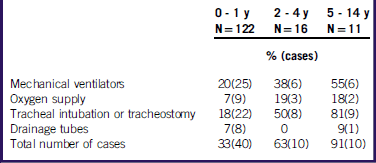
The details of pediatric patients coded as immediate who had medical devices are shown in Table 2. In a disaster, 40% of the pediatric hospitalized patients coded as immediate by the START method would have required continuous care and were potential evacuees.
The Details of Pediatric Patients Coded as Immediate Who Had Medical Devices

DISCUSSION
This study highlights 3 important issues about the hospital’s preparedness to handle pediatric patients through a disaster drill. First, it is difficult to promote disaster education for staff who are not well trained on handling disasters. Second, the START method is suitable for children aged older than 5 years old, but it has a high proportion of over-triaging in younger children. Third, it may be necessary to evacuate a large number of patients from Japanese children’s hospitals during a mass casualty incident.
Disaster Education for the Staff Members
Although we allowed 2 months for the predrill education, staff members were unable to sufficiently master their triage skills, especially in completing triage tags. We noted that 42% of the triage tags were incomplete; this was considered a problem as we aimed for a 100% completion rate. It has been reported that multiple training sessions are necessary for the mastery of basic procedural skills such as triage. Furthermore, brief and frequent training provided by a computer-based education program can be effective for the acquisition and maintenance of skills.Reference Roppolo, Pepe and Campbell 8
Primary Triage Methods Suitable for Childrens
A correlation has been reported between over-triaging and critical mortality in disasters, indicating that over-triaging can result in an increase in preventable deaths in this setting.Reference Frykberg 9 The high rates of over-triaging in children may lead to increased mortality, as also occurs with under-triage. To minimize this problem, different triage methods could be used for different age groups. However, if multiple triage methods are adopted, there are problems related to education and the selection of a suitable method for younger patients. In our study, we found that it was difficult to provide education about even 1 triage method to staff members. It seems likely that adopting multiple triage methods would not be practical and could cause confusion during a mass casualty incident. Moreover, it is not easy to select a triage method that is suitable for younger children because there are no marked differences in accuracy for children among triage methods.Reference Price, Brace-McDonnell and Stallard 10 It may be necessary to tolerate a high rate of over-triaging among young children during primary triage by the START method, while appropriately classifying children by more accurate secondary triage performed when time and resources are available.
In this study, there was no discrepancy between START categories in immediate and true-immediate pediatric patients aged older than 5 years and those in adult patients aged older 15 years. However, if the patients were aged younger than 4 years, especially younger than 1 year of age, there was a discrepancy between START categories in immediate and true-immediate pediatric patients. Most patients who were categorized as immediate although they should have been truly categorized as nonimmediate belonged to the categories of “respiratory rate >30 breaths per minute” and/or “cannot follow commands.” It may be suggested that these results are useful for establishing a new triage method suitable for younger children. To improve the accuracy of the triage for children, we should consider a new triage method that can be judged according the physiological and developmental differences among younger children.
Treatment and Transport of Pediatric Patients
In this study, we assessed the potential need for the evacuation of pediatric inpatients at our hospital. In addition to potential evacuees among inpatients, many new victims should be expected to arrive at the hospital in a mass casualty incident. Pediatric emergencies are less common than emergencies among adults, so fewer hospitals are able to provide critical care for children in each region. Therefore, development of a transport system between the hospitals in a wide area is necessary to provide suitable treatment for many patients who require critical care but cannot be treated in the disaster zone.
This study had several limitations. First, it was performed at a single center. Second, we did not verify the correct identification of the triage priority at the time of the triage. Third, there may be other critical devices used for hospitalized patients that were not included as the criteria for evacuation. A need for evacuation was not evaluated for any group except the immediate group. There was no comparison between the START method and other triage methods for children. Finally, it is also essential to compare the rates of over-triaging by staff with or without predrill to evaluate the efficacy of triage education. However, in this study, we could only evaluate the rate of over-triaging by all of the staff who triaged the patients in the actual training. After performing similar triage drills several times, an additional study should be conducted to evaluate the efficacy of triage education.
CONCLUSION
We investigated disaster preparedness at a children’s hospital in Japan using a disaster drill that emphasized the triage of patients hospitalized in a mass casualty incident. Our findings suggest that disaster preparedness, such as educating hospital staff regarding disasters and establishing evacuation systems for a number of pediatric patients when a disaster happens, is essential for caring for hospitalized children during a mass casualty incident.
Acknowledgment
This study was approved by our ethics committee (Yokohama City University).
This work was funded by Japan Society of the Promotion of Science KAKENHI Grant Number 17K17064 [Grant-in-Aid for Young scientists (B)].
We acknowledge the support of Dr Masafumi Gima (National Center for Child Health and Development) and Dr Takeru Abe (Yokohama City University Medical Center).
Conflict of Interest
All the authors (Chiaki Toida, Takashi Muguruma, and Keiji Hashimoto) declare no conflict of interest associated with this manuscript.