Gold is an interesting and unique catalyst that is relatively inert in the bulk state, but catalytically active when its particle size is reduced to the nanoscale regime.Reference Hutchings1 Excellent catalytic activities are observed for highly dispersed gold nanoparticles on metal oxide supports, particularly for CO oxidation.Reference Schubert, Hackenberg, van Veen, Muhler, Plzak and Jurgen Behm2 The catalytic activity of gold nanoparticles is strongly dependent on particle size, but the composition and structure of the supporting oxide also play a role.Reference Schubert, Hackenberg, van Veen, Muhler, Plzak and Jurgen Behm2
The exact nature of the catalytically active species within metal oxide support systems is still unclear.Reference Hutchings1 Several studies have suggested that Au0 is the active species, but mechanisms involving cationic gold (Au3+, Au+, or both) have also been proposed.Reference Fierro-Gonzalez and Gates3 The low concentration and fine dispersion of gold particles on metal oxide supports hamper experimental investigations of the catalytic species.Reference Hutchings1 Modeling the system is also a challenge as a wide array of interactions between the gold nanoparticles and oxide supports are possible.Reference Fierro-Gonzalez and Gates3
To investigate the importance of Au3+ as a catalytic species, Kurzman et al.Reference Kurzman, Ouyang, Bin Im, Li, Hu, Scott and Seshadri4 have studied CO oxidation in the presence of La4LiAuO8. Originally reported by Abbattista et al.,Reference Abbattista, Vallino and Mazza5 La4LiAuO8 crystallizes in an ordered variant of the Nd2CuO4 structure, containing layers of corner-connected LiO4 and AuO4 square planes separated by two fluorite-type layers of La and O. Each AuO4 moiety is isolated, which makes La4LiAuO8 an interesting model compound to investigate heterogeneous catalysis by square planar Au3+ ions. Although not an effective catalyst for the oxidation of CO, the compound is remarkably stable toward thermal decomposition, which occurs near 935 °C.Reference Kurzman, Ouyang, Bin Im, Li, Hu, Scott and Seshadri4 The observed weight loss upon decomposition has been reported as 2.7%, corresponding to the formation of metallic Au and either 2 La2O3 + ½ Li2O or 1.5 La2O3 + LiLaO2.Reference Kurzman, Ouyang, Bin Im, Li, Hu, Scott and Seshadri4 LiLaO2 is more likely to form than Li2O, but the results are ambiguous as only one small diffraction peak could be indexed to LaLiO2 in the decomposed material.
LiLaO2 is the only binary compound in the La2O3–Li2O system that forms between 750 and 1000 °C.Reference Abbattista and Vallino6 It is believed to be isomorphous to LiEuO2, but the detailed crystal structures of LiEuO2 and LiLaO2 are not known. LiLaO2 was observed as a decomposition product of Li3La(C2O4)3·9 H2O,Reference Deb, Baruah and Dass7 and it has been reported as an effective catalyst for methane oxidation.Reference Kinnemann, Kieffer, Kaddouri, Poix and Rehspringer8
The thermal stability of La4LiAuO8, along with the paucity of thermochemical data for trivalent gold oxide compounds, led us to investigate the energetics of La4LiAuO8 and its decomposition product LiLaO2. Here, we present the enthalpies of formation for La4LiAuO8 and LiLaO2 obtained by high-temperature oxide melt solution calorimetry and investigate the energetics of the La4LiAuO8 decomposition.
The La4LiAuO8 powder was synthesized according to previously reported methods by Kurzman et al.Reference Kurzman, Ouyang, Bin Im, Li, Hu, Scott and Seshadri4 LiLaO2 was synthesized following the procedure by Abbattista and Vallino.Reference Abbattista and Vallino6 LiOH·H2O (Aldrich Chemical 131066-3, Aldrich, St. Louis, MO) was heated for 16 h at 250 °C to form LiOH. An excess of LiOH (2:1 ratio) was ground with La2O3 (Aldrich Chemical 131281-8), pelletized, and wrapped in silver foil. The sample was heated at 775 °C for 10 h.
The samples were characterized by powder x-ray diffraction using a Bruker D8 Advance diffractometer (Cu Kα radiation; Bruker, Madison, WI) equipped with a LynxEye solid state detector. Rietveld refinements were performed using the XND code; the GSAS/EXPGUI suite was used for simultaneous Lebail fitting and Rietveld refinement; and the JADE 8.0 software was used for particle size estimation from Scherrer broadening. Thermogravimetric analysis (TGA)/differential scanning calorimetry (DSC) analysis was performed on a LABSYS Evo (Setaram Instruments, Caluire, France) from 30 to 1200 °C in air with heating rate of 10 °C/min.
High-temperature oxide melt solution calorimetry was performed using a specially built twin calorimeter of the Tian–Calvet type operating at 800 °C that has been previously described.Reference Navrotsky9 Pelletized samples (∼5 mg) were dropped into a platinum crucible containing 30 g of a lead borate, 2PbO·B2O3, solvent. The drop solution experiments were performed with air bubbling through the melt to sweep out evolved gases. The calorimeter was calibrated using ∼5 mg pellets of α-Al2O3 (99.997 wt% metal basis; Alfa Aesar, Ward Hill, MA). The drop solution enthalpy value for Li2O is necessary component of the thermochemical cycle. Lithium oxide absorbs water to form LiOH·H2O, and it is difficult to accurately measure the ΔH dsol directly. However, the ΔH dsol has been calculated from the ΔH dsol of the more stable Li2CO3 compound and related thermodynamic parameters.
The powder x-ray diffraction pattern of La4LiAuO8 confirmed that the sample was nearly phase-pure with small amounts of La2O3 and metallic gold. Quantitative analysis by multiphase Rietveld refinement indicated the sample contained 0.5 wt% face-centered cubic (fcc) Au and 2.8 wt% La2O3. The x-ray diffraction pattern of the LaLiO2 sample agreed with that obtained by Abbatista and VallinoReference Abbattista and Vallino6 and also indicated a small amount of La2O3. Because phase fractions cannot be estimated from diffraction data of a multiphase mixture when one (or more) of the phases lacks a structural model, quantification of the impurity amounts was determined by thermogravimetry, described in the following section. Preparing pure LaLiO2 is problematic because it is a very reactive material; the absence of any high quality structural work in the literature reflects the difficulty in obtaining the phase. Despite numerous attempts, it was not possible to prepare better samples of LiLaO2. The major impurity phases were lithium hydroxide and lanthanum oxide and have been corrected for in the thermochemical calculations.
The TGA of La4LiAuO8 indicates that the material persists up to 931 °C [Fig. 1(a)]. The DSC curve contains two endothermic peaks, one accounting for the decomposition of La4LiAuO8 and the second corresponding to the melting of gold (1064 °C). Kurzman et al.Reference Kurzman, Ouyang, Bin Im, Li, Hu, Scott and Seshadri4 previously reported the decomposition temperature for La4LiAuO8 in air as 935 °C, in good agreement with our results. The weight loss after decomposition of La4LiAuO8 is 2.6 wt%, which correlates with the final products: Au + 2 La2O3+ 1/2 Li2O or Au + 1.5 La2O3 + LiLaO2. The diffraction pattern of the decomposition products contains peaks of metallic gold and lanthanum oxide. An additional broad peak at 29° 2θ may be associated with a major peak of LiLaO2, though this assignment is unclear given the absence of intensity at 35° 2θ, which is claimed to be the strongest reflection associated with LiLaO2.Reference Abbattista and Vallino6
The thermogravimetric analysis/differential scanning calorimetry (TGA/DSC) curves for (a) La4LiAuO8 indicate that the compound is stable until 931 °C. The weight changes observed in (b) LaLiO2 indicates that a small amount of the initial starting materials are still present in the final sample.

The TGA/DSC curve of LiLaO2 is more complex, with weight changes occurring at several temperatures [Fig. 1(b)]. Initially, a weight gain occurs followed immediately by a weight loss from 50 to 110 °C, indicating the presence of a small amount of the initial LiOH starting material. Additional evidence for the presence of LiOH includes the sharp endothermic peak in the DSC curve at 425 °C that corresponds to the melting temperature of LiOH. Decomposition of LiOH to Li2O is also evident with the weight loss and broad exothermic peak from 450 to 825 °C. From the weight loss in the TGA curve, the amount of LiOH in the sample was estimated to be 1.8 wt%. The weight loss at 300 °C corresponds to the decomposition of La(OH)3 to La2O3. Lanthanum oxide readily transforms to a hydroxide phase in the presence of a base (LiOH). The weight loss associated with the decomposition of La(OH)3 indicates that La2O3 is present as 12 wt% in the sample.
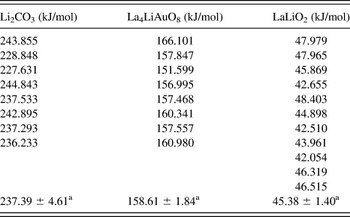
La4LiAuO8 and LiLaO2 dissolved completely in the lead borate melt, which was evidenced by a stable baseline during the calorimetric experiments, consistent measured enthalpies, and visual inspection of the solidified melt. The heat effects observed for both samples were endothermic. The average ΔH dsol (in kJ/mol) for the La4LiAuO8, LiLaO2, and Li2CO3 and two standard deviations of the mean were calculated from a total of eight to ten measurements for each and are summarized in Table I.
Enthalpy of drop solution ΔH dsol (kJ/mol) for Li2CO3, La4LiAuO8, and LiLaO2 in lead borate at 800 °C.

a Error is two standard deviations of the mean.
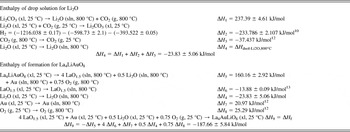
The thermochemical cycle used to calculate the enthalpy of drop solution for Li2O is given in Table II. The formation enthalpy of Li2CO3 was calculated from Li2O and CO2 gasReference Chase, Davies, Downey, Furrip, McDonald and Syverud10 and the heat capacity of CO2 gas from 25 to 800 °C.Reference Robbie and Hemingway12 Using the enthalpy of drop solution for Li2CO3, the ΔH drp−sol for Li2O was calculated to be −23.83 ± 5.06 kJ/mol.
Thermochemical cycles used to determine ΔH f−ox for La4LiAuO8.

The enthalpy of drop solution for La4LiAuO8 was corrected for the 7.16 mol% La2O3 and 2.1 mol% Au resulting in ΔH dsol−corr of 160.16 ± 1.84 kJ/mol. The thermochemical cycles used in the calculations for the heats of formation from the oxides for La4LiAuO8 are summarized in Table II. The ΔH corr−dsol for La4LiAuO8 (ΔH 5), the ΔH dsol for LaO1.5 (ΔH 6),Reference Robbie and Hemingway12 ΔH dsol of Li2O (ΔH 4) and the integrated heat capacity from 298 to 800 °C for Au metal (ΔH 7) and O2 gas (ΔH 8)Reference Robbie and Hemingway12 were used to calculate the enthalpy of formation from the oxides for La4LiAuO8, −187.66 ± 5.84 kJ/mol.
The residue from the thermal analysis experiment was analyzed by powder x-ray diffraction. The diffraction peaks matched those of fcc Au and La2O3. Li2O was not observed in the x-ray diffraction pattern. The three peaks associated with Au metal were fit, and the average particle size was calculated based on the ScherrerReference Scherrer11 equation to be 39 ± 2 nm.
The effect of the Au particle size on the heat of formation of La4LiAuO8 was estimated using the following relationship

where SA is the surface area of the particle in m2/mol and γ is the surface energy (J/m2). The surface energy of gold nanoparticles is in the range of 1.2–1.5 J/m2.Reference Arcidiacono, Bieri, Poulikakos and Grigoropoulos14 The value used for these calculations, 1.46 J/m2, was taken from size-dependent evaporation data reported by Nanda.Reference Nanda15 Using this value, the difference in the ΔH dsol−nano from the ΔH dsol−bulk is 1.12 kJ/mol. Therefore, the ΔH 7 value decreases from 20.97 to 19.85 kJ/mol. This change results in a ΔH f−corr value for La4LiAuO8 of −188.77 ± 5.1 kJ/mol. The correction, however, is within the experimental error of the enthalpy of formation.
Few studies on the energetics of trivalent gold oxides have been reported. The enthalpy of formation for Au2O3 has been determined using several different techniques, including DSC.Reference Nanda15 The experimental values for the ΔH f of Au2O3 range from −3.5 to −13 kJ/mol.Reference Ashcroft and Schwarzmann16 DFT calculationsReference Shi, Asahi and Stampfl17 estimate ΔH f of Au2O3 to be −50.1 kJ/mol. Thus, La4LiAuO8 is energetically more stable than Au2O3 when compared on a per mol basis. The heats of formation for other trivalent gold oxides have not been reported.
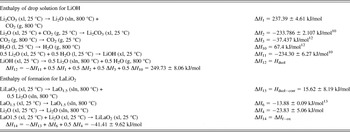
The average ΔH dsol for LiLaO2 was based upon 10 drops, resulting in a value of 45.38 ± 1.40 kJ/mol (Fig. 1). The value was corrected for the presence of 12.6 mol% LiOH and 6.2 mol% La2O3. The drop solution value for LiOH has not been measured, but a thermochemical cycle can be written from ΔH drp−sol (ΔH 1) and ΔH f−ox (ΔH 8) of Li2CO3,Reference Chase, Davies, Downey, Furrip, McDonald and Syverud10 the integrated heat capacity of H2O (ΔH 10) and CO2 (ΔH 3) gas from 800 to 25 °C,Reference Robbie and Hemingway12 and the formation enthalpy (ΔH 11) of LiOH (Table III).Reference Chase, Davies, Downey, Furrip, McDonald and Syverud10 The corrected enthalpy of drop solution (ΔH 13 = ΔH dsol−corr) for LaLiO2 is 15.62 ± 8.18 kJ/mol.
Thermochemical cycles used to determine ΔH f-ox for LiLaO2.

The enthalpy of formation for LaLiO2 was calculated from the ΔH dsol−corr for LaLiO2 (ΔH 13), the measured enthalpy of drop solution for La2O3 (ΔH 6), and the calculated drop solution value for Li2O (ΔH 4), resulting in a value of −41.4 ± 9.6 kJ/mol. The large error associated with the ΔH f−ox for LaLiO2 is due to the presence of LiOH and the error of the ΔH f−ox of LiOH.
The thermal stability of La4LiAuO8 is interesting given the oxophobic nature of gold. Kurzman et al.Reference Kurzman, Ouyang, Bin Im, Li, Hu, Scott and Seshadri4 suggest that the stability can be attributed to the presence of covalent Au–O bonding due to the presence of highly electropositive counter cations. To provide insight into the decomposition of La4LiAuO8, the decomposition temperature was calculated from the experimentally derived thermodynamic data for La4LiAuO8 and LiLaO2.
The enthalpy of decomposition based upon the formation of LaLiO2 can be determined from the following thermochemical cycle

The Ellingham diagram for oxidation reactions involving solid phases plots ΔG⁰ versus temperature.Reference Ellingham18 As ΔG⁰ = ΔH⁰ − TΔS⁰, the slope of the line is equal to −ΔS⁰ and the lines are generally parallel to one another for most oxides. For the decomposition of La4LiAuO8, the oxygen is released rather than consumed so the entropy change is positive. The entropy value used for these calculations, per mole of O2 gas, (145 J/mol K) was taken from the average value for metal oxides.Reference Gaskell19

At a given temperature and pO2

so

The calculated decomposition temperature is within error of the experimental value.
Considering the formation of Li2O as a decomposition product of La4LiAuO8 involves the following reaction

Inserting this ΔH decomp value into the equation for ΔG decomp results in a decomposition temperature of 1331 ± 43 °C, which is 396 °C higher than the experimental value. Therefore, the thermodynamics of the decomposition reaction of La4AuLiO8 indicate that LaLiO2 is the likely product.
The results from the oxide melt solution calorimetry of La4LiAuO8 indicate that the compound is thermodynamically stable with respect to the constituent oxides and is more stable than binary trivalent gold oxide, Au2O3. The enthalpy of formation for LaLiO2 with respect to the oxides is small and exothermic. The decomposition of La4LiAuO8 occurs at 931 °C and results in metallic gold, lanthanum oxide, and lanthanum lithium oxide. The formation of LaLiO2 as a decomposition product for La4LiAuO8 was confirmed by calculating the decomposition temperature from measured thermodynamic parameters. The calculated value (979 ± 95 °C) agrees well with the experimental results.
ACKNOWLEDGMENTS
The authors thank the U.S. Department of Energy, Office of Basic Energy Sciences for supporting this work through Grants DE-FG02-03ER46053 and DE-FG02-10ER16081. J.A. Kurzman thanks the ConvEne Integrative Graduate Education and Research Traineeship (IGERT) Program (NSF-DGE0801627) for an Associateship.