Introduction
The speed and density of railway traffic have increased in many parts of the world.Reference Forsberg and Vázquez 1 In addition, the extensive crash avoidance systems 2 , Reference Tang and Yip 3 have failed to prevent train crashes from occurring around the world.Reference Saccomanno, Young-Jin Park and Fu 4 These crashes, which are becoming more frequent, cause mass casualties to the extent that they can be classified as disasters (≥10 killed and/or ≥100 non-fatally injured).Reference Forsberg 5
Significant improvements have been implemented concerning the train carriages’ construction and crashworthinessReference Forsberg and Björnstig 6 - Reference Tyrell, Severson and Marquis 9 in order to protect passengers as the speed rises. The improvements have been considerable, and the number of fatalities per railway disaster has decreased steadily throughout the last hundred years.Reference Saccomanno, Young-Jin Park and Fu 4 However, the escalating speeds challenge these improvements. The kinetic energy imparted by a moving train to a passenger is dependent upon the mass (m) and the velocity (v) of the moving train (Kinetic energy=1/2 mv2). Thus, the mass of a train combined with the velocity results in an enormous amount of kinetic energy being transferred to the structures of the train and the bodies of the passengers.Reference Simons and Kirkpatrick 10
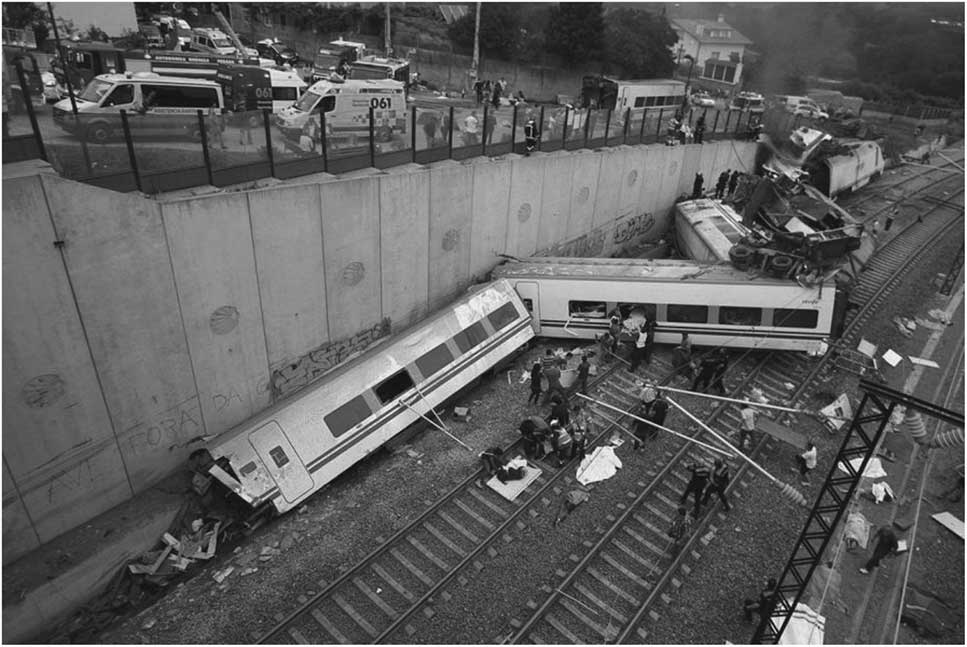
With increased use of railway networks and escalating train speeds, safety becomes an important worldwide issue for the future. Nevertheless, there are relatively few experiences of how high-velocity train crashes affect travelers’ injuries. Therefore, the aim of this study was to investigate the fatal and non-fatal injuries and the main interacting factors that contributed to the injury process in the crash phase of the 2013 high-velocity train crash in Angrois, outside Santiago de Compostela, Spain (Figure 1).
The Train Crash in Angrois, Outside Santiago de Compostela, Spain in 2013. (Photo: José Antonio Iglesias Vázquez; 061-Galicia).

Method
Data Collection and Analysis
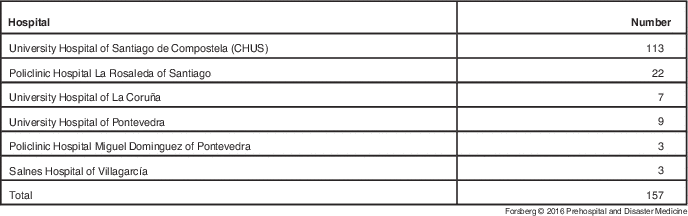
Interacting factors which affected the injury outcome were observed at the crash site by carriage inspections and official reportsReference Rautji and Dogra 11 concerning the approximated train speed. Data on injuries from hospital records (n=157) of all the injured who were admitted to the six different hospitals in the region (Table 1) were evaluated retrospectively, focusing on the injuries and compiled by descriptive statistics. The instant fatalities (n=63) data were collected on site.
Hospitals in the Region that Received Injured from the Crash

Ethical Considerations
The scientists did not receive any personal information from the hospital records, only the data on the different injuries were distributed. Therefore, injuries could not be traced directly or indirectly to a specific person. Thus, this study was in accordance with principles outlined in the Declaration of Helsinki created by the World Medical Association (Ferney-Voltaire, France) concerning ethical principles for medical research involving human subjects.
Results
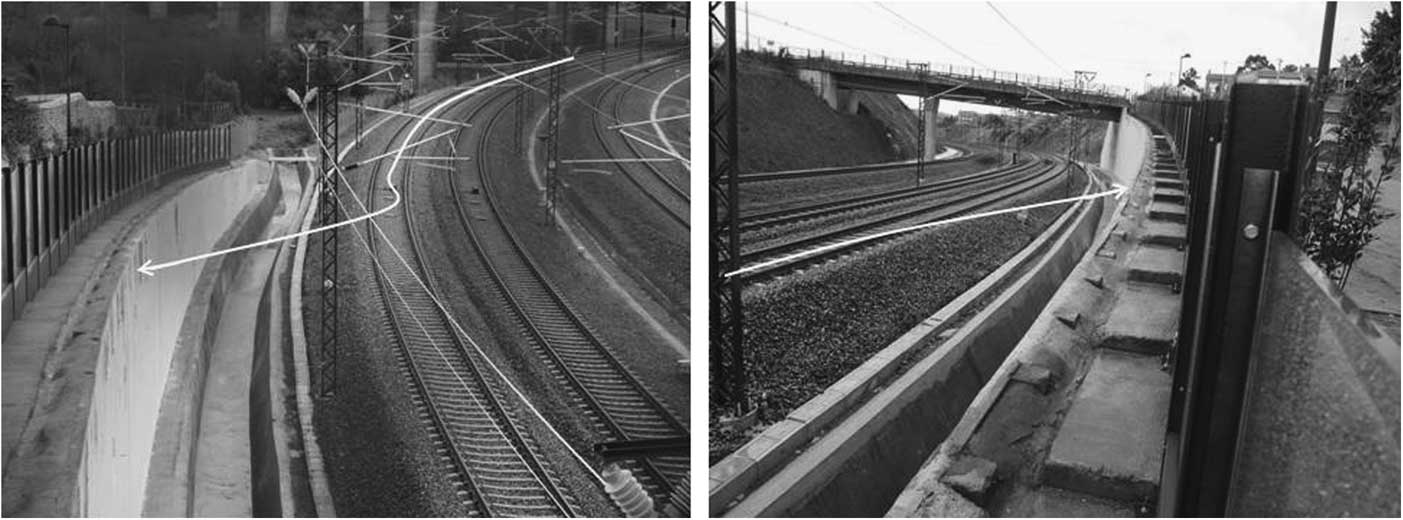
Two hundred and twenty-two unrestrained people (218 passengers and four crew members) were on board the train when it derailed on the route from Madrid to Ferrol (Spain) on July 24, 2013. The crash occurred at 8:41 pm in Angrois, just outside Santiago de Compostela, Spain. The second carriage (front generator) of a high-speed train set derailed in a curve (Figure 2) at a speed of approximately 180 km/hour (recommended maximum speed for the curve 80 km/hour) pulling the other 12 carriages (eight passenger carriages, one dining carriage, one generator carriage, and two locomotives) off the track (Figure 1). Four carriages overturned and the rear generator and engine caught fire. One passenger carriage was thrown approximately four to five meters up onto the road above the embankment.Reference Rautji and Dogra 11
The Curve from Different Directions Where the Train Set Derailed. Observe the sharp edge of the water chute (right). (Photo: Rebecca Forsberg).

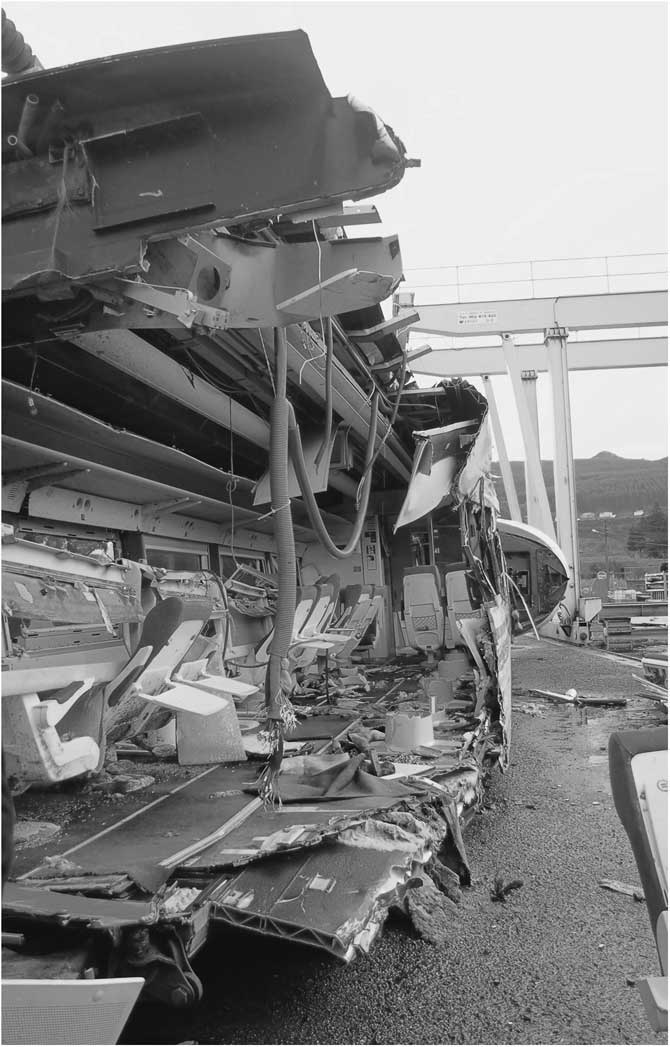
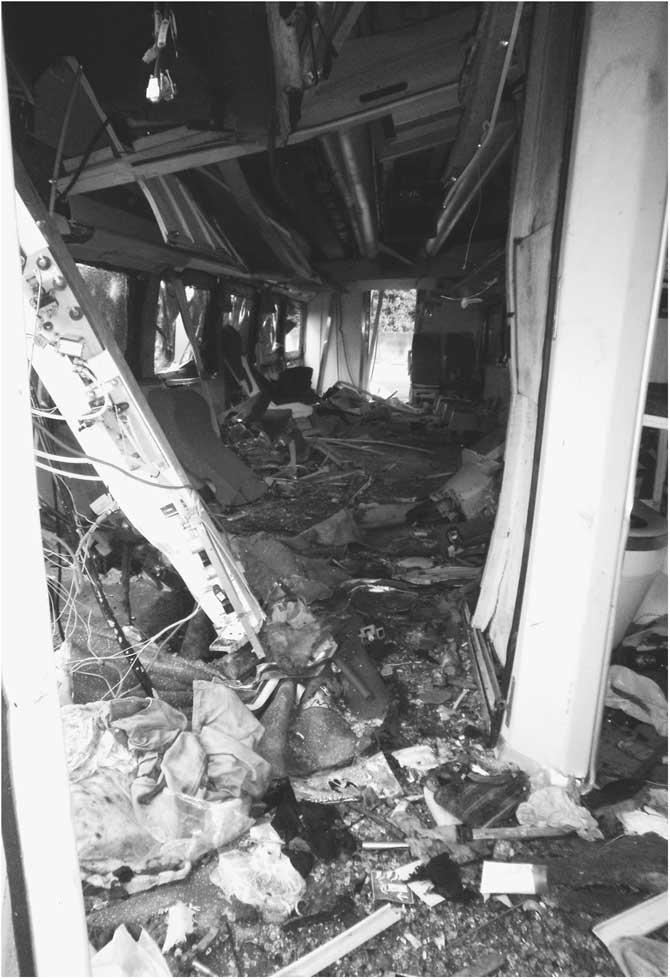
Some of the carriages slid against a sharp edge of a water chute (Figure 2) that ran alongside the tracks. This resulted in extensive exterior deformations on the carriages (Figure 3). Additionally, the interior structures loosened in several carriages, even those that did not slide against the water chute (Figure 4).
The Sharp Edge Caused Extensive Damage to the Carriages Exterior and Interior. (Photo: Rebecca Forsberg).

Interior Debris Included Loosened Interior Structures, Luggage, and Passengers. (Photo: Rebecca Forsberg).

Of the 222 people, 99% (n=220) suffered fatal or non-fatal injuries at the crash. Thirty-three percent (n=72) suffered fatal injuries, of which 88% (n=63) died at the crash site. On site, 29% (n=63) were triaged as dead (black), 17% (n=37) as immediate (red), 15% (n=34) as urgent (yellow), and 39% (n=86) as delayed (green).
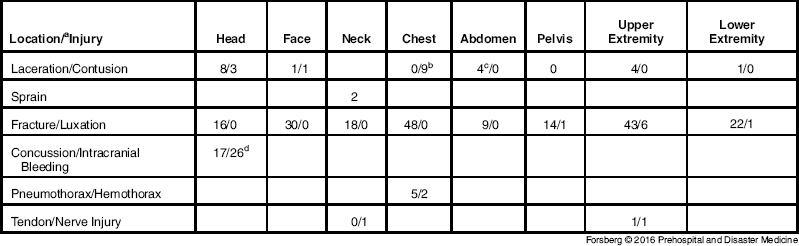
One hundred and fifty-seven injured travelers were admitted to six different hospitals in the region (Table 1). Nine of those died at the hospital. Those admitted to hospitals sustained 294 well-defined injuries that are illustrated in Table 2. All those admitted to hospitals suffered unspecified minor contusions or wounds, and several of those were multiple (n=63; 40%; excluded in Table 2). Twenty-one percent (n=33) of those admitted to hospitals suffered multi-trauma (ie, extensive, severe, and/or critical injuries).
Type and Localization of 294 Well-defined Injuries on all 157 Injured Occupants Admitted to the Hospital (Superficial lacerations and contusions that were not well-defined were excluded.)

a “Neck” includes cervical spine injuries; “chest” includes thoracic spine injuries; “abdomen” includes lumbar spine injuries. The “lower extremity” includes all injuries below the pelvis and “upper extremity” includes all injuries to the arms, shoulders, and scapula.
b Lung contusion.
c Two liver ruptures, one open abdominal cavity, and one laceration of the diaphragm.
d Eg, epidural, subdural, and subarachnoid hemorrhages.
Fractures were the most frequent (n=200; 69 %) injury, of which six were complicated. The head, face, and neck sustained 42% (n=123) of the injuries with several including internal bleeding (n=26) to the head and cervical fractures (n=18). The trunk (chest, abdomen, and pelvis) was also a frequently injured body part (n=92; 32%), including injuries such as hemothorax, pneumothorax, lung contusions, liver ruptures, and laceration of diaphragms. Twenty-six injured victims (17%) suffered multiple costal fractures with pleural emissions (n=7) and sternal fractures (n=7).
Discussion
This study reveals that nearly all occupants (99%) on board the train suffered injuries in the 2013 high-velocity train crash in Angrois, outside Santiago de Compostela, Spain. Thus, the kinetic energy that must be absorbed at 180 km/hour is much greater than the human injury threshold. The energy that was transferred to the human body in the high-speed crash led to major injury outcomes with many fatal, severe, and critical injuries.
The improvements in train construction and crashworthiness have been remarkable over the years.Reference Forsberg and Björnstig 6 - Reference Tyrell, Severson and Marquis 9 Thus, there has been a steady downward trend concerning the average number of fatalities in train disasters over the previous decades, resulting in a death rate average in train disasters of approximately 30-40 from 1990 through 2009.Reference Saccomanno, Young-Jin Park and Fu 4 Exterior design of train carriages continues to evolve to provide even better passenger protection.Reference Forsberg and Björnstig 6 However, even with such improvements, the rail carriages cannot, as the present study demonstrates, withstand the high energies produced in today’s high-speed train crashes. The number of fatally injured victims (n=72) in this study was similar to the high-speed crash in Eschede (Germany), where 101 suffered fatal injuries when the train set derailed at 200 km/hour, 12 indicating a worrying trend concerning high-speed crashes. Though, in both of these cases, the influences of the ambient surrounding had a critical impact on the outcome. In Eschede, when the carriages derailed and collided with a bridge, the location of the bridge or the railway track (close to the bridge) and the absence of solid over-bridge design caused the bridge to collapse. The collapsed bridge had an enormous impact on the destruction of the carriages and worsened the consequences. In this study, the surrounding design of the curve with the sharp edges of the water chute alongside the railway track caused some of the carriages to be opened like a tin can (Figure 2 and Figure 3) when the carriages slid against it. A conceivable scenario is that the unbelted passengers landed against the side of the carriage that slid against the sharp edge, causing severe injuries. It is, therefore, a high priority that the environmental designs surrounding all sharp curves be considered. In Cumbria, United Kingdom in 2007, a passenger train derailed on a steep embankment causing eight of the nine carriages to slide down and injured more than 80 passengers.Reference Oestern, Huels, Quirini and Pohlemann 13 A fatal collision in China killed 39 passengers and injured nearly 200 when four of the six carriages fell from a bridge in 2011. 14 Further, the design of the buffer stops affected the outcome when a train collided with one in Buenos Aires, Argentina, killing 52 at a speed of 26 km/hour. 15
The head, face, and neck sustained most injuries compared to other body parts (41%), closely followed by the trunk (chest, abdomen, and pelvis; 32%). This differs from the findings in Forsberg et al. 16 that found the trunk was the body part that sustained most injuries. The number of tables, a factor that has been shown to cause trunk injuries, 16 , Reference Forsberg, Holgersson, Bodén and Björnstig 17 was relatively low in the carriages, except in the dining carriage. Relatively few tables may explain the relatively low number of injuries to the trunk in the present study. Tyrell et al.,Reference Gao and Tian 8 on the other hand, evaluated unrestrained forward-facing occupants in rows without tables and noted that the occupants build up speed relative to the interior, resulting in a severe impact. The inertial mass of the body follows the head into the seat, creating considerably large forces on the head and neck that are nearly impossible to survive, which may explain the number of head, face, and neck injuries in this study. Compartmentalization of the passengers, or a three-point belt would, according to Tyrell et al.,Reference Gao and Tian 8 reduce the distance before impacting the interior with an increase of survival in high-speed train crashes. In this case, seatbelts had probably reduced a number of injuries as they had prevented passengers from falling out from the carriages and thus sliding against the sharp concrete edge when the carriages were opened. Smaller compartments, 16 or injury-mitigating strategies of table design,Reference Gao and Tian 8 , Reference Forsberg, Holgersson, Bodén and Björnstig 17 , Reference Ilkjær and Lind 18 with the aim to absorb energy and compartmentalize the passengers, may also reduce the risk of passengers being injured.
Furthermore, the fact that one of the carriages was thrown up on the road above the embankment (Figure 1) by the massive forces cannot be disregarded. Also, four of the carriages overturned, an occurrence that increases the lethality and injury risk. 16 , Reference Severson and Parent 19 Because the rail carriages were not equipped with seat belts, the passengers most likely were thrown against various structures and into each other during the crash phase, which in other studies has proven to be an inducing factor for the emergence of injuries 16 , Reference Forsberg, Holgersson, Bodén and Björnstig 17 , Reference Braden 20 , Reference Holgersson, Forsberg and Saveman 21 (an experience that has been described as being in a tumble dryer).Reference Holgersson, Forsberg and Saveman 21 , Reference Fothergill, Ebbs and Reese 22
Loosened interiors and unsecured luggage also can cause injuries in a crash; 16 , Reference Forsberg, Holgersson, Bodén and Björnstig 17 , Reference Holgersson, Forsberg and Saveman 21 , Reference Forsberg and Saveman 23 Figure 4 leaves little doubt that this was also the case in this crash. The train set did not have sealable luggage hatches, like in airplanes, allowing suitcases to fly around as projectiles, a factor causing injuries in previous crashes.Reference Forsberg, Holgersson, Bodén and Björnstig 17 , Reference Severson and Parent 19 , Reference Holgersson, Forsberg and Saveman 21 , Reference Forsberg and Saveman 23 , Reference Eriksson, Ericsson, Lundström and Thorson 24 These interior shortcomings indicate that methods to improve interior safety to reduce morbidity and mortality of future crashes merit further investigation. 16 , Reference Braden 20 , Reference Forsberg, Holgersson, Bodén and Björnstig 17 , Reference Cugnoni, Fincham and Skinner 25
Limitations
It would have been desirable to find significant correlations between injuries and their causes. Nevertheless, detailed data, such as seating position or passengers’ descriptions, and/or video from surveillance cameras on the crash sequence, were not possible to obtain. If they could have been collected, the present study could have been supplemented with a statistical analysis method to find correlations between injuries and inducing objects. This highlights the importance of gathering as much data as possible after a crash to obtain a more solid basis for injury mitigation measures.
There are also risks that the physician or nurse may fail to document injuries in the medical chart because of suspected relative unimportance or miscoding of data during data abstraction.Reference Eckstein and Heightman 26 Thereby, there is a possibility that less serious injuries could become under-reported in serious accidents, like in this specific case study.
A combination of quantitative and qualitative methods could have enriched the study as important information that was not obtained may have emerged by interviewing the victims. A broader and deeper understanding on the passengers’ injuries, injury objects, and further consequences thus could have been revealed.
Finally, it also would have been desirable to take part in forensic protocols on those who died at the accident site in order to examine the main causes of death; however, this was not possible in the present study.
Conclusion and Future Research
A mass-casualty incident with an extensive amount of fatal, severe, and critical injuries, such as multi-trauma, internal bleeding to the head and trunk, and severe cervical, sternal, and costal fractures, is most probable with a high-velocity train; this presents prehospital challenges. This finding draws attention to the importance of more robust carriage exteriors and injury minimizing designs of both railway carriages and the surrounding environment to reduce injuries and fatalities in future high-speed crashes.
The crash in Angrois revealed that improved passenger protection also needs to include: improved high-velocity exterior crashworthiness; an injury reducing environment; firmly attached interiors and secured belongings; ompartmentalization strategies to minimize the occupant’s impact velocity (eg, table configurations or smaller compartments); and opportunities for passenger to be seated during the crash phase (eg with safety belts).
Acknowledgements
First, the authors wish to thank the persons from different organizations and authorities for generously sharing their experiences and data from the train crash. Second, the authors would also like to thank Professor Ulf Björnstig for valuable input and Mr. Loren Gill for revising the language. Last, they would like to show gratitude to the Swedish National Board of Health and Welfare (Stockholm, Sweden) for financial support for the study.