The survival of premature children has increased over the past decades as a result, among other factors, of the change of perspective in neonatal care (Mwaniki, Atieno, Lawn, & Newton, Reference Mwaniki, Atieno, Lawn and Newton2012) and the contribution of monitoring programs (Glass, et al., Reference Glass, Costarino, Stayer, Brett, Cladis and Davis2015). However, prematurity, which increases as the number of weeks of pregnancy decreases, is considered a risk factor for development with short-, medium-, and long-term effects (Arnaud et al., Reference Arnaud, Daubisse-Marliac, White-Koning, Pierrat, Larroque, Grandjean and Kaminsk2007; Doyle & Casalaz, Reference Doyle and Casalaz2001; Ionio et al., Reference Ionio, Riboni, Confalonieri, Dallatomasina, Mascheronie, Bonanomi and Comi2016; Myers & Ment, Reference Myers and Ment2009).
Research on psychological skills in premature infants reports controversial results. Some studies show similar development in children of very low birth weight (hereinafter VLBW) and term infants with respect to the acquisition of early language skills, although the former group obtains slightly lower scores (Sansavini et al., Reference Sansavini, Guarini, Alessandroni, Faldella, Giovanelli and Salvioli2006), thus flagging prematurity as a risk factor for development. Other research suggests worse neurodevelopmental outcomes throughout childhood in the acquisition of cognitive, motor, and language skills and in socio-emotional skills (Månsson & Stjernqvist, Reference Månsson and Stjernqvist2014; Serenius et al., Reference Serenius, Källén, Blennow, Ewald, Fellman, Holmström and Olhager2013), which worsens further the shorter the gestational age at birth (Bhutta, Cleves, Casey, Cradock, & Anand, Reference Bhutta, Cleves, Casey, Cradock and Anand2002). Prematurity is also considered a risk factor for psychological adjustment in early childhood (Delobel-Ayoub et al., Reference Delobel-Ayoub, Kaminski, Marret, Burguet, Marchand, Sylvie and Larroque2006). Compared to children born at term, VLBW infants show higher scores on internalizing and externalizing behavior. Although these scores are within the average range, there are also a higher proportion of premature infants with scores in the clinical range compared to the control sample (Månsson, Stjernqvist, & Bäckström, Reference Månsson, Stjernqvist and Bäckström2014). Regarding gender differences in preterm children, previous studies have not found significant differences between boys and girls in terms of internalizing or externalizing problems at two years corrected age (Huhtala et al., Reference Huhtala, Korja, Lehtonen, Haataja, Lapinleimu and Rautava2012; Kaaresen et al., Reference Kaaresen, Rønning, Tunby, Nordhov, Ulvund and Dahl2008).
Premature birth often represents a stressful life event for parents (Spinelli, Poehlmann, & Bolt, Reference Spinelli, Poehlmann and Bolt2013) and consequently their role as caregivers can be a difficult challenge.
Parental stress is a particular type of stress that must be understood in the context of rearing. Research about parental stress of preterm infants is subject to much debate. Ong, Chandran, and Boo (Reference Ong, Chandran and Boo2001) found higher levels of stress in parents of preterm children versus parents of term-born children. Identical results were found by Taylor, Klein, Minich, and Hack (Reference Taylor, Klein, Minich and Hack2001). However, other studies found no significant differences on the mothers’ stress levels of preterm and term-born children (Halpern, Brand, & Malone, Reference Halpern, Brand and Malone2001; Tommiska, Östberg, & Fellman, Reference Tommiska, Östberg and Fellman2002).
The characteristics and psychological states of parents have a direct impact on the early interactions they establish with their children, these interactions being the basis of infant attachment (Aarnoudse-Moens, Weisglas-Kuperus, van Goudoever, & Oosterlaan, Reference Aarnoudse-Moens, Weisglas-Kuperus, van Goudoever and Oosterlaan2009; Muller-Nix et al., Reference Muller-Nix, Forcada-Guex, Pierrehumbert, Jaunin, Borghini and Ansermet2004). The evaluation of attachment has been studied in the population of premature infants and, to a lesser extent, in VLBW children. Some authors find no differences between the attachment patterns of premature infants and infants born at term (Korja, Latva, & Lehtonen, Reference Korja, Latva and Lehtonen2012). In terms of the prevalence of different types of insecure attachment (avoidant, resistant) in premature infants, some research shows a higher percentage of avoidant attachments (Butcher, Kalverboer, Minderaa, van Doormaal, & ten Wolde, Reference Butcher, Kalverboer, Minderaa, Doormaal and ten Wolde1993; Frodi & Thompson, Reference Frodi and Thompson1985) in proportions similar to those found in studies with a normative population according to the meta-analysis by van Ijzendoorn, Schuengel, and Bakerman-Kranenburg (Reference van Ijzendoorn, Schuengel and Bakermans-Kranenburg1999). Meanwhile, although Goldberg, Perrotta, Minde, and Corter (Reference Goldberg, Perrotta, Minde and Corter1986) and Brisch et al. (Reference Brisch, Bechinger, Betzler, Heinemann, Kachele, Pohlandt, Schmucker and Buchheim2005) also find a higher frequency of avoidant attachment, their proportion is higher than that reported by van Ijzendoorn et al. (Reference van Ijzendoorn, Schuengel and Bakermans-Kranenburg1999). However, other research finds that premature infants more frequently present insecure-resistant attachment (Plunkett, Meisels, Stiefel, Pasick, & Roloff, Reference Plunkett, Meisels, Stiefel, Pasick and Roloff1986; Schwichtenberg, Shah, & Poehlman, Reference Schwichtenberg, Shah and Poehlmann2013). Finally, Wolke, Eryigit-Madzwamuse, and Gutbrod (2014) recently found very low percentages for avoidant (3%) and resistant (4%) attachment and a high percentage of disorganized attachment (23%) among preterm infants. The authors note the association of prematurity with developmental delays as a possible cause of the percentages they found. In general, studies show that premature birth is a risk factor for child development and parenting.
Follow-up studies of very preterm and very or extremely low birth weight infants have paid little attention to gender differences. Knowing the gender differences in early development may be crucial to interpreting follow-up studies more comprehensively (Hindmarsh, Callaghan, Mohay, & Rogers, Reference Hindmarsh, O’Callaghan, Mohay and Rogers2000). Studies have shown that prematurely born boys tend to show higher rates of mortality and morbidity than girls (Peacock, Marston, Marlow, Calvert, & Greenough, Reference Peacock, Marston, Marlow, Calvert and Greenough2012). The follow-up studies have demonstrated that girls have higher scores on cognitive, language and socio-emotional developmental skills (Brothwood, Wolke, Gamsu, Benson, & Cooper, Reference Brothwood, Wolke, Gamsu, Benson and Cooper1986; Claas et al., 2011; Hindmarsh, O’Callaghan, Mohay, & Rogers Reference Hindmarsh, O’Callaghan, Mohay and Rogers2000; Wolke, Reference Wolke1998).
Care received during hospitalization at birth and early care programs are two of the variables that cushion the impact of prematurity on development (Als et al., Reference Als, Duffy, McAnulty, Rivkin, Vajapeyam, Mulkern and Eichenwald2004, Reference Als, Duffy, McAnulty, Butler, Lightbody, Kosta, Weisenfeld and Warfield2012; McAnulty et al., Reference McAnulty, Butler, Bernstein, Als, Duffy and Zurakowski2010). By contrast, few studies have a profile of relevant outcomes in neurodevelopment, child adjustment and attachment patterns in VLBW infants and parental stress. The general aim of our study is therefore to provide an overview of these variables in a sample of Spanish infants weighing < 1,500 g or who were < 32 weeks gestational age (GA) at birth and attended follow-up at two years corrected age. More specifically, the objectives of this study are: (1) To explore the socio-demographic profile of VLBW children (i.e., educational, occupational and income level of the parents); (2) to compare cognition, language, motor and socio-emotional profiles according to the normative scores of the Bayley-III scales; (3) to analyze the children´s psychological adjustment in terms of internalizing and externalizing behavioral problems; (4) to study maternal stress in the VLBW population; (5) to get an overview of the attachment patterns in premature children; and finally (6) to perform an analysis of gender differences on the studied variables.
Method
Participants
The sample consisted of 130 preterm infants (54% girls) with a gestational age of less than 32 weeks, or weighing less than or equal to 1,500 grams at birth. The sample came from two Level III– C public hospitals (Hospital 12 de Octubre and Hospital La Paz), both located in the city of Madrid and both with similar characteristics in terms of number of patients and features and care of their respective Neonatal Intensive Care Units (NICU). The inclusion criteria considered for the study were: Birth in the study center or transfer to the center during the first 48 hours of life during 2012; absence of major prenatal or postnatal malformations; absence of chromosomopathies; absence of neonatal (newborn under the age of one month) complications; corrected age of approximately 24 months at the time of the evaluation; absence of parental drug consumption or abuse; absence of parental language limitations; and parental informed consent. All children attended follow-up at two years corrected age. At 36 weeks (corrected age), medical complications were identified in some of the infants (n = 20) during their NICU stay. Due to the absence of significant differences between children affected (n = 7) and not affected by brain injury or by bronchopulmonary dysplasia (n = 13; need for oxygen therapy beyond 36 weeks) on the main variables of this study (Wilks’ λ, p > .05 from multivariate analysis of variance for continuous variables, and Chi-square, χ2, p < .05 for categorical variables), all participants were included in the sample. The study was approved by the Clinical Research Ethics Committee of both hospitals.
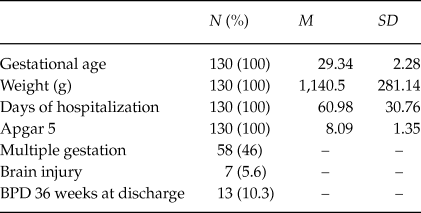
The corrected age of the children was M = 22.26 months; SD = 0.93, with mean chronological age (M chronological = 24.98 months; SD = 0.99); and mean gestational age (MGA = 29.34 weeks; SD = 2.28). The average birth weight in grams was M = 1,140.50 grams; SD = 281.14. The response rate from parents to the various tests used during the evaluation process was 70%. The socio-demographic characteristics of the families of origin are set out in the relevant entry in the results section. The analysis of the differences between hospitals in all the variables of the study was not statistically significant (p < .05). The main variables of the participants´ medical history are included in Table 1.
Medical History of the Sample (N = 130)

Note: BPD 36: bronchopulmonary dysplasia defined as the need for oxygen therapy beyond 36 weeks of corrected age or hospital discharge.
Measures
Medical record and history. Medical records from the hospitals’ medical archives provided the child’s date of birth, gestational age and weight at birth. We conducted an ad hoc interview with parents that included the family’s socio-demographic and economic data: Level of education, occupation and monthly income of both parents.
Instruments administered to the child:
Development Evaluation: The child development profile was evaluated using the Bayley Scales of Infant and Toddler Development III (Bayley, Reference Bayley2006). This is a child development assessment tool for children aged between 16 days and 42 months. The information it provides includes data on cognitive, language, motor and social-emotional development. The first three categories are directly assessed by the professional while the last one is reported by the mother by means of the Bayley Scales. The raw scores can be transformed into two scores: (a) Composite score with M = 100 and SD = 3; and (b) scale scores with M = 10 and SD = 3, to obtain information about the child’s development by differentiating receptive and communicative language development, and gross and fine motor skills development. The application of all these scores thereby allows us to compare different developmental skills between children.
The quality of attachment was evaluated using the Strange Situation Procedure (Ainsworth, Blehar, Waters, & Wall, Reference Ainsworth, Blehar, Waters and Wall1978). This is a situational test consisting of eight episodes presented in a fixed order that is used to analyze the activation and deactivation of the behavioral attachment system and children’s emotional reactions to the presence, absence and reunion with their mothers. All the procedures were video recorded. The quality of attachment was analyzed in the three categories of classification developed by Ainsworth et al. (1978, pp. 59–63): Secure (B), insecure-avoidant (A) and insecure-resistant (C).
The videos were coded by the first author, who is certified by the Institute of Child Development, University of Minnesota, and several trained coders. The inter-rater reliability was 95%.
Instruments administered to the parents:
Behavioral problems of children. Mothers completed the Achenbach System of Empirically Based Assessment ASEBA (Achenbach & Rescorla, Reference Achenbach and Rescorla2001) for children aged 1½ to 5 years. This scale consists of 113 items that assess behavioral and emotional problems in children, which are answered using a three-point Likert scale: 2 almost always, 1 sometimes, 0 rarely or never. For this study we only considered the global dimensions: Internalizing problems (e.g. anxiety/depression, withdrawal and somatic complaints) and externalizing problems (e.g., breach of rules and aggressive behavior). The internal consistency of internalizing problems in this study was .82; for externalizing problems .86, and .96 for the total score.
Social and emotional development was evaluated using the Socio-Emotional Scale forming part of the Bayley Scales of Infant and Toddler Development III (Bayley, Reference Bayley2006). This scale is derived from The Greenspan Social-Emotional Growth Chart: A Screening Questionnaire for Infants and Young Children (Greenspan, Reference Greenspan2004). It consists of 35 sequenced items between 0 months and 42 months following the developmental milestones of social and emotional development. Parents have to complete the items for the age range of their child. Each item is scored using a six-point Likert scale. The raw scores are transformed into scale scores with M = 10 and SD = 3.
To assess the level of stress experienced by adults in their role as parents, we used the Parenting Stress Index (PSI) in its short form (Abidin, Reference Abidin1995; Spanish adaptation by Díaz-Herrero, Brito de la Nuez, López, & Pérez-López, 2010). The questionnaire consists of 36 items to be answered using a five-point Likert scale. These items are organized around three subscales containing 12 items each: Parenting stress, which is defined as the discomfort experienced by parents in the development of their role as parents. Parenting stress refers to perceived self-efficacy, competence and parental satisfaction.
The second scale, the Parent-Child Dysfunctional Interaction, reports the extent of adjustment between the parents’ expectations and the perceived difficulties of raising their child and the degree of reinforcement that they receive from their children. The final scale is called Difficult Child and refers to the degree of difficulty that parents experience to control their child´s behavior. The sum of the scores of the three subscales provides an overall Total Stress score. The internal consistency of the scales in their original version was .87 for Parenting Stress; .80 for Parent-Child Dysfunctional Interaction; .85 for Difficult Child; and .91 for Total Stress. Three factors were found in the Spanish version with the following internal consistencies: Stress from child care .90; Parenting Stress .87; and Total Stress .91. The internal consistency of these factors in the mothers in our study was .90 for the Parenting Stress Index; .85 for the Dysfunctional Interaction scale; .85 for Difficult Child; and .93 for Total Stress.
Procedure
We phoned 160 parents whose children were included in the High Risk Neonates Monitoring Program in two public hospitals in Madrid and who met the inclusion criteria. All were informed of the study during the call. In total, 138 children and their parents came to the appointment, 86.25% of those contacted. Eight children were ruled out due to circumstances such as illness or lack of cooperation of the child, yielding a final overall sample of 130 children. We obtained the informed consent of 100% of the parents prior to the assessment. At the same appointment the parents were given a set of questionnaires to be completed and returned. We provided a stamped addressed envelope to make it easier to send them back.
The children were evaluated in one session using the methods described in the relevant section. The evaluation was conducted by three trained psychologists. The order of the evaluation tests was always the same and there was a flexible time interval between them depending on the needs of the children and parents. Statistical analyses were performed using the SPSS statistical package (version 20.0).
Results
Socio-demographic Profile
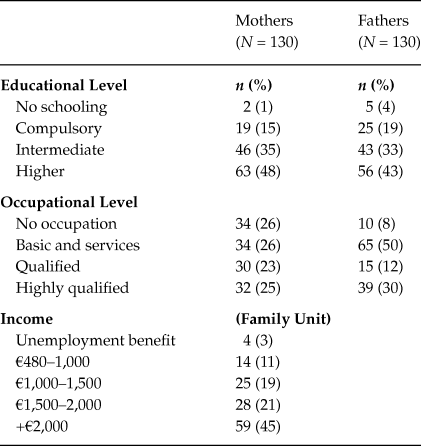
The families were mostly of Spanish nationality (81%), although 10% came from South America, 5% from Africa and 4% from India. The average number of members making up the family unit was 4 (SD = 1) with a number of siblings ranging from 1 to 6. Most of the children (95%) lived with their mother and father in the same household. The educational, occupational and income level of the parents is described in Table 2. As shown in this table, the distribution of educational level was similar between fathers and mothers, with a predominance of intermediate and university education. The occupations of the mothers were distributed equally among the various levels, while among the fathers, basic or service level and highly qualified occupations predominated.
Frequency and Percentage of Occupational and Educational Levels of Both Parents and Household Income

Note: Compulsory = primary and lower secondary; Intermediate = upper secondary and vocational training; Higher = university. Basic occupational level includes services, construction, transport, industry, primary sector and entertainment; Qualified = education, management and security; Highly qualified = health, technology, economics and justice.
Developmental Cognitive, Language, Motor and Socio-emotional Profile
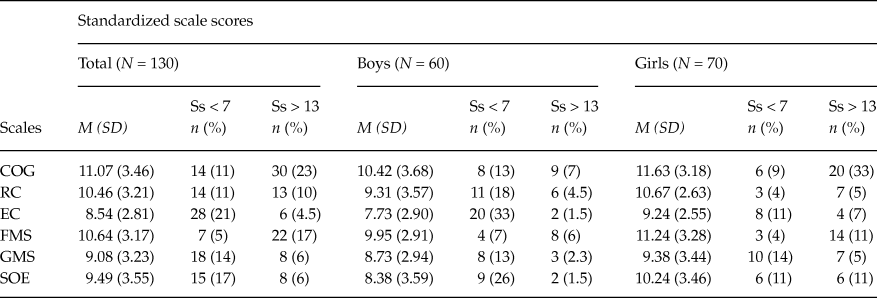
Cognitive, language, motor and socio-emotional functions were analyzed from both the scaled and composite scores. The scaled scores on cognitive, language, motor and socio-emotional dimensions gave a mean similar to those assessed and corresponding to the normative population of the same age as the study group (see Table 3). In both the total sample and the groups of boys and girls, the mean evaluated levels of development were similar to the mean scores of the normative group. None of the mean scores diverged significantly from the average scale score of mean 10 and standard deviation 3. The percentage of children with development levels below the scale score of 7 (equivalent to the 1st percentile) or below the normative sample assessed using the Bayley’s (2006) scale ranged from 5% in fine motor skills to 21% in expressive communication. We found a higher percentage of boys than girls with scores below 7 on some scales except for gross motor skills, in which the percentages were similar in boys and girls. The percentages of boys with scores less than 1 SD below the mean ranged from 7% (gross motor skills) to 33% (expressive communication); and in the group of girls from 4% (receptive communication and fine motor skills) to 14% (gross motor skills).
Results of the Bayley–III Development Standardized Scale Scores

Note: M = mean; SD = standard deviation; COG = cognitive; RC = receptive communication; EC = expressive communication: FMS = fine motor skills; GMS = gross motor skills. SOE = socio-emotional; Ss = scale score (M = 10; SD = 3); Ss < 7 are equivalent to the 9th percentile on the cognitive scale, and equivalent to the 1st percentile or lower on the communication and motor skills scales; Ss > 13 are equivalent to the 84th percentile on the cognitive scale, and equivalent to the 88th percentile or higher on the language and motor skills scales. The assessment was performed at the corrected age of 2 years.
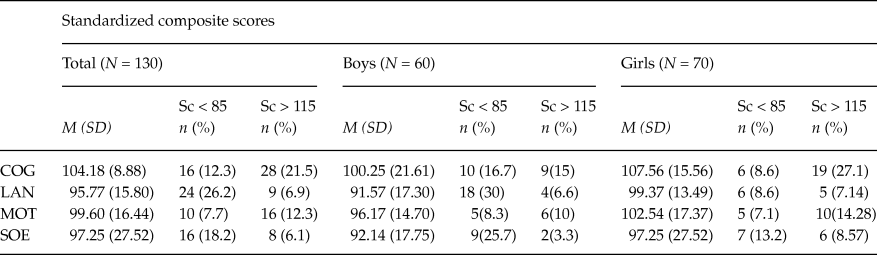
Similar results were found for composite scores (see Table 4). That is, the mean scores on composite scores were similar to the mean scores of the normative group (Mean = 100; SD = 15) in both the total sample and the groups of boys and girls. The percentage of children with developmental levels below the scale composite score of 85 (equivalent to the 16th percentile) or below the normative sample assessed using the Bayley’s (2006) scale ranged from 7.7% in motor skills to 26.2% in language. We found a higher percentage of boys than girls with scores below 85 on all scales except for motor skills, in which the percentages were similar for boys and girls. The percentages of boys with scores less than 1 SD below the mean ranged from 8.3% (motor skills) to 30% (language); and in the group of girls from 8.6% (cognitive or language skills) to 13.2% (socio-emotional skills).
Results of the Bayley–III Development Standardized Scale Composite Scores

Note: M = mean; SD = standard deviation; COG = cognitive; LAN = communication; MOT = motor skills; SOE = socio-emotional; Sc = composite score (M = 100; SD = 15); Sc < 85 are equivalent to the 16th percentile on the composite scales; Sc > 115 are equivalent to the 84th percentile on the composite scales. The assessment was performed at the corrected age of 2 years
Differences between the genders in the development dimensions were analyzed by multivariate analysis of variance (MANOVA), taking the development scales as dependent variables and the gender of the children as an independent variable. Multivariate contrasts, taking subscales of the same dimension as dependent variables (i.e., language development and motor development), were significant for language, Wilks’ λ = .92, F(2, 127) = 5.13, p = .0007, η2p = .07) but not for motor skills, Wilks’ λ = .95, F(2, 127) = 2.75, p = .067, η2p = .004. Univariate analysis using ANOVA indicated that girls show significantly better development of both receptive language, F(1, 128) = 5.97, mean square, MS = 59.29, p = .016, η2p = .04 and expressive language, F(1, 128) = 9.95, MS = 73.61, p = .002, η2p = .07. On the social-emotional scale, F(1, 85) = 5.54, MS = 66.50, p = .021, η2p = .06, and cognitive scale F(1, 128) = 4.04, MS = 47.45, p = .04, η2p = .02, girls also scored significantly higher than boys. Likewise, girls scored significantly higher on the cognitive composite scale, F(1, 128) = 4.77, p = .03, η2p = .05, language composite scale, F(1, 128) = 9.37, p = .003, η2p = .09, and motor composite scale, F(1, 128) = 6.12, p = .01, η2p = .06. No significant gender differences were found on the socio-emotional composite scale, F(1, 128) = .94, p = .33, η2p = .01.
Psychological Adjustment: Internalizing and Externalizing Problems
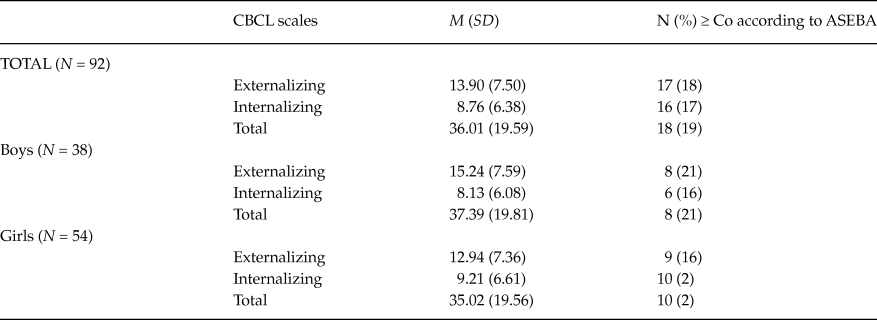
In terms of the behavior problems assessed, the mean scores and standard deviations in the dimensions of the Achenbach Child Behavior Checklist (CBCL), together with the percentage of children who exceeded the defined cut-off (normative mean plus a standard deviation) are shown in Table 5. The comparison of means using the Student’s t-test between the population of preterm infants (included in Table 4) and the scores of the normative population assessed using the ASEBA (N = 300) in externalizing problems (M ASEBA = 13.1, SD = 7.8), internalizing problems (M ASEBA = 8.7, SD = 6.3) and total problems (M ASEBA = 33.4, SD = 18.8) was not significant in any of these respective dimensions: t = 0.88, df = 156, p = .811; t = 0.07, df = 150, p = .930; t = 1.12, df = 146, p = .26. Around 20% of children were over the cut-off in these disorders compared with the normative sample. When the percentage was separated into boys and girls, the latter showed lower percentages compared to the former, especially in internalizing problems.
Frequency and Percentage of Attachment Patterns

Note: (*) 5 children could not be evaluated due to technical problems in the recordings.
The multivariate analysis of variance (MANOVA) to analyze gender differences in psychopathological problems showed a significant multivariate contrast (Wilks’ λ = .92, F(2, 88) = 3.67, p = .02, η2p = .07); however, univariate analysis using ANOVA did not confirm these differences either for internalizing problems, F(1, 89) = 0.62, MS = 25.62 p = .43, or for externalizing problems, F(1, 89) = 2.09, MS = 116.41 p = .15. Finally, it should be noted that although these differences were not significant, the mothers tended to report more internalizing problems in girls and externalizing problems in boys.
Maternal Stress Levels
Regarding the maternal stress levels reported by mothers, mean scores for each of the factors were lower than the mean level of each of these scales (midpoint of scales = 12) (see Table 6). If we look at the mean score of the cut-off (Co = 50) found by Abidin (Reference Abidin1995) on the various scales, the average levels found in our study are similar, except for the total stress score, which is higher. In terms of the distribution of scores above Co = 50 on the various scales, just over half of the mothers reported high levels of stress on the Parenting Stress Index (56.2%). More than half of mothers obtained scores above Co = 50 on Dysfunctional Interaction (66.7%) and Difficult Child (60.4%). 56.3% of mothers reported a high level of total stress.
Means, Standard Deviations and Percentage of Subjects with Significant Symptoms in the Global Dimensions of the CBCL

Note: CBCL = Achenbach Child Behavior Check-list; M = mean; SD = standard deviation; df = degrees of freedom; ASEBA = Achenbach System of Empirically Based Assessment (Achenbach, 2001). Co = cut-off obtained from the sum of the mean plus a standard deviation corresponding to the exteriorizing (Co = 21), interiorizing (Co = 15) and total (Co = 52) scales of the ASEBA normative sample
Pattern of Attachment
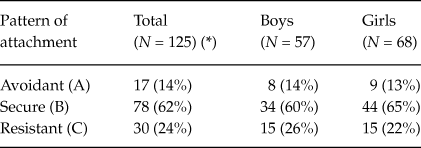
The most common pattern of attachment in both the total sample and in the group of boys and girls separately was secure (B), followed by insecure-resistant (C). The least common attachment pattern was insecure-avoidant (A). This distribution was similar for both genders and no significant differences were found between boys and girls, Chi-square, χ2 = 0.37 (2), p = .82. However, there was a slightly higher percentage of secure attachment for girls than boys, and a slightly lower percentage of insecure-resistant attachment for boys than girls (see Table 7).
Means, Standard Deviations and Percentage of Subjects with Significant Scores on the Maternal Stress Variable

Note: PSI = Parenting Stress Index. M = mean; SD = standard deviation; Co = cut-off. The 85th percentile obtained by Abidin (Reference Abidin1995) has been used as the Co = 33 maternal distress; 26 dysfunctional interaction; 33 difficult child; 86 total stress.
Discussion
The general aim of our study was to provide an overview of all the variables related to child development in premature infants at two years corrected age in a Spanish sample, including not only the traditionally studied measures such as cognitive, language and motor skills development, but also others related to social-emotional development, psychological adjustment and patterns of attachment. In the case of the mothers, we include analysis of the stress levels associated with the task of raising their premature children as a factor for understanding mother-child interactions. Although the literature on development, parenting and prematurity is extensive, very few studies have provided an overview of these variables and gender differences at two years of age. In fact, we did not find any studies with this objective in the Spanish population. Following the specific objectives of this study, we initially analyzed the socio-demographic profile of the VLBW population. The results showed that children came mainly from Spanish families, with a small minority of families coming from South America, Africa and India. Most of the children lived together with their mother and father in the same household. The parents’ educational level was similar between fathers and mothers, with a predominance of intermediate and university education. With regard to professional occupation, fathers’ occupations were predominantly basic and highly qualified, while mothers’ professional occupations were equally distributed among the considered levels.
In regard to the second aim of this study to compare the children’s developmental level to the normative population, our findings showed that the mean scores for cognitive, language, motor skills and socio-emotional development of the children in our sample were similar to those of the normative group contained in the BDS III (Bayley, Reference Bayley2006). These results are in line with the general findings of Sansavani et al. (2006). However, we also found a small (5%) to moderate (33%) percentage of children whose scores were lower than expected for their age in percentiles considered to represent developmental disorders or delay. Regarding gender differences, we found that girls tended to score higher than boys on cognitive, language and socio-emotional development. These results were consistent with previous studies that showed significant differences by gender on the children´s developmental levels (Brothwood et al., Reference Brothwood, Wolke, Gamsu, Benson and Cooper1986; Claas et al., 2011; Hindmarsh, O´Callaghan, Mohay, & Rogers Reference Hindmarsh, O’Callaghan, Mohay and Rogers2000; Wolke, Reference Wolke1998).
We can analyze our results in the light of the debate that surrounds whether the BDS III underestimates developmental delays. For example, Anderson, de Luca, Hutchinson, Roberts & Doyle (Reference Anderson, De Luca, Hutchinson, Roberts and Doyle2010) found that premature infants yield average scores similar to the normative scores in the BDS III. However, these averages are significantly lower when compared to the group of children born at term in their sample. The findings of averages near or above normative values are almost a constant in studies with premature children evaluated with BDS III, a measure which has suitable psychometric properties and is widely used to assess development in premature infants.
These arguments point to the need to analyze the scores obtained by the children in follow-up visits, addressing not only the composite and scaled scores but also their clinical relevance. Outcomes require fine-grained interpretations by the professional to identify children whose developmental progress in some areas may be jeopardized. This is not only due to the importance of skills assessed on the development scale, but also because from a development standpoint it entails a disorder or developmental delay on which future capacities rest.
Indeed, from a mental health perspective we should consider that healthy growth essentially refers to healthy socio-emotional development and adaptation. In spite of the fact that mental health is a key challenge in the development field, the developmental assessment of children´s social and emotional skills is not usually an objective of the follow-up programs in the hospital setting. Fortunately, today we have instruments that allow us to assess these developmental domains and to obtain a more accurate developmental profile. As DelCarmen-Wiggins, and Carter (2001) pointed out, it is more difficult to quantify the levels of children´s development by developmental delay alone, as this tends to underestimate or even ignore the real needs of the preterm infant population.
With these ideas in mind, we considered our third aim; the study of the infant’s psychological adjustment. The scores obtained by the children of our sample in terms of psychological adjustment are within the range of the general population and even include scores below the cut-off set by the ASEBA scale (Achenbach & Rescorla, Reference Achenbach and Rescorla2001). These findings are in line with the study by Delobel-Ayoub et al. (Reference Delobel-Ayoub, Kaminski, Marret, Burguet, Marchand, Sylvie and Larroque2006). By contrast, we found no significant gender differences. These data are consistent with the findings of previous studies such as by Huhtala et al. (Reference Huhtala, Korja, Lehtonen, Haataja, Lapinleimu and Munck2011) and Kaaresen et al. (Reference Kaaresen, Rønning, Tunby, Nordhov, Ulvund and Dahl2008). It is therefore possible that prematurity is not a decisive variable in the development of emotional disorders and that other factors (i.e., maternal well-being, family socio-economic situation, temperament or other characteristics of the child) may play a greater role in the emergence of psychological maladjustment.
Development is considered to be a dynamic and bidirectional process wherein the child’s characteristics (nature) both influence and are influenced by the child-rearing context (nurture) (Evangelista & McLellan, Reference Evangelista and McLellan2004; Schore, Reference Schore2005). From this approach, development and parenting have to be explained by interdependent processes in a bidirectional way.
The mothers’ perceived self-efficacy and competence is shaped as a result of the perceived balance between the mothers’ demands and their resources to face these demands, known as maternal stress. Maternal stress is related to the deployment of caring and nurturing strategies. It is a relevant factor to be taken into account, not only as a variable that affects the parents´ well-being, but also as a variable that affects the child´s development and well-being.
As regards perceived maternal stress (fourth aim of our study), the mothers´ stress levels were found to be within normal range. These results were consistent with previous studies such as by Halpern et al. (Reference Halpern, Brand and Malone2001) or Tommiska et al. (Reference Tommiska, Östberg and Fellman2002). However, the more in-depth analysis of perceived maternal stress scores showed a different picture. According to values proposed by Abidin (Reference Abidin1995), about half of mothers significantly perceived lack of competence, self-efficacy and parental satisfaction in their role as primary caregivers (i.e., maternal distress scale). Moreover, mothers showed low satisfaction concerning the task of raising their children (i.e., dysfunctional interaction scale) and they also reported difficulties controlling their children´s behavior (i.e. difficult child scale). These results were in line with previous studies that found high levels of parental stress in parents of preterm children (Ong et al., Reference Ong, Chandran and Boo2001; Taylor et al., Reference Taylor, Klein, Minich and Hack2001).
The sense of self-efficacy and competence is related to the deployment of caring and nurturing strategies, which means it is a relevant factor to be taken into account not only as a variable that affects the well-being of parents but also as a variable affecting child development and wellbeing.
One of the key factors in the relationship between development and parenting is early interactions, which are key steps in the pattern of attachment. Authors such as Korja et al. (Reference Korja, Latva and Lehtonen2012) point out that differences in maternal behavior during interaction in the first months of life continue up to two years. The scarcity of studies that address the quality of attachment in premature children at two years of age is possibly due to the limited use of the Strange Situation Procedure. Nevertheless, Marvin (1972, Reference Marvin, Alloway, Pliner and Krames1977) conducted studies with normative population children at two years of age and found that these children’s behavior in the Strange Situation Procedure with respect to the activation and deactivation of the attachment behavioral system in connection with separation and reunion is comparable to that of children aged 1. Ainsworth et al. (Reference Ainsworth, Blehar, Waters and Wall1978) analyze these results and indicate that “[…] this suggests that they may be individual characteristics of children which change little during preschool developmental periods” (p. 200). Thus the Strange Situation is considered a valid and reliable procedure at this age. Furthermore, the pattern of infant attachment is related to child development and adjustment (DeKlyen & Greenberg, Reference DeKlyen, Greenberg, Cassidy and Shaver2008).
The fifth aim of our study was to evaluate the quality of the attachment pattern of children as a key indicator in the emotional history of the mother-child dyad. In terms of the distribution of attachment patterns, we found a somewhat higher percentage of children with pattern B (secure) than the average reported by the meta-analysis of van Ijzendoorn et al. (Reference van Ijzendoorn, Schuengel and Bakermans-Kranenburg1999) in the normative population. Our data are in line with findings by other authors in that the proportion of secure attachments among premature infants is similar to that of term infants (Korja et al., Reference Korja, Latva and Lehtonen2012).
However, we were especially interested in gaining greater insight into the quality of insecure attachment patterns, since the origin and evolution of these patterns is a challenge in screening, assessment and intervention with the child and their attachment figure. Furthermore, the relationship between insecure attachment and developmental difficulties is well known (DeKlyen & Greenberg, Reference DeKlyen, Greenberg, Cassidy and Shaver2008; Kobak, Cassidy, Lyons-Ruth, & Ziv, Reference Kobak, Cassidy, Lyons-Ruth, Ziv, Cicchetti and Cohen2006).
In the literature, the most common insecure attachment pattern in the normative population is avoidant (A), followed by resistant (C) (van Ijzendoorn et al., Reference van Ijzendoorn, Schuengel and Bakermans-Kranenburg1999). Although some studies found the same trend in premature infants (Butcher et al., Reference Butcher, Kalverboer, Minderaa, Doormaal and ten Wolde1993; Frodi & Thompson, Reference Frodi and Thompson1985), in line with studies by Plunkett et al. (Reference Plunkett, Meisels, Stiefel, Pasick and Roloff1986) and Schwichtenberg, Shah, & Poehlmann (Reference Schwichtenberg, Shah and Poehlmann2013), we found a higher prevalence of insecure resistant attachments (C). These results could be interpreted in the light of studies indicating that early interactions of mothers of premature infants and their children have specific characteristics. Bhutta et al. (Reference Bhutta, Cleves, Casey, Cradock and Anand2002) and Muller-Nix et al. (Reference Muller-Nix, Forcada-Guex, Pierrehumbert, Jaunin, Borghini and Ansermet2004) found that mothers of premature infants promote and develop less adjusted and sensitive interactions than those observed in dyads of children born at term. Their activation levels are also higher and they are more intrusive and inconsistent in their responses to children’s demands. Levels of inconsistency and intrusiveness are two of the factors that promote insecure resistant attachment patterns.
Overall, our data provide a developmental profile broadly similar to that of the normative population and that found by other researchers. The maternal stress and sense of efficacy and competence of the mothers in our sample was found to be in line with average values, while the percentage of children with secure attachment is similar to the figures found by researchers in premature infants and even in samples not at risk.
Studies on the development of premature children and their parents often point to what could be called “correction” or “protection” factors. Sometimes the characteristics of the sample (both children and parents) or the context of early development (such as the type of care received during the months of admission to Neonatal Intensive Care Units or follow-up programs) are propounded to explain results that put premature infants and infants born at term on an equal footing. This being so, perhaps the most accurate reading of the results in the literature is that prematurity is a risk factor for development and parenting (Arnaud et al., Reference Arnaud, Daubisse-Marliac, White-Koning, Pierrat, Larroque, Grandjean and Kaminsk2007; Doyle & Casalaz, Reference Doyle and Casalaz2001; Ionio et al., Reference Ionio, Riboni, Confalonieri, Dallatomasina, Mascheronie, Bonanomi and Comi2016; Myers & Ment, Reference Myers and Ment2009), and that this risk factor may be lessened if certain promoting or protective factors are present. In our study, both hospitals have development-centered care for preterm infants, which could in part explain the positive results found in our sample. This study was conducted in two hospitals that provide development-centered care where parents may have 24–hour free access to the NICU, the promotion of kangaroo-care and professional support for parents. All these services can promote infant-parent co-regulation and infants’ brain development (Schore, Reference Schore2005). Parents’ attendance of the NICU and the children’s development-centered care allow parents to better understand the evolution and needs of their children. All these services encourage the parents’ self-confidence and their perceived self-efficacy, decreasing their levels of stress and increasing the sensitive parent-child interactions (Welch & Myers, Reference Welch and Myers2016). Furthermore, both hospitals provide follow-up programs at discharge that could also explain the child development and adjustment results we found. These programs (although they are not specifically for parents) may help parents to feel they are supported in some way in raising their children.
Despite these preventive actions provided by the hospitals, we really need to consider the clinical significance and relevance of scores which are slightly lower than those considered as means on all domains of development (i.e., cognitive; receptive and expressive language; fine and gross motor) that we assessed. Even though these scores do not emphasize a disorder or developmental delay, they are indicative that the developmental skills on which future skills are to be based have not been fully or satisfactorily acquired.
Likewise, a suitable follow-up program should include assessment and support of parents’ psychological well-being as primary caregivers. The particular circumstances in which parents of premature children have to deploy skills as primary caregivers are a risk factor. Parents who are convinced of their competencies and effective as primary caregivers will generate feelings of security and confidence in their children towards them, i.e. secure attachments, which is one of the most important factors associated with optimal development. It is crucial that social-emotional development and attachment are interpreted as key areas in child development and are part of follow-up and early intervention programs for premature infants and their parents. The evaluation of socio-emotional developmental milestones enables early identification of indicators of developmental disorders or delays, as well as evidence of insecure attachments that should be subject to intervention.
The wellbeing and development of premature children and their parents as primary caregivers are complex and mutually influencing factors. Intervention programs should be designed to reduce risk factors and increase protective factors for the child, parents and the child-rearing environment (Sameroff & Fiese, Reference Sameroff, Fiese and Zeanah2000).
A quality approach unquestionably calls for a multidisciplinary perspective (i.e. psychologists, pediatricians, nurses, social workers) within the NICU, with the implementation of follow-up and early intervention programs. Promoting healthy growth for premature children (i.e., at risk children or children with developmental delays or disabilities) requires a comprehensive inter-disciplinary assessment (Guralnick, Reference Guralnick and Guralnick2000). This approach produces a developmental profile for children, taking into account their family functioning, parent-child relations, parenting practice and socioeconomic information. All these data will support the decision-making process for diagnostic and intervention purposes. Effective and efficient interventions can only be carried out from an integrated multidisciplinary perspective.