1. Introduction
As many biologists and philosophers have noted, information was a central concept in twentieth-century biology, and is likely to remain central throughout the twenty-first century. However, the term information in its meaning-related sense is rarely defined, and as Oyama has shown, there are many problems in applying it to biological systems (Oyama Reference Oyama1985). Recently, in a target paper in Philosophy of Science (June Reference Maynard Smith2000), John Maynard Smith has re-kindled interest in an analysis of the concept of information in biology, using an evolutionary approach. His article focused mainly on genetic information and the way it can be said to specify the form and function of living organisms. For Maynard Smith (hereafter, MS) the notion of biological information is intimately linked with the idea that the signal carrying the information (e.g., DNA) and the response to it are products of natural selection.
Before discussing how the concept of semantic biological information is to be defined and used, there is a need to justify the usefulness of “information talk.” It can be argued that focusing on the diverse mechanisms underlying the processes of DNA replication, transcription, translation, signal transduction, and communication between organisms may be more useful than an attempt to generalize these processes under a common conceptual umbrella of “information” transmission, re-construction, processing, and so on. After all, genetic heredity, signal transduction within and among cells, and communication between individuals are processes that occur at different levels of organization and entail entirely different biochemical and physiological mechanisms, so relating them all to “information” may lead to distorted views of one or more or these biological processes. As Oyama (Reference Oyama1985) has shown, this is a valid concern, particularly when the genetic system becomes the prototype for thinking about information. The problem is that the genetic system is highly specific and in many ways unusual, and an excessive focus on genes and their inheritance tends to lead to gene-based metaphors and analogies in other areas (for example, “memes” in cultural studies), which may be inappropriate or misleading. One can therefore choose to abandon general information talk, or alternatively suggest a general definition of semantic information in biology that recognizes that there are different types of information, and different ways of acquiring, re-constructing, and sharing it.
Suggesting a general definition of “information” requires finding a common denominator for the different types of things or processes that we intuitively recognize as “information” or as “information carriers”; moreover, this common denominator and the definition based on it should lead to useful generalizations or perspectives. Information theory provides such a common denominator, defining information as the measure of the probability of a particular message being selected from the set of all possible messages. It assumes the existence of sender, receiver, channel, encoding and decoding processes, and a set of messages which is compatible with this communication system. The theory calculates the probability of transmitting a particular message with specified accuracy (Shannon and Weaver Reference Shannon and Weaver1949). However, this probabilistic, general measure of information is indifferent to function and meaning: for example, a DNA sequence coding for a fully functional enzyme contains as much information as a same-length sequence that codes for a completely non-functional enzyme; similarly, a string of nonsense words and a meaningful sentence of the same length are equivalent with respect to information content. Since what we seek is a meaning and function related concept of biological information, one that can be used in an evolutionary framework, the meaning-free concept of information theory is insufficient.
In everyday usage, as in biology, a train timetable, the molecules of distinctive food substances that are present in the milk received by a suckling mammal, a recipe for an apple pie, an alarm call, a DNA sequence, the concentration of a chemical in the nutrient broth of a bacterial colony, the appearance of the sky for an observing ape, the length of the day for a plant, and a piece of computer software are all called “information.” We have here a motley collection made up of environmental cues (the appearance of the sky, day length), man-made instructions (train timetable, recipe, software), evolved biological signals (alarm call, chemical signal), and hereditary material (a very special type of evolved biological signal). What do they have in common?
A train timetable, a piece of software, a transmitted chemical, a recipe, an alarm call, an environmental cue, and a DNA sequence do share important general attributes. First, in all cases, there is a special type of reaction between a receiver organism (or organism-designed system) and what we may call the “source,” and in all cases this reaction affects the actual or the potential actions of the receiver. Thus, a train timetable affects the potential actions of a reader; molecules of distinctive food substances in a youngster's milk may affect its future food preferences (probably by guiding the development of the nervous system and of specific receptors); a recipe for an apple pie is something that may affect the baking activities of a cook; an alarm call may affect the behavior of an animal that hears it; a DNA sequence may affect the phenotype of an offspring organism; the concentration of a particular nutrient may affect the aggregative response of bacteria; the appearance of the sky may affect the behavior of an observing ape; day length may affect the flowering time of a plant, software may affect the output of a computer.
Second, in all these cases, the reaction of the receiver to the source leads to a complex, regulated chain of events in the receiver, and in all cases this chain of events depends on the way the source is organized rather than on its energy content or its precise chemical constitution. Energy or material may be transferred from the source to the receiver, but it is not necessary for this type of reaction. In fact, the source may remain completely unchanged following the reaction, as happens with sources such as the appearance of the sky, day length, a recipe, a train timetable, and most types of software. More generally, there is no necessary correlation between the energy or material transferred from the source to the receiver and the magnitude of the receiver's functional response as measured in energy terms.
Third, in all cases the reaction to the source contributes to a type of response by the receiver that is beneficial over evolutionary time.
Fourth, in all cases variations in the form of the source often lead to corresponding variations in the form of the response: variations in DNA lead to variations in development; variations in train timetables lead to variations in the behavior of the traveler-reader; variations in the molecules in mother's milk lead to variations in the behavior of the child; variations in the sky lead to variations in the behavior of the ape, etc. This contrasts with non-informational reactions involving material and energy transfer that change the state of the receiver. In the latter the effect on the receiver is proportional to the amount transferred, as, for example, when organisms consume food. With non-informational reactions, variations in organization are either unimportant or are important only to the extent that they contribute to the efficiency of energy or material transfer. Consider two identical pieces of meat, having exactly the same constituents and caloric content, one prepared as a steak the other minced and served as meatballs. Although when a starving human eats the two pieces of meat, one in the form of a steak, the other in the form of minced meatballs, there is a reaction of the eater with the meat, and the reaction may well change the state of the eater (she has gained calories and is not starving), there is nothing inherently different in the steak calories and meatball calories. Both steak and meatball will be digested and broken down to their constituent parts to be used as sources of energy and material. Neither steak nor meatball can be said to be interpreted in a steak-specific manner or meatball-specific manner by the individual. Of course, the digestive system is a complex evolved system and all the molecular reactions in this system are functional, specific, and dependent on the organization of the enzyme and the reactants. However, although the structure and function of enzymes depend on information, the enzymes and substrates do not have source/receiver relations. When food is eaten the receiver is the organism, and in this case the organism's adaptive response is not to variations in the organization of the meat, but to its caloric and material content. The two forms of meat—steak and meatball—are primarily sources of material and energy, not information (unless they are used as socially or culturally relevant signs about class or religion, for example).
On the basis of the common properties just listed, all of which are necessary for something to be referred to as “information,” I shall suggest a semantic definition of information. I shall argue that when thinking about biologically relevant information, a functional-evolutionary perspective is necessary, but the focus should be neither on the evolution of the signal “carrying” the information, nor on the evolution of the final specific response. Rather, it should be on the evolution of the system mediating between the two—on the interpreting system of the receiver. The definition I suggest accommodates environmental cues as potential informational sources, and makes it easier to think about non-genetic information and its transmission through non-genetic inheritance systems.
2. A Definition of Biological Information
A source—an entity or a process—can be said to have information when a receiver system reacts to this source in a special way. The reaction of the receiver to the source has to be such that the reaction can actually or potentially change the state of the receiver in a (usually) functional manner. Moreover, there must be a consistent relation between variations in the form of the source and the corresponding changes in the receiver.
What I mean by “form” is the organization of the features and/or the actions of the source, and specifically those aspects of organization with which the receiver reacts. The source eliciting the special type of reaction in the receiver will be referred to as “input” or “information cue,” and the processes in the receiver that result in a regular and functional response will be called “interpretation.” The term “signal” will be reserved only for evolved informational inputs, that is, evolved inputs produced by an evolved or otherwise designed source. “Functional” is here used to mean the consistent causal role that a part plays within an encompassing man-designed or natural-selection-designed system, a role that usually contributes to the goal-oriented behavior of this system. (I will discuss the term “functional” more fully below.)
The first thing to note about the proposed definition of information is that it gives a central role to the interpretative system of the receiver of information. Like MS's approach, my definition is based on evolutionary considerations, but it is different from the definition implied by MS (he does not offer a formal definition), which requires that the input, like the final response (output), must have evolved by natural selection. My definition requires instead that the processes mediating between input and output—the interpretation and evaluation processes of the receiver—are the products of natural selection. These processes, which during ontogeny develop in a context-sensitive manner, underlie the receiver's functional, and usually adaptive, response. The focus on interpretative processes is the central feature of the definition.
The second thing to note follows from this. My definition does not require that the form of the input must have evolved through natural selection. The definition allows for environmental cues such as a sky full of black clouds to be considered as informational sources, even though the cloudy sky has not evolved by natural selection. Most people will say that a sky full of black clouds provides information about rain to an intelligent vertebrate such as an ape. The clouds are not black as a warning for the observer, but their blackness is a reliable informational cue leading to the adaptive, learning-dependent, shelter-seeking response of the perceiving organism (and is often more reliable information than a TV weather forecast). We have to assume that there was past evolution of complex perceptual and cognitive processes that interpret this perceptual cue in an adaptive manner, leading to the anticipation of the rain, to the search of shelter, and to flexible responses to variations in the appearance of the sky. It is thus the receiver that actively constructs information: it is the receiver that makes the source, the black cloudy sky, into an informational input. Clearly, according to my definition, genes have no theoretically privileged informational status. They are just one type of informational source that contributes to the development of living organisms (Griffiths and Gray Reference Griffiths, Gray, Oyama, Griffiths and Gray2001, Sterelny and Griffiths Reference Sterelny and Griffiths1999).
Of course, in order for external, non-evolved cues like a black cloudy sky to be interpreted adaptively, the interpretation system of the receiver must be able to respond to the cloudy sky, a recurrent environmental agent, by specifically altering its internal state. This usually involves a whole chain of causally related reactions. When we look at any signal transduction network, we see that the first response to a cue becomes a signal to the second element in the system, the second element's response becomes a signal to the third element, and so on. Most signals in a network are therefore both signals and responses (depending on their relative position as upstream and downstream elements in the chain of reactions). Only the primary input cue and the final output response may not have this dual function.
Communication is a special type of informational reaction, which occurs when both the source and the receiver have evolved (or been designed) to interact with each other on a regular basis. Therefore, when examining communication, the evolution of both the sender's and receiver's signaling and interpretation strategies require equal attention (Hauser Reference Hauser1997). MS's focus on signals means that he identifies the notion of information with communication, which is very restrictive.
A third point to note is that, according to the concept of information that I am suggesting, for a reaction to be considered as informational, the reaction of the receiver to the source must usually lead (in whatever circuitous manner) to an adaptive response. In other words, the reaction must have a function in the evolutionary sense. The notion of functionality as used and defined in evolutionary theory (Wright Reference Wright1973, developed by Millikan Reference Millikan1984) is therefore central to the definition. However, my use of the term function is more general than the original usage of Wright, who defined a part's function as the part's effects which have evolved though natural selection. I combine Wright's notion with the sense of function used by Cummins (Reference Cummins1975), who defined functions in terms of their causal role in the encompassing system's behavior, rather than with respect to evolutionary theory. I therefore employ “function” in a similar sense to that discussed by Kitcher (Reference Kitcher1993): as a general design-based notion. According to this view, the function of a part or a process (such as a reaction between an informational source and a receiver) has to be analyzed in terms of its causal role in the receiver system, which now or in the past contributed to the designed (by natural selection or by human intelligence) goal-oriented behavior of the encompassing whole (the receiver). Since, from an evolutionary perspective, in order to have a function a part (unit or process) must consistently contribute (or must have contributed in the past) to the most general goal-directed behavior of the encompassing system, i.e., the reproductive success of the organism, the notions of function and adaptive evolution through natural selection are tightly related. For a biological structure or process to have a non-incidental functional effect, it must have evolved by natural selection. However, focusing on the evolution of the receiver, which is the result of multiple and extremely complex past selective processes and various historical and developmental constraints, obviates the need to find a direct and straightforward relationship, brought about by natural selection, between the input and the response to it (which is what Wright's original definition of function required). This may be the way round Godfrey-Smith's (Reference Godfrey-Smith1993) and Amundson and Lauder's (Reference Amundson and Lauder1993) criticism of the evolutionary interpretation of function as too restricted to be of general applicability in biology. In my view, to be called “functional” the informational input has had to contribute to the evolution by natural or artificial selection of the receiver, but it may have done so in a very circuitous way.
My fourth point is related to the last one. It is that although the response has to have evolved, it is not necessary that it is a directly evolved specific adaptive response, rather than being the product of a more general evolved adaptive system. For example, an engineer can interpret a plan and build an airplane by using his highly evolved brain, but the ability to build airplanes has not evolved as a unit-trait through natural selection. Building airplanes is one of many adaptive responses of a human brain that has evolved for more general purposes. Or take the cloudy sky yet again: although the response to black clouds is adaptive, a specific “black-cloudy-sky-response” is unlikely to be an evolved unit-trait. The response is a manifestation of a more generally evolved cognitive system (the nervous system of the receiver), which is able to recognize and respond adaptively to environmental regularities. Hence, it is not always possible, or necessary, to find a simple, adaptive, directly-evolved relation between the input provided by the source and the response (output) of the receiver.
It can be argued that the information in an alarm call, a cloudy sky, or a chemical signal in a bacterial colony, has very little in common with what we call information in DNA. In the first category of cases it is easy to see what the response to the source adapts the receiver to (an alarm call warns the bird there are predators around; the cloudy sky alerts the ape to the coming storm; the chemical alerts the bacteria to imminent starvation). But it is not clear that the receiver system (the cell) “responds” to DNA, and that the response to DNA adapts the cell to anything in particular. Rather, DNA is simply “read” by the cell, so it is not information in the same sense. In other words, DNA is information “about” the cell or the organism, rather than “for” the cell or the organism. However, if instead of thinking about DNA in general we think about a particular locus with a particular allele, it is not difficult to think about the functional role of this particular allele in a particular set of environmental circumstances. Hence we can say that for all types of information, including alarm calls and pieces of DNA, a source S (allele, alarm call, cloudy sky, etc.) carries information about a state E for a receiver R (an organism or an organism-designed product), if the receiver has an interpretation system that reacts to S in a way that usually ends up adapting R (or its designer, if R is humanly designed) to E. (I am grateful to Peter Godfrey-Smith for suggesting this way of expressing the idea.) However, for S to be an information input rather than a source of energy or material, it is also necessary that it is its form, and variations in this form, rather than any other attribute, which affect R's specific response.
This leads to my fifth point: for there to be information, whether associated with evolved or non-evolved sources, it is necessary that there is a consistent relation between variation in some aspect of the organization of the source and the functional response of the receiver. This is true by definition for any evolved receiver system—there are always at least two alternative “interpretations” to a signal in an evolved system. At least one organizational state of the source leads to a process resulting in a functional response by the receiver, while all other organizational states do not. In most cases there are more than two alternatives (+ and −), of course. Thus, variations in the appearance of the sky lead to variations in the functional responses of the intelligent ape, variations in DNA lead to corresponding variations in the behavior of the cell, variations in an alarm call lead to variations in the response of group members, and so on.
3. Other Properties of Biological Information
MS and his commentators referred to several other properties of genetic or genetically-coded biological information: informational signals are gratuitous (Monod Reference Monod1971); they are relatively specific; they imply notions of misinterpretation or error; and they are intentional. In addition, MS noted that whether or not there is adaptive feedback from response to signal is contingent upon the particular properties of the information-processing system (see MS Reference Maynard Smith2000, Sterelny Reference Sterelny2000, Sarkar Reference Sarkar2000, Godfrey-Smith Reference Godfrey-Smith2000). All of these properties, which I discuss below, are compatible with my general definition of information, and are not limited to the specific case of genetic information.
When the informational inputs are signals produced by an organism as part of a communication or transmission system, rather than being abiotic cues (e.g., a cloudy sky or day length), they are gratuitous in that there is no necessary connection between their form and their function. This gratuity (also called semioticity, see Sarkar Reference Sarkar2000) is an inevitable consequence of the evolved nature of any biological signaling system: if evolution had been different, the biologically produced signal associated with a given adaptive response could, and almost certainly would, have been different. It must be noted, however, that although all evolved signals are arbitrary or gratuitous in this general sense, for some signals their meaning is associated with their production cost. Take, for example, the meaning of the peacock's tail: as an honest indicator of its owner's fitness, the message of the tail to the peahen is associated with the cost of producing and maintaining it. With other types of signals, such as spoken words, there is no relation between the form of the signal and the cost of production. As Lachmann et al. (Reference Lachmann Michael and Bergstrom2001) have pointed out, when the receiver can immediately evaluate the honesty of signals, and can punish dishonesty, signals can be cheap to produce and their form is unrelated to the production cost. Thus, although all evolved signals are gratuitous, we need to qualify the way the form of a signal is related to its production and maintenance cost. Gratuity is also a feature of abiotic information cues: the fact that the cloudy sky is a reliable information cue for an ape is dependent on the peculiarities of the ape's perceptual system and brain, both products of evolution. A different evolutionary path would have led to another aspect of the environment being used by the organism as a cue alerting it to an imminent storm. There is nothing necessary in a particular aspect of the environment acting as information. “Information” is conferred by the receiver.
The way in which the status of the source as an informational input depends on the interpreting system is clear if we consider the following hypothetical case. Imagine, as James Griesemer (Reference Griesemerforthcoming) suggests, that in very ancient proto-cells, DNA was not used as an informational resource, but as a high-energy storage polymer. High-energy bonds were stored in linear, largely inert, DNA polymers that could be broken up when needed. The sequence of the DNA polymer was, of course, of no significance. Now add to the scenario the somewhat unlikely supposition that such a storage-DNA-polymer has, by chance, the precise sequence of the gene coding for the alpha chain of hemoglobin. This of course has no special consequences for the proto-cell, since there is no cellular system that can interpret this sequence in a specific way. As far as the proto-cell is concerned, any DNA sequence of the same length with the same AT/CG ratio is the same. Contrast this with a nonsense DNA sequence with an accidentally open reading frame in a modern cell: this sequence will be interpreted by a modern evolved cell (or cell-free extract) even if the sequence has been randomly generated by a DNA synthesizer machine. This latter case illustrates something obvious and important which has been noted by MS and others: once an input (even if randomly generated) conforms to a type that is recognized by an interpreting organism as an informational input, it will be interpreted—treated as information—even though this may well lead to a non-adaptive response. And of course, mistakes in the process of interpreting any input can also lead to non-adaptive responses. The notion of interpretation is always associated with that of occasional misinterpretation, or error.
Another point which MS noted is that the irreversibility of information transfer—in his terms, it moves from signal to response but not from response back to signal—is a contingent fact, not a necessary property of an information processing system. Often, but not always, there is no adaptive feedback from response to signal. Irreversibility is certainly true for some abiotic information sources: the response of the plant to day length does not affect the latter, and reading a recipe does not alter it. In the sense that (as the central dogma asserts) there is no back translation, the flow of information from DNA to protein is not reversible either. On the other hand, a cellular response such as a change in gene regulation (the culmination of signal transduction) often has feedback effects on signaling molecules earlier in the chain, which lead to the chemical modification of these molecules (Heldin and Purton Reference Heldin and Purton1996). And of course neural signals are often modified by the perceptual or motor response of the animal. Even with the genetic system, the idea that there may be an adaptive feedback between the response and the original source (DNA sequence) is not far-fetched, and does not depend on reverse-translation (Caporale Reference Caporale1999, Jablonka and Lamb Reference Jablonka and Lambin preparation). Clearly, when adaptive responses to the environment feed back into the interpreting system, they do so in a way that corresponds to its regulatory organization. In the case of the DNA system, what we know of gene regulation implies that such feedback must involve modifications in regulatory DNA sequences. Of course, the ability to make such an adaptive response must be the result of natural selection. In all signal transduction systems, environmental cues and their regular modifications become informational signals by virtue of the properties of the evolved receiver system.
MS has noted that the most important characteristic of biological information is that it is designed (by natural selection or by human intelligence), and in this sense is “intentional.” Hence, MS's notion of intentionality is related to the notion of function (as is Millikan's (Reference Millikan1984)). According to MS:
In biology, the statement A carries information about B implies that A has the form it does because it carries that information. A DNA molecule has a particular sequence because it specifies a particular protein, but a cloud is not black because it predicts rain. This element of intentionality comes from natural selection.” (MS Reference Maynard Smith2000, 189–190)
In Maynard Smith's terms, A is seen as a signal that carries information about something (B, the protein, a trait), and we may presume that it is the organism that this information is for. According to my interpretation, A can be said to carry information for B and about the environment of B, because B has been designed to so interpret A. A in this case is an informational input, which can, but need not be a signal, and B is the receiver of this input, which interprets it. Although signals, by definition, carry information for receivers and about senders, and hence can be said to be “intentional,” a more general ascription of evolutionary “intentionality” is to the interpretation processes, because this applies to the transmission of information in general (about the environment and for the receiver), and not just to the special case of communication. In the case of the genetic system, DNA (like any internal within-receiver signal, such as a hormone), is also part of the receiver itself. This is a special case of tightly evolved receiver-signal system. It is only when we think about the difference that variations in a particular allele make, that we can differentiate between the signaling aspect of DNA and its aspect as part of the receiver.
I have not addressed the question of the origin of information—how functional information first emerged (which is a different formulation of the origin of life question). The analysis of this question is beyond the scope of this article (for discussion see Maynard Smith and Szathmáry Reference Maynard Smith and Szathmáry1995. However, according to my definition, information is something that can exist only when there are living (or more generally, designed) systems. Only living systems make a source into an informational input. The more complex the organism, the more information it constructs.
4. The Inheritance of Information
My definition of information allows me to examine and compare different types of heritable information without a priori biasing the discussion towards the idiosyncrasies of genetic information and transmission. However, before I make such comparisons, bearing in mind Oyama's criticism of informational terms in biology (Oyama Reference Oyama1985, Reference Oyama2000, Reference Oyama, Oyama, Griffiths and Gray2001), I need to stress that I use the term transmission not for the handing over of pre-existing entities, but to denote any process that results in an organization pattern from one entity being reproduced in another. Thus, when talking about heredity, an entity is related to others by special processes that lead to the reconstruction of its organization in those other entities. Examples of such special processes are DNA replication; the epigenetic mechanisms involved in reconstructing functional cellular states; socially mediated learning, etc. Inheritance implies that an entity is both a receiver and a potential source of information, and information is heritable when it leads to the reconstruction of some aspects of the internal organization of one entity in another. The process of transmitting information from one entity to another delimits what I call a “generation.” This means that one can use “generation” in relation to both genetic (parent-offspring) and cultural (teacher-student) transmission. It also means that all the “offspring” of a given “parent” (whether genetic or cultural) belong to a single generation, even when produced at long time intervals, with some offspring being much older than others. Moreover, horizontal transmission—the transfer of information between individuals belonging to the same generation—can be treated in the same terms: whatever their age, individuals who possess information are the “older generation” with respect to those that acquire the information through interactions with them. Transmission from chronologically older to younger entities (which may sometimes be mediated through horizontal transmission) is, however, necessary for long-term evolution.
According to my definition of information, all processes of re-production and inheritance entail informational reactions. However, there are different types of inheritance systems, and different types of information (Jablonka, Lamb, and Avital Reference Jablonka Eva and Avital1998, Jablonka Reference Jablonka, Oyama, Griffiths and Gray2001). So although general concepts of information and inheritance are useful and necessary when considering the broader issues in evolutionary theory, these concepts have to be qualified if they are to be of more specific use. For this we need answers to a number of questions about information in the different inheritance systems. Is there heritable variation in information? If there is, is it ‘limited’ (with very few variants possible) or ‘unlimited’ (effectively with an infinite number of variants) (Maynard Smith and Szathmáry Reference Maynard Smith and Szathmáry1995)? How is heritable variation generated (are there evolved systems for generating variations, or is new variation the result of accidents and mistakes)? Is heritable information reproduced component by component (modular, as in DNA replication), or as a whole (holistic, as in an auto-catalytic cycle) (see Maynard Smith and Szathmáry Reference Maynard Smith and Szathmáry1995, Jablonka and Szathmáry Reference Jablonka and Szathmáry1995, and Szathmáry Reference Eörs2000)? How is information transmitted (is there a dedicated system for the transmission of a given type of information)? Is transmission sensitive to the functional effects of the information and to the process of transmission itself? Can latent (potential, non-actualized) forms of information be transmitted? What is the dominant mode of transmission (vertical or non-vertical)? These questions imply that the genetic system is not the only system through which information is inherited, although it is the most fundamental one, and variations in the genetic system can affect all levels of biological organization and information.
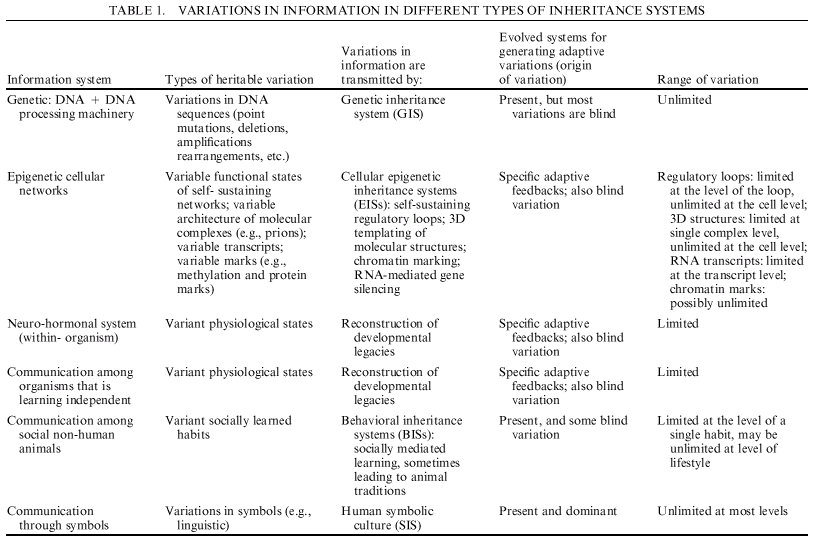
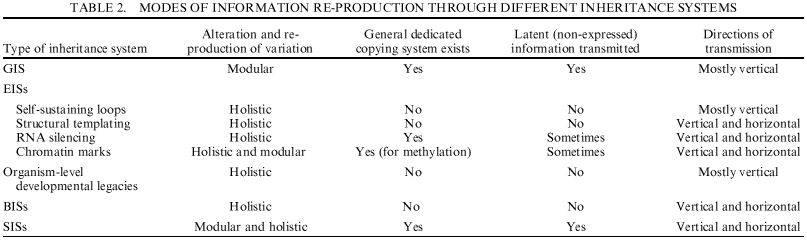
I have summarized the properties of different evolved biological information systems that operate in inheritance in the form of two tables. Table 1 groups different information processing systems into general categories, and compares them with respect to the heritable variation associated with each category. Table 2 compares the way information is re-produced by different inheritance systems. Since some of the terms may be unfamiliar, I shall outline the salient properties of the each inheritance system. (For a more leisurely and detailed discussion see Jablonka Reference Jablonka, Oyama, Griffiths and Gray2001.)

| Information system | Types of heritable variation | Variations in information are transmitted by: | Evolved systems for generating adaptive variations (origin of variation) |
Range of variation |
|---|---|---|---|---|
| Genetic: DNA + DNA processing machinery | Variations in DNA sequences (point mutations, deletions, amplifications rearrangements, etc.) | Genetic inheritance system (GIS) | Present, but most variations are blind | Unlimited |
| Epigenetic cellular networks | Variable functional states of self- sustaining networks; variable architecture of molecular complexes (e.g., prions); variable transcripts; variable marks (e.g., methylation and protein marks) | Cellular epigenetic inheritance systems (EISs): self-sustaining regulatory loops; 3D templating of molecular structures; chromatin marking; RNA-mediated gene silencing | Specific adaptive feedbacks; also blind variation | Regulatory loops: limited at the level of the loop, unlimited at the cell level; 3D structures: limited at single complex level, unlimited at the cell level; RNA transcripts: limited at the transcript level; chromatin marks: possibly unlimited |
| Neuro-hormonal system (within- organism) | Variant physiological states | Reconstruction of developmental legacies | Specific adaptive feedbacks; also blind variation | Limited |
| Communication among organisms that is learning independent | Variant physiological states | Reconstruction of developmental legacies | Specific adaptive feedbacks; also blind variation | Limited |
| Communication among social non-human animals | Variant socially learned habits | Behavioral inheritance systems (BISs): socially mediated learning, sometimes leading to animal traditions | Present, and some blind variation | Limited at the level of a single habit, may be unlimited at level of lifestyle |
| Communication through symbols | Variations in symbols (e.g., linguistic) | Human symbolic culture (SIS) | Present and dominant | Unlimited at most levels |

| Type of inheritance system | Alteration and re-production of variation | General dedicated copying system exists | Latent (non-expressed) information transmitted | Directions of transmission |
|---|---|---|---|---|
| GIS | Modular | Yes | Yes | Mostly vertical |
| EISs | ||||
| Self-sustaining loops | Holistic | No | No | Mostly vertical |
| Structural templating | Holistic | No | No | Vertical and horizontal |
| RNA silencing | Holistic | Yes | Sometimes | Vertical and horizontal |
| Chromatin marks | Holistic and modular | Yes (for methylation) | Sometimes | Vertical and horizontal |
| Organism-level developmental legacies | Holistic | No | No | Mostly vertical |
| BISs | Holistic | No | No | Vertical and horizontal |
| SISs | Modular and holistic | Yes | Yes | Vertical and horizontal |
The genetic inheritance system (GIS) is based on the replication of DNA, a linear molecule made up of four different units. These units, the nucleotides containing the bases adenine (A), thymine (T), guanine (G), and cytosine (C), can be altered and replicated one by one. Maynard Smith and Szathmáry (Reference Maynard Smith and Szathmáry1995) refer to this as “modular” replication. The replication machinery is insensitive to the sequence of the four units, and to the functional utility of the sequence. The modular nature of alteration and reproduction allows a large number of variations in sequence to be generated and transmitted. A DNA sequence of 100 nucleotides has more possible variations that the number of atoms in our galaxy, so, in the terms of used by Maynard Smith and Szathmáry (Reference Maynard Smith and Szathmáry1995), heredity is unlimited. In sexually reproducing organisms, most genetic variation is generated through the sexual process—through the segregation and recombination of chromosomes during gamete formation, and the subsequent fusion of different gametes. New variations in DNA are often the results of chance mutations: they result from replication mistakes, unrepaired or misrepaired damage caused by physical and chemical insults, and the activity of mobile genetic elements. In addition, there are evolved cellular systems that can target mutations to specific regions in response to particular classes of stressful environmental circumstances (for reviews see Caporale Reference Caporale1999).
The genetic inheritance system is the only one of the types of inheritance that I shall describe in which the generation and the transmission of variations in information is largely independent of the developmental conditions of the organisms (even if we allow for some targeted mutations). But even with the GIS, there are internal filters and discriminatory criteria for what are acceptable DNA variations, so the organism is not a passive vehicle for all chance DNA changes. In addition to having an impressive repertoire of repair systems, foreign DNA that is introduced into a eukaryotic cell is met with some formidable intracellular “immune” responses: such foreign DNA, especially when it arrives in many copies, is usually silenced, and sometimes excised and mutated (see for example, Irelan and Selker Reference Irelan and Selker1997). Nevertheless, much genetic variation does seem to be transmitted without regard to its functional content.
Epigenetic inheritance systems (EISs) underlie cellular heredity—the inheritance, from one cell generation to the next, of functional and structural cellular variations that do not depend on differences in DNA sequence. A functional cell state may persist through many cell divisions, even when the stimulus that originally induced this state is no longer present. Cellular heredity is usually considered in the context of cell differentiation: in the same multicellular body, most cells have identical DNA, yet liver cells divide to give more liver cells, skin cells give more skin cells, and so on. The information underlying the specialized cell states is transmitted from mother cell to daughter cell in each lineage, even though the lineages have the same DNA. Epigenetic inheritance is not limited to within-organism inheritance, however. Variations in cellular states that are independent of DNA variations are transmitted between generations of unicellular organisms, and also between multicellular organisms such as plants, fungi, and mammals (for reviews see Jablonka and Lamb Reference Jablonka and Lamb1995, Reference Jablonka and Lamb1998, and Reference Jablonka and Lambin preparation).
There are several different mechanisms of epigenetic inheritance. Probably the most common EIS is based on self-sustaining regulatory loops, through which the activity-state of a metabolic network is maintained through positive feedback by one of the gene products in the network. The simplest case is when a gene positively regulates its own transcription. In this case, a gene, which was originally turned on through an interaction with an external agent, produces a product that reacts with its own regulatory region to induce transcription, thus making the external agent unnecessary for its continued activity. Two genetically identical lineages of cells in an identical environment can thus have different heritable metabolic states if their inductive histories have been different.
A second type of EIS is based on templating: pre-existing three-dimensional cellular structures act as templates for the production of new daughter-structures. Such architectural templating is thought to underlie the multiplication and transmission of prions, the infectious protein particles that are associated with degenerative diseases of the nervous system such as BSE (bovine spongiform encephalopathy, or mad cow disease), scrapie in sheep, and CJD (Creutzfeldt-Jakob disease) in humans. In this EIS and the previous one, transmission is “holistic” rather than modular, because the whole structure, or the functional state of the loop as a whole, is transmitted from cell to cell.
The third EIS, chromatin marking, is based on the inheritance of the patterns of DNA-bound molecules such as proteins, RNAs, or small chemical groups. Collectively, these are referred to as “chromatin marks.” Marks are established during development and as a result of environmental induction. The chromatin marks on a gene's DNA sequence affect the regulation of its transcription, and hence how a character develops. Crucially, some marks can be reproduced when DNA replicates. Cytosine methylation at CG sites is good example of cell-heritable chromatin marks. Cytosine, one of the four DNA nucleotides, can have a methyl group attached to it (Cm), or it can lack it (C). When cytosine has guanine next to it, the two strands of DNA have mirror image symmetry: CG on one strand is complementary to GC on the other; similarly CmG is complementary to GCm. Patterns of DNA methylation can be reconstructed following semi-conservative DNA replication because when regions of DNA with CmG sites replicate, the old strands retain their methylated state. The complementary GC sites on the new strands have non-methylated cytosine, so, immediately after replication, the DNA duplex is hemi-methylated; it is CmG/GC. However, enzyme-complexes that recognize and have a special affinity for these non-symmetrical, hemi-methylated sites preferentially methylate the new strand. Since the enzyme-complex does not recognize and methylate sites that are symmetrically non-methylated, the original methylation pattern is reconstructed: a methylated site in the old strand ends up having a methylated complementary site, while a non-methylated site in the old strand has a non-methylated complementary site. In this way the pattern of methylated and non-methylated sites is reproduced in both daughter molecules. Other types of chromatin marks, for example DNA-bound protein marks, are also reproduced following DNA replication, although the details of the processes are not understood.
The fourth EIS involves a recently discovered epigenetic mechanism known as RNA-mediated gene silencing (Fire Reference Fire1999). The system is based on the silencing effect of small RNA molecules (known as siRNAs) that originate from much larger RNA transcripts. What seems to happen is that RNA molecules that have certain topological peculiarities are recognized by an enzyme that chops them up into small siRNAs. Then, with the help of special RNA-replicating enzymes, these siRNAs are replicated many times, and copies are transmitted to daughter cells when the cell divides. The siRNAs can also move from cell to cell, behaving like infectious agents or chemical signals. In ways that are not yet fully understood, siRNAs destroy copies of the large transcript from which they were derived. They also associate with copies of the gene that mothered their transcript. This leads to the formation of a stable chromatin mark (often a methylation pattern), which suppresses the activity of the gene and can be transmitted to the next cell generation.
With all four EISs, for functional or structural variations to be transmitted to the next cell generation, they have to have special properties: for the first EIS there has to be a special type of regulatory network-organization; for the second, a special structural organization; for the third, a particular type of chromatin marking; for the fourth, a peculiar RNA topology. Cellular variations that are not associated with these special types of organization cannot be passed to the next generations. Thus, unlike DNA variations, which can always be transmitted whatever the sequence, only a subset of the functional and structural states of cells is potentially heritable. Moreover, at the level of the single heritable unit (a self-maintaining loop, a three-dimensional structure, a chromatin mark, an RNA-mediated state of gene silence), the number of variant heritable states is usually limited: a self-sustaining metabolic loop is usually either “on” or “off”; a particular prion has very few heritable conformations; a protein mark on a given DNA sequence has few heritable alternatives; an RNA transcript is either recognized as peculiar and its gene is silenced or it is not. The methylation system is somewhat exceptional, since a CG rich gene has many potential heritable patterns of methylation, although probably only a small set of them may make a functional difference to the gene's transcriptional activity. In general, however, at the level of individual units, heritable variation in the epigenetic system is very limited.
Developmental legacies, the molecular products and consequences of the parents’ developmental history, can sometimes be re-produced and re-generated in the offspring generation (see Griesemer Reference Griesemer2000). For example, environmentally induced maternal effects in plants can be inherited for several generations (see Miao, Bazzaz, and Primack Reference Miao, Bazzaz and Primack1991); multigenerational interactions between symbionts and their hosts that involve direct transmission of the symbionts, or that occur through the re-construction of parental developmental effects can be reproduced (Paracer and Ahmadjian Reference Paracer and Ahmadjian2000, Sterelny Reference Sterelny, Oyama, Griffiths and Gray2001); food preferences and host preferences may be reproduced within lineages of insects (Thompson and Pellmyr Reference Thompson and Pellmyr1991); gender behavior and sex ratio can be inherited in lineages of Mongolian gerbils (Clark, Karpiuk, and Galef Reference Clark, Karpiuk and Galef1993). In all these cases and many others, developmental legacies are re-produced in ways that are specific to the particular case. There is no general machinery for transmitting all variant developmental legacies, whatever they are. On the contrary, only a small set of the many developmental variations that an organism can exhibit are reliably reproduced in its offspring, and like most cellular epigenetic variations, these too usually show limited heritable variation.
Behavioral inheritance systems (BISs) lead to the reproduction of information about behavior—about behavioral preferences and patterns of behavior. The activities of one individual, the source, change the state of another individual, the receiver. The transmission and interpretation of behavioral information are through processes of socially-mediated learning. In several different ways, naïve individuals can learn and develop patterns of behavior similar to those of experienced individuals (often, but not necessarily, their parents). This type of re-production depends on the social organization of the relevant social unit (the family, extended family or non-kin group), on social attentiveness, and on several types of social learning. The mechanisms of socially mediated learning are quite general, but whether or a not a particular pattern of behavior is reproduced in descendants depends on the animal's memory, its learning capacity, the social setting, the nature of the developing behavior, and so on. When habits are regularly transmitted between generations through socially mediated learning, animal traditions are established (Avital and Jablonka Reference Avital and Jablonka2000).
The symbolic inheritance system (SIS) is a specifically human inheritance system. The transmission of information through symbols allows a great deal of cultural and social evolution, and this has been modelled and discussed extensively (for a recent summary of the different approaches, see Laland and Brown Reference Laland and Brown2002). Symbol-based information transmission can occur both vertically and horizontally, and in several different ways. These have somewhat different properties. Language, for example, is modularly organized at the level of sentences, and an enormous number of linguistic variations can be generated and transmitted. But a symbolic system in which information is acquired and transmitted through pictures has a more holistic organization, with the parts being more interdependent. Unlike BISs, symbolic systems can transmit latent information about behavior (e.g., non-acted-upon ideas, transmitted through written or oral traditions). In this, SISs resemble the genetic system, but this does not mean that the reproduction of information through SISs is insensitive to content. Some mechanical copying may occur (through photocopiers for example), but usually a large element of symbol-based transmission is sensitive to the content of the information, and to the psychological, social, and cultural development of the individual or the group. Thus, unlike most new information in the GIS, new symbolic information is targeted because its acquisition and transmission are guided by basic cognitive coherence rules and categories. Symbolic information, like all behavioral information, is also constructed and edited—it is tested and adjusted to fit existing ideas and habits before it is passed on. A feature peculiar to the construction of symbolic information is that future goals and future plans are involved in the construction process.
In addition to the direct reproduction of information through the various inheritance systems just described, information can also be transmitted indirectly, through ecological niche construction (Lewontin Reference Lewontin and Bendall1983, Odling-Smee Reference Odling-Smee and Plotkin1988, Odling-Smee, Laland, and Feldman Reference Odling-Smee, Laland and Feldman1996). Organisms often create an environment for their descendants, providing a niche that is usually quite similar to their own. Through their activities, they modify the environment (think, for example, how beavers alter the landscape), and their descendants react and respond (often adaptively) to cues in the environment that their ancestors constructed. When the constructed niche is the society and the culture, niche construction is an inseparable aspect of the BISs and the SISs. The source of information is the environment, which is being constructed by the behavioral (or symbolic) information of the organisms that are interpreting it and altering it.
This brief survey of the different systems and ways through which information is transmitted between generations highlights several points. First, as Tables 1 and 2 both show, there are a lot of different information processing systems and different types of information, and we need to study them in their own right, rather than as shadows of the GIS.
Second, as Table 1 shows, although heredity may be limited at one level of organization, it can be unlimited at a higher level. Hence, a single site in DNA has limited heredity, with only 4 variant transmissible possibilities, while a DNA sequence of 10 nucleotides strung together has over a million variations. Similarly a self-sustaining loop may have only two transmissible states, but a cell with 20 independent loops would have more than a million transmissible variant states.
Third, a lot of heritable variation is targeted, and some of it is also edited and modified by the organism before it is passed on. Since the internal mechanisms that target and construct variation filter out a lot of noise, the low fidelity of transmission of a variant does not lead to the disintegration of the information transmitted by the inheritance system. Most of the new targeted and filtered variations that are transmitted have a high chance of being either neutral or adaptive.
Fourth, the tables show that a lot of information is transferred horizontally, among entities that do not have a genealogical parent-offspring (vertical) relationship. In the genetic system, horizontal gene transfer is usually virus-mediated, and such transfer can occur not only within a population, but also among individuals belonging to very different taxa. Patterns of behavior and ideas are also often transmitted horizontally across genetic lineages. Of course, when reproduction is looked at from the virus's or the idea's point of view, it can be claimed that information transfer is always vertical—viruses give rise, vertically, to more viruses, and ideas spread by various processes of vertical, symbolically mediated, social learning. However, neither viruses nor ideas have an independent reproductive ability—the reproduction of viruses depends on a cellular system of interpretation and replication, while the spread of ideas depends on the structure of the cognitive system of the individuals and groups that construct, transmit, and acquire them. Moreover, with ideas, both their acquisition and transmission are part of the developmental-learning processes of senders and receivers, which often feed back on their very content and structure. Nevertheless, with viral infection and spread, and with the systems through which ideas are transmitted and reconstructed, two parties—hosts (receivers) and viruses (senders), and the senders and receivers of ideas—partake in the process and co-evolve. Thus viruses will co-evolve with their hosts, and the way of transmitting ideas will co-evolve with the way these ideas are acquired. One interesting result of this co-evolution will be that the form of the virus (its nucleic acid sequence and often its resultant morphological form), and the form of an idea (how well it fits the cognitive biases of cultural agents) will change through evolution.
It is difficult to evaluate the relative importance of the different inheritance systems and the different modes of information transmission in evolution. The first problem is that for many of the inheritance systems, the empirical and theoretical work has not yet been done. The second is that the theoretical criteria that have been used for high evolvability are commonly derived from the peculiar properties of gene-inspired replicators and the genetic inheritance system. Sterelny (Reference Sterelny, Oyama, Griffiths and Gray2001), for example, defines sets of conditions that are important for the high evolvability of different types of entities with different ways of transmitting information. His criteria are based on the properties of the replicators of these entities, and his notion of “replicator” is inspired by the prototypical replicator, the gene. As a result, when Sterelny finds that human cultural transmission does not score high according to these criteria, he concludes that cultural transmission is not an inheritance mechanism. However, the criteria that Sterelny uses are not equally relevant for the evolvability of entities that have non-genetic inheritance systems. For example, the “high fidelity of replication” criterion which Sterelny adopts is not as relevant when there are internal filtering mechanisms that ensure that the transmitted variations are often adaptive. Sterelny's reliance on gene-based criteria also overlooks the fact that the accumulation of socially learned variations need not occur along a single axis (e.g., one habit becoming increasingly more complex), but can affect other correlated habits and thus alter a whole lifestyle in a cumulative manner (Avital and Jablonka Reference Avital and Jablonka2000).
The evolution of new types of information and of interpretations of information is a subject that has been receiving a lot of attention recently (Jablonka Reference Jablonka1994; Maynard Smith and Szathmáry Reference Maynard Smith and Szathmáry1995; Jablonka, Lamb, and Avital Reference Jablonka Eva and Avital1998). I shall not go into this question here, but I want to point out that the evolution of new types of information and interpretation systems (and new sources of functionality) has occurred several times during the evolution of life. Moreover, when a new type of information evolves, the new information system, and the evolution based on it, can be decoupled from the evolution based on the information at the primary DNA level (which has enabled the new information system to evolve). An obvious example is the extensive decoupling of information at the cultural level from information at the DNA level. However, as Tables 1 and 2 show, when new information is associated with a new system of heredity, all types of heritable information have a degree of autonomy, and it is important to see how this autonomy affects evolutionary change (Sterelny Reference Sterelny, Oyama, Griffiths and Gray2001).
5. Information Sharing
Defining information in the way that I have suggested, and recognizing that information is inherited in a variety of ways, not just through the genetic system, changes the way that one approaches various evolutionary problems. One of these is the evolution of communication. Communication involves either receiving a signal from a sender or a reciprocal exchange of signals, and for present purposes both will be said to involve “information sharing.”
A major problem for evolutionary biologists is to explain the very existence of evolutionarily stable communication. When organisms communicate, information is transmitted: a signal sent by a signaler influences the internal state of a receiver, and usually affects its behavioral responses. In evolutionary terms, we need to know how the signaler benefits from accurately representing the state of the world through its signaling (rather than misrepresenting it), and how the receiver benefits from heeding the signal rather than ignoring it. If communication has evolved, then both sender and receiver should gain (on average) from sending and receiving a given signal. Yet sender and receiver often do not have coincident interests, and sometimes it may benefit senders to misrepresent the world, and benefit receivers to ignore signals. So why is communication so often stable? What are the evolutionary incentives for not sending misleading signals?
One answer is that the individuals involved do have coincident interests, for example genetic interests, so selection has favored reliable signaling in kin groups. Another possibility is that since signalers and receivers often change roles, only the senders of reliable signals will receive reliable signals, so the benefit comes from reciprocation (Hauser Reference Hauser1997). It is also possible that communication enhances group productivity, and selection between groups is important in maintaining systems of intragroup communication (Avital and Jablonka Reference Avital and Jablonka2000). Yet another possibility is that receivers evolved to respond only to costly signals, because when a signal is costly to produce, and the costs are proportional to the signal's veracity, only costly and hence reliable signals will not be ignored (Zahavi and Zahavi Reference Zahavi and Zahavi1997). Related to this is the possibility that when the cost of misleading (rather than the cost of producing an honest signal) is high, signals will be reliable (Lachmann et al. Reference Lachmann Michael and Bergstrom2001). In general, it is necessary to assume that there are always some special types of social interactions, population-dynamic effects, or balance of costs that make communication or any other form of cooperation stable.
Given that conditions promoting evolutionarily stable cooperation exist, how does giving and receiving information differ from giving and receiving non-informational resources (material, energy)? Avital and Jablonka (Reference Avital and Jablonka2000) and Lachmann, Sella, and Jablonka (Reference Lachmann Michael and Jablonka2000) have stressed that the most important difference between the sharing of informational and non-informational resources is that information sharing is not subject to the intrinsic conservation principles that characterize the sharing of non-informational resources. When an organism shares food with another, it loses the amount that it gives away. But an organism that shares information with others retains its own information, and the cost of information sharing need not be proportional to the number of individuals with whom the organism shares it. For example, take a mother chukar partridge who is being followed by her chicks as she forages for edible seeds, and emits a food call when she encounters an edible food source. She can be said to be sharing her information with the chicks while “demonstrating” to them what is good to eat. In doing so, she does not lose information about what is edible; in fact, by acting upon her information—going through the processes of interpreting it again—she is probably often consolidating it, making it more reliable. Practice bolsters memory, so in a sense the more information you give away the more you have! Moreover, “demonstrating” to eight rather than to four chicks does not require a proportional increase in the mother's expenditure of energy; the extra cost to the mother, if it exists, is negligible (Smith Reference Smith1977, Avital and Jablonka Reference Avital and Jablonka2000). Of course, information sharing can have a significant cost, and sharing information about a limited energy resource (food) is just as costly as the direct sharing of energy. But in many cases the cost of mutually sharing information is only a fraction of the cost that a solitary individual would incur to gain the same amount of information.
Lachmann, Sella, and Jablonka (Reference Lachmann Michael and Jablonka2000) modeled a simple case of information sharing. They assumed that all individuals in a group (such as bacteria in a colony) interact with the environment and make a response to a particular cue (e.g., the concentration of a nutrient). The environmental cue is therefore seen as carrying information about the environment, and the organisms respond to the cue by changing their behavior, for example by releasing a chemical factor into the medium. Each individual can make mistakes in its interpretation of the cue, and therefore responses are error-prone. The responses of each individual are, in turn, used as a signal, a source of information, to other individuals, about the interpretation of the environmental cue the individual has received—about its evaluation of the environment. An organism is assumed to have more information about the environment if it has more signals available, and its fitness is proportional to how much information it has. Information is said to be shared when individuals make their responses to the external cue available to all the other members of the group. The results of the simple models are straightforward: information sharing leads to fitness gains because it reduces the costs of responding correctly to the environmental cue. This is true even when we take into consideration errors in transmitting information and the costs of sharing it. For an individual in a group, the cost of acquiring information decreases with growing group size, and the amount of information that it can gather increases with the size of the group. In sharing conditions, an individual pays less for more! Therefore, in cooperation-promoting social conditions, information sharing is expected to be common, as indeed it is. For example, myxobacteria measure and respond to the state of nutrient in their local environment, and the response of each individual is made available to other neighboring cells. As a result of this signaling (in which as many as 100,000 cells can participate), each cell has more information, and this leads to a global response: the cells aggregate and form a fruiting body when the information indicates that the food supply is globally exhausted, or alternatively, continue their semi-unicellular existence if food is sufficient (Kaiser Reference Kaiser, England, Hobbs, Bainton and Roberts1999).
These special properties of information sharing may have non-trivial evolutionary consequences. For example, while the cost of acquiring information decreases with group size, the benefits from any additional information eventually level off, so that big collectives may dedicate only a fraction of their individuals to collecting information. This might guide the evolution of specialization and a division of labor, and be an important factor in the transition to new levels of biological organization, such as the transition to multicellularity (Lachmann, Sella, and Jablonka Reference Lachmann Michael and Jablonka2000).
Thinking in terms of information also forces one to pay close attention to the context in which information is acquired, used, and shared. One of the examples that Avital and Jablonka (Reference Avital and Jablonka2000) discussed is the role of information sharing in the long-term monogamous relationships of birds. They suggested that the choice of mate and the consolidation of the relationship between the mates might involve acquiring and sharing information that is individual and pair-specific. This means that mate choice does not depend only on identifying characters in a potential mate that are indicators of good genes; it also depends on obtaining information about the potential mate's ecological and social background from things such as song dialect, or past familiarity. These indicate how compatible the potential partner is with the more idiosyncratic and personal demands and needs of the particular individual seeking a mate. Once a mate has been chosen, mutual learning may produce non-transferable information. For example, in some African shrikes and other songbirds, the two mates perform a mutual singing display, a well-coordinated “duet” that is learned over a period of weeks. The learned duet is specific to the pair, and should one of the mates desert, a new duet would have to be learned, at considerable cost, with a new mate. Although the information the duet carries can be repeatedly used and re-adjusted by pair members, this pair-specific information is not readily applied to relationships with other individuals. Obviously, when information is individual and pair-specific in this way, the costs of deserting a mate are high, and the relative benefits of cooperation are higher than they would be when information is transferable. Avital and Jablonka (Reference Avital and Jablonka2000) have argued that the non-transferable aspect of information sharing between long-term monogamous mates may be one of the reasons for the remarkable stability of such cooperative relationships.
The few examples described above show that focusing on the special features of information highlights some important aspects of communication, and allows us to offer new evolutionary explanations for the observed stability of some types of communication.
6. Conclusions
I have suggested that thinking about information in terms of the receiver's interpreting system makes it possible to expand MS's notion of biological function-related information and formulate a general definition. According to my definition, a source becomes an informational input when an interpreting receiver can react to the form of the source (and variations in this form) in a functional manner. The definition that I have suggested is therefore a broad one, appropriate for information stemming from environmental cues as well as evolved signals. The relationship between the input and the receiver's response can be complex, since the evolution of the interpretation system mediating between the two will often relate input and response only indirectly. Nevertheless, focusing on the interpreting receiver makes it possible to compare information from different types of sources.
Although it is generally recognized that there are different types of biological information and information processing systems, it is less generally appreciated that there are also several types of hereditary and evolutionary phenomena associated with these systems. Information is transmitted not only through genetic inheritance, but also through cellular and organism-level epigenetic processes, through non-symbolic social learning, and through symbolic learning. Each of these non-genetic inheritance systems has its own regularities and constraints, which are very different from the regularities and constraints of heredity associated with DNA replication. Consequently, heredity and evolution through these systems have to be studied on their own terms, rather than as somewhat deviant reflections of genetic inheritance and evolution. Moreover, since biological information has special properties that make its transmission very different from the transmission of materials and energy, sometimes focusing on these special properties can uncover interesting evolutionary effects. For example, the evolution of communication among co-operating members of a group becomes more understandable.
I share with Maynard Smith and Szathmáry (Reference Maynard Smith and Szathmáry1995) the conviction that the evolution of ways of storing and transmitting information has been a major theme in the evolution of life. As I see it, one of the most important aspects of this evolution has been the selection of systems that can interpret additional types of information, and the consequent emergence of new inheritance systems. I believe that these new inheritance systems were the basis of some of the major transitions that led to the evolution of new levels of complexity and individuality. Therefore, understanding these evolutionary transitions will require thinking about all types of heritable information, not just that which is transmitted through the genetic system.